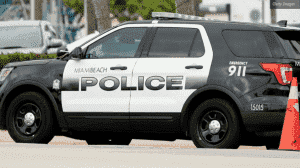
A Miami fleet vehicle accident injury lawyer, such as Law Offices of Anidjar and Levine, helps protect a claimant’s rights after a crash involving a company vehicle. Counsel can preserve crucial evidence, review dispatch logs, maintenance records, and vehicle data, identify all liable parties, and manage insurer communications.
This is important because fleet cases often involve multiple policies, employer oversight, and serious long-term losses. Legal guidance from a Miami Car Accident Lawyer also supports accurate valuation of medical costs, lost income, and future harm, with further points outlined below.
Main Takeaways
- Seek immediate medical care, report the crash, and document the scene with photos, witness contacts, and fleet vehicle details.
- Preserve evidence such as police reports, medical records, dispatch logs, maintenance files, and electronic vehicle data.
- A Miami fleet vehicle accident injury lawyer investigates driver conduct, company oversight, and all liable parties beyond the driver.
- Fleet accident claims are complex because they may involve employer liability, multiple insurers, and layered corporate policies.
- A lawyer handles insurer communications, prevents harmful statements, and pursues full compensation for medical bills, lost income, and future damages.


How We Can Help With Your Miami Fleet Vehicle Accident Injury Claim
In the aftermath of a collision involving a fleet vehicle, effective legal representation can play a central role in protecting an injured person’s rights and strengthening the claim. Counsel can manage communications, organize documentation, and preserve vital evidence so the injured person may focus on recovery and continued responsibilities to family, work, and community.
A firm’s support often begins with a careful review of records, witness information, photographs, and available company data. From there, attorneys develop a clear claims strategy designed to present losses accurately and respond to insurer tactics with discipline. They can also coordinate with medical providers, calculate damages, and prepare persuasive demand materials that reflect present and future needs.
Guidance on settlement timing is equally important because resolving a claim too early may leave crucial losses uncovered. Throughout the process, experienced counsel provides structure, accountability, and informed advocacy, helping injured individuals pursue fair compensation while preserving dignity, stability, and the ability to serve others well.
OUR CONSULTATIONSARE FREE
START YOUR FREE CASE REVIEW

Understanding Miami Fleet Vehicle Accident Injury Cases
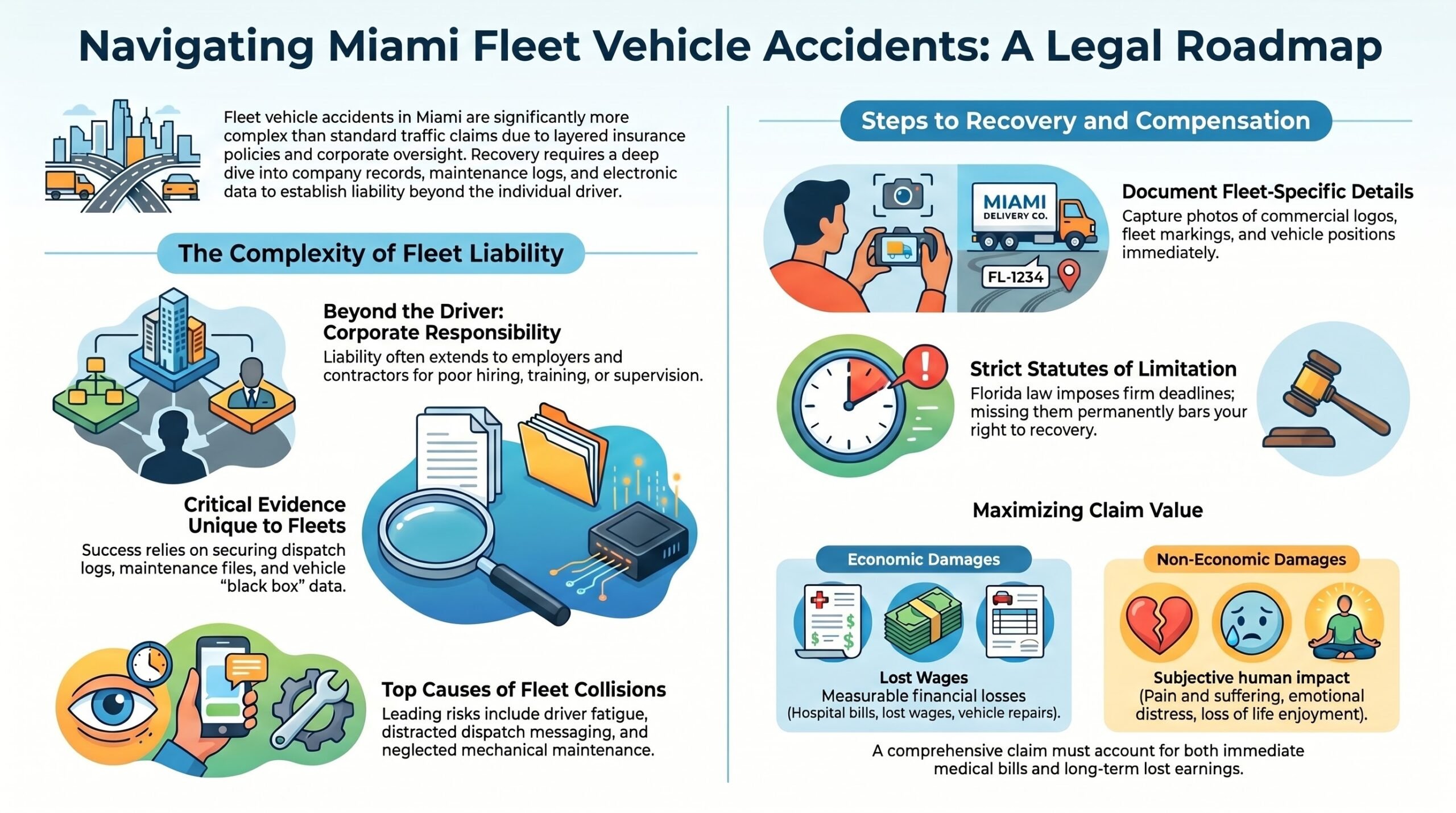
Why do Miami fleet vehicle accident injury cases often require closer analysis than other traffic claims? These matters usually involve multiple parties, layered insurance policies, employer oversight, and company records that can affect responsibility. A careful review helps clarify whether an injured person is facing ordinary driver error, fleet liability, or signs of corporate negligence within a larger business operation.
In Miami, fleet vehicle cases often differ because the driver may have been working within the scope of employment at the time of the collision. That issue can expand the claim beyond the individual driver and place attention on the company’s legal duties. Evidence may include dispatch logs, maintenance files, hiring records, electronic data, and internal policies. Each source can help explain how the vehicle was managed and whether safety obligations were properly followed. For people committed to protecting others, understanding these cases supports accountability, encourages safer transportation practices, and helps injured victims pursue fair recovery with confidence and dignity.
Common Causes of Miami Fleet Vehicle Accidents
Several recurring factors contribute to fleet vehicle accidents in Miami, and each presents serious safety and liability concerns. Common causes include driver fatigue, distracted fleet driving, improper vehicle maintenance, and speeding or other reckless conduct behind the wheel. A clear understanding of these risks helps frame how negligence may arise in fleet accident injury cases.
Driver Fatigue Risks
Operating for long hours with limited rest, fleet drivers face a heightened risk of fatigue-related errors that can lead to serious collisions on Miami roads. Exhaustion can slow reaction time, impair judgment, and reduce the ability to respond safely to changing traffic conditions.
In fleet operations, poor shift scheduling often increases fatigue, especially when overnight routes or extended duty periods interfere with normal sleep. Circadian disruption may further weaken alertness, coordination, and decision-making during critical driving hours. Service-minded employers can help protect drivers and the public by enforcing rest requirements, monitoring hours, and promoting realistic delivery expectations. When companies overlook warning signs of fatigue, the likelihood of preventable harm rises markedly. Careful staffing practices, responsible supervision, and strong safety policies remain vital measures to reduce fatigue-related fleet accidents and preserve community well-being.
Distracted Fleet Driving
Beyond fatigue, distracted fleet driving remains a frequent source of serious crashes on Miami roads. Commercial drivers often operate under tight schedules, steer unfamiliar routes, and manage communications while moving through dense traffic. These pressures can create dangerous lapses in attention that place occupants, cyclists, and nearby motorists at risk.
Common examples include phone use, dispatch messaging, GPS programming, eating, and other in-cab distractions that pull a driver’s eyes or mind away from the roadway. Even a brief delay in perception can prevent timely braking or lane correction. In urban settings, distracted driving by fleets also increases pedestrian hazards near crosswalks, bus stops, schools, and delivery zones. Organizations committed to public service generally reduce harm by enforcing focused driving policies, providing training, and limiting unnecessary driver communications during active trips.
Improper Vehicle Maintenance
In many Miami fleet collisions, improper vehicle maintenance is a preventable factor that can turn routine driving conditions into serious safety failures. When commercial vehicles are not serviced consistently, worn tires, failing lights, handling problems, and degraded braking systems may place employees, passengers, and the public at unnecessary risk.
Responsible fleet management requires strict maintenance schedules, timely repairs, and documented brake inspections performed by qualified professionals. These measures help identify defects before they contribute to collisions and demonstrate a commitment to protecting others on the road. Neglecting routine service can also expose companies to liability, especially when records reveal missed inspections or unresolved mechanical issues. In a city with heavy traffic and demanding delivery routes, mechanical reliability is not merely an operational concern, but a basic duty of care for all.
Speeding And Reckless Driving
Many Miami fleet vehicle accidents involve speeding or other reckless driving behaviors that reduce a driver’s ability to react to traffic changes, road hazards, and sudden stops. When commercial drivers operate at excessive speed, braking distances increase and collisions become more severe, placing occupants, pedestrians, and nearby motorists at greater risk.
Reckless conduct may also include aggressive overtaking, unsafe lane changes, tailgating, or ignoring traffic controls to meet delivery schedules. Such decisions can reflect poor supervision, unrealistic employer expectations, or inadequate driver training. Organizations committed to public safety often recognize that careful scheduling, clear policies, and consistent enforcement help prevent these crashes. After a collision, an attorney may examine vehicle data, witness statements, and company records to determine whether speeding or reckless driving contributed to the incident and resulting losses.


Legal Rights of Miami Fleet Vehicle Accident Injury Victims
Clarity matters when evaluating the legal rights of Miami fleet vehicle accident injury victims, because those rights often determine how medical costs, lost income, property damage, and other losses may be recovered. These claims may involve private employers, government entities, insurers, and multiple policies, requiring careful review of liability, coverage, and deadlines under Florida law.
A clear understanding of legal rights helps Miami fleet accident victims pursue compensation for medical bills, lost income, property damage, and related losses.
- Injured employees may seek workers’ compensation benefits for medical treatment and wage loss after a work-related fleet vehicle crash.
- Nonemployees may pursue negligence claims against drivers, employers, or contractors whose conduct caused preventable harm.
- Cases involving public vehicles may raise municipal liability issues, notice requirements, damage limits, and sovereign immunity defenses.
- Families may also protect broader community welfare by asserting rights that encourage safer hiring, training, supervision, and vehicle maintenance.
A thorough legal assessment can clarify available remedies, identify responsible parties, and support fair recovery for those endeavoring to care for others after serious injury or loss.
Steps to Take After a Miami Fleet Vehicle Accident Injury
After a Miami fleet vehicle accident injury, prompt action can restore both health and a potential legal claim. Priority is generally given to obtaining immediate medical care, documenting the crash scene with as much detail as possible, and reporting the accident without unnecessary delay. These initial measures often provide a stronger foundation for evaluating injuries, establishing fault, and preserving important evidence.
Seek Immediate Medical Care
In the immediate aftermath of a Miami fleet vehicle accident, prompt medical evaluation should be a priority, even when injuries appear minor or symptoms have not yet fully developed. Early assessment helps protect health, supports recovery, and identifies internal injuries, concussions, or soft tissue damage that may worsen without timely treatment.
Those involved should follow emergency recommendations, attend urgent care or hospital visits, and carefully monitor post-crash symptoms in the hours and days ahead. Medical professionals can distinguish between conditions requiring immediate intervention and those appropriate for home care, and provide instructions to reduce complications. Prompt treatment demonstrates a responsible commitment to personal well-being and to the people who depend on one’s ability to recover and continue serving others safely. It also creates a clear medical timeline for later review.
Document The Crash Scene
Preserve the crash scene through careful documentation whenever safety permits, because early evidence often shapes how liability and damages are later evaluated. After a collision involving a Miami fleet vehicle, helpful observers can support injured parties by gathering clear, organized information without interfering with emergency care. Photographic documentation should capture vehicle positions, damage, skid marks, traffic signals, road conditions, debris, and visible injuries from multiple angles. Close-up and wide shots can provide useful context.
Notes should include the time, weather, location, and any identifying fleet markings or commercial logos. When others saw the impact, respectful witness statements may help preserve details that fade quickly. Contact information should be recorded accurately. Personal observations should remain factual and limited to what was actually seen or heard. Thorough documentation can strengthen a later claim and protect those seeking accountability.
Report The Accident Promptly
Without unnecessary delay, the accident should be reported to law enforcement and, when applicable, to the fleet operator or employer, because prompt reporting creates an official record that may later prove important in establishing fault and documenting losses. Timely reporting also helps preserve witness recollections, confirms vehicle assignments, and supports later insurance or injury claims.
Police notification is especially important when injuries, significant property damage, or disputes about how the collision occurred are present. A clear report can assist families, employers, insurers, and medical providers in coordinating responsible next steps. Information shared should remain accurate and limited to known facts, without speculation or unnecessary admissions. If a fleet vehicle was involved, internal reporting procedures should be followed carefully and copies of all submitted forms, emails, claim numbers, and related correspondence retained.
How a Miami Fleet Vehicle Accident Injury Lawyer Can Help You
Navigate the aftermath of a fleet vehicle collision with legal guidance focused on both immediate needs and long-term recovery. A Miami fleet vehicle accident injury lawyer helps injured people protect their rights while preserving evidence, identifying responsible parties, and coordinating communication with insurers.
Counsel may examine fleet liability issues, maintenance records, employment policies, and driver screening practices to determine whether negligence extended beyond the individual driver.
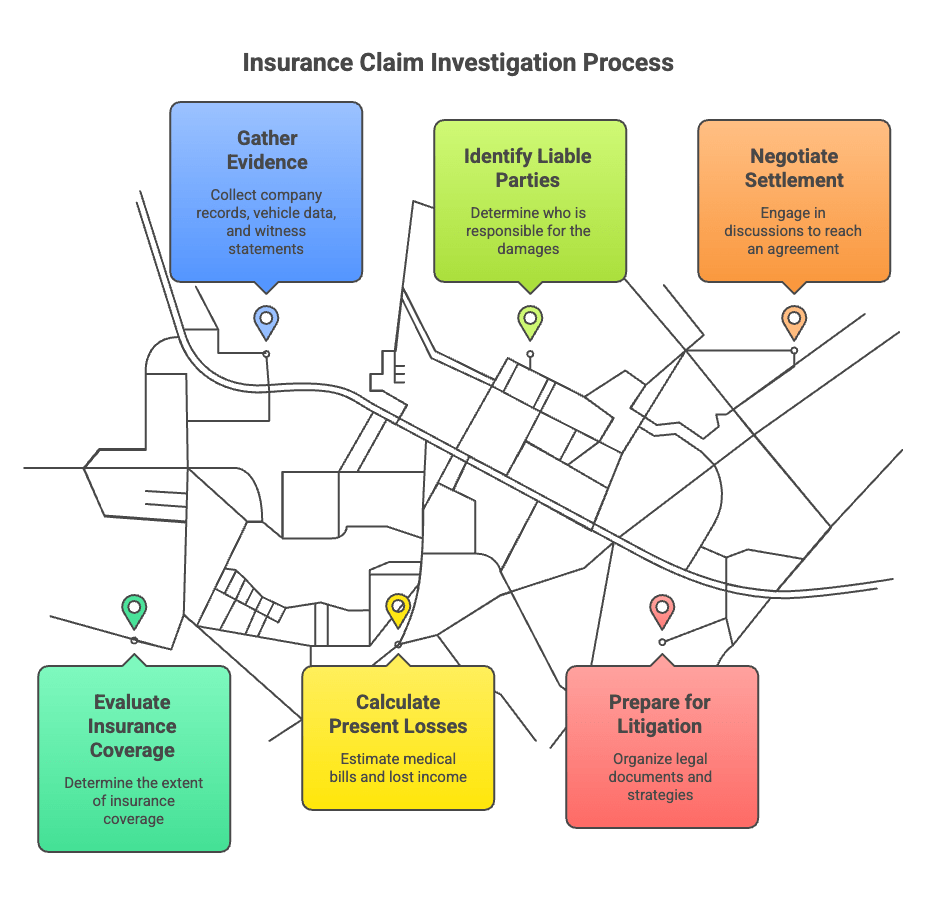
- Investigates company records, vehicle data, and witness statements
- Evaluates insurance coverage and identifies all liable parties
- Calculates present losses, including medical bills and lost income
- Negotiates firmly and prepares for litigation when necessary
This support allows injured individuals and their families to focus on recovery and caring for others in their community. An attorney also helps prevent damaging statements, missed deadlines, and undervalued claims. With a structured approach, legal counsel seeks accountability, fair compensation, and a resolution that reflects the collision’s full impact on daily life.
Long-Term Effects of Miami Fleet Vehicle Accident Injuries
Miami fleet vehicle accident injuries often extend beyond the initial recovery period, leaving individuals with lasting physical limitations that affect mobility, work capacity, and daily function. These accidents may also produce significant emotional and mental effects, including anxiety, depression, and ongoing psychological strain that interferes with long-term well-being. In addition, the financial consequences can remain substantial, as continued medical care, rehabilitation needs, and lost income place enduring pressure on injured parties and their families.
Lasting Physical Limitations
Mobility often becomes the clearest measure of how a fleet vehicle accident continues to affect daily life long after the initial injuries are treated. Some individuals develop chronic mobility restrictions that limit walking, lifting, bending, or standing for extended periods, reducing their ability to work, volunteer, or consistently care for others.
These lasting physical limitations may arise from spinal damage, joint injuries, nerve trauma, or surgical complications. Recovery can require ongoing therapy, pain management, and adaptive equipment such as braces, canes, modified vehicles, or home accessibility features. Even when a person appears stable, reduced strength, impaired coordination, and diminished endurance can alter ordinary routines and future responsibilities. In serious cases, long-term assistance becomes necessary, and legal guidance may help secure resources needed to support treatment, independence, and practical daily functioning over time.
Emotional And Mental Impact
Long-term harm from a fleet vehicle accident is not limited to physical restrictions, as many individuals also experience significant emotional and psychological effects that interfere with daily stability. Survivors may struggle with anxiety, disturbed sleep, irritability, and persistent fear when traveling or returning to service-oriented responsibilities.
In more serious cases, post-traumatic stress can affect concentration, relationships, and confidence, making ordinary tasks feel unpredictable or unsafe. Emotional strain may also deepen feelings of isolation, especially when pain or limited mobility reduces community involvement. Professional support often plays an important role in recovery, including counseling, trauma-informed care, and practical coping strategies tailored to daily routines. With consistent treatment and compassionate support, many individuals gradually regain emotional balance, strengthen resilience, and continue serving others with greater awareness, patience, and care.
Ongoing Financial Burdens
Managing the financial aftermath of a fleet vehicle accident often becomes an extended challenge, particularly when injuries require ongoing medical care, rehabilitation, and time away from work. Beyond immediate expenses, many injured individuals face lost wages, reduced earning capacity, and mounting household obligations that continue long after the collision.
For families committed to caring for others, these burdens can limit their ability to meet daily responsibilities, support dependents, and participate in community service. Ongoing rehabilitation may require transportation costs, specialized equipment, home modifications, and repeated medical evaluations. Insurance disputes or delayed claims can worsen the strain, leaving basic needs unmet. A careful legal assessment can help document present and future losses, preserve financial stability, and support access to the resources necessary for recovery and continued service to loved ones.
Proving Liability in Miami Fleet Vehicle Accident Injury Cases
Establishing liability in a Miami fleet vehicle accident case requires a careful examination of the facts, the parties involved, and the legal duties that may have been breached. Evidence often includes police reports, witness statements, vehicle data, maintenance records, and photographs from the scene. These materials help determine whether negligence by the driver, the fleet owner, or another party caused the collision and resulting harm.
Liability may extend beyond the individual driver when a company fails in driver training, hiring, supervision, or vehicle upkeep. Courts and investigators may assess corporate oversight to determine whether unsafe policies, unrealistic schedules, or ignored safety complaints contributed to the crash. In some cases, maintenance contractors, cargo loaders, or manufacturers may also share responsibility. A thorough legal review connects each act or omission to the injuries suffered, thereby supporting accountability and helping injured people pursue the resources needed to restore stability, dignity, and service to their families and communities.
Dealing With Insurance Companies After a Miami Fleet Vehicle Accident Injury
Guide communications with insurers carefully after a Miami fleet vehicle accident injury, because early statements, settlement offers, and document requests can markedly affect the value and direction of a claim. Injured individuals should provide accurate basic facts, yet avoid speculation, recorded statements, or broad authorizations without informed review. Careful communication helps protect resources needed for medical care, family stability, and continued service to others.
Insurance representatives often use adjuster tactics designed to limit payouts, including minimizing injuries, disputing treatment, or urging quick resolutions before losses are fully understood. Thorough records, consistent medical documentation, and organized expense information strengthen credibility during claim negotiation. It is also prudent to preserve correspondence and note every insurer contact, including dates, names, and topics discussed. When a fleet vehicle is involved, multiple policies and corporate interests may complicate discussions, making disciplined responses especially important. A measured approach promotes fairness, protects legal rights, and supports responsible recovery after a serious collision.
What to Expect During a Miami Fleet Vehicle Accident Injury Claim Process
A Miami fleet vehicle accident injury claim typically begins with the initial filing, followed by a structured review of the facts and available documentation. The process often includes a liability investigation, a careful assessment of medical evidence, and ongoing communication with insurers and other parties involved. Depending on the strength of the evidence and the parties’ positions, the matter may proceed toward settlement negotiations or formal litigation.
Initial Claim Filing
At the outset of a Miami fleet vehicle accident injury claim, the initial filing typically involves notifying the appropriate insurance carriers, identifying the fleet owner and any corporate parties involved, and submitting basic facts about the collision, the injuries, and the resulting losses.
This early stage often requires organized records, including medical summaries, repair estimates, wage information, and contact details for witnesses. Careful attention to claim timelines and filing deadlines helps preserve the right to seek compensation and supports a smoother administrative process. A claimant may also be asked to provide photographs, incident reports, and proof of treatment. Prompt, accurate filing can reduce avoidable delays and help responsible parties respond appropriately. For those focused on serving others, a well-prepared filing can provide stability, protect resources, and promote accountability during a difficult recovery period.
Liability Investigation Steps
Determining liability generally begins with a structured review of how the collision occurred, who controlled the fleet vehicle, and whether any corporate policies, maintenance failures, or driver conduct contributed to the event. Investigators typically gather police reports, photographs, electronic data, witness statements, and company records to build a reliable timeline.
Attention then turns to compliance and oversight. This often includes reviewing driver work logs, dispatch instructions, inspection histories, and any onboard communications that may clarify issues related to speed, routing, fatigue, or supervision. Post-crash forensics may be used to analyze vehicle damage, braking patterns, and roadway conditions. When service to the public is involved, a careful investigation helps identify every responsible party, including employers, contractors, maintenance providers, or insurers, so claims can proceed on a fair, informed, and accountable basis.
Medical Evidence Review
Once the facts of the collision and the responsible parties have been identified, the claim process typically turns to a careful review of the injured person’s medical evidence. Records from emergency care, hospital visits, specialists, rehabilitation providers, and pharmacies are examined to understand the nature, timing, and progression of injuries. This review helps determine whether the reported harm is consistent with the crash mechanics and the person’s treatment history.
In many fleet vehicle cases, medical documentation is assessed alongside forensic analysis of impact forces and imaging interpretation of X-rays, CT scans, or MRIs. Physicians’ notes, diagnostic findings, and functional limitations may be compared to employment demands and daily activities. A thorough, organized review supports accurate documentation, promotes informed decision-making, and helps assure the injured person’s needs are responsibly recognized.
Settlement And Litigation
With the medical record and liability evidence assembled, a Miami fleet vehicle accident injury claim typically enters settlement discussions with the insurer, the fleet operator, or other potentially responsible parties. Counsel typically develops a Settlement strategy that accounts for medical losses, future care, lost income, and non-economic damages, while remaining mindful of policy limits and comparative fault issues. If negotiations do not produce a fair result, litigation may begin through a formal complaint, discovery, depositions, and motion practice.
Throughout this phase, attorneys often continue negotiations because many claims resolve before trial. In some matters, Litigation financing may be carefully evaluated when prolonged proceedings create financial pressure on the injured person and their family. A disciplined process helps protect accountability, encourages responsible corporate conduct, and supports recovery for those harmed while serving the community.
Compensation for Miami Fleet Vehicle Accident Injury Damages
Accountability often begins with a clear assessment of the losses caused by a Miami fleet vehicle accident. Compensation may cover medical care, rehabilitation, lost income, reduced earning capacity, property repair, and other measurable consequences resulting from the collision. A careful review of records, witness statements, and company policies helps establish responsibility and supports fair valuation. Thoughtful settlement strategies can also encourage efficient resolution while protecting the injured person’s long-term interests.
When misconduct appears especially reckless, punitive damages may become relevant under limited circumstances. In fleet cases, compensation analysis often considers employer oversight, driver training, maintenance practices, and compliance with safety rules. Insurance coverage, contractual obligations, and evidence preservation also influence the amount ultimately recovered. An experienced legal advocate can organize documentation, present a coherent claim, and challenge efforts to minimize legitimate losses. This process serves not only the injured individual, but also broader community safety by reinforcing higher standards for commercial vehicle operations.
Economic vs Non-Economic Damages in Miami Fleet Vehicle Accident Cases
In Miami fleet vehicle accident cases, damages generally fall into two primary categories, economic and non-economic, each serving a distinct role in valuing a claim. Economic damages typically include measurable financial losses such as medical expenses, lost wages, and property damage, while non-economic losses address pain and suffering, emotional distress, and diminished quality of life. Establishing either form of damage in Miami requires reliable documentation, credible testimony, and evidence that clearly connects the losses to the accident.
Economic Damage Categories
Under Florida law, economic damages in Miami fleet vehicle accident cases refer to the measurable financial losses caused by the collision, while non-economic damages address the more subjective human impact of the injury.
These damages commonly include emergency treatment, hospital bills, rehabilitation costs, prescription expenses, and anticipated future medical care. They also cover lost wages when injuries prevent a person from working or reduce earning capacity over time. In addition, property damage may include vehicle repair or replacement, damaged equipment, and other out-of-pocket costs tied directly to the crash. Documentation, such as invoices, payroll records, estimates, and expert evaluations, helps establish these amounts with clarity. Careful proof of economic losses supports fair recovery, which can ease financial strain and allow injured individuals and families to focus on stability, service, and rebuilding after a serious fleet collision.
Non-Economic Losses Explained
While economic damages address measurable financial loss, non-economic damages concern the personal consequences of a Miami fleet vehicle accident that do not appear on a bill or receipt. These losses may include physical pain, emotional suffering, anxiety, loss of enjoyment of life, and changes in close family relationships.
In service-minded communities, recognizing these harms matters because injury can limit a person’s ability to care for loved ones, participate in ministry, or support neighbors. Courts generally classify these harms as subjective damages, since each person experiences them differently. Pain valuation accordingly considers the human effect of trauma rather than a fixed market price. When serious injuries disrupt daily dignity, independence, or peace of mind, non-economic losses help reflect the full impact of the accident on the injured person’s life and relationships.
Proving Damages In Miami
Clarity is essential when proving damages in a Miami fleet vehicle accident case because compensation depends on evidence linking the collision to both financial loss and personal harm. Economic damages are commonly shown through documentary evidence such as medical invoices, wage records, repair estimates, and transportation costs. These materials help establish measurable losses and support fair recovery.
Non-economic damages require a different showing because pain, disability, and emotional suffering are not reflected in simple bills. In these cases, expert testimony from physicians, therapists, or vocational authorities may explain how injuries affect daily function, relationships, and future well-being. A careful presentation of both categories allows those pursuing justice to demonstrate the full impact of the event and seek resources that support recovery, stability, and continued service to others.
When a Miami Fleet Vehicle Accident Injury Case Goes to Trial vs Settlement
How a Miami fleet vehicle accident injury case proceeds, whether toward settlement or trial, depends on several practical and legal factors. Attorneys often evaluate the strength of liability, medical evidence, witness credibility, insurance limits, and the willingness of all parties to resolve the harm responsibly. Settlement timing may depend on whether treatment has stabilized and whether future losses can be estimated with confidence.
A case is more likely to settle when evidence is clear, damages are well documented, and both sides prefer certainty over continued expense. Trial becomes more likely when fault is disputed, injuries are contested, or a fleet operator refuses to offer reasonable compensation. Counsel also considers jury dynamics, because community views on commercial driving practices, safety policies, and corporate accountability can influence risk. For people focused on serving others, an informed decision balances fair recovery with time, stress, and the broader goal of encouraging safer fleet operations. Each path requires preparation, discipline, and careful judgment throughout the litigation process.
The Statute of Limitations for Miami Fleet Vehicle Accident Injury Cases
In Florida, the time allowed to file a fleet vehicle accident injury claim is controlled by strict statutes of limitations, and missing the applicable deadline can bar recovery regardless of the claim’s underlying value. For those seeking to protect injured people and uphold community responsibility, understanding the filing period is vital, because even strong evidence cannot revive an expired claim.
In many Miami fleet vehicle cases, the limitation period depends on the type of action asserted, the parties’ identities, and whether a governmental entity is involved. Certain circumstances may affect calculation, including deadline tolling, but such exceptions are narrow and fact-specific. Delays caused by medical uncertainty, ongoing settlement discussions, or discovery interruptions usually do not stop the clock unless a recognized legal basis applies. Careful record preservation, prompt incident reporting, and close attention to statutory notice requirements help guarantee that a claim is evaluated on its substance rather than lost to procedural time bars.
When to Contact a Miami Fleet Vehicle Accident Injury Lawyer
Because filing deadlines continue to run while evidence can fade and insurance positions can harden, contacting a Miami fleet vehicle accident injury lawyer soon after a collision is often advisable. Early action helps preserve records, witness accounts, vehicle data, and photographs that may clarify how the incident occurred and who may be responsible.
Contact is especially prudent after injuries, disputed fault, commercial insurance outreach, or requests for recorded statements. Prompt guidance can also support respectful communication with medical providers, employers, and Emergency contacts while helping ensure important facts are not overlooked. Legal timing matters when a fleet vehicle is tied to company policies, maintenance histories, or multiple potentially liable parties.
Even before full treatment is complete, an initial consultation may help an injured person understand immediate steps, document losses, and avoid preventable mistakes. If a family is trying to care for others while navigating uncertainty, early legal communication can provide structure, preserve options, and support informed decision-making during a difficult period.
Why You Need an Experienced Miami Fleet Vehicle Accident Injury Lawyer
Beyond the immediate aftermath of a collision, the value of an experienced Miami fleet vehicle accident injury lawyer often lies in the ability to identify issues that do not appear in an ordinary traffic claim. Fleet cases may involve employer liability, maintenance records, driver logs, subcontractors, and corporate insurers, each of which can affect responsibility and recovery.
An experienced lawyer can preserve evidence before it disappears, interpret Local regulations, and determine whether company policies contributed to unsafe driving conditions. This work often protects not only the injured person, but also others who rely on safer roads and accountable business practices. Skilled counsel can also address Insurance audits, disputed coverage, and attempts to minimize losses through incomplete investigations. In matters involving commercial vehicles, early legal guidance helps establish a clear record, supports fair compensation, and encourages responsible conduct by fleet operators. That level of advocacy is often crucial when injuries create medical, financial, and service-related burdens for families and communities.
How to Choose the Right Miami Fleet Vehicle Accident Injury Lawyer for Your Case
How should an injured person evaluate a lawyer after a Miami fleet vehicle accident, when the case may involve corporate defendants, layered insurance policies, and disputed facts? A careful review should begin with the attorney’s experience handling commercial vehicle claims, including cases against employers, contractors, and insurers. Attention should also be given to courtroom readiness, investigation resources, and communication practices.
Local reputation matters because fleet cases often depend on familiarity with Miami courts, medical providers, and accident experts. An injured person should examine reviews, the lawyer’s professional standing, and whether the lawyer explains the strategy in clear, respectful terms. Fee structures should be discussed early, with written terms that explain costs, contingency percentages, and litigation expenses. It is also wise to ask how the firm gathers records, preserves evidence, and responds to settlement pressure. The right lawyer demonstrates competence, transparency, and a steady commitment to pursuing fair results that support the injured person’s recovery and future stability.
About The Law Offices of Anidjar & Levine
In the context of Miami fleet vehicle accident litigation, The Law Offices of Anidjar & Levine presents a practice focused on representing injured individuals in matters involving commercial drivers, employer liability, and insurance disputes. The firm emphasizes responsive communication, careful case preparation, and advocacy aimed at protecting those facing medical, financial, and practical burdens after serious collisions.
Its firm history reflects a sustained commitment to personal injury representation across Florida, with attention to cases involving company cars, delivery vans, service trucks, and other fleet vehicles. The practice addresses liability questions, gathers records, works with experts, and pursues compensation for treatment costs, lost income, and related harm. For readers motivated by service to others, this approach may reflect values of accountability, dignity, and practical support during recovery.
Client testimonials frequently describe accessibility, professionalism, and consistent guidance, which collectively suggest a legal team organized to manage intricate claims while keeping injured clients informed and supported throughout the process.
Frequently Asked Questions
Can I Sue if a City-Owned Fleet Vehicle Caused the Accident?
Yes, a person may sue if a city-owned fleet vehicle caused the accident, but sovereign immunity can limit claims and damages. Municipal liability may exist when a government employee acts negligently within official duties. Because strict notice requirements and short filing deadlines often apply, prompt action is crucial. Careful documentation, medical records, and witness information can help protect the injured party’s ability to seek accountability and recovery while advancing the public good.
What if the Fleet Driver Were Working for a Rideshare Company?
If the fleet driver was working for a rideshare company, liability may extend beyond the individual driver. Rideshare liability often depends on whether the driver was logged into the app, transporting a passenger, or acting outside company policies. Those facts can determine available insurance coverage and the company’s responsibility. A careful investigation helps injured parties pursue compensation effectively, while also protecting the interests of passengers, pedestrians, and other motorists involved.
Are Black Box Data and GPS Records Available in Fleet Accident Cases?
Yes, black box data and GPS records are often available in fleet accident cases, particularly when vehicles use telematics systems. These materials may include event data, speed, braking, location history, and timestamp logs that help clarify what occurred. Their availability depends on vehicle equipment, company retention policies, and prompt preservation efforts. Those assisting injured parties should seek these records quickly, because delay can result in overwriting, loss, or a disputed chain of custody.
How Are Claims Handled When Multiple Fleet Vehicles Are Involved?
Claims involving several fleet vehicles are typically handled through coordinated investigations, shared insurer communications, and careful review of each driver’s conduct, vehicle data, and company policies. Adjusters and counsel assess multiple liability issues early, then address apportionment challenges to determine each party’s financial responsibility. They also evaluate injury severity, property damage, and contractual obligations. A structured process helps protect injured parties, supports fair compensation, and promotes accountable resolution for all involved.
Can Immigration Status Affect a Miami Fleet Accident Injury Claim?
Yes, immigration status can influence certain aspects of a fleet accident injury claim, but it does not automatically bar recovery under Florida law. It may affect insurance eligibility, access to documentation, and concerns about immigration consequences during litigation or settlement. A careful legal review helps protect rights, preserve evidence, and guide families toward informed decisions. Service-minded counsel often focuses on lawful compensation while minimizing unnecessary exposure and procedural risk.
—————————
Fleet vehicle accidents in Miami often involve intricate liability issues, serious injuries, and aggressive insurance defenses. A qualified Miami Car Accident Lawyer can evaluate the facts, protect the victim’s rights, and pursue full compensation for medical costs, lost income, and related damages.
The Law Offices of Anidjar & Levine provide focused legal guidance tailored to these cases. With informed representation, injured parties are better positioned to navigate the claims process and seek a fair and timely resolution of their matter.