Injured in Orlando or anywhere in Orange County? Evidence disappears fast, and insurance companies move faster. We investigate, document, and fight for the full compensation you deserve.
The Law Offices of Anidjar & Levine can assess liability, causation, and documented damages after an accident or other harmful event.
An Orlando Personal Injury Lawyer may investigate evidence, identify responsible parties, communicate with insurers, and negotiate compensation for medical expenses, lost income, property damage, pain, and long-term effects.
Florida’s comparative negligence rules can reduce recovery when an injured person shares responsibility.
Prompt medical care, evidence preservation, and deadline review are important.
The following information explains case types, legal rights, and selecting qualified representation.
Main Takeaways
 An Orlando personal injury lawyer evaluates liability, evidence, injuries, and potential compensation under Florida law.
- They handle insurer communications, negotiate settlements, and prepare claims for litigation when necessary.
- Common cases include vehicle crashes, slip-and-falls, workplace injuries, medical negligence, and defective products.
- Compensation may cover medical expenses, lost income, property damage, rehabilitation, pain, emotional distress, and future losses.
- Prompt medical care, evidence preservation, and legal advice can help protect rights and meet Florida filing deadlines.
How We Can Help With Your Orlando Personal Injury Claim
When an injury occurs because of another party’s negligence, an Orlando personal injury lawyer can provide structured guidance throughout the claims process. The lawyer may begin by reviewing available records, identifying responsible parties, and explaining procedural requirements in clear terms. This support allows an injured person to focus on recovery while still making informed decisions.
Legal assistance can include evaluating documented losses, organizing supporting evidence, and communicating with insurers or opposing representatives. Negotiation strategies may be developed to present a well-supported position, address disputed issues, and pursue a fair resolution without unnecessary delay. Each recommendation can reflect the client’s circumstances, objectives, and ability to serve family or community responsibilities during recovery.


Trial readiness preparation also remains important, even when settlement discussions appear productive. Counsel may preserve relevant evidence, prepare witnesses, and analyze potential arguments so the claim is not weakened by assumptions about settlement. Through organized advocacy and consistent communication, the lawyer helps protect the claimant’s interests while advancing the matter responsibly and efficiently.
Understanding Orlando Personal Injury Cases
OUR CONSULTATIONSARE FREE
START YOUR FREE CASE REVIEW

Orlando personal injury cases arise from incidents in which another party’s conduct may have caused physical harm, financial loss, or both. Understanding a claim requires examining liability, available evidence, and the connection between the conduct and the reported injuries. An injured person generally must establish that the responsible party owed a duty, breached that duty, and caused legally recognized harm.
Florida’s Comparative Negligence framework may reduce compensation when the injured person shares responsibility for the incident. The percentage assigned to each party can materially affect recovery. Damages Calculation also requires careful evaluation of medical expenses, lost income, rehabilitation needs, property losses, and potential future consequences. Nonfinancial harm, including pain, emotional distress, and diminished quality of life, may receive consideration under applicable law.
A thorough review should preserve records, identify witnesses, and assess relevant deadlines. Legal guidance can help families and injured people understand available remedies while ensuring that claims are presented accurately, responsibly, and in service of fair accountability.
Common Causes of Orlando Personal Injuries


Common personal injury claims in Orlando often arise from motor vehicle accidents, slip and falls, workplace injuries, and medical negligence. Each cause involves distinct legal and factual considerations, including liability, the extent of harm, and available evidence. Understanding these circumstances helps clarify when an injured person may have grounds for pursuing compensation.
Motor Vehicle Accidents
Motor vehicle accidents are a leading source of personal injury claims in Orlando, often resulting from distracted driving, speeding, impaired operation, or failure to obey traffic laws. Drivers who text, adjust navigation systems, or otherwise divert attention create serious risks for motorists, passengers, bicyclists, and pedestrians. Exceeding posted speed limits reduces reaction time and increases the force of collisions, while aggressive lane changes and following too closely can produce preventable crashes. Some accidents also involve defective vehicle components, unsafe road conditions, or inadequate maintenance. After a collision, injured people may require medical treatment, transportation assistance, and support with insurance communications. A personal injury lawyer can help clarify available remedies, preserve evidence, identify responsible parties, and pursue compensation while treating each affected person with professionalism, diligence, and respect.
Slip And Falls
Slip-and-fall accidents are a frequent source of personal injury claims in Orlando, often arising from wet floors, uneven surfaces, poor lighting, loose carpeting, or inadequate maintenance. Property owners and managers generally have a responsibility to address known hazards and provide reasonable warnings when dangers cannot be corrected immediately. When negligent maintenance contributes to a fall, an injured visitor may experience medical expenses, lost income, and lasting physical limitations. Evidence such as photographs, incident reports, witness statements, and surveillance footage can help clarify how the accident occurred. Water damage claims may also reveal recurring leaks or unresolved flooring problems that created unsafe conditions. A careful evaluation can determine whether the property’s condition, the owner’s knowledge, and the injured person’s conduct affected potential recovery under Florida law and support informed assistance for those seeking relief.
Workplace Injuries
Workplace injuries in Orlando can result from falls, machinery malfunctions, vehicle collisions, unsafe construction conditions, repetitive physical tasks, or inadequate safety training. Injured employees may face lost income, physical limitations, and uncertainty about available benefits while attempting to recover and support their families. Florida’s workers’ compensation system generally provides medical care and wage replacement, but Workers’ Compensation Denials can delay assistance or create serious financial pressure. A personal injury lawyer may review incident reports, safety policies, witness statements, and employment records to determine whether additional legal options exist. Employer Negligence Proof can become important when unsafe conditions, inadequate supervision, defective equipment, or ignored hazards contributed to an injury. Prompt reporting and careful documentation can preserve evidence and help qualified professionals evaluate the claim fairly.
Medical Negligence
When healthcare providers in Orlando fail to meet accepted standards of care, patients may suffer injuries that are more severe than their original medical conditions. Medical negligence can involve surgical errors, medication mistakes, inadequate monitoring, or a failure to diagnose a serious illness. Providers may also cause harm through delayed treatment, especially when symptoms require prompt evaluation or intervention. Before certain procedures, patients generally should receive Informed consent information addressing material risks, alternatives, and expected outcomes.
A provider’s conduct is evaluated against the applicable standard of care, considering the circumstances and professional practices involved. Individuals seeking to serve affected patients can help them preserve medical records, obtain qualified reviews, and understand available options. Legal analysis may determine whether negligence caused additional harm and identify responsible parties for potential compensation.
Legal Rights of Orlando Personal Injury Lawyer Injury Victims
Individuals injured because of another party’s negligence may possess critical legal rights under Florida law, including the right to seek compensation for medical expenses, lost income, property damage, pain and suffering, and other documented losses. These rights allow victims to pursue accountability while supporting recovery and continued service to their families and communities.
 Victims may consult qualified counsel, understand applicable deadlines, and evaluate whether a settlement or civil action best protects their interests.
- Evidence preservation is critical. Medical records, photographs, witness information, employment documentation, and related communications may help establish liability and damages.
- When an injury proves fatal, surviving relatives may have grounds for Wrongful Death claims seeking eligible financial damages under Florida law.
A victim generally has the right to communicate with insurers through informed representation rather than accepting an inadequate offer. Florida’s statute of limitations can restrict the time available to file suit, making prompt legal evaluation important. Careful documentation, truthful communication, and adherence to medical recommendations can strengthen an orderly claim review. Responsible legal guidance also helps protect vulnerable individuals from procedural mistakes.
Why Do Orlando Personal Injury Lawyer Injuries Happen?
Personal injuries in Orlando commonly result from preventable acts of negligence, unsafe property conditions, defective products, traffic collisions, and inadequate supervision. Drivers may speed, operate vehicles while distracted, or disregard traffic signals, creating serious risks for passengers, pedestrians, and cyclists. Property owners can contribute to harm by failing to repair hazards, provide adequate lighting, or warn visitors about known dangers.
Workplace incidents may arise from insufficient training, defective equipment, or missing safety procedures. Medical injuries can occur when healthcare providers depart from accepted standards of care. Product-related injuries may involve manufacturing defects, misleading instructions, or inadequate warnings. In some cases, multiple parties share responsibility, including contractors, employers, manufacturers, and insurers.
Insurance claim delays can further complicate recovery by postponing access to compensation for treatment and indispensable needs. Evidence preservation tips include documenting conditions, obtaining witness information, retaining medical records, and preserving damaged property. Understanding these contributing factors helps affected individuals and their advocates evaluate accountability and promote fair assistance.
What Should You Do After an Orlando Personal Injury?
After an Orlando personal injury, the injured person should seek immediate medical care, even when symptoms appear minor. They should document the accident by preserving evidence, recording relevant details, and obtaining witness information when possible. Promptly contacting an experienced injury lawyer can help protect legal rights and support an informed evaluation of potential claims.
Seek Immediate Medical Care
Prompt medical evaluation is important after an injury, even when symptoms initially appear minor or absent. A qualified healthcare professional can identify hidden conditions, establish an appropriate treatment plan, and explain warning signs requiring urgent attention. Delaying care may allow injuries to worsen and can complicate recovery, particularly when pain or swelling develops gradually. The injured person should describe all symptoms accurately, disclose relevant medical history, and follow recommended instructions regarding medication, activity, and follow-up appointments. Medical records can provide proper documentation of the injury, diagnosis, and treatment, supporting continuity of care and helping authorized representatives understand the person’s needs. If transportation is difficult, a trusted individual or emergency service may assist. Prompt care also helps protect the well-being of others responsible for providing support during recovery.
Document The Accident
When circumstances permit, the injured person should document the accident as soon as possible while details remain clear. A written account should record the date, time, location, conditions, sequence of events, and apparent injuries. Names and contact information for witnesses, drivers, passengers, and Emergency contacts should be preserved accurately. Photo documentation can capture vehicle positions, property damage, road conditions, visible injuries, signage, and other relevant circumstances. The individual should retain medical records, receipts, repair estimates, and related correspondence in an organized file. A post-accident checklist can help confirm that vital tasks are completed without overlooking important details. Insurance reporting should be made promptly, using factual, consistent information and avoiding speculation about fault. Copies of statements, claim numbers, and submitted materials should also be retained for reliable future reference.
Contact An Injury Lawyer
Consulting an Orlando personal injury lawyer can help an injured person understand available legal options, preserve important evidence, and avoid decisions that may weaken a claim. After receiving necessary medical care, the injured person should contact counsel promptly and provide accurate information about the incident, treatment, witnesses, insurance communications, and documented losses. A lawyer can evaluate potential liability, explain deadlines, and recommend appropriate steps without disrupting ongoing recovery. Many firms provide 24/7 consultation options for individuals who need guidance outside standard business hours. When injuries require immediate attention, emergency legal intake may help begin an initial case review while critical facts remain available. The injured person should avoid admitting fault, signing releases, or posting accident details publicly before obtaining advice. Prompt, careful communication also enables counsel to support family members and protect the interests of others affected.
Critical Evidence in an Orlando Personal Injury Case
A strong Orlando personal injury case depends on organized evidence that connects the incident to the claimed harm and losses.
Vital categories include:
- Medical records;
- Accident-scene evidence and witness statements;
- Financial-loss documentation.
Together, these materials can clarify liability, establish the extent of injuries, and support the compensation sought.
Medical Records
Medical records provide essential evidence in an Orlando personal injury case by documenting the nature, severity, and progression of an injured person’s condition. Emergency evaluations, diagnostic imaging, treatment notes, prescriptions, and expert reports can connect reported symptoms to the incident and establish the care required. Consistent documentation may also demonstrate how injuries affect mobility, employment, daily responsibilities, and overall quality of life. Records should accurately reflect complaints such as Chronic Pain and emotional Distress, including their duration, intensity, and effects on functioning. Prompt medical attention strengthens continuity of care and helps identify whether recovery is progressing or complications are developing. An attorney may review these materials to organize damages, address disputed medical histories, and present the injured person’s needs clearly while supporting a fair resolution.
Accident Scene Evidence
When an accident occurs, evidence from the scene can preserve facts that may later become unavailable or disputed in an Orlando personal injury case. Prompt documentation may establish roadway conditions, vehicle positions, traffic signals, lighting, weather, and visible hazards before conditions change. Photo Documentation should capture the broader scene, property damage, debris, skid marks, signage, and relevant injuries from multiple angles. Preserving GPS Data from phones, vehicles, delivery platforms, or navigation systems may help establish location, travel direction, timing, and movement before the incident. Digital files should retain original timestamps and metadata, while physical evidence should remain undisturbed whenever safety permits. An attorney may also recommend obtaining surveillance footage, maintenance records, or official incident reports. Careful preservation supports accurate evaluation and helps responsible advocates present reliable facts for injured people.
Witness Statements
Reliable witness statements can supplement photographs, digital records, and other evidence gathered at an accident scene. Individuals who observed the collision, conditions, or events immediately afterward may clarify disputed facts and identify conduct that other evidence cannot show. Prompt statement gathering helps preserve accurate recollections before memories fade or accounts are influenced by later discussions. A careful interviewer records each witness’s name, contact information, location, observations, and relationship to the involved parties. Witness credibility depends on factors such as firsthand perception, consistency, neutrality, and the ability to explain what was seen or heard. Statements should distinguish personal observations from assumptions or secondhand information. Respectful communication encourages cooperation while protecting the integrity of the investigation. Attorneys may compare accounts, resolve inconsistencies, and determine which testimony can effectively support a client’s injury claim.
Financial Loss Documentation
Financial loss documentation establishes the economic impact of an injury and provides necessary support for a personal injury claim in Orlando. It allows an injured person and legal representatives to present verifiable evidence rather than estimates or unsupported assertions.
Relevant records may include medical invoices, prescription receipts, transportation costs, repair bills, and proof of lost wages. Receipt collection should begin promptly, with documents organized by date, provider, and expense category. Employers can provide wage statements, attendance records, and confirmation of missed work.
A careful Loss Calculation should distinguish expenses already incurred from anticipated treatment, reduced earning capacity, and other measurable losses. Consistent documentation helps attorneys evaluate damages, identify discrepancies, and negotiate responsibly with insurers. Maintaining copies, preserving electronic records, and recording related payments can strengthen the claim while supporting fair assistance for the injured individual and family.
Long-Term Effects of Orlando Personal Injuries
Long-term personal injuries may cause chronic pain and discomfort that interfere with daily activities, employment, and overall quality of life. Injured individuals may also experience emotional and mental strain, including anxiety, depression, or trauma-related symptoms. Ongoing medical expenses for treatment, rehabilitation, medication, and follow-up care can create substantial financial burdens over time.
Chronic Pain And Discomfort
When injuries from an Orlando personal injury incident fail to recover properly, persistent pain and discomfort may become a significant long-term consequence. Individuals may experience aching, stiffness, burning sensations, or reduced mobility that interferes with work, household responsibilities, and daily service to others. Treating chronic pain often requires coordinated care involving physicians, physical therapists, medication management, and carefully monitored lifestyle adjustments. Treatment plans may change as symptoms develop, making consistent medical follow-up important. Long-term symptom documentation can help demonstrate how discomfort affects functional capacity and whether prescribed care provides meaningful improvement. Records should identify pain levels, triggers, limitations, appointments, medications, and related expenses. When symptoms remain unresolved, qualified legal guidance may help evaluate available compensation for continuing medical needs, lost income, and reduced quality of life while preserving reliable evidence for an injury claim.
Emotional And Mental Strain
Emotional and mental strain may become a lasting consequence of injuries sustained in an Orlando personal injury incident. Individuals may experience anxiety, depression, irritability, sleep disruption, or fear related to activities once considered routine. These effects can influence relationships, employment, independence, and the ability to participate confidently in community life. Recognizing such changes early allows family members, caregivers, and other supportive individuals to respond with patience and respect rather than judgment. Effective coping strategies may include maintaining structured routines, practicing relaxation techniques, recording emotional symptoms, and gradually rebuilding safe activities. Counseling support can help an injured person process trauma, develop practical coping skills, and address persistent distress. Professional assessment is especially important when symptoms interfere with daily functioning or create thoughts of hopelessness. Compassionate support promotes stability, dignity, and recovery.
Ongoing Medical Expenses
Ongoing medical expenses may place a considerable financial burden on individuals recovering from Orlando personal injury incidents, particularly when treatment extends beyond the initial emergency care. Continuing costs can include expert visits, physical therapy, prescription medication, diagnostic testing, medical equipment, and future procedures. Accurate documentation is crucial for Keeping Medical Bills organized and demonstrating how each expense relates to the injury. A qualified Orlando personal injury lawyer may review medical records, insurance statements, and professional treatment forecasts to evaluate anticipated needs. Determining How to Calculate Damages often requires consideration of both current payments and reasonably expected future care. Individuals serving injured community members should recognize that delayed treatment, recurring symptoms, and permanent limitations can greatly affect financial recovery. Careful evidence preservation supports fair negotiations and helps establish the full long-term impact of an injury.
Legal Term Defined
What Is Negligence in an Orlando Personal Injury Case?
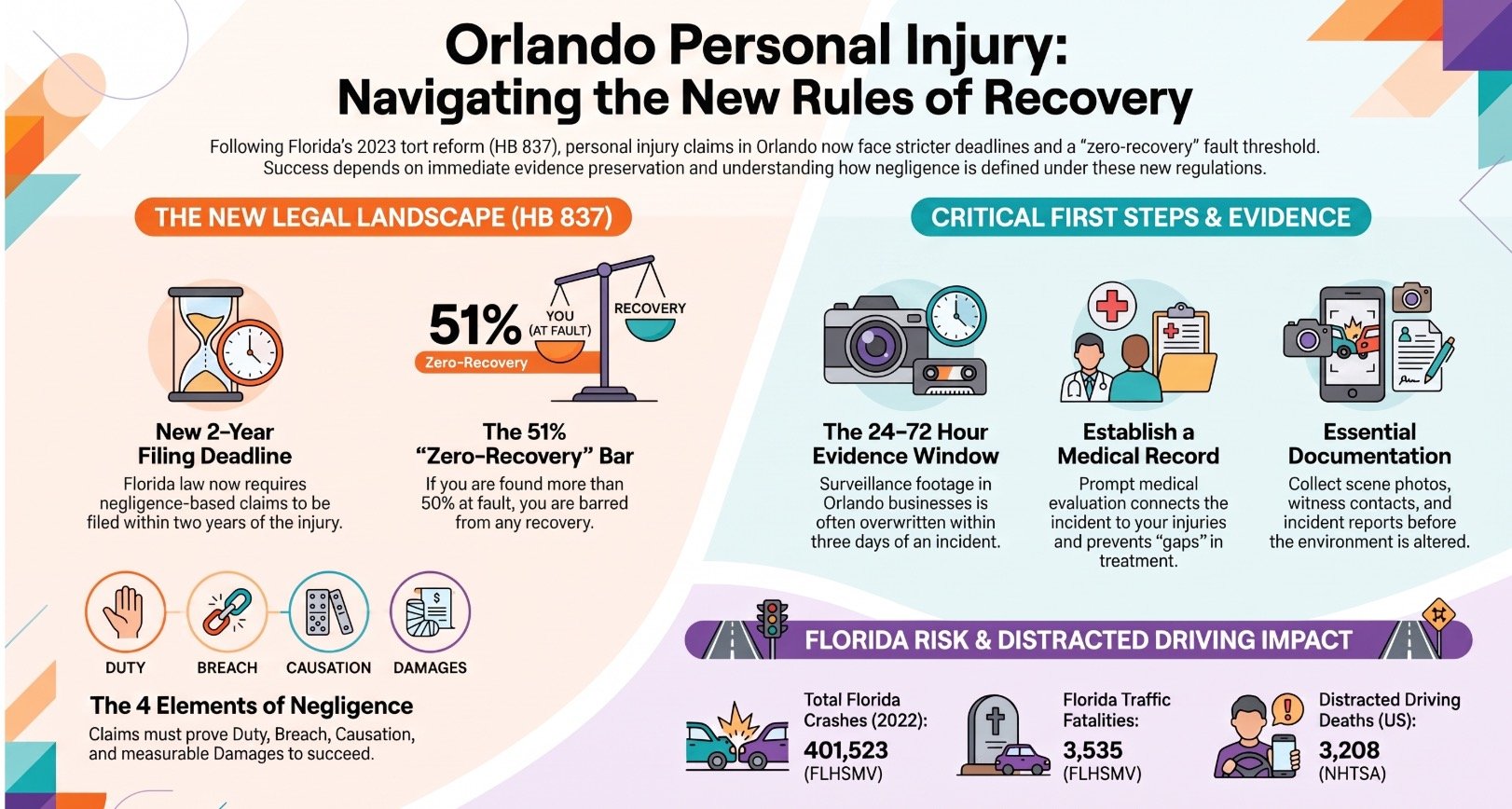
Negligence is the legal foundation of virtually every Orlando personal injury claim. To recover compensation from an at-fault party, an injured person must prove four elements: duty (the responsible party owed a legal obligation of reasonable care, whether as a driver, property owner, employer, or product manufacturer); breach (that party failed to meet the required standard of care, for example by running a red light on Colonial Drive, leaving a hazard unmarked on a floor, distracted driving, or failing to maintain safe premises); causation (the breach directly caused the incident and the resulting injuries); and damages (the injured person suffered measurable losses, including medical bills, lost income, property damage, pain and suffering, and future care needs). Florida HB 837 (2023) added a critical layer: under the modified comparative fault rule, if an injured person is found 51% or more responsible, they recover nothing. This gives insurance carriers a powerful financial incentive to build comparative fault arguments against Orlando injury victims.
Proving Liability in Orlando Personal Injury Cases
Proving liability in Orlando personal injury cases requires evidence demonstrating that another party’s negligence or wrongful conduct caused the accident and resulting harm. A claimant generally must establish the Negligence elements: duty, breach, causation, and damages. Evidence may include photographs, eyewitness statements, surveillance footage, incident reports, medical records, and testimony from qualified experts. These materials should connect the defendant’s conduct to the specific injuries and financial losses experienced by the injured person. For example, records may show that a driver ignored traffic rules, a property owner failed to correct a dangerous condition, or an employer permitted unsafe practices. Florida comparative fault can reduce a claimant’s recovery when the claimant contributed to the incident. Accordingly, careful analysis should address every party’s conduct and assign responsibility accurately. Preserving evidence promptly, documenting symptoms, and following medical recommendations can strengthen the factual record. A personal injury lawyer may organize this information, identify responsible parties, and present a clear case that supports accountability and service to those affected.
Event Data Recorder Evidence in Orlando Personal Injury Cases
Most passenger vehicles manufactured after 2012 are equipped with an Event Data Recorder (EDR), sometimes called a black box, that captures critical data in the seconds before and during a collision. According to NHTSA, EDR systems routinely record vehicle speed, brake application, throttle position, steering input, and seat-belt status. This data can confirm or contradict what an at-fault driver claims happened, making it among the most powerful evidence available in an Orlando personal injury case.
There is a significant risk: EDR data can be overwritten within 24 to 72 hours if the vehicle is started again or involved in a subsequent event. Our firm sends preservation letters immediately after being retained, demanding that the vehicle and its EDR data be preserved before that window closes. We also work with certified EDR specialists to retrieve and authenticate recordings. If you were injured in a crash involving a commercial truck or fleet vehicle on I-4, the 408 Expressway, or any other Orange County roadway, EDR preservation is especially urgent because fleet managers may return vehicles to service quickly.
Dealing With Insurance Companies After an Orlando Personal Injury
Insurance companies often begin evaluating a claim soon after an Orlando personal injury occurs, and their representatives may request evidence, medical authorizations, or settlement discussions before the full extent of the injuries is known. A claimant should provide accurate information while avoiding speculation about fault, future treatment, or recovery. Recorded statements can later be reviewed closely, so careful preparation is important before speaking with an adjuster.
An insurer may also conduct a coverage investigation to determine applicable policy limits, exclusions, and responsibility for payment. Claimants should preserve medical records, photographs, correspondence, and cost documentation that support the reported losses. Insurer deadlines may govern notice requirements, forms, and responses; however, a deadline does not necessarily require immediate acceptance of a settlement offer. A qualified Orlando injury attorney can communicate with adjusters, protect the claimant’s interests, and help ensure that requests are addressed appropriately. This approach allows injured people to remain focused on treatment while pursuing fair, informed consideration of their claims.
What to Expect During an Orlando Personal Injury Claim Process
An Orlando personal injury claim typically begins with an initial case evaluation to assess liability, damages, and available legal options. The process may then involve gathering evidence, communicating with insurers, and negotiating compensation based on the documented losses. If negotiations succeed, the claim is resolved through a settlement; otherwise, further legal action may be considered.
Initial Case Evaluation
During an initial case evaluation, an Orlando personal injury lawyer reviews the circumstances of the incident, identifies potentially liable parties, and determines whether the available facts support a legal claim. The discussion generally covers the client’s injuries, financial losses, insurance communications, and desired objectives. Client eligibility may depend on legal deadlines, the nature of the harm, available coverage, and whether another party’s conduct contributed to the incident. The lawyer may explain potential legal theories, applicable procedures, and realistic outcomes without promising a specific result. The client can also learn how representation works, including communication practices, fees, and decision-making responsibilities. A preliminary claim timeline may be outlined, identifying significant deadlines and expected stages from consultation through resolution. This evaluation allows both parties to determine whether the representation can serve the client’s interests responsibly.
Gathering Evidence
As a personal injury claim progresses, the Orlando personal injury lawyer gathers and preserves evidence that may establish liability, the extent of the injuries, and the resulting financial losses. This process may include obtaining accident reports, medical records, photographs, witness statements, employment records, and relevant property or surveillance materials. Digital documentation, including messages, electronic photographs, location data, and online records, can help clarify timelines and preserve details that might otherwise disappear. The client may be asked to identify witnesses, maintain treatment records, and provide information concerning expenses and missed work. Attorney communications help organize these materials, identify missing evidence, and explain requests for cooperation. Properly preserved evidence supports a clear factual presentation while protecting the client’s interests throughout the claim evaluation and preparation process.
Negotiating With Insurers
Negotiations with insurers typically begin after the Orlando personal injury lawyer has reviewed the available evidence, assessed liability, and calculated the client’s damages. The lawyer then presents a demand supported by medical records, wage documentation, photographs, and other relevant proof. Insurers may respond with questions, requests for additional documentation, or an initial offer that does not reflect the claim’s full value. Understanding insurer tactics helps the lawyer identify delays, disputed facts, and attempts to minimize documented losses. A carefully developed settlement strategy considers immediate expenses, future treatment, lost earning capacity, and the client’s broader needs. Communication remains professional and measured throughout the process. The lawyer explains significant developments, protects the client from pressured decisions, and advocates for fair consideration while preserving evidence and maintaining a clear record of all discussions.
Resolving Your Claim
Once insurer negotiations conclude, the claim may be resolved through a settlement, continued negotiations, or litigation if the parties cannot reach a fair agreement. A settlement provides compensation without a trial, but the injured person generally releases further claims after accepting payment. Before signing, counsel may review medical records, projected expenses, lost income, and applicable insurance limits to determine whether the offer serves the client’s long-term interests.
Effective insurance negotiation tips include documenting every demand, preserving communications, and responding with evidence rather than speculation. Liability proofing necessities may include photographs, witness statements, incident reports, expert opinions, and records showing how the injury developed. If negotiations fail, litigation may involve pleadings, discovery, depositions, motions, and trial preparation. Throughout the process, legal representatives can explain risks, protect procedural rights, and pursue a resolution that supports recovery and accountability.
Compensation for Orlando Personal Injury Damages
Compensation for Orlando personal injury damages may cover medical expenses, lost income, diminished earning capacity, property damage, and the physical pain and emotional distress resulting from the injury. An attorney evaluates available evidence, identifies responsible parties, and presents a demand that reflects the client’s documented needs. Florida Insurance Negotiations may involve reviewing policy limits, liability positions, medical records, employment documentation, and settlement offers. Careful preparation can help protect an injured person from accepting an inadequate resolution before treatment and financial consequences are understood.
Pain Damages Calculations require consideration of injury severity, treatment duration, recovery limitations, and the effect on daily responsibilities. Counsel may also address future medical care, continuing impairment, and losses supported by qualified professionals. Clear communication allows clients and their families to make informed decisions while preserving dignity throughout the process. Because each claim depends on its facts, an Orlando personal injury lawyer generally develops a tailored strategy, seeks fair compensation, and works to hold negligent parties accountable under Florida law.
Economic vs Non-Economic Damages in Orlando Personal Cases
Economic damages compensate measurable financial losses, including medical expenses, lost income, and future treatment costs. Non-economic damages address less tangible harms, such as pain, emotional distress, and diminished quality of life. Comparing these damage calculations requires evidence of financial impact alongside a reasoned assessment of the injury’s broader effects.
Economic Damages Explained
When a personal injury claim is evaluated in Orlando, damages generally fall into two categories: economic and non-economic. Economic damages represent measurable financial losses caused by an injury. They may include emergency treatment, hospital services, medication, rehabilitation, medical equipment, and future healthcare expenses. Lost wages, reduced earning capacity, property damage, and necessary transportation costs may also qualify when supported by reliable evidence. Documentation is required, including invoices, pay records, medical bills, employment statements, and expert projections. In insurance claims, careful calculation helps establish the amount reasonably needed to restore financial stability. An attorney may organize these records, verify future costs, and present them within a settlement strategy. Accurate economic-loss analysis supports fair resolution and helps protect injured people from bearing expenses attributable to another party’s conduct.
Non-Economic Damages Defined
Non-economic damages address the personal effects of an injury that do not have a fixed invoice or readily calculated market value. They may include physical pain, emotional distress, mental anguish, disfigurement, disability, inconvenience, and diminished enjoyment of life. Such losses can affect an injured person’s relationships, independence, confidence, and ability to participate in ordinary activities. Pain vs compensation reflects the challenge of recognizing suffering without reducing it to a simple price. Florida damages proof generally relies on medical records, testimony, treatment history, personal accounts, and observations from family members or other witnesses. The evidence should demonstrate how the injury changed daily life and caused lasting consequences. A careful presentation helps decision-makers understand the human impact while preserving a fair, fact-based evaluation of the claim and the person’s needs.
Comparing Damage Calculations
A complete personal injury claim in Orlando typically combines economic and non-economic damages to reflect both measurable financial losses and the broader effects of an injury. Economic damages may include medical bills, rehabilitation costs, lost income, property damage, and documented expenses. Non-economic damages address pain, emotional distress, reduced enjoyment of life, disfigurement, and diminished relationships. Because these losses lack identical receipts, courts and insurers may apply different valuation methods, including evidence-based comparisons and severity assessments. Documentation, medical opinions, employment records, and testimony can support both categories. Future recovery requires careful consideration of anticipated treatment, lasting limitations, and probable earnings losses. A fair calculation should avoid duplication while recognizing the claimant’s complete circumstances. Legal professionals may help present reliable evidence and distinguish provable financial harm from subjective, yet legally compensable, personal consequences.
When an Orlando Personal Injury Case Goes to Trial vs Settlement
Evaluating whether an Orlando personal injury case should proceed to trial or resolve through settlement requires careful analysis of the evidence, damages, liability, and potential risks. A settlement may provide a faster, more predictable resolution, allowing an injured person to obtain compensation without the uncertainty, expense, and emotional demands of courtroom proceedings. However, an offer may not adequately reflect documented losses or future needs.
Trial strategy becomes important when liability is disputed, the insurer undervalues the claim, or negotiations reach an impasse. Counsel may assess witness credibility, medical documentation, expert opinions, and the likely presentation before a judge or jury. Strong preparation can also improve settlement leverage, even when trial remains a secondary option.
A trial introduces risks, including an unfavorable verdict, delayed payment, and increased legal costs. Settlement terms should, in light of this, be reviewed carefully, including release language, payment timing, and unresolved obligations. The appropriate path depends on the injured person’s objectives, evidence, tolerance for uncertainty, and need for a fair, responsible resolution.
Florida Laws That May Affect Your Orlando Personal Case
Florida law can substantially influence the outcome of an Orlando personal injury case by establishing filing deadlines, liability standards, damage limitations, and rules governing insurance claims. These provisions help determine how responsibility is evaluated and how compensation may be pursued.
- Florida comparative fault rules may reduce an injured person’s recovery when that person shares responsibility for the incident. Evidence concerning conduct, causation, and resulting harm consequently remains significant.
- Florida’s no-fault automobile insurance system generally requires injured drivers to seek initial benefits through personal injury protection coverage. Serious injuries may permit claims against an at-fault driver, subject to applicable requirements.
- Certain statutes address governmental defendants, medical negligence, wrongful death, and available damages. Their procedures and limits can differ from ordinary negligence claims, making careful legal analysis important.
A qualified Orlando personal injury lawyer can review insurance policies, preserve evidence, identify responsible parties, and explain how these laws affect a client’s ability to serve family, employees, or other dependents. Such guidance supports informed decisions while promoting a fair and orderly resolution.
Orlando Personal Injury Claims: What the Numbers Reveal About Crash Victims in Orange County
The scale of personal injury harm in Orlando is difficult to overstate. According to FLHSMV 2022 Florida Traffic Crash Facts, Florida recorded 401,523 total crashes, 3,535 fatalities, and more than 253,888 people injured in a single year, with economic losses exceeding $19.4 billion statewide. Orange County, which includes Orlando, consistently ranks among the most crash-heavy counties in Florida with an estimated 32,000 to 36,000 crashes annually, driven by year-round tourist traffic to the Orlando theme park corridor, dense I-4 congestion, and heavy commuter volume along Florida’s Turnpike and 408. Distracted driving alone contributed to more than 50,000 Florida crashes in that period, and NHTSA reported 3,308 distraction-related fatalities nationally in 2022.
Florida HB 837, effective March 24, 2023, fundamentally reshaped every Orlando personal injury claim. The law cut the statute of limitations from 4 years to 2 years for most negligence claims, and replaced pure comparative fault with a modified system: if an injured person is found 51% or more at fault, they recover nothing. Insurance carriers know this threshold and routinely build their defense strategy around pushing fault percentages past that line. For Orlando injury victims, a weak evidence record or a delayed response can cost everything.
Crash scene evidence, including surveillance footage, witness accounts, EDR data from the at-fault vehicle, and physical road evidence, typically begins degrading or disappearing within 24 to 72 hours. This window closes before most injured people have even left the hospital. Immediate legal action and evidence preservation are the foundation of every successful Orlando personal injury claim under Florida law.
Florida PIP Coverage and Orlando Personal Injury Claims
Florida requires most motor vehicle owners to carry at least $10,000 in Personal Injury Protection (PIP) coverage, which pays 80 percent of reasonable medical expenses and 60 percent of lost wages regardless of who caused the accident. To activate PIP benefits, injured people must seek medical treatment within 14 days of the crash. PIP is considered no-fault coverage, meaning your own insurer pays these initial benefits without requiring proof of another driver’s fault.
However, PIP has important limits. It covers only $10,000 in total benefits and does not compensate for pain and suffering. To sue an at-fault driver for full damages, Florida law requires that your injury meet the serious injury threshold: a permanent injury, significant and permanent scarring or disfigurement, or death. If your injuries are serious enough, stepping outside the no-fault system and pursuing a liability claim against the at-fault party may recover substantially more than PIP alone can provide.
The Statute of Limitations for Orlando Personal Injury Cases
Timely filing is important in an Orlando personal injury case because Florida’s statute of limitations generally restricts how long an injured person has to bring a lawsuit. For many negligence claims, Florida law provides two years from the date of the injury. Missing that deadline can lead to dismissal, even when the underlying claim appears valid.
The applicable period may differ according to the defendant, injury type, and governing statute. Claims involving medical negligence, wrongful death, or a governmental entity may require distinct deadlines and preliminary notices. Certain Florida injury exceptions can alter when the limitations period begins or extend the time available to file. For example, a minor’s circumstances, an undiscovered injury, or a defendant’s absence from the state may affect the calculation.
Potential tolling periods for claims can pause the deadline under limited conditions, but these rules are fact-specific. Accurate documentation of the incident and prompt attention to filing requirements help protect the interests of injured people and their families.
How an Orlando Personal Injury Lawyer Can Help You
An Orlando personal injury lawyer can provide structured legal guidance after an accident, from investigating the facts to pursuing appropriate compensation. This support can help injured people protect their interests while remaining focused on recovery and responsibilities to family or community.
An Orlando personal injury lawyer helps accident victims investigate claims, pursue fair compensation, and protect their interests throughout recovery.
- Fact development: The lawyer may collect records, interview witnesses, evaluate medical documentation, and identify parties whose conduct contributed to the harm.
- Claim evaluation: By examining losses, liability, and applicable coverage, counsel can explain the potential value of a claim and develop a thoughtful compensation strategy.
- Negotiation and representation: Counsel can communicate with insurers, address disputed facts, and review an Insurance settlement for fairness before recommending acceptance or further action.
A lawyer may also coordinate evidence and organize communications, reducing confusion during a demanding period. Professional representation promotes orderly decision-making and helps make certain that a claimant’s account, treatment, financial losses, and service-related obligations receive appropriate consideration throughout the legal process.
When to Contact a Orlando Personal Injury Lawyer
Contacting an Orlando personal injury lawyer soon after an accident can help preserve evidence, clarify legal rights, and prevent avoidable mistakes in the claim process. A consultation is appropriate when injuries require medical treatment, fault is disputed, insurance representatives request statements, or another party denies responsibility. Early guidance may also help identify witnesses, secure photographs, document expenses, and organize relevant medical records before information becomes difficult to obtain.
Legal assistance can be especially important when an injury affects a person’s ability to work, care for family, or continue serving others in the community. Individuals facing serious harm should not wait for an insurer to determine whether a claim has value. Statute awareness is crucial because filing deadlines vary according to the claim and circumstances, and missed deadlines may restrict recovery. In 24/7 emergencies, immediate medical care takes priority, followed by prompt legal consultation when practical. A lawyer can also explain communication boundaries and appropriate next steps without disrupting necessary treatment or personal responsibilities.
Why You Need an Experienced Orlando Personal Injury Lawyer
Because injury claims often involve disputed facts, complex medical evidence, and strict procedural requirements, experienced legal representation can materially affect the outcome. An Orlando personal injury lawyer evaluates liability, preserves relevant evidence, and identifies damages that may otherwise be overlooked. This disciplined approach helps protect injured people while allowing them to focus on medical recovery and personal responsibilities.
Experienced counsel also applies informed Negotiation Strategies when communicating with insurers, defendants, and opposing attorneys. A careful assessment of claim value, coverage, and documented losses can support a fair resolution rather than an inadequate early settlement. If negotiations fail, Trial Preparation becomes critical. Counsel can organize witnesses, medical records, expert testimony, and legal arguments into a coherent case presentation.
How to Choose the Right Florida Personal Injury Lawyer for Your Case
The decision should begin with careful review of relevant experience, case history, and the lawyer’s ability to handle the specific type of injury, insurance dispute, or liability question involved in the claim. A suitable attorney should demonstrate organized case preparation, sound judgment, and a genuine commitment to protecting the client’s well-being while pursuing fair compensation. Ask specifically about their experience with Florida’s HB 837 comparative fault rules and how they approach fault disputes with insurers. Also ask about Board Certification in Civil Trial and an AV Preeminent rating from Martindale-Hubbell, independent credentials that confirm the highest levels of professional excellence and courtroom readiness.
Client communication is another essential measure. The lawyer should explain options clearly, provide timely updates, and answer questions with honesty and respect. This approach helps injured people make informed decisions during a difficult period without feeling pressured or confused about what is happening with their case. Potential clients should also review fee agreements carefully before signing anything, understanding contingency arrangements, potential expenses, and how costs may affect the net recovery. By evaluating experience, communication, availability, and fee structure, an injured person can select counsel prepared to serve their interests with diligence, integrity, and professional care throughout the full life of the claim.
About The Law Offices of Anidjar & Levine
Founded in 2005 by Marc Anidjar and Glen Levine, the firm began as a two-person operation working out of a construction office conference room. Over the past 20 years, that modest start has grown into one of Florida’s most recognized personal injury practices, with more than $1 billion recovered in settlements on behalf of injury clients across the state. We bring that same determination and depth of experience to every Orlando personal injury case we handle.
The Law Offices of Anidjar & Levine is a Florida personal injury firm that represents individuals seeking compensation after accidents and other injury-causing events. The firm handles matters involving motor vehicle collisions, premises liability, wrongful death, and other claims in which negligence may have caused harm. Its attorneys evaluate the available evidence, explain potential legal options, and develop strategies suited to each client’s circumstances. The Anidjar & Levine Approach emphasizes preparation, responsiveness, and advocacy throughout the claims process.
This may include investigating liability, documenting damages, communicating with insurers, and pursuing litigation when a fair resolution cannot be reached through negotiation. Client Communication remains an important component of the firm’s services. Regular updates and accessible explanations can help clients understand procedural developments and make informed decisions. By combining legal knowledge with attentive representation, the firm seeks to assist injured people and families while protecting their interests during challenging personal injury proceedings in Florida’s intricate legal system.
Marc Anidjar, Co-Founder & Personal Injury Attorney
Marc Anidjar co-founded the firm in 2005 and has spent two decades representing seriously injured people throughout Florida. He is Board Certified in Civil Trial Law by The Florida Bar, a distinction held by fewer than 3 percent of Florida attorneys, and holds an AV Preeminent rating from Martindale-Hubbell, the legal industry’s highest peer-review recognition for professional excellence and ethical standards.
Glen Levine, Co-Founder & Personal Injury Attorney
Glen Levine co-founded the firm alongside Marc Anidjar and has represented injury clients across Florida for more than 20 years. He holds an AV Preeminent rating from Martindale-Hubbell and is committed to clear communication, thorough case preparation, and protecting each client’s right to full and fair compensation after a serious injury.
Frequently Asked Questions
Can I Afford to Hire an Orlando Personal Injury Lawyer?
Many injured people can afford legal representation because personal injury attorneys commonly use contingency fees, meaning payment is generally collected only if compensation is recovered. The attorney’s agreement should clearly explain the percentage, case expenses, and possible obligations if the claim is unsuccessful. Some firms also offer payment plans for costs not covered by contingency arrangements. A prospective client should compare written terms, ask direct questions, and confirm whether representation aligns with personal circumstances.
Will My Personal Injury Case Affect My Immigration Status?
A personal injury case generally does not affect an individual’s immigration status, particularly when the person seeks compensation as an injured victim. However, immigration consequences may arise from unrelated criminal conduct, misrepresentation, or certain legal proceedings. The personal injury impact depends on the individual’s visa, pending applications, and case circumstances. A qualified immigration attorney should review the situation alongside personal injury counsel before settlement, testimony, or communication with government agencies occurs.
Can Family Members Attend Meetings With My Personal Injury Lawyer?
Yes, family members may generally attend meetings with a personal injury lawyer when the client and attorney agree. Their presence can provide support, help recall information, or assist with communication. However, attorney communication may be affected if relatives interrupt, answer questions, or become involved in decisions. Confidentiality concerns also arise because sharing privileged discussions with third parties can weaken protection. The client should ask the lawyer about attendance and establish clear boundaries beforehand.
What Should I Wear When Meeting an Orlando Personal Injury Lawyer?
A client should wear Comfortable clothing that is clean, neat, and appropriate for a professional meeting. Formal business attire is usually unnecessary, but clothing should reflect respect for the legal process and the lawyer’s time. Wear closed toe shoes suitable for walking and office settings. Avoid strong cologne, perfume, or other distracting scents. Bring documents, medical records, correspondence, and identification, organizing them so the attorney can review relevant information efficiently.
Can I Change Lawyers During My Personal Injury Case?
Yes, an injured person can generally change lawyers during a personal injury case, although the process depends on case timing, court rules, and any existing obligations. Change representation should begin with a careful review of the current retainer and client consent. The individual should notify the former attorney in writing, authorize file transfer, and confirm payment responsibilities. A written agreement with new counsel should clearly address fees, expenses, and ongoing responsibilities.
What is the statute of limitations for Orlando personal injury cases?
Under Florida HB 837, effective March 24, 2023, most negligence-based personal injury claims must be filed within 2 years from the date of injury. Missing this deadline permanently bars recovery regardless of how strong the underlying facts are. Certain claims against government entities may require written notice within even shorter windows.
How does Florida PIP coverage affect my Orlando personal injury claim?
Florida’s Personal Injury Protection (PIP) law requires drivers to carry $10,000 in no-fault coverage that pays 80 percent of medical bills and 60 percent of lost wages after an accident, regardless of fault. You must seek treatment within 14 days to activate PIP. However, PIP does not cover pain and suffering, and its $10,000 limit is often exhausted quickly. To pursue full compensation from an at-fault driver, your injuries must meet Florida’s serious injury threshold.
How does Florida HB 837 affect Orlando personal injury cases?
Florida HB 837, which took effect March 24, 2023, changed two critical rules: modified comparative fault means if you are found 51 percent or more at fault, you recover nothing; and the statute of limitations was reduced from 4 years to 2 years. These changes make early legal action, thorough evidence collection, and experienced representation more important than ever.
Orlando and Orange County Local Resources
The following local resources may help injured people and their families in the days and weeks after a serious accident. If you are experiencing an emergency, call 911 first.
Hospitals and Emergency Care
- Orlando Regional Medical Center — Level I Trauma Center · 52 W Underwood St, Orlando, FL 32806 · 321-841-5111
- AdventHealth Orlando — 601 E Rollins St, Orlando, FL 32803 · 407-303-6611
- Winnie Palmer Hospital for Women & Babies — 83 W Miller St, Orlando, FL 32806 · 407-649-6011
- Nemours Children’s Hospital, Florida — 13535 Nemours Pkwy, Orlando, FL 32827 · 407-650-7000
Police and Highway Patrol
- Orlando Police Department — 100 S Hughey Ave, Orlando, FL 32801 · Non-emergency: 321-235-5300
- Orange County Sheriff’s Office — 2500 W Colonial Dr, Orlando, FL 32804 · 407-254-7000
- Florida Highway Patrol — Troop D (Central Florida) · 407-737-2213
- Request a Florida Crash Report (FLHSMV)
Courts and Legal Services
- Ninth Judicial Circuit Court of Florida — Orange County Courthouse, 425 N Orange Ave, Orlando, FL 32801 · 407-836-2000
- Orange County Clerk of Courts · 407-836-2000
- Community Legal Services of Mid-Florida — Free civil legal help · 407-841-7777
- Florida Bar Lawyer Referral Service · 800-342-8011
Mental Health and Crisis Support
- 988 Suicide & Crisis Lifeline — 24/7 free confidential support · 988
- 211 Heart of Florida United Way — 24/7 helpline for crisis, counseling, and community resource referrals · 211
- Aspire Health Partners — 5151 Adanson St, Orlando, FL 32804 · 407-875-3700
- Central Florida Behavioral Hospital — 6601 Central Florida Pkwy, Orlando, FL 32821 · 407-370-0111
Victim Services and Additional Support
- Orange County Crime Victim Services — 24-hour crisis line · 407-836-7315
- Florida Department of Health in Orange County · 407-858-1400
- Florida Department of Financial Services — Consumer Insurance Help · 877-693-5236
Personal injury claims in Orlando often involve serious injuries, complex liability issues, and aggressive insurance defense. An Orlando Personal Injury Lawyer from The Law Offices of Anidjar & Levine can evaluate the incident, identify responsible parties, preserve critical evidence, and pursue compensation for medical expenses, lost wages, and other damages. Prompt legal guidance can help protect an injured person’s rights and strengthen the claim. Those harmed in an Orange County accident should consider contacting an experienced attorney for a confidential case review.
Orlando personal injury claims require timely action, careful documentation, and informed legal guidance. Victims may face medical expenses, lost income, insurance disputes, and lasting physical or emotional consequences. An experienced Orlando Personal Injury Lawyer can evaluate liability, protect applicable rights, and pursue fair compensation through negotiation or litigation when necessary. The Law Offices of Anidjar & Levine provide case-specific counsel to individuals seeking accountability after an injury. Prompt consultation may help preserve evidence and strengthen the claim.
Real Reviews From Our Clients!
“After my car accident on I-4, I had no idea what to do. The team at Anidjar & Levine handled everything from the insurance company to my medical bills. They kept me informed every step of the way and got me a settlement I never expected.”
— Vanessa L., Orlando
“I slipped and fell at an Orlando resort and hurt my back badly. I was worried about affording a lawyer, but Anidjar & Levine took my case on contingency and fought hard for me. Professional, responsive, and truly on my side.”
— Devon H., Kissimmee
“Dealing with the insurance company after my accident was overwhelming. Anidjar & Levine stepped in immediately, preserved the evidence, and dealt with the adjusters so I could focus on healing. The result was far better than anything I could have achieved on my own.”
— Sofia R., Winter Park