Were you hurt in a crash on I-95, the Palmetto, or Biscayne Boulevard? Florida’s new 2-year deadline and the 51% fault bar can quickly wreck a case. Our Miami car accident lawyers move fast to protect you.
Main Takeaways From This Guide
Miami drivers face some of Florida’s busiest and most dangerous roads. I-95, I-195, the Dolphin Expressway, the Palmetto Expressway, SR-826, Brickell Avenue, and Biscayne Boulevard all run through a dense mix of commuters, tourists, rideshare drivers, and commercial trucks. When something goes wrong, a Miami car crash can involve several drivers, multiple insurance companies, and injuries that take weeks to fully show their effects.
If you were hurt in a Miami crash caused by someone else, Florida law gives you the right to seek money damages. But that right has strict limits. HB 837, which took effect March 24, 2023, cut the deadline to file most lawsuits from four years to two years. The law also changed the comparative fault rule to a 51% bar. If a jury finds you more than half at fault, you get nothing.
The goal of this guide is to give you clear, simple answers about what to do, what to say, what to avoid, and when to call a lawyer. For a free, 24/7 case review, call our Miami office at 305-384-6882 or our main line at 1-800-747-3733.
How We Can Help With Your Miami Car Accident Injury Claim


When you hire our firm, you do not have to deal with the insurance company alone. Our team handles everything, from the first phone call with the adjuster to the final settlement check. We know how Miami-Dade insurers operate; we know how fast they move to lock in low offers, and we know what evidence to grab before it disappears. From day one, we work to level the playing field.
OUR CONSULTATIONSARE FREE
START YOUR FREE CASE REVIEW

Our attorneys gather every piece of evidence that supports your claim: the Florida Traffic Crash Report, your medical records, photos of the scene, witness statements, and any dash-cam or surveillance footage from nearby businesses along the crash corridor. We send formal preservation letters, called spoliation letters, to protect that evidence before it is overwritten or lost. We also work with doctors, accident reconstructionists, and medical experts to show the full picture of your injuries and how they will affect your future.
Most of all, we work on a contingency fee basis. That means you pay us nothing upfront, and nothing out of pocket. We only get paid when we win your case through a settlement or a verdict. If you want to talk with our team about your Miami crash, you can also contact us online any time.
Understanding Miami Car Accident Injury Cases


A Miami car accident case is a Florida personal injury claim filed by someone hurt in a crash caused by another driver’s negligence. Under Florida law, the injured person (called the plaintiff) must prove four things: the other driver owed a duty of care, the driver broke that duty, the breach caused the crash, and the plaintiff suffered real damages as a result. Those four parts are the backbone of every claim.
In Miami specifically, cases often involve more than two drivers. A chain-reaction crash on I-95 might involve five or six vehicles. A left-turn crash on Brickell might involve a rideshare driver, a delivery van, and a tourist in a rental car. Each driver carries different insurance, lives in a different state, and tells a different story. Sorting all that out is one of the main jobs of a Miami car accident lawyer.
Miami cases also run on a tight clock. Florida’s HB 837 reform shortened the filing deadline to 2 years and raised the bar on comparative fault. Insurance companies know this, so they move fast to lock in statements and low offers before the injured person can understand their case. The best way to stop that is to get a lawyer involved as early as possible.
Common Causes of Miami Car Accidents
Miami’s traffic density, year-round tourist flow, and complex interchanges create a specific set of crash risks. The most common causes we see are distracted driving (texting, phone use, in-car screens), speeding (especially on I-95 and the Palmetto), running red lights (common at busy Brickell and downtown intersections), and following too closely in stop-and-go traffic. Rear-end crashes alone make up a large share of Miami-Dade’s crash total each year.
Impaired driving is another major cause. Miami has a vibrant nightlife, and crashes involving drunk drivers rise sharply late at night and in the hours after major events. Rideshare and food-delivery driver fatigue also plays a role. Many drivers work long shifts across apps like Uber, Lyft, and DoorDash, and tired driving behaves a lot like drunk driving.
Finally, Miami weather matters. Afternoon thunderstorms can flood streets within minutes and cut visibility to almost nothing. Hurricane-season weather, poorly maintained roads, and work zones along major corridors like SR-826 all contribute to the crash count. Our Miami attorneys handle cases involving each of these causes.
Legal Rights of Miami Car Accident Injury Victims
If you were hurt in a Miami crash caused by someone else, Florida law gives you several important rights. You have the right to seek money damages for your medical bills, lost wages, and pain and suffering. You have the right to file a claim with the at-fault driver’s insurance company. If that claim does not resolve the case fairly, you have the right to file a lawsuit and take your case to a Miami-Dade jury.
You also have the right to hire an attorney. The attorney works for you, not for the insurance company. You have the right to refuse to give a recorded statement to the other side’s insurance adjuster. You have the right to refuse to sign a blanket medical release that gives the insurance company access to your entire medical history, including records unrelated to the crash.
You have the right to say no to any low settlement offer that does not fairly compensate you. Insurance companies count on injured people not knowing these rights. A Miami car accident lawyer can protect you. If a loved one died in the crash, close family members may also have a Miami wrongful death claim.
Steps to Take After a Miami Car Accident Injury
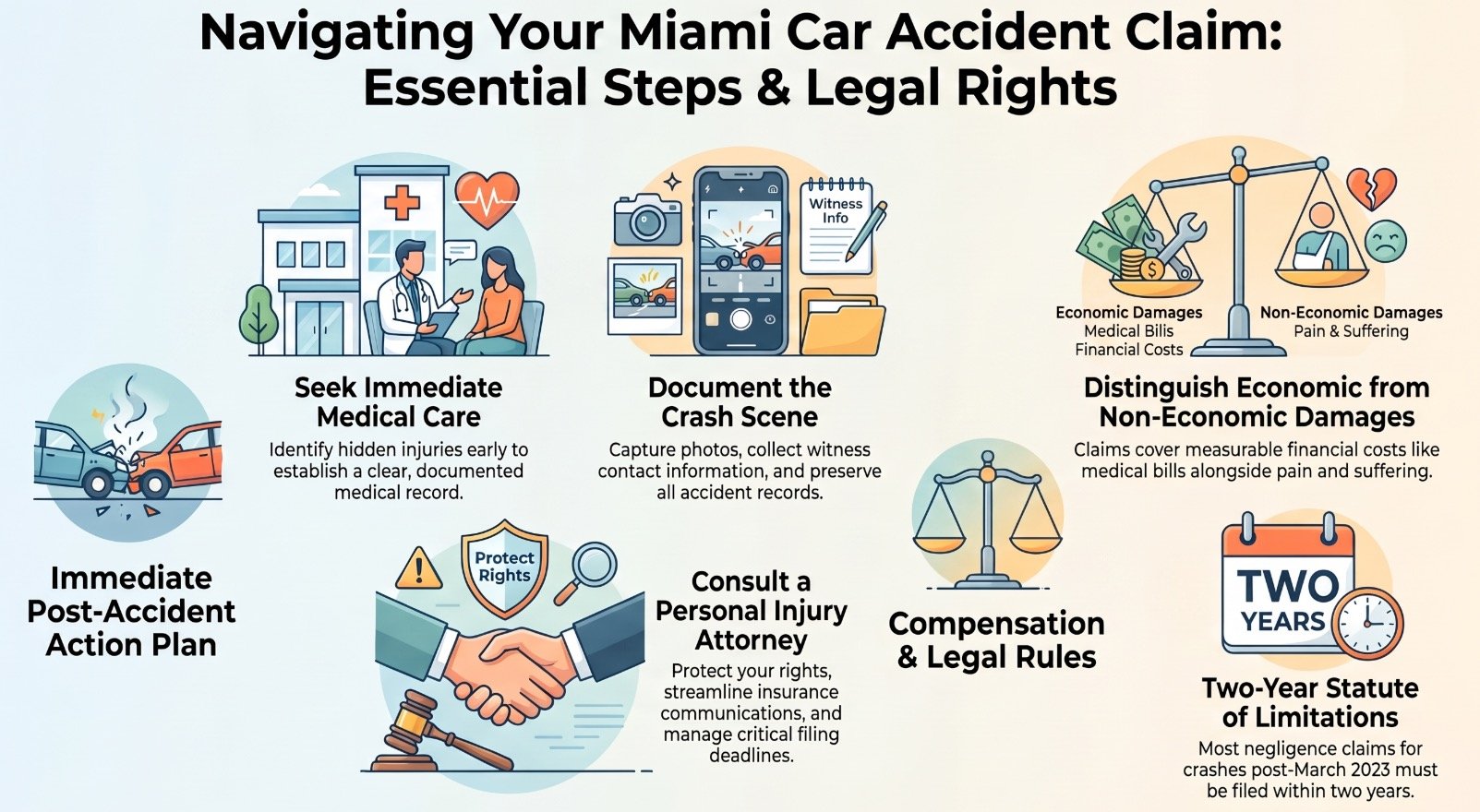
First, check for injuries and move to a safe spot if you can. Turn on your hazard lights. Call 911, even if the crash looks minor. Florida law requires you to report a crash when there is injury, death, or vehicle damage over $500, and most Miami crashes meet at least one of those criteria. When the officer arrives, give a short and honest account. Stick to facts and avoid guessing about speeds, angles, or fault. Never say “I’m sorry” at the scene, because an adjuster can twist that into an admission of fault later.
Next, gather evidence. Take photos of both vehicles from every angle. Capture skid marks, debris, traffic signals, road signs, and the surrounding area. Get names, phone numbers, and license plates of all drivers. Collect contact information from any witnesses. Miami has many out-of-town drivers, so getting phone numbers at the scene is important. Those witnesses may be hard to find later.
Then, get medical care right away, even if you feel okay. Some of the worst crash injuries, like brain bleeds, cracked vertebrae, or internal injuries, do not hurt at first. A hospital or urgent care visit builds a medical record on the same day as the crash. Without that record, the insurance company will argue that your injuries did not come from the crash.
Remember Florida’s PIP rule: treatment must start within 14 days or you lose PIP benefits entirely.
How a Miami Car Accident Lawyer Can Help You
A Miami car accident lawyer handles every part of the legal process so you can focus on healing. The attorney investigates the crash, pulls the police report and medical records, interviews witnesses, and sends formal preservation letters to protect physical and electronic evidence. For serious cases, the lawyer may hire an accident reconstruction expert to recreate the crash step by step.
The attorney also negotiates with every insurance company involved. That often means your own PIP carrier, the at-fault driver’s liability carrier, your health insurer, and sometimes your own uninsured/underinsured motorist carrier if the at-fault driver was uninsured or had low policy limits. A lawyer who knows how these policies work together can often triple or quadruple what an injured person could recover on their own.
If the insurance company will not pay fairly, your lawyer files a lawsuit in the Miami-Dade County 11th Judicial Circuit. From there, the case moves through discovery (where both sides exchange evidence), depositions (where witnesses answer questions under oath), mediation, and if needed, trial. Our firm takes cases all the way to a jury when the insurance company refuses to make a fair offer.
Event Data Recorder, Black Box, and Surveillance Evidence in Miami Crashes
Most cars and trucks built after 2012 have a small computer inside called an Event Data Recorder (EDR), sometimes called a “black box.” It records what the vehicle was doing in the seconds before, during, and after a crash. The data includes speed, braking, throttle position, steering input, and seat belt status. According to the National Highway Traffic Safety Administration (NHTSA), EDR data is admissible in court when a qualified specialist properly preserves and downloads it.
EDR data can prove that another driver was speeding, braking late, or accelerating into the crash. In a Miami case where fault is disputed, that data can be the single most important piece of evidence. The catch is that EDR data can be overwritten within days once the vehicle is driven, repaired, or scrapped. That is why fast legal action matters.
Beyond EDR data, Miami is covered in private and public surveillance cameras. Businesses along Brickell, Lincoln Road, the beachfront, and major highways record footage that often captures crashes nearby. Most of those systems overwrite on a 24- to 72-hour cycle. If no one asks for the footage within that window, it is gone forever. Our attorneys send preservation requests the same day we are retained.
Miami Car Accident Claims — Key Data at a Glance
Miami-Dade County consistently ranks among Florida’s most dangerous counties for car crashes. According to FLHSMV 2022 Florida Traffic Crash Facts, Florida reported 401,523 crashes, 3,535 deaths, and more than 253,888 injuries in a single year. Miami-Dade County accounts for roughly 60,000 of those crashes each year, which is one of the highest totals in the state. Economic losses from Florida crashes topped $19.4 billion in 2022.
Florida’s HB 837 reform, effective March 24, 2023, reshaped every Miami car accident claim. The 2-year statute of limitations and 51% zero-recovery fault bar stack on top of Florida’s PIP rules to create a tight legal window. Insurance companies know this and move fast. Physical evidence like EDR data, dash-cam footage, skid marks, and surveillance video can degrade within 24 to 72 hours. The infographic below shows the key data points every Miami crash victim should know.
Proving Liability in Miami Car Accident Injury Cases
Liability means legal fault for the crash. To prove liability under Florida law, your attorney must show four things. First, the other driver owed you a duty of care, which every driver on a Florida road does. Second, the driver broke that duty by acting carelessly, like running a red light, speeding, or texting. Third, that careless act caused the crash. And fourth, the crash caused you real harm, measured in medical bills, lost wages, and other damages.
Evidence of liability can come from many sources. The Florida Traffic Crash Report is the starting point. It names the drivers, lists any citations, and includes a diagram of the scene. Witness statements add detail about what the drivers were doing before the crash. Dash-cam and surveillance footage can show the crash itself. EDR data from the vehicles can show speeds and braking in the final seconds. In complex cases, an accident reconstruction expert may use all of this to recreate the crash.
Insurance adjusters push back hard on liability. They argue the injured driver changed lanes without signaling, was speeding, was distracted, or should have seen the hazard. Under HB 837, if the jury puts more than half the fault on the injured driver, the case ends with zero recovery. That is why building a clean liability story early matters so much.
Dealing With Insurance Companies After a Miami Car Accident Injury
Insurance companies are not on your side. Even your own insurance company has one goal: pay as little as possible on every claim. Adjusters are trained, experienced, and well-resourced. The injured person is often in pain, stressed about bills, and unfamiliar with Florida’s complicated no-fault and tort rules. That is an unfair fight, and the insurance company counts on it.
Here are three mistakes to avoid. First, do not give a recorded statement to the other driver’s insurance company before you talk with a lawyer. Adjusters ask questions in a specific order designed to lock in statements they can later use against you. Second, do not sign a blanket medical release. Those forms give the insurance company access to your entire medical history, including records unrelated to the crash. Third, do not accept the first settlement offer. First offers are almost always a fraction of the real case value.
Your lawyer handles all contact with the insurance company. That means every phone call, every letter, and every request goes through counsel. The adjuster cannot call you directly once you are represented. This simple shift takes enormous pressure off the injured person and almost always leads to a better outcome.
What to Expect During a Miami Car Accident Injury Claim Process
A Miami car accident claim moves through several stages. First comes the investigation phase, where your attorney gathers evidence, interviews witnesses, pulls records, and preserves physical and electronic evidence. During this time, you continue medical treatment and keep every bill, prescription, and discharge instruction. This phase usually lasts from the day of the crash until your doctor says you have reached maximum medical improvement (MMI).
Next comes the demand and negotiation phase. Once your medical treatment is far enough along, your lawyer sends the insurance company a detailed demand letter laying out the facts, the law, your injuries, and the damages. The insurance company then responds with a counter-offer. Negotiations often take weeks or months and may involve several rounds of letters, phone calls, and medical record exchanges.
If negotiations fail, your lawyer files a lawsuit in Miami-Dade’s 11th Judicial Circuit. That begins the litigation phase: discovery, depositions, motions, and if needed, mediation and trial. Most car accident cases settle before trial, but some do go to a jury. From start to finish, a Miami car accident case can take anywhere from several months (for simple cases that settle quickly) to two or three years (for serious cases that go to trial).
Compensation for Miami Car Accident Injury Damages
Florida law allows injured crash victims to recover several types of damages. These fall into two main groups: economic damages (real dollars you can add up) and non-economic damages (harm that is not tied to a receipt but is still very real). Economic damages include past and future medical bills, lost wages, loss of future earning capacity, out-of-pocket expenses, and property damage to your vehicle.
Non-economic damages cover pain and suffering, mental anguish, loss of enjoyment of life, scarring and disfigurement, and loss of consortium (which covers the harm to a spouse’s relationship with the injured person). In Florida, non-economic damages for pain and suffering are only available if you meet the serious injury threshold, which generally requires a permanent injury, significant scarring, or death.
In rare cases involving drunk driving, intentional misconduct, or gross negligence, Florida law also allows punitive damages. These are extra damages meant to punish reckless behavior and discourage others from doing the same. Punitive damages are capped under Florida law, but they can add significant value to a case involving an impaired or reckless driver.
Economic vs. Non-Economic Damages in Miami Car Accident Cases
Economic damages are easier to prove because they come with paperwork. Every emergency room visit, surgery, physical therapy session, lost workday, and repair estimate generates a bill or record. Your lawyer gathers those documents and adds them up. Experts project future medical costs and lost wages based on your injuries, your age, and your career path.
Non-economic damages are harder to quantify, but they are not harder to prove. They just require different evidence. Photos of your injuries over time, a journal describing the daily impact of the crash, statements from friends and family, and testimony from mental health providers all build the non-economic damages picture. Insurance companies often try to minimize these damages because they are harder to pin to a number, but a good lawyer knows how to present them clearly to a jury.
In most serious Miami cases, non-economic damages make up a large share of the total recovery. A crash victim who misses six months of work and faces lifelong back pain might have $150,000 in economic damages and $400,000 or more in non-economic damages, depending on the specific facts of the case.
Legal Term Defined
What Is Florida PIP and How Does It Apply to Miami Crashes?
Florida’s No-Fault Law (Fla. Stat. §627.736) requires most drivers to carry at least $10,000 in Personal Injury Protection, called PIP. PIP pays 80% of medical bills and 60% of lost wages no matter who caused the crash. But PIP only kicks in if you get medical treatment within 14 days of the crash. Miss that window and you lose the benefit.
To sue the at-fault driver for pain and suffering, you must meet Florida’s serious injury threshold: a permanent injury, significant and permanent scarring or disfigurement, or death. Under HB 837 (March 24, 2023), you have only 2 years to file a lawsuit and must be less than 51% at fault to recover anything.
When a Miami Car Accident Injury Case Goes to Trial vs. Settlement
Most Florida car accident cases settle before trial. That is because trial is expensive, slow, and uncertain for both sides. The insurance company does not want a Miami-Dade jury to decide how much your case is worth, especially if liability is clear and your injuries are serious. Your lawyer uses that pressure to negotiate a fair settlement without going all the way to court.
But some cases do go to trial. Cases where the insurance company refuses to make a reasonable offer, where liability is sharply disputed, or where the damages are so large that the carrier wants to minimize payment are more likely to go before a jury. Our firm prepares every case as if it will go to trial. That preparation often convinces the insurance company to settle at full value.
If your case does go to trial, the process can take several days to several weeks. A jury of six Miami-Dade residents hears the evidence from both sides and decides fault and damages. The judge then enters judgment based on the verdict. Trial is a serious step, but when the insurance company refuses to pay fairly, it is sometimes the only path to full recovery.
Long-Term Effects of Miami Car Accident Injuries
Serious car accident injuries can affect a person for years, or for the rest of their life. Traumatic brain injuries (TBIs) can cause changes in memory, mood, and personality that may never fully go away. Spinal cord injuries can lead to permanent weakness, chronic pain, or paralysis. Multiple fractures, especially crush fractures, can leave a victim with lifelong mobility problems and recurring surgeries.
Beyond the physical injuries, car accident survivors often struggle with mental health effects. Post-traumatic stress disorder, anxiety, depression, sleep problems, and fear of driving are all common. Florida law recognizes these effects as real injuries, and they are compensable. Documentation from a licensed mental health provider is critical to building a non-economic damages claim for these conditions.
Economic effects can be just as serious. A permanent injury that forces a victim to leave their career or take a lower-paying job can cost hundreds of thousands or even millions of dollars in lost earning capacity. Your lawyer works with vocational experts and economists to project those future losses accurately so the settlement or verdict covers them.
Florida PIP and the Serious Injury Threshold
Florida’s Personal Injury Protection (PIP) law applies to every Miami car accident. Under Fla. Stat. §627.736, most drivers must carry at least $10,000 in PIP coverage. PIP pays 80% of medical bills and 60% of lost wages regardless of who caused the crash. But PIP only applies if you receive initial medical treatment within 14 days. Miss that deadline and PIP benefits are lost entirely.
To sue the at-fault driver for pain and suffering (not just economic losses), Florida requires you to cross the serious injury threshold. That means proving at least one of the following: significant and permanent loss of an important bodily function, permanent injury within a reasonable degree of medical probability, significant and permanent scarring or disfigurement, or death. Soft-tissue injuries sometimes qualify, but it takes careful medical documentation.
Working with an attorney who understands how PIP, health insurance, MedPay, uninsured/underinsured motorist coverage, and the at-fault driver’s liability policy fit together can mean the difference between paying bills out of pocket and recovering every covered dollar. For complex cases involving multiple vehicles or Miami commercial truck crashes, this coordination is especially important.
The Statute of Limitations for Miami Car Accident Injury Cases
Florida’s 2023 tort reform law, HB 837, cut the statute of limitations for most negligence claims from four years to two years. That change took effect on March 24, 2023, and it applies to every Miami car accident claim arising from a crash on or after that date. Two years sounds like plenty of time, but it goes fast when you are dealing with surgeries, physical therapy, insurance disputes, and the daily effects of a serious injury.
If a loved one died in a Miami crash, the family generally has two years from the date of death to file a wrongful death claim under Florida’s Wrongful Death Act. Deadlines can shift in cases involving minors, government defendants (like a city bus), or dram-shop claims against bars that served visibly drunk drivers. Several of these shorter notice periods must be met well before the two-year lawsuit deadline, so quick action matters.
Missing the statute of limitations ends the case, no matter how strong the facts are. Courts generally cannot extend the deadline for most negligence claims. That is why the single most important step after a Miami crash is to contact an experienced attorney as soon as possible.
When to Contact a Miami Car Accident Lawyer
The best time to call a lawyer is the same day as the crash or the day after. Fast legal action lets your attorney send preservation letters before evidence is lost, interview witnesses while their memories are fresh, and shield you from aggressive insurance adjusters who want to lock in low statements. The sooner you have a lawyer, the stronger your case becomes.
You should also call if the insurance company has already contacted you, asked for a recorded statement, offered a quick settlement, or sent a release to sign. Those are all signs that the insurance company is moving faster than you are. A lawyer can slow that process down and make sure you don’t sign anything before you know the full picture of your injuries.
Finally, call a lawyer any time you are confused about what to do next, worried about mounting medical bills, or struggling to deal with your own insurance company. Our consultations are free, available 24/7, and obligation-free. If we are a good fit, we take the case on contingency, meaning you pay nothing unless we win. Call 305-384-6882 any time.
Why You Need an Experienced Miami Car Accident Lawyer
Not every lawyer handles Florida car accident cases. And not every lawyer who does has deep experience in Miami-Dade County. Our firm has been representing injured Floridians since 2005, and we have recovered more than $1 billion in settlements for injury clients across the state. We know the Miami courts, the local insurance adjusters, the hospitals and treating physicians, and the way Miami-Dade juries evaluate cases.
Experience matters at every step. An experienced lawyer knows which experts to hire, which arguments the insurance company will make, and how to counter them. An experienced lawyer knows the typical settlement range for your type of injury, so you do not accept a lowball offer. An experienced lawyer also knows when to go to trial and when to accept a strong offer.
Beyond skill, you want a lawyer who treats you like a person, not a file number. Our team keeps clients informed at every step, returns calls promptly, and explains options clearly. Our goal is to keep you feeling heard, respected, and well represented throughout a difficult process. Our Miami personal injury team handles car crashes, truck crashes, motorcycle crashes, slip-and-fall cases, and more across Miami-Dade County.
How to Choose the Right Miami Car Accident Lawyer for Your Case
Start with experience. Ask how many Florida car accident cases the firm has handled and how long the firm has been in business. Ask about results. Ask about Miami-Dade County experience specifically. A firm that works across Florida and has an actual Miami office (not just a virtual address) knows the local courts and insurance landscape far better than a firm based elsewhere.
Then look at credentials. Board Certification in Civil Trial Law by The Florida Bar is a serious credential held by fewer than 3% of Florida attorneys. An AV Preeminent rating from Martindale-Hubbell is the top peer-reviewed recognition for professional excellence and ethics. Both credentials are independent and cannot be bought. Ask which attorneys at the firm hold them.
Finally, pay attention to communication and fee structure. Your attorney should return calls quickly, explain things clearly, and update you on your case regularly. Most personal injury firms, including Anidjar & Levine, work on a contingency fee basis. You pay nothing unless we win. Get the fee agreement in writing before you sign and make sure you understand the percentage, the costs, and how expenses are handled.
About The Law Offices of Anidjar & Levine
Founded in 2005 by Marc Anidjar and Glen Levine, The Law Offices of Anidjar & Levine began as a two-person operation working out of a construction office conference room. Over the past 20 years, that modest start has grown into one of Florida’s most recognized personal injury practices, with more than $1 billion recovered in settlements on behalf of injury clients across the state. We bring that same determination and depth of experience to every Miami car accident case we handle.
Our Miami office sits at 75 Valencia Avenue, Suite 100, in Coral Gables, a short drive from downtown Miami, Brickell, the airport, and every major hospital treating crash victims in Miami-Dade. We serve clients across the county, from Miami Beach and Aventura to Kendall, Doral, and Homestead. We also serve clients across Florida through offices in Fort Lauderdale, Jacksonville, Orlando, Tampa, Fort Myers, West Palm Beach, Daytona Beach, and Naples.
Marc Anidjar, Co-Founder & Personal Injury Attorney
Marc Anidjar co-founded the firm in 2005 and has spent two decades representing seriously injured people throughout Florida. He is Board Certified in Civil Trial Law by The Florida Bar, a distinction held by fewer than 3 percent of Florida attorneys. He also holds an AV Preeminent rating from Martindale-Hubbell, the legal industry’s highest peer-review recognition for professional excellence and ethical standards.
Glen Levine, Co-Founder & Personal Injury Attorney
Glen Levine co-founded the firm alongside Marc Anidjar and has represented injury clients across Florida for more than 20 years. He also holds an AV Preeminent rating from Martindale-Hubbell. He is committed to clear communication, thorough case preparation, and protecting each client’s right to full and fair compensation after a serious injury.
Frequently Asked Questions
What is the statute of limitations for a Miami car accident case?
Under Florida HB 837, effective March 24, 2023, most negligence-based car accident claims must be filed within 2 years from the date of the crash. Missing this deadline permanently bars recovery, regardless of how strong the underlying facts are. The clock runs faster than most people expect, so contact a lawyer as soon as possible.
Does Florida PIP apply to Miami car accidents?
Yes. Florida requires most drivers to carry at least $10,000 in Personal Injury Protection (PIP) under Fla. Stat. §627.736. PIP pays 80% of medical bills and 60% of lost wages regardless of fault. But PIP benefits are only available if you receive initial medical treatment within 14 days of the crash. Miss that window and PIP is gone.
How does Florida HB 837 affect Miami car accident cases?
Florida HB 837 (March 24, 2023) replaced pure comparative fault with modified comparative fault (51% bar) and reduced the statute of limitations from 4 years to 2 years. Insurers now argue aggressively that the injured driver shares the blame in an effort to clear the 51% line, which would end the case with zero recovery.
Can I still recover if I was partially at fault for a Miami car accident?
Yes, as long as you were less than 51% at fault. Under Florida’s modified comparative fault system, your damages are reduced by your percentage of fault. If a jury finds you 20% at fault, your damages are reduced by 20%. If a jury finds you 51% or more at fault, you recover nothing. Building a case that pushes the majority of fault onto the other driver is one of the most important jobs of your attorney.
What are the most common injuries in a Miami car accident?
Common injuries include whiplash, concussions and traumatic brain injuries, back and neck injuries, spinal cord injuries, broken bones, internal injuries, lacerations, burns, and post-traumatic stress disorder. Soft-tissue injuries are the most common overall. The more serious injuries typically require surgery, physical therapy, and long-term care.
What should I do immediately after a Miami car accident?
Call 911, check for injuries, move to a safe spot if you can, and wait for police. Take photos of both vehicles, the scene, and any injuries. Get contact information from witnesses and the other drivers. Seek medical attention within the 14-day PIP window. Do not give a recorded statement to any insurance company before talking with a lawyer, and do not sign any release.
What if the other driver was uninsured or underinsured?
Florida does not require drivers to carry bodily injury liability coverage, so many Miami drivers only have the PIP minimum. If the at-fault driver was uninsured or did not have enough coverage, your own uninsured/underinsured motorist (UM/UIM) policy may step in. Your attorney will review every available coverage source to maximize your recovery.
Miami and Miami-Dade County Local Resources
The following local resources may help injured drivers and their families in the days and weeks after a serious Miami crash. If you are experiencing an emergency, call 911 first.
Hospitals and Emergency Care
• Jackson Memorial Hospital — Level I Trauma Center · 1611 NW 12th Ave, Miami, FL 33136 · 305-585-1111
• Mount Sinai Medical Center — 4300 Alton Rd, Miami Beach, FL 33140 · 305-674-2121
• Baptist Hospital of Miami — 8900 N Kendall Dr, Miami, FL 33176 · 786-596-1960
• Mercy Hospital Miami — 3663 S Miami Ave, Miami, FL 33133 · 305-854-4400
Police and Highway Patrol
• City of Miami Police Department — 400 NW 2nd Ave, Miami, FL 33128 · Non-emergency: 305-579-6111
• Miami-Dade Police Department · Non-emergency: 305-476-5423
• Florida Highway Patrol — Troop E (Miami) · 305-470-2500
• Request a Florida Crash Report (FLHSMV)
Courts
• Eleventh Judicial Circuit Court of Florida — Miami-Dade County Courthouse, 73 W Flagler St, Miami, FL 33130 · 305-275-1155
• Miami-Dade County Clerk of the Courts · 305-275-1155
Mental Health and Crisis Support
• 988 Suicide & Crisis Lifeline — 24/7 free confidential support · 988
• Switchboard of Miami (211) — 24/7 helpline · 211
• Citrus Health Network — Behavioral Health Services · 305-825-0300
Victim Services and Additional Support
• Miami-Dade County Victim Services · 305-547-7430
• Florida Department of Health in Miami-Dade County · 305-575-5000
• Florida Department of Financial Services — Consumer Insurance Help · 877-693-5236
Car accident claims in Miami often involve serious injuries, Florida’s complex PIP rules, HB 837’s compressed deadlines, and aggressive insurance company defenses aimed at blaming the injured driver. A Miami Car Accident Lawyer from The Law Offices of Anidjar & Levine can identify every responsible party, coordinate every available coverage source, preserve EDR and surveillance evidence, and pursue compensation for medical expenses, lost wages, and pain and suffering. Prompt legal guidance can help protect an injured person’s rights and strengthen the claim. Those hurt in a Miami-Dade crash should consider contacting an experienced attorney for a confidential case review. Our team is available 24/7 at 305-384-6882 or toll-free at 1-800-747-3733.
Real Reviews From Our Clients!
“I got rear-ended on I-95 near Brickell during morning rush. The other driver’s insurance company tried to say I stopped short. Anidjar & Levine pulled the EDR data from the other car, proved the driver was speeding and texting, and secured a settlement that covered every medical bill and my lost income.”
— Carlos M., Miami
“A driver ran a red light on Biscayne Boulevard and T-boned my car. I had serious back and neck injuries. Anidjar & Levine handled every call with the insurance company, coordinated my PIP, health insurance, and the at-fault driver’s policy, and got me a settlement I never could have reached on my own.”
— Jasmine R., Coral Gables
“After my crash on the Palmetto Expressway, the insurance company kept trying to blame me for the pile-up. Anidjar & Levine investigated the whole chain, got dash-cam footage from a nearby truck, and proved another driver was at fault. Professional, responsive, and truly on my side.”
— David P., Kendall