Injured in an Uber or Lyft crash in West Palm Beach? Rideshare coverage shifts based on the driver’s app status. We identify every applicable policy and fight for the full compensation you deserve.
The Law Offices of Anidjar & Levine helps injured passengers, motorists, pedestrians, and cyclists evaluate liability after a rideshare accident. These cases may involve the rideshare driver, another motorist, vehicle owners, insurers, or the platform, depending on the driver’s status at the time of the collision.
A West Palm Beach Personal Injury Lawyer can preserve app records, obtain reports and video, organize medical evidence, assess lost income, and manage insurer communications.
Prompt legal guidance can also help protect deadlines and prevent premature statements.
Main Takeaways
 A West Palm Beach rideshare accident lawyer can evaluate liability, injuries, deadlines, and available insurance coverage.
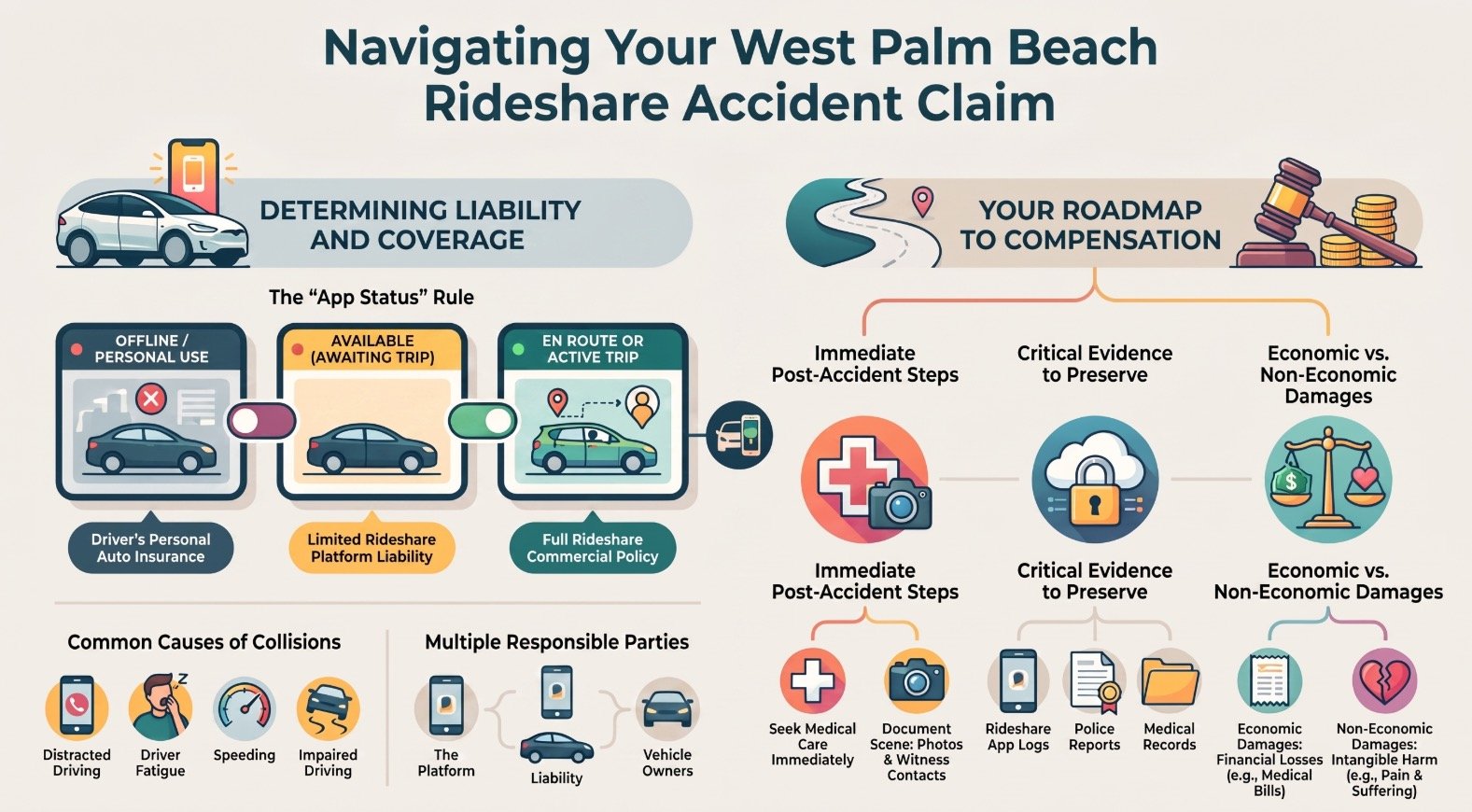
- Coverage may depend on whether the rideshare driver was offline, awaiting a trip, en route, or transporting a passenger.
- Evidence can include crash reports, photographs, medical records, witness contacts, surveillance footage, and rideshare trip data.
- Potentially responsible parties may include the rideshare driver, other motorists, vehicle owners, transportation platforms, or maintenance providers.
- Seek prompt medical care and legal advice while preserving records, following treatment, and limiting communications with insurers.
How We Can Help With Your West Palm Beach Rideshare Accident Injury Claim
After a rideshare accident in West Palm Beach, an injured passenger, driver, pedestrian, or other affected party may face complicated insurance issues and significant financial losses. A qualified legal team can evaluate available coverage, identify responsible parties, and communicate with insurers on the claimant’s behalf. This assistance helps protect individuals from premature settlements or statements that could weaken a valid claim.
Counsel can explain Insurance claim timelines, including reporting deadlines, documentation requirements, and the potential effects of delayed notice. The team may also organize medical records, wage information, repair estimates, and other materials needed to accurately demonstrate losses. Evidence preservation steps can include securing photographs, vehicle data, surveillance footage, witness contact information, and rideshare app records before they disappear or become difficult to obtain.
Understanding West Palm Beach Rideshare Accident Injury Cases
Understanding a West Palm Beach rideshare accident injury case requires examining the driver’s status, the passenger’s circumstances, and the insurance coverage available when the collision occurred. Coverage may differ depending on whether the driver was offline, available for a request, traveling to pick up a passenger, or transporting someone. The injured person’s role also matters, including whether they were a passenger, another motorist, cyclist, or pedestrian. Liability evidence can include medical records, vehicle damage documentation, witness accounts, trip information, and applicable policy terms. Medical expenses may include emergency treatment, rehabilitation, prescriptions, and anticipated future care.
Lost income, reduced earning capacity, and other legally recognized losses may also affect the claim’s value. A careful evaluation helps identify responsible parties and applicable coverage without making premature assumptions. Counsel can then develop a settlement strategy based on documented injuries, liability evidence, policy limits, and long-term needs while communicating respectfully with everyone affected.
Common Causes of West Palm Beach Rideshare Accidents
Rideshare accidents in West Palm Beach may result from distracted driving, speeding, reckless maneuvers, or other unsafe decisions behind the wheel. Impaired driving can further compromise a driver’s judgment, coordination, and reaction time. Driver fatigue is also a significant concern, particularly when extended driving hours reduce alertness and increase the likelihood of collisions.
Distracted Driving
Distracted driving is a significant cause of rideshare accidents in West Palm Beach, where drivers may divide their attention among navigation applications, passenger requests, phone notifications, and surrounding traffic. Cell phone use can draw a driver’s eyes from the roadway and hands from the steering wheel, even when a trip-related message appears urgent. Distracted passengers may also interrupt a driver by requesting route changes, adjusting climate controls, or engaging in demanding conversations. These divided-attention behaviors can delay recognition of pedestrians, cyclists, traffic signals, and vehicles entering an intersection.
Rideshare companies and drivers have a responsibility to promote safe transportation by limiting nonessential interactions while a vehicle is moving. Passengers can assist by allowing navigation systems to operate without interference and by reporting concerning conduct through appropriate company channels. Injured individuals may require prompt legal guidance.
Speeding And Reckless Driving
When drivers exceed posted speed limits or operate vehicles recklessly, the risk of a serious West Palm Beach rideshare accident increases substantially. Speeding reduces reaction time, lengthens stopping distances, and intensifies the force of a collision. Rideshare passengers may face significant injuries when a driver travels too quickly for traffic, weather, construction, or roadway conditions.
Reckless conduct can include aggressive lane changes, tailgating, sudden passing, and failing to yield at intersections or pedestrian crossings. These actions can endanger passengers, motorists, cyclists, and pedestrians who reasonably rely on predictable traffic behavior. Drivers providing transportation services have a responsibility to protect those entrusted to them by following speed limits and maintaining appropriate control. After a crash, evidence such as vehicle data, traffic-camera footage, witness accounts, and app records may help establish whether excessive speed or unsafe maneuvering contributed to the accident.
Impaired Driving
Alcohol, cannabis, prescription medications, and other impairing substances can materially compromise a rideshare driver’s judgment, coordination, reaction time, and ability to respond to changing traffic conditions. Impairment may cause unsafe lane changes, delayed braking, poor speed control, or failure to recognize pedestrians and other motorists. Because rideshare drivers transport members of the public, their conduct can place passengers, surrounding drivers, and pedestrians at significant risk. Evidence may include witness statements, police observations, toxicology reports, receipts, or admissions concerning substance use. Law enforcement may conduct alcohol testing and evaluate blood alcohol levels when alcohol is suspected.
Drug impairment can be more difficult to establish, particularly when prescription medications are involved, but documented warnings and observable conduct may remain relevant. Injured individuals should preserve records and seek informed legal guidance regarding potential claims.
Driver Fatigue
Driver fatigue is a major safety concern in rideshare transportation, especially when drivers work extended hours, accept late-night trips, or drive without adequate rest. Fatigue can impair reaction time, judgment, attention, and the ability to recognize changing roadway conditions. These effects can become more dangerous during periods of limited nighttime visibility, when pedestrians, cyclists, and vehicles are harder to identify. Traffic congestion may further increase exhaustion because prolonged stop-and-go driving demands constant concentration and can extend a driver’s working period. Rideshare companies and drivers have a responsibility to place passenger and public safety above earnings or scheduling pressures. A fatigued driver who causes a collision may face legal consequences, while injured passengers and others may require medical care, documentation, and informed guidance regarding available remedies.
Legal Rights of West Palm Beach Rideshare Accident Injury Victims
Rideshare accident injury victims in West Palm Beach may have legal rights to pursue compensation for medical expenses, lost income, property damage, and pain and suffering. These rights can depend on fault, injury severity, available insurance, and compliance with Florida’s procedural requirements. Understanding Florida traffic laws and insurance coverage basics can help victims evaluate potential claims and protect their interests.
Rideshare accident victims may pursue compensation for medical expenses, lost income, property damage, and pain and suffering.
 Victims may seek compensation from responsible drivers, rideshare companies, or applicable insurers, depending on the driver’s status during the collision.
- They have the right to document injuries, obtain medical care, preserve evidence, and communicate with insurers without providing unnecessary statements.
- A victim may consult a qualified attorney to assess liability, identify coverage, calculate damages, and negotiate a fair resolution.
- Florida deadlines can restrict the time available to file a lawsuit, making prompt legal evaluation important.
Serving others includes helping injured people understand these protections, avoid preventable mistakes, and pursue accountability through lawful channels. Each claim requires careful review of its specific facts and available evidence.
Why Do West Palm Beach Rideshare Accident Injuries Happen?
Why do rideshare accident injuries occur in West Palm Beach? Several factors contribute, including congested roads, tourist traffic, unfamiliar drivers, and frequent stops near airports, hotels, and entertainment districts. Rideshare drivers may also experience pressure to accept trips quickly, meet platform demands, or continue working while fatigued. Distraction from navigation applications, passenger communications, and changing pickup locations can further reduce attention.
Injuries may become more complicated because multiple parties can share responsibility, including a rideshare driver, another motorist, a vehicle owner, or the transportation platform. Rideshare policy differences can affect available insurance coverage depending on whether the driver was offline, awaiting a request, traveling to a passenger, or carrying a passenger. These distinctions often require careful review of trip records and collision facts.
Financial recovery can also vary according to medical expenses, lost income, long-term needs, and legal fee structures. Understanding these causes helps injured people receive informed, compassionate support while promoting accountability and safer transportation practices throughout West Palm Beach.
What Should You Do After a West Palm Beach Rideshare Accident Injury?
After a West Palm Beach rideshare accident injury, the injured person should seek immediate medical care, even if symptoms initially appear minor. Document accident details, medical records, witness information, and photographs carefully to support any potential claim. Contacting a rideshare lawyer can help clarify insurance coverage, preserve evidence, and protect the injured person’s legal interests.
Seek Immediate Medical Care
Prompt medical care should be a priority for anyone injured in a West Palm Beach rideshare accident, even when symptoms initially appear minor. A medical evaluation can identify concussions, internal injuries, or soft-tissue damage that may worsen without treatment. The injured person should follow the provider’s recommendations, attend follow-up appointments, and promptly report new or intensifying symptoms. Those actions support recovery while creating a clear medical account of the accident’s effects. The patient should preserve medical records, including examination notes, diagnostic results, prescriptions, discharge instructions, and billing statements. If symptoms develop after an initial evaluation, additional care remains important and should not be delayed for convenience.
Relatives, caregivers, and other responsible individuals can help arrange transportation and support compliance with treatment, particularly when pain or impairment limits independent decision-making.
Document The Accident
Start accurate documentation as soon as the injured person can safely do so, because details may become difficult to recall and available evidence can change. Record the vehicle scene before vehicles move, if safety conditions permit. Photo evidence may include vehicle positions, road conditions, traffic signals, visible injuries, property damage, and relevant surroundings. The injured person should obtain witness contact information, including names and telephone numbers, without pressuring anyone to provide statements. Also preserve ride details, driver information, rideshare app records, and medical transport information. Keep insurance communication factual and limited to necessary reporting details. Written notes should identify the date, time, location, weather, and sequence of events. Copies of reports, receipts, and electronic records should be securely retained for future reference.
Contact A Rideshare Lawyer
When should an injured rideshare passenger or another accident victim contact a lawyer? Legal guidance may be appropriate soon after medical care begins, particularly when injuries are serious, treatment will continue, or responsibility is unclear. A rideshare attorney can preserve evidence, identify applicable insurance policies, and communicate with insurers while the injured person focuses on recovery and supporting loved ones.
Early consultation is especially important after an Insurance claim denial or a fault determination dispute. Rideshare cases may involve the driver, transportation company, personal auto coverage, commercial policies, and other potentially responsible parties. A lawyer can evaluate changing coverage, request records, interview witnesses, and assess whether a settlement reflects documented losses. Prompt assistance also helps protect filing deadlines and prevents statements or agreements from unintentionally limiting the victim’s legal rights and ability to pursue other claims.
Critical Evidence in a West Palm Beach Rideshare Accident Injury Case
A strong West Palm Beach rideshare accident injury case depends on timely collection and preservation of evidence that establishes liability, the collision’s circumstances, and resulting harm. Important records may come from the rideshare platform, investigating officers, medical providers, witnesses, and available video sources.
The following evidence categories can help clarify the claim:
 Rideshare app records
- Police accident reports
- Medical treatment documentation
- Witness statements and footage
Rideshare App Records
Rideshare app records can provide crucial evidence in a West Palm Beach rideshare accident injury case by documenting the trip’s timing, route, driver activity, and passenger status. These records may show when a driver accepted a request, arrived, began transporting a passenger, and completed or canceled the trip. They can also help establish whether the driver was logged into the platform, which may affect applicable coverage and responsibility. Preserving driver logs, digital receipts, in-app messages, and location data can help evaluate the sequence of events and identify relevant witnesses. Because platforms may retain information for limited periods, prompt legal action can help prevent loss of crucial material. This documentation may support insurance claims by clarifying trip status, vehicle use, and the parties involved. It also helps attorneys serve injured people with accurate, evidence-based guidance.
Police Accident Reports
Police accident reports provide an independent account of a West Palm Beach rideshare collision and may support claims involving passengers, drivers, pedestrians, and other motorists. Officers may document roadway conditions, vehicle positions, visible damage, witness statements, citations, and each person’s description of events. These details can clarify right-of-way issues, lane changes, speeding allegations, and Traffic signal disputes. The report may also identify the rideshare company, driver, passenger status, and insurance information available at the scene.
Although an officer’s conclusions are not conclusive, inconsistencies or omissions can guide further investigation and help establish responsibility. Investigators may compare the report with app safety settings, electronic trip information, photographs, surveillance footage, and witness accounts. Promptly obtaining the report and preserving related evidence allows legal representatives to serve injured people effectively while evaluating potential claims.
Medical Treatment Documentation
Medical treatment documentation provides essential evidence of the injuries sustained in a West Palm Beach rideshare accident and the care required afterward. Emergency records, diagnostic imaging, physician evaluations, prescriptions, and therapy notes can establish the nature, severity, and progression of physical harm. Consistent documentation also helps link symptoms to the collision and shows whether patients followed recommended treatment. These records may clarify limitations affecting work, household responsibilities, and daily activities, allowing a legal representative to evaluate appropriate compensation. Ride-share safety features and driver background checks may concern broader liability issues, but medical evidence directly addresses injury consequences. Organized records help attorneys, insurers, and courts serve injured people fairly and efficiently.
Witness Statements and Footage
When available, witness statements and video footage can provide objective evidence of how a West Palm Beach rideshare accident occurred and who may bear responsibility. Collect statements promptly while recollections remain fresh, and record each person’s location, observations, and contact information. Investigators may review Surveillance Cameras from businesses, residences, traffic intersections, or rideshare vehicles, subject to preservation and access requirements. Video Timestamping can help establish the sequence of events, vehicle speeds, traffic signals, and conditions before impact. Witness Credibility may depend on visibility, distance, attention, potential bias, and the ability to explain observations accurately.
Statement Consistency between witnesses, physical evidence, medical records, and digital data can strengthen reliability. Preserving original files and documenting how evidence was obtained helps protect its value for injured people seeking fair treatment and accountability.
Long-Term Effects of West Palm Beach Rideshare Accident Injuries
Rideshare accident injuries may result in chronic pain, reduced mobility, and long-term disability that affect a person’s ability to work and manage daily activities. Emotional and psychological effects, including anxiety, depression, and trauma-related symptoms, may also continue after physical wounds recover. These lasting conditions can create ongoing medical, rehabilitation, and financial needs that require careful evaluation.
Chronic Pain And Disability
Chronic pain and disability can develop after a West Palm Beach rideshare accident, even when initial injuries appear manageable. Persistent spinal, joint, or nerve damage may restrict mobility, employment, and daily responsibilities. Medical evaluations, treatment records, rehabilitation plans, and vocational assessments can document how limitations progress and affect a person’s ability to serve family, coworkers, and community. A rideshare accident lawyer may examine evidentiary footage, driver conduct, vehicle maintenance, and insurance coverage when identifying responsible parties. These records can also influence settlement value by demonstrating future medical expenses, lost earning capacity, adaptive equipment needs, and ongoing personal assistance.
Wrongful death claims differ from disability claims, but serious injuries can still impose substantial long-term costs. Timely legal guidance helps preserve evidence and supports a fair recovery for necessary care and continuing limitations.
Emotional And Psychological Effects
Emotional and psychological effects may persist long after physical injuries from a West Palm Beach rideshare accident have stabilized. Survivors may experience anxiety, depression, sleep disruption, irritability, or difficulty trusting vehicles and unfamiliar drivers. Some develop PTSD Symptoms, including intrusive memories, heightened alertness, emotional numbness, and distress when encountering places or situations associated with the collision. These reactions can interfere with relationships, employment, and ordinary responsibilities, even when outward recovery appears complete. Trauma Counseling may help individuals process the event, develop coping strategies, and regain a sense of safety. Support from compassionate family members, advocates, and qualified mental health professionals can also reduce isolation and encourage recovery.
Recognizing these effects allows others to respond with patience, respect, and appropriate assistance rather than dismissing distress that may not be physically visible.
Ongoing Medical And Financial Needs
Long-term injuries from a West Palm Beach rideshare accident may create continuing medical and financial needs that extend well beyond the initial recovery period. Survivors may require surgeries, rehabilitation, medication, mobility equipment, counseling, or in-home assistance. These costs can continue while injuries limit work capacity, reduce earning potential, and increase household responsibilities. A careful assessment should account for anticipated treatment, permanent limitations, lost income, and necessary support services. Families facing a fatality may pursue a Wrongful death claim addressing funeral expenses, financial support, and loss of companionship.
Punitive damages may be available when particularly reckless or intentional conduct warrants additional punishment, although eligibility depends on the facts. Because proof standards differ among claims, records, medical opinions, employment evidence, and other documentation can help establish damages and future needs.
Legal Term Defined
What Is Rideshare (TNC) Insurance Coverage in Florida?
Florida’s Transportation Network Company (TNC) law (Fla. Stat. §627.748) requires rideshare companies like Uber and Lyft to maintain coverage that changes based on the driver’s app status at the moment of a crash. Phase 1 (app off): Only the driver’s personal auto policy applies. Phase 2 (app on, waiting for a ride request): The TNC must provide at least $50,000 per person / $100,000 per incident bodily injury liability and $25,000 property damage, plus applicable PIP. Phase 3 (en route to pick up or actively transporting a passenger): The TNC must provide $1,000,000 in third-party liability coverage plus uninsured/underinsured motorist coverage. Determining which phase applied at the exact moment of a West Palm Beach rideshare crash is often the single most important issue in the case, because the difference between Phase 2 and Phase 3 can be nearly $950,000 in available coverage. Florida HB 837 (2023) also applies to every rideshare claim, meaning the injured person must be less than 51% at fault to recover anything.
Proving Liability in West Palm Beach Rideshare Accident Injury Cases
When a rideshare passenger is injured, proving liability requires establishing how the collision occurred and which parties owed legal duties at the time. Evidence may include crash reports, witness statements, photographs, surveillance footage, and available electronic trip records. Investigators assess whether the rideshare driver violated traffic laws, drove while distracted, or failed to respond reasonably to roadway conditions. Negligent maintenance may also create responsibility when worn tires, defective brakes, or other mechanical failures contributed to the crash. Vehicle inspections, repair histories, and service records can help determine whether a dangerous condition should have been discovered or corrected. In some cases, another motorist, a maintenance provider, or a vehicle owner may share fault.
Documentation of injuries, treatment, lost income, and property damage helps connect the collision to the claimed losses. A careful liability analysis identifies each responsible party and preserves evidence needed to serve the injured person’s interests fairly and effectively. Witness cooperation and timely legal review can prevent essential facts from disappearing.
Event Data Recorder and Rideshare App Data in West Palm Beach Rideshare Cases
Rideshare cases involve two distinct sources of electronic evidence. First, most vehicles built after 2012 have an Event Data Recorder (EDR) that captures speed, braking, throttle, steering input, and seat-belt status in the seconds before and during a crash. According to NHTSA, this data can confirm or contradict what a driver claims happened.
Second, and equally important, is the rideshare app data itself. Uber and Lyft servers hold precise timestamps, GPS logs, driver-app-status records (offline, available, en route, on-trip), passenger pickup and drop-off times, and route data. This app data is the single most decisive evidence for determining which insurance phase applied at the moment of the crash, which controls whether $50,000 or $1,000,000 in liability coverage is available. Both EDR and app data can be lost or overwritten within days if not preserved through proper legal spoliation letters. Our firm sends preservation demands to the driver, Uber or Lyft, and any at-fault third party immediately upon being retained.
Dealing With Insurance Companies After a West Palm Beach Rideshare Accident Injury
After liability evidence has been identified, insurance communications become a significant part of protecting a rideshare accident injury claim. Injured individuals should provide insurers with accurate, limited information and avoid recorded statements, settlement discussions, or authorizations that could unnecessarily broaden access to private medical records. A representative can help preserve the claim’s value while communicating respectfully with adjusters and seeking fair treatment.
Rideshare claims may involve the driver’s personal carrier, the rideshare company’s insurer, or other applicable coverage, depending on the driver’s status and policy terms. Relevant materials should be organized, including medical records, bills, wage documentation, photographs, Surveillance footage, witness information, and App GPS logs showing the trip’s timing and location. Prompt notice may be required, but early contact does not require an injured person to accept an insurer’s position. Review all correspondence carefully, and correct inconsistent explanations with documented facts. This disciplined approach helps protect available benefits and supports informed decisions throughout recovery.
What to Expect During a West Palm Beach Rideshare Accident Injury Claim Process
A rideshare accident injury claim typically begins with an initial case evaluation to assess liability, damages, and applicable legal issues. The process may then include investigating insurance coverage and collecting medical evidence that documents the injuries and related losses. Based on the evidence and the insurer’s response, the injured party may consider settlement or proceed with litigation.
Initial Case Evaluation
How does the initial case evaluation shape a West Palm Beach rideshare accident injury claim? It establishes the facts, identifies immediate needs, and determines which legal issues require careful attention. A legal professional may review the collision date, location, involved vehicles, driver activity, reported injuries, medical treatment, and available witness information. This discussion also helps clarify the client’s goals while setting realistic expectations about documentation, communication, and potential timelines.
Early guidance can protect a person from avoidable mistakes, including premature statements or incomplete records. Counsel may recommend evidence-preservation steps, such as securing photographs, medical records, repair estimates, app information, and communications related to the ride. An Insurance coverage investigation may follow as a separate phase, examining applicable policies and responsibilities. The evaluation provides an organized foundation for serving the injured person effectively throughout the claim.
Insurance Coverage Investigation
When a rideshare accident involves multiple potential insurers, the coverage investigation determines which policies may apply and in what order. The process typically examines the rideshare company’s policy, the driver’s personal automobile coverage, and any applicable coverage maintained by other involved motorists. Investigators review the driver’s app status, trip records, vehicle ownership, and driver employment status to identify the relevant coverage period. They may also request police reports, dispatch information, electronic records, and surveillance footage from nearby businesses or traffic systems. Insurers often assess whether the driver was waiting for a request, traveling to a passenger, or actively transporting one, because each stage may trigger different policy limits. A careful investigation helps prevent premature denials and directs communications to the responsible carriers.
Coverage findings also guide negotiations and claim strategy.
Medical Evidence Collection
Medical evidence collection establishes the nature, extent, and likely duration of injuries sustained in a rideshare collision. After receiving appropriate care, the injured person should preserve emergency records, diagnostic images, physician notes, prescriptions, and invoices. Follow-up evaluations can document continuing symptoms, treatment progress, work restrictions, and anticipated medical needs. Consistent communication with providers helps create an accurate record and prevents gaps that may complicate an injury claim.
The claim review may also require evidence connecting injuries to the crash. Ambulance reports, hospital records, and statements about pain or functional limitations can provide that context. Photographs of visible injuries and a symptom journal may further support medical documentation. Although buckle up safety information and vehicle maintenance logs concern crash circumstances, they may help clarify contributing conditions when collected through appropriate channels. A lawyer can organize these materials while protecting confidential health information and ensuring providers receive necessary authorization.
Settlement Or Litigation Decisions
After organizing the medical record, the injured person generally must decide whether to pursue a negotiated settlement or prepare the claim for litigation. Counsel may evaluate liability evidence, medical prognosis, wage losses, and available insurance before recommending either path. Insurance coverage gaps can affect recovery, particularly when rideshare policies, personal coverage, and other applicable policies overlap or leave disputed responsibility. A settlement may provide a faster, more predictable resolution, but its terms should account for future treatment and unresolved damages.
Litigation can create leverage and permit formal discovery, although it requires time, preparation, and acceptance of greater uncertainty. Trial strategy planning may include identifying witnesses, preserving digital records, consulting medical professionals, and addressing comparative fault arguments. Throughout the process, informed decisions should protect the injured person’s interests while supporting a fair outcome.
Compensation for West Palm Beach Rideshare Accident Injury Damages
Compensation for West Palm Beach rideshare accident injuries may cover the full range of losses caused by another party’s negligence, including medical expenses, lost income, reduced earning capacity, and pain and suffering. Your recovery depends on the facts, the severity of your injuries, and the responsibility of the driver, rideshare company, vehicle owner, or another involved party.
Strong liability evidence can include crash reports, witness statements, photographs, traffic-camera footage, vehicle data, and rideshare application records. This documentation may help establish how the collision occurred and identify applicable insurance coverage. In rideshare claims, coverage can vary according to whether the driver was offline, waiting for a request, traveling to pick up a passenger, or transporting one.
A careful evaluation should consider ongoing treatment, rehabilitation needs, work limitations, and how injuries affect daily responsibilities. Counsel may communicate with insurers, preserve relevant records, and pursue a resolution that supports the injured person’s recovery while holding negligent parties accountable. Timely legal guidance can protect critical evidence and claim rights.
Economic vs Non-Economic Damages in West Palm Beach Rideshare Accident Cases
Economic damages may cover medical expenses, lost wages, property damage, and other verifiable financial losses resulting from a rideshare accident. Non-economic damages address less tangible harm, including pain and suffering, emotional distress, and diminished quality of life. Calculating total compensation requires evaluating both categories and measuring the evidence supporting each claimed loss.
Economic Damages
When a rideshare accident causes financial losses, economic damages may provide compensation for the measurable costs resulting from the collision. These damages can include emergency treatment, hospital bills, medication, rehabilitation, and anticipated medical care. They may also cover wages lost during recovery, reduced future earning capacity, vehicle repairs, replacement transportation, and other documented out-of-pocket expenses. Records such as invoices, pay statements, repair estimates, and medical reports help establish the amount requested. In West Palm Beach cases, responsibility may involve the rideshare driver, another motorist, or an insurance provider, depending on the circumstances and applicable coverage. An attorney can provide an assumption-free liability assessment and a clear case timeline, helping affected individuals understand evidence requirements, insurance communications, and potential recovery without promising outcomes or overlooking disputed liability issues.
Non-Economic Damages
Beyond documented financial losses, a rideshare accident may produce non-financial damages that address the personal effects of an injury. These damages can reflect physical pain, emotional distress, mental anguish, diminished enjoyment of life, disfigurement, and inconvenience associated with recovery. Unlike medical bills or lost wages, they lack a fixed receipt or uniform market value. Their evaluation may consider the injury’s severity, treatment demands, duration, and effect on daily relationships and responsibilities. During settlement negotiation, an injured person may present medical records, testimony, and personal accounts to support negotiating compensation for these consequences. Insurance disputes can arise when carriers question the seriousness of symptoms or attempt to limit policy coverage.
Careful documentation and clear advocacy help ensure that the claimant’s experience receives appropriate consideration without confusing non-economic harm with documented financial losses or total compensation calculations.
Calculating Total Compensation
In a West Palm Beach rideshare accident case, total compensation generally combines economic and non-economic damages to reflect both measurable losses and the injury’s broader effects. Economic damages may include emergency treatment, rehabilitation, medication, future medical care, lost income, reduced earning capacity, and property damage. Medical documentation and billing verification help establish the amount and necessity of these losses. Non-economic damages address pain, emotional distress, inconvenience, disfigurement, disability, and diminished enjoyment of life. Their value depends on injury severity, recovery duration, permanence, and daily limitations. Accurate valuation also requires app evidence preservation to clarify trip status, vehicle involvement, and potentially applicable insurance coverage.
Witness identification can support liability findings and document changing symptoms or functional restrictions. A careful assessment enables injured people and their families to pursue fair compensation while serving their long-term interests.
When a West Palm Beach Rideshare Accident Injury Case Goes to Trial vs Settlement
A West Palm Beach rideshare accident injury case may resolve through settlement or proceed to trial, depending on the strength of the evidence, the parties’ willingness to negotiate, and the extent of the injured person’s damages. A settlement can provide compensation sooner, reduce uncertainty, and spare an injured person from testimony and cross-examination. Effective settlement negotiation strategy typically relies on organized medical records, documented losses, witness accounts, and a clear presentation of future needs.
Trial may become necessary when insurers dispute responsibility, question the severity of injuries, or refuse to offer fair compensation. The injured person’s legal team must then present admissible evidence, examine witnesses, and explain how the incident affected daily life, work, and long-term wellbeing. App-based evidence preservation can help protect trip records, driver activity, location data, and communications before information disappears. Whether pursuing resolution or trial, counsel serves the injured person by preparing thoroughly, communicating clearly, and pursuing an outcome supported by the evidence.
Florida Laws That May Affect Your West Palm Beach Rideshare Accident Case
Florida law can materially affect a West Palm Beach rideshare accident case by determining liability, insurance coverage, filing deadlines, and the damages an injured person may recover.
Several legal principles help clarify how claims should be evaluated:
- Florida negligence generally requires proof that a party owed a duty, breached it, and caused compensable harm. Evidence may include traffic records, medical documentation, and witness accounts.
- Comparative fault can reduce compensation when an injured person contributed to the accident. A careful investigation helps assign responsibility fairly among drivers, passengers, companies, and other parties.
- Rideshare liability may depend on the driver’s status, including whether a passenger was present, the driver accepted a trip, or the driver was awaiting a request. Available insurance can change accordingly.
- Vicarious responsibility may apply when an employer or business is legally accountable for conduct performed within an employment relationship. Independent-contractor classifications can complicate that analysis.
These rules support informed advocacy and help injured people pursue appropriate assistance while protecting their families and communities.
West Palm Beach Rideshare Accident Claims: What the Numbers Reveal About Uber and Lyft Crash Victims in Palm Beach County
The scale of rideshare use and rideshare-related crash risk in West Palm Beach and greater Palm Beach County has grown sharply as Uber and Lyft trip volumes surged post-2020. According to FLHSMV 2022 Florida Traffic Crash Facts, Florida recorded 401,523 total crashes, 3,535 fatalities, and more than 253,888 injuries in a single year, with statewide economic losses exceeding $19.4 billion. Palm Beach County, which includes West Palm Beach, Boca Raton, Boynton Beach, Delray Beach, and Wellington, generates an estimated 25,000 to 30,000 crashes annually, with a rising share involving Transportation Network Company (TNC) vehicles driven by Uber and Lyft drivers along I-95, Okeechobee Boulevard, and US-1. NHTSA reported 3,308 distraction-related fatalities nationally in 2022, with in-app navigation and next-ride prompts contributing to rideshare-driver distraction risk.
Florida HB 837, effective March 24, 2023, fundamentally reshaped every West Palm Beach rideshare accident claim. The law cut the statute of limitations from 4 years to 2 years for most negligence claims, and replaced pure comparative fault with a modified system: if an injured person is found 51% or more at fault, they recover nothing. In rideshare cases, insurance carriers also aggressively dispute which coverage phase applied, hoping to shift a Phase 3 claim (with $1M in coverage) into a Phase 2 claim (with only $50K per person) or into a Phase 1 claim relying solely on the driver’s personal auto policy.
Rideshare-specific evidence, including Uber or Lyft trip logs, driver-app-status timestamps, EDR data from the at-fault vehicle, surveillance footage, and passenger receipts, degrades within 24 to 72 hours. TNC servers may not preserve detailed records indefinitely without a spoliation letter, and the at-fault vehicle’s EDR can be overwritten by the next ignition cycle. Immediate legal action and multi-directional evidence preservation are the foundation of every successful West Palm Beach rideshare accident claim.
Florida PIP Coverage and West Palm Beach Rideshare Accident Claims
Florida’s Personal Injury Protection (PIP) law requires most motor vehicle owners to carry at least $10,000 in no-fault coverage that pays 80 percent of medical bills and 60 percent of lost wages after a crash, regardless of fault. In a rideshare context, PIP coverage can come from the injured passenger’s own auto policy (if they own a vehicle), a household member’s policy, or in some cases from Uber’s or Lyft’s contingent PIP. To activate PIP, treatment must begin within 14 days of the crash.
However, PIP has important limits. It covers only $10,000 in total benefits and does not compensate for pain and suffering. To sue the at-fault party for full damages, Florida law requires that your injury meet the serious injury threshold: a permanent injury, significant and permanent scarring or disfigurement, or death. In West Palm Beach rideshare cases, coordinating PIP, health insurance, the driver’s personal auto policy, and the applicable TNC coverage phase can be complex. Our attorneys can identify every available coverage source and pursue the maximum recovery.
The Statute of Limitations for West Palm Beach Rideshare Accident Injury Cases
Timely action is another factor that can determine whether a West Palm Beach rideshare accident claim may proceed. Florida law establishes deadlines, known as statutes of limitations, for filing injury and wrongful death lawsuits. Missing the applicable deadline can result in dismissal, even when the evidence strongly supports the injured person’s position.
The specific period may depend on the claim’s nature, the parties involved, the date of the crash, and whether a government entity is implicated. Limited exceptions can alter when the filing period begins or pauses, but they should not be assumed. Early attention allows time to identify responsible parties, preserve Insurance documentation, and obtain medical records that connect injuries to the collision.
A claimant should also recognize that insurance notice requirements and lawsuit deadlines are separate obligations. Promptly documenting treatment, expenses, lost income, and communications can help preserve an accurate account. Because deadlines may shift with changing circumstances, obtain reliable legal information before the limitations period approaches.
How a West Palm Beach Rideshare Accident Lawyer Can Help You
When a rideshare collision causes injuries, legal counsel can help identify the potentially responsible parties, evaluate applicable insurance coverage, and preserve evidence needed to support the claim. A West Palm Beach rideshare accident lawyer can coordinate with medical providers, insurers, witnesses, and investigators while protecting the injured person’s interests.
- Investigating liability: Counsel may examine driver conduct, vehicle maintenance, roadway conditions, and rideshare records to determine how the collision occurred.
- Analyzing Insurance Coverage: The lawyer can review personal policies, rideshare policies, and available commercial coverage to clarify which benefits may apply.
- Documenting damages: Medical bills, lost earnings, rehabilitation needs, and continuing limitations can be organized into a complete claim supported by reliable evidence.
- Developing Legal Strategy: Counsel can assess settlement proposals, communicate with opposing parties, and pursue appropriate legal remedies when compensation does not reflect the person’s losses.
This assistance allows injured people and their families to focus on recovery while a qualified advocate addresses intricate legal and insurance matters with disciplined attention.
When to Contact a West Palm Beach Rideshare Accident Lawyer
Contacting a West Palm Beach rideshare accident lawyer soon after a collision can help protect evidence, preserve insurance rights, and prevent avoidable delays in pursuing compensation. Early guidance may be appropriate when injuries require medical treatment, symptoms worsen, or the full extent of harm remains uncertain. You can also contact a lawyer if the rideshare company, driver, or insurer requests a recorded statement, offers a settlement, or disputes responsibility.
Prompt consultation is particularly important when multiple vehicles, passengers, pedestrians, or delivery services were involved. Parking lot collisions may appear minor, yet they can produce significant injuries and complicated questions about vehicle movement, property ownership, and available coverage. Fatigue red flags, such as prolonged driving, missed breaks, or erratic conduct, may also warrant immediate legal review if they contributed to the crash.
A consultation can help preserve photographs, medical records, witness information, app data, and surveillance footage. Avoid signing releases or accepting payment before understanding potential claims, deadlines, and responsibilities.
Why You Need an Experienced West Palm Beach Rideshare Accident Lawyer
An experienced West Palm Beach rideshare accident lawyer can evaluate the collision, identify the responsible parties, and determine which insurance policies may apply. Rideshare claims often involve the driver, transportation network company, other motorists, and insurers with differing coverage positions. Experienced counsel can preserve evidence, including application records, vehicle data, photographs, medical documentation, and communications that may clarify how the crash occurred.
Legal knowledge also helps address witness credibility. A lawyer can compare statements with physical evidence, spot inconsistencies, and present reliable testimony clearly and logically. The lawyer can further investigate app liability by determining whether the driver was offline, available for a trip, en route to a passenger, or transporting that passenger when the collision occurred. Each status may affect available coverage and responsibility.
How to Choose the Right Florida Personal Injury Lawyer for Your Case
Start by carefully reviewing the lawyer’s relevant experience, case history, and ability to handle the specific type of injury, insurance dispute, or liability question in your claim. A suitable attorney should demonstrate organized case preparation, sound judgment, and a genuine commitment to protecting the client’s well-being while pursuing fair compensation. Ask specifically about their experience with Florida’s HB 837 comparative fault rules and how they approach fault disputes with insurers. Also ask about Board Certification in Civil Trial and an AV Preeminent rating from Martindale-Hubbell, independent credentials that confirm the highest levels of professional excellence and courtroom readiness.
Client communication is another essential measure. The lawyer should explain options clearly, provide timely updates, and answer questions with honesty and respect. This approach helps injured people make informed decisions during a difficult period without feeling pressured or confused about what is happening with their case. Potential clients should also review fee agreements carefully before signing anything, understanding contingency arrangements, potential expenses, and how costs may affect the net recovery. By evaluating experience, communication, availability, and fee structure, an injured person can select counsel prepared to serve their interests with diligence, integrity, and professional care throughout the full life of the claim.
About The Law Offices of Anidjar & Levine
Founded in 2005 by Marc Anidjar and Glen Levine, the firm began as a two-person operation working out of a construction office conference room. Over the past 20 years, that modest start has grown into one of Florida’s most recognized personal injury practices, with more than $1 billion recovered in settlements for injury clients across the state. We bring that same determination and depth of experience to every West Palm Beach rideshare accident case we handle.
The Law Offices of Anidjar & Levine represents individuals injured in rideshare collisions and other motor vehicle accidents throughout Florida. Its attorneys assess each matter carefully, explaining available legal options and potential sources of compensation. This approach allows injured clients and their families to make informed decisions while focusing on medical recovery.
Rideshare claims may involve drivers, transportation companies, insurers, and differing coverage policies. The firm addresses these complications through systematic Evidence Collection, including crash reports, medical records, application data, witness statements, and available video footage. This information can support Establishing Liability and clarify how negligence contributed to the collision.
The Law Offices of Anidjar & Levine also evaluates damages such as treatment expenses, lost income, diminished earning capacity, and ongoing care needs. Its legal team communicates with insurance representatives and opposing parties on a client’s behalf, seeking fair treatment throughout the process. Prospective clients may contact the firm to discuss their circumstances and learn whether legal representation may serve their interests.
Marc Anidjar, Co-Founder & Personal Injury Attorney
Marc Anidjar co-founded the firm in 2005 and has spent two decades representing seriously injured people throughout Florida. He is Board Certified in Civil Trial Law by The Florida Bar, a distinction held by fewer than 3 percent of Florida attorneys, and holds an AV Preeminent rating from Martindale-Hubbell, the legal industry’s highest peer-review recognition for professional excellence and ethical standards.
Glen Levine, Co-Founder & Personal Injury Attorney
Glen Levine co-founded the firm alongside Marc Anidjar and has represented injury clients across Florida for more than 20 years. He holds an AV Preeminent rating from Martindale-Hubbell and is committed to clear communication, thorough case preparation, and protecting each client’s right to full and fair compensation after a serious injury.
Frequently Asked Questions
Can I Sue Uber or Lyft if I Was Injured as a Passenger?
An injured passenger may be able to sue Uber or Lyft, although responsibility depends on the crash’s circumstances, the driver’s status, and available insurance coverage. Evidence of Uber negligence or Lyft liability may support a claim, but the companies often argue that drivers are independent contractors. Their commercial policies may apply during a rideshare trip, while other coverage can govern different periods. A qualified attorney can evaluate evidence, deadlines, damages, and applicable insurance.
What Happens if My Rideshare Driver Was Uninsured?
If a rideshare driver was uninsured, an injured passenger may still pursue compensation through the rideshare company’s Uninsured coverage, depending on the driver’s status and the circumstances of the collision. Florida regulations generally require transportation network companies to maintain insurance that can apply when a driver’s personal policy does not respond. Coverage limits, policy exclusions, fault, and available medical evidence influence recovery. Reporting the crash promptly and getting legal guidance helps protect the passenger’s interests.
Are Rideshare Accidents Different When Transporting Children?
Rideshare accidents involving children may raise additional Child safety and liability considerations. Drivers must follow applicable restraint laws, use appropriate car seats when required, and exercise heightened care during pickup, transport, and drop-off. Liability may involve the driver, rideshare company, vehicle owner, or another negligent party, depending on insurance coverage and employment status. A careful investigation should document restraint use, supervision, injuries, and policy terms to protect the child’s interests.
Can I Recover Damages for Injuries Caused by a Rideshare Vehicle’s Defective Equipment?
A person may recover damages when a rideshare vehicle’s defective equipment causes injuries, provided evidence establishes that the defect contributed to the collision. Potentially responsible parties may include the vehicle owner, rideshare driver, manufacturer, distributor, or maintenance provider. Relevant proof can include inspection records, repair histories, photographs, expert analysis, and medical documentation. Compensation options may cover medical expenses, lost income, rehabilitation, pain, and future care, subject to applicable insurance coverage and filing deadlines.
Will a Rideshare Accident Affect My Immigration Status?
A rideshare accident generally does not affect a person’s immigration status solely because an injury claim is filed. However, Visa Impact and Immigration Consequences may arise from unrelated criminal conduct, misrepresentation, or immigration violations, so individualized legal advice is important. The injured person should pursue appropriate Legal Options and preserve medical records, reports, witness details, and other evidence. An attorney can coordinate injury representation while protecting confidentiality and identifying immigration concerns.
What is the statute of limitations for West Palm Beach rideshare accident cases?
Under Florida HB 837, effective March 24, 2023, most negligence-based rideshare accident claims must be filed within 2 years from the date of the crash. Missing this deadline permanently bars recovery, no matter how strong the underlying facts are.
Which insurance policy applies in a West Palm Beach Uber or Lyft accident?
Florida law (Fla. Stat. §627.748) requires TNCs to carry insurance in three phases. Phase 1 (app off): only the driver’s personal auto policy. Phase 2 (app on, no ride accepted): $50,000/$100,000 bodily injury and $25,000 property damage. Phase 3 (en route or transporting a passenger): $1,000,000 in third-party liability plus UM/UIM. The phase in effect at the exact moment of the crash controls which policy pays, which is why preserving Uber or Lyft app data is critical.
How does Florida HB 837 affect West Palm Beach rideshare accident cases?
Florida HB 837 (March 24, 2023) replaced pure comparative fault with modified comparative fault (51% bar) and reduced the statute of limitations from 4 years to 2 years. These changes, combined with the three-phase TNC insurance regime and aggressive phase-downgrade defenses, make early legal action and thorough evidence collection essential in every West Palm Beach rideshare accident claim.
West Palm Beach and Palm Beach County Local Resources
The following local resources may help injured people and their families in the days and weeks after a serious accident. If you are experiencing an emergency, call 911 first.
Hospitals and Emergency Care
- Good Samaritan Medical Center — 1309 N Flagler Dr, West Palm Beach, FL 33401 · 561-655-5511
- St. Mary’s Medical Center — Level I Trauma Center · 901 45th St, West Palm Beach, FL 33407 · 561-844-6300
- JFK Medical Center — 5301 S Congress Ave, Atlantis, FL 33462 · 561-965-3000
- Palm Beach Gardens Medical Center — 3360 Burns Rd, Palm Beach Gardens, FL 33410 · 561-622-1411
Police and Highway Patrol
- West Palm Beach Police Department — 600 Banyan Blvd, West Palm Beach, FL 33401 · Non-emergency: 561-822-1900
- Palm Beach County Sheriff’s Office — 3228 Gun Club Rd, West Palm Beach, FL 33406 · 561-688-3000
- Florida Highway Patrol — Troop L (West Palm Beach) · 561-357-4900
- Request a Florida Crash Report (FLHSMV)
Courts
- Fifteenth Judicial Circuit Court of Florida — Main Courthouse, 205 N Dixie Hwy, West Palm Beach, FL 33401 · 561-355-2996
- Palm Beach County Clerk of the Circuit Court · 561-355-2996
Mental Health and Crisis Support
- 988 Suicide & Crisis Lifeline — 24/7 free confidential support · 988
- 211 Palm Beach/Treasure Coast — 24/7 helpline · 211
- Jerome Golden Center for Behavioral Health — 1041 45th St, West Palm Beach, FL 33407 · 561-383-8000
- South County Mental Health Center — 16158 S Military Trail, Delray Beach, FL 33484 · 561-495-2330
Victim Services and Additional Support
- Palm Beach County Victim Services — 24-hour crisis line · 561-355-2418
- Florida Department of Health in Palm Beach County · 561-840-4500
- Florida Department of Financial Services — Consumer Insurance Help · 877-693-5236
Rideshare accident claims in West Palm Beach often involve serious injuries, complex three-phase TNC insurance coverage disputes, and aggressive defense by Uber, Lyft, and their carriers. A West Palm Beach Rideshare Accident Lawyer from The Law Offices of Anidjar & Levine can determine which insurance phase applied, identify every responsible party, preserve app data and EDR evidence, and pursue compensation for medical expenses, lost wages, and other damages. Prompt legal guidance can help protect an injured person’s rights and strengthen the claim. Those harmed in an Uber or Lyft crash in Palm Beach County should consider contacting an experienced attorney for a confidential case review.


Real Reviews From Our Clients!
“I was a passenger in an Uber that got T-boned on Okeechobee Boulevard. The insurance companies immediately started arguing over which policy applied. Anidjar & Levine got the trip data preserved within days, proved the driver was in Phase 3, and secured a settlement under the $1M policy that covered every medical bill and my lost income.”
— Rachel D., West Palm Beach
“My Lyft driver hit a stopped car on I-95 and I ended up with two herniated discs. Lyft’s insurer tried to say the driver had just gone offline. Anidjar & Levine got the app logs, proved otherwise, and made sure I did not sign anything that would have shortchanged my recovery.”
— Marcus J., Delray Beach
“After an Uber driver ran a red light and hit my car, I had no idea how to pursue the claim. Anidjar & Levine handled everything, dealt with the driver’s personal insurance and Uber’s policy, and got me a fair settlement. Professional, responsive, and truly on my side.”
— Yolanda P., Boynton Beach