

The Law Offices of Anidjar and Levine help individuals in Florida pursue Social Security disability benefits, workers’ compensation, insurance proceeds, and related financial recovery. A lawyer can evaluate medical eligibility, work credits, employment history, functional limitations, and applicable deadlines. Counsel may gather records, address inconsistencies, prepare persuasive statements, and challenge denials through reconsideration or further administrative review. For additional information about injury-related legal representation, visit our Florida Personal Injury Lawyer page. Because incomplete evidence and missed deadlines can jeopardize benefits, professional guidance may be valuable.
Main Takeaways
- A Florida Social Security lawyer can assess disability eligibility, work credits, insured status, and applicable benefit programs.
- Legal assistance helps gather medical records, employment evidence, symptom documentation, and functional-limitations statements supporting a claim.
- Lawyers can review denial notices, identify procedural or evidentiary errors, and develop reconsideration or appeal strategies.
- Strict filing deadlines should be tracked carefully to preserve Social Security, workers’ compensation, and insurance-related rights.
- Counsel can distinguish Social Security disability claims from workers’ compensation and injury matters while coordinating available benefits.


How We Can Help With Your Florida Social Security Benefits, Compensation & Process Injury Claim
An experienced Florida Social Security benefits and injury claim lawyer can help individuals understand eligibility requirements, gather supporting medical and employment records, meet filing deadlines, and pursue the compensation available under applicable law. For people committed to serving others, legal guidance can reduce administrative burdens and help them focus on recovery, family responsibilities, or community service.
Counsel can evaluate disability-related facts, identify inconsistencies in agency records, and explain how medical limitations affect eligibility. When Wrong Claim Denials occur, a lawyer can review notices, determine whether procedural or evidentiary errors contributed to them, and develop an organized Appeal Strategy. Representation may also include communicating with agencies, coordinating documentation from treating professionals, and preparing clear statements that accurately describe functional limitations.
A careful advocate preserves important deadlines and helps prevent avoidable mistakes that could weaken a claim. By providing informed guidance and disciplined preparation, legal counsel supports individuals seeking fair consideration while promoting an efficient, respectful process for resolving their benefits or injury claim.
OUR CONSULTATIONSARE FREE
START YOUR FREE CASE REVIEW

Understanding Florida Social Security Benefits, Compensation & Process Injury Cases
Understanding Florida Social Security benefits, compensation, and injury cases begins with distinguishing the legal standards, documentation requirements, and procedures that govern each type of claim. Social Security disability claims require evidence of a medically determinable condition that limits substantial work activity and is expected to last at least twelve months or result in death. Compensation claims may involve different statutory requirements, eligibility rules, and methods for calculating benefits. Injury-related matters require careful evaluation of medical records, functional limitations, employment information, and supporting testimony.
Claimants should understand that the Social Security Administration evaluates the complete record, not merely a diagnosis. Consistent treatment documentation and accurate reporting can clarify the effect of limitations on daily activities and work capacity. Appeal deadlines are strict, and missing one may restrict further review. At disability hearings, testimony, exhibits, and responses to administrative questions must address the relevant legal criteria. Qualified guidance can help individuals and families guide each process responsibly while protecting access to available benefits and fair consideration.
Common Causes of Florida Social Security Benefits, Compensation & Process
Common issues include workplace injuries and disabilities that limit an individual’s ability to maintain employment. Gaps in medical evidence or delays in claim processing may weaken an application, while eligibility disputes can further delay access to benefits. Each circumstance requires careful documentation and evaluation under applicable Social Security standards.
Workplace Injuries And Disabilities
Workplace injuries and disabilities can substantially affect a person’s ability to earn a living, perform routine activities, and maintain financial stability. Accidents involving machinery, falls, repetitive motion, hazardous substances, or vehicle use may cause lasting physical limitations. Occupational illnesses and mental health conditions can also restrict an individual’s ability to perform necessary job duties. When an injury prevents a return to previous employment, Work restrictions may affect eligibility for workers’ compensation, employer accommodations, or federal disability benefits. Vocational rehabilitation may help an affected worker develop new skills, identify suitable employment, and transition safely into another occupation. Individuals assisting injured workers should clearly explain available programs, deadlines, and eligibility criteria. They should also recognize that benefit decisions depend on functional limitations and their impact on substantial work activity.
Medical Evidence Gaps
Gaps in medical evidence can significantly weaken a Florida Social Security disability claim, particularly when medical records fail to document the claimant’s symptoms, treatment history, functional limitations, or the expected duration with sufficient detail. Inconsistent treatment, missed appointments, incomplete examinations, and vague provider statements may leave important questions unresolved. Records should explain how a condition affects sitting, standing, walking, lifting, concentrating, communicating, or maintaining regular attendance. Objective findings are valuable, but clinical observations and credible longitudinal reports can also clarify limitations when testing is inconclusive. A treating provider’s opinion should address specific abilities and restrictions rather than merely identify a diagnosis. Vocational evidence may help connect documented impairments to job demands and demonstrate limited work capacity. Organized records, clear medical opinions, and consistent symptom reporting allow decision-makers to evaluate the claim fairly and understand its practical consequences.
Delayed Claim Processing
Although some processing delays are unavoidable, a Florida Social Security disability claim may be delayed when the agency must obtain missing medical records, schedule additional examinations, verify work history, or resolve inconsistencies in the application. Claimant documentation that is incomplete, outdated, or difficult to confirm can require repeated requests and extend the review period. Agency workloads, consultations with medical professionals, and backlogs at the state disability determination office may also slow communication. Claimants can help by responding promptly, providing accurate contact information, attending scheduled examinations, and submitting requested records without delay. A representative may monitor correspondence, identify unanswered requests, and maintain organized evidence. Careful tracking is especially important because processing delays do not automatically extend Appeals deadlines. Timely action preserves procedural rights while the claim remains under review and helps reduce avoidable interruptions.
Benefit Eligibility Disputes
Benefit eligibility disputes may arise when the Social Security Administration determines that an applicant does not satisfy the program’s medical, work-related, financial, or insured-status requirements. Denials may result from incomplete medical evidence, inconsistent treatment records, insufficient work credits, excess income, or findings that an individual can perform available employment. Applicants may challenge these conclusions by requesting reconsideration, submitting updated documentation, and explaining how symptoms limit daily activities and sustained work. Vocational assessments can clarify transferable skills, functional restrictions, and whether realistic employment exists in the national economy. For individuals seeking to serve others, job placement training may demonstrate efforts to pursue suitable work while supporting evidence of continuing limitations. A representative can organize records, meet filing deadlines, identify procedural errors, and present a focused appeal based on applicable Social Security rules.
Don’t Wait. Call Our Florida Personal Injury Lawyers Now!


Legal Rights of Florida Social Security Benefits, Compensation & Process Injury Victims
Florida injury victims may have legal rights to Social Security disability benefits, workers’ compensation, insurance proceeds, or other forms of financial recovery, depending on the nature of the injury and the circumstances surrounding it.
These rights can help protect housing, medical care, and household stability while a person recovers or adapts to lasting limitations.
- Workplace eligibility may determine access to workers’ compensation benefits.
- Social Security rules may require proof of a qualifying disability and limited work capacity.
- Claim timelines should be tracked carefully to prevent procedural loss of benefits.
- Evidence preservation, including medical records and employment documents, can strengthen a claim.
- Appeal deadlines must be observed when an agency, insurer, or employer denies requested relief.
Victims may also have the right to legal representation, claim information, reasonable accommodations, and a fair evaluation of supporting evidence. A qualified attorney can explain overlapping benefit systems, identify responsible parties, communicate with agencies or insurers, and help preserve available remedies. Prompt guidance enables injured individuals and their families to make informed decisions that serve their long-term interests.
Why Do Florida Social Security Benefits, Compensation & Process Injuries Happen?
Why do Florida Social Security benefits, compensation, and related legal injuries arise? These disputes often develop when physical or psychological conditions limit a person’s ability to work, yet eligibility standards, filing requirements, or benefit calculations are misunderstood. Workplace strain may be caused by repetitive motion, heavy lifting, unsafe conditions, prolonged stress, and inadequate accommodation. A resulting illness or injury can become legally significant when it prevents substantial employment or requires continuing treatment.
Administrative failures also contribute. Medical documentation errors, such as incomplete records, inconsistent diagnoses, missing treatment histories, or unclear functional limitations, can make a legitimate claim appear unsupported. Delayed employer reporting, disputed causation, and inaccurate wage information may further complicate compensation matters. Some injuries arise during the benefits process itself when procedural mistakes, communication failures, or insufficient notice affect a person’s opportunity to receive lawful assistance. Understanding these contributing factors helps service-oriented professionals recognize how vulnerable individuals can be to harm from both underlying conditions and flawed systems.
What Should You Do After a Florida Social Security Benefits, Compensation & Process Injury?
After an injury, the individual should seek immediate medical care to document the condition and begin appropriate treatment. The injury should also be reported promptly through the required channels, with copies of all relevant records retained. Consulting a qualified benefits lawyer can help protect the individual’s rights and clarify available compensation or Social Security options.
Seek Immediate Medical Care
Prompt medical attention should be obtained as soon as a disabling injury or medical condition occurs, even when the symptoms initially appear manageable. A qualified clinician can identify hidden complications, begin appropriate treatment, and create an objective medical record relevant to a Social Security disability claim. If symptoms are severe, the Emergency Room may provide necessary stabilization and urgent evaluation. Otherwise, a primary care provider or an appropriate expert should be contacted promptly for examination and guidance. Patients should accurately describe symptoms, limitations, onset, and changes in daily functioning. Documentation Tips include requesting copies of examination notes, diagnostic results, prescriptions, and treatment instructions, then preserving them in an organized file. Consistent medical follow-up can demonstrate the condition’s seriousness and support an accurate assessment of functional limitations. Caregivers may assist with transportation, communication, and record organization.
Report the Injury Promptly
Timely reporting of an injury or disabling condition can help preserve accurate evidence and prevent avoidable gaps in a Florida Social Security disability claim. Prompt reporting should identify the date, location, symptoms, and circumstances surrounding the condition. A claimant may provide written notice to an employer when workplace duties contributed to the injury and retain copies of employer notifications and related responses. Documentation timing matters because medical records, incident reports, witness statements, and employment records can become harder to obtain over time. Each report should use consistent descriptions of limitations and avoid speculation about diagnosis or long-term outcomes. If symptoms worsen, medical escalation may require follow-up evaluation, updated restrictions, or emergency treatment. Accurate, timely records help demonstrate how the condition affects necessary work activities and daily functioning.
Consult a Benefits Lawyer
A Florida benefits lawyer can evaluate whether an injury or disabling condition supports a Social Security disability claim, workers’ compensation benefits, or another available form of assistance. The lawyer can review medical records, employment history, insurance notices, and deadlines affecting the individual’s rights. Early guidance may help preserve evidence, identify responsible parties, and prevent inconsistent statements from weakening a claim. Vocational assessments can clarify whether physical or cognitive limitations prevent the person from performing previous work or adjusting to other employment. If an agency denies benefits, counsel can prepare benefit appeals, organize supporting documentation, and represent the claimant at hearings or reviews. A qualified lawyer may also explain fee arrangements and coordinate with medical providers. Prompt consultation supports an orderly process and helps eligible individuals obtain resources needed for recovery and stability.
Don’t Wait. Call Our Florida Personal Injury Lawyers Now!
Critical Evidence in a Florida Social Security Benefits, Compensation & Process Injury Case
Critical evidence can establish the nature of an injury, its effect on work capacity, and the need for Social Security benefits or related compensation.
Relevant materials may include:
- Medical records documenting diagnoses, treatment, and limitations
- Disability documentation from qualified medical professionals
- Employment history showing job duties and lost earning capacity
- Witness statements describing symptoms and functional restrictions
- Benefit applications, agency decisions, and supporting correspondence
Together, these records can create a clear, consistent account of the claimant’s condition and support the legal process.
Medical Records
Medical records provide essential evidence in a Florida Social Security disability claim by documenting the claimant’s diagnoses, symptoms, treatment history, functional limitations, and expected prognosis. Consistent medical records can establish proof of disability by showing how a medically determinable condition affects daily activities and the ability to maintain substantial gainful employment. Treatment notes, examination findings, imaging results, laboratory reports, and medication histories may help explain the severity and persistence of impairment. Records should accurately identify reported symptoms, clinical observations, treatment responses, and any continuing restrictions. Administrative reviewers may compare these materials with statements from the claimant and other evidence when evaluating eligibility. Promptly gathering complete records from physicians, hospitals, disease care experts, and treatment facilities helps guarantee that decision-makers receive a reliable medical history and can assess the claim fairly and responsibly.
Disability Documentation
Beyond medical records, disability documentation should present a complete, organized account of how an impairment limits an individual’s ability to work and perform routine activities. Consistent symptom tracking can clarify frequency, duration, severity, and triggers, particularly when symptoms fluctuate or worsen over time. A claimant may document medication effects, treatment responses, required rest periods, and difficulties with concentration, mobility, communication, or personal care. Statements from caregivers, family members, or other knowledgeable individuals may provide useful observations, provided they remain specific and consistent with clinical evidence. Daily activity descriptions should explain functional limitations rather than merely list completed tasks, and should include the assistance, time, or accommodations required. Clear timelines, supporting records, and accurate descriptions help decision-makers evaluate credibility and determine whether limitations meet Social Security disability standards under applicable Florida procedures.
Employment History
Employment history provides key evidence in a Florida Social Security disability claim because it shows how an impairment has affected a claimant’s ability to perform work over time. Work history documentation should identify employers, dates, earnings, job titles, and the physical or mental demands associated with each position. Accurate records help establish whether the claimant performed substantial gainful activity and whether symptoms caused reduced hours, reassignment, or eventual job loss. Job duty verification can clarify requirements involving lifting, standing, walking, concentration, communication, or interaction with others. Medical evidence becomes more meaningful when connected to these documented workplace demands. Claimants should provide consistent information across applications, medical appointments, and employment records. Careful preparation assists decision-makers in evaluating functional limitations and supports a fair determination of eligibility for benefits.
Witness Statements
Witness statements can provide important supporting evidence in a Florida Social Security disability claim by describing how an impairment affects a claimant’s daily activities and ability to work. Statements from relatives, caregivers, former coworkers, supervisors, or healthcare providers may explain observed limitations that medical records do not fully capture. Effective statements identify specific behaviors, dates, frequency, and consequences rather than offering general conclusions about disability. For example, a witness might describe missed work, difficulty concentrating, restricted mobility, medication effects, or the assistance required for routine tasks. Consistency with medical evidence, employment history, and other disability documentation can strengthen the record. Decision-makers may also evaluate a witness’s credibility, including the witness’s relationship to the claimant, opportunity for observation, and accuracy. Careful, truthful accounts can help clarify functional limitations without overstating them.
Long-Term Effects of Florida Social Security Benefits, Compensation & Process Injuries
Long-term injuries may create ongoing medical expenses that require careful documentation and sustained financial planning. They can also reduce earning capacity, affecting a claimant’s ability to maintain employment and meet future obligations. Long-term benefit planning helps address eligibility, payment continuity, and changing medical or financial circumstances.
Ongoing Medical Expenses
Ongoing medical expenses can become a significant concern when a disabling condition requires continued treatment, prescription medication, rehabilitation, or focused care. These costs may include expert visits, diagnostic testing, durable medical equipment, therapy, transportation, and necessary adjustments to home care. Accurate records can help establish the frequency, necessity, and projected duration of treatment. Telehealth documentation may also provide a clear record of ongoing consultations, symptom changes, and prescribed care when travel is difficult. A claimant may benefit from preserving invoices, pharmacy records, insurance statements, and provider recommendations in an organized file. Vocational rehabilitation professionals may identify supportive services that promote independence while documenting related medical needs. Legal guidance can help clarify which evidence should accompany a disability claim, particularly when treatment is ongoing, and documentation must demonstrate persistent limitations.
Reduced Earning Capacity
When a disabling condition limits the ability to work, reduced earning capacity may affect both present income and future financial stability. An individual may be unable to return to the same occupation, maintain prior hours, or perform duties with comparable efficiency. These limitations can reduce wages, advancement opportunities, and access to employer benefits. Careful job impact documentation may help establish how medical restrictions affect specific tasks, attendance, productivity, and employment prospects. Relevant records can include medical opinions, employment histories, wage information, performance evaluations, and statements from supervisors or coworkers. Vocational rehabilitation options may provide assessment, retraining, placement assistance, or workplace accommodations when a return to employment remains possible. Legal counsel can help organize evidence and explain how reduced capacity relates to eligibility or compensation without overstating future outcomes or addressing benefit-planning issues.
Long-Term Benefit Planning
A sound benefit plan considers how a disabling injury may affect income, medical needs, work capacity, and household stability over time. A careful review should identify available Social Security benefits, workers’ compensation resources, private insurance, and potential offsets before making financial decisions. Because eligibility standards, application deadlines, and medical evidence requirements can affect outcomes, an injured individual may benefit from organized records and consistent documentation of treatment. Long-term planning should also address changing limitations, future care costs, and the possibility that reduced capacity will affect retirement savings or family responsibilities. Vocational retraining may provide a practical path toward suitable employment when recovery permits modified duties. Counsel can help explain Social Security funding, coordinate benefit applications, and evaluate how current choices may affect later assistance. Periodic reassessment remains important as medical and employment circumstances evolve.
Proving Liability in Florida Social Security Benefits, Compensation & Process Injury Cases
Liability in Florida Social Security benefits, compensation, and process injury cases depends on establishing that a responsible party violated a legal duty and that the violation caused a compensable loss. A careful review identifies the applicable statute, agency requirement, contractual obligation, or professional standard. Records may show missed deadlines, inaccurate submissions, inadequate notice, mishandled medical information, or other conduct that impaired a claimant’s rights.
Evidence preservation should begin promptly. Relevant applications, correspondence, notices, medical records, electronic communications, telephone logs, and agency decisions should be collected and maintained in their original form. A detailed timeline can connect each event to the resulting denial, delay, financial hardship, or loss of procedural protection.
Witness credibility proof may also be significant. Statements from claimants, family members, medical providers, advocates, employees, or other observers should be consistent, specific, and supported by available documentation. Legal counsel may analyze causation, challenge unsupported defenses, and present organized evidence that assists a court or reviewing authority in determining responsibility and appropriate relief.
Dealing With Insurance Companies After a Florida Social Security Benefits, Compensation & Process Injury
Insurance companies may become involved when a Florida Social Security benefits, compensation, or process injury claim includes private disability coverage, employer-sponsored benefits, medical-payment provisions, or related liability issues. Their representatives may request medical records, employment information, authorizations, and statements concerning the injury. Claimants should provide accurate information while avoiding speculation, unsupported conclusions, or admissions that could undermine legitimate benefits.
Effective Policy communication requires reviewing coverage terms, deadlines, exclusions, and obligations before responding to correspondence. Written records of calls, requests, and submitted documents can help preserve clarity and identify inconsistencies. An insurer’s initial position may not reflect the full value or scope of available coverage, particularly when medical limitations affect earning capacity and daily responsibilities.
During claim negotiation, organized evidence and precise explanations may support a fair evaluation. Counsel can communicate with adjusters, challenge improper requests, address conflicting medical interpretations, and protect confidential information. Individuals serving injured people should encourage prompt, truthful cooperation while recognizing that insurers are protecting their financial interests. Careful communication helps preserve rights without escalating unnecessary disputes or compromising future remedies.
What to Expect During a Florida Social Security Benefits, Compensation & Process Injury Claim Process
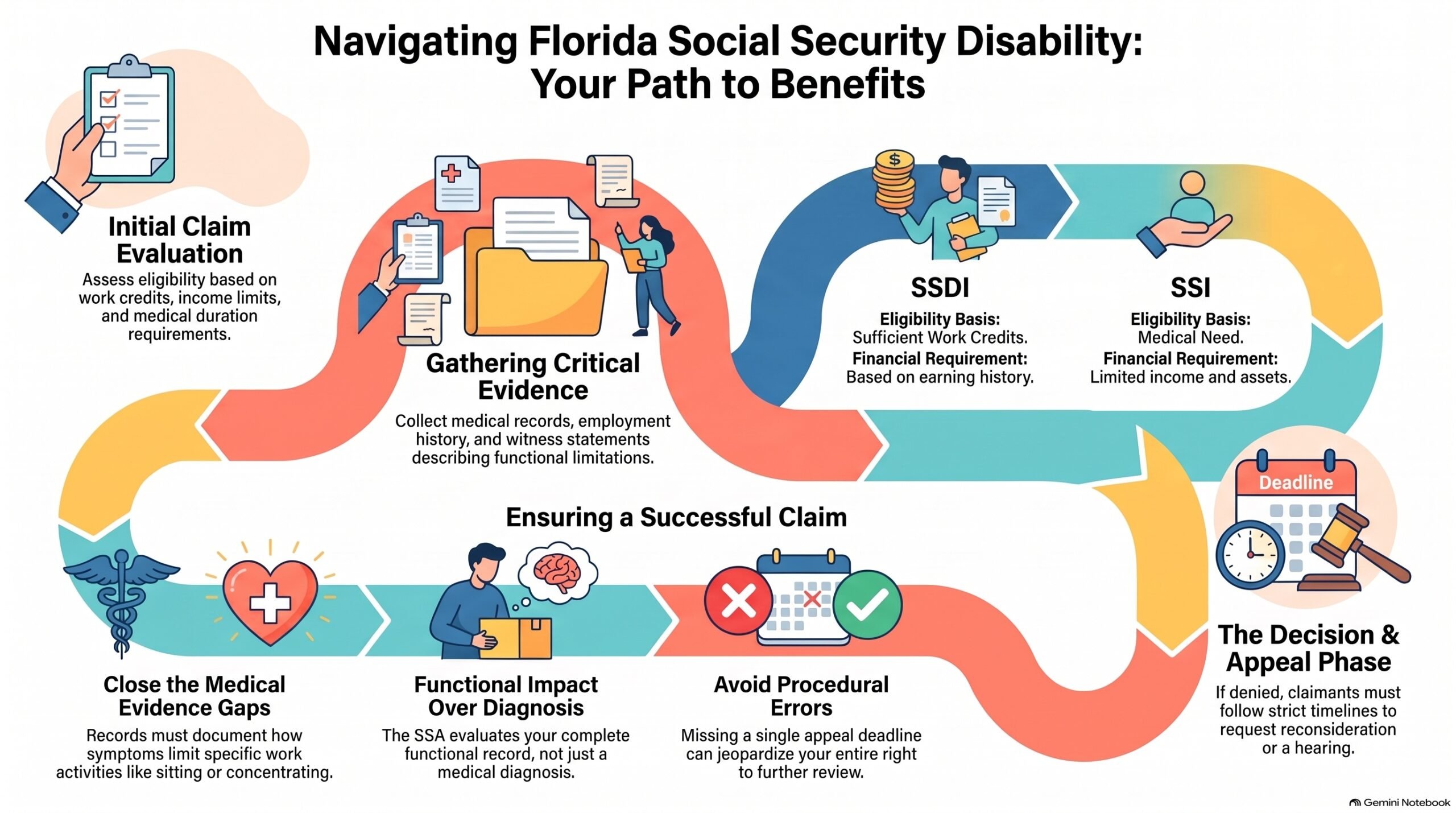
A Florida Social Security injury claim generally begins with an initial evaluation to assess eligibility, potential compensation, and the strength of the available evidence. The process then involves gathering supporting documentation, followed by medical and legal review of the claimant’s condition, records, and circumstances. After a decision is issued, the claimant may need to address the appeals process if benefits or compensation are denied.
Initial Claim Evaluation
During the initial claim evaluation, a Florida Social Security benefits, compensation, or workers’ compensation attorney reviews the claimant’s medical records, employment history, income information, and relevant agency correspondence to determine whether the available evidence supports a viable claim. The attorney assesses disability eligibility under applicable federal standards, including whether the condition limits substantial work and is expected to persist for the required duration. The evaluation also considers procedural deadlines, benefit categories, and the claimant’s prior interactions with the Social Security Administration. Counsel may explain potential reasons for claim denial, such as insufficient medical support, earnings exceeding allowable limits, or failure to follow agency procedures. This early review helps establish realistic expectations, identify legal issues, and determine whether representation can promote a fair, orderly process for the claimant and those depending on needed benefits.
Gathering Supporting Documentation
Effective documentation is crucial to presenting a complete Florida Social Security benefits or compensation claim, particularly when a process-related injury affects the claimant’s ability to work. The claimant should gather treatment records, diagnostic results, medication lists, hospitalization documents, and statements describing functional limitations. A Medical records checklist can help organize providers, dates of service, diagnoses, procedures, and outstanding requests. Employment records, wage information, job descriptions, and incident reports may further demonstrate how the injury affected the claimant’s ability to perform core duties. Consistent records should explain symptoms, restrictions, expected duration, and effects on daily activities without exaggeration. A disability evidence strategy should preserve documents in chronological order, identify missing information, and maintain copies of every submission. Organized supporting materials can help representatives serve claimants efficiently while reducing avoidable delays.
Medical And Legal Review
Once supporting records are assembled, the claim typically proceeds through medical and legal review. Medical documentation is examined to determine whether diagnoses, treatment history, functional limitations, and expected duration are adequately supported. Reviewers may compare clinical findings with reported symptoms and the requirements for qualifying disability or compensation. A legal representative can organize the evidence, identify gaps, and explain how the records relate to the claimant’s ability to work and perform daily activities. The agency or insurer may request additional records, clarification from treating providers, or an independent exam by a designated medical professional. Claimants should attend scheduled examinations, provide accurate information, and promptly report changes in treatment or condition. Careful preparation helps protect the integrity of the claim and supports a complete, fair evaluation for all involved.
Decision And Appeals Process
After the medical and legal review is complete, the Social Security Administration or insurer issues a written decision explaining whether the claim is approved, denied, or requires further action. A Social Security denial should identify the reasons for the outcome and explain available appeal options. Claimants must track appeal deadlines carefully because missing a filing date may restrict further review. The appeal process commonly proceeds through reconsideration, administrative review hearings, and, when appropriate, judicial review. Each stage may impose specific evidence requirements, including updated medical records, employment information, witness statements, and documentation addressing functional limitations. A representative can help organize submissions, respond to agency requests, and prepare the claimant for questioning. Prompt attention to notices and consistent cooperation with reviewing agencies supports a thorough, orderly presentation of the claim.
Compensation for Florida Social Security Benefits, Compensation & Process Injury Damages
Compensation for Florida Social Security–related injury damages depends on the type of claim, the claimant’s medical evidence, and the benefits or losses established through the applicable legal process. Social Security disability benefits generally replace a portion of lost income rather than provide damages for an injury itself. A claimant may seek past-due benefits, continuing monthly payments, or Supplemental Security Income when eligibility requirements are satisfied. Wrongful denial appeals can address agency errors, incomplete records, or an incorrect assessment of functional limitations. Strong medical documentation should describe diagnoses, treatment history, work-related restrictions, expected duration, and the effect of symptoms on daily activities. Claimants may also ask counsel to evaluate Noncovered medical costs, although Social Security programs do not routinely reimburse every expense associated with a disability. Legal review can identify available remedies, filing deadlines, and evidence needed for hearings or federal review. A lawyer may also help protect dependent benefits and coordinate related public assistance without promising recovery beyond authorized benefits.
Economic vs Non-Economic Damages in Florida Social Security Benefits, Compensation & Process Cases
Florida Social Security-related claims may involve economic damages, such as lost income, medical expenses, and necessary rehabilitation costs. Non-economic damages may cover pain, emotional distress, or diminished quality of life, as permitted by the governing law. Proving either category requires reliable documentation, credible evidence, and a clear connection between the claimed losses and the underlying condition or conduct.
Economic Damages
Economic damages in Florida Social Security benefits, compensation, and process cases generally concern the measurable financial losses resulting from a denied, delayed, or improperly calculated claim. These losses may include unpaid disability benefits, reduced household income, medical expenses, and documented cost of care associated with a qualifying condition. They can also encompass transportation, medication, rehabilitation services, and other necessary expenditures that the claimant could not reasonably avoid. Vocational rehabilitation expenses may be relevant when a person requires structured assistance to develop work skills or pursue suitable employment. Accurate records, benefit statements, invoices, employment histories, and medical documentation help establish the amount and timing of financial harm. An attorney representing claimants may evaluate the available evidence, identify recoverable losses, and present a clear calculation in appeals or related proceedings.
Non-Economic Damages
A claimant’s non-economic losses generally relate to the personal effects of a disabling condition rather than to a specific financial amount. In Florida Social Security matters, these effects may include pain, emotional distress, reduced independence, disrupted family relationships, and diminished quality of life. Unlike lost wages or medical expenses, such losses do not ordinarily receive a separate payment through Social Security Disability Insurance or Supplemental Security Income. The programs primarily determine eligibility and provide benefits under federal rules. Consequently, an incorrect eligibility decision may exacerbate hardship by prolonging uncertainty and limiting access to vital support. Social Security claims also differ from personal injury cases, in which non-economic damages may be recoverable through litigation or insurance negotiations. Understanding this distinction helps advocates serve claimants realistically while directing attention toward available benefits and appropriate legal remedies.
Proving Damages Claims
When evaluating a Social Security claim, proving damages requires distinguishing documented economic losses from non-economic effects that do not ordinarily generate separate compensation. Economic losses may include unpaid benefits, medical expenses, vocational services, and other costs supported by reliable records. A claimant should preserve award notices, payment histories, employment records, receipts, and medical documentation to establish the amount and timing of each loss. A careful damages calculation should connect those losses to the disabling condition or administrative error rather than relying on estimates alone. Non-economic effects, such as stress, uncertainty, and diminished quality of life, may provide important evidence of harm, but Social Security programs generally focus on eligibility and entitlement to benefits rather than tort-style emotional distress awards. Clear evidence enables representatives and decision-makers to evaluate claims fairly and serve affected individuals responsibly.
Don’t Wait. Call Our Florida Personal Injury Lawyers Now!
When a Florida Social Security Benefits, Compensation & Process Injury Case Goes to Trial vs. Settlement
Although many Florida Social Security benefits, compensation, and personal injury cases resolve through settlement, some proceed to trial when liability, eligibility, the extent of injuries, or the value of benefits remains disputed. A settlement may provide a faster, more predictable resolution, while trial permits each side to present evidence, question witnesses, and request a formal decision. Counsel typically evaluates medical records, employment history, agency findings, witness credibility, projected expenses, and the client’s ability to undergo additional delay.
A Trial readiness check helps determine whether the evidence is complete, the testimony is reliable, and the client understands the potential outcomes. Settlement leverage factors may include the strength of documentation, disputed factual issues, litigation costs, available insurance, and the risk of an unfavorable ruling. Neither path is automatically superior. The appropriate choice depends on the client’s objectives, health, financial circumstances, and need for dependable support. Careful advice helps preserve dignity, promote informed decisions, and advance a fair resolution for those seeking necessary assistance.
Florida Laws That May Affect Your Florida Social Security Benefits, Compensation & Process Case
Florida laws may affect a Social Security benefits, compensation, or personal injury case by shaping eligibility, filing deadlines, evidence requirements, available damages, and the procedures for challenging an adverse decision. State workers’ compensation rules may determine whether an injury arose from employment, while federal Social Security standards separately evaluate disability, work history, and medical limitations.
Counsel serving injured individuals should examine how these systems interact before advising a client.
- Florida workers’ rights may include medical treatment, wage-loss benefits, and workplace protections.
- Workers’ compensation evidence can influence related disability applications and the disability benefits impact.
- Comparative negligence principles may affect recovery in certain personal injury claims.
- Government immunity rules can restrict claims against public employers or agencies.
- Administrative review procedures may require organized medical records, employment documentation, and witness statements.
Florida statutes, agency regulations, and federal requirements can produce different results for similar conditions. A careful legal assessment helps protect eligible claimants, coordinate available remedies, and present accurate information to decision-makers. Experienced counsel can explain applicable rules while respecting each client’s circumstances and service needs.
The Statute of Limitations for Florida Social Security Benefits, Compensation & Personal Injury Cases
Deadlines can determine whether a Florida Social Security, workers’ compensation, or personal injury claim proceeds, making early legal review vital. Each system imposes different limitation periods and notice requirements, and missing one may prevent consideration of otherwise valid circumstances.
Social Security claimants generally must request reconsideration or a hearing within specified appeal timelines stated in agency notices. Workers’ compensation cases may require prompt reporting to an employer, followed by filing within the statutory time limits. Personal injury claims are governed by Florida limitation rules that vary depending on the injury, the defendant, and applicable exceptions. Government defendants can involve additional notice and shortened deadlines.
Certain circumstances may support equitable tolling, which can pause a deadline when extraordinary conditions prevented timely action, but this doctrine is limited and fact-dependent. Disability, misinformation, delayed discovery, or improper notice may affect analysis without automatically extending a filing period. Preserving notices, medical records, employment documentation, and correspondence helps establish when obligations arose and whether an exception applies. Careful calendar management supports timely service to injured individuals.
How a Florida Social Security Benefits, Compensation & Process Lawyer Can Help You
A Florida Social Security benefits, compensation, and process lawyer can assess the facts, identify applicable deadlines, and explain the procedural requirements governing a claim. Legal guidance may help representatives serve an applicant’s interests while organizing persuasive, accurate documentation.
A Florida Social Security lawyer can clarify deadlines, procedural requirements, and documentation strategies while protecting an applicant’s interests.
A lawyer may assist by:
- Reviewing work history, earnings information, and functional limitations for consistency.
- Identifying missing evidence and requesting updated medical records from appropriate providers.
- Preparing forms and written statements that clearly describe disabling conditions and their practical effects.
- Communicating with the Social Security Administration, responding to notices, and correcting misunderstandings in the record.
- Developing an Appeals strategy based on the decision, supporting evidence, and applicable administrative standards.
Counsel may also help clarify how compensation, benefits, and procedural decisions interact, reducing avoidable omissions during review. By presenting relevant information in an organized manner, the lawyer supports fair consideration of the claimant’s circumstances. This assistance can be particularly valuable when family members, caregivers, or advocates are helping another person pursue benefits while balancing service responsibilities.
When to Contact a Florida Social Security Benefits, Compensation & Process Lawyer
Early legal guidance may be appropriate when a claimant is uncertain about eligibility, unable to gather sufficient medical evidence, or facing a denial of Social Security benefits. A Florida Social Security benefits, compensation, and process lawyer may also be contacted before an application is filed when work history, disability requirements, or Earnings limits create uncertainty.
Prompt consultation becomes particularly important after a denial, overpayment notice, or request for additional documentation. Claimants should identify appeal deadlines immediately because missing a filing period can restrict further review. Legal assistance may help organize medical records, employment information, and agency correspondence so the claim is presented accurately and on time.
A lawyer may also be appropriate when a claimant’s condition changes, benefits are threatened during a continuing disability review, or a hearing is scheduled. Families assisting an injured or disabled person can seek guidance when communication, transportation, or decision-making barriers complicate the process. Early attention allows available options to be evaluated before essential procedural rights expire.
Why You Need an Experienced Florida Social Security Benefits, Compensation & Process Lawyer
When a Social Security claim involves disputed eligibility, incomplete medical evidence, or a prior denial, an experienced Florida Social Security benefits, compensation, and process lawyer can provide structured guidance through each stage of the matter. Such counsel helps identify applicable program requirements, explain procedural obligations, and reduce errors that could delay critical assistance. Appeal deadlines require careful monitoring because missed filing periods may limit available remedies or require additional justification. A lawyer can also develop a documentation strategy that organizes medical records, employment information, functional limitations, and supporting statements into a coherent presentation. This focused preparation enables decision-makers to evaluate the claimant’s circumstances more accurately. Experienced representation may further clarify communications from the Social Security Administration, prepare responses to requests, and present relevant arguments during administrative review or hearings. By handling intricate processes responsibly, counsel allows families, advocates, and caregivers to devote greater attention to supporting individuals seeking benefits while preserving the integrity of the claim.
How to Choose the Right Florida Social Security Benefits, Compensation & Process Lawyer for Your Case
Selecting the right Florida Social Security benefits, compensation, and process lawyer requires careful review of the attorney’s experience, communication practices, and familiarity with the specific benefit program involved. A qualified lawyer should understand applications, denials, appeals, hearings, and documentation requirements for disability, retirement, survivor, or supplemental income claims. Reviewing professional credentials, case preparation methods, and client communication policies can help identify dependable representation.
During an initial consultation, the prospective client should ask who will manage the case, how updates will be provided, and which records may be necessary. A Client consultation checklist can organize questions about fees, timelines, potential challenges, and the lawyer’s role throughout the process. Individuals should also determine whether the firm offers a free case review and clearly explains possible outcomes without making unrealistic promises. The right advocate should demonstrate patience, responsiveness, and respect for the claimant’s circumstances. Careful comparison allows families and individuals to select counsel prepared to protect their rights and support access to vital benefits.
About The Law Offices of Anidjar & Levine
The Law Offices of Anidjar & Levine represents individuals and families seeking guidance with Social Security benefits, compensation, and related legal processes in Florida.
Its attorneys assist clients who may be managing disability claims, benefit disputes, eligibility questions, or administrative appeals.
The firm evaluates each matter carefully, explains the available legal options, and helps individuals understand the procedures that affect their claims.
A client-focused consultation allows the legal team to identify relevant facts, clarify objectives, and develop a practical approach suited to the person’s circumstances.
The firm also provides Document preparation assistance, helping organize medical records, employment information, correspondence, and other materials that may support a submission or appeal.
This structured preparation can reduce avoidable omissions and promote clearer communication with reviewing agencies.
The Law Offices of Anidjar & Levine emphasizes attentive representation and informed decision-making.
By serving clients with diligence and professionalism, the firm seeks to help Florida residents pursue benefits and compensation through established legal channels while respecting each client’s needs, responsibilities, and long-term interests.
Frequently Asked Questions
Can I Receive Social Security Benefits While Working in Florida?
A worker in Florida can receive Social Security benefits while employed, but the effect depends on benefit type, age, and income. Eligibility Limits apply to disability recipients and individuals claiming retirement benefits before full retirement age. Work Earnings may trigger Benefit Reductions under annual thresholds. Recipients must satisfy Reporting Requirements by promptly disclosing employment and income changes. After reaching full retirement age, earnings generally no longer reduce retirement benefits, although taxes may still apply.
What Is the Difference Between SSDI and Supplemental Security Income?
SSDI and Supplemental Security Income are distinct federal disability programs. SSDI provides benefits to workers who have qualifying medical conditions and sufficient work credits under SSDI eligibility rules. Benefit amounts generally depend on the individual’s earnings history. SSI serves disabled, blind, or older individuals with limited income and resources, regardless of work history. Applicants must satisfy SSI income limits and asset requirements. Both programs require documented eligibility and ongoing reporting obligations.
How Does My Family Qualify for Social Security Survivor Benefits?
Families may qualify for Social Security survivor benefits when a deceased worker earned sufficient Social Security credits. A surviving spouse may qualify at age 60 or older, or at 50 if disabled; Widow eligibility may also apply when caring for the worker’s child. Child benefits generally cover unmarried children under 18, or up to 19 while attending secondary school, and disabled adult children whose disability began before age 22.
Can Non-Citizens Receive Social Security Benefits in Florida?
Non-citizens may receive Social Security benefits in Florida if they meet federal eligibility requirements. Lawful permanent residents and certain other qualified noncitizens can often qualify through sufficient work history, while others may receive benefits under specific immigration classifications or agreements. Eligibility depends on the benefit type, immigration status, earnings record, and residence requirements. A qualified representative can review documentation, explain available options, and help applicants pursue benefits accurately and responsibly.
How Are Social Security Benefit Amounts Calculated?
Social Security benefit amounts are calculated primarily from a worker’s covered earnings history and the age at which benefits begin. The Social Security Administration adjusts past wages for national wage growth, identifies the highest 35 years of earnings, and calculates average indexed monthly earnings. A statutory benefit formula then determines the primary insurance amount. Claiming before full retirement age generally reduces payments, while delayed retirement credits may increase them.
—————————
Florida Social Security benefits, compensation, and personal injury claims require careful evaluation, thorough documentation, and timely legal action.
An experienced Florida attorney can assess eligibility, identify responsible parties, protect procedural rights, and pursue available benefits or compensation throughout each stage of the case.
The Law Offices of Anidjar and Levine provide informed guidance tailored to each client’s circumstances.
Individuals facing a denied claim, a serious injury, or a complex legal process should promptly seek qualified counsel, including a Florida Personal Injury Lawyer, to protect their interests.

