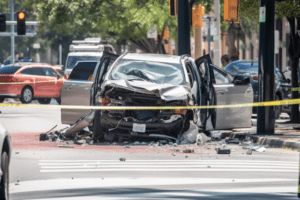
When a crash on I-4, International Drive, or Orange Blossom Trail turns your life upside down, you need a team that moves immediately to preserve evidence and fight for what you deserve.
The Law Offices of Anidjar & Levine can guide injured people through the legal process, preserve evidence, review insurance coverage, and identify all potentially liable parties.
An Orlando Personal Injury Lawyer may assist with documenting medical care, lost income, pain impacts, future needs, and communications with insurers.
Claims often involve negligence, comparative fault, distracted driving, impaired driving, unsafe roads, or vehicle maintenance issues.
Prompt legal guidance can strengthen valuation and protect deadlines, with more details below on rights, evidence, and recovery options.
What Is Florida’s No-Fault PIP Insurance System?
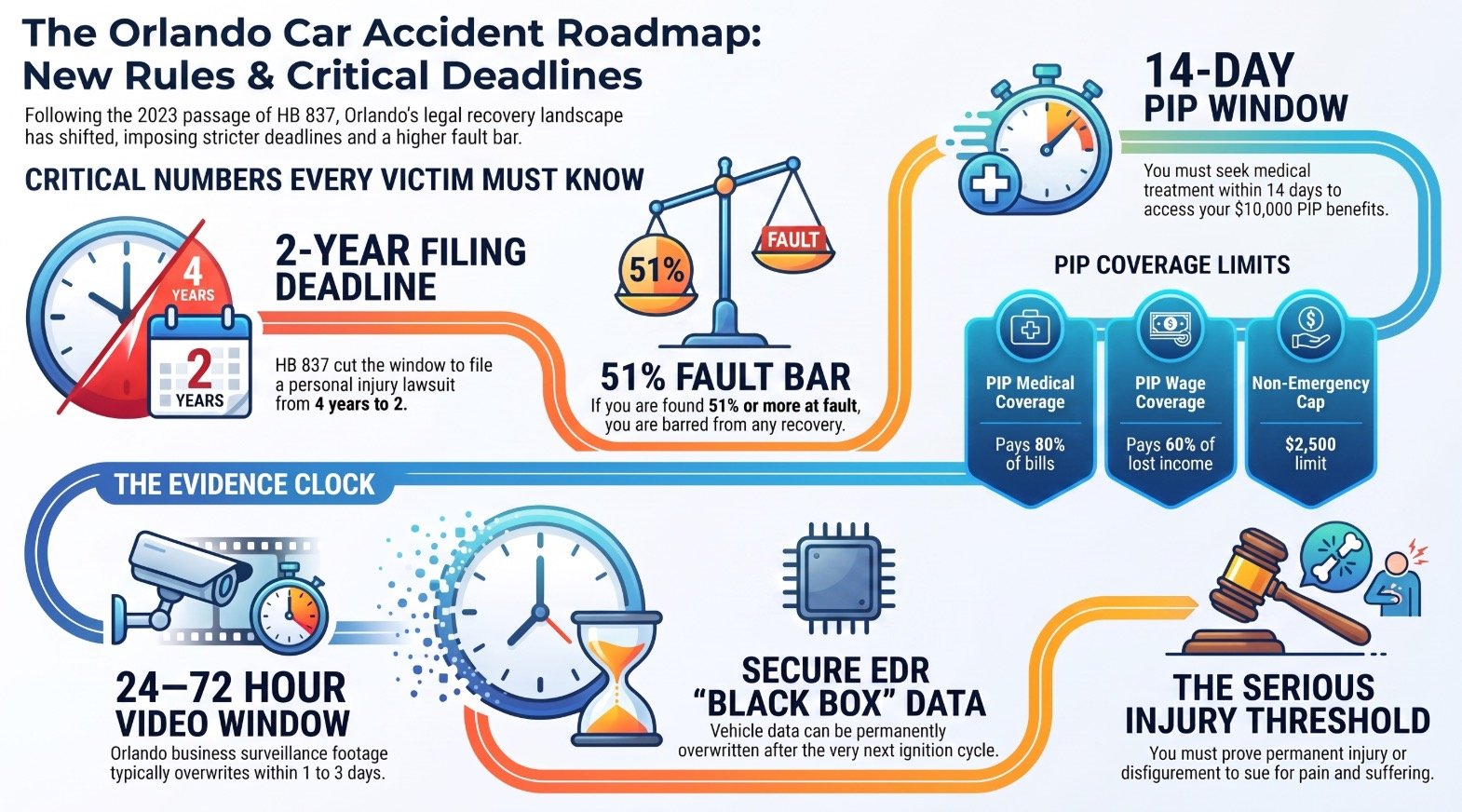
Florida’s no-fault system requires most vehicle owners to carry at least $10,000 in Personal Injury Protection (PIP) coverage. After a car accident, PIP pays 80% of your medical bills and 60% of lost wages, regardless of who caused the crash, but only if treatment begins within 14 days of the accident. To sue the at-fault driver directly for pain and suffering, you must meet Florida’s serious injury threshold: a permanent injury, significant and permanent disfigurement, or death. The no-fault system does not prevent a full lawsuit; it simply sets a minimum threshold. An Orlando car accident lawyer can evaluate whether your injuries meet that threshold and how to maximize recovery across all available coverage options under Florida law.
Main Takeaways
- An Orlando car accident lawyer can guide injured people through claims, deadlines, insurer communications, and legal next steps.
- A lawyer may evaluate fault, insurance coverage, medical damages, lost income, pain impacts, and future care needs.
- Strong claims often rely on police reports, medical records, witness statements, photos, videos, and prompt documentation.
- Liability may involve distracted driving, impairment, speeding, unsafe lane changes, poor maintenance, hazardous roads, or construction risks.
- Many car accident lawyers offer contingency fee representation, meaning no upfront attorney fees under agreed terms.
How We Can Help With Your Orlando Car Accident Injury Claim
After a serious collision, an Orlando car accident lawyer can help an injured person understand the legal process, protect a potential claim, and pursue compensation from the responsible parties. Counsel provides organized guidance, allowing the person and family to focus on recovery while legal matters are handled with discipline and care. This support often includes reviewing available insurance coverage, identifying liable parties, and communicating with insurers in a measured, documented manner.
A lawyer may also explain contingency fee options, which can allow representation without upfront attorney fees, subject to the terms of the agreement. This structure may be especially important for injured people trying to meet medical, household, and work-related obligations while recovering from serious harm. Through careful case management, the lawyer helps maintain order, protect deadlines, and promote a fair opportunity for recovery.
For more on how Florida’s PIP system works in car accident claims: Florida PIP Insurance Explained.
Understanding Orlando Car Accident Injury Cases
An Orlando car accident injury case often turns on the specific facts of the collision, the extent of the injuries, and the available sources of insurance or other compensation. Each case may involve medical treatment, lost income, reduced earning ability, pain, and long-term care needs. A careful review helps identify who may be legally responsible and what damages may be pursued, both under Florida’s no-fault PIP system and through a direct negligence claim against the at-fault driver when the serious injury threshold is met.
Understanding the claim process is crucial for injured people and their families. Evidence must be preserved, deadlines monitored, and communications with insurers handled with accuracy. Some matters also include property damage claims, which address vehicle repair, replacement, and related losses. In the most serious situations, families may pursue wrongful death claims to seek accountability after a fatal crash. A well-prepared injury case focuses on documentation, credible proof, and fair valuation, supporting a path toward recovery with dignity, responsibility, and practical guidance.
Orlando Car Accident Statistics: Understanding the Risk on Orange County Roads
Orlando and Orange County sit at the heart of one of Florida’s most heavily trafficked corridors. According to the FLHSMV 2022 Florida Traffic Crash Facts, Florida recorded 401,523 total crashes and 3,535 fatalities statewide, with an estimated economic loss of $19.4 billion.
Orange County consistently ranks among the highest-volume crash counties in the state, driven by I-4 corridor traffic, tourism-related congestion on International Drive, and heavy commuter patterns on US 441 and SR 408. The National Highway Traffic Safety Administration reported 3,208 distracted driving deaths nationwide in 2024.
Florida’s HB 837 (2023) cut the personal injury filing window to two years and imposes a 51% comparative fault bar that eliminates all recovery when the injured driver is found more than half responsible. Surveillance footage near Orlando crash scenes typically overwrites within 24 to 72 hours, and EDR black box data from the other vehicle can be overwritten after the next ignition cycle, making immediate legal action essential after any serious Orange County crash.
Common Causes of Orlando Car Accidents
Orlando car accidents often result from identifiable conduct or conditions that increase the risk of serious injury. Common causes include distracted driving, impaired driving, speeding and recklessness, and hazardous road conditions. Understanding these factors can help clarify liability, strengthen injury claims, and guide the legal evaluation of a crash in Orange County.
Distracted Driving
Because a driver’s attention must remain on the road, even a brief distraction can create a serious risk of collision on Orlando’s busy streets, highways, and intersections. Distracted driving may involve phone use, navigation screens, eating, grooming, or conversations that draw focus away from traffic conditions. When a crash occurs, texting evidence, call logs, app activity, and witness statements may help show that a driver failed to act with reasonable care. Florida’s distracted driving laws address certain unsafe behaviors, especially handheld device use in designated areas, and violations may support a negligence claim. Careful review of the facts surrounding the distraction can clarify responsibility and connect a preventable lapse in attention to the harm suffered by injured people and their families.
Impaired Driving
When a driver operates a vehicle under the influence of alcohol, illegal drugs, or impairing prescription medication, the risk of a serious collision increases sharply. Impairment can reduce judgment, delay reaction time, and affect the ability to recognize pedestrians, cyclists, emergency vehicles, and changing traffic signals. In Orlando, these crashes often leave injured people needing extended medical care and guidance through a complex claims process. Evidence may include officer observations, witness statements, toxicology reports, and alcohol testing conducted after the incident. When DUI charges arise from the same event, the criminal case may proceed separately from any civil claim for injury-related losses. A careful review of records helps identify responsibility, preserve crucial facts, and support fair accountability for those harmed.
Speeding and Recklessness
Although speed limits are designed to reduce predictable roadway risks, speeding and reckless driving remain major causes of severe crashes in the Orlando area. Excessive speed reduces reaction time, increases stopping distance, and magnifies the force of impact, often leaving injured people with lasting medical, financial, and personal burdens. Reckless behavior, including aggressive lane changes, tailgating, street racing, or ignoring traffic signals, may show a disregard for the safety of others. Attorneys reviewing these collisions may examine police reports, witness statements, vehicle damage, traffic camera footage, and electronic data to identify evidence of reckless driving. Careful investigation helps determine accountability and supports those seeking fair recovery after preventable harm on Orlando roads.
Hazardous Road Conditions
Hazardous road conditions can contribute to serious collisions throughout Orlando, especially where poor maintenance, inadequate signage, standing water, construction debris, or defective traffic signals create unexpected dangers for motorists. Although Florida does not face traditional winter road hazards, sudden rain, slick pavement, and reduced visibility can create serious risks. A poorly marked construction zone may force drivers into abrupt lane changes, lead to uneven surfaces, or create confusing traffic patterns. When public agencies, contractors, or maintenance providers fail to address known hazards, injured people may need careful guidance to identify responsible parties. Legal professionals serving accident victims review roadway design, repair records, inspection reports, and witness accounts to determine whether negligence contributed to the crash.
Why Do Orlando Car Accident Injuries Happen?
Orlando car accident injuries often occur because ordinary driving conditions can become dangerous when motorists fail to use reasonable care. Collisions may result from speeding, distracted driving, impaired driving, unsafe lane changes, or following too closely. In a busy metropolitan area with heavy tourist traffic, these choices can harm workers, families, pedestrians, and visitors who depend on safe roads to meet their daily needs.
Other injury causes may involve conditions beyond one driver’s conduct. Faulty vehicle maintenance can contribute when worn brakes, defective tires, broken lights, or steering problems make a vehicle unsafe. Commercial operators, rideshare drivers, and private owners may create risks when inspections and repairs are neglected. Road design and public maintenance may also affect crash risks. Poorly timed signals, missing signs, dangerous intersections, or unrepaired hazards can raise government liability issues when a public entity’s negligence contributes to an accident. Each cause requires careful review to accurately identify responsibility.
Your Legal Rights After an Orlando Car Accident
After a serious collision, injured people in Orlando have legal rights that may allow them to seek compensation for medical expenses, lost income, pain and suffering, and other losses caused by another party’s negligence. These rights exist to help restore stability, protect families, and support recovery after a preventable crash.
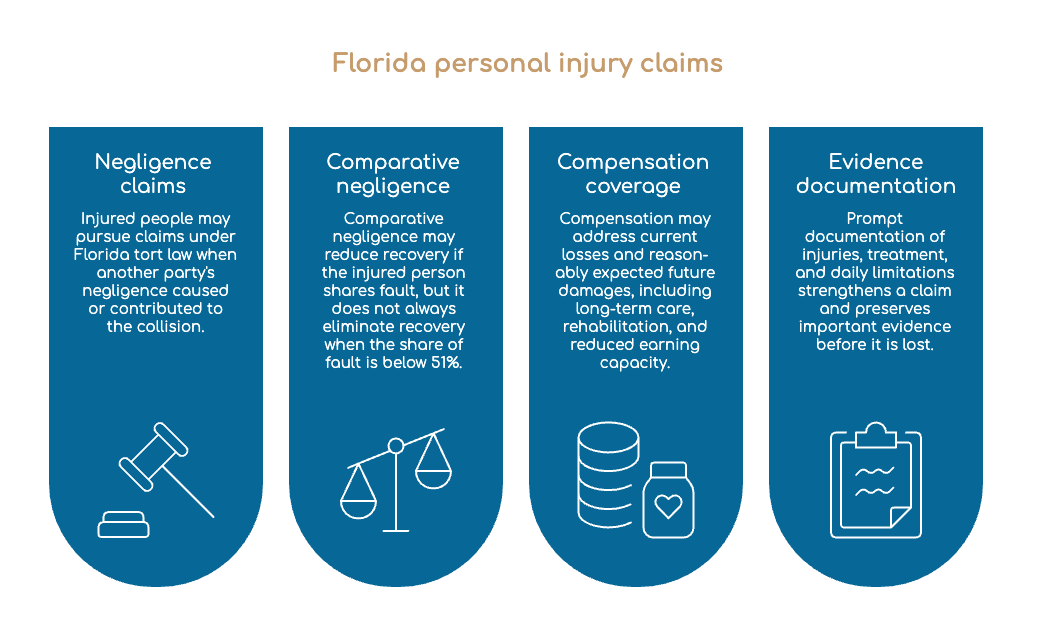
- Injured people may pursue claims under Florida tort law when another party’s negligence caused or contributed to the collision.
- Comparative negligence may reduce recovery if the injured person shares fault, but it does not always eliminate recovery when the share of fault is below 51%.
- Compensation may address current losses and reasonably expected future damages, including long-term care, rehabilitation, and reduced earning capacity.
- Prompt documentation of injuries, treatment, and daily limitations strengthens a claim and preserves important evidence before it is lost.
An Orlando car accident lawyer may evaluate liability, review insurance coverage, and communicate with insurers on the injured person’s behalf. By understanding available remedies, injured individuals can make informed decisions while focusing on recovery and rebuilding stability after a difficult crash.
Steps to Take After an Orlando Car Accident
After an Orlando car accident injury, the injured person should seek medical attention promptly, even when symptoms appear minor. The accident should also be reported to the proper authorities, creating an official record that may be important for insurance and legal purposes. Consulting an attorney can help protect the injured person’s rights, preserve evidence, and guide the next steps in pursuing compensation.
Seek Medical Attention
When a crash causes any level of injury, prompt medical attention should be a priority, even if symptoms appear minor at first. A medical evaluation can identify conditions that may not be immediately visible, including concussions, internal injuries, soft tissue damage, or delayed pain responses. Seeking care also preserves the ability to meet Florida’s 14-day PIP treatment window, which is required to access your own no-fault benefits. Medical records create vital documentation showing the nature of injuries, recommended treatment, and the connection between the collision and later symptoms. Following a provider’s instructions supports recovery and reduces the risk of complications. Continued appointments allow long-term health monitoring, especially when injuries affect mobility, cognition, or daily functioning after the incident.
Report the Accident
Reporting the accident to the proper authorities is an important step that supports safety, accountability, and future claim documentation. A person involved should contact law enforcement, especially when injuries, vehicle damage, road hazards, or disputed facts are present. Officers can assess the scene, direct traffic, request emergency assistance, and create an official report that may later clarify what occurred. While waiting, individuals should remain calm, avoid assigning blame, and provide accurate information to responders. If able, gathering witness names and contact information is also important, as neutral observers may help confirm essential details that differ from the other driver’s account. Names and phone numbers should be recorded when practical, without disrupting emergency personnel or medical care for anyone involved.
Consult an Attorney
Once immediate safety concerns and reporting obligations have been addressed, consulting an attorney can help protect rights and clarify the next steps after an Orlando car accident injury. An attorney may review crash reports, medical records, insurance communications, and available evidence to determine whether compensation may be pursued. This guidance is especially valuable when an injured person is focused on recovery and may not recognize the insurer’s early tactics for what they are. A lawyer may also explain how auto policies, health benefits, and umbrella coverage could affect available resources. Prompt legal advice helps preserve evidence, meet deadlines, and reduce avoidable mistakes during the claims process. Many firms offer free 24/7 consultations with no upfront obligation.
Critical Evidence in an Orlando Car Accident Injury Case
Critical evidence can shape the outcome of an Orlando car accident injury case, particularly when liability, damages, and causation are disputed. A lawyer may evaluate key materials to establish what occurred, how injuries developed, and how the crash affected the injured person’s life. Important evidence may include police crash reports, medical treatment records, witness statements, photos and videos from the crash scene, and EDR data and dashcam footage, when available.
Police Crash Reports
After a collision in Orlando, the police crash report often becomes one of the first documents reviewed in a personal injury claim. It may identify drivers, passengers, witnesses, vehicle positions, citations, roadway conditions, and preliminary fault observations. A careful scene investigation by responding officers can preserve details that later help clarify how the crash occurred. However, the report is not always conclusive, and errors or omissions may require correction through additional evidence. The report may also support insurance disclosure requirements, helping carriers evaluate coverage and responsibility. An Orlando car accident lawyer may use it to assess claims, coordinate records, and protect the injured party’s legal position from the beginning of the process.
Medical Treatment Records
While a police crash report may help explain how a collision occurred, medical treatment records often show how the collision affected the injured person. These records can document diagnoses, pain complaints, imaging results, treatment plans, work restrictions, and follow-up care. In an Orlando car accident injury case, they help connect physical harm to the crash and support damages with organized, professional detail. Medical records may also strengthen liability proof when they align with crash photos, vehicle damage, and insurance documentation. Consistent records can reduce disputes over timing, severity, and whether care was reasonably necessary.
For more on which records matter most: “What Medical Records Matter Most in a Florida Injury Claim.”
Witness Statements
When a collision is disputed, witness statements can provide an independent account of what occurred before, during, and after the crash. Neutral observers may describe driver behavior, signal changes, traffic flow, roadway conditions, or evasive actions. These details can assist in evaluating accident causation, especially when involved parties provide conflicting reports. A careful legal review may compare witness accounts with police findings, medical timelines, and available traffic camera footage to identify consistency or gaps. Prompt collection is important because memories can fade and witnesses may become difficult to locate. Credible witness statements may help clarify responsibility and support a claim for fair recovery after an Orlando car accident.
Photos and Videos
Photos and videos can be among the most persuasive forms of evidence in an Orlando car accident injury case, because they may capture details that written reports or personal recollections overlook. Images of vehicle damage, skid marks, traffic signals, road hazards, injuries, and weather conditions can support accurate crash documentation. Video from dash cameras, nearby businesses, traffic systems, or bystanders may help clarify speed, lane position, impact sequence, and driver behavior. Recordings should be preserved quickly, stored securely, and reviewed without alteration. Clear visual evidence can help insurers and courts understand what occurred, promoting fair evaluation and informed support for the injured person after the collision.
Florida PIP / No-Fault Insurance and Your Orlando Car Accident Claim
Florida is a no-fault state, which means that after a car accident, your own Personal Injury Protection (PIP) insurance pays for your initial medical treatment and a portion of lost wages, regardless of who caused the crash. Florida law requires all vehicle owners to carry at least $10,000 in PIP coverage. PIP pays 80% of reasonable and necessary medical bills and 60% of lost income, subject to that $10,000 limit. To access PIP benefits, treatment must begin within 14 days of the accident. Emergency medical conditions allow access to the full $10,000 limit; non-emergency conditions are capped at $2,500.
PIP does not cover pain and suffering, and its $10,000 limit is often exhausted quickly in serious crashes. To pursue additional compensation, including pain and suffering, from the at-fault driver, an injured person must meet Florida’s serious injury threshold: a permanent injury, significant and permanent disfigurement, or death. When this threshold is met, a direct lawsuit against the negligent driver may be filed. An Orlando car accident lawyer can evaluate your specific injuries against this threshold, identify all available coverage, including uninsured motorist coverage, and ensure that every potential source of compensation is considered in your claim.
How an Orlando Car Accident Lawyer Can Help You
A lawyer may help an injured person organize facts, preserve evidence, and present losses with care, allowing the claim to be supported by recovery with discipline and purpose. An Orlando car accident lawyer can evaluate liability, review insurance claim timing, and identify documentation that strengthens the case. This work may include medical records, witness accounts, repair estimates, and vehicle maintenance records, especially when mechanical issues or disputed fault arise.
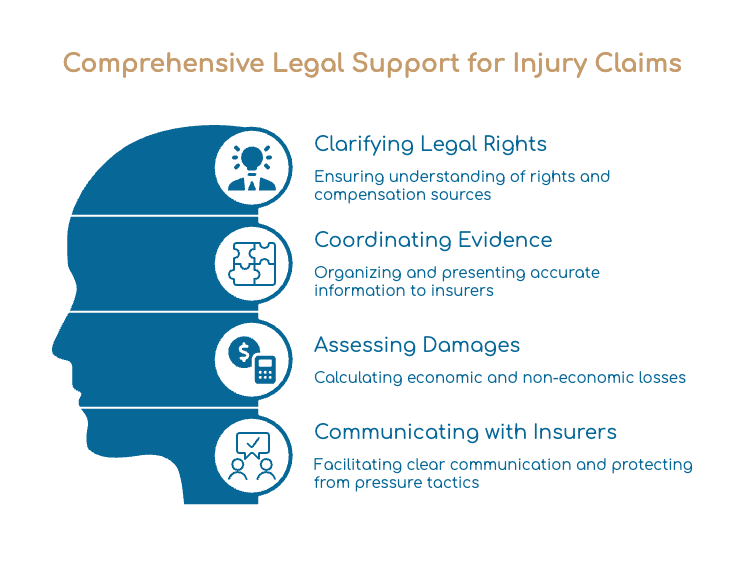
- Clarifying legal rights and identifying all available sources of compensation, including PIP, liability coverage, and uninsured motorist policies.
- Coordinating evidence to ensure insurers receive accurate, complete information that supports a strong, defensible claim presentation.
- Assessing medical expenses, lost income, and future care needs to ensure that all economic and non-economic damages are properly calculated and documented.
- Communicating with insurers to reduce confusion, avoid harmful statements, and protect the injured person from pressure tactics designed to reduce or eliminate fair recovery.
Long-Term Effects of Orlando Car Accident Injuries
Long-term injuries from an Orlando car accident may extend well beyond initial treatment, often involving chronic pain challenges that affect mobility, work capacity, and daily function. Emotional trauma can also influence recovery, especially when anxiety, depression, or post-accident fear disrupt normal routines. Future medical needs, including ongoing therapy, specialist care, and potential procedures, should be carefully considered when evaluating the full impact of a claim.
Chronic Pain Challenges
Although some injuries appear to mend within weeks, many car accident victims develop chronic pain that continues to affect mobility, sleep, employment, and daily functioning. Neck, back, joint, and nerve pain may persist after fractures, soft tissue injuries, or spinal trauma, requiring ongoing evaluation and coordinated care. Careful attention to treatment consistency is critical, because gaps in care may complicate recovery and create openings for insurers to dispute the severity of the injury. Effective pain management can include physical therapy, medication oversight, injections, or specialist referrals, depending on medical findings. When chronic pain limits work duties or household responsibilities, the long-term consequences may be substantial and should be clearly recorded and documented as part of the claim.
For more context on how Florida values serious injury claims: Average Personal Injury Settlements in Florida by Case Type.
Emotional Trauma Impact
After a serious collision, emotional trauma can become one of the most disruptive long-term effects for car accident victims. Fear, irritability, sleep disturbance, and anxiety may interfere with work, family duties, and daily life. Post-accident anxiety may also appear in specific routines, including driving, riding as a passenger, or passing the crash location. When mental health concerns remain untreated, injured people may withdraw from supportive relationships and lose confidence in ordinary activities. Careful documentation of emotional symptoms, counseling records, and functional limitations can help show how trauma has altered the person’s life beyond visible physical injuries, supporting a claim for non-economic damages that reflects the true human cost of the crash.
Future Medical Needs
Often, the full cost of serious car accident injuries in Orlando becomes clear only after the initial emergency treatment has ended. Ongoing care may include surgeries, medication management, pain treatment, assistive devices, home modifications, and periodic specialist evaluations. Careful rehabilitation planning can identify medical services needed months or years later. This planning should consider mobility limitations, cognitive changes, chronic pain, and the need for occupational or physical therapy. Future medical needs may also affect earning capacity, making future wage loss a necessary part of a complete damages assessment. A well-supported claim relies on medical opinions, life-care projections, and employment evidence, so that decision-makers can understand the ongoing burden and provide resources to support stability and recovery.
Proving Liability in Orlando Car Accident Injury Cases
When an injury claim follows a motor vehicle collision, liability must be established through evidence that shows who caused the crash and how that conduct led to the resulting harm. In Orlando car accident injury cases, this often requires police reports, witness statements, photographs, traffic camera footage, vehicle damage analysis, and medical records connecting injuries to the event. A careful liability review examines whether a driver violated traffic laws, failed to yield, followed too closely, drove distracted, or acted unreasonably under the circumstances. It may also consider shared fault, road conditions, or defects involving a vehicle component.
Strong evidence supports informed negotiation and shapes trial strategy when responsibility is disputed. Attorneys may consult accident reconstruction experts, preserve electronic data, and organize timelines that clarify cause and effect. Florida’s comparative fault rules mean that even a partial attribution of responsibility to the injured driver can reduce recovery, making thorough liability investigation essential to protecting the full value of the claim. This disciplined approach helps demonstrate negligence while giving the injured person the fair representation they deserve.
Dealing With Insurance Companies After an Orlando Car Accident
Although insurance companies may appear cooperative at the beginning of a claim, their primary role is to evaluate exposure and limit financial loss. After an Orlando car accident injury, injured individuals often face recorded statement requests, quick settlement offers, and repeated documentation requests. Each response should be accurate, measured, and consistent with available medical records, repair estimates, and witness information. A representative who genuinely serves the injured person’s interests helps protect them from unfair pressure while ensuring the claim is presented responsibly.
Claim denials may result from alleged policy exclusions, disputed fault, or incomplete proof of injury. Careful preservation of evidence, including photographs, crash reports, treatment records, and communication logs, supports a stronger position when disputes arise. Legal deadlines also require close attention, because missed filing periods can limit or eliminate recovery options entirely. By managing insurer communication with discipline and compassion, counsel can help preserve the injured person’s rights, reduce confusion, and support a fair evaluation of the harm suffered.
What to Expect During an Orlando Car Accident Injury Claim
An Orlando car accident injury claim typically begins with an initial case evaluation, where liability, damages, and available insurance coverage are reviewed. The next stages often involve evidence collection, medical documentation, and structured communication with insurance companies during negotiation. If a fair settlement cannot be reached, the claim may proceed toward litigation and trial, where a court determines the outcome.
Initial Case Evaluation
The initial case evaluation ensures the attorney understands the injured person’s needs, immediate concerns, and potential legal options. During this review, the lawyer typically discusses the crash circumstances, medical treatment, work limitations, and communications from insurers. This meeting also helps identify urgent deadlines, including insurance claim timelines that may affect benefits or recovery. The attorney may also outline a settlement negotiation strategy, based on liability issues, injury severity, and available coverage. A thorough evaluation sets expectations, promotes informed decisions, and helps ensure the process begins with organization and purpose.
Evidence Collection Steps
Once the initial case evaluation identifies the injured person’s needs and legal options, the Orlando car accident lawyer typically begins gathering evidence to support liability, damages, and insurance coverage issues. This stage may include obtaining police reports, medical records, repair estimates, photographs, witness statements, and available video footage. Careful liability documentation helps clarify how the crash occurred, who acted negligently, and how the injuries affect daily responsibilities. The lawyer may also review employment records, treatment plans, and provider opinions to accurately assess financial and personal losses. Because insurance claim deadlines can affect the injured person’s ability to seek compensation, evidence is promptly organized and carefully preserved.
Insurance Negotiation Process
After the evidence has been organized and the full scope of the claim is better understood, the Orlando car accident lawyer may begin communications with the insurance company to pursue a fair resolution. This stage often involves presenting liability facts, medical documentation, wage information, and records showing how the injury affected daily life. The lawyer may address questions from the adjuster, correct incomplete assumptions, and ensure that evidence preservation remains a priority if additional records are needed. Negotiations may involve written demands, review of responses, and careful valuation of losses. The lawyer’s role is to protect the claim from undervaluation while maintaining organized, purposeful communication throughout the process.
Settlement or Trial
At this stage of the claim, an Orlando car accident lawyer may evaluate whether settlement remains appropriate or whether litigation is necessary to pursue adequate compensation. This review often considers the history of insurance negotiations, medical evidence, liability disputes, and the client’s long-term needs. A careful settlement valuation may help determine whether an insurer’s offer fairly reflects lost income, treatment costs, pain, and future limitations. When settlement serves the injured person’s recovery and stability, counsel may recommend resolution without trial. When disputed facts, inadequate offers, or contested fault prevent fairness, litigation may proceed. Trial preparation can include witness review, expert testimony, evidence organization, and juror selection.
Compensation for Orlando Car Accident Injury Damages
When an auto collision causes physical injury, financial loss, or long-term impairment, compensation may depend on the strength of the evidence, the severity of the damages, and the available insurance coverage. An Orlando car accident lawyer may review records, witness statements, vehicle damage, and medical evaluations to determine how to present an injury claim. This process includes documenting treatment costs, follow-up care, prescriptions, therapy, and related expenses. For seriously injured individuals, long-term disability planning may also become necessary, especially when injuries affect work capacity, mobility, or daily independence. A careful claim presentation can help identify future care needs, reduced earning ability, and support requirements.
Economic vs. Non-Economic Damages in Orlando Car Accident Cases
In Orlando car accident cases, damages are generally divided into economic losses, such as medical bills and lost income, and non-economic losses, such as pain and suffering. Calculating economic losses requires documentation, while valuing pain and suffering often depends on the severity, duration, and impact of the injuries. Proving damage claims requires clear evidence, consistent records, and a careful presentation of how the accident affected the injured person’s life.
Calculating Economic Losses
Economic losses in an Orlando car accident case represent the measurable financial harm caused by the crash, including medical expenses, lost income, reduced earning capacity, property damage, and related out-of-pocket costs. Calculating these losses requires organized records, careful review, and attention to insurance coverage. Attorneys often examine hospital bills, therapy invoices, prescription receipts, repair estimates, wage statements, and employer records to confirm the full amount owed. Medical expense documentation is especially important because treatment charges must be linked to the collision and supported by credible records. When injuries limit future work, financial experts may assess earnings history, job duties, and long-term limitations. This process helps ensure that a claim reflects actual financial need.
Valuing Pain and Suffering
Although medical bills and wage records can show financial losses, pain and suffering requires a different evaluation because it concerns the human impact of an Orlando car accident. Non-economic damages may reflect physical discomfort, loss of enjoyment, anxiety, sleep disruption, and strain on family responsibilities. How damages are assessed depends on the severity and duration of injuries, the effect on daily life, and the credibility of the injured person’s experience. Courts and insurers may consider treatment history, functional limitations, and emotional distress documentation when estimating a fair value. Unlike economic losses, these harms do not follow a simple invoice or payroll figure. A careful valuation recognizes that recovery includes dignity, stability, and the ability to participate meaningfully in work, home life, and relationships after the collision.
Proving Damage Claims
When an Orlando car accident claim moves from valuation to proof, the injured person must connect each claimed loss to reliable evidence. Economic damages require records such as medical bills, wage statements, repair estimates, and provider reports showing treatment needs. Non-economic damages require a different approach, often using medical narratives, daily limitations, family observations, and evidence of reduced independence. A lawyer may organize these materials to show how the collision changed not only finances but also practical life. Insurance coverage limits can affect recovery, so proof must be focused and complete before negotiation begins. Careful presentation helps insurers, judges, or juries evaluate losses fairly and responsibly in each case.
When an Orlando Car Accident Case Goes to Trial vs. Settlement
Because each car accident claim develops differently, an Orlando car accident lawyer typically evaluates trial and settlement options by examining liability, the severity of injuries, available insurance coverage, medical documentation, and the conduct of the opposing party. Settlement may serve injured people by resolving claims efficiently, limiting delay, and preserving resources needed for recovery and family stability. Effective settlement negotiation strategies often involve organized evidence, clear damage calculations, and measured responses to insurer positions. When settlement discussions fail to produce a just result, trial may become necessary to present the claim before a judge or jury. The attorney may assess witness credibility, expert testimony, courtroom risks, and the client’s long-term needs before recommending resolution or litigation.
Florida Laws That May Affect Your Orlando Car Accident Case
Florida law can greatly shape how an Orlando car accident claim is assessed, discussed, and resolved. These rules influence fault, compensation, insurance recovery, and the practical steps taken to protect an injured person’s future stability.
- Comparative negligence may lower compensation when an injured person is partly responsible for the collision, and eliminates recovery entirely above 51% fault (HB 837).
- Insurance policy limits can limit available recovery, even when losses exceed the at-fault driver’s coverage, making uninsured motorist coverage critical.
- Florida’s no-fault PIP system may require initial medical expenses to proceed through personal injury protection coverage before a direct lawsuit against the at-fault driver is available.
- Evidence rules affect how crash reports, medical records, witness statements, and expert opinions are used to build and support a claim during negotiation or litigation.
These laws require careful case evaluation and disciplined communication with insurers.
A claim may depend not only on injury severity, but also on coverage analysis, liability evidence, and compliance with procedural requirements.
The Statute of Limitations for Orlando Car Accident Cases
For injury claims arising from an Orlando car accident, the statute of limitations sets a strict deadline for filing a lawsuit. In Florida, most negligence-based injury cases must be filed within 2 years of the crash, under HB 837 (effective March 24, 2023). Missing this deadline can bar recovery entirely, regardless of the harm suffered or the strength of the available evidence.
This time limit affects more than court filing. Evidence preservation should begin early, because photos, vehicle data, medical records, and witness memories may become harder to secure as time passes. Each responsible party must also be identified before the filing period expires. Insurance timelines may move faster or slower than litigation deadlines, but they do not extend the statute of limitations. A careful settlement strategy should account for both, allowing fair review while protecting the right to sue if negotiations fail. Timely action supports accountability and helps preserve resources for those injured and their families throughout the process.
When to Contact an Orlando Car Accident Lawyer
Early case assessment can be critical after an Orlando car accident, especially when injuries, disputed fault, or insurance delays create uncertainty. A person should consider contacting an Orlando car accident lawyer soon after medical needs are addressed and immediate safety concerns are resolved. Prompt communication helps preserve records, witness information, photographs, and repair documentation before important details are lost or altered. An emergency consultation may be appropriate when a crash involves serious injury, a fatality, a commercial vehicle, an uninsured driver, or pressure from an insurance representative. Contact should not be delayed when fault is unclear, multiple vehicles are involved, or the insurer requests a recorded statement. A lawyer can explain the legal timeline, including notice requirements, claim deadlines, and evidence-preservation steps, so that responsible decisions are made early in the process.
Why You Need an Experienced Orlando Car Accident Lawyer
Once the timing of legal contact is understood, the value of experience becomes a central consideration in an Orlando car accident claim. An experienced lawyer helps injured people navigate a process that can quickly become overwhelming, especially when insurer tactics, medical complexity, and financial pressure converge at once. Experience supports the preservation of evidence, including photographs, witness statements, vehicle data, and roadway details that may fade or disappear. A lawyer can coordinate medical documentation so that treatment records, diagnoses, restrictions, and future care needs are presented accurately.
During settlement negotiation, experienced representation can evaluate offers against documented losses, applicable law, and long-term needs. This guidance helps protect injured individuals from pressured decisions while promoting a fair, orderly process toward resolution. At Anidjar & Levine, that preparation is anchored by Glen Levine’s Board Certification in Civil Trial, the highest credential awarded by the Florida Bar, and the firm’s AV Preeminent rating from Martindale-Hubbell, independently confirmed designations that reflect the highest standards of legal excellence.
How to Choose the Right Orlando Car Accident Lawyer for Your Case
Choosing the right Orlando car accident lawyer requires careful review of qualifications, case focus, and the lawyer’s ability to manage the practical demands of an injury claim. A suitable attorney should have direct experience with motor vehicle collision cases, including claims involving medical treatment, lost income, property damage, and disputed liability. Client communication should also be evaluated before representation begins. A dependable lawyer explains legal options clearly, provides timely updates, and responds to concerns with respect and patience.
Ask specifically about Board Certification in Civil Trial and an AV Preeminent rating from Martindale-Hubbell. These independent credentials confirm the highest levels of professional excellence and courtroom readiness, which matter because the opposing insurer evaluates your attorney’s credentials when deciding how seriously to take your claim. Fee structure is another important consideration, and many injury lawyers use contingency fees, meaning payment depends on a successful recovery.
Real Reviews From Our Clients!
Lisa M. ★★★★★
“I was rear-ended near the Millenia interchange on I-4 and suffered a concussion and cervical spine injury. The insurer tried to claim my symptoms were pre-existing. Anidjar & Levine pulled the other driver’s EDR data and dashcam footage and proved the full force of the impact. My settlement covered all my specialist care and missed work. I am so grateful for how hard they fought for me.”
Kevin R. ★★★★★
“A driver ran a red light on International Drive and hit me at the intersection. The at-fault driver only had minimum coverage, so we had to pursue my own uninsured motorist policy. The team at Anidjar & Levine handled the whole process and made sure I received fair compensation for my injuries and lost time at work. They kept me informed at every step and never made me feel like just another case.”
Angela S. ★★★★★
“A distracted driver crossed into my lane on Orange Blossom Trail and sideswiped my car. The insurer immediately tried to say I had contributed to the crash. Glen Levine’s team responded with witness statements and the police report and shut that argument down completely. I felt like they genuinely cared about getting me a fair result. I would recommend this firm without hesitation to anyone hurt in a car accident in Orlando.”
About The Law Offices of Anidjar & Levine
Founded in 2005 by Marc Anidjar and Glen Levine, the firm began as a two-person operation working out of a construction office conference room. Over the past 20 years, that modest start has grown into one of Florida’s most recognized personal injury practices, with more than $1 billion recovered in settlements for injury clients across the state. We bring that same determination and depth of experience to every car accident case we handle in Orlando and throughout Orange County.
After reviewing the qualities that help identify a capable Orlando car accident lawyer, injured individuals may consider how a specific firm’s experience and client service align with those standards. The Law Offices of Anidjar & Levine represents crash victims with an approach centered on attentive communication, organized case preparation, and practical guidance. The firm evaluates liability, insurance coverage, medical documentation, and damages to develop a legal strategy suited to each client’s circumstances. The firm also works on a contingency fee basis, meaning clients generally do not pay attorney fees unless compensation is recovered.
Marc Anidjar — Senior Partner
Marc Anidjar oversees the day-to-day operations of the firm and has settled thousands of cases, including car accident matters, catastrophic injury cases, and complex multi-party claims, across nearly two decades of practice. He earned his Bachelor of Science from the University of Florida in 1999 and his Juris Doctor from Nova Southeastern University, Shepard Broad School of Law in 2003. His client-centered approach ensures that every injured person receives attentive, organized, and results-focused representation from the first consultation through final resolution.


Glen Levine — Senior Partner
Glen Levine is a founding partner who oversees all of the firm’s litigation, including car accident cases where insurers frequently use HB 837’s modified comparative fault rule to limit or eliminate recovery for injured drivers. In 2019, Mr. Levine became Board Certified in Civil Trial, the highest level of evaluation by the Florida Bar. He is consistently AV Rated by Martindale-Hubbell, the highest preeminence designation the service awards. AVVO has rated Mr. Levine 10 out of 10 (“Superb”). He received the “Lawyer of Distinction” designation in 2017, 2018, and 2019; was named to Florida Trend Magazine’s “Legal Elite” list in 2017; was recognized by the Miami Herald as a Top Rated Lawyer in South Florida in 2015; and was a finalist in the personal injury category for “South Florida Leaders in the Law” in 2013.
With more than 50,000 clients served and 419 years of combined legal experience across our team, we have the resources and depth to handle car accident cases of any complexity in Orlando and throughout Orange County. Our results reflect that commitment: we recovered more than $20 million for a single Jacksonville family and secured more than $6 million for another family in a separate case. We also obtained a recovery for a family in Broward County that was recognized as one of the top ten settlements of the year in Florida.
Our team includes lawyers, investigators, and medical and legal support professionals who thoroughly investigate each case and pursue the full value of every client’s losses. With two board-certified civil trial lawyers on staff, your Orlando car accident claim is backed by the highest credentials Florida law allows. We are available 24 hours a day, 7 days a week, with offices in Fort Lauderdale, Miami, West Palm Beach, Fort Myers, Tampa, Orlando, and Jacksonville.
We are also deeply invested in the communities we serve. For 15 years, we have participated in Christmas on Las Olas, and we proudly sponsor the KISS Cares radiothon, raising money for Joe DiMaggio Children’s Hospital. We also support the Scripps Howard Foundation’s “If You Give a Child a Book” campaign, MADD, the Jewish Federation, Special Compass, and dozens of other local causes across Florida. We proudly sponsor the Miami Dolphins, Miami Heat, Florida Panthers, and Tampa Bay Lightning.
Past results do not guarantee a similar outcome in future cases. Each case is evaluated individually based on its unique facts and circumstances.
Frequently Asked Questions
What Is Florida’s No-Fault PIP System and How Does It Affect My Orlando Car Accident Claim?
Florida’s no-fault system requires most vehicle owners to carry at least $10,000 in Personal Injury Protection (PIP) coverage. After a car accident, PIP pays 80% of medical bills and 60% of lost wages regardless of who caused the crash, but only if treatment begins within 14 days of the accident. To sue the at-fault driver directly for pain and suffering, you must meet Florida’s serious injury threshold: a permanent injury, significant and permanent disfigurement, or death. An Orlando car accident lawyer can evaluate whether your injuries meet this threshold and how to maximize recovery under all available coverage.
How Much Does an Orlando Car Accident Lawyer Cost?
An Orlando car accident lawyer typically costs nothing upfront, because many use a contingency fee arrangement. Under this model, payment comes from the settlement or verdict, typically ranging from 25% to 40%, depending on the stage of the case. A written fee agreement should explain costs, litigation expenses, and deductions before representation begins. This structure helps injured people seek accountability while preserving resources for medical care and family support.
Can Tourists File Orlando Car Accident Injury Claims?
Yes, tourists may file Orlando car accident injury claims as long as they meet the legal eligibility requirements under Florida law. Visitors from other states or countries injured in Orlando collisions may pursue compensation for medical costs, lost income, pain, and related losses. Claimants should satisfy reporting requirements, preserve medical records, document losses, and act within applicable deadlines. Prompt legal guidance helps protect rights and ensures claims are handled with careful attention.
Do Minor Crashes Still Require Legal Help?
Yes, minor crashes may still require legal help when injuries occur, fault is disputed, or costs are delayed. Florida insurance claims can involve deadlines and coverage limits that affect recovery. Medical billing review may reveal errors or unpaid treatment. Traffic citations can influence liability findings. Legal guidance helps protect rights, preserve evidence, and serve injured parties with diligence, even when the initial damage appears small.
Can I Switch Lawyers During My Car Accident Case?
Yes, a person may switch lawyers during a car accident case, provided proper notice is given and fee obligations are reviewed. Choosing new counsel should focus on competence, communication, and commitment to the client’s best interests. A careful transition protects deadlines, evidence, and negotiations, allowing the injured person to continue seeking fair recovery.
What Is the Statute of Limitations for an Orlando Car Accident Claim?
Under Florida’s 2023 tort reform (HB 837, effective March 24, 2023), most negligence-based car accident injury claims must be filed within 2 years of the crash. Missing this deadline bars recovery entirely, regardless of injury severity or the strength of the evidence. Because evidence must be preserved and liability assessed before filing, early legal consultation is strongly advised for anyone injured in an Orlando car accident in Orange County.
How Does Florida’s Modified Comparative Fault Rule (HB 837) Affect My Orlando Car Accident Claim?
Florida’s modified comparative fault rule (effective March 24, 2023) means that if you are found 51% or more at fault for the car accident, you recover nothing, regardless of how severe your injuries are. Insurers routinely build fault arguments based on speed, lane position, and reaction time. Police reports, EDR data from the other vehicle, dashcam footage, and witness statements are the most effective tools for protecting your fault percentage and preserving your right to full compensation in Orlando and throughout Orange County.
A car accident in Orlando can create significant medical, financial, and legal challenges.
The right attorney can evaluate the claim, protect your rights, and pursue fair compensation through careful investigation and negotiation.
The Law Offices of Anidjar & Levine provides knowledgeable representation for injured people seeking accountability after a crash, including guidance from an Orlando Personal Injury Lawyer.
Those affected should act promptly, as deadlines and evidence can influence the outcome of a case.
You may also find our guides on what medical records matter most and average personal injury settlements in Florida helpful as you navigate your claim.