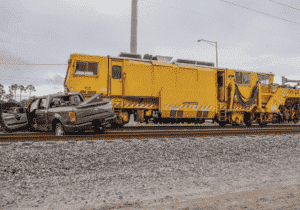
When a commercial truck collision leaves you facing serious injuries, mounting bills, and a carrier’s legal team already building its defense, you need advocates who move faster and fight harder than the insurer expects.
The Law Offices of Anidjar & Levine helps injured people preserve evidence, evaluate liability, and pursue compensation after a commercial vehicle crash in Jacksonville.
A Jacksonville Personal Injury Lawyer can provide support by securing police reports, driver logs, maintenance records, black box data, medical documentation, and witness statements while managing insurer communications and claim deadlines.
What Is a Truck Accident Injury Claim?
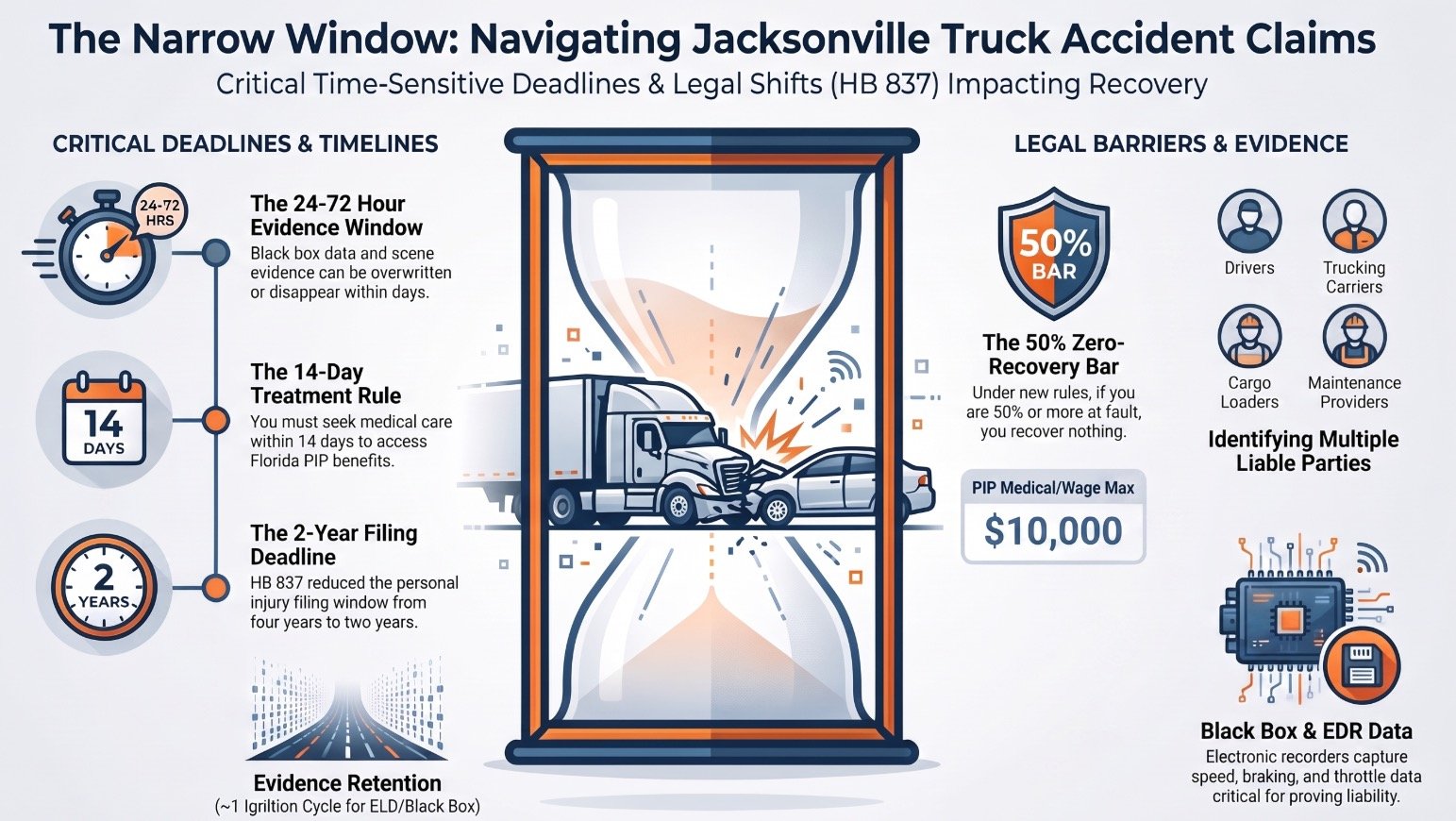
A truck accident injury claim is a legal action brought by a person who suffers physical, financial, or emotional harm resulting from a commercial vehicle collision caused by another party’s negligence. Unlike standard car accident claims, truck accident cases often involve the truck driver, the carrier, maintenance contractors, cargo loaders, and multiple commercial insurers simultaneously. In Florida, the injured driver must first seek up to $10,000 in PIP benefits from their own insurer, with treatment beginning within 14 days of the crash. To recover compensation beyond PIP, including pain and suffering, the injured person must generally meet Florida’s serious injury threshold: a permanent injury, significant and permanent disfigurement, or death. Under HB 837 (2023), the filing deadline is 2 years, and any party found 50% or more at fault is barred from any recovery.
Main Takeaways
- A Jacksonville truck accident lawyer helps preserve evidence, document damages, and guide injured people and families after serious commercial vehicle crashes.
- Truck accident claims often involve multiple parties, including drivers, trucking companies, maintenance providers, and cargo loaders, each with separate insurance coverage.
- Key evidence may include police reports, driver logbooks, black box EDR data, maintenance records, and crash-scene photographs, all of which can disappear within days.
- Common causes include driver fatigue, distracted driving, improper cargo loading, poor maintenance, and carrier pressure to meet unrealistic delivery schedules.
- Prompt legal support can help with insurance disputes, medical record review, compensation evaluation, and compliance with Florida’s two-year filing deadline under HB 837.
How We Can Help With Your Jacksonville Truck Accident Injury Claim
After a serious truck crash, an injured person may face medical treatment, lost income, insurance disputes, and questions about who is legally responsible. A Jacksonville truck accident lawyer can provide organized guidance, allowing the injured person and family to focus on recovery. Legal counsel may preserve evidence, communicate with insurers, review medical records, and document financial losses with care.
A firm can also monitor the insurance timeline, helping prevent missed deadlines and incomplete submissions that may weaken a claim. Through a thoughtful settlement strategy, counsel can evaluate offers, measure future needs, and respond with facts rather than pressure. This support may include coordinating expert reviews, identifying available coverage, and presenting the claim in a clear, responsible manner. By managing these tasks, the lawyer helps protect the injured person’s rights while promoting a process grounded in diligence, fairness, and accountability for all parties involved.
For an overview of how Florida’s PIP system shapes the initial car accident claim: Florida PIP Insurance Explained.
Understanding Jacksonville Truck Accident Injury Cases
Understanding a Jacksonville truck accident injury case begins with recognizing that these claims often involve more than a simple traffic collision. They may require careful review of injuries, vehicle damage, medical treatment, insurance coverage, and the responsibilities of multiple parties. A strong claim often depends on timely crash-scene documentation, including photographs, witness statements, police reports, and records documenting how the collision affected the injured person’s daily life.
Medical records and professional evaluations may also help connect the harm suffered to the incident. Because truck-related injuries can create lasting physical, financial, and personal burdens, the evaluation of compensation must be thorough and evidence-based. Each case should be approached with discipline, accuracy, and concern for restoring stability to those harmed while preserving their legal rights.
Jacksonville Truck Accident Claims: What the Numbers Tell Us About Commercial Vehicle Risk in Duval County
The numbers behind Jacksonville truck accident claims reveal why injured people in Duval County face one of the most contested legal environments in Florida. According to the FLHSMV 2022 Florida Traffic Crash Facts, Florida recorded 401,523 total crashes and 3,535 traffic fatalities statewide, with Duval County among the top crash counties due to Jacksonville’s I-95/I-10/I-295 interchange, significant port traffic, and heavy commercial truck volume on surface streets and highway corridors.
NHTSA data shows distracted driving killed 3,208 people nationally in 2024, and distraction is a leading cause of the rear-end and lane-change truck collisions that dominate Jacksonville personal injury claims.
Florida’s HB 837 (2023) reshaped every truck accident claim by shortening the filing window to 2 years and imposing a 50% comparative fault bar that bars recovery when the injured person is found more than half responsible. Florida’s PIP system covers only $10,000 maximum for initial medical expenses, an amount routinely exhausted by a single emergency room visit after a serious truck crash. Commercial truck black box EDR data can be overwritten after the next ignition cycle, and physical crash evidence begins degrading within 24 to 72 hours, making immediate preservation the single most important action after any serious truck accident in Jacksonville.
Common Causes of Jacksonville Truck Accidents
Truck accidents in Jacksonville often arise from preventable conditions that increase the risk of severe roadway harm. Common causes include driver fatigue, distracted driving, improper cargo loading, and poor truck maintenance, each of which may indicate negligence by a driver, trucking company, or other responsible party. Identifying these factors is critical when evaluating liability, preserving evidence, and determining the strength of an injury claim.
Driver Fatigue
When commercial drivers remain on the road beyond safe limits, fatigue can impair judgment, slow reaction time, and increase the risk of a serious Jacksonville truck accident. Long hours, irregular schedules, overnight routes, and pressure to meet delivery deadlines can leave drivers unable to operate heavy vehicles safely. Fatigue may also result from untreated sleep disorders, poor rest periods, or inadequate company supervision. Federal hours-of-service rules and accurate logging compliance are designed to reduce these risks, but violations can place the public in danger. After a crash, driver records, electronic logs, medical information, and employer practices may help show whether exhaustion contributed to the collision and resulting harm for injured people.
Distracted Driving
Although commercial driving demands constant attention, distracted driving remains a common cause of serious truck accidents in Jacksonville. A driver who looks away from traffic, reaches for an object, adjusts navigation, or engages in conversation may lose the seconds needed to prevent harm. Because tractor-trailers require greater stopping distances and careful lane control, even a brief distraction can place nearby motorists, passengers, cyclists, and workers in danger.
Cell phone risks are especially concerning because texting or reading messages involves visual, manual, and cognitive distractions. In congested areas of Jacksonville, one missed traffic signal or delayed response can contribute to rear-end crashes, sideswipes, and multi-vehicle collisions. Attorneys reviewing these incidents may examine phone records, onboard data, witness statements, and video evidence to determine whether preventable inattention contributed to the crash.
Improper Cargo Loading
Improper cargo loading can make a commercial vehicle unstable long before it enters Jacksonville traffic. When freight is stacked unevenly, inadequately restrained, or placed beyond safe limits, the truck may sway, jackknife, or overturn during routine braking or lane changes. These hazards can endanger families, workers, and first responders who share the road.
Federal and industry load securement standards require careful placement, restraint, and inspection of cargo before transport. Violations may indicate preventable carelessness by shippers, loaders, carriers, or drivers. Weight distribution defects are especially dangerous because they can shift the vehicle’s center of gravity and reduce safe handling. In a Jacksonville truck accident claim, reviewing bills of lading, loading records, and cargo evidence may help identify responsible parties and support accountability for injured people.
Poor Truck Maintenance
Because commercial trucks operate under heavy loads and demanding schedules, poor maintenance can quickly turn routine travel into a serious safety risk. When a trucking company, maintenance provider, or driver neglects inspections and repairs, important systems may fail without warning. Defective brakes can increase stopping distance, especially in Jacksonville traffic, where sudden slowdowns are common. Worn tires may reduce traction, raise the risk of blowouts, and make it harder for a driver to maintain control during rain or heavy congestion.
Proper maintenance is not merely an operational concern; it is a public safety duty owed to everyone sharing the road. Records of inspections, repairs, and service schedules may help determine whether preventable neglect contributed to a crash and harmed innocent motorists.
Your Legal Rights After a Jacksonville Truck Accident Injury
A person injured in a Jacksonville truck accident may have the right to pursue compensation when another party’s negligence, misconduct, or regulatory violation caused the crash. These rights may include claims for medical expenses, lost income, diminished earning capacity, pain, and necessary long-term care.
- The right to seek accountability from a driver, trucking company, maintenance provider, cargo loader, or other responsible entity whose negligence caused the crash.
- The right to preserve and use black-box EDR data, driver logbooks, maintenance records, and cargo documentation to counter the carrier’s comparative-fault arguments.
- The right to reject unfair settlement offers and request full evaluation of future losses, including long-term medical care, lost earning capacity, and non-economic damages.
- Family members may pursue related claims when injuries affect household support, caregiving, companionship, or the injured person’s ability to meet prior responsibilities.
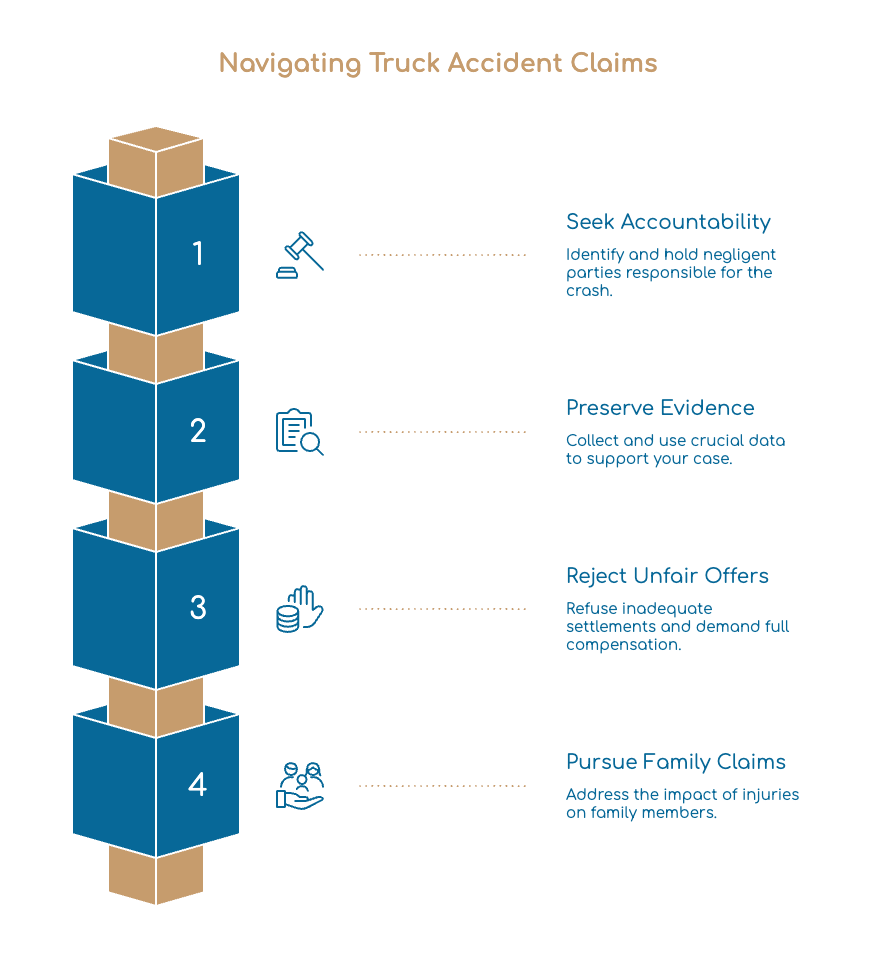
These rights help restore stability and allow advocates to serve injured individuals with diligence and respect after a serious commercial vehicle collision in Jacksonville and throughout Duval County.
Why Do Truck Accident Injuries Happen in Jacksonville?
In Jacksonville, severe truck injuries may result from driver fatigue, speeding, distracted driving, improper lane changes, or failure to account for stopping distance. Commercial trucks also create heightened risks when cargo is unsecured, brakes are poorly maintained, or companies pressure drivers to meet unrealistic delivery schedules. Common road hazards, including construction zones, limited visibility, sudden congestion, and unsafe merge areas on the I-95/I-10 corridor, can increase the likelihood of serious harm when large vehicles are involved.
Investigators often look for wrongful-collision patterns, such as rear-end impacts, underride crashes, sideswipe events, and wide-turn collisions, to determine whether negligence contributed. Identifying these causes supports accountability and safer transportation practices, while helping distinguish unavoidable incidents from preventable conduct that placed families, motorists, and communities at risk on Jacksonville roadways.
What Should You Do After a Jacksonville Truck Accident Injury?
After a Jacksonville truck accident injury, the injured person should take prompt, organized steps to protect health, safety, and any potential legal claim. Immediate medical care, a formal accident report, and careful preservation of evidence can materially affect how the incident is documented and evaluated. These actions help establish the connection between the crash, the injuries, and the losses that may follow.
Seek Immediate Medical Care
Seek prompt medical care for any injury after a Jacksonville truck accident, even if symptoms seem minor or delayed. A qualified medical provider can evaluate hidden trauma, including concussions, internal injuries, spinal damage, and soft tissue harm that may worsen without treatment. Timely care also creates medical records that connect injuries to the collision, supporting later claims and responsible advocacy for the injured person and family. For car accident claims, treatment must begin within 14 days of the crash to preserve Florida PIP benefits. Delays may allow insurers to question whether the truck crash caused the condition. Consistent follow-up care demonstrates diligence, protects health, and helps others involved understand the true impact of the injury.
Report the Accident
When a truck accident causes injury in Jacksonville, the crash should be reported to law enforcement as quickly as possible. A formal report creates an official record, alerts emergency responders, and helps ensure injured people receive appropriate assistance. Those present should first follow basic scene safety steps, such as moving from active traffic when possible, warning others of hazards, and waiting for trained responders if conditions are dangerous.
A responding officer may document driver identities, vehicle information, roadway conditions, and preliminary observations. Injured individuals, passengers, and helpful bystanders should provide accurate facts without guessing or assigning blame. If it can be done safely, witness contact information should be shared with the officer. Prompt reporting supports accountability, public safety, and orderly care for everyone affected by the collision.
Preserve Critical Evidence
Because evidence can quickly disappear after a commercial truck collision, injured individuals should take reasonable steps to preserve information that may later help clarify how the crash occurred. Photographs of vehicle positions, roadway marks, cargo spills, weather conditions, and visible injuries may provide valuable context for investigators. If possible, names and contact information for drivers, passengers, first responders, and bystanders should be documented promptly.
Nearby businesses, traffic cameras, dash cameras, and residential security systems may contain video footage showing the truck’s movement before impact. Preserving damaged personal property, medical records, repair estimates, and insurance communications may also support a complete record. Careful evidence preservation helps protect truth, accountability, and the injured person’s ability to seek fair resolution.
Critical Evidence in a Jacksonville Truck Accident Injury Case
Critical evidence often determines how clearly a Jacksonville truck accident claim can establish fault, regulatory violations, and resulting losses. Key materials may include police crash reports, driver logbooks, truck maintenance records, black box EDR data, and witness statements. Each item can provide important context regarding the collision, the truck’s condition, and the conduct of the driver or trucking company.
Police Crash Reports
After a serious truck collision in Jacksonville, the police crash report often serves as foundational evidence in an injury claim. Prepared by the responding officer, it may identify the drivers, vehicles, roadway conditions, apparent violations, insurance details, and the officer’s preliminary assessment of fault. For injured people and those helping them seek fair treatment, this document can clarify early facts before memories fade or evidence is lost. It may also contain witness statements, diagrams, photograph references, and notes about citations or contributing factors. In liability disputes, insurers and attorneys often compare the report with medical records, vehicle damage, and other evidence. Although not always conclusive, a well-reviewed crash report can guide investigation, support negotiations, and help protect an injured person’s legal rights.
Driver Logbooks
A police crash report may identify early signs of driver fatigue or regulatory violations, but driver logbooks often provide the deeper record needed to evaluate what happened leading up to a Jacksonville truck accident. These records may show driving time, rest breaks, duty status, and route details, helping investigators determine whether the driver complied with federal safety rules. When driver logbook errors appear, they may suggest carelessness, pressure from a carrier, or an attempt to conceal unsafe conduct. Hours-of-service violations are especially important because excessive driving can reduce alertness and endanger everyone sharing the road. For injured people and families seeking accountability, careful review of logbooks can provide a clearer understanding of preventable harm and assist counsel in accurately and carefully identifying responsible parties.
Truck Maintenance Records
When a commercial truck is involved in a Jacksonville accident, maintenance records can reveal whether mechanical problems contributed to the crash. These records may show missed repairs, overdue service, worn brakes, tire defects, wheel guidance issues, or lighting failures that placed others at risk. A careful review can help determine whether the trucking company followed required safety inspections and responded properly to known hazards. Maintenance files may also indicate whether problems reported by a driver were ignored or delayed, creating preventable danger for motorists, passengers, and pedestrians. Preserving these documents quickly is critical, because they may clarify responsibility and support a thorough evaluation of the injured person’s claim.
Black Box EDR Data
Modern commercial trucks contain Event Data Recorders (EDRs) that capture speed, braking force, throttle position, seat belt use, engine fault codes, and sudden changes in operation in the seconds before impact. According to NHTSA, Event Data Recorders provide an objective pre-crash record that can confirm or refute a carrier insurer’s comparative fault argument — particularly claims that the injured person was driving negligently. EDR data can be overwritten when the vehicle’s ignition is cycled after a crash, making formal spoliation letters essential immediately after any serious collision. Our firm sends these preservation demands on the day of retention.
Learn more: How Black Box Data Can Make or Break Your Florida Truck Accident Case.
Long-Term Effects of Jacksonville Truck Accident Injuries
Truck accident injuries in Jacksonville can create lasting consequences, including chronic pain complications that require ongoing treatment and careful medical documentation. These injuries may also reduce earning capacity when an injured person cannot return to prior work or must accept lower-paying employment. Emotional trauma recovery is another significant concern, as psychological effects may persist long after physical injuries have stabilized.
Chronic Pain Complications
After a serious collision involving a commercial vehicle, chronic pain can become one of the most disruptive long-term complications for injured motorists, passengers, and pedestrians in Jacksonville. Lingering back, neck, joint, or nerve pain may affect sleep, mobility, caregiving duties, and community participation. These symptoms often require coordinated pain management through physicians, therapists, and experts who monitor function and adjust treatment over time. Medication management may also be necessary, particularly when prescriptions must balance relief with safety, side effects, and dependency risks. Careful documentation of symptoms, diagnoses, appointments, and treatment response helps clarify the continuing impact of truck accident injuries and supports fair evaluation of long-term needs.
Lost Earning Capacity
When a serious Jacksonville truck accident causes lasting physical or cognitive limitations, lost earning capacity may become a central part of the injury claim. This loss concerns the injured person’s reduced ability to earn income over time, not merely wages missed during recovery. Evaluators may review medical restrictions, prior earnings, education, job duties, and likely career advancement to measure the financial effect. The issue can be especially important for caregivers, public servants, and skilled laborers whose work supports families and communities. A Jacksonville truck accident lawyer may help document vocational losses, consult qualified experts, and present evidence that reflects the full value of diminished earning ability.
For context on how Florida values serious injury claims: Average Personal Injury Settlements in Florida by Case Type.
Emotional Trauma Recovery
Although physical injuries often receive immediate attention, emotional trauma can remain a lasting consequence of a serious Jacksonville truck accident. Survivors may experience anxiety, sleep disruption, depression, intrusive memories, or fear of driving, each of which can impair daily responsibilities and relationships. For individuals committed to caring for family, work, and community, these effects may create additional strain and reduce their capacity to serve others consistently.
Mental health professionals may recommend structured treatment including gradual exposure therapy, stress management, and support groups. In a legal claim, records of diagnosis, treatment frequency, and functional limitations may help show the long-term impact of emotional trauma and the need for continued care, supporting fair compensation for harm that goes beyond what a medical bill alone can capture.
Proving Liability in Jacksonville Truck Accident Injury Cases
Because truck accident claims often involve multiple companies and layers of responsibility, proving liability requires a careful investigation into how the collision occurred and who had the legal duty to prevent it. Attorneys may examine driver conduct, carrier practices, vehicle maintenance records, cargo loading procedures, and compliance with federal and Florida safety rules. Each fact helps determine whether negligence by a driver, trucking company, maintenance provider, or another party contributed to the harm.
Effective proof often depends on the preservation of prompt evidence. Witness statements, traffic signal footage, police reports, electronic logging data, and truck inspection records can clarify timing, speed, visibility, and decision-making before impact. In Jacksonville, roadway design, port traffic, and commercial delivery routes may also influence the liability analysis. A careful legal review supports injured people while honoring the broader duty to protect families, workers, and communities from preventable harm caused by unsafe trucking practices.
Understanding which medical records matter most in a Florida injury claim is critical to connecting the crash to documented harm.
Dealing With Insurance Companies After a Jacksonville Truck Accident Injury
After liability evidence is identified, insurance companies often become central to how a Jacksonville truck accident injury claim develops. Adjusters may request statements, records, authorizations, or early settlement discussions, and each response can affect the value of the claim. Careful communication helps protect the injured person while supporting a fair review of the harm caused.
Medical bill documentation should be organized, complete, and consistent with treatment records because insurers often compare expenses with diagnoses, prognoses, and documented limitations. Gaps in care, unclear invoices, or incomplete records may be used to question the severity of injuries. Those assisting an injured person should encourage timely treatment, accurate recordkeeping, and thoughtful responses to insurer inquiries. The insurance claim timeline also requires attention, as deadlines may involve policy notice requirements, document submissions, or follow-up communications. A disciplined approach can reduce delays, preserve credibility, and help ensure the claim is evaluated with seriousness and respect.
What to Expect During a Jacksonville Truck Accident Injury Claim Process
A Jacksonville truck accident injury claim typically begins with an initial case evaluation, where liability, damages, and available insurance coverage are reviewed. The process then moves into evidence collection and insurance negotiations, which may involve accident reports, medical records, witness statements, and communications with multiple insurers. If a fair settlement cannot be reached, the claim may proceed toward litigation, where the dispute is resolved through formal legal action.
Initial Case Evaluation
During the initial case evaluation, a Jacksonville truck accident lawyer reviews the available facts to determine how the crash occurred, who may be liable, and what damages may be recoverable. This meeting helps clarify the injured person’s goals, medical condition, employment losses, and immediate family needs. The lawyer may explain deadlines, insurance issues, and the role of commercial trucking regulations without requiring the client to resolve those matters alone. A preliminary evidence timeline may be outlined to identify crucial events, such as the collision, treatment, reporting, and insurer contact. The evaluation also supports an early settlement strategy, focused on protecting the client’s dignity while pursuing fair compensation. This step provides practical guidance, allowing the injured person and support network to make informed decisions.
Evidence Collection Process
Once the claim moves beyond the initial evaluation, evidence collection becomes a structured effort to preserve facts before records disappear, memories fade, or vehicles are repaired. In a Jacksonville truck accident injury claim, this stage may involve securing crash reports, medical records, driver logs, maintenance files, inspection records, and electronic data from the commercial vehicle. A careful witness interview can help clarify roadway conditions, driver conduct, and the sequence of events. Available camera footage from traffic systems, nearby businesses, dash cameras, or security devices may also provide objective support. Thorough evidence gathering creates a reliable foundation for understanding responsibility, documenting harm, and ensuring that each decision rests on verifiable information.
Insurance Negotiation Steps
After the evidence has been organized and damages have been evaluated, insurance negotiation often begins with a formal demand package sent to the responsible insurer or insurers. This package typically summarizes the crash, medical treatment, lost income, future needs, and supporting documentation. A careful liability assessment helps identify how the truck driver, carrier, maintenance provider, or other parties contributed to the harm. Insurers then review records, photographs, expert findings, and witness statements before issuing a response. During this stage, the injured person’s representative may answer questions, correct incomplete assumptions, and challenge attempts to minimize responsibility.
Settlement or Litigation
If insurance negotiations do not produce a fair resolution, the claim may proceed toward settlement discussions with greater pressure or formal litigation in court. At this stage, the injured person’s legal team evaluates liability, damages, and trial risks while continuing to serve the client’s practical needs. Insurance negotiation may continue after a lawsuit is filed, often through mediation or structured settlement conferences. Evidence preservation remains important, including driver records, electronic logging data, maintenance files, medical records, and witness testimony. If settlement is not reasonable, litigation allows a court to examine disputed facts and determine responsibility. A disciplined approach helps protect the claim, support informed decisions, and pursue fair compensation with diligence and integrity.
Compensation for Jacksonville Truck Accident Injury Damages
When a truck accident causes serious injuries, compensation may be available for both financial losses and broader personal harm. In Jacksonville, recovery often depends on proving how the collision occurred, who owed a duty of care, and how that duty was breached. A lawyer may evaluate driver conduct, trucking company practices, maintenance records, loading procedures, and insurance coverage to identify responsible parties.
Careful documentation supports a claim from the beginning. Medical records, witness statements, crash reports, electronic logging data, and other court evidence may help connect the injuries to the truck accident. Negligence defenses, including claims that the injured person contributed to the crash, must also be addressed with organized proof and clear legal analysis. For individuals and families focused on restoring stability, compensation can provide resources for treatment, caregiving needs, and future planning while accountability is pursued through negotiation or litigation.
Economic vs. Non-Economic Damages in Jacksonville Truck Accident Cases
Truck accident claims in Jacksonville often involve both economic and non-economic damages, each addressing a different category of loss. Economic damages reflect measurable financial harm, while non-economic damages account for personal impacts such as pain, suffering, and diminished quality of life. Proving these losses requires organized evidence, credible documentation, and a clear connection between the collision and the claimed damages.
Economic Damages Explained
Economic damages in a Jacksonville truck accident case are the measurable financial losses resulting from the collision, including medical bills, lost income, reduced earning capacity, rehabilitation expenses, property damage, and other out-of-pocket costs. Types of expenses may include emergency care, surgery, prescription medication, medical equipment, vehicle repair, rental transportation, and necessary household assistance during recovery. Economic damages calculations often require careful review of invoices, wage statements, tax records, expert opinions, and projected future treatment needs. In truck accident claims, accuracy is important because serious injuries can create long-term financial strain. A well-documented claim helps ensure that recovery efforts address practical needs and protect the injured person’s stability.
Non-Economic Damages Explained
Although financial losses are often easier to document, non-economic damages in a Jacksonville truck accident case address the personal harm that does not come with a direct invoice or receipt. These damages may include pain, emotional distress, loss of enjoyment of life, disfigurement, or the strain placed on family relationships. For people committed to serving others, such losses can be especially profound when injuries limit caregiving, employment, or community involvement. Florida’s comparative negligence rules may reduce recovery if the injured person shares responsibility for the crash, making careful evidence review important from the outset.
Proving Truck Accident Losses
After considering the personal impact of non-economic harm, a Jacksonville truck accident claim must also show how each loss is proven and valued. Economic damages require documents that connect the crash to measurable costs, including medical bills, wage records, repair estimates, and future care opinions. Non-economic damages depend on medical notes, witness statements, photographs, therapy records, and consistent descriptions of pain, limitations, and emotional strain. A lawyer may organize these materials to present a clear account of hardship and responsibility, helping insurers, courts, and juries understand the full harm caused and supporting a claim that reflects both financial loss and human impact.
When a Jacksonville Truck Accident Injury Case Goes to Trial vs. Settlement
When a Jacksonville truck accident injury case advances beyond the initial claim stage, the central question often becomes whether to resolve the case through settlement or proceed to trial. Settlement may provide a more predictable path, allowing injured individuals and their families to secure resources without the delays and uncertainty of a courtroom. The settlement timeline often depends on medical recovery, evidence development, insurer evaluation, and each party’s willingness to negotiate in good faith.
Trial strategy becomes important when the defense disputes liability, minimizes injuries, or refuses to offer fair compensation. Preparing for trial can strengthen negotiation leverage because thorough evidence, expert support, and a clear presentation of damages demonstrate readiness to proceed. If trial is necessary, jury selection may influence how the facts are received and understood. A careful legal approach helps protect the injured person’s interests while supporting a just resolution that serves both accountability and recovery.
Florida Laws That May Affect Your Jacksonville Truck Accident Case
In a Jacksonville truck accident case, Florida law can shape nearly every stage of the claim, from determining fault to calculating recoverable damages. These rules help protect injured people, while encouraging accountability for unsafe conduct by drivers, carriers, and related businesses.
- Comparative negligence may reduce compensation when an injured person shares responsibility for the incident, and under HB 837, reaching 50% fault bars all recovery entirely, making careful evidence review essential from the outset of any truck accident claim.
- No-fault insurance rules require the injured driver to seek up to $10,000 in PIP benefits from their own insurer first; treatment must begin within 14 days of the crash, and serious injuries can support claims against at-fault commercial parties beyond the PIP cap.
- Commercial vehicle regulations impose state safety duties affecting maintenance, hiring, training, and supervision, which may provide additional grounds for liability beyond the individual driver’s negligent conduct.
- Federal preemption laws can override conflicting state rules, especially on carrier operations and safety standards under FMCSA, making a review of both state and federal requirements essential in any commercial truck accident case.
- Vicarious liability may hold trucking companies responsible when their drivers cause harm while acting in the course of business, even when the carrier attempts to classify drivers as independent contractors to limit its exposure.
A careful legal review can help identify applicable laws, preserve useful evidence, and support a claim that serves the injured person’s recovery needs.
The Statute of Limitations for Jacksonville Truck Accident Injury Cases
Because filing deadlines can determine whether an injured person may pursue compensation, the statute of limitations is a central issue in Jacksonville truck accident injury cases. In Florida, most negligence-based injury claims must be filed within 2 years of the crash under HB 837 (effective March 24, 2023). If a lawsuit is not filed within that period, the court may dismiss the claim, regardless of the severity of the injuries or the hardship experienced by the injured person.
Certain circumstances may affect how the deadline is calculated, including claims involving government entities or delayed discovery of particular harms. A careful medical treatment timeline may also support the accurate documentation of injuries, recovery needs, and losses within the available time. During this period, insurance communications should be handled with caution, because statements, delays, or incomplete records may affect the claim. Timely action helps preserve evidence, protect rights, and support responsible efforts to serve injured individuals and their families.
How a Jacksonville Truck Accident Lawyer Can Help You
After a serious truck collision, a Jacksonville truck accident lawyer can help an injured person understand legal options, preserve vital evidence, and pursue compensation through a structured claim process. Counsel may coordinate the claim so the injured person can focus on recovery, family obligations, and service to the community.
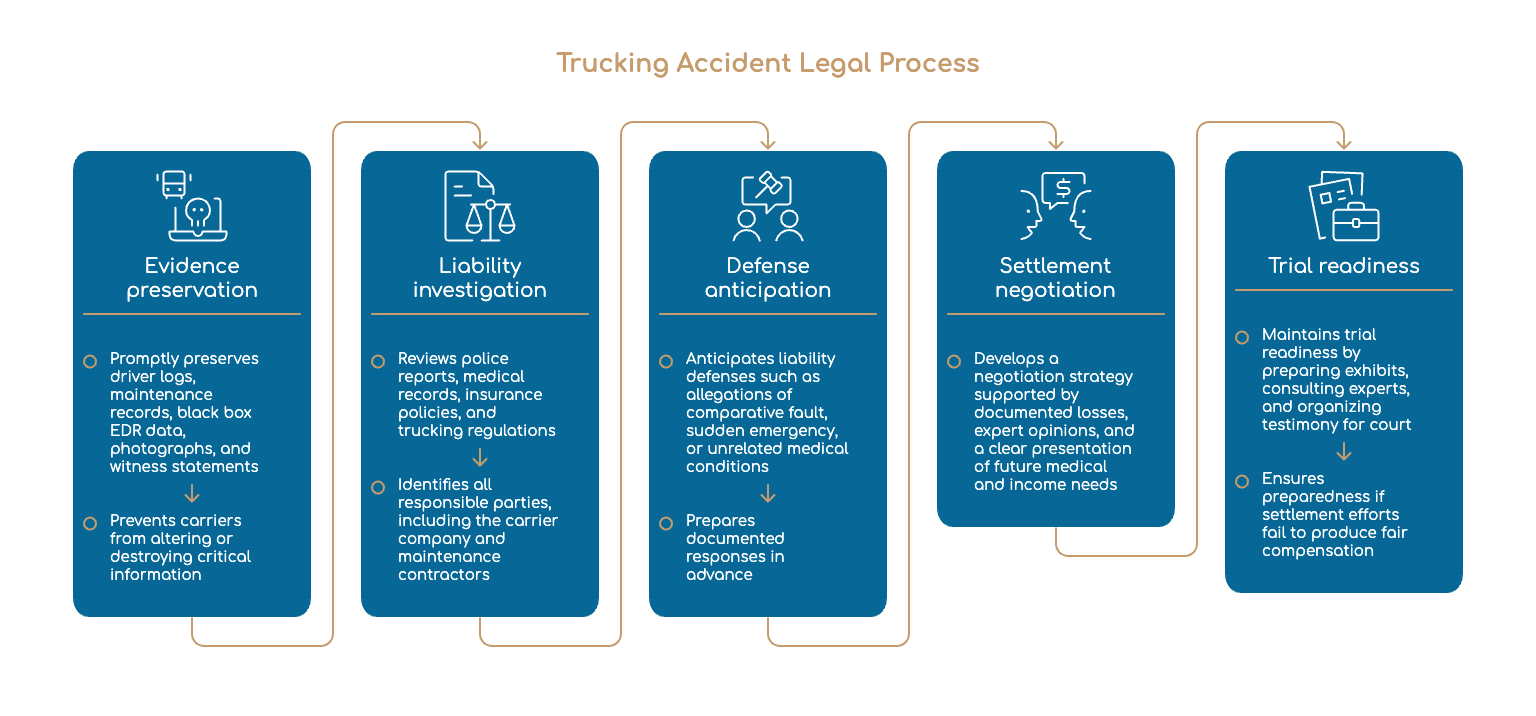
- Evidence preservation: The lawyer promptly preserves driver logs, maintenance records, black box EDR data, photographs, and witness statements before carriers can alter or destroy them.
- Liability investigation: Reviews police reports, medical records, insurance policies, and trucking regulations to identify all responsible parties, including the carrier company and maintenance contractors.
- Defense anticipation: Anticipates liability defenses such as allegations of comparative fault, sudden emergency, or unrelated medical conditions, and prepares documented responses in advance.
- Settlement negotiation: Develops a negotiation strategy supported by documented losses, expert opinions, and a clear presentation of future medical and income needs.
- Trial readiness: Maintains trial readiness by preparing exhibits, consulting experts, and organizing testimony for court if settlement efforts fail to produce fair compensation.
When to Contact a Jacksonville Truck Accident Lawyer
Contact should occur as soon as medical needs are addressed and immediate safety concerns are under control. Early communication enables timely preservation of evidence, including driver logs, electronic control data, maintenance records, photographs, witness accounts, and company communications, which may otherwise be lost or altered within hours of the crash.
A person should also consider legal guidance when injuries require continued treatment, liability is disputed, multiple vehicles are involved, or a trucking company contacts the injured party directly. Prompt attention is especially important after an insurance claim denial, delayed response, or low settlement offer, because deadlines and documentation requirements can affect available options. Families caring for an injured loved one may benefit from seeking guidance before signing releases, giving recorded statements, or accepting payment. Timely consultation helps protect the person’s interests and supports responsible decision-making during recovery from a serious commercial truck accident.
Why You Need an Experienced Jacksonville Truck Accident Lawyer
A truck accident claim in Jacksonville often involves more than a standard insurance dispute, as commercial carriers, corporate insurers, maintenance contractors, and federal safety regulations may all affect the outcome. An experienced lawyer helps injured individuals understand these overlapping issues while protecting their ability to seek fair compensation. This support can be especially important when the injured person is focused on recovery, family responsibilities, and the needs of others who depend on stable care and income.
A lawyer familiar with truck accident litigation can identify evidence of liability, including driver logs, inspection records, black box data, loading documents, and company safety practices. Preserving and analyzing this information may clarify fault before it is lost or altered. Experience also informs settlement strategy, helping measure medical costs, lost wages, future care, and other losses against insurer arguments.
At Anidjar & Levine, that experience is anchored by Glen Levine’s Board Certification in Civil Trial and the firm’s AV Preeminent rating from Martindale-Hubbell, independently verified credentials that distinguish serious litigation preparation from general practice. Court process readiness is equally important, even when settlement is possible, because preparation for litigation often shapes negotiation strength.
How to Choose the Right Jacksonville Truck Accident Lawyer for Your Case
Selecting the right Jacksonville truck accident lawyer begins with evaluating whether the attorney has direct experience handling commercial trucking claims, not merely general motor vehicle cases. A suitable lawyer should understand federal trucking regulations, driver qualification records, maintenance logs, black box data, and the role of carrier insurers and corporate defendants. These case evaluation criteria help injured individuals and their families identify counsel prepared to investigate thoroughly and protect their interests.
Careful consideration should also be given to responsiveness, organization, and clarity. Ask how often updates will be provided, who will answer questions, and whether the lawyer explains legal options in plain terms. A dependable attorney should show respect for the client’s goals, medical needs, and desire for stability. Ask specifically about Board Certification in Civil Trial and an AV Preeminent rating. Attorney fees should be discussed in writing before representation begins. Many truck accident lawyers work on a contingency basis, meaning no fee unless compensation is recovered.
Real Reviews From Our Clients!
Marcus D. ★★★★★
“A commercial truck ran a red light on I-95 and hit my car at highway speed. I had a spinal injury that required surgery and months of rehabilitation. The trucking company’s insurer immediately sent an adjuster and tried to get me to give a recorded statement before I even left the hospital. I called Anidjar & Levine the same day. They sent a spoliation letter immediately to preserve the truck’s black box data, pulled the driver’s logbooks, and found hours-of-service violations the carrier had tried to bury. The settlement they negotiated covered everything, including my future care needs. I cannot recommend them highly enough.”
Renata F. ★★★★★
“My husband was seriously hurt when an 18-wheeler merged into his lane without warning near the Jacksonville port. The carrier’s lawyers were aggressive from the start, arguing that my husband had changed lanes first. Anidjar & Levine obtained the truck’s EDR data and dashcam footage from a nearby vehicle that showed exactly what happened. They fought back against every attempt to push fault onto my husband and recovered a settlement that covered his lost income and long-term care. This firm genuinely cares about the families they represent.”
Kevin T. ★★★★★
“I was hit by an overloaded flatbed truck on I-10 and suffered a permanent knee injury that ended my career in construction. I had no idea how to deal with a carrier with multiple insurance policies and a team of corporate lawyers. Anidjar & Levine investigated the cargo loading records, found load securement violations, and identified both the carrier and the shipping company as responsible parties. They pursued every avenue and delivered a result that accounted for my lost career, not just my medical bills. I am grateful every day for their work.”
About The Law Offices of Anidjar & Levine
Founded in 2005 by Marc Anidjar and Glen Levine, the firm began as a two-person operation working out of a construction office conference room. Over the past 20 years, that modest start has grown into one of Florida’s most recognized personal injury practices, with more than $1 billion recovered in settlements for injury clients across the state. We bring that same determination and depth of experience to every truck accident case we handle in Jacksonville and throughout Duval County.
Marc Anidjar — Senior Partner
Marc Anidjar oversees the day-to-day operations of the firm and has settled thousands of cases, including commercial truck accident matters, catastrophic injury cases, and complex multi-party claims, across nearly two decades of practice. He earned his Bachelor of Science from the University of Florida in 1999 and his Juris Doctor from Nova Southeastern University, Shepard Broad School of Law in 2003. His client-centered approach ensures that every injured person receives attentive, organized, and results-focused representation from the first consultation through final resolution.


Glen Levine — Senior Partner
Glen Levine is a founding partner who oversees all of the firm’s litigation, including truck accident cases where carrier insurers invoke HB 837’s comparative fault bar to reduce or eliminate valid claims. In 2019, Mr. Levine became Board Certified in Civil Trial, the highest level of evaluation by the Florida Bar. He is consistently AV Rated by Martindale-Hubbell, the highest preeminence designation the service awards. AVVO has rated Mr. Levine 10 out of 10 (“Superb”). He received the “Lawyer of Distinction” designation in 2017, 2018, and 2019; was named to Florida Trend Magazine’s “Legal Elite” list in 2017; was recognized by the Miami Herald as a Top Rated Lawyer in South Florida in 2015; and was a finalist in the personal injury category for “South Florida Leaders in the Law” in 2013.
With more than 50,000 clients served and 419 years of combined legal experience across our team, we have the resources and depth to handle truck accident cases of any complexity in Jacksonville and throughout Duval County. Our results reflect that commitment: we recovered more than $20 million for a single Jacksonville family and secured more than $6 million for another family in a separate case. We also obtained a recovery for a family in Broward County, which was recognized as one of the top 10 settlements of the year in Florida.
Our team includes lawyers, investigators, and medical and legal support professionals who thoroughly investigate each case and pursue the full value of every client’s losses. With two board-certified civil trial lawyers on staff, your truck accident claim is backed by the highest credentials available under Florida law. We are available 24 hours a day, 7 days a week, with offices in Fort Lauderdale, Miami, West Palm Beach, Fort Myers, Tampa, Orlando, and Jacksonville.
We are also deeply invested in the communities we serve. For 15 years, we have participated in Christmas on Las Olas, and we proudly sponsor the KISS Cares radiothon, raising money for Joe DiMaggio Children’s Hospital. We also support the Scripps Howard Foundation’s “If You Give a Child a Book” campaign, MADD, the Jewish Federation, Special Compass, and dozens of other local causes across Florida. We proudly sponsor the Miami Dolphins, Miami Heat, Florida Panthers, and Tampa Bay Lightning.
Past results do not guarantee a similar outcome in future cases. Each case is evaluated individually based on its unique facts and circumstances.
Frequently Asked Questions
Can Out-of-State Visitors File Truck Accident Claims in Jacksonville?
Yes, out-of-state plaintiffs may file truck accident claims in Jacksonville when the crash occurred there or when responsible parties have sufficient ties to Florida. Jurisdiction rules determine where the claim may proceed, which court has authority, and what deadlines apply. Visitors should preserve evidence, seek medical care, and notify insurers promptly. Legal guidance can help protect rights, coordinate records, and pursue fair compensation under applicable Florida law.
Will My Truck Accident Case Affect My Driving Record?
A truck accident case may affect a driving record if the driver receives a citation, is found at fault, or faces license action. Civil claims alone usually do not create insurance points, though insurers may adjust rates after reported crashes. There is generally no direct credit impact from a claim, unless unpaid judgments or related debts arise. Careful documentation helps protect responsible drivers while supporting fair outcomes for injured people.
Can I Switch Lawyers During a Truck Accident Case?
Yes, a person may change lawyers during a truck accident case. The process generally requires client consent, notice to the current attorney, and formal attorney substitution filed with the court when litigation is pending. A careful change helps protect deadlines, evidence, and communication with insurers or opposing counsel. Those serving an injured client should make sure the change supports continuity, ethical duties, and the client’s best interests throughout the claim.
Do Truck Accident Claims Involve Federal Trucking Regulations?
Yes, truck accident claims often involve federal trucking regulations, especially when commercial carriers operate across state lines. FMCSA compliance standards govern driver hours, vehicle maintenance, cargo securement, drug testing, and driver qualifications. Federal preemption laws can affect how state claims interact with national safety rules. A careful review helps protect injured people, supports accountability, and identifies violations that may establish negligence or liability.
Are Underride Accidents Handled Differently Than Other Truck Crashes?
Yes, underride accidents are handled differently because they often require specific evidence about guard integrity, impact geometry, conspicuity markings, and compliance history. Investigators may evaluate different liability theories involving the truck driver, carrier, trailer manufacturer, maintenance provider, or cargo loader. These claims demand careful reconstruction and preservation of physical proof. Legal representation should prioritize accountability, safety improvements, and fair recovery for those seriously harmed.
How Long Do I Have to File a Jacksonville Truck Accident Lawsuit?
Under Florida’s 2023 tort reform (HB 837, effective March 24, 2023), most truck accident injury claims must be filed within 2 years of the crash. Missing this deadline can permanently bar you from compensation, regardless of injury severity or the extent of the trucking company’s negligence. Different rules may apply in claims involving government vehicles or delayed discovery of specific injuries. Prompt legal consultation is essential to protecting your filing rights.
How Does Florida’s Modified Comparative Fault Rule (HB 837) Affect My Jacksonville Truck Accident Claim?
Florida’s modified comparative fault rule (effective March 24, 2023) directly affects how much you can recover after a truck accident in Jacksonville. Under HB 837, if you are found 50% or more at fault for the collision, you recover nothing, regardless of the severity of your injuries or medical costs. Commercial carrier insurers routinely build comparative fault arguments to push the injured person’s share above this threshold.
Black box EDR data, driver logbooks, and witness statements are the most effective tools for defeating these arguments, making immediate evidence preservation the single most critical action after any serious truck crash in Jacksonville or Duval County.
Truck accident claims in Jacksonville often involve serious injuries, complex evidence, and multiple liable parties. A qualified Jacksonville truck accident lawyer can evaluate the crash, protect the injured person’s rights, and pursue compensation for medical care, lost income, and other damages.
The Law Offices of Anidjar & Levine provides experienced legal guidance for injured clients and their families, including support from a Jacksonville Personal Injury Lawyer.
Prompt legal action can help preserve evidence, address insurance challenges, and support a stronger claim for recovery.