A Daytona Beach Truck Accident Lawyer from The Law Offices of Anidjar and Levine can investigate whether negligent maintenance, defective parts, improper repairs, or driver conduct caused a truck collision.
The investigation may include service records, inspection reports, electronic data, photographs, witness accounts, and expert analysis of failed components.
Legal counsel can help preserve evidence, communicate with insurers, organize medical documentation, and pursue compensation for medical treatment, lost income, pain and suffering, property damage, and future limitations.
Further information can explain liability, evidence preservation, and how to select appropriate legal representation.
Main Takeaways
- A Daytona Beach truck mechanical failure lawyer investigates whether poor maintenance, defective parts, negligent repairs, or driver conduct caused the collision.
- Attorneys preserve maintenance records, inspection reports, electronic data, photographs, vehicle components, and witness statements before evidence disappears.
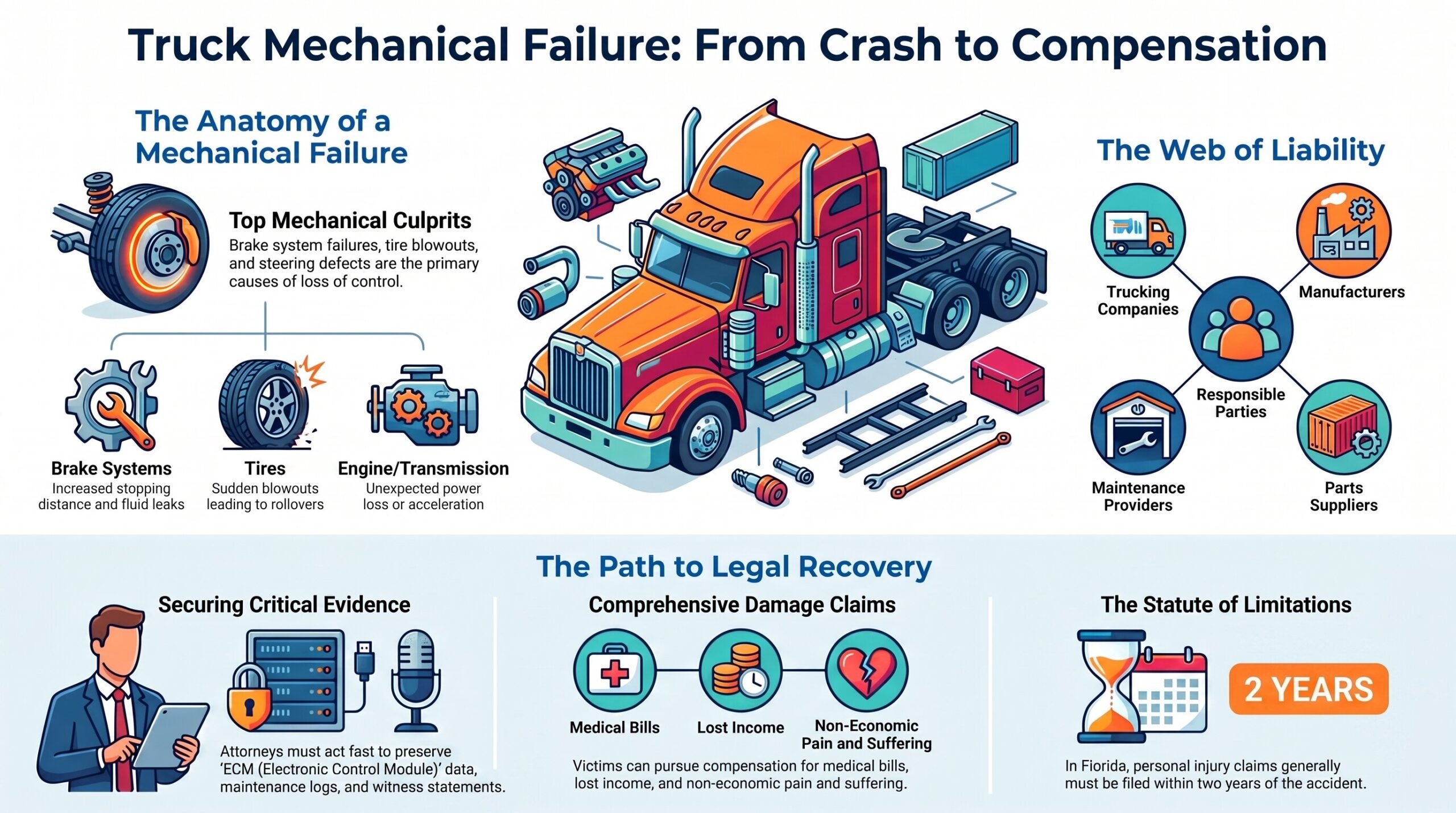
- Mechanical failures may involve brakes, tires, steering, suspension, engines, or transmissions, each requiring specialized evaluation and evidence.
- Potentially responsible parties include trucking companies, drivers, repair facilities, maintenance providers, manufacturers, and parts suppliers.
- Injury claims may seek medical expenses, future treatment, lost income, reduced earning capacity, pain, suffering, and property damage.


How We Can Help With Your Daytona Beach Truck Mechanical Failure Accident Injury Claim
When a truck’s mechanical failure causes a collision, an experienced Daytona Beach truck mechanical failure accident lawyer can help identify the responsible parties and pursue compensation for the injured person. The lawyer may review maintenance records, inspection reports, driver statements, electronic data, and photographs to determine how the failure occurred and whether preventable conditions contributed to the crash.
Counsel can communicate with insurers, preserve evidence, and organize medical documentation while protecting the claimant from statements that could undermine the case. The investigation may examine the trucking company, maintenance provider, parts manufacturer, and other entities whose conduct affected safety. Applicable Negligence standards guide the assessment of duties, breaches, causation, and damages.
If litigation becomes necessary, the lawyer can present technical evidence clearly and address jury considerations involving fault, credibility, and the requested recovery. By handling these responsibilities, legal counsel allows the injured person and family to focus on treatment and stability while a professional advocate pursues a fair result.
OUR CONSULTATIONSARE FREE
START YOUR FREE CASE REVIEW

Understanding Daytona Beach Truck Mechanical Failure Accident Injury Cases
Truck mechanical failure accident injury cases involve more than determining who was driving at the time of a collision. They require careful examination of the truck, maintenance records, inspection documents, and surrounding circumstances. A thorough fault investigation may assess whether a carrier, owner, maintenance provider, manufacturer, or another party failed to meet applicable safety responsibilities. Investigators may also review driver logs, electronic data, photographs, witness accounts, and dashcam footage to establish how the event occurred.
Medical records are equally important because they document the nature, severity, and anticipated consequences of injuries. Evidence concerning lost income, treatment costs, rehabilitation, and continuing limitations can help clarify the full scope of damages. Because vital evidence may be altered, lost, or repaired after a crash, prompt preservation efforts are essential. A careful legal evaluation helps identify responsible parties, protect an injured person’s rights, and support a claim focused on recovery and accountability.
Common Causes of Daytona Beach Truck Mechanical Failure Accident
Mechanical failures in Daytona Beach truck accidents may result from brake system failures, tire blowouts, or defects affecting steering and suspension components. Engine and transmission defects can also impair vehicle control, acceleration, or safe operation. Identifying the specific mechanical cause is crucial when evaluating liability and potential legal claims.
Brake System Failures
Brake system failures are a significant cause of commercial truck collisions in Daytona Beach, often resulting from worn brake components, inadequate maintenance, improper adjustments, or defects in the braking system. Brake maintenance should follow manufacturer requirements and include timely replacement of worn pads, linings, drums, and related hardware. A documented brake inspection may reveal air-pressure loss, fluid leaks, uneven braking, or other conditions that reduce stopping performance.
Drivers and carriers should recognize warning signs, including unusual noises, vibration, increased stopping distance, or a soft brake pedal, and address them before operation continues. Driver distraction can also prevent timely responses when braking problems arise. When a mechanical failure contributes to a collision, maintenance records, inspection reports, and repair histories may help clarify responsibility and support injured individuals seeking appropriate assistance.
Tire Blowouts
Tire blowouts are a common cause of truck mechanical failure accidents in Daytona Beach and may result from underinflation, excessive wear, overloading, punctures, or defective tires. A failed tire can cause sudden loss of control, debris hazards, or a vehicle rollover, placing occupants and nearby motorists at serious risk. Commercial carriers and drivers generally have responsibilities to inspect tires, maintain proper inflation, observe load limits, and remove unsafe equipment from service.
Tire maintenance negligence may involve skipped inspections, inadequate repairs, delayed replacement, or failure to document recurring defects. Retreaded tire failures can also occur when retreading is improperly performed, applied to unsuitable casings, or not monitored during operation. Evidence may include inspection records, maintenance logs, photographs, tire fragments, and shipment information, helping establish whether preventable conditions contributed to the collision.
Steering And Suspension Issues
When maneuvering or suspension components fail, a commercial truck may become difficult to control, drift from its lane, or respond unpredictably during braking and turns. Worn tie rods, damaged steering gears, loose connections, and defective wheel alignment can impair a driver’s ability to maintain a safe path. Suspension failures involving springs, shocks, or axles may increase body roll, reduce braking stability, and create uneven tire contact. These conditions can develop through inadequate inspections, neglected maintenance, overloaded equipment, or impacts with roadway hazards. Driver fatigue may further reduce the likelihood that a warning sign, vibration, or change in handling will be recognized promptly. Fleet operators and maintenance providers have a responsibility to identify defects and remove unsafe trucks from service. Evidence may include inspection records, repair histories, photographs, and witness accounts.
Engine And Transmission Defects
Engine and transmission defects can cause a commercial truck to lose power, accelerate unexpectedly, or become difficult to control in traffic. Malfunctioning fuel systems, defective electronic controls, inadequate lubrication, and transmission failures may create dangerous conditions for occupants and nearby motorists. A stalled truck can obstruct travel lanes, while unexpected gear changes may interfere with braking and steering.
Fleet operators should monitor Software Recall Announcements and make sure that required repairs are completed without delay. Investigators may also examine maintenance records, diagnostic data, inspection reports, and the Manufacturer Defect History to determine whether a known problem contributed to the collision. Prompt documentation can preserve evidence and clarify responsibility. When mechanical defects injure another person, affected families may benefit from professional guidance regarding reporting requirements, available compensation, and measures that guide safer commercial transportation.


Legal Rights of Daytona Beach Truck Mechanical Failure Accident Injury Victims
Daytona Beach truck mechanical failure accident victims may have legal rights to pursue compensation when defective parts, inadequate maintenance, negligent repairs, or other preventable conditions contribute to a collision. A qualified attorney can preserve evidence, identify responsible parties, and explain available legal remedies. Negligence vs liability requires careful analysis because a manufacturer, carrier, repair facility, or driver may bear responsibility under different legal theories.
Victims may seek recovery for:
- Medical expenses and necessary future treatment
- Lost income and reduced earning capacity
- Pain, suffering, and diminished quality of life
- Property damage and other documented losses
Compensation calculations should reflect both current costs and reasonably foreseeable consequences. Timely investigation can help secure maintenance records, inspection reports, electronic data, and witness accounts before evidence is lost. Victims and families can support others by reporting concerns accurately, preserving related documents, and avoiding statements that could undermine a claim. Since filing deadlines and procedural requirements vary, prompt consultation with an experienced Daytona Beach attorney can protect legal rights and promote accountability.
Why Do Daytona Beach Truck Mechanical Failure Accident Injuries Happen?
Truck mechanical failure accident injuries in Daytona Beach commonly result from preventable defects, inadequate maintenance, improper repairs, or the continued operation of unsafe equipment. Maintenance Negligence may occur when trucking companies, fleet managers, or contractors overlook inspections, postpone necessary servicing, or fail to replace worn components. Brake deterioration, tire blowouts, guidance problems, lighting failures, and defective coupling systems can compromise a truck’s control and stability, creating serious hazards for motorists, passengers, and pedestrians.
Vehicle Design Defects may also contribute when a truck contains an unsafe component, inadequate safety system, or engineering flaw that increases the likelihood of malfunction or collision. Improper repairs can introduce additional dangers when technicians use unsuitable parts, follow incorrect procedures, or fail to verify completed work. Excessive loading, poor weight distribution, and violations of manufacturer warnings may further strain mechanical systems. Identifying the underlying cause generally requires examination of maintenance records, inspection histories, repair documentation, vehicle components, and applicable safety standards.
What Should You Do After a Daytona Beach Truck Mechanical Failure Accident Injury?
After a Daytona Beach truck mechanical failure accident injury, the injured person should seek immediate medical care, even if symptoms initially appear minor. The accident scene should be documented with photographs, witness information, and relevant vehicle details when it is safe to do so. Contacting a truck accident lawyer can help preserve evidence, assess potential liability, and protect the person’s legal interests.
Seek Immediate Medical Care
When an injury occurs in a Daytona Beach truck mechanical failure accident, the injured person should seek immediate medical care, even if the symptoms initially appear minor. Emergency treatment can identify hidden injuries, prevent complications, and establish an appropriate plan for recovery. Some conditions, including concussions, internal bleeding, and spinal trauma, may not produce noticeable symptoms immediately. A prompt evaluation also creates medical documentation connecting the reported symptoms to the accident and recording the treatment received.
The injured person should describe all symptoms accurately, disclose relevant medical history, and follow the provider’s instructions regarding testing, medication, therapy, and follow-up appointments. If transportation is unsafe, emergency services should be contacted. Timely medical attention protects health, supports informed decisions, and helps ensure that necessary care remains available throughout recovery.
Document The Accident Scene
If medically safe, the injured person should document the Daytona Beach truck mechanical failure accident scene before vehicles, debris, or other conditions are changed. Photographs should capture all vehicle damage, disabled components, tire conditions, roadway defects, debris, skid marks, traffic signs, lighting, and surrounding structures. Images from multiple distances and angles can preserve details that may later disappear.
Recording traffic conditions, weather, visibility, road congestion, and lane positions may help explain how the collision occurred. Witnesses should be asked for their names and contact information, provided they can respond without interfering with emergency operations. The injured person should avoid moving evidence or attempting repairs, since those actions may alter important facts. Notes should identify the date, time, location, and apparent mechanical problems while observations remain fresh.
Contact A Truck Accident Lawyer
Why should an injured person contact a truck accident lawyer promptly after a Daytona Beach mechanical failure crash? Early legal guidance can protect important rights while evidence remains available. A lawyer may help the injured individual obtain medical records, preserve photographs, identify witnesses, and prevent insurers from minimizing legitimate losses. Because mechanical failures can involve drivers, trucking companies, maintenance providers, manufacturers, or parts distributors, responsibility may require a detailed fault investigation.
Counsel can review inspection reports, maintenance histories, electronic data, and applicable safety regulations to determine how the collision occurred. The lawyer can also explain Florida injury benefits, insurance coverage, filing deadlines, and potential compensation for medical expenses, lost income, rehabilitation, and continuing care. Prompt representation allows families and community supporters to focus on recovery while a qualified advocate manages communications and protects the claim.
Critical Evidence in a Daytona Beach Truck Mechanical Failure Accident Injury Case
Critical evidence may establish whether a mechanical failure caused the Daytona Beach truck accident and who may bear responsibility.
Key sources include:
- Maintenance and repair records
- Black box data
- Inspection and defect evidence
- Witness statements and crash-site documentation
Together, these materials can clarify the truck’s condition, the sequence of events, and whether negligence or a defective component contributed to the injury.
Maintenance and Repair Records
Maintenance and repair records can provide key evidence in a Daytona Beach truck mechanical failure accident injury case by showing whether the vehicle was properly inspected, serviced, and repaired before the collision. These documents may identify overdue maintenance, repeated defects, parts replacements, inspection findings, and recommendations that were ignored. They can also reveal whether a carrier followed federal and company safety procedures or permitted operation despite known problems.
Work orders, invoices, inspection forms, and communication between drivers, mechanics, and management may help establish notice and responsibility. Records could further show whether fatigue and driver workload affected reporting or inspections, particularly when insufficient staffing delayed repairs. Preserving these materials allows an injured person and legal counsel to evaluate the mechanical history accurately and pursue accountability while supporting the needs of affected families.
Black Box Data
When properly preserved and interpreted, black box data can provide objective evidence in a Daytona Beach truck mechanical failure accident injury case. Event data may record speed, braking, wheel direction input, engine performance, and warnings immediately before and during a collision. These records can help establish whether a driver responded appropriately, whether speed limit enforcement issues contributed, or whether an alleged mechanical problem affected control. Data may also identify patterns relevant to Brake system maintenance, such as repeated braking events or system alerts, without replacing professional evaluation.
A qualified investigator can request preservation of the module and compare its information with crash reports, witness accounts, and roadway conditions. Attorneys serving injured individuals may also consider device inspection procedures and roadside hazard reporting records when evaluating the data’s reliability and context.
Inspection and Defect Evidence
Thorough inspection and defect evidence can help establish whether a truck’s mechanical failure resulted from negligent maintenance, defective parts, or an unsafe repair in a Daytona Beach truck mechanical failure accident injury case. A qualified Vehicle inspection may identify worn components, improper adjustments, fluid leaks, brake deficiencies, or other conditions that contributed to the collision. Investigators may also examine prior repairs to determine whether work was incomplete, performed incorrectly, or followed by recurring problems.
The truck’s service history can reveal missed maintenance intervals, manufacturer notices, recurring defects, and decisions affecting roadway safety. Careful defect spotting may require preserving failed parts, photographing damage, obtaining maintenance records, and consulting qualified mechanical experts. This evidence can clarify responsibility and support fair assistance for injured individuals and their families.
Witness and Crash-Site Documentation
Witness statements and crash-site documentation can provide crucial evidence in a Daytona Beach truck mechanical failure accident injury case by preserving observations that may otherwise be lost. Prompt Witness Interviews may identify what drivers, pedestrians, passengers, and emergency personnel noticed before, during, and after the collision. Their accounts can clarify unusual braking, handling, tire movement, warning sounds, fluid leaks, or visible equipment damage.
Crash-site photographs and video should document vehicle positions, roadway conditions, debris patterns, skid marks, lighting, and nearby signs before conditions change. Camera Safety practices help preserve footage from traffic systems, businesses, residences, and vehicle cameras while respecting privacy and maintaining a reliable chain of custody. Investigators may also record weather, measurements, and scene diagrams. This organized evidence can assist qualified professionals in evaluating mechanical failure, responsibility, and the injured person’s need for support.
Long-Term Effects of Daytona Beach Truck Mechanical Failure Accident Injuries
Long-term injuries from truck mechanical failure accidents may produce chronic pain conditions that require continuing medical care and treatment. Ongoing mobility challenges can limit daily activities, employment opportunities, and personal independence. These physical effects may also create substantial emotional and financial strain for injured individuals and their families.
Chronic Pain Conditions
When a truck mechanical failure accident causes significant trauma, the resulting injuries may develop into chronic pain conditions that persist well beyond the initial recovery period. Nerve damage, spinal injuries, fractures, and soft-tissue trauma can produce recurring or constant discomfort, sometimes accompanied by sleep disruption, fatigue, or emotional strain. Effective care may require coordinated evaluation by physicians, pain experts, and mental health professionals. Medication management should be carefully monitored to balance symptom relief with potential side effects, dependency concerns, and interactions.
Treatment adherence is important because missed appointments, inconsistent therapy, or abrupt medication changes may complicate recovery and documentation. A detailed pain journal can help providers identify patterns and adjust care. Legal counsel may also help injured individuals pursue resources needed for appropriate long-term treatment and support.
Ongoing Mobility Challenges
Persistent pain may also limit mobility after a Daytona Beach truck mechanical failure accident, particularly when injuries affect the spine, joints, nerves, or weight-bearing bones. Reduced strength, balance, or range of motion can make walking, climbing stairs, driving, and completing household tasks difficult. Some individuals may require canes, walkers, wheelchairs, braces, or modified vehicles, depending on medical assessments and recovery progress. Ongoing rehabilitation may include physical therapy, occupational therapy, and coordinated follow-up with experts to preserve function and prevent further limitations.
Accessible mobility planning can help identify safe routes, bathroom modifications, transportation options, and workplace accommodations. Family members, caregivers, and community support services may assist with transportation, errands, and daily activities while independence is restored. Consistent medical documentation can clarify changing needs and support appropriate long-term care coordination.
Emotional And Financial Strain
The emotional and financial strain following a Daytona Beach truck mechanical failure accident can continue well beyond the initial medical treatment. Persistent pain, reduced mobility, and anxiety may interfere with employment, family responsibilities, and daily independence. Lost wages can compound medical expenses, rehabilitation costs, transportation needs, and the potential requirement for long-term assistance. These pressures may also affect caregivers who reduce working hours to provide support.
A careful assessment of available compensation can help address both present losses and anticipated needs. No Fault Options may provide limited benefits, although eligibility and coverage depend on the applicable insurance policies and circumstances. An injured person may also consider settlement vs. trial after reviewing liability evidence, damages, and litigation risks. Timely legal guidance can help preserve records, communicate with insurers, and pursue a resolution that supports recovery and protects household stability.
Proving Liability in Daytona Beach Truck Mechanical Failure Accident Injury Cases
Establishing liability in a Daytona Beach truck mechanical failure accident injury case requires evidence showing that a defective, neglected, or improperly repaired component caused the crash and resulting harm. Investigators may examine maintenance records, inspection reports, repair invoices, electronic logging data, and photographs from the scene. The truck’s age, service history, and operating conditions can help determine whether a preventable failure occurred.
Potentially responsible parties may include the trucking company, maintenance provider, manufacturer, parts distributor, or driver, depending on the evidence. Expert witnesses can evaluate brake systems, tires, steering components, loading practices, and repair methods, then explain how a failure contributed to the collision. Preservation of the truck and failed parts is required because later repairs or disposal may eliminate vital proof.
Clear documentation also assists with insurance disputes by connecting the mechanical defect to specific injuries and losses. A careful liability investigation supports accountability and helps injured individuals pursue appropriate remedies while protecting public safety.
Dealing With Insurance Companies After a Daytona Beach Truck Mechanical Failure Accident Injury
After liability evidence has been preserved, communication with insurance companies becomes an important part of a Daytona Beach truck mechanical failure accident injury claim. An insurer may request recorded statements, medical authorizations, employment information, or other documents. Each request should be evaluated carefully because incomplete explanations or broad releases can affect the value of a claim.
Adjusters may investigate whether maintenance records, component defects, driver conduct, or prior medical conditions contributed to the injury. They may also issue Policy claim denials based on exclusions, disputed causation, insufficient documentation, or alleged comparative fault. A qualified representative can review the policy language, challenge unsupported conclusions, and organize evidence demonstrating the injury’s consequences.
Insurance companies may employ settlement leverage tactics, including quick offers, repeated delays, or pressure to resolve a claim before treatment is complete. A careful approach protects the injured person’s interests while preserving respectful, constructive communication. Medical records, wage documentation, repair evidence, and documented expenses can support informed negotiations and help ensure that available benefits are evaluated responsibly.
What to Expect During a Daytona Beach Truck Mechanical Failure Accident Injury Claim Process
A Daytona Beach truck mechanical failure accident claim generally begins with an initial case evaluation to assess liability, injuries, and potential damages. The process then involves collecting evidence, communicating with insurers, and negotiating a fair resolution based on the documented facts. If settlement efforts fail, the matter may proceed to trial, where the available evidence and legal arguments are presented to the court.
Initial Case Evaluation
The initial case evaluation gives a Daytona Beach truck mechanical failure accident injury claim a structured starting point by examining how the crash occurred, which component failed, and who may bear legal responsibility. During this meeting, the injured person can explain symptoms, treatment, financial effects, and ongoing needs. Counsel may review available insurance information and assess whether the circumstances suggest negligence by a driver, carrier, maintenance provider, manufacturer, or another party.
Medical record collection helps clarify diagnoses, treatment progress, and the connection between the injuries and collision. Practical witness statement tips may include recording names, contact information, and each person’s immediate observations while memories remain reliable. The evaluation also identifies urgent legal deadlines, discusses realistic objectives, and establishes a communication plan focused on protecting the claimant’s interests and supporting recovery.
Evidence Collection
When evidence collection begins, counsel typically works to preserve and organize information that may establish how the mechanical failure occurred and which parties contributed to the Daytona Beach truck collision. This process can include obtaining photographs, roadway conditions, vehicle damage records, maintenance histories, and driver statements. Safety inspections, repair invoices, recall notices, and electronic data may help identify neglected defects or improper servicing.
Counsel may also request dispatch records, cargo documentation, employment files, and post-accident reporting from relevant agencies or businesses. Witness interviews can clarify events that physical evidence cannot fully explain. Investigators may inspect the truck, document damaged components, and consult qualified mechanical or reconstruction professionals. Prompt preservation efforts are important because vehicles may be repaired, records may be altered, and memories may become less reliable over time.
Insurance Negotiations
How insurers respond to a Daytona Beach truck mechanical failure injury claim may depend on the available evidence, the reported injuries, and the policies covering the truck, driver, carrier, owner, or maintenance provider. Adjusters typically review crash reports, medical records, inspection documents, and maintenance histories before evaluating responsibility and damages. Evidence of faulty maintenance may support a claim against a carrier, owner, or service provider, while policy language determines available insurance coverage.
Claimants may be asked to provide recorded statements, authorize medical releases, or accept an early offer. Careful review helps prevent incomplete information from limiting recovery. Representatives can communicate with insurers, organize supporting documentation, and monitor settlement deadlines. They may also explain requests, protect privacy, and ensure that the injured person’s needs remain central throughout the claims process.
Settlement Or Trial
After insurance negotiations begin, a Daytona Beach truck mechanical failure injury claim may resolve through a negotiated settlement or proceed to trial. During insurance negotiation, the parties assess liability, medical records, lost income, property damage, and the long-term effect of injuries. Settlement timing can vary because investigations, treatment, and insurer evaluations may require substantial documentation. A claimant may accept an offer when it fairly addresses present and future losses, but acceptance generally ends the legal claim.
If negotiations fail, counsel may recommend litigation and develop an evidence strategy involving maintenance records, inspection histories, electronic data, photographs, witness accounts, and qualified experts. Trial preparation includes depositions, motions, exhibit organization, and witness preparation. Although trial may provide an opportunity for a fuller award, it also involves uncertainty, expense, and delay.
Compensation for Daytona Beach Truck Mechanical Failure Accident Injury Damages
Compensation for injuries caused by a truck’s mechanical failure in Daytona Beach may include medical expenses, lost income, reduced earning capacity, property damage, and non-economic losses such as pain and diminished quality of life. A careful claim may also address rehabilitation, necessary transportation, household assistance, and future care supported by reliable evidence. Families may pursue Wrongful Death claims when a mechanical defect or maintenance failure causes a fatal collision, seeking damages available under Florida law.
Settlement timelines vary according to injury severity, medical recovery, insurance coverage, and the investigation of responsible parties. Comparative negligence may affect the amount recovered if another driver’s conduct contributed to the crash, although liability must be evaluated from the complete evidence. Attorneys serving injured people can preserve maintenance records, inspection reports, electronic data, witness accounts, and expert opinions. Thorough Trial preparation may become necessary when insurers dispute causation, fault, or damages. Prompt legal guidance helps protect deadlines and supports a fair resolution for victims and families.
Economic vs Non-Economic Damages in Daytona Beach Truck Mechanical Failure Accident Cases
Damages in Daytona Beach truck mechanical failure cases may include economic losses, such as medical expenses, lost wages, and future rehabilitation costs. Non-economic damages can address pain, emotional distress, reduced quality of life, and other less readily measured harms. Establishing either category generally requires reliable records, expert testimony, and evidence connecting the losses to the mechanical failure and resulting accident.
Economic Damages
In Daytona Beach truck mechanical failure accident cases, economic damages represent the measurable financial losses caused by the collision and its resulting injuries. These damages may include emergency treatment, hospitalization, surgery, medication, rehabilitation, and necessary medical equipment. They can also cover transportation to appointments, property damage, and income lost during recovery. If injuries reduce future earning capacity, projected losses may require employment records, medical opinions, and vocational analysis.
A careful maintenance record review may help establish whether neglected repairs or defective components contributed to the crash and resulting expenses. Counsel may organize invoices, wage documentation, insurance statements, and treatment records to calculate the claim accurately. This evidence supports an effective insurance settlement strategy and helps ensure that responsible parties address the victim’s documented financial needs fully and fairly.
Non-Economic Damages
Beyond documented financial losses, non-economic damages address the human effects of a truck mechanical failure accident in Daytona Beach. These damages may include physical pain, emotional distress, diminished enjoyment of life, disfigurement, and loss of companionship. Mental Health Impacts, such as anxiety, depression, trauma, or sleep disruption, may greatly affect recovery and daily functioning. Unlike medical bills or lost wages, these losses do not have fixed prices, so their value depends on the injury’s severity, duration, and influence on personal relationships and responsibilities.
Injury Documentation can help convey the lived consequences without reducing them to financial figures. An attorney may consider Insurance Bad Faith when an insurer unfairly undervalues these harms. A thoughtful Settlement Strategy should seek recognition of the person’s dignity, suffering, and long-term needs while serving the interests of a fair resolution.
Proving Damage Claims
Establishing damage claims in a Daytona Beach truck mechanical failure accident requires clear proof of both economic and non-economic losses. Economic damages may include emergency care, ongoing medical treatment, rehabilitation, lost wages, reduced earning capacity, property damage, and necessary transportation expenses. Records, invoices, employment documentation, and expert assessments help demonstrate their value.
Non-economic damages address pain, emotional distress, disfigurement, disability, and diminished enjoyment of life. Detailed medical notes, witness testimony, and personal accounts can support these less tangible losses. The claimant must also connect the harm to the crash while satisfying proof standards, including evidence of a defective part, inadequate maintenance, or another responsible party’s breach of duty.
A carefully documented Insurance negotiation strategy can present damages persuasively, challenge inadequate offers, and preserve evidence needed for potential litigation when settlement discussions fail to provide fair compensation.
When a Daytona Beach Truck Mechanical Failure Accident Injury Case Goes to Trial vs Settlement
When a Daytona Beach truck mechanical failure accident causes serious injury, the injured party may resolve the claim through settlement or pursue compensation at trial. Settlement can provide a defined recovery without the uncertainty, expense, and delay associated with courtroom proceedings. It may also allow injured individuals and their families to focus on medical care and rebuilding daily stability.
A Negotiation strategy typically relies on organized evidence, documented losses, medical opinions, and a clear explanation of how the mechanical failure caused the injuries. The parties may exchange offers, evaluate liability positions, and identify acceptable terms through counsel.
Trial becomes more likely when negotiations stall, responsibility is disputed, or the proposed compensation does not adequately address the proven harm. Trial preparation includes developing witnesses, reviewing technical records, preparing exhibits, and presenting damages in a structured manner. A court then determines the outcome based on admitted evidence and testimony. A qualified attorney can help evaluate both paths and pursue a resolution serving the injured party’s legitimate needs.
Florida Laws That May Affect Your Daytona Beach Truck Mechanical Failure Accident Case
Florida law may affect nearly every part of a Daytona Beach truck mechanical failure accident claim, including the time limit for filing, the proof required to establish negligence, and the damages available for documented injuries and losses. Other legal rules may guide how responsibility is evaluated and how compensation is pursued.
Florida law shapes filing deadlines, proof of negligence, responsibility assessments, and compensation in Daytona Beach truck mechanical failure claims.
- Comparative negligence rules may reduce recovery when an injured person shares responsibility for the collision.
- No-fault PIP coverage may provide initial benefits for medical treatment and certain lost wages, regardless of fault.
- Evidence may need to show that negligent maintenance, defective parts, or inspection failures caused the crash.
- Commercial trucking regulations may support claims involving driver qualifications, maintenance records, loading practices, or carrier oversight.
Florida law may also distinguish economic damages, such as treatment costs, from noneconomic damages, including pain and diminished quality of life. Careful documentation helps present an accurate claim and supports fair treatment for those affected.
The Statute of Limitations for Daytona Beach Truck Mechanical Failure Accident Injury Cases
A statute of limitations sets the deadline for filing a Daytona Beach truck mechanical failure accident injury lawsuit. In Florida, personal injury claims generally must be filed within two years after the accident, although specific facts can alter that period. Claims involving a government-owned vehicle may require earlier notice and different deadlines.
The filing period can also depend on when an injury was discovered, whether the injured person was a minor, or whether the defendant left Florida. Preserving records, medical documentation, maintenance histories, and witness information remains important because evidence may become harder to obtain as time passes.
Wrongful death eligibility creates additional considerations. Florida generally requires a wrongful death action within two years of the death, but exceptions may apply. Jury trial timelines do not extend the statute; the lawsuit must be filed before the applicable deadline, even if trial occurs much later. Missing the deadline can bar recovery, making prompt attention crucial for affected families.
How a Daytona Beach Truck Mechanical Failure Accident Lawyer Can Help You
Timely legal action is only one part of protecting a claim after a truck mechanical failure accident. A Daytona Beach truck mechanical failure accident lawyer can investigate the event, preserve essential evidence, and coordinate with professionals who understand vehicle systems, roadway conditions, and commercial transportation practices. This support allows an injured person to focus on recovery while a legal team serves the broader goal of accountability.
Key services may include:
- Inspecting maintenance records, electronic data, repair invoices, and driver reports.
- Arranging independent examinations and manufacturer defect analysis when a component may have failed.
- Identifying responsible parties, including carriers, repair facilities, manufacturers, or parts distributors.
- Handling Insurance coverage disputes and presenting documented damages to opposing insurers.
Counsel can also calculate medical expenses, lost income, rehabilitation needs, and other losses, then pursue appropriate compensation through negotiation or litigation. By organizing evidence and communicating with every involved party, the lawyer helps protect the claimant’s interests and promotes a fair resolution for affected families and communities.
When to Contact a Daytona Beach Truck Mechanical Failure Accident Lawyer
Knowing when to contact a Daytona Beach truck mechanical failure accident lawyer can materially affect the strength of an injured person’s claim. Consultation is appropriate as soon as medical treatment begins, particularly when injuries involve hospitalization, surgery, lasting impairment, or substantial expenses. Early legal guidance may also be important when a commercial driver, trucking company, insurer, manufacturer, maintenance provider, or government entity could share responsibility.
A lawyer can advise what to preserve, including photographs, medical records, repair estimates, vehicle information, witness contacts, and employment documentation. The injured person should avoid repairing, selling, or discarding damaged property before its condition is documented. Guidance regarding what to say to insurers can help prevent incomplete or inaccurate statements from affecting the claim.
An early case evaluation may clarify potential deadlines, available sources of compensation, and steps for preserving evidence. Prompt contact is especially prudent when an insurer requests a recorded statement, offers a settlement, or seeks access to medical records before liability and damages have been adequately reviewed.
Why You Need an Experienced Daytona Beach Truck Mechanical Failure Accident Lawyer
Because truck mechanical failure claims often involve multiple potentially responsible parties, experienced legal counsel is important to a thorough investigation. A qualified Daytona Beach attorney can examine maintenance records, inspection reports, driver logs, repair histories, and electronic data before key evidence disappears. This work may identify negligence by a carrier, mechanic, manufacturer, parts supplier, or other entity.
Experienced representation also helps address Insurance claim denial strategies, including efforts to blame the driver, minimize injuries, or characterize a preventable defect as unavoidable. Counsel can organize medical documentation and crash evidence to present a clear, supported demand while protecting an injured person’s rights during negotiations.
Mechanical failures may also create wrong-way allegations risks when directing, braking, or tire problems cause a vehicle to cross lanes. An attorney can investigate whether those allegations are supported by physical evidence rather than assumptions. This careful advocacy serves injured individuals and families by pursuing accountability, preserving fairness, and supporting informed decisions throughout the claim process.
How to Choose the Right Daytona Beach Truck Mechanical Failure Accident Lawyer for Your Case
Selecting the right Daytona Beach truck mechanical failure accident lawyer requires careful evaluation of the attorney’s experience, investigative resources, and record handling complex commercial vehicle claims. A qualified attorney should understand federal and Florida trucking regulations, maintenance records, inspection requirements, and the potential responsibility of drivers, carriers, repair facilities, or manufacturers.
Prospective clients should ask how the lawyer investigates mechanical failures, preserves vehicle evidence, consults qualified experts, and identifies all applicable insurance coverage. The firm’s Client Communication practices also merit attention. Clear explanations, timely updates, accessible representatives, and respectful treatment help families make informed decisions during a difficult period.
A strong Case Strategy should address liability, damages, medical documentation, lost income, and long-term care needs. The attorney should explain likely challenges without promising a specific outcome. Reviews, professional credentials, trial experience, and fee arrangements can provide additional insight. Careful comparison allows an injured person or supportive family member to select counsel prepared to pursue accountability and protect the client’s interests.
About The Law Offices of Anidjar & Levine
The Law Offices of Anidjar & Levine represents individuals and families pursuing compensation after truck mechanical failure accidents in Daytona Beach and throughout Florida.
The firm’s attorneys examine how defective parts, neglected repairs, improper inspections, or unsafe maintenance may have contributed to a collision.
Their work can include reviewing Truck maintenance logs, service records, inspection reports, driver statements, and available electronic data to identify potential responsibility.
When a trucking company or insurer disputes liability, counsel evaluates technical evidence and challenges unsupported gearbox malfunction defenses.
The legal team may consult qualified engineers, mechanics, and accident reconstruction professionals to clarify how a failure occurred and whether reasonable safety procedures were followed.
Attorneys also assess medical documentation, lost income, property damage, and other losses connected to the crash.
The firm seeks to provide informed guidance, communicate case developments clearly, and pursue fair compensation through negotiation or litigation.
Its representation is designed to help injured clients and families address immediate needs while protecting their legal interests.
Frequently Asked Questions
Can I Still Recover Damages if the Truck Driver Was Not Cited for a Violation?
Yes, an unissued citation does not automatically prevent an injured person from recovering damages. Civil claims rely on evidence, not solely traffic enforcement decisions. Negligence Proof may include maintenance records, inspection reports, driver statements, photographs, expert analysis, and evidence of mechanical defects. Comparative Negligence could reduce compensation if the injured person partly contributed to the harm. A qualified attorney can assess liability, preserve evidence, and pursue recovery under applicable Florida law.
What Happens if a Defective Truck Part Manufacturer Contributed to My Accident?
A defective truck part may create a claim against the manufacturer, distributor, or other responsible parties. The injured person generally must establish Product defect liability by showing that a design, manufacturing, or warning defect existed and contributed substantially to the crash. Negligence causation may also apply when careless inspection, maintenance, or distribution worsened the danger. Evidence may include maintenance records, expert analysis, photographs, and preserved component parts.
Can Family Members Bring Claims After a Fatal Truck Mechanical Failure Accident?
Family members may bring claims after a fatal truck mechanical failure accident when state law recognizes their relationship and establishes wrongful death eligibility. Typically, a surviving spouse, children, or designated relatives may seek compensation for lost financial support, services, funeral expenses, and emotional losses. The available claim may depend on negligence, defective parts, or maintenance failures. Because statute limitations timelines vary, families should promptly preserve evidence and obtain qualified legal guidance.
Will My Case Require Testimony From Accident Reconstruction or Mechanical Engineering Experts?
Whether expert testimony is required depends on the disputed facts and the court’s evidentiary rules. Accident reconstruction experts may explain collision dynamics, timing, visibility, and causation, while mechanical engineers can assess defective parts, maintenance practices, inspection failures, or alternative causes. Strong Negligence proof may require one or both professionals when technical issues exceed ordinary understanding. Expert necessity is determined case by case, considering available records, witness accounts, and the intricacy of the alleged failure.
Can I Afford a Truck Mechanical Failure Accident Lawyer Without Upfront Payment?
A truck mechanical failure accident lawyer may be affordable without upfront payment, depending on the firm and circumstances. Many attorneys handle injury claims through a contingency fee, receiving payment only if compensation is recovered. During an attorney consultation, the prospective client should ask about case expenses, investigation costs, and whether payment plans are available for matters requiring litigation. Written fee agreements clarify responsibilities and help clients make informed decisions while preserving access to legal assistance.
—————————
Victims of truck crashes caused by mechanical failures may face serious injuries, financial losses, and complex liability issues involving drivers, carriers, maintenance providers, or manufacturers.
Prompt legal guidance can help preserve evidence, identify responsible parties, and pursue available compensation.
The Law Offices of Anidjar and Levine carefully evaluate each Daytona Beach case and advocate for injured clients throughout the claims process.
Individuals affected by these accidents should seek qualified counsel from a Daytona Beach Truck Accident Lawyer before making statements or accepting a settlement offer.