The Law Offices of Anidjar and Levine helps Daytona Beach families investigate fatal truck collisions, identify potentially responsible parties, and preserve evidence such as driver logs, black-box data, maintenance records, and surveillance footage.
Under Florida law, the personal representative generally pursues the claim for eligible survivors and the estate, subject to statutory deadlines.
Recoverable losses may include medical and funeral expenses, lost financial support, and lost companionship.
For related legal information, visit our Daytona Beach Truck Accident Lawyer page for details about case evaluation, evidence, damages, and family decision-making.
Main Takeaways
- A Daytona Beach wrongful death truck accident lawyer can evaluate eligibility, deadlines, surviving-family rights, and potentially responsible parties under Florida law.
- The case typically requires proving negligence, causation, and legally recognized losses using crash reports, medical records, and other evidence.
- Investigations may examine driver fatigue, distraction, speeding, impairment, maintenance failures, cargo loading, electronic logs, and company safety practices.
- Potential compensation may include medical and funeral expenses, lost financial support, lost companionship, and other statutory damages.
- Early legal guidance helps preserve evidence, identify the proper representative, calculate long-term losses, and evaluate settlement or litigation options.


How We Can Help With Your Daytona Beach Wrongful Death Truck Accident Injury Claim
When a commercial truck crash results in a death, surviving family members may face substantial financial losses, difficult legal decisions, and uncertainty about who can be held responsible. A Daytona Beach legal team can provide organized support while treating the family’s circumstances with respect and care.
The initial process may identify surviving family roles and explain how relationships affect available legal options. Counsel can gather immediate documentation, including crash reports, medical records, employment information, insurance materials, and funeral invoices. Preserving this information helps clarify the circumstances and prevents important evidence from being overlooked.
A careful review can calculate accident-related expenses, such as medical treatment, burial costs, lost income, and other measurable financial effects. The legal team may also help families understand wrongful death claim eligibility under applicable Florida law, including filing deadlines and potentially responsible parties. By coordinating communication, evaluating records, and addressing procedural requirements, the team allows family members to focus on supporting one another while informed representatives pursue appropriate accountability.
OUR CONSULTATIONSARE FREE
START YOUR FREE CASE REVIEW

Understanding Daytona Beach Wrongful Death Truck Accident Injury Cases
Understanding a Daytona Beach wrongful death truck accident case requires examining how the crash occurred, which parties may be legally responsible, and what losses the surviving family members sustained. These cases often involve extensive evidence, including collision records, medical documentation, employment information, and testimony concerning the deceased person’s family role.
The Wrongful Death Process generally begins with identifying the proper representative, preserving evidence, evaluating liability, and determining whether settlement or litigation is appropriate. Florida law may permit eligible survivors to seek compensation for medical and funeral expenses, lost financial support, lost companionship, and other legally recognized harms. Because each family’s circumstances differ, a careful Damages Calculation must account for income, benefits, household contributions, and future needs without relying on assumptions.
A lawyer serving affected families can coordinate communication, explain procedural requirements, and protect the claim from avoidable errors. Compassionate guidance remains important, but decisions should be grounded in documented facts, applicable law, and the family’s long-term interests.
Common Causes of Daytona Beach Wrongful Death Truck Accident
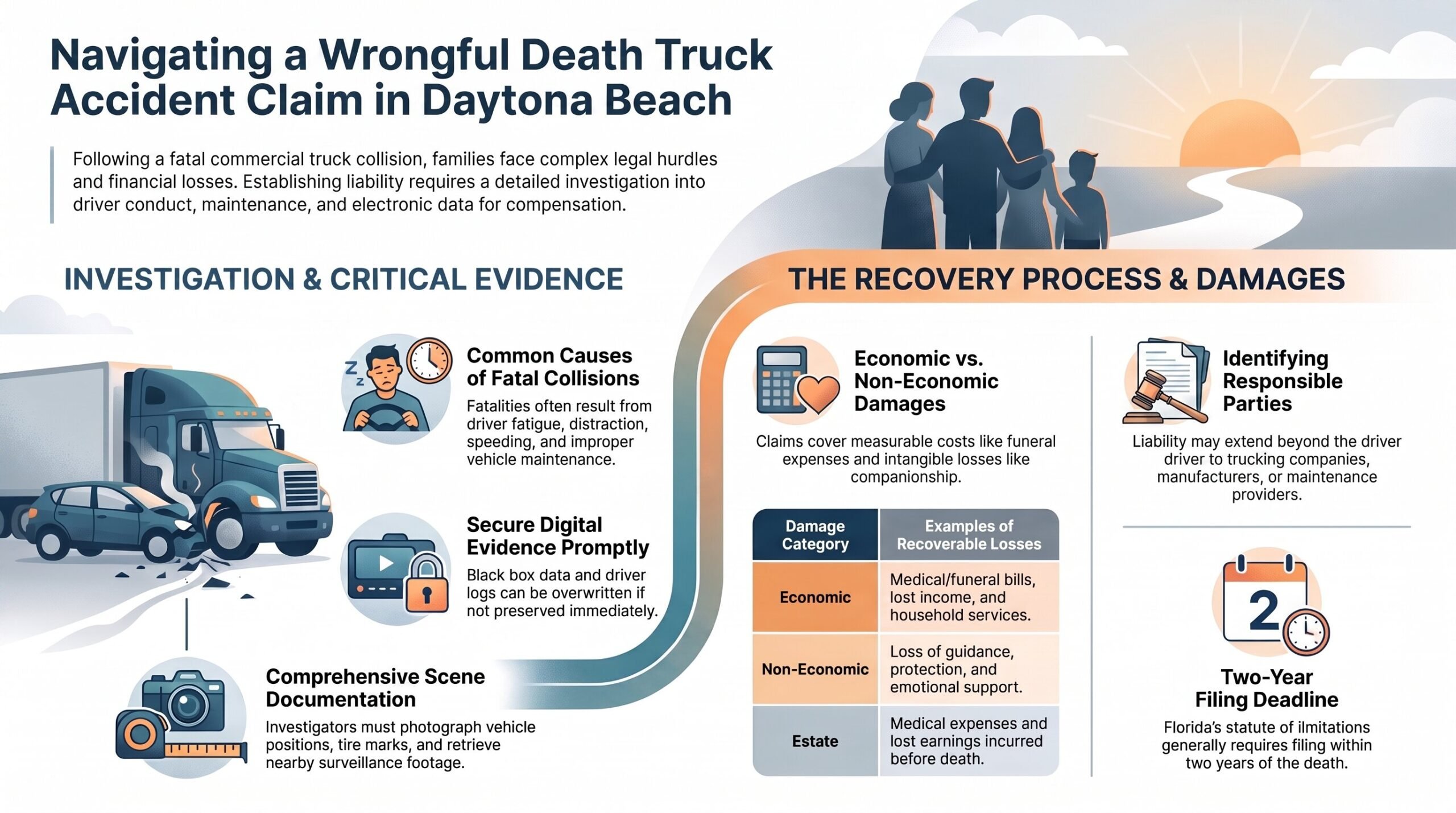
Common causes of fatal truck crashes in Daytona Beach include driver fatigue or distraction, speeding, and other forms of reckless driving. Improper maintenance can contribute to mechanical failures, while overloaded or unsecured cargo may affect vehicle control and create hazardous roadway conditions. Examining these factors can help establish how negligence contributed to a wrongful death.
Driver Fatigue And Distraction
Driver fatigue and distraction are significant causes of fatal commercial truck collisions in Daytona Beach, as they can impair a driver’s judgment, reaction time, and ability to maintain control. Long shifts, inadequate rest, and irregular schedules may reduce alertness, while distracted driving diverts attention from traffic conditions and roadway hazards. Cellphone usage, including texting, calling, or reviewing messages, can create visual, manual, and cognitive distractions.
Investigators may examine electronic logs, dispatch records, surveillance footage, and witness accounts to determine whether fatigue or distraction contributed to a collision. Impairment detection can involve driver interviews, medical evaluations, and review of workplace policies concerning rest and communications. Toxicology testing may also identify substances that worsened drowsiness or impaired concentration. These findings can help families and legal professionals pursue accountability and support safer commercial transportation practices.
Speeding And Reckless Driving
Speeding and reckless driving can make a commercial truck collision substantially more dangerous, particularly on Daytona Beach roads with heavy traffic, changing speed limits, and frequent merging. Excessive speed reduces a truck operator’s reaction time, increases stopping distance, and magnifies the force transferred during impact. Aggressive lane changes, following too closely, improper passing, and ignoring traffic signals can create risks for motorists, pedestrians, and cyclists.
Distracted driving may further impair judgment, especially when a driver handles a phone, adjusts navigation, or diverts attention from the roadway. Evidence such as vehicle data, witness statements, traffic-camera recordings, and crash-scene measurements may help clarify whether unsafe speed or conduct contributed to a fatal collision. Speeding penalties may apply separately, while surviving families may pursue accountability through appropriate legal channels.
Improper Truck Maintenance
When a commercial truck is not properly inspected or maintained, a mechanical failure can cause a catastrophic collision with little warning. Worn brake components, defective tires, damaged guidance systems, and malfunctioning lights can prevent a driver from stopping, controlling, or adequately seeing surrounding traffic. Federal and state rules require carriers to perform routine inspections, document defects, and remove unsafe vehicles from service. Failure to follow these duties may indicate inadequate Inspection Compliance and expose roadway users to unreasonable danger.
Maintenance records, repair invoices, inspection reports, and driver complaints can help establish whether a carrier recognized a problem but failed to correct it. Cargo Securement procedures may also reveal broader safety-management deficiencies, although maintenance failures remain distinct from improperly loaded freight. Careful investigation can clarify responsibility and support affected families seeking accountability.
Overloaded Or Unsecured Cargo
Improperly loaded, overloaded, or unsecured cargo can shift during transit, destabilize a commercial truck, extend its stopping distance, or fall into adjacent lanes and create a deadly hazard. Federal and state regulations require carriers and drivers to observe weight limits, distribute loads appropriately, and use equipment capable of maintaining proper securement throughout a trip. Failure to follow these safeguards may cause rollovers, jackknifing, tire failures, or collisions with nearby vehicles.
Effective cargo shift prevention requires inspections before departure, reassessment after driving begins, and prompt correction of loosened straps, chains, or restraints. When a truck operator ignores these responsibilities, other road users may suffer fatal injuries without warning. Investigators can examine loading records, vehicle inspections, weigh-station data, and electronic logs to determine whether negligent cargo handling contributed to a wrongful death.


Legal Rights of Daytona Beach Wrongful Death Truck Accident Injury Victims
Families who lose a loved one in a Daytona Beach truck accident may have legal rights to pursue compensation through a wrongful death claim.
Eligible survivors may seek damages for medical expenses, funeral costs, lost financial support, and the loss of companionship, subject to Florida law and applicable filing deadlines.
- Claim evaluation: An attorney may identify responsible parties, assess Comparative Negligence issues, and explain potential recovery.
- Evidence Preservation: Prompt collection of crash reports, vehicle data, maintenance records, witness accounts, and medical documentation can protect the family’s position.
- Insurance Negotiation: Counsel may address insurers, calculate damages, and pursue a fair settlement while preparing for litigation if necessary.
Wrongful Death Burdens can include proving negligence, causation, and legally recognized losses. Family members may also have rights to receive claim updates, participate in decisions, and obtain compassionate guidance throughout the process. Each case depends on evidence, relationships, and statutory requirements. A qualified legal professional can help survivors serve the family’s interests while preserving dignity and accountability.
Don’t Wait. Call Our Daytona Beach Truck Accident Lawyers Now.
Why Do Daytona Beach Wrongful Death Truck Accident Injuries Happen?
Daytona Beach wrongful death truck accident injuries often result from preventable failures involving driver conduct, vehicle maintenance, company policies, or roadway conditions. Driver fatigue, distraction, impairment, speeding, and inadequate training can reduce reaction time and impair judgment. Transportation companies may contribute by imposing unrealistic schedules, overlooking regulatory violations, or failing to supervise employees properly. Mechanical defects, worn brakes, overloaded trailers, and tire failures can also cause devastating collisions, particularly when Safety Inspections are incomplete or improperly documented.
Some incidents arise from Truck Design Flaws, including limited visibility, unstable cargo systems, or inadequate underride protection. Poorly maintained roads, confusing construction zones, and insufficient lighting may further increase danger. Determining causation requires careful evaluation of records, vehicle data, maintenance histories, and employment policies. Investigators may conduct Witness Interviews and examine Wrongful Evidence, such as altered logs or discarded components, to identify misconduct or concealment. These factors can establish how preventable failures caused fatal injuries and clarify accountability for affected families and communities.
What Should You Do After a Daytona Beach Wrongful Death Truck Accident Injury?
After a Daytona Beach wrongful death truck accident injury, the injured person should seek immediate medical care, even when symptoms initially appear minor. The accident should also be reported to law enforcement, with an official record requested for future reference. Preserving photographs, medical records, witness information, and other evidence can help establish what occurred and support potential legal claims.
Seek Immediate Medical Care
Following a truck accident, an injured person should receive immediate medical evaluation, even when symptoms appear minor or delayed. A qualified provider can identify internal injuries, document symptoms, and establish treatment recommendations before complications develop. Prompt care also helps connect physical conditions to the collision, which may become important during the wrongful death timeline when injuries contribute to a fatal outcome. Medical records, diagnostic images, prescriptions, and follow-up instructions should be retained carefully.
These materials may support evidence preservation steps by creating an objective account of the person’s condition and recovery needs. Family members and caregivers can assist with transportation, appointment scheduling, medication management, and communication with providers. If symptoms worsen, emergency services should be contacted without delay. Consistent treatment and honest reporting help restore health while preserving reliable information for those seeking accountability.
Report The Accident
When a truck accident results in a fatality or life-threatening injury, the incident should be reported promptly to local law enforcement and emergency services. A surviving driver, passenger, or witness should provide the dispatcher with the location, number of vehicles, apparent injuries, and immediate hazards. Officers can coordinate medical response, protect people from additional traffic dangers, and prepare an official crash report.
Information should be given accurately without speculation or assigning blame. If possible, witnesses should remain available until officers arrive and provide names and contact details for follow-up. Witness statement documentation can help clarify differing accounts and support a reliable investigation. Investigators may also examine roadway conditions, vehicle positions, and traffic controls for Driver event reconstruction. Prompt reporting enables coordinated assistance and preserves accurate facts for affected families.
Preserve Evidence
Preserving evidence can help establish how the collision occurred and identify the parties responsible for the resulting death or injury. After a Daytona Beach truck crash, surviving family members or their representatives should preserve photographs, medical records, vehicle damage, roadway conditions, and visible debris. Witness statement preservation should begin promptly because recollections may change, and witnesses may become difficult to locate. Names, contact information, and written accounts can assist an investigation without placing pressure on those who observed the event. Dashcam footage recovery may also reveal traffic signals, vehicle movements, driver conduct, or conditions immediately before impact. Important recordings can be overwritten, so requests to nearby businesses, residences, and transportation operators should be made quickly. Legal counsel may issue preservation notices and coordinate evidence collection while respecting the family’s needs.
Critical Evidence in a Daytona Beach Wrongful Death Truck Accident Injury Case
Critical evidence may establish how the collision occurred, who was responsible, and the losses sustained by surviving family members.
- Truck driver records and black box data
- Accident scene evidence
- Medical and financial records
A careful review of these materials can clarify liability, preserve disputed facts, and support the wrongful death claim.
Truck Driver Records
Truck driver records can provide essential evidence in a Daytona Beach wrongful death truck accident case by documenting the driver’s qualifications, conduct, and compliance with federal and state safety requirements. These materials may include licensing records, medical certifications, training histories, disciplinary reports, and hours-of-service logs. Inspection reports and employer communications can also reveal whether management recognized unsafe practices or permitted a driver to operate while unqualified, fatigued, or improperly trained.
Records concerning cargo securing may help determine whether shifting or unsecured freight contributed to the collision. Investigators may compare written accounts with dashcam footage, witness statements, and vehicle inspection findings to identify inconsistencies. Preserving these documents promptly supports an accurate investigation and helps families, counsel, and responsible parties evaluate the evidence without compromising the pursuit of accountability and service.
Black Box Data
When available, black box data can provide objective evidence about a commercial truck’s operation before and during a fatal collision in Daytona Beach. Event data recorders may preserve speed, braking, throttle application, seat-belt use, and other information, depending on the vehicle and system. Such records can help clarify driver behavior and identify whether braking occurred before impact or whether excessive speed contributed to the crash.
Black box evidence does not replace Eyewitness testimony, but it may support or challenge an account and affect its eyewitness value when memories differ. Investigators may also compare recorded timing with traffic signal documentation to evaluate whether the truck entered an intersection lawfully. Preservation requests are important because data can be overwritten, restricted, or lost during vehicle repairs, inspection, or disposal.
Accident Scene Evidence
Beyond electronic records, physical evidence at the accident scene can provide an independent account of how a fatal truck collision occurred in Daytona Beach. Investigators may photograph vehicle positions, roadway damage, tire marks, debris patterns, traffic signals, lighting, and weather conditions before evidence is disturbed. These details can help clarify impact direction, visibility, braking, and potential roadway hazards. Witness statement collection should occur promptly, while recollections remain reliable and contact information can be preserved for later testimony.
Nearby businesses, residences, and transportation systems may possess relevant video, making surveillance footage retrieval an important preservation effort before recordings are automatically overwritten. Property damage, cargo displacement, and truck component conditions may also support reconstruction. Careful scene documentation helps protect the family’s right to a complete, objective evaluation of responsibility.
Medical And Financial Records
Medical and financial records can establish the nature of the decedent’s injuries, treatment, expenses, and financial contributions to the household. Hospital records, physician notes, diagnostic studies, and prescription histories may connect the fatal condition to the trucking collision and document the care provided. Billing statements and insurance correspondence help identify medical costs, while tax returns, pay stubs, employment records, and business documents may demonstrate lost income and services previously supplied to dependents.
Attorneys may obtain these materials lawfully through authorizations, subpoenas, or formal discovery while protecting confidential information. Witness statements preservation should occur promptly because recollections may change or disappear. Counsel also maintains reliable chain-of-custody documentation and courtroom evidence handling procedures, helping establish authenticity and preventing disputes that could distract from the family’s pursuit of accountability and lawful compensation.
Don’t Wait. Call Our Daytona Beach Truck Accident Lawyers Now.
Long-Term Effects of Daytona Beach Wrongful Death Truck Accident Injuries
Long-term injuries from a truck accident may require ongoing medical treatment, rehabilitation, and related expenses. Survivors and families may also experience persistent emotional and psychological trauma that affects daily life and relationships. These consequences can create lasting financial hardship through lost income, reduced earning capacity, and continuing care costs.
Ongoing Medical Expenses
When a truck accident causes fatal injuries, the resulting medical expenses may continue to affect the deceased person’s estate and surviving family after death. Hospitals, rehabilitation providers, consultants, and home-care services may submit bills for treatment provided before the individual’s death. Outstanding balances can reduce estate assets and complicate distributions to beneficiaries. Families may also need to examine insurance obligations, Medicare coverage issues, deductibles, and disputed claims when determining the full financial impact.
A wrongful death claim may seek compensation for reasonable medical costs connected to the fatal injuries, supported by invoices, records, and expert testimony. Long-term disability planning may also help identify benefits, lost earnings, and coverage interrupted by the accident. Legal professionals can assist families in preserving documentation, evaluating liability, and pursuing funds that protect dependents and honor the individual’s financial responsibilities.
Emotional and Psychological Trauma
The death of a loved one in a Daytona Beach truck accident can cause lasting emotional and psychological trauma for surviving family members. Grief may remain intense long after the collision, affecting sleep, concentration, relationships, and daily responsibilities. Some individuals experience traumatic flashbacks, recurring nightmares, or emotional distress when encountering trucks, roadways, or accident-related reminders.
Persistent stress symptoms can include irritability, withdrawal, anxiety, and physical tension. In severe cases, survivors may develop post-accident PTSD, requiring evaluation by a qualified mental-health professional. Long-term counseling can help family members process grief, develop coping strategies, and regain stability while honoring the deceased person’s memory. Supportive relatives, community resources, and compassionate legal guidance may also help survivors address their needs with dignity during the recovery process.
Lasting Financial Hardship
Although a wrongful death truck accident may cause immediate financial disruption, its economic effects can continue for years after the collision. Families may lose wages, health insurance, retirement contributions, and the practical services previously provided by the deceased. Medical expenses, funeral costs, and ongoing counseling can further strain limited resources, particularly when surviving dependents require long-term support. Florida wrongful death statutes determine which relatives may pursue recovery and which losses may qualify as damages.
Potential damages limits can affect the amount available, while attorney fees and litigation expenses may influence the family’s net recovery. Prompt evidence preservation can help establish liability, income history, medical needs, and future financial losses. Careful legal evaluation enables responsible advocacy, protects dependents’ interests, and supports a fair resolution responsive to the family’s continuing obligations.
Don’t Wait. Call Our Daytona Beach Truck Accident Lawyers Now.
Proving Liability in Daytona Beach Wrongful Death Truck Accident Injury Cases
Establishing liability in a Daytona Beach wrongful death truck accident case requires evidence showing that a truck driver, trucking company, maintenance provider, or another responsible party failed to meet a legal duty and that the failure caused the fatal collision. Investigators may examine crash-scene photographs, vehicle data, driver logs, inspection records, employment policies, and compliance histories. Witness statements can clarify traffic conditions, vehicle movements, driver conduct, and events immediately before impact.
Expert analysis may address braking, speed, visibility, mechanical defects, or roadway conditions. A careful damages calculation documents funeral expenses, lost income, lost household support, and the family’s other legally recognized losses. Counsel may use these findings during settlement negotiation while preserving a complete record for trial preparation. The process should remain focused on accountability and service to surviving relatives, who may need reliable guidance while coping with permanent financial and personal consequences. Establishing each link between duty, breach, causation, and damages strengthens the family’s pursuit of justice.
Dealing With Insurance Companies After a Daytona Beach Wrongful Death Truck Accident Injury
When a fatal truck collision occurs, surviving family members may soon face communications with insurers representing the trucking company, driver, or other potentially responsible parties. Adjusters may request recorded statements, medical authorizations, employment information, or access to personal accounts. Families should respond cautiously, recognizing that an insurer’s primary obligation is to assess its own financial exposure, not to safeguard the family’s interests.
Documenting Accident Details can help preserve information before memories fade. Records may include photographs, police reports, vehicle information, delivery records, medical bills, and correspondence with insurers. Witness Statement Collection should be handled promptly, with contact information and objective accounts preserved without coaching or speculation.
A family may avoid signing a release or accepting an early settlement before understanding the claim’s full value and the consequences of waiving future rights. Communications should remain accurate and limited to verified facts. A wrongful death attorney can communicate with insurers, protect the family from unfair pressure, and help ensure that relevant evidence and damages receive careful consideration.
What to Expect During a Daytona Beach Wrongful Death Truck Accident Injury Claim Process
A wrongful death truck accident claim typically begins with an initial case evaluation to assess liability, damages, and legal options. Evidence is then gathered, including crash reports, medical records, witness statements, and relevant trucking documentation, before negotiations with insurers begin. If a fair resolution cannot be reached, the surviving family members may pursue wrongful death compensation through litigation.
Initial Case Evaluation
The initial case evaluation provides surviving family members with a structured assessment of whether a wrongful death truck accident claim may be pursued in Daytona Beach. Counsel typically reviews the reported collision, the relationship of eligible beneficiaries, and potential legal deadlines. The discussion may address how negligence, causation, and recoverable losses could be established without requiring relatives to make immediate decisions.
Families may also receive guidance about protecting relevant information, including requests to Preserve Witnesses and secure Traffic Signal Records before routine retention periods cause them to disappear. The evaluation can clarify communication procedures, anticipated stages, and the responsibilities involved in representing the estate. It also helps identify conflicts or limitations that could affect the matter, allowing families to weigh informed, service-oriented legal assistance with greater confidence.
Gathering Evidence
Effective evidence gathering begins with promptly identifying and preserving information that may establish how the truck crash occurred and who may be responsible. A legal team may obtain police reports, crash scene photographs, vehicle damage records, medical documentation, and available roadway or weather information. Witness statements can clarify traffic conditions, driver conduct, and events immediately before impact. Video footage from traffic cameras, businesses, nearby residences, or vehicle systems may also reveal important details.
Attorneys may request trucking company records, including driver qualification files, hours-of-service logs, inspection reports, maintenance histories, and electronic data. Preservation letters can help prevent relevant materials from being altered or destroyed. Family members can assist by providing documents and identifying potential witnesses while avoiding direct contact with involved insurers or company representatives.
Negotiating With Insurers
Following evidence preservation, negotiations with insurers typically address liability, available coverage, and the financial losses associated with the death. Insurers may request recorded statements, medical records, employment information, and other materials to evaluate the claim. Documentation requirements should be reviewed carefully, because incomplete or inconsistent submissions can delay consideration or invite disputes. Negotiation tactics may include presenting organized evidence, identifying policy limits, addressing comparative-fault arguments, and responding to low settlement proposals with documented reasons.
Communication protocols establish who may speak with adjusters, how correspondence is preserved, and when updates are provided to the family. Representatives should monitor settlement deadlines and insurer response periods without making rushed decisions. Throughout discussions, the process should remain respectful, accurate, and focused on protecting the family’s interests while allowing informed decisions about available claim options.
Pursuing Wrongful Death Compensation
Pursuing wrongful death compensation in a Daytona Beach truck accident claim generally involves establishing liability, documenting the family’s losses, and identifying all applicable sources of insurance coverage. The process may begin with a thorough investigation of the collision, including evidence preservation, vehicle inspections, driver records, electronic logs, medical documentation, and witness statements.
When a liability dispute arises, investigators and legal representatives may analyze traffic laws, trucking regulations, maintenance records, and company policies to determine responsibility. Financial losses can include funeral expenses, medical costs, lost income, lost household services, and diminished future support. Nonfinancial damages may also be available under Florida law. Negotiations with insurers could lead to settlement, but a lawsuit may become necessary if offers do not fairly address the surviving family’s documented needs and lawful interests.
Compensation for Daytona Beach Wrongful Death Truck Accident Injury Damages
Compensation in a Daytona Beach wrongful death truck accident claim may address the financial and personal losses suffered by eligible surviving family members. The available recovery depends on evidence showing how the collision occurred, who was responsible, and which relatives have legal standing under Florida law. Wrongful Death Claims may require documentation concerning the decedent’s relationships, contributions, and the consequences experienced by survivors. Liability can involve a truck driver, motor carrier, maintenance provider, manufacturer, or another responsible party.
Comparative Negligence may reduce an award if the defense establishes that the decedent contributed to the accident, making careful investigation critical. An attorney may preserve vehicle data, obtain employment and medical records, interview witnesses, and coordinate testimony from qualified professionals. Families often benefit from counsel who communicates clearly, respects their circumstances, and protects their interests throughout negotiations or litigation. Prompt action can also help preserve evidence and guarantee that statutory deadlines do not prevent eligible survivors from seeking appropriate relief.
Economic vs Non-Economic Damages in Daytona Beach Wrongful Death Truck Accident Cases
Wrongful death compensation may include economic damages, such as lost income, medical expenses, and funeral costs. Non-economic losses can address the value of companionship, guidance, and other intangible harms suffered by surviving family members. Calculating the full recovery requires evaluating financial records, family relationships, future earnings, and the circumstances of the truck accident.
Economic Damages Explained
Economic damages in a Daytona Beach wrongful death truck accident case represent the measurable financial losses caused by the victim’s death. These losses may include emergency treatment, hospitalization, funeral expenses, and burial costs. They can also encompass the income, benefits, and household contributions the victim would likely have provided to surviving family members. Calculating lost earnings may require reviewing employment records, tax returns, career history, age, and expected work-life duration.
A careful truck crash investigation can establish liability while identifying records relevant to each claimed expense. Damages documentation, including invoices, pay statements, benefit summaries, and financial projections, helps demonstrate the amount requested. Legal professionals may work with economists, employers, and medical providers to present reliable calculations. Accurate evaluation supports responsible advocacy for dependents facing financial hardship after the collision.
Non-Economic Losses
Beyond documented financial losses, a Daytona Beach wrongful death truck accident case may involve non-economic damages for the human impact of the victim’s death. These losses can include the family’s grief, loss of companionship, emotional support, guidance, and the disruption of established family relationships. Unlike medical bills or lost earnings, non-economic harm is personal and cannot be established through invoices alone. Possible Evidence may include Witness Statements from relatives, friends, counselors, caregivers, and others familiar with the relationship and the family’s resulting hardship.
Records describing the victim’s role in household decision-making, childcare, and emotional support may also provide important context. Future Medical Needs and Life Care Planning generally concern ongoing injury-related expenses, but they may help document emotional treatment required by surviving family members when supported by qualified professionals.
Calculating Wrongful Death Compensation
When a fatal truck collision occurs, compensation is generally calculated by evaluating both the family’s measurable financial losses and the personal harm caused by the death. Economic damages may include medical and funeral expenses, lost wages, diminished future earning capacity, household services, and lost benefits. Financial records, employment history, and expert analysis can help establish these amounts. Non-economic damages address loss of companionship, guidance, protection, and emotional support, although valuation varies under applicable Florida law and case circumstances.
Thorough truck evidence preservation may reveal negligence, regulatory violations, maintenance failures, or insurer misconduct affecting liability and recovery. A careful insurance settlement strategy should account for all present and anticipated losses before negotiations begin. Families often benefit from organized documentation and qualified legal guidance to pursue a fair resolution while serving their long-term needs.
When a Daytona Beach Wrongful Death Truck Accident Injury Case Goes to Trial vs Settlement
A Daytona Beach wrongful death truck accident case may resolve through settlement or proceed to trial, depending on liability disputes, the strength of the evidence, the damages involved, and the parties’ willingness to negotiate. Settlement can provide a more predictable resolution, reduce litigation costs, and spare surviving family members from the demands of courtroom proceedings. A sound negotiation strategy evaluates the available proof, projected losses, and the interests of those seeking accountability and support.
Trial preparation becomes important when opposing parties dispute responsibility or decline to offer adequate compensation. Counsel may organize evidence preservation efforts, consult qualified experts, and develop a clear presentation for the court. Witness testimony, medical documentation, employment records, accident reconstruction, and other materials can help establish what occurred and how the loss affected the family. Although trial outcomes remain uncertain, a well-prepared case may encourage meaningful settlement discussions. The appropriate path depends on informed advice, the family’s priorities, and the case’s specific circumstances.
Florida Laws That May Affect Your Daytona Beach Wrongful Death Truck Accident Case
Florida law establishes the framework for determining liability, identifying eligible survivors, and calculating damages in a Daytona Beach wrongful death truck accident case. Florida Wrongful Death law generally permits a personal representative to pursue losses suffered by the estate and survivors, including funeral expenses, lost support, and certain emotional losses.
Several rules may influence the claim:
- Comparative Negligence Rules: A survivor’s or decedent’s proven share of fault may reduce recoverable damages. Evidence concerning driving conduct, vehicle maintenance, employer oversight, and roadway conditions can in turn be significant.
- Trucking Regulations: Federal and state requirements governing driver qualifications, hours of service, inspections, cargo securement, and maintenance may help establish whether negligent conduct contributed to the collision.
- Vicarious and Employer Liability: A motor carrier may face responsibility for an employee’s actions within the scope of employment. Separate claims may arise from negligent hiring, supervision, retention, or training.
Counsel can help families and representatives preserve evidence, identify responsible parties, and present a claim that supports accountability and service to affected survivors.
The Statute of Limitations for Daytona Beach Wrongful Death Truck Accident Injury Cases
Timely action is also necessary because Florida’s statute of limitations restricts the period in which a wrongful death truck accident claim may be filed. Generally, a wrongful death action must be brought within two years after the decedent’s death. Certain circumstances may alter that deadline, including claims involving governmental entities, medical treatment, or delayed discovery of relevant facts. Because exceptions are narrowly applied, families should identify the applicable filing period without delay.
The personal representative of the estate typically files the lawsuit for eligible survivors. Wrongful Death Eligibility may depend on the relationship to the deceased, dependency, and the losses recognized under Florida law. A late filing can permanently bar otherwise valid compensation, regardless of the truck driver’s conduct or the severity of the family’s losses.
Comparative Fault may also affect damages if the decedent contributed to the accident. Preserving records, identifying witnesses, and confirming deadlines supports orderly administration of the estate and protects the interests of those relying on it.
How a Daytona Beach Wrongful Death Truck Accident Lawyer Can Help You
When a fatal truck collision occurs, legal counsel can provide the structured guidance necessary to protect the estate and surviving family members. A Daytona Beach wrongful death truck accident lawyer can coordinate the legal process while treating the family’s needs with dignity and care. Counsel may:
Legal counsel helps families investigate fatal truck collisions, preserve evidence, and pursue rightful compensation with dignity and care.
- Investigate the crash, review driver records, inspect the truck, and identify potentially responsible parties, including carriers, contractors, or manufacturers.
- Develop an Evidence preservation checklist covering photographs, medical records, witness information, electronic logging data, maintenance files, and available surveillance footage.
- Calculate and pursue Wrongful death damages, which may include funeral expenses, lost income and services, medical costs, and the survivors’ loss of companionship or support.
The lawyer can also communicate with insurers, organize documentation, and present the estate’s position during negotiations or litigation. This assistance allows relatives and appointed representatives to focus on serving one another and managing practical responsibilities while counsel addresses intricate evidentiary and financial issues with accountability and respect throughout the proceeding.
When to Contact a Daytona Beach Wrongful Death Truck Accident Lawyer
Early legal guidance can help preserve evidence and clarify the rights of the estate and surviving family members after a fatal truck collision. A Daytona Beach wrongful death truck accident lawyer may be contacted as soon as practical, preferably before insurers, trucking companies, or other parties request statements or access to records. Prompt consultation allows the family’s representative to organize a Wrongful death checklist, including medical records, death certificates, employment information, insurance documents, witness contacts, and available crash details.
Legal contact is also appropriate when liability is disputed, multiple vehicles are involved, a commercial carrier may share responsibility, or deadlines could affect the estate’s claim. Counsel can explain applicable filing periods and identify information needed to evaluate losses without pressuring grieving relatives to make immediate decisions. Families may also seek advice before accepting an offer, because the Settlement negotiation timeline can involve investigation, documentation, demands, responses, and careful review of proposed terms. Early contact supports orderly decision-making and protects the family’s ability to serve the estate’s interests.
Why You Need an Experienced Daytona Beach Wrongful Death Truck Accident Lawyer
A seasoned Daytona Beach wrongful death truck accident lawyer is essential because fatal commercial truck collisions often involve complex liability questions, extensive evidence, and multiple potentially responsible parties. Counsel can investigate driver conduct, trucking-company policies, maintenance records, cargo loading, and regulatory compliance before important information disappears. A lawyer may also coordinate accident reconstruction, preserve electronic logging data, and identify insurers whose interests could conflict with the family’s need for accountability.
An evidence preservation checklist helps organize photographs, medical records, witness details, vehicle information, and official reports while memories remain reliable. In addition, survivor communication guidance can help relatives respond to insurers, employers, and investigators without unintentionally compromising their rights. Experienced representation allows grieving families to focus on supporting one another while legal professionals address procedural requirements, evaluate recoverable losses, and pursue responsible parties. This service-oriented approach promotes fairness, protects vulnerable survivors, and supports a thorough, respectful effort to obtain justice and financial stability.
How to Choose the Right Daytona Beach Wrongful Death Truck Accident Lawyer for Your Case
Selecting the right Daytona Beach wrongful death truck accident lawyer requires careful evaluation of the attorney’s experience, investigative resources, and approach to family communication. A qualified lawyer should understand commercial trucking regulations, insurance practices, and the evidence needed to establish liability. Families may ask how the attorney handles Case investigation, including obtaining driver logs, maintenance records, electronic data, photographs, and witness accounts before evidence disappears.
The lawyer should also explain potential wrongful death damages clearly, including medical expenses, funeral costs, lost income, loss of companionship, and other legally recognized losses. Honest discussions about case strengths, challenges, fees, timelines, and realistic outcomes can help relatives make informed decisions without unnecessary pressure.
Professional accessibility is equally important. An attorney who listens respectfully, provides consistent updates, and coordinates with the family’s support network can reduce confusion during a difficult period. References, disciplinary history, trial experience, and written engagement terms require careful review before representation begins.
About The Law Offices of Anidjar & Levine
Families evaluating legal representation may consider The Law Offices of Anidjar & Levine, a Florida personal injury firm that handles wrongful death and truck accident claims.
Its attorneys represent families seeking accountability and financial support after preventable collisions, while maintaining a service-oriented approach during difficult proceedings.
The firm may assist with a Truck Accident Investigation by examining crash reports, driver qualifications, vehicle maintenance records, electronic logging data, and applicable trucking regulations.
This review can help identify whether negligence involved a driver, carrier, maintenance provider, manufacturer, or another responsible party. Attorneys may also coordinate with investigators and qualified experts when accident dynamics or liability require expert analysis.
Evidence Preservation is another important consideration.
Counsel can issue preservation requests, obtain relevant records, document vehicle damage, and pursue available video, communication, and employment information before it disappears or changes.
The firm may clearly explain potential claims, deadlines, and litigation options, enabling families to make informed decisions while protecting their interests and honoring the needs of those affected.
Frequently Asked Questions
Can Surviving Family Members Attend Court Proceedings in a Wrongful Death Case?
Surviving family members can generally attend court proceedings in a wrongful death case, although attendance rules may vary by jurisdiction, courtroom capacity, and the stage of litigation. The court may limit access during witness testimony to protect fairness or privacy. Family members may also have court participation rights through a designated representative, attorney, or victim-impact process. Legal counsel can explain applicable procedures and help relatives attend respectfully while supporting the case.
How Are Wrongful Death Settlements Distributed Among Eligible Florida Beneficiaries?
Wrongful death settlements in Florida are distributed among eligible beneficiaries according to statutory priorities, proven losses, and the decedent’s circumstances. Marital priority generally gives the surviving spouse an important share, while children and other qualifying relatives may receive portions under Florida law. Named beneficiaries may receive proceeds from separate insurance or contract-based benefits, subject to applicable terms. A court may approve allocation when disputes arise, ensuring fair treatment and proper service to all entitled survivors.
Can a Wrongful Death Claim Affect the Deceased Person’s Pending Personal Injury Lawsuit?
A wrongful death claim can affect the deceased person’s pending personal injury lawsuit because Florida law may convert relevant claims into a Survival action. That action permits the personal representative to pursue damages the deceased could have recovered, including medical expenses, lost earnings, and certain losses incurred before death. The lawsuit impact depends on the case’s facts, procedural status, and available insurance. Separate wrongful death damages generally belong to eligible beneficiaries, while recovery allocation requires careful legal review.
What Happens if the Truck Driver or Company Files for Bankruptcy?
If the truck driver or company files for bankruptcy, the pending claim may be subject to bankruptcy protection and an automatic stay, temporarily halting creditor remedies and collection activity. The wrongful death claim generally must be reported in the bankruptcy case, where its treatment depends on the bankruptcy chapter, insurance coverage, and available assets. A claim discharge may eliminate the company’s personal liability, but insurance proceeds or exceptions to discharge can preserve recovery.
Are Wrongful Death Lawsuit Proceeds Taxable in Florida?
Wrongful death lawsuit proceeds are generally not taxable in Florida when they compensate survivors for physical injury, death, or related losses. Taxation timing and the settlement’s allocation can affect treatment, especially where interest or punitive damages are included. Distribution rules may determine each recipient’s obligations. A personal injury overlap can complicate classification. Court attendance is not itself taxable. Bankruptcy impact may reduce recovery, but does not automatically change tax rules.
—————————
Families facing a fatal truck collision in Daytona Beach may confront medical expenses, lost financial support, and profound emotional hardship.
A Daytona Beach Truck Accident Lawyer can evaluate the evidence, identify responsible parties, and pursue compensation under Florida law.
Prompt legal guidance may also help preserve vital records, witness accounts, and trucking data.
The Law Offices of Anidjar and Levine can assess the circumstances, explain available remedies, and advocate for the surviving family’s interests throughout the claim or litigation process.