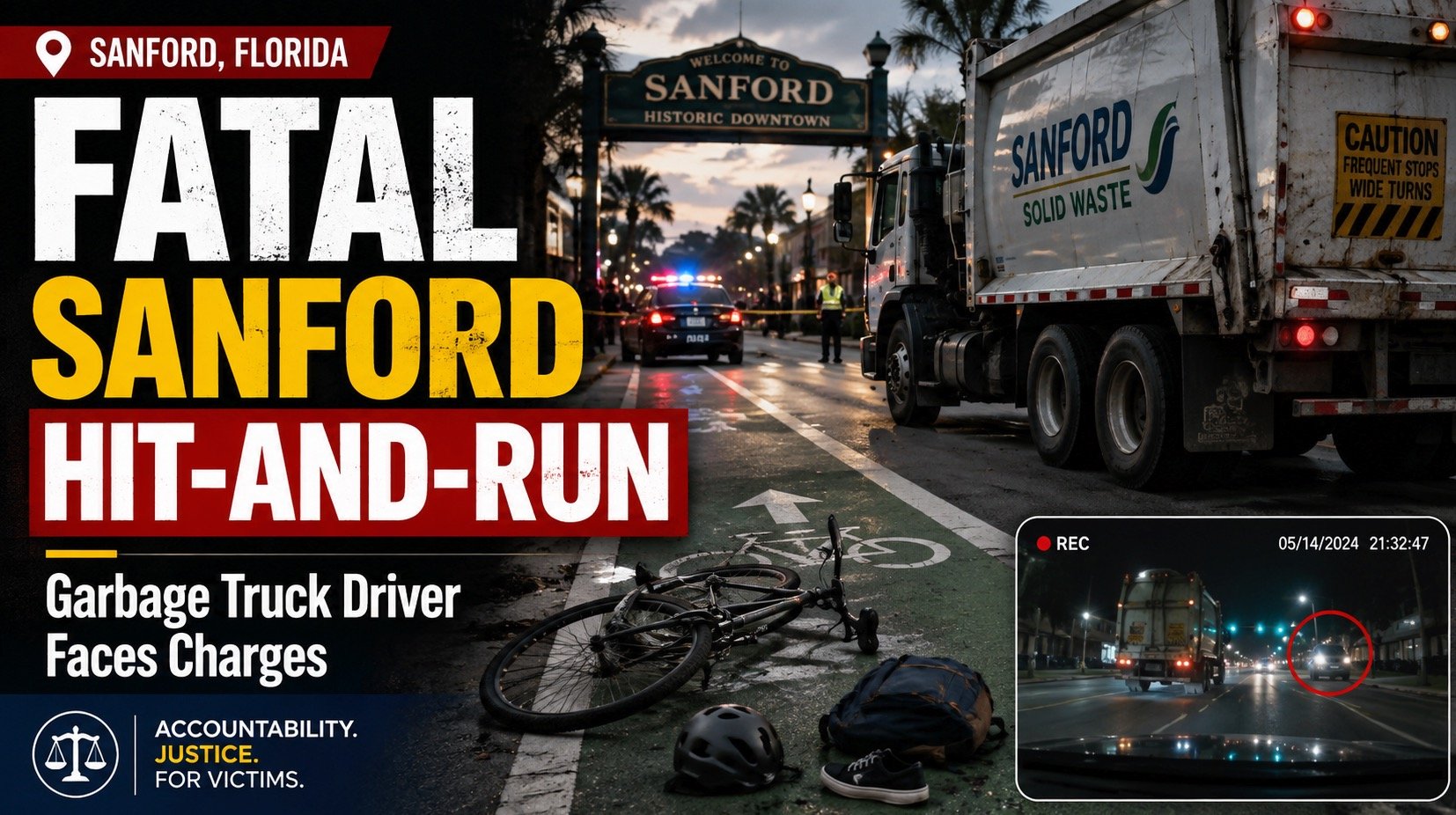
A city truck hit a cyclist in a marked bike lane and drove away. When a government vehicle causes a death in Florida, the rules and deadlines are different.
If you need a Sanford bicycle accident lawyer after a crash involving a municipal truck, a commercial vehicle, or a driver who fled the scene, the clock on your rights is already running. On the morning of August 4, 2026, a City of Sanford garbage truck struck and killed 40-year-old bicyclist Manuel Martinez at the intersection of Martin Luther King Jr. Boulevard and W. Airport Boulevard. The driver is accused of leaving the scene without stopping to render aid. Cases like this one raise a set of legal questions most Florida families have never had to think about — and several of them come with deadlines measured in months, not years.
Call The Law Offices of Anidjar & Levine at 1-800-747-3733 for a free, no-obligation consultation. Learn more about Garbage Truck Accidents.
There is no fee unless we recover for you.
Main Takeaways
- A City of Sanford rear-loader garbage truck struck an e-bike rider who was in a designated bike lane and wearing a high-visibility vest.
- Because the vehicle belonged to a municipality, any civil claim runs through Florida’s sovereign immunity statute, which imposes a pre-suit notice requirement and caps damages at $200,000 per person.
- Under Florida law, an e-bike rider has the same rights and protections as any other bicyclist.
- A criminal prosecution does not compensate a family. Only a separate civil claim does, and the two proceed on different timelines.
- Dashcam video, GPS telematics, and municipal records are the backbone of these cases — and much of it can be overwritten within days.
What Happened: The August 4, 2026 Sanford Crash
According to information released by the Sanford Police Department, the collision occurred at approximately 8:00 a.m. on Tuesday, August 4, 2026, at the intersection of Martin Luther King Jr. Boulevard and W. Airport Boulevard.
A City of Sanford Class V rear-loader garbage truck and a bicyclist were both traveling northbound on Martin Luther King Jr. Boulevard. As the garbage truck attempted a right-hand turn onto Airport Boulevard, it struck the bicyclist, who was also making a right turn. The rider, later identified as 40-year-old Manuel Martinez, was transported to a local hospital, where he died from his injuries.
Mr. Martinez was operating an e-bike in the designated bicycle lane and was wearing a high-visibility reflective vest at the time of the crash.
The truck’s driver, a City of Sanford employee, allegedly did not stop or render aid. Investigators recovered dashcam footage from the vehicle, which reportedly shows a sudden jolt at the rear of the truck at the moment of impact, followed by the vehicle accelerating away from the intersection. The recording is also said to document the truck speeding, running multiple stop signs, and passing a marked police vehicle without stopping to report the collision.
A witness at the scene provided a description that allowed officers to identify the specific municipal vehicle and its operator. When questioned, the driver reportedly stated she “did not know what to do,” and said she had tried to reach her supervisor and locate a police officer — an account investigators say is difficult to square with the footage showing her driving past a marked patrol unit.
Charges and current status
- Criminal charge: Leaving the scene of an accident resulting in death.
- Traffic citation: Violating the right of way of a cyclist.
- Bond: Set at $15,000, with GPS monitoring required as a condition of release. A follow-up hearing is scheduled for September 8, 2026.
- Employment status: The driver, a city employee since March 2021, has been placed on administrative suspension pending the outcome of the investigation.
The City of Sanford has expressed condolences to the Martinez family, described the event as a tragic incident, and stated that it is cooperating fully with the police investigation. The Sanford Police Department and Crimeline continue to seek information from the public.
All charges are allegations. Every person accused of a crime is presumed innocent unless and until proven guilty in a court of law.
Who Manuel Martinez Was
Behind every crash report is a person, and behind every wrongful death claim is a family trying to hold onto who that person was.
Family members described Manuel Martinez as kind-hearted and a hopeless romantic with a deep passion for music. He taught himself to play drums and bass guitar. He was a father, and he passed his love of music to his daughter — teaching her to play bass.
Florida’s Wrongful Death Act exists precisely because losses like that are real and legally recognized. The statute does not treat a life as a line item. It allows surviving family members to recover for the companionship, guidance, and support they will never receive again, alongside the more easily calculated financial losses.
Florida Bicycle and E-Bike Accident Statistics
Florida is, by a wide margin, the most dangerous state in the country for people on bicycles. State data compiled by the Florida Department of Highway Safety and Motor Vehicles recorded more than 9,300 bicycle crashes statewide in 2024, producing over 8,800 injuries and roughly 200 bicyclist deaths. Preliminary 2025 figures showed 195 cyclist fatalities — essentially no improvement. Florida holds about 6% of the U.S. population but accounts for roughly 17% of all bicycle fatalities nationwide, a per-capita death rate of about 8.4 cyclist deaths per million residents, which is far above any other state.
Enforcement has not kept pace. Despite Florida’s three-foot safe passing law, only about 130 motorists statewide were cited for violating it in 2024 — against more than 9,000 bicycle crashes that same year. Nationally, the National Highway Traffic Safety Administration reports that the large majority of fatal bicyclist crashes occur in urban areas, and intersections remain one of the highest-risk locations for riders. For context on the broader picture, FLHSMV’s crash facts have documented roughly 401,523 total Florida crashes, 3,535 traffic fatalities, and $21.4 billion in economic losses in a single reporting year.
Those numbers explain why cyclist cases are rarely simple. Insurers and government risk managers know that juries are sometimes primed to blame the rider, and they build their defense around that assumption from day one. Countering it takes fast evidence preservation, accident reconstruction, and a lawyer who understands both Florida bicycle law and the procedural traps that apply when the at-fault vehicle belongs to a city.
Common Causes: The Anatomy of a “Right Hook” Crash
The Sanford collision fits a pattern cyclists know well, and most drivers have never heard of. A right hook occurs when a motor vehicle turns right across the path of a cyclist who is traveling straight or turning in the adjacent bike lane.
Heavy trucks make the geometry far more lethal.
- Off-tracking: A long truck’s rear wheels follow a tighter arc than the front wheels during a turn, sweeping into space the driver believes is clear. A cyclist beside the cab can be struck by the trailer or rear axle.
- Blind spots: Garbage trucks have extensive no-zones along the right side and rear. A rider in a high-visibility vest can still be invisible if the driver never checks a mirror before initiating the turn.
- Failure to yield: Florida law requires a turning driver to yield to a bicyclist lawfully proceeding in a bike lane. Turning across an occupied bike lane without yielding is a right-of-way violation.
Route pressure and schedule demands: Sanitation routes run on tight timelines. Rushed turns, rolling stops, and skipped mirror checks are predictable consequences of schedule pressure — and they are a legitimate area of inquiry in a civil case.
Inadequate training or equipment: Missing side-view cameras, unrepaired mirrors, absent audible turn alarms, or a driver never trained on cyclist awareness can all support a negligence claim against the vehicle’s owner independent of the driver’s conduct.
Florida Law: E-Bike Riders Have the Same Rights as Bicyclists
When a rider on an electric bicycle is injured, insurers sometimes argue the e-bike was something other than a bicycle — a motor vehicle, a moped, an unregistered vehicle. Florida law forecloses that argument.
Under Florida Statute § 316.20655, an electric bicycle and its operator are afforded all the rights and privileges — and are subject to all the duties — of a bicycle and bicyclist. E-bikes may be ridden anywhere bicycles are allowed, including streets, highways, roadways, shoulders, bicycle lanes, and multiuse paths. Riders are expressly exempt from requirements relating to financial responsibility, driver licensing, vehicle registration, and title certificates.
Practically, that means an e-bike rider struck in a marked bike lane is in the same legal position as any other cyclist. The absence of insurance or registration on the bike is not a defense, and it is not evidence of fault.
Other Florida rules that frequently matter in these cases:
Bicycles are vehicles: A bicyclist riding on a roadway has the rights and duties of any other vehicle driver, including the right to be yielded to when lawfully proceeding.
Three-foot passing law: A driver overtaking a bicycle must leave a minimum of three feet of clearance.
No helmet requirement for adults: Florida requires helmets only for riders under 16. For adult riders, the absence of a helmet is generally not admissible to establish comparative fault in the same way insurers often imply.
- Duty to stop and render aid. Every driver involved in a crash involving injury or death must stop, remain at the scene, provide identifying information, and render reasonable assistance.
Criminal Charges Versus a Civil Claim: Two Separate Tracks
Families are often told to “wait and see what happens with the criminal case.” That advice can cost them everything.
A criminal prosecution is brought by the State of Florida to punish conduct. It does not pay a family’s mortgage, replace lost income, or compensate for the loss of a parent. A civil claim is a separate proceeding, brought by the family, with a different burden of proof and different deadlines that run independently of the criminal calendar.


The criminal side
Under Florida Statute § 316.027, willfully leaving the scene of a crash involving a death is a first-degree felony. A conviction carries a maximum of 30 years in prison, a mandatory minimum of 4 years, and a minimum three-year driver’s license revocation. Prosecutors must prove guilt beyond a reasonable doubt.
The civil side
A wrongful death claim requires proof only by the greater weight of the evidence — a materially lower bar. A driver can be acquitted, have charges reduced, or accept a plea, and the family’s civil claim can still succeed. Conversely, a criminal conviction does not automatically produce a civil recovery; the family still has to prove damages and navigate the procedural requirements that apply to government defendants.
Why waiting is dangerous
Criminal cases routinely take a year or longer. Civil notice deadlines against a government entity do not pause while that plays out. Neither does evidence retention. A family that waits for a verdict may find the notice window closed and the fleet telematics data long since purged.
Don’t Wait. Call Our Daytona Beach Truck Accident Lawyers Now.
Suing a City in Florida: Sovereign Immunity and § 768.28
This is the part of the case most people do not see coming. When the at-fault vehicle belongs to a city, county, school board, or state agency, an entirely different rulebook applies.


Florida has waived immunity — but only partly
Florida Statute § 768.28 waives sovereign immunity for the negligent acts of government employees acting within the scope of their employment. That waiver is what makes a claim against the City of Sanford possible at all. But it comes with conditions.
The pre-suit notice requirement
Before any lawsuit can be filed, the claimant must present the claim in writing to the responsible agency and, in most cases, to the Florida Department of Financial Services. For a wrongful death claim, that written notice must be presented within two years of the death. This is a condition precedent — meaning a family that files suit without first serving proper notice can have the case dismissed regardless of how clear the liability is.
The waiting period
After notice is served, the agency generally has an investigation window before suit may proceed. In wrongful death matters, failure by the Department of Financial Services or the agency to reach a final disposition within 90 days is treated as a denial, which allows the case to move forward. For other injury claims, the standard investigation period is 180 days. During that window, an experienced lawyer is not idle — that is when preservation letters, public records requests, and reconstruction work happen.
The damage caps
Recovery against a Florida government entity is capped at $200,000 per person and $300,000 per incident. The Legislature considered raising these figures in 2026, but the bill was vetoed, leaving the long-standing caps in place. In a case involving a death, a surviving child, and decades of lost support, that cap can be a fraction of the actual loss.
The claims bill process
Amounts above the cap are not automatically unavailable — but recovering them requires the Florida Legislature to pass a claims bill, a special act authorizing payment of an excess judgment. Claims bills are slow, politically contingent, and far from guaranteed. Any lawyer telling a family a claims bill is a sure thing is not being straight with them.
The individual-liability wrinkle
Section 768.28(9) contains a provision that matters enormously in hit-and-run cases involving public employees. A government employee is personally immune from suit for ordinary negligence committed in the scope of employment — the government answers instead. But that immunity disappears if the employee acted in bad faith, with malicious purpose, or in a manner exhibiting wanton and willful disregard of human safety. In that situation, the employee can be sued personally, and the government may not be liable for that conduct.
That creates a genuine strategic question in a case where a municipal driver is accused of striking a cyclist and then fleeing. Was the collision itself ordinary negligence within the scope of employment, making the city responsible under the cap? Or does the alleged flight constitute wanton and willful disregard, shifting exposure to the driver individually — who may have far less ability to pay? Careful pleading in the alternative, and rapid investigation into what the city knew about this driver’s record, training, and route pressure, are what separate a well-handled case from a disappointing one.
Claims against the city beyond the driver’s conduct
A municipality’s own negligence can be an independent basis for liability — negligent hiring, negligent retention, negligent training, negligent supervision, or failure to maintain safe equipment on the vehicle. These theories require public records: driver qualification files, prior complaints, disciplinary history, training curricula, maintenance logs, and route scheduling data. Florida’s public records law is a powerful tool here, and it works best when used early.
The Florida Wrongful Death Act: Who Can Recover and What For
Florida’s Wrongful Death Act, found at §§ 768.16–768.26, governs every fatal injury claim in the state.
The action is filed by the personal representative of the decedent’s estate, on behalf of both the estate and the surviving family members. Opening an estate in probate is therefore a necessary early step, and it is one families frequently do not realize is required until a lawyer explains it.
Recoverable damages can include:
- Lost support and services the survivors would have received, calculated from the date of injury and projected over the decedent’s expected working life.
- Loss of parental companionship, instruction, and guidance for a surviving minor child, plus mental pain and suffering from the date of injury.
- Loss of companionship and protection for a surviving spouse, and mental pain and suffering.
- Medical and funeral expenses paid by a survivor or by the estate.
- The estate’s lost earnings from the date of injury to death, and the loss of net accumulations the estate would reasonably have expected.
The deadline to file a Florida wrongful death action is generally two years from the date of death. When the defendant is a government entity, that two-year window has to accommodate the pre-suit notice requirement and the agency’s response period inside it — which is exactly why families should not wait.
The Evidence That Decides These Cases
In a case built around a fleeing municipal vehicle, the evidence is unusually rich — and unusually perishable.
- Onboard camera systems – GPS and fleet telematics. Municipal fleets log position, speed, harsh braking, and idle time second by second. This data can independently establish speed at impact and the acceleration afterward.
- Event data recorder (black box) downloads – Most modern commercial vehicles capture speed, throttle, braking, and steering input in the seconds surrounding an impact. That data can be overwritten by subsequent ignition cycles, so preservation requests go out immediately and downloads are performed by certified specialists.
- Spoliation letters – Formal written demands to preserve evidence, sent to the city, its risk management department, its insurer, the vehicle’s manufacturer, and nearby businesses. Once notice is given, a party that destroys evidence anyway can face court sanctions or an adverse inference instruction telling the jury to assume the destroyed evidence was unfavorable.
- Cell phone records – Subpoenas can obtain carrier records showing calls, texts, or data use at the exact moment of impact — evidence that is frequently decisive on the question of driver attention.
- Public records – Driver qualification files, training records, prior complaints and discipline, vehicle maintenance and inspection logs, route assignments, and internal incident reports.
- Independent scene evidence – Roadway measurements, sight-line analysis, signal timing, bike lane striping condition, and surveillance video from adjacent businesses — most of which is gone within 72 hours.
Insurance Coverage for Injured Cyclists in Florida
Cyclists are often told they have no coverage because a bicycle carries no insurance. That is usually wrong.
PIP through your own or a relative’s auto policy. Florida’s no-fault system requires a minimum of $10,000 in personal injury protection. A cyclist struck by a motor vehicle can frequently access PIP benefits under their own auto policy or the policy of a resident relative. PIP pays 80% of reasonable medical expenses and 60% of lost wages, and treatment must begin within 14 days of the crash — a deadline that quietly forfeits benefits for people who “wait to see if it gets better.”
Uninsured and underinsured motorist coverage. UM coverage is the most overlooked asset in hit-and-run cases. It applies when the at-fault driver is never identified, carries no insurance, or carries too little. In a case where a government defendant’s liability is capped at $200,000, UM coverage may be the difference between a partial recovery and one that reflects the actual loss. Stacked UM policies across multiple household vehicles can multiply available limits substantially.
The serious injury threshold. To pursue a bodily injury claim against the at-fault driver directly, Florida requires the injury to meet a threshold: permanent injury within a reasonable degree of medical probability, significant and permanent scarring or disfigurement, significant and permanent loss of an important bodily function, or death. A fatality categorically clears this threshold.
Understanding your policy rights is important. The Florida Department of Financial Services publishes consumer guidance on filing and disputing insurance claims, and it is also the agency that receives statutory notice in claims against government entities.
Florida Deadlines You Cannot Afford to Miss
- 14 days — deadline to begin medical treatment to preserve Florida PIP benefits.
- 24–72 hours — the practical window before roadway evidence and business surveillance footage disappear.
- 90 days — the period after notice in which a government agency’s failure to resolve a wrongful death claim is deemed a denial.
- 180 days — the standard agency investigation period for non-death injury claims against a government entity.
- 2 years — deadline to present written notice of a wrongful death claim to a government entity, and the general deadline to file a Florida wrongful death lawsuit.
- 2 years — the filing deadline for most Florida negligence-based injury claims following the 2023 tort reform law (HB 837), reduced from the prior four-year period.
What to Do If a Government Vehicle Injured You or Someone You Love
- Get medical care immediately and keep going – Gaps in treatment are the first thing a defense adjuster looks for, and the 14-day PIP window is unforgiving.
- Do not give a recorded statement to the city’s risk management office or its insurer before speaking with a lawyer. Those calls are not neutral fact-gathering.
- Preserve the bicycle, helmet, clothing, and any damaged equipment. Do not repair or discard anything. The physical evidence supports reconstruction of impact angle and speed.
- Photograph everything while it exists — the scene, the bike lane striping, sight lines, signage, and injuries as they heal.
- Write down witness names and contact information before they scatter. Independent witnesses win right-of-way disputes.
- Request the crash report and keep every medical bill, wage record, and out-of-pocket receipt.
- Stay off social media. Posts, photos, and check-ins are routinely pulled and repurposed to argue that injuries are exaggerated.
- Talk to a lawyer before the notice window narrows. Government claims have procedural requirements that do not forgive good intentions.
How a Sanford Bicycle Accident Lawyer Can Help
A case against a municipality is not a bigger version of a car accident case. It is a different case, with a different opponent, and it rewards preparation that starts in the first week.
- Serve immediate spoliation and preservation letters on the city, its insurer, and third parties holding video.
- File Florida public records requests for driver files, training, discipline, maintenance logs, and route data.
- Retain accident reconstruction and EDR specialists to independently establish speed, angle, and driver input.
- Draft and serve the statutory notice of claim on the correct agencies within the deadline.
- Open the probate estate and appoint a personal representative so the wrongful death action can be filed properly.
- Identify every available insurance layer, including UM, stacked household policies, and excess coverage.
- Work with economists and life-care planners to document the full scope of lost support and services.
- Coordinate with the criminal prosecution so the civil case benefits from it without being held hostage to its timeline.
Learn more about our Florida bicycle accident practice, our wrongful death representation, and how we handle hit-and-run claims. You can also see the communities we serve across Florida.
Don’t Wait. Call Our Daytona Beach Truck Accident Lawyers Now.
Frequently Asked Questions
Can you sue the City of Sanford after a garbage truck accident?
Yes, but Florida’s sovereign immunity law limits how and when. Under Florida Statute § 768.28, you must present a written notice of claim to the city and to the Florida Department of Financial Services before filing suit, and recovery against a government entity is capped at $200,000 per person and $300,000 per incident. Amounts above those caps generally require a legislative claims bill.
How long do I have to file a claim against a Florida city or county?
For a wrongful death claim, the written notice must be presented within two years of the death, and the lawsuit itself must generally be filed within two years. For non-death injury claims against a government entity, the notice window is longer, but waiting is dangerous. Missing the notice requirement can bar the claim entirely no matter how strong the evidence is.
Do e-bike riders have the same legal rights as bicyclists in Florida?
Yes. Florida Statute § 316.20655 gives electric bicycles and their operators all the rights, privileges, and duties of a bicycle and bicyclist. E-bike riders may use streets, roadways, shoulders, bicycle lanes, and multiuse paths, and they are not required to carry a driver license, registration, or motor vehicle insurance.
What is a right hook bicycle crash?
A right hook happens when a motor vehicle turns right across the path of a cyclist traveling straight or turning in an adjacent bike lane. Large trucks are especially dangerous because of long blind spots along the right side and because the rear wheels track inside the turn. Florida law requires the turning driver to yield to a cyclist lawfully in the bike lane.
Does the criminal case have to finish before the family files a civil claim?
No. The criminal prosecution and the civil wrongful death claim are separate tracks with different burdens of proof, different parties, and different deadlines. Waiting for a criminal case to resolve can cause a family to miss civil notice deadlines and lose evidence. The two cases can and usually should proceed in parallel.
Who can recover money under the Florida Wrongful Death Act?
The personal representative of the estate files the action on behalf of the estate and the surviving family members. Survivors can include a spouse, children, parents, and in some circumstances other blood relatives who were dependent on the decedent. Recoverable damages can include lost support and services, loss of companionship, mental pain and suffering, medical and funeral expenses, and the estate’s lost earnings.
Can a cyclist with no car insurance still recover PIP benefits in Florida?
Possibly. A bicycle or e-bike does not carry PIP, but an injured cyclist may be able to access $10,000 in PIP benefits through their own auto policy or the policy of a resident relative. PIP pays 80% of medical bills and 60% of lost wages, and treatment must begin within 14 days of the crash.
What evidence matters most in a hit-and-run bicycle case?
Vehicle dashcam and rear camera footage, GPS and telematics data, event data recorder downloads, municipal maintenance and dispatch logs, driver training and disciplinary files, nearby business surveillance video, and independent witness statements. Much of this data is overwritten within days, which is why a preservation letter should go out immediately.
Does it cost anything to talk to a Sanford bicycle accident lawyer?
No. Anidjar & Levine offers a free consultation and handles personal injury and wrongful death matters on a contingency fee basis, meaning there is no attorney fee unless we recover compensation for you.
About The Law Offices of Anidjar & Levine
Founded in 2005 by Marc Anidjar and Glen Levine, the firm began as a two-person operation working out of a construction office conference room. Over the past 20 years, that modest start has grown into one of Florida’s most recognized personal injury practices — with more than $1 billion recovered in settlements on behalf of injury clients across the state. We bring that same determination and depth of experience to every case we handle.
We represent injured cyclists, e-bike riders, pedestrians, and families across Sanford, Seminole County, and the rest of Florida. Cases involving municipal vehicles demand a firm that knows the sovereign immunity rules cold, moves quickly on public records and preservation, and is prepared to litigate rather than accept the first capped offer that appears.
Speak With a Sanford Bicycle Accident Lawyer Today
If a bicycle or e-bike crash took someone from your family — or left you seriously injured — you should not have to figure out notice deadlines, damage caps, and claims bills on your own while you are grieving.
Call The Law Offices of Anidjar & Levine at 1-800-747-3733 for a free case review. We work on contingency: no fee unless we recover for you.
This article is provided for general informational purposes and does not constitute legal advice or create an attorney-client relationship. Details of the August 4, 2026 incident are drawn from public reports and official statements available at the time of publication and may change as the investigation proceeds. All criminal charges are allegations, and every accused person is presumed innocent unless and until proven guilty. Every case is different, and past results do not guarantee a similar outcome.