
The Law Offices of Anidjar and Levine, a Daytona Beach Truck Accident Lawyer, investigates truck rollover crashes, preserves vehicle data, maintenance records, cargo information, electronic logs, photographs, and witness accounts, and evaluates potential liability.
Responsible parties may include drivers, trucking companies, vehicle owners, manufacturers, or others.
Legal claims may seek compensation for medical expenses, lost income, property damage, pain and suffering, and future care.
Prompt medical treatment and evidence preservation are important because Florida filing deadlines apply.
Additional guidance can address crash investigation, insurance issues, and claim preparation.
Main Takeaways
- A Daytona Beach truck rollover accident lawyer can coordinate investigations, insurers, medical providers, and evidence preservation from consultation through resolution.
- Lawyers examine driver conduct, cargo loading, maintenance, training, roadway conditions, and trucking compliance to identify potentially responsible parties.
- Important evidence may include photographs, vehicle data, maintenance records, driver logs, cargo documents, witness statements, and roadway video.
- Potential compensation can include medical expenses, lost income, property damage, pain and suffering, and future care needs.
- Prompt legal guidance matters because evidence may disappear and Florida deadlines can restrict the time to file a lawsuit.


How We Can Help With Your Daytona Beach Truck Rollover Accident Injury Claim
When a truck rollover accident causes serious injuries, the legal team at a Daytona Beach truck accident law firm can help protect the injured person’s rights and pursue appropriate compensation. The firm can provide clear guidance from the initial consultation through claim resolution, allowing the injured person and family to focus on medical needs.
Attorneys may coordinate with investigators, insurers, medical providers, and other professionals while maintaining a careful record of relevant communications. Truck Scene Safety remains crucial during site inspections, particularly when roadway hazards, unstable vehicles, or damaged cargo present continuing risks. Legal representatives can work with qualified personnel to document conditions without interfering with emergency operations.
Evidence Preservation is also important. Counsel may seek photographs, video recordings, vehicle data, maintenance records, driver logs, cargo information, and witness statements before materials disappear or become altered. The legal team can organize these details, communicate with opposing insurers, and pursue a claim based on documented losses, treatment, and future needs.
OUR CONSULTATIONSARE FREE
START YOUR FREE CASE REVIEW

Understanding Daytona Beach Truck Rollover Accident Injury Cases
Understanding a Daytona Beach truck rollover accident injury case requires examining how the crash occurred, who may be responsible, and how the injuries affect the victim’s life. Each claim depends on reliable facts, timely evaluation, and careful attention to the individual’s medical and financial needs.
Medical documentation can establish diagnoses, treatment requirements, recovery expectations, and the relationship between the collision and reported harm. Records may also help demonstrate lost income, continuing care, and changes in daily functioning. Insurance coverage must be reviewed to identify available benefits, policy limits, and potential sources of compensation.
Evidence preservation is critical because photographs, vehicle data, witness accounts, and official reports may clarify disputed facts. Liability disputes can involve the truck driver, carrier, vehicle owner, maintenance providers, or other parties, depending on the evidence. A careful legal assessment helps protect the injured person’s interests while supporting fair resolution. Compassionate representation also assists families in understanding procedures and making informed decisions during a difficult recovery.
Common Causes of Daytona Beach Truck Rollover Accident
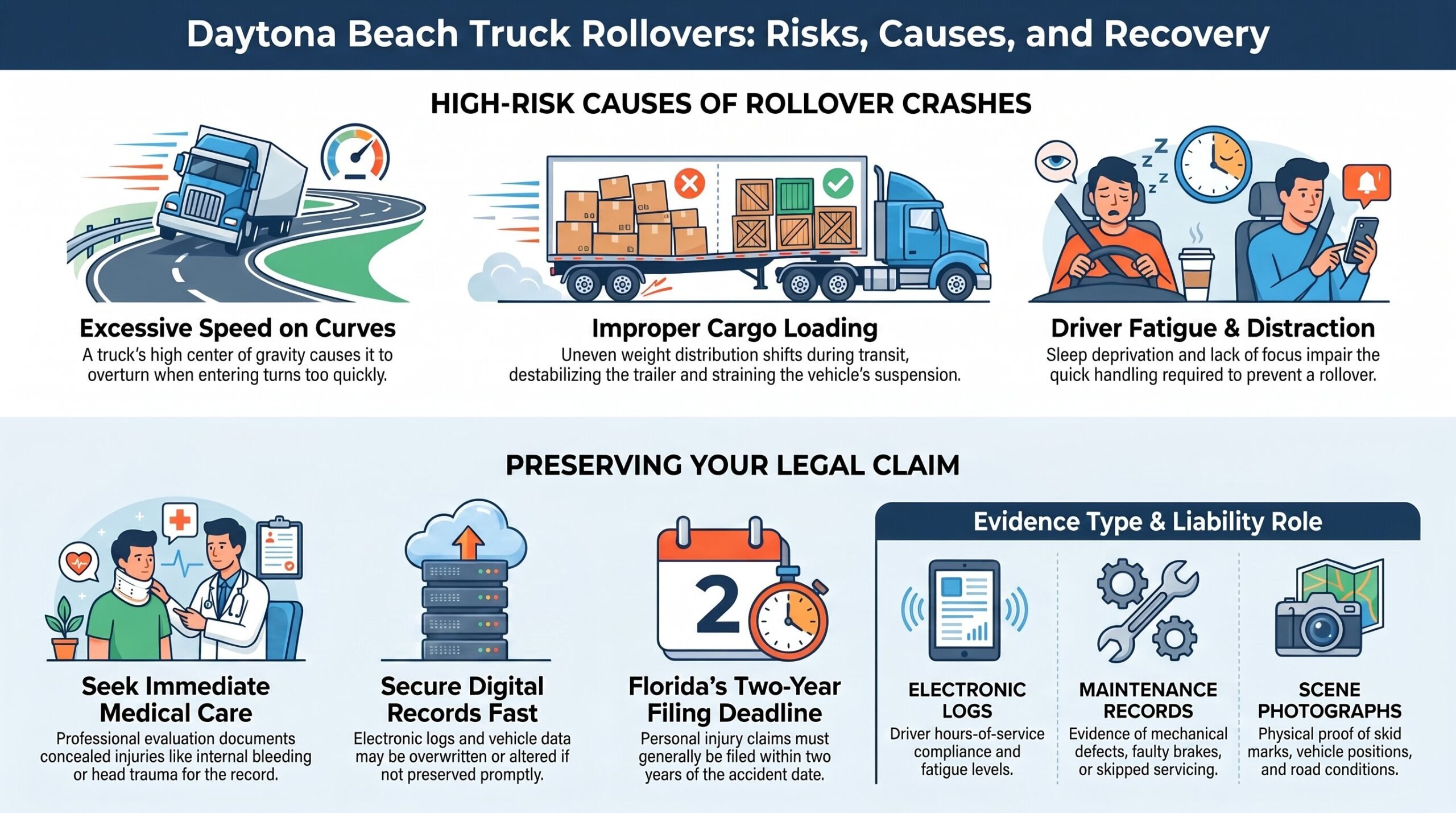
Truck rollover accidents in Daytona Beach may result from excessive speed, improper cargo loading, sharp turns, or driver fatigue. Each factor can reduce vehicle stability and increase the likelihood of a rollover, particularly when multiple risks occur together. Identifying the underlying cause is vital when evaluating liability and the circumstances of an injury case.
Excessive Speed
Excessive speed is a significant contributor to truck rollover accidents in Daytona Beach because it reduces a driver’s ability to maintain control during turns, sudden actions, or roadway hazards. When a commercial truck enters a curve too quickly, its elevated center of gravity can cause the vehicle to lean dangerously and overturn. Speed also limits the time available to respond to congestion, debris, changing lanes, or stalled traffic. Traffic signal violations may compound this danger when a truck proceeds through an intersection without sufficient time to brake or navigate safely.
In addition, driver distraction can prevent timely recognition of speed-related hazards. Injured individuals and families may benefit from documenting roadway conditions, vehicle damage, witness accounts, and available surveillance footage. Such evidence can help clarify whether excessive speed contributed to the rollover.
Improper Cargo Loading
Improper cargo loading can substantially increase the risk of a truck rollover accident in Daytona Beach by shifting the vehicle’s center of gravity and reducing its stability. Unevenly distributed freight may place excessive weight on one side, making the truck more vulnerable when traveling over uneven pavement or responding to ordinary road conditions. Vehicle Overloading can also strain tires, suspension components, and braking systems, limiting the driver’s ability to maintain control.
Effective Cargo Securement requires appropriate restraints, proper weight distribution, and compliance with applicable transportation regulations. When loading procedures are neglected, cargo may shift during transit, further destabilizing the vehicle and endangering nearby motorists. Investigators may review loading records, inspection reports, and company practices to determine whether preventable violations contributed to the crash and resulting injuries.
Sharp Turns
When a commercial vehicle enters a sharp turn at an unsafe speed, its elevated center of gravity can cause the body and cargo to shift outward, increasing the risk of a rollover. This danger may arise on highway ramps, intersections, or narrow roads where sudden handling corrections are required. Distracted Driving can prevent a truck operator from recognizing a curve, judging its radius, or reducing speed in time.
Brake Failures may further limit the operator’s ability to control momentum before entering the turn. Proper speed management, attentive operation, and routine vehicle inspections help reduce these hazards and protect passengers, motorists, and pedestrians. When a rollover occurs, injured individuals may benefit from prompt medical attention and guidance from a Daytona Beach truck rollover accident lawyer regarding available legal remedies.
Driver Fatigue
Driver fatigue can impair a truck operator’s alertness, reaction time, and ability to maintain steady control, substantially increasing the risk of a rollover. Sleep deprivation may slow responses, reduce judgment, and make it difficult to recognize changing roadway conditions or manage a vehicle’s center of gravity. Long shifts, irregular schedules, inadequate rest breaks, and overnight driving can intensify this hazard. A fatigued operator may drift within a lane, miss speed changes, overcorrect direction, or respond too late to curves and sudden obstacles.
Observable fatigue signals can include frequent yawning, heavy eyelids, repeated blinking, wandering thoughts, and inconsistent speed. Employers and drivers share responsibility for addressing these warning signs through lawful scheduling, adequate sleep, and timely rest. Preventing fatigue-related crashes helps protect passengers, nearby motorists, and the broader Daytona Beach community.


Legal Rights of Daytona Beach Truck Rollover Accident Injury Victims
Don’t Wait. Call Our Daytona Beach Truck Accident Lawyers Now.
Truck rollover accident victims in Daytona Beach may have legal rights to pursue compensation for medical expenses, lost income, property damage, and pain and suffering when another party’s negligence contributed to the crash.
A timely legal evaluation can help preserve evidence, identify responsible parties, and protect a victim’s interests during Insurance Coverage negotiations or Liability Disputes.
- Victims may seek damages from negligent drivers, trucking companies, manufacturers, or other legally responsible parties.
- Medical documentation and employment records can substantiate current losses and support claims for future needs.
- Insurers may request statements or releases that could affect recovery, making informed guidance important before settlement.
- Florida deadlines may restrict the time available to file a lawsuit, so prompt action remains crucial.
A qualified attorney can investigate the claim, communicate with insurers, assess settlement offers, and pursue litigation when appropriate. Supporting injured community members requires careful attention to their rights, dignity, and long-term welfare throughout the legal process. Each case depends on its evidence, applicable law, and proven damages.
Why Do Daytona Beach Truck Rollover Accident Injuries Happen?
Understanding why rollover injuries occur can help clarify liability and the evidence needed to support a claim. These crashes often result from excessive speed, abrupt handling, driver distraction, fatigue, or impaired judgment. A truck’s high center of gravity can make it especially vulnerable when a driver enters a curve too quickly or responds suddenly to traffic conditions.
Improperly loaded or secured cargo may shift during travel, reducing stability and causing a trailer to overturn. Mechanical defects, including defective tires, brakes, suspension components, or guidance systems, can also contribute. Inadequate Driver training may leave operators unprepared to manage narrow roads, severe weather, or emergency maneuvers.
Effective trucking compliance is another important factor. Violations involving inspection schedules, hours-of-service limits, cargo securement, or maintenance can increase crash risks. Roadway design, construction zones, standing water, and poor visibility may further influence the event. Identifying these contributing conditions helps determine whether responsibility rests with a driver, carrier, maintenance provider, cargo handler, manufacturer, or other party.
Don’t Wait. Call Our Daytona Beach Truck Accident Lawyers Now.
What Should You Do After a Daytona Beach Truck Rollover Accident Injury?
After a Daytona Beach truck rollover accident injury, the injured person should seek immediate medical care, even if symptoms initially appear minor. The accident scene should be documented through photographs, witness information, and available vehicle or roadway details. Consulting a truck accident lawyer can help preserve evidence and clarify potential legal rights and claims.
Seek Immediate Medical Care
Prompt medical attention is vital after a Daytona Beach truck rollover accident, even when an injured person believes the condition is minor. A qualified healthcare professional should evaluate every occupant for concealed injuries, including internal bleeding, head trauma, spinal damage, and delayed symptoms. Emergency treatment may stabilize dangerous conditions and establish a timely medical record. Following discharge, symptom monitoring remains important because pain, dizziness, numbness, or cognitive changes can develop hours or days later.
The injured person should follow all instructions, attend recommended appointments, and promptly report worsening symptoms. Medical records, prescriptions, and related Legal documents should be preserved for future reference. Accurate medical information also supports insurance reporting, although statements to insurers should remain factual and limited. Prompt care helps recover health while clarifying the injury’s scope.
Document The Accident Scene
When conditions permit, the injured person or a designated witness should document the Daytona Beach truck rollover accident scene before vehicles or other evidence are moved. Photographs and videos should show vehicle positions, roadway conditions, skid marks, debris, traffic signals, lighting, weather, visible injuries, and property damage. Images should be taken from multiple distances and angles without entering unsafe areas or interfering with emergency personnel. Witness statement collection should include names, telephone numbers, and brief accounts of what each person observed.
Statements should be recorded accurately, without prompting or speculation. If nearby businesses, residences, or traffic systems may have captured the incident, prompt action is important for securing roadway video footage because recordings may be overwritten. Preserving these details can assist medical providers, insurers, and appropriate authorities in understanding what occurred.
Consult A Truck Accident Lawyer
Why consult a truck accident lawyer after a Daytona Beach rollover injury? A qualified attorney can protect an injured person’s rights while coordinating medical, insurance, and legal concerns. Truck crashes often involve commercial carriers, multiple insurers, electronic records, maintenance histories, and questions about driver conduct. An attorney can identify responsible parties, preserve evidence, and assess whether negligence contributed to the rollover.
Early legal guidance also helps establish a realistic Settlement timeline. The attorney may investigate damages, communicate with insurers, and seek compensation for treatment, lost income, rehabilitation, and future needs. If negotiations fail, counsel can develop a court strategy supported by accident evidence, medical documentation, and qualified witnesses. Consulting promptly allows the injured individual and family to make informed decisions while focusing on recovery and receiving appropriate assistance throughout the process.
Don’t Wait. Call Our Daytona Beach Truck Accident Lawyers Now.
Critical Evidence in a Daytona Beach Truck Rollover Accident Injury Case
A strong Daytona Beach truck rollover accident injury case depends on preserving evidence that clarifies how the collision occurred and who may be responsible. Important records and physical proof can establish vehicle defects, driver conduct, regulatory violations, and the severity of resulting injuries.
Essential evidence may include:
- Accident scene photographs
- Truck maintenance records
- Driver qualification files
- Electronic logging data
Accident Scene Photos
Photographs taken at a truck rollover accident scene can preserve important evidence that may otherwise disappear as vehicles are moved, debris is removed, and roadway conditions change. Images should document vehicle positions, overturned cargo, roadway marks, damaged guardrails, traffic signals, weather conditions, and visible injuries. Wide views can establish the scene’s layout, while close photographs may capture tire marks, broken components, and property damage. Photographs from witnesses, passengers, responding officers, and nearby businesses may provide additional perspectives.
They can be compared with Witness statements to clarify how the collision occurred and identify inconsistencies. Images may also help establish the extent of losses when insurers evaluate insurance coverage. A legal representative can organize this evidence, preserve original files, and seek additional records when necessary to support an injured person’s claim.
Truck Maintenance Records
Beyond photographs of the accident scene, truck maintenance records may show whether a mechanical defect contributed to the rollover. These documents can identify scheduled servicing, reported repairs, inspection results, and unresolved equipment problems. A detailed brake inspection may reveal worn components, hydraulic concerns, or other conditions affecting stopping and stability. Tire replacements, suspension work, handling repairs, and load-related maintenance may also clarify whether the vehicle received appropriate care before the crash.
Missing entries, altered records, or repeated deferrals can support an allegation of maintenance negligence, particularly when the same defect appeared in earlier service reports. Preserving these records promptly helps establish what the carrier or maintenance provider knew and when action should have occurred. Such evidence can assist injured individuals and their families in seeking accountability and supporting fair compensation.
Driver Qualification Files
Driver qualification files can help determine whether a truck driver involved in a Daytona Beach rollover accident was properly licensed, trained, and medically qualified to operate the vehicle. These records may include license classifications, medical examiner certifications, employment applications, road-test results, training histories, and required safety compliance documents. They can also reveal prior disqualifying violations, suspended licenses, failed drug or alcohol tests, or inadequate instruction for handling the vehicle.
Investigators may obtain driver record requests from state agencies and compare those records with the carrier’s file. Missing, outdated, or inconsistent information may indicate negligent hiring, retention, or supervision. Careful review helps clarify whether the trucking company followed federal qualification requirements and took reasonable measures to protect motorists, passengers, and other individuals who could be affected by an unqualified driver’s conduct.
Electronic Logging Data
Electronic logging data can help establish whether a truck driver complied with federal hours-of-service limits before a Daytona Beach rollover accident. These records may show driving time, rest periods, vehicle movement, and duty-status changes, offering an objective timeline of the driver’s activities. Investigators can compare electronic logs with dispatch records, fuel receipts, toll data, inspection reports, and cellular location information to identify inconsistencies or possible falsification.
Such evidence may clarify whether fatigue, extended driving, or inadequate rest contributed to the crash. It can also support an assessment of FMCSA hours of service compliance and reveal whether a motor carrier monitored required limits. Preserving this Safety compliance documentation promptly is important because electronic records may be overwritten or altered. Careful review can assist injured individuals, families, and safety professionals seeking an accurate account.
Long-Term Effects of Daytona Beach Truck Rollover Accident Injuries
Truck rollover injuries may produce chronic pain conditions that persist long after initial treatment and affect daily activities. Permanent mobility limitations can require assistive devices, ongoing rehabilitation, or changes to employment and living arrangements. These physical consequences may also create lasting emotional and financial strain for injured individuals and their families.
Chronic Pain Conditions
Chronic pain frequently develops after a Daytona Beach truck rollover accident, particularly when injuries involve the spine, joints, muscles, or nerves. Symptoms may persist for months or years, affecting sleep, concentration, employment, and a person’s ability to fulfill family or community responsibilities. Medical evaluation can identify underlying damage and guide treatment, which may include medication, physical therapy, counseling, or pain-management services. Consistent records of symptoms, appointments, prescriptions, and functional limitations can help demonstrate the condition’s continuing impact.
Legal guidance should address Statute Deadlines and Evidence Preservation before important information is lost. A careful Trial Strategy may connect the pain to the crash and account for anticipated treatment costs. Wrongful Death claims differ, but families may also need prompt assistance when chronic injury eventually contributes to a fatal outcome.
Permanent Mobility Limitations
Permanent mobility limitations may result when a Daytona Beach truck rollover accident causes severe spinal cord, brain, bone, joint, or nerve injuries. Affected individuals may require wheelchairs, braces, walkers, or other assistive equipment, and everyday activities can demand substantial adaptation. Long-term rehabilitation may include physical therapy, occupational therapy, medical evaluations, and training designed to preserve independence. Recovery Planning can help coordinate treatment, home modifications, transportation needs, and continuing care with appropriate professionals.
Depending on the injury’s severity and its effect on work capacity, Disability Benefits may provide critical support through available public or private programs. Emotional Trauma can also accompany the loss of mobility, making access to counseling and supportive services important. Documentation of diagnoses, limitations, treatment, and prognosis may clarify long-term needs and protect legal interests.
Emotional And Financial Strain
The long-term effects of injuries from a Daytona Beach truck rollover accident may create substantial emotional and financial strain for injured individuals and their families. Ongoing pain, reduced independence, and uncertainty about recovery can contribute to anxiety, depression, or persistent emotional distress. Family members may also experience caregiver fatigue while adjusting work schedules and household responsibilities. Lost income, diminished earning capacity, rehabilitation costs, and necessary home or vehicle modifications can place significant pressure on limited resources.
Insurance paperwork stress may intensify when claims require extensive documentation, repeated communication, or disputes regarding coverage. Likewise, medical bill anxiety can arise as balances accumulate despite insurance payments. Compassionate support, organized records, and timely legal guidance may help families understand available resources and pursue compensation for qualifying long-term losses.
Proving Liability in Daytona Beach Truck Rollover Accident Injury Cases
When a truck rollover causes injuries in Daytona Beach, proving liability requires evidence showing who acted negligently and how that conduct contributed to the crash. Investigators may examine driver decisions, vehicle maintenance, cargo loading, roadway conditions, and employer safety practices. Evidence can include police reports, photographs, electronic logging data, inspection records, surveillance footage, and medical documentation connecting the injuries to the collision.
Witness statement collection should occur promptly because recollections can change, and witnesses may become difficult to locate. Statements may clarify vehicle speed, lane movements, unsecured cargo, warning signs, and events immediately preceding the rollover. Accident reconstruction specialists can analyze physical evidence and determine whether excessive speed, improper maneuvering, mechanical failure, or another preventable condition caused the loss of control.
A potential claimant should also preserve relevant records and identify responsible parties early. Florida injury claim deadlines may restrict the time available to pursue legal relief, making timely investigation essential. Careful evidence preservation helps establish negligence and supports an accurate assessment of recoverable damages.
Dealing With Insurance Companies After a Daytona Beach Truck Rollover Accident Injury
After a Daytona Beach truck rollover injury, insurance companies may promptly investigate the crash while evaluating whether to accept, limit, or deny a claim. Their representatives may request statements, medical records, photographs, employment information, and other evidence. Injured individuals should provide accurate facts, avoid speculation, and refrain from minimizing symptoms or discussing fault before understanding their rights.
Medical bills documentation should be organized carefully, including invoices, receipts, prescription records, treatment summaries, and insurance explanations of benefits. This material can help demonstrate the financial effect of the injury and identify unpaid balances. Records should also reflect follow-up appointments and recommended care.
Post-accident communication with insurers should remain factual and limited to necessary information. Written correspondence can reduce misunderstandings, while recorded statements and settlement documents warrant careful review. An attorney may communicate with adjusters, protect confidential information, and address attempts to shift blame. Prompt legal guidance can help preserve evidence and support fair treatment for the injured person.
What to Expect During a Daytona Beach Truck Rollover Accident Injury Claim Process
A Daytona Beach truck rollover accident injury claim typically begins with an initial case evaluation to assess liability, damages, and available legal options. The process may involve gathering accident records, medical documentation, witness statements, and other evidence before insurance claim negotiations commence. If a fair resolution cannot be reached, court proceedings may follow, ultimately concluding through settlement, judgment, or another formal resolution.
Initial Case Evaluation
The initial case evaluation establishes whether a Daytona Beach truck rollover accident injury claim has a viable legal and factual foundation. An attorney typically reviews the reported injuries, treatment history, Medical documentation, employment impact, and applicable deadlines. The evaluation also considers potential defendants, available insurance coverage, and whether an insurance denial or inadequate offer requires further legal action.
Liability disputes may involve the truck driver, trucking company, maintenance providers, manufacturers, or other responsible parties, but the assessment remains focused on legal viability rather than prematurely resolving contested facts. Counsel may explain possible remedies, claim limitations, litigation risks, and expected communication procedures. If the claim appears supportable, representation terms and a strategy for future settlement negotiations can be discussed, while preserving the injured person’s interests and respecting the needs of others.
Evidence Gathering Process
When evidence gathering begins, counsel works to preserve and organize information that may establish how the Daytona Beach truck rollover occurred, who may be responsible, and how the injuries affected the claimant. The process may include obtaining crash reports, photographs, vehicle inspection records, electronic logging data, maintenance histories, and applicable company policies. Counsel may identify witnesses, secure Witness statements, and review surveillance footage, roadway conditions, weather records, and available emergency response documentation.
Medical records and employment information can help document treatment, limitations, and related losses without relying solely on recollection. Investigators may inspect the truck and accident scene when appropriate, while qualified professionals evaluate mechanical, operational, or roadway issues. These materials help develop a coherent liability theory and preserve reliable evidence before it becomes unavailable or altered.
Insurance Claim Negotiations
Although insurance claim negotiations may begin after initial evidence has been collected, they often involve continuing review of liability, medical treatment, and financial losses. An insurer may request records, photographs, employment information, and explanations of how the rollover occurred. Witness statement collection can clarify roadway conditions, vehicle movements, and conduct before impact. Medical documentation should connect diagnosed conditions to the collision and show necessary treatment, prognosis, and related expenses.
In rollover cases, roofline injury documentation may help explain injuries caused by vehicle deformation or occupant contact. A claim representative may present an initial offer that does not reflect projected care, lost earning capacity, or other compensable harm. Careful evaluation, organized supporting materials, and timely communication help protect the injured person’s interests. Legal guidance may assist with valuation, deadlines, and settlement discussions.
Court Proceedings And Resolution
If settlement negotiations do not resolve a Daytona Beach truck rollover injury claim, the injured party may proceed with a civil lawsuit seeking compensation for medical expenses, lost income, pain and suffering, and other documented damages. The attorney typically files a complaint, serves the responsible parties, and manages deadlines for responses. During discovery, both sides exchange records, take depositions, and consult medical or accident-reconstruction experts. The Trial Timeline may extend several months or longer, depending on court schedules, disputes, and the intricacy of the evidence.
A thoughtful Settlement Strategy can continue throughout litigation, including mediation or conferences designed to avoid trial when appropriate. If the case reaches trial, each side presents evidence and arguments before a judge or jury determines liability and damages. Court orders may then enforce the final resolution.
Compensation for Daytona Beach Truck Rollover Accident Injury Damages
Compensation for injuries sustained in a Daytona Beach truck rollover accident may include medical expenses, lost income, reduced future earning capacity, property damage, and non-economic losses such as pain, emotional distress, and diminished quality of life. A careful evaluation considers the full effect of the collision, including continuing treatment, rehabilitation, transportation needs, and assistance required during recovery. The Insurance claim timeline may depend on prompt notice, insurer investigation, liability review, and the availability of supporting evidence.
Early medical record collection helps document diagnoses, procedures, prescribed care, prognosis, and the connection between the crash and claimed injuries. Witness statements, photographs, employment records, repair estimates, and trucking company documents may also support the claim. A representative may communicate with insurers, protect the injured person from premature settlement demands, and organize evidence for negotiation or litigation. Because each person’s circumstances differ, compensation should reflect documented losses and future needs rather than an insurer’s initial assessment. Careful preparation can help preserve resources needed for recovery and family responsibilities.
Economic vs Non-Economic Damages in Daytona Beach Truck Rollover Accident Cases
Economic damages may include medical expenses, lost income, property damage, and other documented financial costs arising from a truck rollover accident. Non-economic losses, including pain and suffering, emotional distress, and diminished quality of life, may also form part of a claim. Calculating total compensation requires evaluating both measurable expenses and the broader personal impact of the injuries.
Economic Damage Categories
A Daytona Beach truck rollover accident claim may involve both economic and non-economic damages, each addressing a different type of harm caused by the crash. Economic damage categories generally include emergency treatment, hospital services, physician visits, prescriptions, rehabilitation, and other documented medical expenses. A claimant may also seek compensation for future care when injuries require continuing treatment. Lost wages, reduced earning capacity, transportation costs, vehicle repairs, and necessary household assistance can represent additional financial losses.
Medical records, employment documents, invoices, and expert evaluations help establish these amounts. Proving negligence remains important because liability must be connected to the claimed expenses. Witness statements may clarify how the rollover occurred and support responsibility. Careful documentation can help a representative evaluate the settlement timeline and protect the claimant’s financial interests.
Non-Economic Losses
When a truck rollover causes pain, emotional distress, or diminished quality of life, non-economic losses may form an important part of the resulting claim. These damages address harm that does not come with fixed bills, including physical discomfort, anxiety, trauma, disfigurement, loss of companionship, and reduced ability to enjoy ordinary activities. In fatal cases, surviving relatives may pursue wrongful death damages for lost guidance, affection, and family support, subject to applicable law.
Evidence preservation can help establish how injuries changed a person’s daily life. Medical records, treatment notes, personal journals, and witness statements may describe pain, emotional distress, sleep disruption, or lasting limitations. A careful evaluation distinguishes these losses from economic damages while recognizing that both categories reflect the full human impact of a serious rollover collision.
Calculating Total Compensation
Although no formula can capture every consequence of a truck rollover, total compensation generally combines economic and non-economic damages arising from the collision. Economic damages may include emergency treatment, hospitalization, rehabilitation, medication, lost wages, reduced earning capacity, property damage, and anticipated future care. Non-economic damages address pain, emotional distress, disfigurement, disability, loss of enjoyment, and diminished quality of life. Valuation depends on medical records, employment documentation, expert projections, and testimony describing daily limitations.
Evidence preservation steps, including collecting photographs, securing vehicle data, and identifying witnesses, can support accurate evaluation. Liability dispute preparation is equally important because comparative fault, maintenance failures, cargo loading, and trucking violations may affect recovery. A careful assessment distinguishes documented losses from unsupported estimates while accounting for treatment needs and long-term consequences. Counsel may also evaluate insurance coverage and settlement offers.
When a Daytona Beach Truck Rollover Accident Injury Case Goes to Trial vs Settlement
The decision to resolve a Daytona Beach truck rollover accident injury case through settlement or trial depends on the strength of the evidence, the extent of the injuries, and the parties’ willingness to reach a fair resolution. A settlement negotiation strategy may provide an efficient path to compensation while reducing uncertainty, expense, and delay. It can also give injured individuals greater control over the outcome and help families address medical, financial, and personal needs sooner.
A trial may become necessary when the opposing party denies responsibility, disputes the severity of injuries, or offers inadequate compensation. Before recommending that course, counsel generally conducts a thorough Pretrial evidence review, including accident reports, photographs, medical records, witness statements, and expert opinions. The review helps determine whether the evidence can withstand courtroom scrutiny and whether testimony will clearly present the claimant’s losses.
The choice should reflect informed judgment, realistic expectations, and the injured person’s long-term interests. Skilled representation supports clients with diligence while seeking a fair and responsible resolution.
Florida Laws That May Affect Your Daytona Beach Truck Rollover Accident Case
Florida laws governing negligence, trucking regulations, insurance coverage, and civil procedure may substantially affect a Daytona Beach truck rollover accident case.
Understanding these rules helps injured people pursue fair treatment while protecting community safety.
- Comparative negligence: Florida may reduce compensation when an injured party shares responsibility for the crash. Evidence concerning vehicle maintenance, traffic conduct, and emergency responses can influence that allocation.
- Trucking regulations: State and federal requirements may address driver qualifications, hours of service, cargo securement, inspections, and maintenance. Violations can support negligence claims when they contributed to the rollover.
- Insurance coverage: Commercial policies, additional insured provisions, and potentially applicable personal policies can affect available compensation. Coverage disputes may require careful review of policy language and accident evidence.
- Punitive damages: In exceptional cases, conduct showing intentional misconduct or gross negligence may justify punitive damages. These damages require proof beyond ordinary carelessness and serve a deterrent purpose.
A qualified attorney can evaluate records, identify responsible parties, and explain procedural requirements without losing sight of the injured person’s practical needs.
The Statute of Limitations for Daytona Beach Truck Rollover Accident Injury Cases
Prompt attention to filing deadlines is important in Daytona Beach truck rollover accident injury cases, because Florida’s statute of limitations can bar a claim if legal action is not commenced within the applicable period. Under current Florida law, personal injury claims generally must be filed within two years after the accident. Different deadlines may apply to wrongful-death claims, claims involving governmental entities, or circumstances affecting when an injury was discovered. Because exceptions are limited and fact-dependent, preserving a claim requires careful attention to the accident date and potentially applicable statutes.
Evidence may also become harder to obtain as time passes. Records concerning Faulty Braking, Lane Departure, or Distracted Driving should be preserved promptly, particularly when Investigating Defects may involve manufacturers, maintenance providers, or other parties. A missed deadline can prevent injured people and families from seeking compensation, regardless of the strength of the underlying facts. Timely legal evaluation supports responsible service to those affected by serious truck crashes.
How a Daytona Beach Truck Rollover Accident Lawyer Can Help You
Once filing deadlines have been evaluated, a Daytona Beach truck rollover accident lawyer can help identify responsible parties, preserve evidence, and develop a claim based on the available facts.
The lawyer may coordinate a focused investigation while supporting an injured person’s interests and family responsibilities.
- Evidence preservation can include securing photographs, vehicle records, electronic logs, maintenance files, and witness accounts before information disappears.
- The lawyer can evaluate negligence defenses, including allegations involving speed, road conditions, loading practices, or comparative fault.
- Expert witnesses may explain rollover mechanics, driver conduct, medical consequences, and long-term service needs.
- A settlement strategy can address insurer tactics, calculate documented losses, and present a supported demand without sacrificing fairness.
Careful post-accident documentation helps connect the collision to treatment, income disruption, property damage, and continuing limitations. Counsel can communicate with insurers, organize records, and assess proposed resolutions. This assistance allows clients to make informed decisions while preserving dignity, accountability, and access to resources for recovery.
When to Contact a Daytona Beach Truck Rollover Accident Lawyer
After a truck rollover accident, contacting a Daytona Beach truck rollover accident lawyer promptly can help protect evidence and clarify legal options before essential information is lost. Early guidance may assist injured individuals and families in documenting medical treatment, preserving photographs, identifying witnesses, and understanding applicable filing deadlines. A consultation is appropriate even when fault appears obvious, because trucking records, vehicle maintenance information, and driver logs may require timely preservation.
Legal advice can also be valuable when an insurer requests statements, offers a quick settlement, delays payment, or issues Insurance Denials. Families should seek counsel promptly when injuries prevent work, require continuing care, or affect household responsibilities. If a loved one dies, a lawyer can explain potential Wrongful Death claims and related deadlines while helping relatives identify recoverable losses. Contact becomes especially important when multiple vehicles, commercial carriers, government entities, or disputed facts are involved. Prompt communication supports informed decisions and helps protect the interests of everyone affected.
Why You Need an Experienced Daytona Beach Truck Rollover Accident Lawyer
An experienced Daytona Beach truck rollover accident lawyer can address the complex factual and legal issues that often arise in these claims. Commercial vehicle collisions may involve driver conduct, maintenance records, loading practices, roadway conditions, and federal or state safety regulations. An experienced attorney can organize these details into a clear account of responsibility while protecting an injured person’s ability to pursue appropriate compensation.
Prompt Evidence Preservation is critical because vehicles may be repaired, electronic data may be overwritten, and inspection records can disappear. Counsel can identify relevant materials, request their retention, and coordinate qualified examinations when necessary. Witness Statements may clarify traffic conditions, vehicle movement, driver behavior, and events immediately preceding the rollover. A lawyer can obtain those accounts carefully and compare them with physical evidence and official reports.
This guidance allows injured individuals and their families to focus on medical recovery while a knowledgeable advocate addresses communications, documentation, and legal deadlines with diligence, serving their interests responsibly.
How to Choose the Right Daytona Beach Truck Rollover Accident Lawyer for Your Case
Selecting the right Daytona Beach truck rollover accident lawyer requires careful consideration of the attorney’s experience, resources, communication practices, and record handling of complex commercial vehicle claims. A qualified lawyer should understand federal and state trucking regulations, carrier responsibilities, maintenance records, driver qualifications, and insurance coverage issues. Experience with rollover investigations can help identify evidence such as electronic logging data, inspection reports, event data, photographs, and witness accounts before information disappears.
Client communication should be clear, timely, and respectful. During an initial consultation, the prospective client can ask how updates are provided, who handles questions, and what decisions require client approval. The lawyer should explain potential challenges without promising a particular outcome.
Case strategy alignment is equally important. The attorney should listen carefully to the injured person’s goals, explain available legal options, and develop a plan consistent with those priorities. Reviewing professional credentials, relevant results, fee terms, and conflict policies can further support an informed, service-focused decision.
About The Law Offices of Anidjar & Levine
The Law Offices of Anidjar & Levine represents individuals injured in Daytona Beach truck rollover accidents and other serious motor vehicle collisions.
The firm’s attorneys evaluate each claim carefully, identify responsible parties, and explain available legal options to injured clients and their families.
Their work may involve examining driver conduct, trucking company practices, vehicle maintenance, roadway conditions, and applicable insurance coverage.
A focused Settlement Strategy is developed according to the circumstances of the collision, the extent of medical treatment, lost income, property damage, and anticipated future needs.
The attorneys also emphasize Evidence Preservation, which can include obtaining photographs, witness statements, electronic logging data, inspection records, maintenance documents, and accident reports before relevant information is lost or altered.
Frequently Asked Questions
Can I Afford to Hire a Daytona Beach Truck Rollover Accident Lawyer?
A person may be able to afford legal representation even without money upfront. Many Daytona Beach truck rollover lawyers offer contingency billing, meaning fees are generally paid only if compensation is recovered. Payment options vary, so the prospective client should request a written agreement explaining attorney fees, case expenses, and any circumstances requiring payment. A consultation can clarify eligibility, potential costs, and available resources while helping the injured person protect legal rights.
Will My Truck Rollover Accident Case Affect My Employment or Professional License?
A truck rollover accident case may affect employment or a professional license, depending on the allegations, driving responsibilities, employer policies, and licensing authority. An employment impact can arise from missed work, restricted duties, required reporting, or a conviction related to negligence, impairment, or unsafe operation. License consequences may include suspension, investigation, or disciplinary action, particularly for commercial drivers and regulated professionals. Legal counsel can explain disclosure duties, protect procedural rights, and coordinate defense strategies.
What Happens if the At-Fault Truck Driver Leaves Florida?
If the at-fault truck driver leaves Florida, the injured party may still pursue compensation through Florida courts, provided jurisdiction and proper service are established. Interstate liability rules can determine which state’s laws, insurance requirements, and filing deadlines apply. A driver’s departure does not automatically end the claim, although locating and serving that person may require additional procedures. Criminal charges, if warranted, are separate from the civil case and may proceed independently through law enforcement.
Can Family Members Attend Meetings About My Truck Rollover Accident Case?
Yes, family members may attend meetings if the client consents and the legal team determines their participation supports the case. The client’s privacy, communication preferences, and Victim safety rights remain central. Attorneys may limit attendance when confidential strategy, medical information, or evidence-gathering logistics require restricted discussion. A family member can assist with records, transportation, and emotional support, but the client should clarify roles and confidentiality expectations before meetings begin.
How Are Attorney Fees Handled in a Daytona Beach Truck Rollover Accident Case?
Attorney fees are commonly handled through a contingency fee arrangement, meaning the client generally pays no upfront legal fee. The attorney receives an agreed percentage of any settlement or court award, typically only if the case succeeds. The payment structure should be explained in a written agreement, including litigation expenses, medical-record costs, and potential liens. Clients should review whether costs are deducted before or after calculating the attorney’s percentage.
—————————
Truck rollover accidents can result in serious injuries, significant financial losses, and complex liability disputes.
Victims may require immediate medical care, comprehensive evidence gathering, and knowledgeable legal guidance to protect their rights.
A qualified Daytona Beach truck rollover accident lawyer can evaluate the circumstances, determine who may be responsible, communicate with insurance companies, and pursue appropriate compensation.
The Law Offices of Anidjar and Levine help injured individuals understand their legal options and seek accountability through a careful, informed approach tailored to their case.
Learn more about a Daytona Beach Truck Accident Lawyer.