A Daytona Beach blind spot truck accident lawyer from The Law Offices of Anidjar and Levine can investigate how a collision occurred, including lane positions, visibility, signaling, speed, and vehicle data.
The lawyer may identify liability involving the truck driver, trucking company, maintenance providers, or other parties while preserving camera footage, telematics, witness accounts, and physical evidence.
Legal representation may support claims for medical expenses, lost income, property damage, pain and suffering, and future care.
Florida’s comparative negligence rules may affect recovery.
Learn more from a Daytona Beach Truck Accident Lawyer.
Main Takeaways
- A Daytona Beach blind-spot truck accident lawyer investigates vehicle positions, visibility, lane changes, roadway conditions, and driver conduct.
- Counsel preserves critical evidence, including photographs, surveillance, witness statements, crash reports, vehicle damage, camera footage, and telematics data.
- Potentially responsible parties may include the truck driver, trucking company, maintenance providers, and other negligent entities.
- A lawyer evaluates injuries, medical treatment, lost income, property damage, comparative negligence, insurance coverage, and applicable claim deadlines.
- Legal representation can handle insurers, prepare settlement demands, establish liability, and pursue litigation when fair compensation is not offered.


How We Can Help With Your Daytona Beach Blind Spot Truck Accident Injury Claim
When a blind spot truck accident causes injury, a Daytona Beach personal injury attorney can investigate the collision, identify the responsible parties, and protect the injured person’s legal interests. The attorney can gather Vehicle Evidence, including photographs, vehicle damage records, surveillance footage, electronic data, and available witness statements. This information may help clarify lane positions, visibility conditions, signaling, speed, and the timing of the impact.
The legal team can also communicate with insurers, preserve relevant records, and organize documentation concerning medical treatment, lost income, and other accident-related losses. By applying Truck Accident Laws and applicable traffic regulations, counsel can evaluate potential claims involving the truck driver, trucking company, maintenance providers, or other responsible entities. Assistance may include preparing settlement demands, addressing disputed liability, and pursuing litigation when negotiations do not provide a fair resolution. These services are intended to support injured individuals and families while promoting accountability, careful investigation, and access to lawful compensation.
OUR CONSULTATIONSARE FREE
START YOUR FREE CASE REVIEW

Understanding Daytona Beach Blind Spot Truck Accident Injury Cases
Blind spot truck accident injury cases in Daytona Beach require a careful examination of how the collision occurred, who controlled the vehicles, and whether visibility or safety procedures contributed to the impact. The evaluation may include vehicle positions, roadway conditions, witness accounts, available video, and medical records. These details help clarify liability and the extent of an injured person’s losses.
Truck operators and companies may be measured against applicable trucking regulations, including requirements involving inspections, safe operation, and recordkeeping. Driver training can also matter when determining whether reasonable precautions were taken. In some cases, Shared negligence may affect the outcome if more than one party contributed to the crash.
Under comparative fault principles, compensation may be reduced according to an injured person’s assigned percentage of responsibility. A thorough claim assessment thus considers immediate injuries, future medical needs, lost income, and non-economic harm while preserving evidence and presenting the circumstances accurately. Certified legal guidance can help families pursue fair treatment.
Common Causes of Daytona Beach Blind Spot Truck Accident
Common causes include large blind spots that limit a truck driver’s view, improper lane changes, and inadequate mirror checks. Distracted truck drivers may also fail to recognize nearby vehicles before operating. These factors can markedly increase the risk of collisions on Daytona Beach roads.
Large Blind Spots
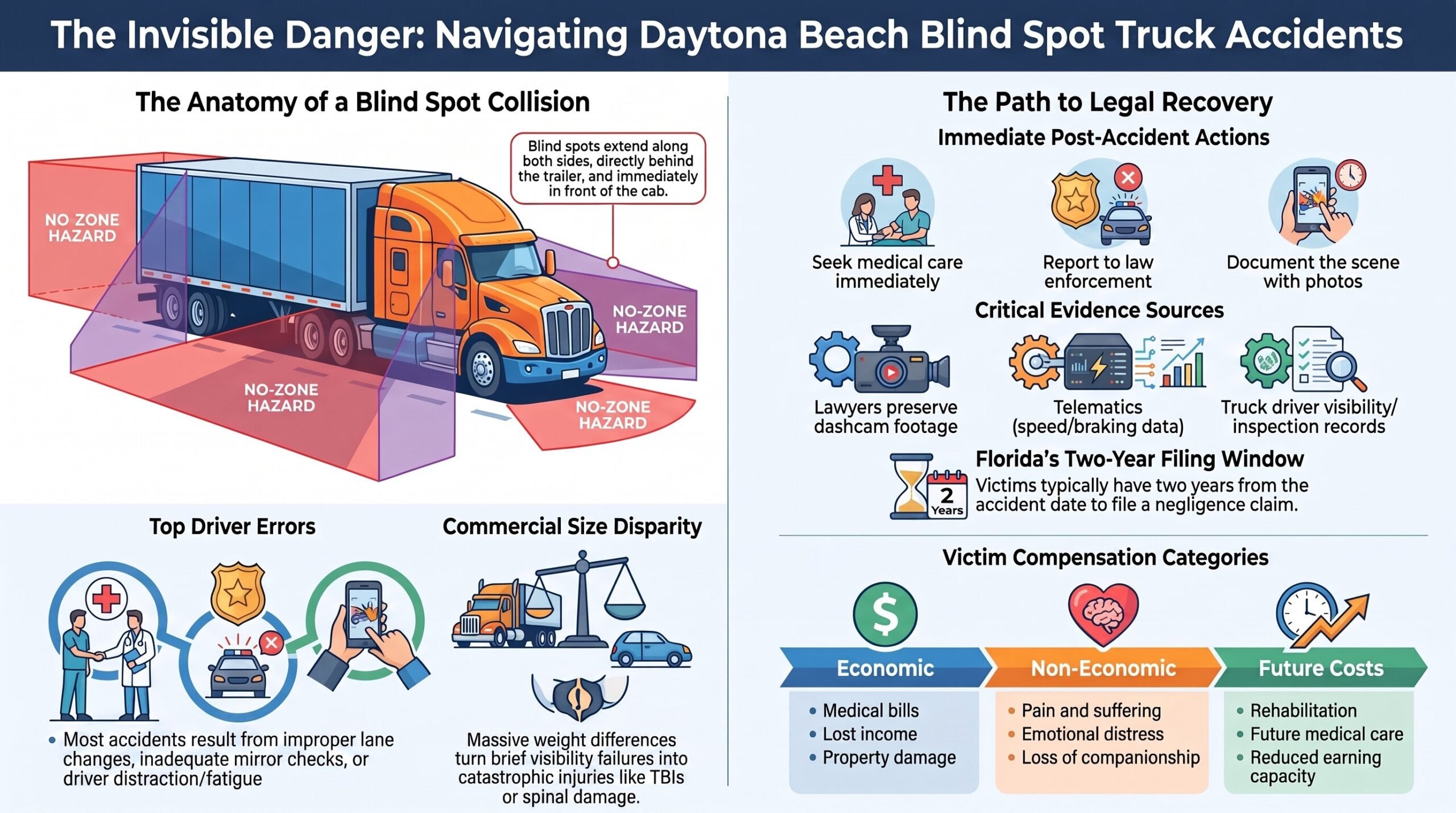
Large blind spots are a significant hazard around commercial trucks because their size and design restrict the driver’s view of nearby vehicles. These areas commonly extend along both sides, directly behind the trailer, and immediately in front of the cab. A passenger vehicle can remain hidden despite being close enough to create serious danger, particularly when traffic is dense or visibility is limited. Nighttime visibility issues may further reduce a truck operator’s ability to identify vehicles positioned outside mirror coverage.
Weather, glare, obstructed mirrors, and inadequate lighting can compound this limitation. After a collision, dashcam footage preservation may help clarify vehicle positions, roadway conditions, and the timing of observed events. Prompt collection of photographs, witness accounts, and vehicle data can assist injured individuals and their representatives in evaluating whether a blind spot contributed to the crash.
Improper Lane Changes
When a commercial truck changes lanes without adequately checking its blind spots, a nearby passenger vehicle may be struck or forced from its lane. Improper lane changes can occur when a driver misjudges surrounding traffic, moves across multiple lanes, or reacts too late to changing roadway conditions. These maneuvers may endanger motorists near a Traffic Signal, particularly where vehicles queue, merge, or turn near an intersection. They can also threaten Crosswalk Safety by pushing vehicles toward pedestrians or designated crossing areas.
Employers can reduce these risks through Crew Training that emphasizes lawful lane changes, patience, and communication. Vehicle Maintenance also supports safe operation by keeping indicators, brakes, and control components functional. When an unsafe lane change causes injury, timely documentation may help clarify responsibility and support affected individuals.
Inadequate Mirror Checks
Inadequate mirror checks can prevent a commercial truck driver from recognizing passenger vehicles traveling alongside or slightly behind the tractor and trailer. Because large trucks have extensive blind zones, a driver who checks mirrors too briefly or relies on one viewing angle may misjudge whether a lane is clear. This error can place nearby motorists in danger when the truck continues forward or begins moving toward an adjacent lane. Effective Driver training should teach consistent mirror scanning, proper adjustment, and awareness of changing traffic positions.
Fleet operators can reinforce these practices through safety protocols requiring checks before movement, during turns, and after extended travel. When mirror inspections are neglected, preventable collisions may result, causing serious injuries and significant disruption for affected families and communities. Careful observation helps protect every road user.
Distracted Truck Drivers
Distracted truck drivers may fail to recognize vehicles occupying a truck’s blind spots, particularly while changing lanes, turning, or merging. Phone distraction can divert a driver’s attention from mirrors, roadway markings, and surrounding traffic, increasing the likelihood of an unsafe operation. Other distractions may include adjusting navigation devices, eating, drinking, or responding to dispatch communications. Fatigue and mental preoccupation can also reduce observation and reaction time, even when a driver appears alert.
Although safety systems, including cameras, sensors, and blind-spot warnings, can assist with detection, they cannot replace attentive driving or thorough mirror checks. Trucking companies may have responsibilities to provide training, enforce safety policies, and monitor compliance. When distraction contributes to a collision, an investigation may examine driver conduct, electronic records, vehicle data, witness statements, and applicable commercial motor vehicle regulations.


Legal Rights of Daytona Beach Blind Spot Truck Accident Injury Victims
Victims injured in Daytona Beach blind spot truck accidents may have legal rights to pursue compensation when a truck driver’s failure to observe surrounding traffic contributes to the collision. A claim may address medical expenses, lost income, rehabilitation, property damage, pain, and other documented losses.
Legal evaluation commonly includes:
Victims of Daytona Beach blind spot truck accidents may pursue compensation for medical expenses, lost income, property damage, and other documented losses.
- Liability evidence: Investigators may examine crash reports, vehicle cameras, witness statements, and applicable trucking records.
- Medical record review: Medical professionals and attorneys may assess treatment records to connect injuries with the collision and document future care needs.
- Comparative negligence rules: Florida’s modified comparative negligence system may reduce recovery when an injured person is partly responsible, subject to applicable statutory limits.
- Insurance and deadlines: Claims must be presented to responsible insurers, and statutory filing deadlines can affect the right to pursue litigation.
Prompt reporting and careful evidence preservation can protect a victim’s interests. A qualified legal representative may communicate with insurers, coordinate documentation, and pursue fair compensation while supporting the injured person’s recovery and family needs.
Don’t Wait. Call Our Daytona Beach Truck Accident Lawyers Now.
Why Do Daytona Beach Blind Spot Truck Accident Injuries Happen?
Blind spot truck accident injuries occur when a commercial truck driver or nearby motorist fails to recognize that another vehicle, cyclist, or pedestrian is positioned in an area with limited visibility. Large trucks have substantial blind zones beside the cab, behind the trailer, and immediately in front of the vehicle. Collisions may result when drivers change lanes, turn, merge, or reverse without adequately checking mirrors and surrounding traffic. Fatigue, distraction, inadequate training, poor mirror adjustment, and pressure to meet delivery schedules can increase these risks.
Nearby motorists may also travel beside a trailer, pass on the wrong side, or remain hidden from the truck operator’s view. Severe vehicle size and weight differences can turn a brief visibility failure into catastrophic harm, including fractures, spinal injuries, and traumatic brain injuries. Such injuries may require extensive Pain Management, rehabilitation, and long-term assistance. Their financial consequences can also influence later settlement negotiations regarding medical costs, lost income, and continuing care.
Don’t Wait. Call Our Daytona Beach Truck Accident Lawyers Now.
What Should You Do After a Daytona Beach Blind Spot Truck Accident Injury?
After a Daytona Beach blind spot truck accident injury, the injured person should seek immediate medical care, even if symptoms initially appear minor. The accident should be reported to law enforcement, and all relevant evidence, including photographs, witness information, medical records, and documented injuries, should be preserved.
Seek Immediate Medical Care
When a truck accident involves a blind-spot impact, injured individuals should obtain immediate medical care, even if symptoms initially appear minor or absent. Adrenaline can mask pain, while concussions, internal injuries, and spinal damage may develop gradually. A prompt evaluation allows healthcare professionals to identify hidden conditions, begin appropriate treatment, and create medical records connecting injuries to the collision. Individuals should describe every symptom accurately, including dizziness, headaches, numbness, confusion, or increasing soreness.
Following discharge instructions and attending recommended appointments can support recovery and prevent complications. A person assisting an injured motorist should help arrange emergency transportation when necessary and avoid moving the individual unless immediate danger exists. They should also preserve safety evidence and obtain witness contact information when doing so does not interfere with urgent medical attention or create additional risk.
Report The Accident
Prompt medical care should be adhered to by reporting the collision to the appropriate authorities. Calling emergency services allows police, firefighters, and medical personnel to respond promptly, secure the roadway, and address immediate hazards. The injured person or a responsible bystander should provide the location, describe the vehicles involved, and explain whether anyone appears trapped or seriously hurt. Accident notification steps may include requesting an official crash report, identifying the responding agency, and obtaining instructions for follow-up.
If the injured person cannot communicate, a witness or passenger may report the collision on that person’s behalf. Authorities should be informed about suspected impairment, unsafe truck operation, or continuing traffic dangers. Accurate reporting supports public safety and helps ensure that all affected individuals receive appropriate assistance while preserving an official account of the incident.
Document Evidence and Injuries
Because evidence can change or disappear quickly, an injured person should document the crash scene and resulting injuries as thoroughly as possible, provided doing so does not interfere with emergency care. Photo documentation should capture vehicle positions, blind-spot damage, roadway conditions, traffic signs, visible injuries, and identifying information for witnesses. If injuries prevent photographs, a trusted companion may assist when appropriate. The individual should obtain medical records from every provider and preserve discharge instructions, prescriptions, diagnostic results, and receipts.
Consistent treatment timelines can help demonstrate how symptoms developed and whether care recommendations were followed. Accident reporting should include the Florida Highway Patrol or local law enforcement report, insurance communications, and any employer or commercial carrier notices. Organized records may help attorneys, insurers, and medical professionals understand the event and provide informed support.
Don’t Wait. Call Our Daytona Beach Truck Accident Lawyers Now.
Critical Evidence in a Daytona Beach Blind Spot Truck Accident Injury Case
Critical evidence can clarify how a blind spot collision occurred and identify whether the truck driver or trucking company failed to follow safety obligations.
A Daytona Beach blind spot truck accident lawyer may evaluate the following sources to establish visibility, vehicle operation, scene conditions, and eyewitness accounts:
- Truck driver visibility records
- Vehicle camera and sensor data
- Accident scene documentation
- Witness statements and testimony
Truck Driver Visibility Records
Truck driver visibility records can provide crucial evidence in a Daytona Beach blind spot truck accident injury case by showing what the driver could see before and during the collision. These records may include inspection reports, written checklists, and company documentation concerning mirror adjustments. They can indicate whether required mirrors were present, properly positioned, and maintained before the trip. Driver training materials and completion records may also show whether the operator received instruction about blind-spot limitations, lane changes, and safe observation practices.
Dispatch logs, route paperwork, and incident reports can help establish the driver’s actions and timing without relying solely on recollection. Preserving these documents may clarify whether inadequate preparation or oversight contributed to the crash. Such evidence can assist injured individuals and their representatives in seeking accountability and fair compensation.
Vehicle Camera And Sensor Data
Vehicle camera and sensor data can supplement visibility records by showing how a commercial truck was operated immediately before and during a Daytona Beach blind spot collision. Forward-facing cameras, side cameras, and event-triggered recordings may reveal lane position, signaling, braking, and driving responses. Telematics can identify speed changes, following distance, hard braking, and unusual movement patterns that may clarify how the crash developed. Recorded driver-monitoring alerts may also help evaluate driver fatigue, including prolonged driving, missed breaks, or repeated warnings.
Device-linked records can indicate cellphone distraction patterns when timing corresponds with camera footage, vehicle movement, or system alerts. Preservation of this information is important because onboard systems may overwrite older files. Attorneys serving injured people can seek relevant data promptly and compare it with testimony and other electronic records.
Accident Scene Documentation
When a blind spot truck collision occurs in Daytona Beach, prompt accident scene documentation can preserve evidence that may later disappear or become difficult to interpret. Photographs should capture vehicle positions, roadway markings, traffic signals, lighting, weather conditions, debris, skid marks, and visible damage from multiple angles. Measurements and clear images can help illustrate sightlines, lane placement, and the distance between vehicles. Dashcam footage, nearby surveillance recordings, and photographs of obstructed views may provide additional context before vehicles are moved or conditions change.
Documentation should identify the date, time, location, and source of each item while preserving original files without alteration. These materials can support a liability investigation by allowing qualified professionals to reconstruct events, evaluate visibility, and compare physical evidence with applicable traffic and trucking safety requirements.
Witness Statements And Testimony
Although physical evidence can establish important facts, witness statements and testimony may clarify what occurred immediately before and during a blind spot collision in Daytona Beach. Witness identification should be documented promptly, including names, contact information, locations, and observations. Independent witnesses may describe vehicle positions, turn signals, speed, traffic conditions, and whether the truck driver checked surrounding lanes. Their accounts can help explain events that photographs or vehicle damage cannot fully establish.
Investigators and attorneys assess credibility factors such as a witness’s vantage point, attention, consistency, relationship to the parties, and ability to perceive events accurately. Statements should be recorded carefully, without leading questions or pressure. A witness may later testify under oath, subject to cross-examination. Preserving these accounts protects injured individuals and supports a fair evaluation of responsibility, particularly when conflicting narratives develop.
Long-Term Effects of Daytona Beach Blind Spot Truck Accident Injuries
Blind spot truck accident injuries may produce chronic pain conditions that persist long after initial treatment ends. Victims may also experience long-term mobility challenges, limiting work capacity, independence, and daily activities. These physical effects can create significant emotional and financial strain for victims and their families.
Chronic Pain Conditions
Chronic pain is a common long-term consequence of injuries sustained in Daytona Beach blind spot truck accidents, particularly when trauma affects the spine, joints, muscles, or nerves. Persistent discomfort may interfere with sleep, concentration, household responsibilities, and emotional well-being, even after visible wounds have recovered. Treatment can include physical therapy, carefully monitored medications, injections, counseling, and other approaches tailored to the patient’s condition.
Medication side effects management is important because prolonged use may cause dependence, digestive problems, fatigue, or other complications. Treating providers may recommend pain journals, follow-up examinations, and diagnostic testing to measure progress and guide care. Work restrictions documentation can explain limitations, necessary accommodations, and expected treatment duration. Organized medical records help injured individuals, families, employers, and legal representatives understand the condition and support appropriate long-term assistance.
Long-Term Mobility Challenges
Long-term mobility challenges may develop after Daytona Beach blind spot truck accident injuries involving the spine, pelvis, joints, muscles, or nervous system. Affected individuals may experience limited walking tolerance, reduced balance, weakness, stiffness, or difficulty transferring between beds, chairs, and vehicles. Some require canes, walkers, wheelchairs, braces, or ongoing physical therapy to preserve function and prevent further complications. Mobility accommodations may include ramps, accessible bathrooms, modified vehicles, ergonomic equipment, and assistance with daily activities.
These changes can restrict driving, household responsibilities, recreation, and community participation. The workplace impact may include difficulty standing, climbing, lifting, reaching, or traveling through large facilities. Medical evaluations and functional assessments can document limitations, identify appropriate rehabilitation, and support informed decisions about safety, accessibility, and long-term care needs for affected individuals and their families.
Emotional and Financial Strain
In the aftermath of a Daytona Beach blind spot truck accident, emotional and financial strain may persist long after the initial injuries have stabilized. Survivors may experience anxiety, depression, sleep disruption, or reduced confidence while adapting to pain and lasting limitations. These effects can interfere with employment, family responsibilities, and participation in community life. Medical treatment, rehabilitation, transportation, and household assistance may create substantial expenses, particularly when income declines or ends.
Careful documentation of symptoms, expenses, lost wages, and proof of negligence can help establish the full scope of harm. A legal representative may also address insurance bad-faith tactics, including delayed responses, inadequate settlement offers, or attempts to shift responsibility. Compassionate support, coordinated medical care, and informed legal guidance can help injured individuals and their families pursue stability and protect vital resources.
Proving Liability in Daytona Beach Blind Spot Truck Accident Injury Cases
Proving liability in a Daytona Beach blind spot truck accident injury case requires evidence showing that the truck driver or another responsible party failed to use reasonable care. Relevant proof may include traffic camera footage, photographs, vehicle damage, eyewitness accounts, police reports, and electronic data showing speed, braking, lane changes, or mirror use. Medical records and expert testimony can connect the collision to documented injuries and establish the extent of harm.
A thorough investigation may also examine whether the driver was properly trained, qualified, and supervised. Negligent Hiring may apply when a company places an unsafe or unqualified driver behind the wheel despite warning signs. Employer Liability may arise when a driver’s careless conduct occurred during assigned work duties. Maintenance records, inspection reports, dispatch documents, and company safety policies can help identify additional failures. Preserving evidence promptly is vital because records may be altered, lost, or routinely destroyed. A qualified legal professional can organize these facts and present a clear claim on the injured person’s behalf.
Dealing With Insurance Companies After a Daytona Beach Blind Spot Truck Accident Injury
After a Daytona Beach blind spot truck accident injury, insurance companies may promptly get in touch with the injured person to obtain statements, medical permissions, or settlement information. The injured person should recognize that these communications may influence the assessment of the claim. Insurance adjuster tactics can include requesting recorded statements, emphasizing disputed facts, seeking broad medical releases, or presenting an early settlement before the full extent of injuries becomes clear.
Careful documentation of medical treatment, lost income, property damage, and accident-related limitations can help preserve accurate information. A person may decline to speculate about fault, future recovery, or prior medical conditions and may request time to review documents before responding. Time-limited claim deadlines can apply to insurance notices, settlement demands, and legal rights, so unnecessary delay can create serious consequences. A qualified Daytona Beach truck accident attorney may communicate with insurers, protect the injured person from improper pressure, and help ensure that relevant evidence and damages receive appropriate consideration.
What to Expect During a Daytona Beach Blind Spot Truck Accident Injury Claim Process
A Daytona Beach blind spot truck accident injury claim typically begins with an initial assessment of the injuries, liability, and available insurance coverage. The process then involves gathering evidence, including medical records, crash reports, witness statements, and vehicle-related information, before negotiations with insurers begin. The claim may conclude through a settlement or, when necessary, further legal action to secure an appropriate resolution.
Initial Claim Assessment
During an initial claim assessment, a Daytona Beach blind spot truck accident lawyer reviews the available facts to determine whether the injured person has a viable legal claim and which parties may bear responsibility. The discussion typically addresses the collision’s circumstances, reported injuries, medical treatment, and effects on daily life. The lawyer may also consider Pre-Incident Warning Signs, including unsafe traffic patterns, inadequate driver awareness, or operational concerns described by the client.
Client Rights Guidance explains available legal options, possible deadlines, communication expectations, and the roles of insurers and other involved parties. This stage helps establish realistic objectives without promising a particular outcome. It also allows the injured person to understand potential challenges, make informed decisions, and receive respectful support while preserving personal dignity throughout the process.
Gathering Evidence
Gathering evidence is a central part of a Daytona Beach blind spot truck accident injury claim because liability may depend on details that are not immediately apparent. The process may include collecting crash reports, photographs, medical records, vehicle damage documentation, and roadway information. Investigators may examine truck-camera systems, electronic logging data, driver records, and maintenance histories when legally available. Eyewitness protocols help preserve accurate statements by identifying witnesses promptly, recording their contact information, and documenting observations before memories change.
Video preservation is also important because traffic cameras, business surveillance, dashcam recordings, and cellphone footage may be automatically overwritten. Legal representatives may send preservation requests to relevant parties and coordinate with qualified professionals to interpret physical evidence. These efforts support an accurate account and help protect an injured person’s ability to pursue appropriate remedies.
Negotiating With Insurers
When an insurer evaluates a Daytona Beach blind spot truck accident claim, its adjuster typically reviews the reported facts, available evidence, medical documentation, and applicable coverage before making a settlement decision. The adjuster may question liability, dispute treatment necessity, or characterize injuries as preexisting. Counsel can respond with organized records, witness accounts, photographs, vehicle data, and testimony concerning faulty lane signals or other contributing conditions.
Negotiations commonly involve written demands, counteroffers, and requests for clarification regarding damages. Medical lien negotiations may also affect the amount available to the injured person after providers or insurers assert reimbursement rights. A representative can communicate with adjusters, protect the claimant from inadvertent statements, and ensure documented losses are presented accurately. Progress may require patience, careful valuation, and informed responses to insurer tactics.
Resolving Your Claim
Resolving a Daytona Beach blind spot truck accident claim typically requires a careful review of liability, medical treatment, documented losses, insurance coverage, and any applicable deadlines. The process may involve collecting crash reports, vehicle data, witness statements, medical records, employment documentation, and evidence of long-term limitations. Investigators may assess whether the truck driver, carrier, maintenance provider, or another party contributed to the collision. Comparative negligence can affect the compensation available if the injured person is assigned partial responsibility.
Insurance tactics may include delaying evaluations, disputing treatment, or presenting early settlement offers before damages are fully understood. A claim may conclude through negotiated settlement, mediation, or litigation. Throughout each stage, organized documentation and informed decisions help preserve the injured person’s interests while supporting a fair resolution.
Compensation for Daytona Beach Blind Spot Truck Accident Injury Damages
Compensation for injuries sustained in a Daytona Beach blind spot truck accident may cover medical expenses, lost income, reduced earning capacity, property damage, and pain and suffering. The available recovery depends on evidence establishing fault, the severity of injuries, treatment requirements, and the effects on daily responsibilities. A claim may also address future care, continued rehabilitation, and other accident-related financial needs when supported by medical documentation and reliable estimates.
A Daytona Beach blind spot truck accident lawyer can gather collision records, witness statements, photographs, medical files, employment documentation, and trucking company information to present a complete demand. Insurance negotiation strategies may include identifying all responsible parties, challenging incomplete assessments, and documenting losses before discussions begin.
Settlement timeline expectations vary according to treatment duration, insurer responsiveness, disputed liability, and the intricacy of available coverage. Claimants should avoid premature agreements before understanding their condition and financial needs. Professional guidance can help protect the interests of injured individuals and families while pursuing a fair resolution through negotiation or litigation.
Economic vs Non-Economic Damages in Daytona Beach Blind Spot Truck Accident Cases
Economic damages may include medical expenses, lost income, property damage, and other measurable financial costs resulting from a blind spot truck accident. Non-economic losses, such as pain and suffering, emotional distress, and diminished quality of life, address harm that lacks a fixed monetary value. Calculating total compensation requires evaluating both categories and connecting each claimed loss to the accident and resulting injuries.
Economic Damage Categories
When a Daytona Beach truck driver fails to detect a vehicle in a blind spot, the resulting collision may create several categories of recoverable damages. Economic damages compensate for measurable financial losses caused by the crash. They may include emergency transportation, hospital treatment, surgery, medication, rehabilitation, follow-up care, and necessary medical equipment. Future medical expenses can also qualify when providers reasonably anticipate continuing treatment. Lost income represents another important category.
Injured workers may support this claim through pay records, employer statements, tax documents, and documenting lost wages during recovery. Reduced earning capacity may apply if lasting restrictions prevent a return to the same work. Medical billing strategies should organize invoices, insurance payments, outstanding balances, and projected costs, helping establish the full financial effect of necessary care and supporting an accurate demand for compensation.
Non-Economic Losses
Non-economic losses address the personal impact of a Daytona Beach blind spot truck accident rather than a specific bill or documented financial expense. They may include physical pain, emotional distress, diminished quality of life, disfigurement, inconvenience, and loss of companionship. These harms can affect injured individuals and families long after treatment begins, particularly when recovery changes daily routines or independence.
Proving Damages requires clear evidence describing how the collision altered a person’s life. Evidence Collection may include medical records, treatment notes, personal journals, and testimony from relatives, friends, or counselors. Witness Statements can help explain visible changes in behavior, mobility, or relationships. In Liability Disputes, opposing parties may question whether the accident caused particular symptoms or emotional effects. Careful documentation and consistent accounts can help present these personal losses fairly and accurately.
Calculating Total Compensation
A complete damages assessment in a Daytona Beach blind spot truck accident case combines documented economic losses with non-economic harm arising from the collision. Economic damages may include emergency treatment, ongoing medical care, rehabilitation, prescription costs, lost wages, reduced earning capacity, property damage, and necessary household assistance. Non-economic damages address pain, emotional distress, diminished quality of life, disfigurement, and loss of companionship. Future losses require medical opinions, vocational analysis, and reliable financial projections rather than speculation.
A Comparative fault evaluation may reduce recovery if evidence shows that another party contributed to the incident. Evidence preservation steps, including securing photographs, vehicle data, medical records, witness statements, and trucking documentation, can support accurate valuation. A careful assessment helps protect injured individuals and supports fair compensation for their needs.
When a Daytona Beach Blind Spot Truck Accident Injury Case Goes to Trial vs Settlement
The decision to resolve a Daytona Beach blind spot truck accident injury case through settlement or trial depends on the strength of the evidence, the extent of the injuries, and the parties’ willingness to accept financial risk. A thorough Discovery strategy may include driver records, vehicle data, witness statements, medical documentation, and surveillance evidence. These materials can clarify responsibility and counter an insurance claim denial.
Settlement often provides a faster, more predictable resolution, helping an injured person obtain resources for treatment and daily needs without the uncertainty of a courtroom. Effective settlement negotiation tactics may address medical costs, lost income, future care, and the practical effects of the injury. However, a trial may become necessary when liability or damages remain seriously disputed, or when negotiations fail to produce a fair offer. At trial, jury selection, witness testimony, exhibits, and attorney arguments shape the outcome. A legal team can evaluate risks, explain available options, and advocate for a resolution that supports the injured person’s recovery.
Florida Laws That May Affect Your Daytona Beach Blind Spot Truck Accident Case
Florida law governs how a Daytona Beach blind spot truck accident claim is investigated, valued, and pursued after settlement negotiations or trial become possible.
Several legal principles may influence evidence review, responsibility, and available compensation:
- Florida comparative negligence rules may reduce a claimant’s recovery if that person is found partly responsible. Evidence about lane positioning, signals, speed, visibility, and attentiveness can thereupon become significant.
- Florida commercial truck regulations address driver qualifications, inspection duties, maintenance, hours of service, cargo security, and equipment requirements. Violations may support an argument that a carrier or driver failed to exercise required care.
- Florida’s vicarious liability principles can affect whether a trucking company bears responsibility for conduct occurring within employment. Separate claims may involve negligent hiring, training, supervision, or retention when supported by the facts.
- Insurance requirements, disclosure obligations, medical documentation, and evidence-preservation duties can shape negotiations and courtroom presentation. Counsel serving injured individuals and families may coordinate records, witness accounts, vehicle data, and employment information to present a reliable, complete claim.
The Statute of Limitations for Daytona Beach Blind Spot Truck Accident Injury Cases
After a Daytona Beach blind spot truck accident, an injured person must identify and comply with the deadline for filing a personal injury lawsuit under Florida law. In many negligence cases, Florida generally allows two years from the accident date, though exceptions can alter that period. Claims involving wrongful death, government entities, property damage, or minors may follow different deadlines and procedural requirements. Missing the applicable deadline can permanently bar recovery, regardless of the severity of the injuries or the strength of available evidence.
Early attention also matters because medical records, vehicle data, witness accounts, and roadway evidence may become harder to obtain over time. Comparative Negligence can affect the amount recovered when multiple parties share responsibility, but it does not extend the filing period. Insurance Disputes may continue while the lawsuit deadline approaches, and settlement discussions ordinarily do not suspend that deadline. Accurate date calculations and prompt preservation of information support fair treatment for injured individuals and their families.
How a Daytona Beach Blind Spot Truck Accident Lawyer Can Help You
Handling a Daytona Beach blind spot truck accident claim requires a careful evaluation of liability, injuries, insurance coverage, and available evidence. A lawyer can help injured individuals and families pursue accountability while protecting their ability to serve their communities and support dependents.
A Daytona Beach truck accident lawyer can investigate blind spot crashes, preserve evidence, and pursue compensation for injured individuals and families.
- The attorney can investigate driver conduct, vehicle maintenance, loading practices, and company policies to identify responsible parties.
- Evidence Preservation may include securing surveillance footage, electronic logging data, driver records, photographs, witness statements, and vehicle inspection materials.
- Medical documentation can connect injuries to the collision and clarify treatment needs, including complications after a Truck Rollover.
- The lawyer can assess applicable insurance policies, communicate with insurers, calculate economic and non-economic losses, and negotiate for appropriate compensation.
When to Contact a Daytona Beach Blind Spot Truck Accident Lawyer
A Daytona Beach blind spot truck accident lawyer should be contacted as soon as possible when a collision causes injury, property damage, or uncertainty about who is responsible. Early guidance can help an injured person communicate carefully with insurers, identify relevant records, and understand available options without delaying necessary medical attention.
Prompt contact also supports evidence preservation. Photos of vehicle positions, roadway conditions, visible damage, traffic signs, and injuries may become important, while witness names, surveillance footage, electronic driving data, and medical records can require timely collection. A lawyer may also help organize these materials before evidence is lost, altered, or overlooked.
Accident claims involve statute deadlines and other timelines that can affect the ability to seek compensation. These deadlines may differ depending on the parties, injuries, government involvement, and applicable claims. Contacting counsel soon after the incident allows time to evaluate notice requirements, preserve documentation, and plan responsible next steps. Individuals should prioritize emergency care and report the collision to appropriate authorities.
Why You Need an Experienced Daytona Beach Blind Spot Truck Accident Lawyer
Experienced legal counsel can be particularly valuable in blind spot truck accident claims because these cases often involve complex evidence, multiple potentially responsible parties, and disputed accounts of how the collision occurred. An experienced Daytona Beach attorney can examine vehicle positions, surveillance footage, electronic records, driver logs, and witness statements to clarify what happened. Counsel may also assess whether the trucking company followed applicable Truck Safety Standards, including inspection, maintenance, training, and visibility requirements.
This review can identify negligence that might otherwise remain overlooked. Legal guidance helps protect an injured person from Insurance Claim Mistakes, such as giving an incomplete recorded statement, accepting an inadequate settlement, or overlooking future medical needs. An attorney can organize evidence, communicate with insurers, and present the claim accurately while the injured individual focuses on recovery and family responsibilities. When several parties may share responsibility, experienced representation can help make sure that each source of compensation is properly evaluated and that the person’s interests receive careful, principled attention.
How to Choose the Right Daytona Beach Blind Spot Truck Accident Lawyer for Your Case
When selecting a Daytona Beach blind spot truck accident lawyer, an injured person should evaluate the attorney’s experience with commercial vehicle collisions, knowledge of federal and Florida trucking regulations, and ability to investigate disputed liability. The lawyer should explain how the legal team will preserve evidence, including photographs, surveillance footage, vehicle data, witness accounts, maintenance records, and driver qualification materials. Familiarity with truck mileage logs and hours-of-service requirements can help identify fatigue, improper scheduling, or inaccurate reporting that may support a claim.
A prospective client should also ask how the attorney assesses Settlement value. A reliable evaluation considers medical expenses, lost income, future care, permanent limitations, pain, and the strength of available liability evidence rather than promising a specific outcome. Clear communication, organized case management, and a willingness to answer questions are equally important. Reviews, professional standing, and experience handling insurers may provide additional insight. The selected lawyer should demonstrate preparation, compassion, and a commitment to protecting the injured person’s interests throughout the process.
About The Law Offices of Anidjar & Levine
The Law Offices of Anidjar & Levine represents individuals injured in serious truck collisions, including accidents involving a commercial vehicle’s blind spots.
Its legal team assists clients in Daytona Beach and throughout Florida with claims involving severe injuries, property damage, and fatal crashes.
Attorneys evaluate collision reports, medical records, electronic logging data, vehicle maintenance histories, and witness accounts to identify evidence of negligence.
This review may reveal unsafe lane changes, inadequate mirror checks, distracted driving, poor training, or violations of trucking regulations.
The firm also helps families pursue Wrongful death lawsuits when a blind-spot collision causes a fatality.
Counsel explains available legal options, communicates with insurers, and works to protect clients from pressure to accept inadequate settlements.
Depending on the circumstances, recoverable damages may include medical expenses, lost income, funeral costs, and the family’s loss of support.
Through case preparation and courtroom advocacy, the firm seeks accountability while serving injured individuals and their families with focused, professional representation.
Frequently Asked Questions
Can Blind Spot Truck Accidents Involve Multiple Vehicles or Chain-Reaction Collisions?
Blind-spot truck accidents can involve multiple vehicles and develop into chain-reaction collisions. A truck changing lanes may strike one vehicle, forcing it into adjacent traffic or causing sudden braking that produces additional impacts. Investigators assess crash causation by examining visibility, signaling, speed, road conditions, and each driver’s actions. Negligence comparison may assign responsibility among the truck operator, trucking company, and other motorists, helping affected individuals pursue fair assistance and accountability.
What Types of Trucks Commonly Cause Blind Spot Accidents in Daytona Beach?
Common causes include tractor-trailers, delivery vehicles, dump trucks, cement mixers, buses, and large recreational vehicles operating on Daytona Beach roads. Their height, length, and limited mirror coverage can conceal smaller cars, motorcycles, and bicycles during turns, lane changes, or backing. Box Truck Drivers may face significant visibility limitations when operating near intersections. Transit Van Blindspots can similarly hide pedestrians and cyclists, making careful mirror checks, signaling, and adequate spacing essential for protecting other road users.
Can Passengers or Pedestrians File Claims After a Daytona Beach Truck Accident?
Passengers and pedestrians may file claims after a Daytona Beach truck accident when another party’s negligence caused their injuries. Passengers can pursue compensation through the truck driver’s, trucking company’s, or other responsible insurer, while pedestrians may bring pedestrian damages claims for medical expenses, lost income, pain, and related losses. Insurance coverage options depend on available policies and liability findings. Prompt medical care, evidence preservation, and legal guidance can help protect each injured person’s rights.
Are Commercial Trucking Company Safety Records Relevant to a Blind Spot Accident?
Commercial trucking company safety records can be relevant in a blind spot accident because they may reveal inadequate training, recurring violations, or failures to correct known hazards. Records concerning Vehicle Inspection, maintenance, and regulatory compliance can help establish whether the truck was properly maintained. Driver Qualification files may show licensing, experience, medical fitness, and prior disciplinary concerns. Such evidence can clarify responsibility and support a fair claim evaluation for injured passengers or pedestrians.
Can Technology Like Cameras and Sensors Help Prevent Future Blind Spot Truck Accidents?
Cameras and sensors can help prevent future blind spot truck accidents by improving driver awareness and warning of nearby vehicles. Their effectiveness depends on camera visibility, accurate sensor calibration, and reliable real-time alerts that allow prompt corrective action. Technology should supplement, not replace, careful Driver training and established safety procedures. Carriers must inspect equipment regularly, address malfunctions promptly, and monitor performance to protect passengers, motorists, and communities sharing the roadway.
—————————
Blind spot truck accidents can result in severe injuries, significant expenses, and complex legal challenges for victims in Daytona Beach.
Determining liability, preserving evidence, and pursuing available compensation are essential steps after a collision.
An experienced Daytona Beach blind spot truck accident lawyer can assess the circumstances, handle insurance issues, and protect an injured person’s legal rights throughout the claims process.
A Daytona Beach Truck Accident Lawyer from The Law Offices of Anidjar and Levine provides informed guidance and determined representation tailored to each client’s situation.