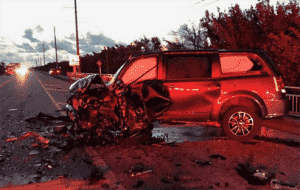
A Miami vehicle defect car accident injury lawyer, such as The Law Offices of Anidjar and Levine, examines whether a defective part, unsafe design, recall issue, or failed repair caused or worsened a crash. This work often includes preserving the vehicle, securing maintenance and recall records, consulting experts, and addressing insurers who dispute fault. Potential claims may involve manufacturers, suppliers, or repair facilities. Compensation can include medical costs, lost income, property damage, and long-term care needs.
The sections below explain these issues in greater detail. For more information, speak with a Miami Car Accident Lawyer.
Main Takeaways
- Preserve the vehicle and failed parts after the crash, and avoid repairs or disposal until experts inspect the evidence.
- Gather photos, police reports, maintenance records, recall notices, and witness statements to help prove a defect caused the accident.
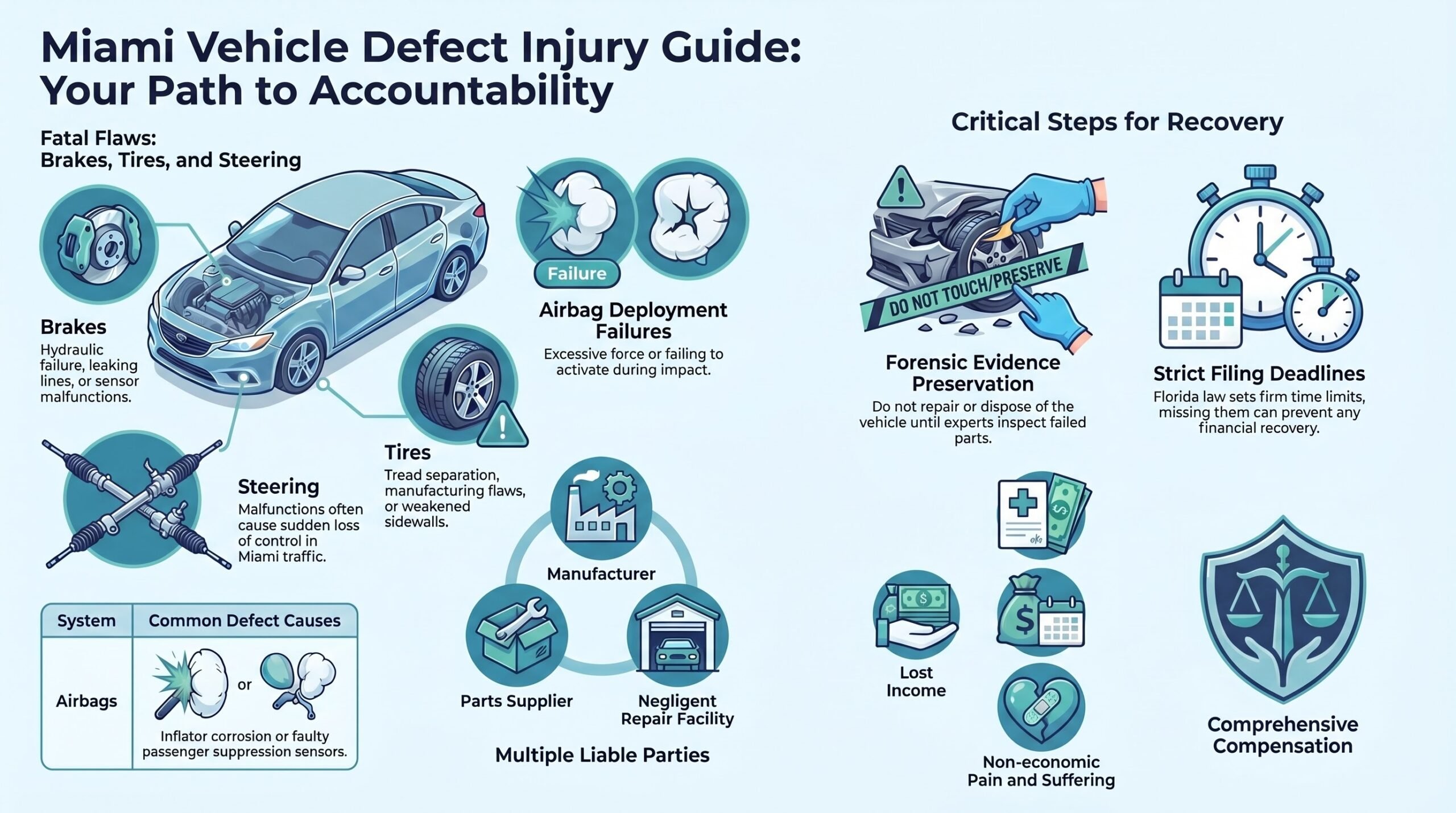
- Common vehicle defects include brake failure, tire blowouts, steering malfunctions, and dangerous airbag deployment or non-deployment.
- A Miami vehicle defect injury lawyer can investigate manufacturers, suppliers, repair shops, and others whose negligence contributed to the crash.
- Legal counsel can handle insurers, retain expert witnesses, and pursue compensation by proving the defect directly caused injuries and losses.
How We Can Help With Your Miami Vehicle Defect Car Accident Injury Claim
In the aftermath of a crash involving a defective vehicle or component, legal counsel can play a central role in identifying the source of liability and protecting the injured party’s right to compensation. A dedicated legal team serves clients by gathering records, preserving damaged parts, and coordinating prompt investigations that support a clear and responsible claim.
Counsel also evaluates manufacturer communications, repair histories, and recall information to determine whether negligence, Warranty disputes, or distribution failures contributed to the harm. When technical issues require specialized analysis, the firm works with qualified professionals whose Expert testimony can clarify how the defect caused or worsened the collision. Attorneys manage insurer communications, calculate losses, and pursue fair recovery for medical costs, lost income, and ongoing care.
If settlement efforts do not meet the client’s needs, they prepare the matter for litigation with disciplined advocacy. Their purpose remains practical service, steady guidance, and protection of the injured person’s legal interests.
Understanding Miami Vehicle Defect Car Accident Injury Cases
Understanding a Miami vehicle defect car accident injury case begins with recognizing that some crashes stem not only from driver conduct, but also from unsafe vehicle design, faulty manufacturing, or defective parts that fail under normal use.


These matters often require careful review of maintenance records, product histories, crash evidence, and expert analysis. A claim may involve manufacturers, distributors, repair facilities, or other parties whose actions placed the public at risk. In some situations, a Vehicle recall may support the argument that a known danger existed before the collision occurred. Even without a recall, injured people may still have grounds to seek accountability when a defective vehicle contributed to harm.
OUR CONSULTATIONSARE FREE
START YOUR FREE CASE REVIEW

From a broader perspective, these cases serve an important public purpose. They support Consumer protection by encouraging safer products and responsible corporate practices. For those committed to helping others, understanding these claims can illuminate how legal action may protect families, prevent future injuries, and promote safer roads throughout Miami communities.
Common Causes of Miami Vehicle Defect Car Accident
Several vehicle defects are commonly associated with serious car accidents in Miami, often because they impair a driver’s ability to maintain control or avoid impact. Common examples include brake system failures, tire blowouts, and steering component malfunctions, each of which can create sudden and dangerous roadway conditions. Defective airbag deployment also remains a significant concern, as it may either fail to protect occupants or cause additional injuries during a collision.
Brake System Failures


Compromise a vehicle’s braking system, and the risk of a serious collision rises immediately. Brake system failures often stem from hydraulic failure, worn brake pads, leaking lines, contaminated fluid, or electronic malfunctions in sensors or control modules. When these defects develop, stopping distance can increase, pedal response may fade, and drivers may lose crucial control in traffic.
For families and communities focused on protecting others, these failures present a preventable danger. Manufacturers, distributors, and maintenance providers are expected to identify unsafe components before harm occurs. In Miami traffic, where sudden stops are common, even a brief delay in braking can cause devastating injuries. Careful investigation of service records, recall history, and component design may reveal whether negligence or a defective part contributed to the crash and resulting losses.
Tire Blowout Defects
On Miami roads, a tire blowout can turn an ordinary trip into a sudden and violent collision with little warning. Such events are often linked to manufacturing flaws, weakened sidewalls, tread separation, overloading, or poor maintenance that compromises tire integrity under heat and roadway stress.
For those committed to protecting others, understanding these defects matters. A careful review may reveal improper installation, aging rubber, underinflation, or missed rim inspections that increase the risk of failure. Blowouts can cause loss of vehicle stability, especially at highway speeds, placing drivers, passengers, and nearby motorists in danger. In many cases, service providers, manufacturers, or distributors may share responsibility when defective tires or negligent upkeep contribute to harm. Prompt investigation helps preserve evidence and supports efforts to secure accountability, safer practices, and fair recovery for injured victims.
Steering Component Malfunctions
While tire failures often cause sudden loss of control, steering component malfunctions can gradually or without warning impair a vehicle’s direction, creating equally serious hazards on Miami roadways. Defects may involve the helm column, tie rods, power steering systems, or electronic controls that guide turning response. In some cases, drivers notice looseness, vibration, or delayed handling before a crash occurs. In others, rack failure or internal part separation results in an immediate inability to helm safely through traffic, at intersections, or around curves.
These conditions can place passengers, pedestrians, and nearby motorists at substantial risk. A careful investigation may determine whether negligent design, manufacturing flaws, or inadequate maintenance contributed to the malfunction. Understanding these failures helps families and advocates pursue accountability, promote safer vehicles, and protect others from preventable harm throughout the Miami community.
Defective Airbag Deployment
Because airbags are designed to reduce injury during a collision, defective airbag deployment can turn a vital safety feature into a source of serious harm on Miami roadways. Failures may include airbags that deploy with excessive force, deploy without impact, or fail to deploy when needed most. In some vehicles, a faulty Airbag sensor can misread crash conditions and delay activation. The Takata recall highlighted how Inflator corrosion may cause an airbag to rupture and send metal fragments into occupants.
Defects involving Passenger suppression systems may also prevent proper protection for adults or children seated in front. When these failures occur, injured individuals often face preventable trauma, costly treatment, and lasting hardship. Careful investigation helps identify responsible manufacturers and supports efforts to protect others from similar harm.
Legal Rights of Miami Vehicle Defect Car Accident Injury Victims
Accountability remains a central principle in vehicle defect claims, particularly when a defective design, manufacturing flaw, or failed safety component contributes to a serious crash in Miami. Injured victims may hold manufacturers, distributors, or other responsible parties liable when negligence or strict liability principles apply.
These legal rights reflect important consumer protections and may arise even when manufacturer recalls were delayed, inadequate, or ignored.
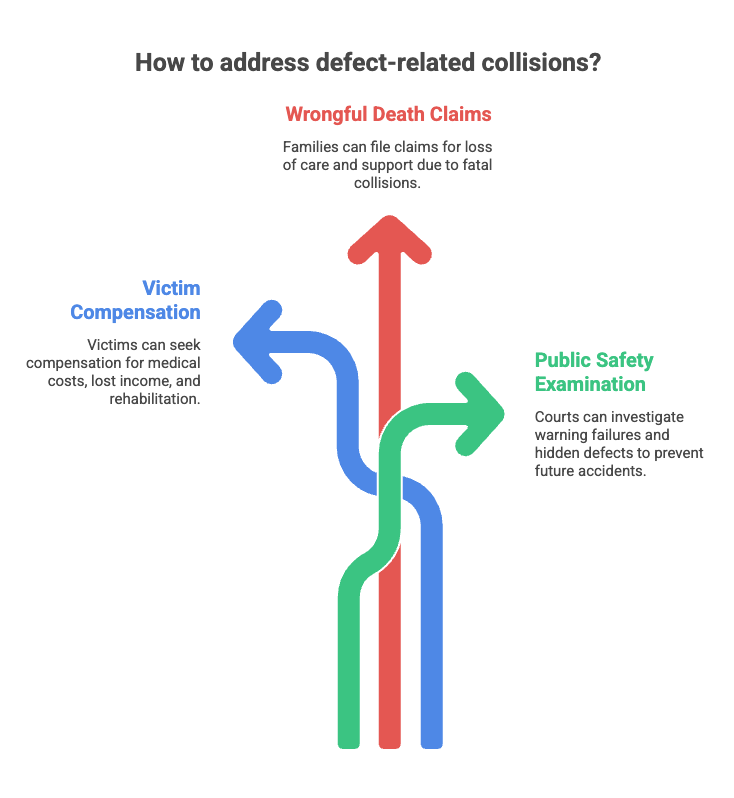
- Victims may pursue compensation for medical costs, lost income, pain, and long-term rehabilitation needs.
- Families may assert wrongful death claims when a fatal defect-related collision deprives a household of care and support.
- Courts may examine warning failures, hidden defects, and preventable hazards affecting broader public safety.
A careful legal review can clarify whether a defective vehicle, tire, brake system, or airbag contributed to the collision. In this setting, civil claims serve not only injured individuals but also the wider community by encouraging safer products, stronger accountability, and more responsible corporate conduct.
Steps to Take After a Miami Vehicle Defect Car Accident Injury
After a Miami vehicle defect car accident injury, prompt medical care is essential to identify injuries and create a clear record of treatment. It is also important to preserve the vehicle and any defective parts, as this evidence may be pivotal in determining liability and supporting a future claim. In addition, the accident should be reported to the appropriate authorities and insurers so that the incident is accurately documented from the outset.
Seek Immediate Medical Care
In the moments following a Miami vehicle defect accident, prompt medical evaluation should be treated as a priority, even when injuries seem minor or delayed. Some conditions, including internal trauma, concussions, and soft tissue damage, may not present clear symptoms at first, yet they can worsen without timely attention and complicate later recovery.
An urgent evaluation also creates a clear treatment timeline, which can support continuity of care and help medical providers respond appropriately to developing symptoms. Individuals who hope to protect their families and serve others responsibly should follow discharge instructions, attend follow-up appointments, and report new pain or limitations immediately. Careful medical attention not only safeguards health, but also documents the full scope of harm and demonstrates that the injured person acted responsibly after the collision occurred.
Preserve Vehicle Evidence
Every damaged component, warning light record, repair invoice, and post-collision photograph may become important evidence when a vehicle defect is suspected. The vehicle should be kept in its post-accident condition whenever possible, without repairs, part replacement, or disposal. Careful forensic preservation helps protect proof of brake failure, airbag malfunction, tire separation, steering issues, or electrical defects that may have contributed to harm.
Photographic documentation should capture the exterior, interior, dashboard indicators, tire tread, deployed safety systems, and any detached parts. Towing and storage arrangements should be chosen carefully so evidence is not altered, lost, or destroyed. Individuals acting to protect others should also retain maintenance records, recall notices, and communications with repair facilities. Preserving this information can support a thorough investigation and help identify preventable dangers for the broader community.
Report The Accident
Prompt reporting creates an official record that can help clarify whether a mechanical failure or defective component contributed to the collision. After a Miami vehicle defect accident, injured individuals should notify law enforcement as soon as possible and request medical assistance for anyone in danger. A timely police report may document roadway conditions, vehicle damage, and observations that later support a defect-related claim.
They should also provide accurate facts without speculation, because early assumptions can obscure the true cause of a crash. When available, eyewitness statements should be identified and preserved, as neutral accounts may confirm unusual vehicle behavior prior to impact. If officers do not respond, the accident should still be reported through the proper agency and insurer. Careful reporting serves injured people, protects others from similar harm, and strengthens accountability.
How a Miami Vehicle Defect Car Accident Injury Lawyer Can Help You
Navigating a vehicle defect claim after a serious crash often requires legal guidance that reaches beyond a standard insurance dispute. A Miami vehicle defect car accident injury lawyer investigates whether Product Liability law applies, identifies defective parts, preserves evidence, and coordinates with Expert Witnesses who can explain how a design, manufacturing, or warning failure contributed to the collision.
- The attorney gathers maintenance records, recall notices, crash data, and vehicle inspections to build a clear factual record.
- The attorney addresses insurers, manufacturers, and suppliers, helping families avoid pressure tactics and incomplete settlements.
- The attorney calculates losses, prepares legal filings, and presents a disciplined claim designed to secure fair compensation.
This support often benefits people focused on protecting loved ones and serving their communities. By managing deadlines, technical proof, and negotiations, counsel allows injured individuals to prioritize recovery and responsibilities to others, while pursuing accountability from every party that may have contributed to the harm.
Long-Term Effects of Miami Vehicle Defect Car Accident Injuries
Vehicle defect car accidents in Miami can produce long-term consequences that extend well beyond the initial injury and recovery period. Common outcomes include chronic pain that disrupts daily functioning, lasting mobility limitations that affect independence and employment, and emotional trauma that alters a person’s mental and emotional stability. These ongoing effects often shape the scope of medical care, financial losses, and legal damages considered in a personal injury claim.
Chronic Pain Challenges
Persistence often defines the aftermath of a defect-related car accident, as chronic pain can continue long after visible injuries appear to have recovered. Victims may experience daily discomfort in the neck, back, shoulders, or joints, which can limit concentration, sleep, and emotional balance. Chronic fatigue often develops alongside persistent pain, making ordinary responsibilities harder to sustain.
Effective Pain management usually requires ongoing medical evaluation, physical therapy, medication oversight, and careful documentation of symptoms. In many cases, chronic pain also affects a person’s ability to care for family members, maintain employment, and participate in community service. A legal review of these long-term consequences can help demonstrate the full extent of harm caused by a defective vehicle. Careful attention to treatment records and expert opinions often strengthens that effort for injured individuals and families.
Lasting Mobility Limitations
Over time, lasting mobility limitations may become one of the most disruptive consequences of a defect-related car accident injury. Damage to the spine, joints, nerves, or muscles can reduce strength, balance, coordination, and endurance, making routine movement far more difficult. As recovery stabilizes, injured individuals may require assistive devices for walking, standing, bathing, or transportation, and many homes may need modifications to improve safety and access.
These limitations often affect employment, caregiving duties, and the ability to participate in community life. Family members and service-oriented support networks may need to coordinate transportation, therapy appointments, and daily tasks. In legal claims, documented mobility loss can help demonstrate ongoing medical needs, reduced independence, and the substantial practical burden created by a defective vehicle and resulting serious physical injury.
Emotional Trauma Impact
Coping with the aftermath of a defect-related crash often involves more than physical recovery, as emotional trauma can continue long after visible injuries begin to heal. Survivors may experience post-traumatic stress, anxiety, sleep disruption, and persistent fear while driving or riding in vehicles. These reactions can affect relationships, work performance, and the ability to support others in daily life.
In many cases, emotional injuries require structured care, including counseling, trauma-informed therapy, and steady community support. Families and caregivers often play an important role by recognizing symptoms early and encouraging consistent treatment. Over time, Emotional resilience can be strengthened through compassionate intervention, healthy routines, and meaningful service to others. Even so, serious psychological effects may persist, underscoring the lasting impact of vehicle-defect accidents on overall well-being and future stability.
Proving Liability in Miami Vehicle Defect Car Accident Injury Cases
Establishing liability in a Miami vehicle defect car accident case requires more than showing that a crash occurred; it requires evidence that a defective component directly contributed to the collision or the resulting injuries. This often begins with evidence preservation, including the vehicle itself, damaged parts, repair records, recall notices, and electronic data. Careful documentation helps protect the facts for those seeking accountability and safer roads for others.
Liability may rest with a manufacturer, parts supplier, repair facility, or another party whose conduct allowed the defect to cause harm. To prove that connection, attorneys commonly rely on expert witnesses, such as engineers, crash reconstruction authorities, and medical professionals. These experts evaluate whether a design flaw, manufacturing error, or inadequate warning made the vehicle unreasonably dangerous. Courts also consider maintenance history, prior complaints, and compliance with safety standards. A well-supported claim shows not only that a defect existed, but that it was a substantial factor in causing injury.
Dealing With Insurance Companies After a Miami Vehicle Defect Car Accident Injury
Many injured motorists discover that insurance issues become more complicated when a vehicle defect may have contributed to a crash in Miami. Insurers may question whether injuries arose from driver negligence, defective parts, or both, and that dispute can affect available coverage, valuation, and communications. Careful documentation often serves injured people best, including photographs, repair records, recall notices, treatment records, and all correspondence with insurers.
A disciplined approach to claim negotiation can help protect the injured person’s interests while promoting fair treatment for everyone involved. Statements to adjusters should remain accurate, limited, and consistent with known facts, especially before the full medical picture is clear. Policy deadlines, comparative fault arguments, and requests for recorded statements may require close attention. Medical billing issues also matter because a hospital, health insurer, or provider may assert a medical lien against any recovery. Prompt review of coverage terms and obligations can reduce confusion, preserve resources, and support responsible recovery for the injured family.
What to Expect During a Miami Vehicle Defect Car Accident Injury Claim Process
A Miami vehicle defect car accident injury claim typically begins with an initial case evaluation, during which the facts of the crash, the suspected defect, and the resulting damages are reviewed. The process then focuses on collecting evidence of defects, along with analysis of insurance coverage and liability among manufacturers, drivers, and other potentially responsible parties. From there, the claim may proceed toward settlement negotiations or, when necessary, trial.
Initial Case Evaluation
At the outset of a Miami vehicle defect car accident injury claim, the initial case evaluation is designed to determine whether the available facts support legal action against a manufacturer, distributor, repair facility, or another responsible party. During this stage, counsel typically offers a free consultation and conducts a case screening to assess the incident, the reported injuries, and the potential connection between the vehicle’s condition and the crash. The review often includes timelines, service history, recall information, medical treatment, and insurance issues, while identifying immediate legal concerns such as filing deadlines or comparative fault arguments.
This early assessment helps injured individuals and families understand their options, make informed decisions, and pursue accountability in ways that promote safety, responsibility, and care for others affected by preventable vehicle failures.
Defect Evidence Collection
Preserving defect-related evidence becomes a central priority once a vehicle defect claim is underway, because the condition of the vehicle and its components may provide vital proof of how the collision occurred. Forensic Preservation measures often include securing the vehicle, retaining failed parts, and preventing repairs or disposal that could alter essential evidence.
Photographic Documentation usually records exterior damage, interior systems, warning lights, tire conditions, and debris patterns. A clear Chain of Custody helps show who handled each component and when, protecting the integrity of the evidence. Expert Consultation may involve engineers, crash reconstruction experts, or mechanics who can evaluate whether a design flaw, manufacturing defect, or malfunction contributed to the incident. Careful evidence collection supports an informed process focused on accountability, public safety, and the well-being of others.
Insurance And Liability
In many Miami vehicle defect claims, insurance coverage and legal liability develop along separate but closely related tracks, because a collision involving a defective vehicle may implicate not only a negligent driver but also a manufacturer, distributor, or parts supplier.
Insurers often review policy terms, exclusions, and injury documentation while attorneys evaluate who owed a duty of care and how that duty was breached. A service-minded claimant should expect requests for repair records, recall notices, photos, and witness statements, because these materials help clarify responsibility. Florida no-fault coverage may apply first, yet additional claims can arise against other responsible parties. Careful attention to claim deadlines is crucial, especially when multiple insurers and businesses are involved. Liability waivers may also be examined, though they do not automatically eliminate accountability for dangerous defects or prevent further legal review.
Settlement Or Trial
During the settlement phase, a Miami vehicle defect car accident claim often turns on the strength of the evidence, the severity of the injuries, and the ability to connect the defect to the crash and resulting losses. Attorneys usually review Settlement Options with insurers, manufacturers, and other responsible parties, aiming to secure resources that support medical care, household stability, and long-term recovery.
If fair terms are not offered, Trial Preparation becomes crucial. This stage may include expert analysis, witness interviews, document review, and the development of clear arguments that explain how the defect caused harm. A court proceeding can take longer, yet it may provide a path to greater accountability. Throughout either route, careful guidance helps injured individuals and their families make informed decisions that protect their well-being and future service to others.
Compensation for Miami Vehicle Defect Car Accident Injury Damages
Accountability often begins with a clear assessment of the losses caused by a vehicle defect collision. In Miami defect cases, compensation may be pursued from manufacturers, distributors, repair facilities, or other responsible parties whose conduct placed motorists and passengers at risk. A careful claim can address medical treatment, rehabilitation needs, lost income, reduced earning ability, property damage, and other provable consequences tied to the defect and resulting crash.
When evidence shows broader misconduct, additional remedies may arise through product liability claims, warranty disputes, or punitive damages in limited circumstances. Legal counsel typically works with engineers, physicians, and reconstruction professionals to connect the defect to the collision and document the full extent of harm. This process serves not only the injured person, but also the wider community by encouraging safer design, honest recalls, and responsible corporate practices. A thorough recovery strategy consequently supports both individual stability and the public interest in roadway safety.
Economic vs Non-Economic Damages in Miami Vehicle Defect Car Accident Cases
In Miami vehicle defect car accident cases, damages are generally divided into economic and non-economic categories, each addressing a different aspect of the claimant’s loss. Economic damages typically include measurable financial losses such as medical expenses, lost income, and property damage, while non-economic losses may involve pain and suffering, emotional distress, and reduced quality of life. Establishing the value of these damages often requires medical records, employment documentation, expert analysis, and other evidence that supports both the existence and extent of the harm.
Economic Damage Categories
For injured motorists in Miami vehicle defect cases, economic damages are the measurable financial losses resulting from the crash and the resulting medical condition. These categories commonly include medical expenses for emergency care, hospitalization, surgery, rehabilitation, medication, and reasonably foreseeable future treatment needs. They also include lost wages when injuries prevent a person from working, as well as diminished earning capacity if long-term limitations reduce future income.
Additional economic losses may include property damage, transportation to medical appointments, household assistance, and other out-of-pocket costs directly tied to the collision caused by the defect. Careful documentation, including bills, repair estimates, payroll records, and expert evaluations, helps accurately establish these damages. A clear accounting of financial harm supports recovery efforts and helps injured individuals secure resources needed to responsibly care for themselves and their families.
Non-Economic Losses
Recovery for a serious vehicle defect injury often extends beyond bills, wage records, and repair estimates. Non-economic losses address human consequences that cannot be measured by receipts alone. In Miami vehicle defect cases, these harms may include physical pain, emotional distress, loss of enjoyment of life, disability, scarring, and the strain placed on family relationships. They also recognize the disruption caused when an injured person can no longer serve loved ones, participate in community life, or maintain prior independence.
Care may involve therapy, grief counseling, and long-term support for anxiety, depression, or trauma symptoms. Although pain valuation is often discussed in legal settings, the central concern remains the person’s diminished daily experience. A careful claim presents these losses respectfully, emphasizing dignity, accountability, and the injured individual’s broader well-being after the collision.
Proving Damage Value
Accuracy governs the valuation of damages in a Miami vehicle-defect car accident case because both economic and non-economic losses must be supported by credible evidence rather than broad estimates. Economic damages are commonly proven through medical bills, wage records, Repair Estimates, and documentation of other out-of-pocket costs. When injuries limit long-term earning ability or ongoing care is expected, experts may assess Future Losses using employment history, treatment plans, and reliable projections.
Non-economic damages require a different showing, yet they also depend on evidence. Pain, emotional suffering, and diminished quality of life are often demonstrated through medical evaluations, testimony from treating providers, and statements from family members who observe daily limitations. Careful proof helps guarantee compensation reflects actual harm and supports recovery with fairness, dignity, stability, and accountability.
When a Miami Vehicle Defect Car Accident Injury Case Goes to Trial vs Settlement
Determining whether a Miami vehicle defect car accident injury case proceeds to trial or resolves through settlement depends on the strength of the evidence, the extent of the injuries, and the willingness of the parties to accept responsibility and negotiate in good faith. Strong expert analysis, preserved vehicle data, and reliable medical records often encourage settlement, especially when liability is clear and insurers recognize likely exposure.
A trial may become necessary when manufacturers, distributors, or insurers dispute causation, deny the defect, or minimize harm. In those circumstances, counsel evaluates Jury dynamics because community perspectives can influence how technical evidence and corporate conduct are understood. Settlement timelines also matter, particularly for families seeking financial stability, continued care, and a measure of closure while remaining focused on serving others. Settlement can reduce uncertainty and expense, but a trial may secure fuller accountability when offers are inadequate. A disciplined case assessment helps determine which path best protects the injured person’s needs, dignity, and long-term well-being.
The Statute of Limitations for Miami Vehicle Defect Car Accident Injury Cases
Whether a vehicle defect claim settles or proceeds to trial, filing deadlines remain a controlling issue in every Miami car accident injury case. Florida law sets strict time limits for bringing personal injury and wrongful death actions, and missing those limits can prevent recovery entirely, regardless of the severity of harm or the strength of the evidence.
In vehicle defect matters, nuances of the statute may affect how the deadline is calculated. The date of the crash often begins the limitations period, yet some product-related facts may emerge later through inspections, recalls, or expert review. Even so, delayed discovery does not always extend the time to file. Different claims, including negligence, strict liability, breach of warranty, or claims against a deceased party’s estate, may carry distinct filing deadlines. Careful attention to records, preservation of evidence, and timely case evaluation help protect the injured person’s interests and support accountability for those harmed in service to others.
When to Contact a Miami Vehicle Defect Car Accident Injury Lawyer
In the aftermath of a serious crash, prompt legal evaluation may be important when the facts suggest that a vehicle component, rather than driver conduct alone, contributed to the injury. Contact may be appropriate when brakes fail, airbags do not deploy, steering malfunctions occur, or a tire defect is suspected.
Early consultation can help identify whether inspection of the vehicle, crash reports, repair records, black box data, and recall information should occur before pivotal material is altered, lost, or discarded. This is especially important when insurers, salvage yards, or repair facilities may move quickly after a collision. Evidence preservation supports a fair review of what happened and protects information that may later clarify responsibility.
Families may also consider prompt outreach when medical records indicate severe injuries that are inconsistent with the reported impact, or when multiple similar incidents suggest a broader safety problem. Timely action can support accountability, informed decision-making, and the protection of others in the community.
Why You Need an Experienced Miami Vehicle Defect Car Accident Injury Lawyer
Often, an experienced Miami vehicle defect car accident injury lawyer is needed because these claims extend far beyond a routine collision dispute and may involve manufacturers, parts suppliers, dealerships, and technical specialists. Defect cases often require careful investigation, evidence preservation, and analysis of engineering failures that may have contributed to serious harm.
An experienced attorney helps identify all responsible parties and link the defect to the injuries suffered. This work can protect not only the injured person, but also others who may face similar dangers on the road. Strong local know-how also matters because Miami courts, insurers, and procedural rules can affect how a claim is developed and presented.
A lawyer with substantial experience can also build an effective trial strategy if a fair resolution is not offered. By coordinating specialists, reviewing recalls, and challenging corporate defenses, counsel places the injured person in a stronger position to pursue accountability, compensation, and meaningful public safety improvements.
How to Choose the Right Miami Vehicle Defect Car Accident Injury Lawyer for Your Case
Selecting the right Miami vehicle defect car accident injury lawyer requires more than choosing a firm that handles general auto accident claims, because defect litigation demands experience with product liability principles, technical evidence, and multi-party disputes. A careful review should focus on whether counsel has handled claims involving manufacturers, distributors, and automotive experts in prior matters.
Prospective clients should examine the lawyer’s record of investigation, courtroom readiness, and ability to explain intricate defect issues clearly. Client testimonials may offer insight into communication, professionalism, and commitment to pursuing outcomes that protect injured people and their families. Fee structures also merit close attention, since transparency helps individuals make informed decisions while preserving resources for recovery and service to loved ones.
It is also wise to weigh responsiveness, access to support staff, and the firm’s approach to record-gathering, evidence preservation, and consulting specialists. A disciplined selection process can markedly strengthen a rightful claim.
About The Law Offices of Anidjar & Levine
Client-focused representation defines The Law Offices of Anidjar & Levine, a firm that assists injured individuals in Miami through structured legal advocacy and attentive case management. The practice emphasizes clear communication, prompt responsiveness, and practical guidance for people facing the consequences of serious collisions involving suspected vehicle defects.
Its approach reflects a service-minded commitment to helping families pursue accountability while preserving dignity throughout the legal process. The firm’s history demonstrates sustained work in personal injury matters, including claims arising from defective components, unsafe designs, and manufacturer negligence. Attorneys and staff coordinate investigations, gather records, and address insurers with disciplined preparation.
Client testimonials often describe accessibility, professionalism, and steady support during difficult periods. Those accounts, while personal, reinforce the firm’s broader reputation for organized representation and consistent follow-through.
For individuals seeking counsel that values both legal precision and humane service, The Law Offices of Anidjar & Levine presents a structured and dependable option in Miami.
Frequently Asked Questions
Can a Recalled Vehicle Still Qualify for a Defect Injury Claim?
Yes, a recalled vehicle can still qualify for a defect injury claim. Liability often depends on whether the defect caused the injury, whether adequate notice and remedy were provided, and how the repair history reflects the vehicle’s condition. A recall does not automatically eliminate manufacturer liability. If a repair failed, was unavailable, or came too late to prevent harm, an injured person may still have a valid claim for compensation.
Who Investigates Whether Aftermarket Parts Contributed to the Crash?
An independent investigator typically examines whether aftermarket parts contributed to a crash. That review may also involve a forensic metallurgist, crash reconstruction experts, and engineers who evaluate installation quality, part design, and material failure. They study vehicle damage, maintenance records, recall data, and electronic evidence. Their findings help families, insurers, and counsel clearly understand causation, support accountability, and identify whether a modified component materially increased the risk of collision.
Can Black Box Data Help Prove a Hidden Vehicle Defect?
Yes, black box data can help prove a hidden vehicle defect. Investigators may compare event data and sensor logs to driver inputs, vehicle responses, and crash timing. When those records show unexpected braking, loss of directional control, or airbag failure, they may support a defect theory. Such evidence can aid those seeking accountability, especially when combined with inspections, recall history, maintenance records, and expert analysis. It often strengthens causation and notice arguments.
Are Rental Cars Covered in Vehicle Defect Accident Claims?
Yes, rental cars may be covered in vehicle defect accident claims when evidence shows a defective part or unsafe design contributed to the crash. Liability may extend to manufacturers, maintenance providers, or rental companies, depending on inspection practices and notice of the defect. Rental liability often depends on contract terms and applicable law. Coverage disputes can arise among insurers, rental agencies, and injured parties, requiring careful review to protect those harmed.
What if Multiple Defects Caused the Same Accident?
When multiple defects contribute to the same accident, liability may be divided among the responsible manufacturers or other parties under principles of shared liability. Courts and investigators often examine cumulative causation, meaning each defect’s role is measured within the overall chain of events. A careful legal and technical review helps determine how the defects interacted, who should be held accountable, and what compensation may properly support the injured person’s recovery and needs.
—————————
Vehicle defect accidents often involve complex liability issues, serious injuries, and substantial financial losses. A careful legal evaluation can help identify responsible parties, preserve critical evidence, and protect the injured person’s right to compensation.
With experienced representation, victims may pursue recovery of medical expenses, lost income, and other damages related to the defect and the resulting crash.
The Miami Car Accident Lawyer at The Law Offices of Anidjar & Levine provides focused guidance for those navigating a Miami vehicle-defect car accident injury claim.