The Law Offices of Anidjar and Levine examines whether an owner, manager, security company, or related party failed to provide reasonable safety measures, such as lighting, locks, access control, or adequate staffing.
Counsel also works to preserve complex evidence, including surveillance footage, access logs, incident reports, maintenance records, and witness statements, while handling insurer communications and civil claims.
Florida law may allow compensation when foreseeable security failures contributed to harm, and the sections below explain how these cases proceed.
To learn more, visit our Florida Sexual Assault Lawyer page.
Main Takeaways
- A Florida apartment complex sexual assault lawyer investigates whether owners, managers, or security companies failed to provide reasonable safety measures.
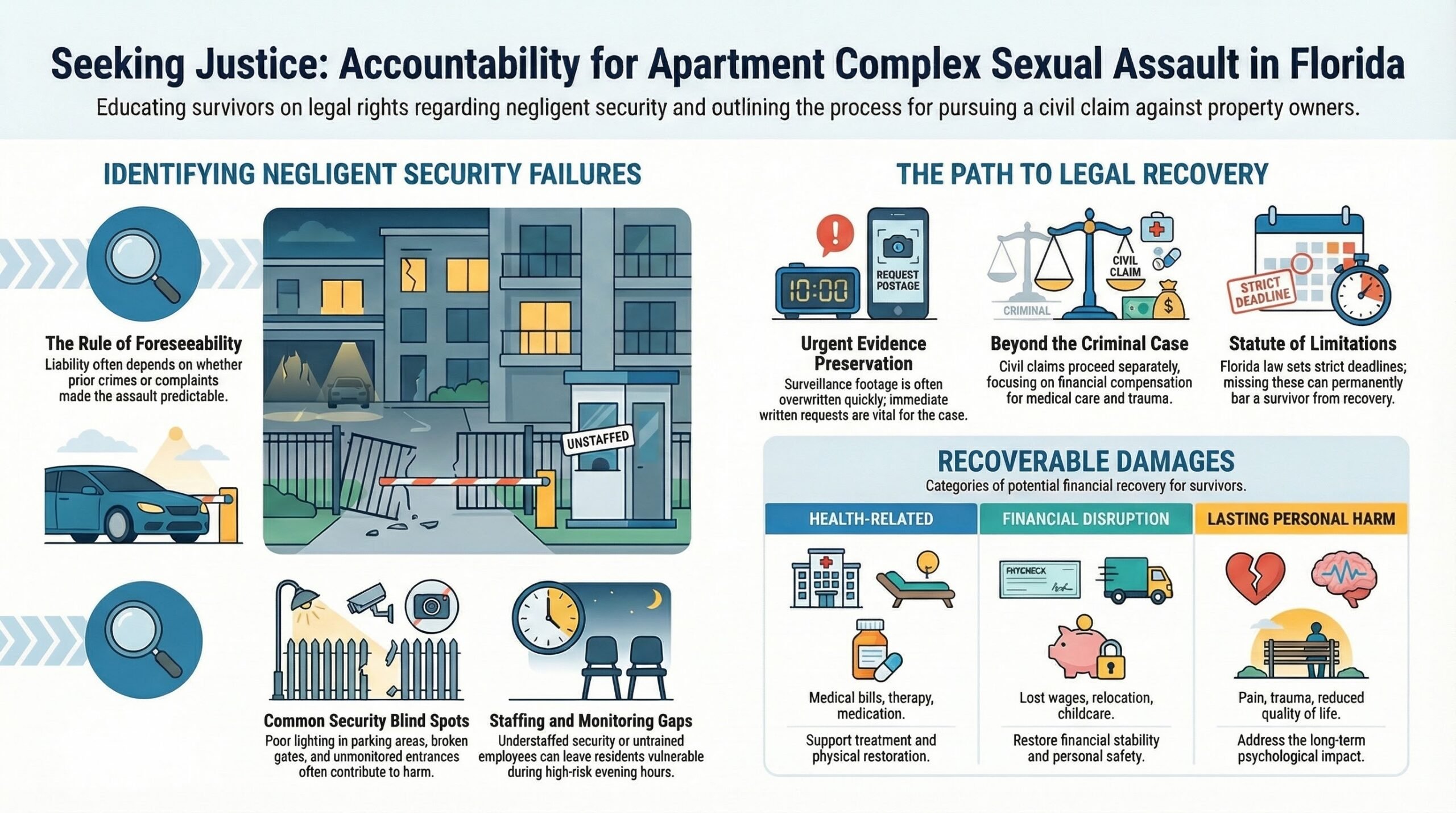
- Liability often depends on foreseeability, including prior incidents, tenant complaints, broken gates, poor lighting, and inadequate security staffing.
- Preserving evidence quickly is critical, including surveillance footage, incident reports, maintenance records, access logs, and witness statements.
- Civil claims can proceed alongside criminal cases, but they serve different purposes and require different standards of proof.
- A lawyer can protect your rights, handle insurers, document damages, and pursue compensation for medical care, counseling, lost income, and pain and suffering.
How We Can Help With Your Florida Apartment Complex Sexual Assault Claim
When a sexual assault occurs at a Florida apartment complex, a qualified attorney can help by evaluating whether the property owner, management company, security provider, or another responsible party failed to provide reasonable safety measures. Counsel may guide survivors and families with steady, service-minded support while protecting their rights and immediate needs.
Legal representation often begins with Evidence preservation, including surveillance footage, incident reports, maintenance records, access logs, witness statements, and electronic communications. An attorney may coordinate with investigators, review lease documents and security policies, and pursue a thorough liability investigation to identify all accountable parties. Counsel can also manage insurer communications, document losses, and prepare a clear demand supported by facts and expert analysis.


If settlement efforts do not produce a fair result, the attorney may file suit and pursue the matter through litigation. Throughout the process, the focus remains on respectful guidance, careful preparation, and meaningful accountability that can support recovery and safer communities for everyone.
Understanding Apartment Complex Sexual Assault Cases in Florida
OUR CONSULTATIONSARE FREE
START YOUR FREE CASE REVIEW

Building on the role counsel plays after an incident, an understanding of apartment complicated sexual assault cases in Florida begins with the legal duties that property owners and related parties may owe to tenants, guests, and other lawful visitors. These matters often involve premises liability principles, foreseeability, and the question of whether reasonable security measures were provided.
A proper overview of consent laws is also important because civil claims may develop alongside criminal investigations, yet each follows different standards of proof and legal purposes. Florida cases may examine notice of prior risks, lease obligations, staffing practices, access control, lighting, and responses to complaints.


Evidence preservation remains fundamental in serving affected individuals and the broader community, as records, surveillance footage, key access data, incident reports, maintenance logs, and communications can shape accountability. A careful review helps determine whether negligence, inadequate security, or related failures contributed to harm, and whether responsible parties can be held legally accountable under Florida law.
Common Scenarios When Apartment Complex Sexual Assault Might Take Place in Florida
Apartment multifaceted sexual assault in Florida may arise in several recurring settings where access control and resident safety measures are inadequate. Common scenarios include poorly lit parking areas, unsecured building entrances, negligent security staffing, and isolated shared amenities that reduce visibility and oversight. Identifying these conditions can help clarify how preventable risks may develop on residential property.
Poorly Lit Parking Areas
Because parking lots are often interim spaces with limited natural surveillance, poorly lit areas can create conditions in which sexual assaults occur with little warning and few immediate witnesses. In Florida apartment complexes, dim lighting near vehicles, stairwells, and walkways may reduce visibility, hinder recognition of suspicious activity, and delay assistance from nearby residents.
When an assault is alleged in such a setting, property conditions, maintenance records, surveillance coverage, and prior complaints may become relevant to determining whether foreseeable risks were adequately addressed. Survivors and families often benefit from clear guidance regarding Incident reporting timelines, available evidence, and supportive next steps.
Legal advocates who provide trauma-informed representation can help preserve dignity while evaluating accountability, coordinating documentation, and encouraging responses that prioritize safety, respect, and community well-being for all residents.
Unsecured Building Entrances
An unsecured entrance can create a major lapse in resident safety, particularly where exterior doors, gates, or access control systems are left broken, propped open, or inadequately monitored. In these conditions, unauthorized individuals may enter hallways, stairwells, and shared spaces without meaningful barriers, increasing the risk of serious harm to tenants and visitors.
Common examples include damaged locks, defective key card systems, padlock failures at pool or laundry enclosures, and side doors that do not latch properly after use. Poor Doorway visibility may further heighten danger when entrances are concealed by overgrown landscaping, obstructed sightlines, or inadequate maintenance. Property owners and managers who serve residential communities are generally expected to promptly identify these hazards and take reasonable corrective steps to prevent violence on the premises.
Negligent Security Staffing
Security failures are not limited to broken locks and open gates; inadequate staffing can leave the property without meaningful oversight during high-risk hours and in vulnerable common areas. When apartment operators understaff security personnel, delay response coverage, or assign untrained employees to monitoring roles, foreseeable dangers may increase substantially.
Florida premises claims often examine whether owners recognized a known Risk duty to provide reasonable protection based on prior incidents, tenant complaints, and neighborhood crime patterns. Courts may also consider whether staffing protocols were consistently followed, including patrol frequency, supervision, and communication practices.
If management reduced coverage to cut costs or ignored repeated warnings, those decisions can affect liability standards. Thoughtful incident prevention requires adequate personnel, clear reporting procedures, and reliable supervision so that residents and guests receive the protection and basic safety they require.
Isolated Shared Amenities
When apartment complexes include pools, fitness rooms, laundry facilities, parking structures, and clubhouse areas that are separated from regular foot traffic, those spaces can present heightened risks if access control and monitoring are inadequate. In Florida properties, isolated amenities may create opportunities for misconduct when surveillance is limited, lighting is poor, or staff response is delayed.
Shared hot tubs, secluded locker areas, and remote laundry rooms may leave residents and guests more vulnerable, particularly in the evening. Broken locks on gates, doors, or changing areas can further undermine safety by allowing unauthorized entry. Property owners and managers who seek to protect those they serve are generally expected to assess foreseeable risks, maintain safe conditions, and promptly correct hazards. Failures in those duties may become central issues in civil sexual assault claims and litigation.
Legal Rights of Apartment Complex Sexual Assault Victims in Florida
Although each case depends on its specific facts, sexual assault victims in Florida apartment complexes may have important legal rights against both the perpetrator and, in some circumstances, the property owner or manager. Florida law may recognize claims for personal injury, negligent security, and related damages when preventable dangers contributed to harm.
Meaningful victim protections and established landlord duties can shape whether civil accountability exists.
- Victims may pursue compensation for medical costs, counseling, lost income, pain, suffering, and other legally recognized losses.
- Property owners or managers may face liability if inadequate lighting, broken gates, failed locks, or poor security foreseeably increase risk.
- Lease provisions, prior incident history, and maintenance records may help evaluate whether reasonable care was provided.
- Privacy rights, anti-retaliation principles, and access to civil justice can help protect dignity while pursuing accountability.
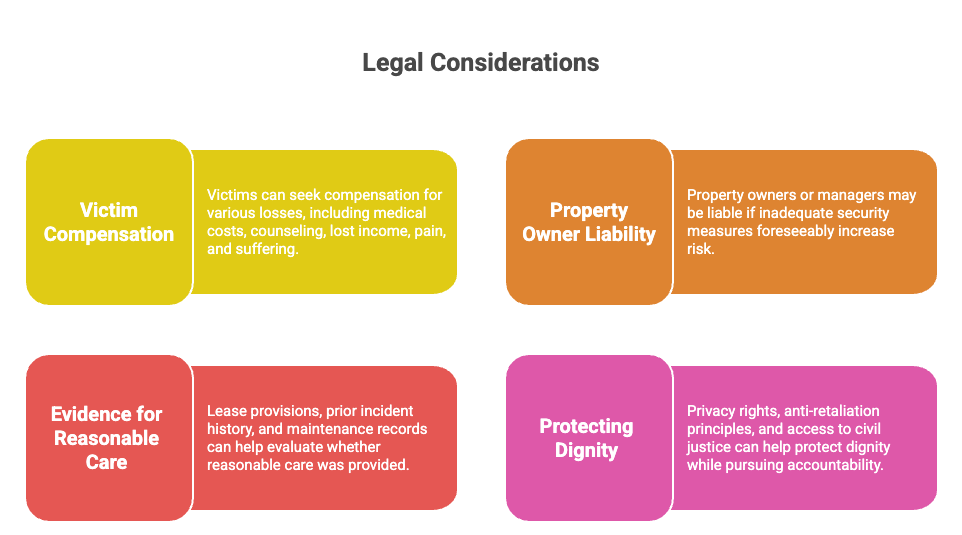
These rights can support safer communities, encourage responsible property management, and promote justice for those harmed and long-term institutional improvement.
Steps to Take After an Apartment Complex Sexual Assault Incident in Florida
After an apartment building sexual assault incident in Florida, the priority is to reach immediate safety and obtain emergency assistance if needed. A timely report to law enforcement and property management can help create an official record of the incident and support any subsequent legal action. It is also important to preserve important evidence, including clothing, messages, photographs, and medical records, as these materials may be essential to an investigation or civil claim.
Seek Immediate Safety
Prioritize immediate safety by moving to a straightforward location away from the apartment complex area where the assault occurred, such as a locked residence, a public place, or the home of a trusted person. If danger remains or injuries require attention, call 911 and seek immediate medical care. A trusted companion may assist with transportation, childcare, or temporary shelter while the person regains stability.
Once safe, practical steps can reduce further risk and preserve order. The individual should secure personal documentation, medications, keys, and vital devices if retrieval can be done without renewed exposure to danger. It may also help to report safety concerns to property management regarding broken locks, poor lighting, or unsecured entrances, strictly to protect others and support immediate protective measures for everyone nearby.
Report The Assault
Once immediate safety has been secured, reporting the assault becomes a key step in protecting the victim’s well-being and preserving the facts of what occurred. Prompt notification to law enforcement, apartment management, or campus security can create an official record and help initiate protective measures for others in the community.
Timely reporting also supports accurate victim-witness statements, which may assist investigators in understanding the sequence of events and identifying potential witnesses. Clear communication about the location, time, and involved parties can strengthen the response from authorities and service providers.
When appropriate, a trusted advocate, family member, or attorney may accompany the victim during this process to promote stability and understanding. Early reporting also assists with evidence preservation by alerting responsible parties to promptly maintain relevant records, surveillance footage, and incident documentation.
Preserve Key Evidence
Preserve all available evidence as quickly as circumstances allow, because even small details may become important in establishing what occurred and who may bear responsibility. If possible, clothing, bedding, photographs, electronic messages, access records, and surveillance footage should be secured without alteration or disposal. Prompt Physical injury documentation can help connect visible harm to the incident and support later medical and legal review.
Care should also be taken to identify anyone who saw, heard, or reported suspicious activity near the apartment complex. Accurate preservation of witness statements may strengthen a timeline, confirm prior complaints, or reveal security failures by owners or managers. Notes regarding dates, times, locations, lighting, locks, and prior safety concerns may also prove valuable. Preserving evidence serves both accountability and the broader protection of others in the community.
How a Florida Apartment Complex Sexual Assault Lawyer Can Help You Initiate a Case
Guidance from a Florida apartment complex sexual assault lawyer can help establish the foundation of a case by identifying potential sources of liability, explaining the legal process, and outlining the evidence needed to support a claim. Counsel may also coordinate Evidence preservation and witness statements so relevant facts are protected and presented responsibly.
- An attorney can assess whether negligent security, poor lighting, broken locks, or inadequate screening contributed to the assault.
- Counsel can identify responsible parties, including owners, management companies, contractors, or security providers, who have duties to protect residents and guests.
- A lawyer can gather records, surveillance footage, maintenance logs, incident reports, and prior complaint histories that may show preventable risks.
- Legal guidance can help a survivor understand filing deadlines, reporting options, and procedural steps while reducing avoidable mistakes.
Through organized case development, legal counsel supports accountability and promotes safer housing practices that may help protect others in the community from future preventable harm.
Long-Term Effects of Apartment Complex Sexual Assault Trauma
The long-term effects of sexual assault in an apartment development setting often include significant emotional and psychological damage, which may persist well beyond the initial incident. Survivors may also face lasting physical consequences, including chronic pain, sleep disruption, and other health-related complications that affect overall well-being. These combined effects can interfere with daily life, limiting a person’s ability to work, maintain relationships, and feel secure in ordinary routines.
Emotional And Psychological Impact
Often, survivors of sexual assault in apartment complexes experience enduring emotional and psychological intricacies that extend far beyond the initial incident. Many face persistent anxiety, depression, sleep disruption, panic, shame, distrust, and recurring memories that interfere with daily functioning and healthy relationships. Concentration may decline, work performance may suffer, and ordinary environments can begin to feel unsafe or overwhelming.
For those committed to helping others, understanding these effects supports compassionate, informed intervention. Survivors may benefit from trauma repair options such as counseling, support groups, and crisis advocacy tailored to individual needs. Access to reliable post assault resources can also promote stability, validation, and a stronger sense of control. When property negligence contributed to the assault, legal guidance may further assist survivors in pursuing accountability while protecting dignity, privacy, and long term emotional repair.
Lasting Physical Consequences
Beyond the immediate trauma, sexual assault in an apartment complex can produce enduring physical consequences that affect health, mobility, and overall functioning. Survivors may experience chronic pain, gynecological injuries, gastrointestinal problems, sexually transmitted infections, sleep disruption, and stress-related cardiovascular symptoms. In some cases, neurological complaints such as headaches, dizziness, or impaired concentration persist long after the assault.
Care teams often rely on forensic evidence gathered soon after the incident to guide diagnosis and preserve important facts. Long-term medical treatment may include surgery, pain management, reproductive care, and rehabilitation services tailored to ongoing symptoms. When legal claims arise, expert testimony can help explain causation, prognosis, and future care needs.
Coordinated psychiatric support may also complement physical treatment, especially where trauma contributes to persistent bodily symptoms and delayed recovery.
Effects On Daily Life
Because trauma from an apartment cluster sexual assault can alter a survivor’s sense of safety for years, its effects on daily life frequently extend into work, school, relationships, and routine personal activities. Concentration may decline, sleep may remain disrupted, and ordinary settings such as hallways, parking areas, or shared laundry rooms may trigger persistent fear. Survivors often modify schedules, avoid neighbors, or relocate, creating financial strain and social isolation.
Family members, caregivers, and advocates commonly assist with transportation, access to counseling, and Safety planning to reduce ongoing risk. Daily decisions may also be shaped by concerns about evidence preservation, medical follow-up, and interactions with property management or law enforcement. Over time, these burdens can diminish independence, academic progress, employment stability, and trust, underscoring the need for informed legal guidance and sustained community support.
What to Expect During a Florida Apartment Complex Sexual Assault Claim Process
A Florida apartment complex sexual assault claim typically begins with an initial case evaluation, during which the facts, potential defendants, and legal options are assessed. The process then moves to evidence gathering, including records, witness statements, and security information, while insurance coverage and liability issues are examined. Depending on the strength of the evidence and the parties’ positions, the matter may proceed toward settlement negotiations or trial.
Initial Case Evaluation
What should a survivor expect during an initial case evaluation for a Florida apartment incident sexual assault claim? During this meeting, counsel generally listens to the survivor’s account, identifies immediate concerns, and explains potential legal options in clear terms. The discussion often addresses safety planning, victim advocacy resources, and practical next steps that support stability and informed decision-making.
The evaluation may also review whether witness-protection issues exist, how evidence preservation should be handled going forward, and whether the apartment complex owed security-related duties. Counsel commonly outlines timelines, confidentiality considerations, and communication expectations. This stage is designed to help the survivor understand the process, assess whether a viable claim may exist, and decide whether pursuing action aligns with personal needs, community safety, and long-term recovery goals.
Evidence Gathering Process
Although each claim develops differently, the evidence-gathering process in a Florida apartment complex sexual assault case generally centers on preserving facts promptly, identifying all available sources of proof, and documenting how the incident may relate to the property owner’s security practices. This stage often includes collecting a Witness statement, securing video surveillance, and organizing incident documentation from law enforcement, medical providers, and apartment management.
Counsel may also seek maintenance logs, prior complaints, access records, and photographs of lighting, gates, locks, and common areas. A proper chain of custody is important when handling physical evidence, digital files, and records, because reliability can affect how the facts are understood. A careful process helps protect accuracy, supports informed advocacy, and promotes accountability for conditions that may have placed residents and guests at risk.
Insurance And Liability
When a Florida apartment complex sexual assault claim moves into the insurance and liability stage, attention typically shifts to which parties may bear legal responsibility and which insurance policies may respond to the reported losses. Attorneys and insurers often examine ownership records, management agreements, prior incident history, security practices, and lease provisions to determine whether the landlord breached duties that contributed to unsafe conditions.
At this point, policies such as Premises liability coverage, commercial general liability insurance, and security contractor coverage may be reviewed for exclusions, notice requirements, and defense obligations. The analysis may also consider whether third parties, including property managers or maintenance vendors, share fault. For those seeking to protect others from similar harm, this stage can clarify accountability, identify available financial resources, and support informed decisions about the claim’s continuing direction and community safety measures.
Settlement Or Trial
As a Florida apartment complex sexual assault claim approaches resolution, the process often turns toward settlement discussions or preparation for trial, depending on the strength of the evidence, the parties’ willingness to negotiate, and the disputed issues that remain. During this stage, counsel evaluates each Witness statement, credibility assessment, medical record, and security report to measure risk and likely outcomes.
Damages negotiation may address medical care, counseling, lost income, and pain and suffering, while also considering future needs and public accountability. If a meaningful resolution cannot be reached, trial readiness becomes critical. Attorneys organize exhibits, prepare testimony, address motions, and refine arguments for presentation before a judge or jury. Along either path, careful preparation supports informed decisions and helps survivors pursue justice in ways that may also protect others.
Compensation for Florida Apartment Complex Sexual Assault Damages
Because damages in a Florida apartment building sexual assault case often extend far beyond immediate medical expenses, compensation may include both economic and non-economic losses tied to the assault and the property owner’s negligent security. In service to survivors and families, Florida law may permit recovery for counseling, relocation costs, lost income, diminished earning capacity, and, in some cases, Wrongful death losses.
| Category | Examples | Purpose |
|---|---|---|
| Health-related costs | medical expenses, therapy, medication | Support treatment and restoration |
| Financial disruption | lost wages, relocation, childcare | Restore stability and safety |
| Lasting personal harm | pain, trauma, reduced quality of life | Address ongoing impact |
| Family losses | funeral costs, loss of support | Help loved ones after fatal harm |
Compensation depends on evidence showing the assault occurred, security failures contributed, and measurable harm followed. Helpful proof may include incident reports, witness statements, security footage, treatment records, and expert opinions. A careful claim seeks accountability while helping survivors rebuild stability, safety, and dignity after profound harm.
Economic vs Non-Economic Damages in Florida Apartment Complex Sexual Assault Cases
In Florida apartment complex sexual assault cases, damages are generally divided into economic and non-economic categories, each addressing a different type of harm. Economic damages often include measurable financial losses such as medical expenses, counseling costs, lost income, and other out-of-pocket consequences, while non-economic damages concern pain and suffering, emotional distress, and loss of enjoyment of life.
Establishing the value of these damages typically requires records, expert opinions, and other evidence that connects the assault to both the financial impact and the broader personal harm.
Economic Damage Categories
Economic damages address the measurable financial losses that follow a sexual assault at an apartment development, while non-economic damages concern the profound personal harm that does not come with a fixed price tag. In Florida cases, economic categories often include emergency care, hospital bills, counseling costs, medication expenses, transportation for treatment, and lost income from missed work. They may also include reduced earning capacity when trauma disrupts future employment, as well as relocation expenses, security upgrades, and other documented out-of-pocket costs.
Clear records, invoices, payroll statements, and expert opinions often support these claims and help advocates pursue practical relief for those harmed. Although non-economic losses and proving emotional damages are separate issues, careful accounting of financial harm remains crucial to securing resources that promote stability, treatment, safety, and long-term recovery for survivors.
Non-Economic Losses
Financial records show only part of the harm that may follow a sexual assault at a Florida apartment complex, as survivors often endure serious losses that no invoice or pay stub can fully measure. Non-economic losses may include pain, emotional distress, anxiety, depression, sleep disruption, humiliation, loss of dignity, and reduced enjoyment of daily life. Some survivors also experience strained relationships, fear in their homes, and lasting trauma that affects personal independence and community involvement.
In these matters, respectful advocacy often considers Victim privacy concerns while recognizing the full human impact of the assault. Careful evidence preservation may also support a clear account of how the event altered a survivor’s sense of safety, trust, and well-being. These losses reflect profound personal harm, even when they are not tied to direct financial expense.
Proving Damage Value
Because damage value often depends on both measurable expense and personal harm, proving it in a Florida apartment complex sexual assault case usually requires a structured presentation of evidence that addresses each category separately. Economic damages are commonly supported through medical bills, therapy costs, lost wages, future treatment estimates, and other documented financial losses tied to the assault.
Non-economic damages often rely on mental health records, expert opinion, victim statements, and testimony from family or caregivers who observe lasting trauma and functional change. Counsel must also anticipate liability defenses that dispute causation, severity, or foreseeability. Prompt preservation of surveillance footage, incident reports, lease records, and prior complaints is important because evidence spoliation can weaken both proof of liability and damage valuation.
Careful documentation helps present a complete account and supports service-oriented advocacy for injured residents.
When a Florida Apartment Complex Sexual Assault Case Goes to Trial vs Settlement
Although many Florida apartment complex sexual assault claims resolve through negotiated settlement, some proceed to trial when liability is disputed, evidence is contested, or the parties differ sharply on the value of the harm suffered. In these matters, counsel evaluates Eyewitness evidence, evidence preservation, trial preparation, and negotiation strategy to determine which path best serves the survivor and promotes accountability.
Settlement may provide privacy, faster compensation, and reduced emotional strain, especially when the apartment owner, management company, or security contractor recognizes significant exposure. Trial may become necessary when defendants deny foreseeability, challenge notice of prior crimes, or minimize security failures. A courtroom also allows a fact-finder to assess witness credibility, weigh expert testimony, and publicly assign responsibility.
Even so, the decision is highly case-specific. Attorneys typically compare litigation risk, probable damages, insurance limits, and the survivor’s goals before recommending a settlement or pursuing a verdict. The objective remains securing justice, meaningful support, and safer housing conditions for others.
The Statute of Limitations for Florida Apartment Complex Sexual Assault Cases
In Florida apartment complex sexual assault cases, the statute of limitations is an important issue that can determine whether a survivor may pursue a civil claim against an apartment owner, management company, security provider, or other responsible party. Florida law sets strict filing deadlines, and those deadlines may vary based on the facts, the legal theory asserted, and whether delayed discovery or tolling rules apply.
Because apartment complex assault claims often involve negligent security, premises liability, or failures in supervision, a careful review of the timeline is critical. Courts generally require claims to be filed within the applicable period, or the case may be barred regardless of its inherent worth. This makes evidence preservation especially significant, since records, surveillance footage, incident reports, and witness recollections may diminish over time.
Timely action also supports broader Victim support efforts by helping responsible institutions identify safety failures and strengthen protections for residents, guests, and vulnerable community members.
When to Contact an Apartment Complex Sexual Assault Lawyer in Florida
When an assault occurs at a Florida apartment complex, prompt consultation with an attorney is often advisable to protect both legal rights and vital evidence. Early legal guidance can help a survivor and supportive family members take orderly, service-minded steps while urgent concerns are addressed through medical care and safety planning.
Contact is often appropriate as soon as possible after emergency needs are met, especially when witnesses may be identified, surveillance footage may be overwritten, or property records may change. Timely counsel can also assist in preserving Trauma documentation, obtaining copies of police reports, and organizing communications with apartment management, insurers, or investigators.
If reporting is delayed, consultation may still be important because evidence can take multiple forms beyond immediate physical proof. Reaching out promptly may help create a clear record of events, support informed decisions, and reduce preventable complications during a difficult period for the survivor and those providing compassionate assistance.
Why You Need an Experienced Florida Apartment Complex Sexual Assault Lawyer
Because apartment complex sexual assault claims often involve overlapping issues of negligent security, premises liability, evidence preservation, and severe personal harm, experienced Florida counsel can provide essential guidance that less focused representation may overlook. Such representation helps survivors and families understand legal duties owed by property owners, managers, and security providers, while protecting important documentation, witness accounts, surveillance footage, and electronic records.
Experienced counsel also helps coordinate a response that respects both legal objectives and human needs. This may include Trauma recovery planning, referrals to supportive services, and communication strategies that reduce unnecessary retraumatization during investigation and litigation. In addition, knowledgeable representation can support tenant safety planning by addressing lease concerns, relocation issues, protective measures, and interactions with apartment management.
By building a thorough claim and anticipating common defense arguments, seasoned legal counsel strengthens accountability efforts and promotes safer housing conditions for current residents and future community members across Florida communities.
How to Choose the Right Apartment Complex Sexual Assault Lawyer for Your Case in Florida
Selecting the right apartment complex sexual assault lawyer in Florida requires more than confirming general personal injury experience. A qualified attorney should understand negligent security claims, trauma-informed communication, and the practical demands of evidence protection. This includes preserving surveillance footage, incident reports, electronic records, and witness statements before crucial information is lost.
Careful evaluation should also include the lawyer’s track record with similar cases, courtroom readiness, and ability to explain legal options clearly. Strong representation often reflects consistent Victim support, respectful case management, and reliable communication throughout each stage of the matter. It is also wise to determine whether the attorney works effectively with investigators, medical professionals, and other experts who may strengthen the claim.
For individuals motivated by service to others, choosing counsel may also involve selecting someone who is committed to accountability and to safer housing conditions. That decision can help advance both personal recovery and broader community protection across Florida.
About The Law Offices of Anidjar & Levine
The Law Offices of Anidjar & Levine presents a record of representing injured people in demanding civil matters, including claims involving premises liability.
In these cases, a firm’s experience can affect how effectively it investigates security failures, gathers evidence, and identifies whether negligent maintenance contributed to unsafe conditions.
The firm is known for a client-centered approach that emphasizes responsiveness, careful case preparation, and practical guidance through each stage of litigation or settlement discussions.
That structure may benefit families and advocates who seek accountability not only for one survivor, but also for safer housing conditions that protect others.
By examining lease records, prior incident reports, repair histories, and property management practices, the firm aims to build a clear narrative of responsibility.
Its background can help clarify legal options while supporting broader community interests in safety, dignity, and meaningful prevention efforts statewide.
Frequently Asked Questions
Can Apartment Complex Security Camera Footage Be Deleted Before I Request It?
Yes, apartment housing complex security camera footage can be deleted before a request is made, because many systems automatically overwrite recordings within days or weeks. Prompt Preservation requests may help protect relevant video and support those seeking accountability. If footage is destroyed after notice, that may raise issues of spoliation evidence, which courts can consider seriously. Acting quickly, documenting all communications, and requesting retention in writing often serves the public interest.
Does Renters Insurance Cover Losses Related to Apartment Complex Sexual Assault?
Renters insurance may cover certain losses after a sexual assault, but coverage often depends on the policy’s terms and the nature of the loss. Medical costs, counseling, and stolen property may be treated differently under Policy coverage exclusions. A careful review of the basics of claim documentation helps affected individuals preserve receipts, reports, and related records. Because insurers vary, a prompt policy review and legal guidance often serve recovery efforts and informed decision-making.
Can I Move Out Early Without Penalty After an Apartment Complex Sexual Assault?
Yes, a tenant may be able to end an early lease without penalty after a sexual assault, depending on state law, lease terms, and the facts involved. Many jurisdictions allow early termination when personal safety is threatened. Strong safety documentation, including police reports, medical records, and written landlord notices, often supports the request. A qualified attorney or local housing advocate can help protect the tenant’s rights and continued well-being.
Will Filing a Claim Affect My Immigration Status in Florida?
Filing a claim in Florida typically does not affect immigration status, and many survivors pursue relief without additional immigration risks. The main concerns often involve a person’s criminal background, prior immigration violations, or inconsistent statements made during related proceedings. A careful legal review helps protect the individual while supporting community safety. It is generally wise for the person to consult both an immigration attorney and a civil attorney before proceeding.
Can Social Media Posts Hurt My Apartment Complex Sexual Assault Case?
Yes, social media posts can seriously harm a case like this. Photos, comments, location tags, and private messages may be used to challenge credibility, suggest factual inconsistencies, or cause evidentiary harm. Even deleted content can remain recoverable. Posts by friends or family may also trigger privacy violations and unwanted disclosure. Careful restraint serves both the individual and the broader pursuit of accountability, and legal guidance is often crucial from the outset.
—————————
Victims of sexual assault in Florida apartment complexes may have legal options beyond the criminal process, particularly when inadequate security or unsafe property conditions contributed to the incident.
An experienced attorney can evaluate the facts, protect the victim’s rights, and pursue compensation for resulting harm.
A Florida Sexual Assault Lawyer from the Law Offices of Anidjar & Levine can assist clients with a focused, informed approach, helping them understand their options and take timely legal action under Florida law.