A Florida college campus sexual assault lawyer, including Law Offices of Anidjar and Levine, helps protect a student’s rights after an assault by preserving evidence, explaining reporting options, and guiding Title IX and school disciplinary procedures.
Legal counsel may also assist with housing changes, no-contact directives, privacy concerns, and communication with campus officials or law enforcement.
In some cases, an attorney can pursue civil remedies for medical costs, counseling, academic disruption, and emotional harm.
Additional guidance on these issues appears below from a Florida Sexual Assault Lawyer.
Main Takeaways
- A Florida campus sexual assault lawyer helps preserve evidence, document events, and protect your rights in school, civil, and reporting processes.
- Early guidance can assist with Title IX complaints, campus disciplinary procedures, and requests for housing changes, academic accommodations, and no-contact orders.
- Important early steps include obtaining medical care, saving messages and clothing, and recording dates, times, witnesses, and relevant communications.
- A lawyer can coordinate respectful communication with the university, address policy violations, and evaluate institutional responsibility for unsafe conditions or prior complaints.
- Florida survivors may report to campus officials, Title IX coordinators, university police, or law enforcement, with some schools also offering anonymous reporting options.
How We Can Help With Your Florida College Campus Sexual Assault Claim
When a student or family is considering legal action after a campus sexual assault in Florida, experienced counsel can provide the structure, discretion, and legal guidance needed to move the claim forward. Representation often begins with careful listening, preservation of records, and a plan centered on safety, accountability, and respectful advocacy.
An attorney may coordinate evidence collection, communicate with the school, and address University policy violations that affected reporting, housing, discipline, or access to education. Counsel can also pursue survivor protection orders, advise on privacy concerns, and help clients avoid unnecessary contact with the accused or institutional representatives.


Where appropriate, legal professionals may work with counselors, medical providers, and trusted family members to support steady decision-making and reduce added strain. Their role is to shoulder procedural burdens, protect legal rights, and seek practical remedies that reflect the client’s goals. This service-focused approach helps survivors and families act with clarity, dignity, and informed confidence.
Understanding College Campus Sexual Assault Cases in Florida
OUR CONSULTATIONSARE FREE
START YOUR FREE CASE REVIEW

Because these claims involve both personal harm and institutional responsibility, college campus sexual assault cases in Florida require a clear understanding of civil law, school procedures, and the practical barriers that often affect reporting and response. These matters may involve claims against individuals, schools, or other entities whose actions or failures contributed to preventable harm.
A careful review often focuses on university policies, campus disciplinary processes, and whether administrators responded appropriately after notice of risk or misconduct. Investigation tactics may include preserving records, reviewing communications, examining security measures, and evaluating prior complaints. Witness statements can help clarify timelines, reporting history, and institutional knowledge.


Victim advocacy also plays an important role by supporting informed decisions, access to resources, and respectful participation throughout the process. In Florida, these cases often require coordinated attention to evidence, procedural rules, and the duties colleges owe to students, employees, visitors, and the broader campus community.
Common Scenarios When College Campus Sexual Assault Might Take Place in Florida
College campus sexual assault in Florida may arise in a range of settings, each presenting distinct factual and legal considerations. Common scenarios include incidents in dorm rooms and at parties, encounters in off-campus housing, and allegations connected to Greek life events. In some cases, reports may also involve study abroad programs, where questions of jurisdiction, school oversight, and available legal remedies can become more intricate.
Dorm Rooms And Parties
Although campus housing and social events are often viewed as routine parts of student life, dorm rooms and parties are among the most common settings where sexual assault allegations arise in Florida colleges and universities. These situations may involve intoxication, privacy, peer pressure, or conflicting accounts about what occurred before, during, and after an encounter.
In these matters, schools often examine Consent standards carefully while seeking trauma informed support for reporting students and fairness for accused students. A thorough party investigation may include access records, messages, security footage, and witness statements from roommates, friends, or resident assistants.
Because dormitories and student gatherings bring individuals into close contact, institutions are expected to respond promptly, protect community safety, and provide processes that promote accountability, respectful treatment, and informed decision-making for everyone involved.
Off-Campus Housing Encounters
In off-campus apartments, rented houses, and privately hosted gatherings, sexual assault allegations may arise under circumstances that are less visible to university staff but still closely connected to student life in Florida. These matters often involve classmates, guests, roommates, or visitors, and they may require prompt reporting to law enforcement and school officials. Evidence preservation can be especially important when incidents occur away from campus security systems.
An off-campus investigation may examine digital communications, access to the property, and surrounding conditions. Witness statements from neighbors, friends, or rideshare drivers may help clarify timelines and interactions. In some cases, landlord liability questions may arise if known safety hazards, broken locks, or negligent security contributed to the setting. Careful legal guidance may help affected individuals protect their rights and support accountability.
Greek Life Events
In these situations, schools and organizations are often expected to promote consent education, enforce Greek chapter rules, and respond promptly to reports. Allegations may involve students, guests, or chapter members, and institutional investigations may examine event planning, security practices, transportation arrangements, and prior complaints. A careful legal review can help clarify rights, responsibilities, and procedural concerns while supporting a safer campus environment.
Attention to prevention and accountability may better protect students and strengthen trust across campus communities.
Study Abroad Incidents
Why do study abroad programs present distinct risks when allegations of campus sexual assault arise? These incidents may involve unfamiliar laws, language barriers, travel logistics, and limited access to trusted campus resources. Students can face pressure in social settings, including alcohol or medication-related impairments, while far from normal support systems. Differences in local policing and medical procedures may complicate evidence collection and the provision of timely care.
Institutions with programs connected to Florida colleges may still need to address conduct occurring overseas, in accordance with school policies and federal obligations. Questions about jurisdiction, discipline, and reporting confidentiality often become more intricate when multiple countries, host organizations, and university offices are involved. Careful guidance helps students, families, and institutions protect safety, preserve rights, and respond in a manner centered on service and accountability.
Legal Rights of College Campus Sexual Assault Victims in Florida
Although the aftermath of campus sexual assault often involves overlapping school and criminal processes, victims in Florida retain distinct legal rights that protect their safety, privacy, and ability to seek accountability. These rights exist under federal campus rules, state law, and civil remedies, and they remain important regardless of Consent defenses, victim credibility disputes, reporting timelines, or potential disciplinary consequences in school proceedings.
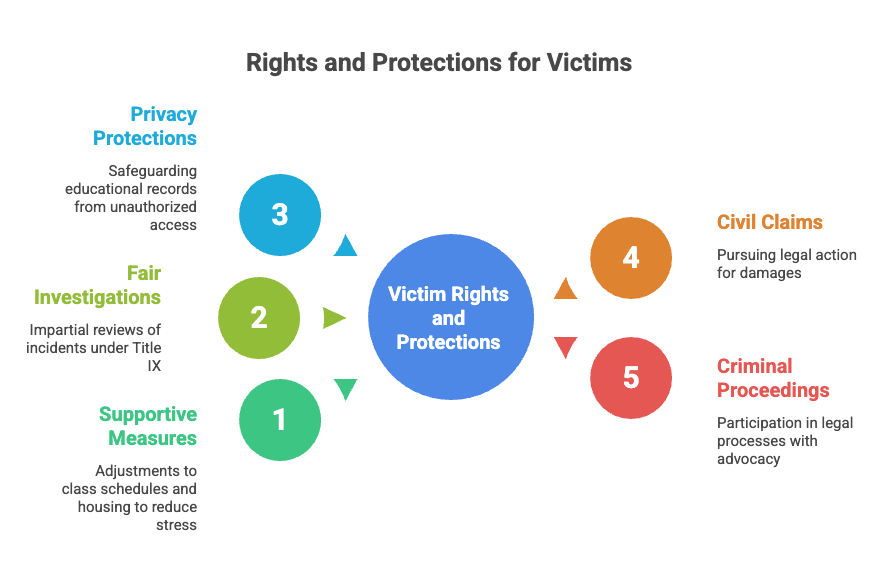
In Florida, campus sexual assault victims retain legal rights safeguarding safety, privacy, and accountability across school, criminal, and civil processes.
- Access to supportive measures, including class changes, housing adjustments, and no-contact directives.
- Fair, impartial school investigations under Title IX and related institutional policies.
- Privacy protections for educational records and limits on unnecessary disclosure.
- The right to pursue civil claims for damages against responsible parties or institutions.
- Participation in criminal proceedings, including notice, protection, and victim advocacy services.
For those committed to serving others, understanding these protections helps institutions, families, and advocates respond lawfully and with care. A knowledgeable attorney may clarify available rights while respecting the victim’s autonomy and long-term educational stability.
Steps to Take After a College Campus Sexual Assault Incident in Florida
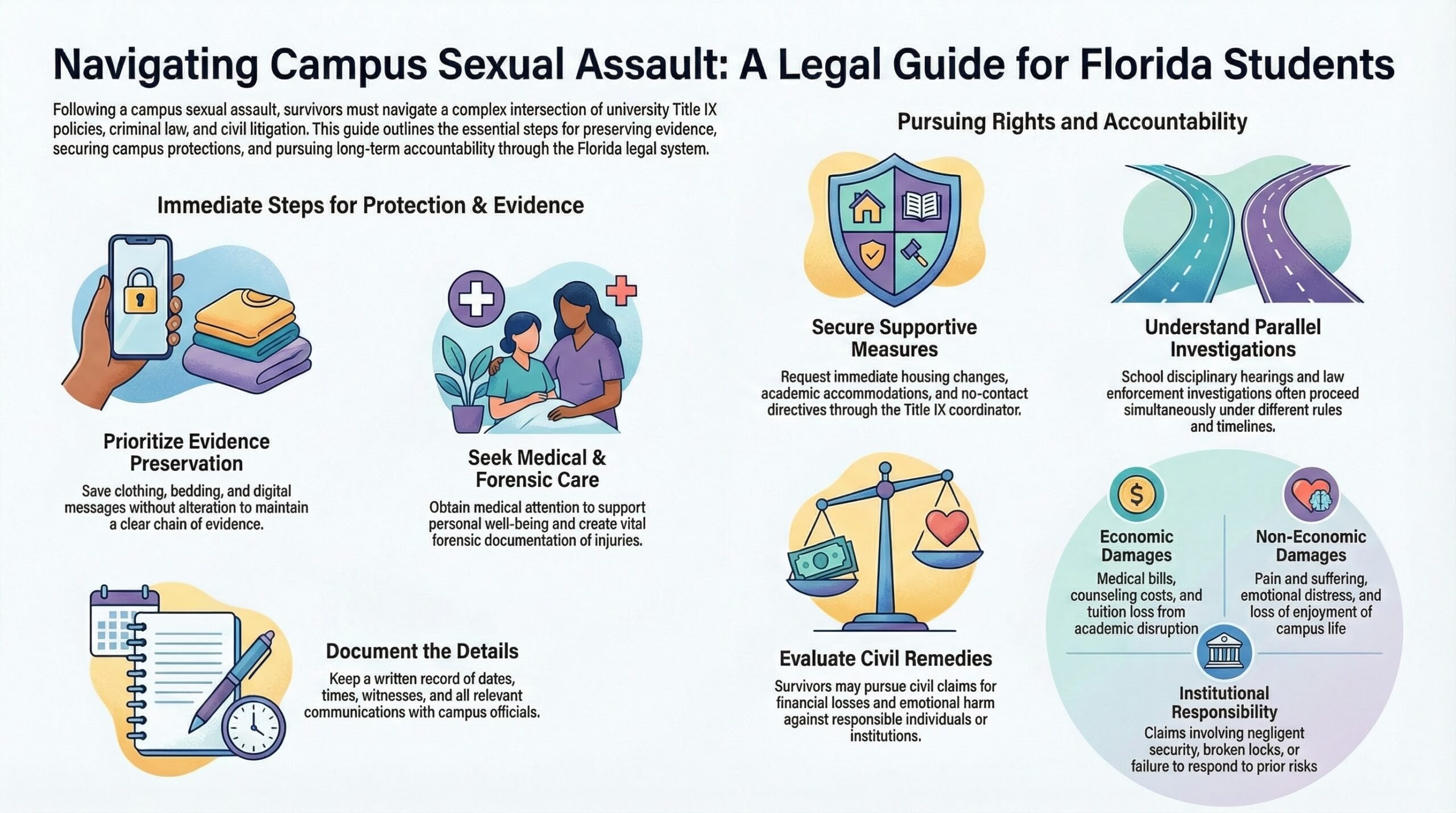
Following a college campus sexual assault incident in Florida, several immediate actions may affect both personal safety and any future legal or disciplinary process. Important early measures often include immediately preserving evidence, reporting the assault to the appropriate campus or law enforcement authorities, and obtaining medical attention when needed. Legal guidance may also help a victim understand available rights, reporting options, and the steps required to protect a potential claim.
Preserve Evidence Immediately
Act promptly to preserve any available evidence, as early documentation can be important for both a criminal investigation and a civil claim arising from a college campus sexual assault in Florida. Helpful measures may include saving clothing, bedding, messages, photographs, and location data without alteration, so that chain preservation remains intact. Medical attention can support personal well-being while also creating forensic documentation of injuries and other relevant findings.
A carefully written record of events, including dates, times, and descriptions of interactions, may help identify Consent evidence and clarify circumstances. Names and contact information for individuals who observed relevant conduct should be retained, as witness statements often become valuable later. By preserving materials responsibly and compassionately, those assisting a survivor can help protect dignity, strengthen accountability, and support informed legal action.
Report The Assault
When a college campus sexual assault is reported promptly, institutional and law enforcement responses can begin while evidence, witness recollections, and digital records remain more readily available. A survivor may notify campus officials, pursue Title IX reporting, or contact university police immediately, depending on safety needs and personal readiness.
Many Florida colleges also provide anonymous options, which can help document patterns and alert administrators to risks affecting the broader campus community. Reporting through student affairs offices, residence life staff, or designated coordinators may trigger supportive measures, including housing changes, academic adjustments, and no-contact directives. Survivors should keep copies of emails, screenshots, and incident reports, since accurate records can assist internal grievance processes.
Prompt reporting also helps institutions fulfill duties to protect students, preserve fairness, and support a safer educational environment for everyone.
Seek Legal Guidance
Consulting a lawyer early can help a survivor understand their legal options, protect important rights, and avoid missteps during school and law-enforcement investigations. Counsel may explain how Florida law, institutional policies, and timelines affect claims, disciplinary proceedings, and evidence preservation. An attorney may also coordinate with campus advocacy offices to help secure supportive measures and no-contact orders.
Legal guidance can assist a survivor in evaluating confidential reporting options, communicating with investigators, and responding to the college’s requests. It may also help families identify trauma resources, document losses, and assess possible civil remedies against responsible parties. By obtaining prompt, informed advice, a survivor is better positioned to make careful decisions that support safety, accountability, and continued access to education, recovery, and community support services.
How a Florida College Campus Sexual Assault Lawyer Can Help You Initiate a Case
Because the early stages of a campus sexual assault claim often involve strict reporting deadlines, preservation of evidence, and overlapping school and legal procedures, a Florida college campus sexual assault lawyer can provide crucial guidance from the outset. Counsel helps survivors understand options, act promptly, and pursue remedies that support personal safety and Campus Accountability within the educational community.
A lawyer may assist by:
- Explaining rights under school policies and Florida law
- Coordinating Confidential Reporting and formal complaints
- Advising on Evidence Protection, including records and communications
- Providing trauma-informed advocacy during interviews and hearings
- Identifying responsible parties and potential civil claims
Through careful case initiation, counsel can help organize documentation, communicate with administrators, and reduce procedural mistakes that may weaken a claim. This early support allows survivors and those assisting them to focus on informed decisions, respectful advocacy, and meaningful action that encourages safer campuses and stronger institutional responsibility for all students and communities.
Long-Term Effects of College Campus Sexual Assault Trauma
College campus sexual assault trauma can produce long-term consequences that extend well beyond the initial incident. These effects often include emotional and psychological harm, significant academic and social challenges, and physical symptoms that may persist over time. A clear understanding of these lasting impacts is important when evaluating how trauma may affect a student’s health, education, and daily functioning.
Emotional And Psychological Impact
Although the physical incident may end in a single moment, the emotional and psychological effects of campus sexual assault often persist for years and can interfere with nearly every aspect of a survivor’s life. Many experience anxiety, depression, intrusive memories, sleep disruption, panic, shame, and diminished trust in others. These responses may complicate Trauma recovery and can intensify when survivors face reporting obstacles, concerns about evidence preservation, or uncertainty regarding court-ordered accommodations.
From a service-oriented perspective, informed support requires patience, consistency, and respect for autonomy. Survivors may struggle with hypervigilance, emotional numbness, irritability, or symptoms associated with post-traumatic stress. Professional counseling, trauma-informed advocacy, and carefully coordinated legal guidance can help restore stability, reinforce safety, and support long-term emotional recovery without minimizing the seriousness of the harm endured.
Academic And Social Challenges
When sexual assault occurs within an academic setting, its effects often extend far beyond the immediate aftermath and can notably disrupt a student’s educational progress and social stability. Concentration may decline, attendance may become inconsistent, and academic performance may suffer as Trauma triggers arise in classrooms, residence halls, or campus events. Some students withdraw from leadership roles, athletics, or internships, limiting future opportunities.
Socially, trust may erode, peer relationships may become strained, and participation in campus life may decrease. Reporting barriers, including fear of retaliation, disbelief, or exposure, can further isolate affected students and delay access to supportive measures. For those seeking to serve others well, recognizing these long-term academic and social disruptions is essential to promoting informed advocacy, meaningful accommodations, and safer educational communities for all students.
Lasting Physical Effects
Beyond academic disruption and social withdrawal, sexual assault may also produce long-term physical effects that interfere with daily functioning, health, and restoration. Survivors may experience chronic pain, gastrointestinal problems, headaches, sleep disturbances, and stress-related cardiovascular symptoms that persist well after the incident. In some cases, a Traumatic brain injury may result from blunt force, strangulation, or falls during the assault, creating lasting cognitive and neurological complications.
Reproductive health concerns, recurring infections, and substance-related health decline may also emerge over time. These conditions often require coordinated medical treatment, counseling, and practical support from those committed to service. The resulting long-term medical costs can be substantial, affecting education, employment, and stability. Careful documentation and informed advocacy may help survivors secure the resources and protection they need.
What to Expect During a Florida College Campus Sexual Assault Claim Process
A Florida college campus sexual assault claim process typically begins with reporting the incident and taking immediate steps to protect the student’s safety and legal interests. From there, the matter may involve evidence collection, fact-finding, and parallel reviews by the school and, in some cases, law enforcement or civil counsel. The process can lead to disciplinary action, legal remedies, or other resolutions, while support services often remain an important part of the student’s recovery and case management.
Reporting And Initial Steps
Because the earliest decisions can affect both safety and legal options, reporting a college campus sexual assault in Florida typically begins with immediate medical care, preservation of evidence, and notice to campus authorities or law enforcement, depending on the circumstances. Schools often explain Confidential reporting options, supportive measures, and emergency protections. They also outline Title IX procedures, including how to submit a complaint and how to request interim accommodations.
At this stage, a survivor may seek help from advocates, counselors, or attorneys who can explain available reporting paths with care and respect. Colleges commonly address housing changes, academic adjustments, no-contact directives, and access to counseling. If law enforcement is contacted, officers may describe next steps and available protections. Early guidance can help individuals make informed choices while prioritizing personal well-being and community safety.
Evidence And Investigation
When a Florida college campus sexual assault claim moves into the evidence and investigation stage, the process generally centers on collecting, preserving, and reviewing information that may clarify what occurred.
This may include photographs, medical records, electronic messages, witness accounts, security footage, and clothing or bedding. Forensic evidence handling is often significant because proper collection and storage can affect reliability and later evaluation. Investigators may also examine timelines, prior communications, and location data to compare accounts with available records.
Survivor statement accuracy matters as interviews are typically conducted carefully, with attention to detail, consistency, and trauma-informed practices that reduce unnecessary pressure. Families, advocates, and service-minded professionals often focus on preserving dignity while helping ensure information is documented thoroughly, respectfully, and in a manner that supports informed evaluation of the claim.
School And Legal Procedures
Although procedures vary by institution, a Florida college campus sexual assault claim commonly moves through parallel school and legal channels, each with its own rules, timelines, and standards for review. Schools typically begin by receiving a report, explaining supportive measures, and examining Title IX obligations. Investigators may interview parties and witnesses, collect documents, and prepare findings for decision-makers.
Separately, law enforcement may open a criminal investigation, gather statements, and evaluate whether charges are warranted under Florida law. These processes do not always move at the same pace, and one may continue regardless of the other. Campus disciplinary procedures often include notice of allegations, opportunities to respond, review of evidence, and a hearing or administrative determination. Careful guidance can help individuals understand expectations, preserve rights, and participate in a manner that respects all involved.
Potential Outcomes And Support
After school and legal procedures begin, attention often turns to the range of outcomes and support that may follow throughout a Florida college campus sexual assault claim. Possible results may include disciplinary findings, protective measures, academic accommodations, no-contact directives, criminal charges, or civil recovery. Each path depends on the evidence, institutional policies, and the survivor’s goals.
Support services remain crucial throughout the process. Advocates may explain how to document incident details, preserve communications, and track medical or counseling records. Counsel can also help coordinate safety planning resources, housing changes, class adjustments, and workplace considerations. For those committed to serving others, understanding these outcomes can improve compassionate response, strengthen referrals, and promote informed assistance.
Steady guidance often helps survivors protect their rights, stability, and long-term well-being during recovery.
Compensation for Florida College Campus Sexual Assault Damages
Because the effects of campus sexual assault often extend far beyond the immediate incident, compensation in a Florida civil claim may address a broad range of damages tied to the survivor’s losses. Courts may consider medical expenses, counseling, academic disruption, and other harm supported by records, testimony, and professional evaluation. In some matters, punitive damages may also be pursued when conduct was especially wrongful under Florida law.
| Area | Examples |
|---|---|
| Health care | Emergency treatment, follow-up care |
| Counseling | Therapy, trauma support services |
| Education | Tuition loss, delayed graduation |
| Daily life | Transportation, safety measures |
| Accountability | Court-awarded punitive damages |
A careful claim presentation can help secure resources that support recovery, stability, and continued service to others within the community. Attorneys often gather documentation, consult qualified experts, and assess institutional facts to present a clear demand. This process seeks financial recovery while reinforcing responsibility and encouraging safer campus environments for students statewide and families.
Economic vs Non-Economic Damages in Florida College Campus Sexual Assault Cases
Florida college campus sexual assault cases may involve both economic damages, such as medical expenses, counseling costs, and lost educational or employment opportunities, and non-economic damages, including pain and suffering, emotional distress, and loss of enjoyment of life. This distinction matters because each category addresses a different type of harm arising from the assault and its aftermath. Establishing these damages often requires documentation, expert support, and other evidence that connects the losses to the underlying misconduct.
Economic Damages Overview
While every case turns on its own facts, damages in a Florida college campus sexual assault claim are generally divided into two categories: economic and non-economic losses. Economic damages address measurable financial harm that can be documented through records, invoices, wage statements, and expert analysis.
In these cases, economic damages may include medical treatment, counseling costs, prescription expenses, transportation to appointments, and other Hidden Costs tied to recovery. They can also include tuition loss, withdrawal-related expenses, reduced academic progress, and Loss of Earnings when employment or future work opportunities are affected. In some matters, additional compensation may cover security-related relocation, property damage, or costs of academic accommodations.
By focusing on objective financial consequences, economic damages aim to restore lost resources and support practical stability during recovery and rebuilding.
Non-Economic Losses Explained
Although financial records can show the out-of-pocket impact of a campus sexual assault, non-economic damages address the human consequences that do not appear on invoices or wage statements. These losses may include pain, humiliation, anxiety, loss of enjoyment of life, and disruption of educational and personal development.
In Florida campus assault cases, non-economic damages recognize that survivors often carry lasting burdens beyond measurable expenses. Emotional distress impacts may affect concentration, sleep, relationships, confidence, and a student’s sense of safety in academic settings. These harms can alter daily functioning and future opportunities, even when direct financial loss seems limited.
A service-minded legal approach considers the full person, not only receipts or account balances. It also acknowledges the value of Trauma recovery resources, supportive care, and restored dignity as important parts of a survivor’s restoration journey.
Proving Campus Assault Damages
Because damages in campus sexual assault cases often extend beyond immediately visible losses, proving them requires clear, organized evidence that connects the assault to both financial harm and personal suffering. In Florida college cases, economic damages may include medical bills, counseling costs, tuition losses, relocation expenses, and reduced earning capacity. Non-economic damages often include pain, emotional distress, humiliation, and loss of enjoyment of education.
Effective evidence collection supports both categories. Records from treatment providers, academic files, employment documents, journals, and witness statements can help show how the assault affected daily functioning and future plans. Testimony may also address trauma symptoms and interrupted academic progress. Although proving consent may arise in liability disputes, damage claims focus on demonstrating the consequences of the assault.
Careful documentation helps survivors pursue accountability while informing institutions, courts, and advocates seeking meaningful support.
When a Florida College Campus Sexual Assault Case Goes to Trial vs Settlement
When a Florida college campus sexual assault case is evaluated for resolution, the decision to proceed to trial or pursue settlement generally turns on the strength of the evidence, the extent of the harm alleged, and the legal and practical risks facing each side. Counsel typically weighs institutional records, witness accounts, and plaintiff testimony to assess credibility, exposure, and likely jury response.
Settlement may be favored when liability appears substantial, and both sides seek privacy, certainty, and reduced emotional strain. It can also provide faster access to financial support and corrective measures that align with victim advocacy goals. Trial strategy becomes more important when facts are disputed, damages are contested, or a defendant refuses meaningful accountability.
In those matters, settlement leverage may increase through discovery, expert review, and motions that clarify weaknesses in the defense. A careful decision requires balancing service to the survivor, evidentiary realities, and the broader interest in campus safety and institutional responsibility.
The Statute of Limitations for Florida College Campus Sexual Assault Cases
Beyond decisions about trial or settlement, timing often determines whether a Florida college campus sexual assault claim may proceed at all. Florida law may impose different limitation periods depending on the legal theory asserted, the age of the harmed person, and whether the claim is directed at an individual, an institution, or both. Because these rules can vary, careful review of dates and applicable statutes is critical.
Practical attention to Evidence preservation also matters, since documents, electronic messages, medical records, and witness recollections may become harder to secure as time passes. Separate reporting deadlines may apply under school policies or Title IX procedures, even when a civil lawsuit remains possible. Campus misconduct findings can influence case strategy, but they do not automatically control a court’s timetable.
In many matters, a prompt attorney consultation helps clarify which deadlines govern, what exceptions may apply, and how timely action may support accountability, safety, and respectful service to others.
When to Contact a College Campus Sexual Assault Lawyer in Florida
Although many individuals hesitate to seek legal guidance until they have gathered more information, early consultation with a Florida college campus sexual assault lawyer often helps protect both legal rights and practical options. Contact is often appropriate soon after an incident, after a report to campus authorities, or when questions arise about confidential reporting, safety measures, or victim privacy.
Prompt legal consultation may also be beneficial before participating in university investigations, disciplinary hearings, or interviews with school officials or law enforcement. Timely guidance can help a student or family understand reporting options, preserve relevant communications, and avoid missteps that affect evidence handling. It may also be important to seek advice when academic accommodations, housing changes, no-contact directives, or medical records become part of the response process.
Even if uncertainty remains about formal action, an early discussion can clarify deadlines, institutional procedures, and available support pathways, allowing informed decisions that better serve personal wellbeing and campus community interests.
Why You Need an Experienced Florida College Campus Sexual Assault Lawyer
Early consultation often helps preserve options, and the value of that step increases significantly when the lawyer has substantial experience handling college campus sexual assault matters in Florida. An experienced attorney understands how campus procedures, Title IX requirements, and related civil and criminal issues can intersect, sometimes on short timelines. That knowledge supports informed action that protects safety, privacy, educational access, and long-term interests.
Experienced counsel also helps survivors and families respond with clarity rather than confusion. Through trauma-informed advocacy, the attorney can communicate with schools, investigators, and disciplinary bodies in a manner that respects the effects of trauma while advancing necessary legal objectives. Immediate legal consultation may also help preserve evidence, prevent harmful statements, and reduce procedural errors that could limit later remedies.
For those motivated by care for students and institutional accountability, seasoned legal guidance serves both individual well-being and the broader goal of safer campus communities for all.
How to Choose the Right College Campus Sexual Assault Lawyer for Your Case in Florida
Selecting the right college campus sexual assault lawyer in Florida requires careful attention to experience, focus, and approach. A qualified attorney should understand campus disciplinary procedures, Title IX concerns, and related civil claims, while also demonstrating a consistent commitment to Victim Advocacy.
Individuals evaluating counsel should review the lawyer’s history with sensitive cases, communication practices, and ability to explain options clearly. The right attorney will provide Confidential Support, protect privacy, and pursue accountability without creating unnecessary stress for the survivor or family. It is also important to consider whether the lawyer listens carefully, responds promptly, and treats every concern with dignity.
A careful selection process may include reviewing credentials, reading client feedback, and scheduling a consultation to assess professionalism and fit. In matters involving trauma and institutional power, effective representation should combine legal skill, steady guidance, and a service-centered commitment to protecting the client’s interests throughout the process.
About The Law Offices of Anidjar & Levine
After considering the qualities that matter when choosing counsel, attention often turns to the law firm’s background, client service, and approach to representation.
The Law Offices of Anidjar & Levine is recognized in Florida for responsive communication, practical guidance, and a client-centered model that seeks to reduce burdens during difficult legal matters.
Their team emphasizes accessibility and respect, including confidential consultations for individuals and families evaluating legal options after campus sexual assault.
In matters involving student survivors, the firm’s work reflects a commitment to victim advocacy and careful case preparation.
Attorneys may assist with understanding civil remedies, preserving evidence, communicating with institutions, and pursuing accountability from responsible parties when supported by the facts.
The firm also prioritizes consistent updates and individualized attention, which can be especially important when clients are balancing academic obligations, emotional recovery, and safety concerns.
This service-focused approach aligns with the needs of those seeking dependable legal support in Florida.
Frequently Asked Questions
Can Parents File a Claim for a Sexually Assaulted College Student?
Yes, parents may file certain claims on behalf of a sexually assaulted college student, particularly if the student is a minor, incapacitated, or otherwise legally unable to proceed independently. For adult students, parental claims are limited, though families may still support reporting, treatment, and College Support Options. Legal viability depends on facts, school conduct, and Mandatory Reporting Rules. Prompt review by qualified counsel helps protect rights and guide service-oriented decisions.
Are Campus Sexual Assault Claims Confidential in Florida?
Yes, campus sexual assault claims in Florida may remain partly private, but complete privacy is not always assured. Schools often allow confidential reporting through designated counselors or advocates, while anonymous tips may support awareness without initiating a full investigation. Once a formal complaint begins, disclosure may be required to safeguard campus safety and ensure due process. Those seeking to assist and support survivors should review school policies and Florida reporting requirements carefully.
Can International Students Pursue Campus Sexual Assault Claims in Florida?
Yes, international students may pursue campus sexual assault claims in Florida, provided the conduct and parties fall within applicable jurisdiction limits. Their immigration status does not usually bar reporting to the school, law enforcement, or civil authorities. They must still comply with institutional procedures and legal time limits. Prompt action helps preserve evidence, protect educational access, and support others by encouraging accountability, safety, and informed use of available campus and community resources.
What if the Assault Occurred During a Study Abroad Program?
If the assault occurred during a study abroad program, a claim may still be possible, depending on the school’s role, program structure, and applicable local law. Jurisdiction Questions often arise when multiple countries, institutions, and legal systems are involved. Federal Reporting duties can still apply to the home institution in some circumstances. Careful review helps affected students identify protective options, preserve evidence, and pursue accountability in a responsible, service-centered manner.
Can Social Media Posts Affect a Campus Sexual Assault Case?
Yes, social media posts can affect a campus sexual assault case substantially. Investigators may review messages, photos, and comments to assess timelines, credibility, and the authenticity of evidence. Posts that appear inconsistent with statements may influence disciplinary findings or related proceedings. At the same time, public accusations can pose a serious risk of defamation if the claims are unverified or misleading. Careful, service-minded reporting and preservation of digital records often support a fair, informed institutional response.
—————————
College campus sexual assault cases in Florida demand prompt action, careful documentation, and informed legal guidance.
Victims may have rights under criminal, civil, and school disciplinary processes, each with distinct requirements and deadlines.
A qualified Florida Sexual Assault Lawyer can assess liability, protect the victim’s interests, and pursue appropriate compensation and accountability.
The Law Offices of Anidjar and Levine represent clients with the experience and focused advocacy these sensitive and intricate matters require.