A Florida civil suit for sexual battery allows survivors to seek compensation and legal accountability from responsible individuals and, in some cases, negligent institutions. Law Offices of Anidjar and Levine helps preserve evidence, evaluate viable claims, explain Florida procedures, and manage filings, deadlines, and communications with care.
These cases may involve workplaces, schools, rideshare services, or nursing homes, and damages can include medical costs, counseling, lost income, and pain and suffering.
Additional guidance from a Florida Sexual Assault Lawyer below explains the process and options.
Main Takeaways
- A Florida lawyer can assess the facts, identify viable civil claims, and explain the steps needed to file under state law.
- Civil sexual battery lawsuits seek compensation for medical care, counseling, lost income, pain and suffering, and other trauma-related losses.
- Claims may target the assailant and, in some cases, employers, schools, rideshare companies, or care facilities that failed to protect others.
- Early evidence preservation is critical, including messages, photos, medical records, witness information, surveillance footage, and a written timeline.
- Defense tactics may dispute consent, notice, causation, or damages, so trauma-informed legal guidance can help protect dignity and strengthen the case.
How We Can Help With Your Florida Civil Suit for Sexual Battery Claim
When a survivor considers a Florida civil suit for sexual battery, experienced legal counsel can provide structure, protection, and a clear path forward. The firm assists by organizing records, preserving evidence, and managing communication so the survivor can focus on recovery and service to family, community, and personal recovery.
Counsel also evaluates all potentially responsible parties, including institutions, and questions of independent contractor liability where control, supervision, or negligent retention may be at issue. Attorneys coordinate with trauma-informed professionals, explain each step in plain language, and prepare filings that reflect the survivor’s goals and dignity. They identify available insurance, document financial and personal losses, and build support for punitive damages claims when misconduct warrants stronger accountability.
Throughout the process, the firm maintains confidentiality, prepares the client for meetings and testimony, and advocates with disciplined professionalism. This careful guidance helps survivors pursue justice in a manner that honors safety, stability, and meaningful long-term restoration.
Understanding Civil Suit for Sexual Battery Cases in Florida


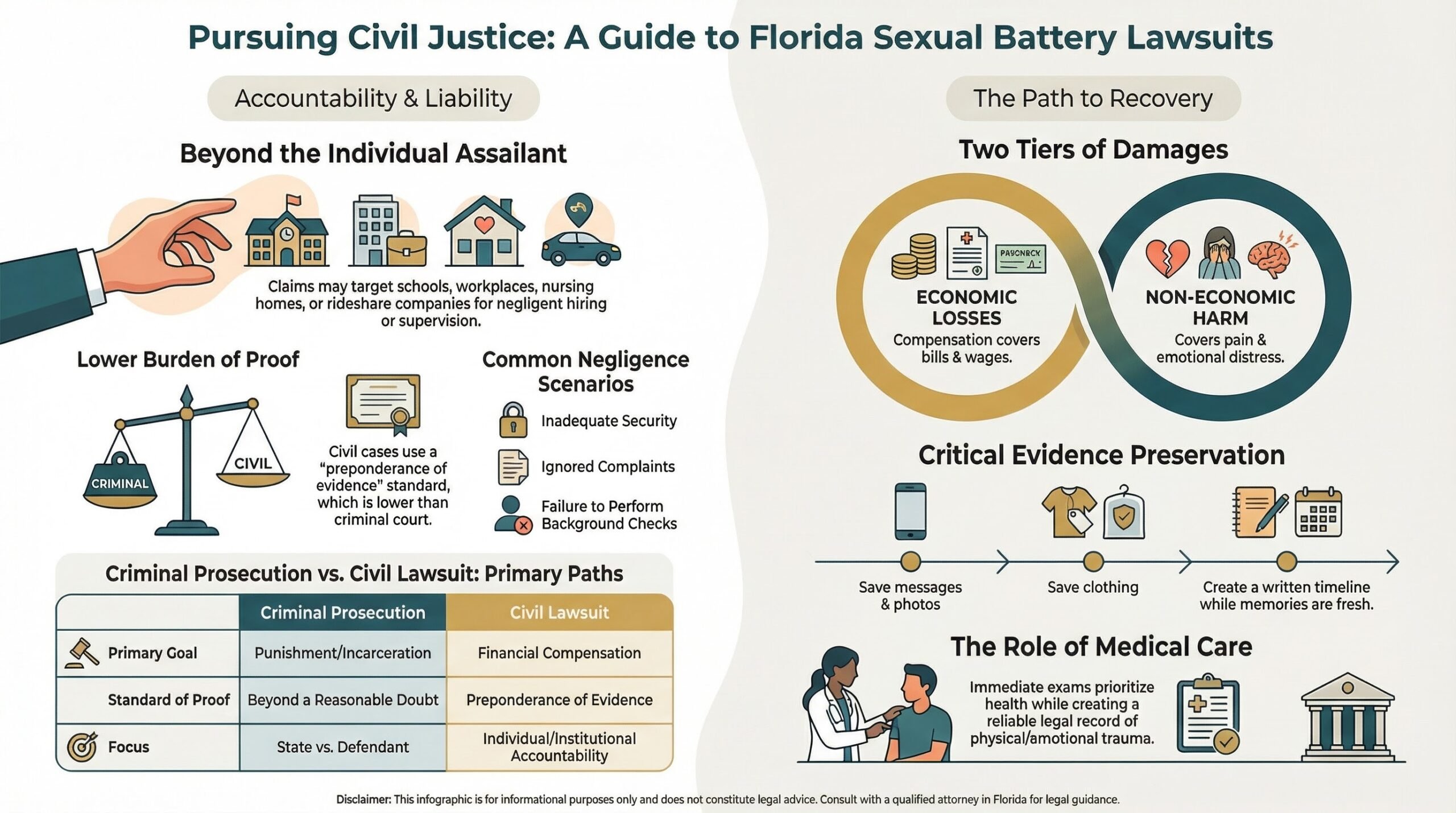
Although a sexual battery may lead to criminal prosecution, a civil suit in Florida serves a different purpose by allowing an injured person to seek financial compensation and legal accountability from the individual, and in some cases the institution, responsible for the harm. In this process, the burden of proof differs from criminal court, and the focus centers on measurable losses, lasting trauma, and other legally recognized damages.
OUR CONSULTATIONSARE FREE
START YOUR FREE CASE REVIEW

A civil claim may require careful documentation, evidence preservation, and prompt legal evaluation to protect the injured person’s rights. Attorneys often assess records, communications, witness statements, and expert opinions to build a sound case. They also guide clients through procedural deadlines, privacy concerns, settlement discussions, and trial preparation when resolution cannot be reached. This framework helps survivors pursue justice in a manner that supports repairing, encourages responsible conduct, and promotes safer communities.
Civil litigation, therefore, serves both individual recovery and the broader public interest through accountability.
Common Scenarios When a Civil Suit for Sexual Battery Might Take Place in Florida
Civil suits for sexual battery in Florida may arise in several settings where individuals or institutions fail to prevent or respond to abusive conduct. Common examples include workplace assault incidents, school or campus abuse, rideshare or taxi attacks, and sexual abuse in nursing homes. Each scenario may involve distinct facts, but all can raise serious questions of liability, negligence, and damages under Florida civil law.
Workplace Assault Incidents


Because workplace environments often involve power imbalances and repeated contact, sexual battery may occur in settings where an employer, supervisor, coworker, or third party exploits access to the victim. Civil claims may arise after assaults during shifts, business travel, off-site meetings, employer housing, or social events tied to work.
In these matters, a careful review may examine negligent hiring, retention, supervision, security failures, and prior complaints. Helpful service to affected individuals often includes preserving records, witness statements, surveillance footage, electronic communications, and medical documentation before evidence spoliation occurs. Defendants may raise liability defenses, including consent, lack of notice, or challenges to causation and damages. A civil suit in Florida may seek accountability, financial recovery, and institutional change that helps protect other workers from similar harm in the future.
School Or Campus Abuse
When sexual battery occurs in a school or campus setting, the surrounding facts often involve a teacher, coach, staff member, student, volunteer, or another person who used institutional access or authority to commit the abuse. Civil claims may arise when a school, college, or university failed to screen personnel, ignored warnings, provided inadequate supervision, or mishandled campus reporting obligations. In these matters, a lawsuit may examine negligent hiring, retention, and security, as well as failures to respond to prior complaints.
Evidence can include disciplinary records, internal communications, witness statements, surveillance footage, and policy violations. A civil action may help secure accountability, financial recovery, and changes that better protect students and families. It may also connect survivors with victim support resources while encouraging safer educational environments and more responsible institutional practices.
Rideshare Or Taxi Attacks
Why do rideshare and taxi sexual battery cases so often raise serious questions about company responsibility in addition to the conduct of the individual driver? In Florida civil claims, these incidents may involve negligent hiring, inadequate background checks, poor supervision, unsafe app features, or failures to respond to prior complaints. Such matters are important for those seeking accountability that may protect future passengers and strengthen safer transportation practices statewide.
A civil suit may examine the Consent standard, the reporting timeline, and witness identification, including riders, dispatch records, GPS data, cameras, and electronic communications. Counsel often evaluates whether the company created or ignored foreseeable risks and documents trauma, medical care, lost income, and other losses relevant to the calculation of damages. Careful case development can support informed decisions and meaningful public safety goals.
Nursing Home Sexual Abuse
Nursing home sexual abuse presents another setting in which a Florida civil suit for sexual battery may arise, often involving vulnerable residents who depend on staff and facility systems for daily protection. Claims may involve assaults by employees, residents, visitors, or outside providers allowed access without adequate screening or supervision. Civil actions often examine negligent hiring, poor monitoring, ignored complaints, and failures to respond to warning signs with urgency and care.
Evidence may include medical findings, witness statements, surveillance records, and disputed consent documentation, especially when cognitive impairment affects a resident’s capacity. Families pursuing accountability may also confront Staff retaliation, intimidation, or sudden changes in treatment after reporting concerns. A civil suit can seek damages while encouraging stronger policies, resident safeguards, reporting practices, and a culture that honors dignity, trust, and safety.
Legal Rights of Civil Suit for Sexual Battery Victims in Florida
Although a criminal prosecution may address punishment, Florida law also permits a sexual battery victim to pursue a civil suit for independent legal relief. In this setting, criminal-versus-civil distinctions matter because the civil system centers on accountability, compensation, and community protection rather than incarceration. A claimant may seek recovery through damages proof based on a preponderance of the evidence, a lower standard than in criminal court, while evidence preservation supports a fair presentation of facts.
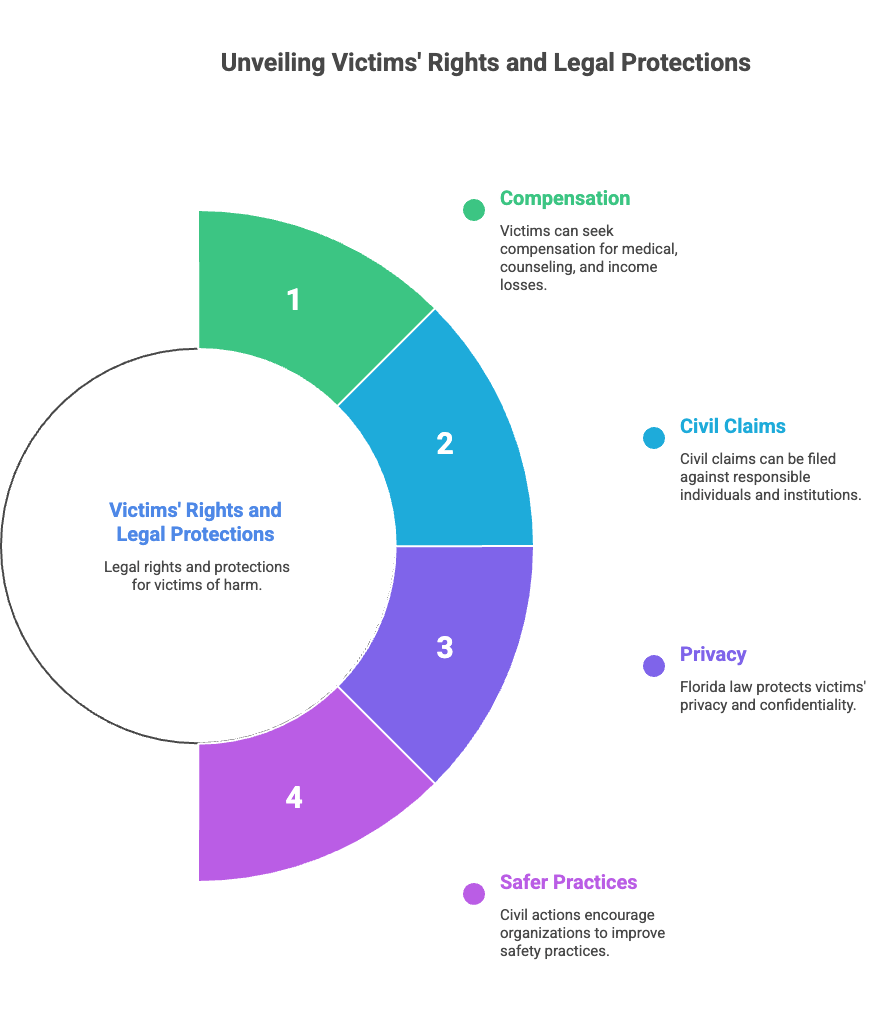
Florida civil law allows sexual battery survivors to seek accountability and compensation under a lower burden of proof.
- Victims may request compensation for medical costs, counseling, lost income, and pain and suffering.
- Civil claims may proceed against responsible individuals and, in some cases, negligent institutions that failed to protect others.
- Florida law may recognize privacy interests, confidentiality protections, and measures that reduce unnecessary public exposure.
- A civil action can promote safer practices by encouraging organizations to strengthen screening, supervision, reporting, and prevention efforts for vulnerable people.
These rights help survivors pursue justice while serving broader public safety interests.
Steps to Take After a Civil Suit for Sexual Battery Incident in Florida
After a sexual battery incident in Florida, the initial steps often influence both personal recovery and the strength of any civil claim. Prompt medical care may restore health and create important records, while preserving physical and documentary evidence can support later legal action. Early consultation with a Florida attorney also helps a victim understand available remedies, deadlines, and the procedures involved in pursuing a civil suit.
Seek Immediate Medical Care
Obtain immediate medical care, as prompt evaluation helps preserve important evidence. A licensed provider can assess injuries, address infection concerns, and recommend follow-up services that protect long-term health. Immediate treatment also creates a reliable record of physical and emotional effects, which may later clarify the extent of harm.
Medical professionals may offer trauma support, crisis referrals, and Therapy aftercare tailored to individual needs. They can assist with documenting symptoms such as pain, bruising, sleep disruption, or anxiety, while recommending medications or professional care when appropriate. In many situations, providers also discuss safety planning, including secure transportation, contact restrictions, and confidential follow-up options.
Seeking prompt care allows concerned individuals and those assisting them to prioritize health, stability, and informed next steps with diligence.
Preserve Key Evidence
Prompt medical care often works alongside careful evidence preservation, because information gathered in the hours and days following a sexual battery incident may later affect a civil claim in Florida. Helpful steps may include saving clothing, photographs, messages, emails, location data, and social media records without alteration. A written timeline of events, injuries, and conversations can also support accuracy while memories remain fresh.
Service-minded support persons may assist by documenting names of potential witnesses and securing witness statements when appropriate. Records showing prior communications, transportation details, or circumstances surrounding the encounter may become relevant as Consent evidence. Individuals are often encouraged to store materials in a safe place, keep copies of medical and police records, and avoid deleting digital content that could later help clarify facts for courts and insurers.
Consult A Florida Attorney
Because civil sexual battery claims in Florida often involve strict filing deadlines, overlapping criminal investigations, and sensitive evidentiary issues, consultation with a Florida attorney can help a claimant evaluate legal options and protect the integrity of the case. Counsel can provide consultation guidance on reporting procedures, insurance questions, potential defendants, and available remedies under Florida law.
An attorney may also coordinate evidentiary preservation, including records requests, witness identification, and secure handling of communications or digital materials. Early legal strategy can reduce avoidable mistakes, prevent harmful disclosures, and support informed decisions regarding settlement or litigation. In matters involving trauma, counsel may also recommend victim support resources to promote stability while the civil process proceeds. Timely legal advice often strengthens accountability efforts and service to affected individuals and communities.
How a Florida Civil Suit for Sexual Battery Lawyer Can Help You Initiate a Case
At the outset, a Florida sexual battery lawyer can help initiate a case by evaluating the underlying facts, identifying viable legal claims, and explaining the procedural steps that must be followed under state law. Counsel also guides evidence preservation, coordinates witness support, and helps survivors act promptly to protect both dignity and community safety.
Key early assistance often includes:
- Reviewing timelines, documents, communications, and related records to assess potential claims.
- Identifying defendants, insurance issues, and institutional responsibilities that may affect recovery.
- Preparing filings, notices, and deadlines so the case begins in an orderly manner.
- Advising on interactions with investigators, employers, schools, or service providers when relevant.
Through these services, counsel provides structure during a difficult process and helps clients make informed decisions that may serve broader accountability goals. Early legal guidance can reduce avoidable mistakes and create a clearer path toward a well-supported civil action in Florida courts.
Long-Term Effects of Civil Suit for Sexual Battery Trauma
The long-term effects of sexual battery trauma often extend well beyond the initial incident, affecting emotional stability and psychological health in lasting ways. Survivors may also experience persistent challenges in relationships and trust, which can influence family dynamics, social interactions, and personal security. In addition, trauma may interfere with work performance and daily functioning, creating ongoing obstacles that a civil suit may seek to address through accountability and compensation.
Emotional And Psychological Impact
Enduring psychological harm often extends far beyond the physical act, affecting a survivor’s sense of safety, trust, and personal stability for years after the incident. Anxiety, depression, sleep disruption, and intrusive memories may interfere with work, concentration, and routine decision-making, even after legal proceedings conclude.
The civil process can intensify distress through courtroom stress, repeated retelling of events, and uncertainty about outcomes. In many cases, Trauma counseling supports emotional processing and helps survivors develop practical coping strategies. Professionals focused on victim advocacy often assist with resource coordination, communication, and informed preparation, which can reduce confusion during litigation.
Over time, restoring stability may require consistent therapeutic care, structured support, and patient attention to triggers that affect daily functioning. A careful legal approach can complement recovery by reducing avoidable pressure and preserving dignity.
Relationship And Trust Challenges
Because sexual battery can alter a survivor’s expectations of safety and control, long-term relationship difficulties often emerge in both intimate and everyday interactions. Trust may become conditional, especially when past violations distorted Consent boundaries and left the survivor alert to subtle shifts in power dynamics.
Family members, partners, friends, and caregivers may observe withdrawal, heightened caution, or difficulty accepting support, for fear of hidden motives. These responses are not signs of indifference; rather, they often reflect protective adaptations shaped by trauma and reinforced by concerns about credibility. Reporting delays can further complicate relationships, as survivors may anticipate doubt, judgment, or pressure to explain behavior that trauma itself has affected. A service-minded community can respond by honoring autonomy, respecting stated limits, and recognizing that rebuilding trust usually requires patience, consistency, and informed care.
Work And Daily Functioning
Often, sexual battery trauma disrupts work performance and routine daily functioning long after the initial harm, affecting concentration, memory, attendance, and tolerance for ordinary stress. Survivors may struggle to maintain Workplace routines, complete ordinary tasks, or respond calmly to daily stressors that once seemed manageable. Fatigue, hypervigilance, and sleep disruption can reduce reliability and productivity, while embarrassment or fear may limit communication with supervisors and colleagues.
In service-oriented settings, these impairments can hinder the ability to consistently and safely care for others. Careful symptom tracking may help document patterns that interfere with employment and household responsibilities over time. Supportive treatment, practical accommodations, and individualized coping strategies can improve stability, but many individuals still face substantial barriers to maintaining income, independence, and reliable daily functioning.

What to Expect During a Florida Civil Suit for Sexual Battery Claim Process
A Florida civil suit for sexual battery typically begins with filing the claim, followed by a structured process of gathering records, witness statements, and other evidence to build the case. The matter may then proceed through settlement discussions and mediation, where the parties assess potential resolution before trial. If no agreement is reached, the case moves to trial, where the court considers liability and the damages that may be awarded.
Filing The Civil Claim
When a civil claim for sexual battery is filed in Florida, the process typically begins with a formal complaint that identifies the parties, outlines the factual basis of the allegations, and states the damages sought. The complaint is filed in the appropriate court, then formally served on the defendant under Florida procedural rules.
After filing, the defendant is given a limited period to respond, usually by answer or motion. Early legal guidance often includes evidence-preservation measures and expert-testimony planning, helping the claim proceed in an orderly and responsible manner. Courts may then issue scheduling directives, address preliminary motions, and set deadlines that shape the litigation path. For those committed to protecting others and promoting accountability, this stage establishes the framework for a focused, legally grounded pursuit of civil remedies under Florida law.
Evidence And Case Building
Following the initial pleadings and court directives, attention turns to gathering and organizing the evidence that will support the civil sexual battery claim. Counsel typically collects medical records, photographs, communications, incident reports, and any prior statements, then evaluates how each item may establish liability, damages, and corroboration. This phase often includes Tactical Deposition Strategies designed to clarify timelines, preserve testimony, and identify inconsistencies without unnecessary confrontation.
Attorneys also conduct Witness Credibility Assessment, reviewing demeanor, consistency, opportunity to observe, and possible bias. Expert input may be considered when trauma, memory, or physical injury requires careful explanation for the court. Throughout this process, documentation is maintained with precision so the claim may be presented responsibly, with respect for the claimant, the judicial system, and the broader goal of accountability and public protection.
Settlement Talks And Mediation
Considered resolution efforts often begin once the parties have a clearer view of the evidence, the claimed damages, and the litigation risks that could affect trial outcomes. During settlement talks, counsel may exchange demands and responses, evaluate insurance issues, and discuss confidentiality, releases, and nonmonetary terms that could serve the claimant’s interests.
Mediation is a structured, private meeting led by a neutral mediator who helps the sides assess strengths, weaknesses, and practical options for resolution. The process typically involves separate sessions, careful communication, and informed decision-making rather than direct confrontation. Attorneys may continue to emphasize evidence preservation because organized records can strengthen negotiating positions and clarify disputed facts.
Claimants may also be encouraged to identify emotional support resources before mediation, helping them approach discussions with stability, preparation, and a stronger sense of personal agency.
Trial Process And Damages
Trial preparation shifts the focus from negotiation to proof, procedure, and the specific damages a claimant may seek from the court or jury. Attorneys organize testimony, expert opinions, and documentary records, with careful preservation of evidence supporting credibility and admissibility at each stage.
During trial, each side presents opening statements, examines witnesses, challenges disputed facts, and argues how Florida law applies. A prior mediation strategy may still influence trial themes, especially where settlement offers reflect disputed liability or harm. Damages may include medical expenses, counseling costs, lost income, pain and suffering, and, in limited cases, punitive damages. The court may also address evidentiary motions, jury instructions, and post-trial requests.
Throughout the process, disciplined preparation serves both accountability and the broader interest of protecting others from similar misconduct.

Compensation for Florida Civil Suit for Sexual Battery Damages
Because a Florida civil suit for sexual battery focuses on compensating the injured person rather than imposing criminal penalties, recoverable damages may include both measurable financial losses and the broader personal harm caused by the abuse. Courts may consider treatment costs, support needs, and care tied to emotional recovery. Timely evidence preservation and reliable witness statements often strengthen a claim and help present a fuller account of harm.
| Area | Human impact | Why it matters |
|---|---|---|
| Counseling | Restores stability | Supports healing |
| Medical care | Addresses trauma | Promotes safety |
| Lost support | Disrupts service to others | Preserves dignity |
In many cases, compensation also covers future therapy options, ongoing medical monitoring, and practical assistance to help the survivor rebuild daily life. This legal process can provide resources that protect wellbeing, encourage continued treatment, and support those who wish to regain strength while continuing to care for their families, work, and communities with renewed confidence.
Economic vs Non-Economic Damages in Florida Civil Suit for Sexual Battery Cases
In Florida, civil suits for sexual battery, damages generally fall into two broad categories: economic losses and non-economic harm. Economic damages often include measurable financial impacts such as medical expenses, counseling costs, lost wages, and reduced earning capacity, while non-economic damages address pain and suffering, emotional distress, and loss of enjoyment of life. The value of either category depends on the available evidence, including records, testimony, and expert opinions used to establish the nature and extent of the harm.
Economic Damage Categories
When a civil suit for sexual battery proceeds in Florida, damages are generally divided into economic and non-economic categories, each serving a distinct purpose in measuring harm. Economic damages address measurable financial losses connected to the incident and its aftermath. These may include medical expenses, counseling costs, prescription charges, lost wages, diminished earning capacity, and other out-of-pocket expenditures supported by records.
Careful documentation often strengthens these claims. Evidence preservation may include bills, employment records, treatment invoices, and related correspondence. Witness statements can also help confirm missed work, changes in job duties, or the need for assistance with daily responsibilities. In service-oriented advocacy, identifying these categories helps professionals pursue compensation that restores financial stability and supports access to necessary care, treatment, and practical resources after serious wrongdoing.
Non-Economic Losses
Although non-economic losses do not appear on invoices or wage statements, they often represent a substantial share of damages in a Florida civil suit involving sexual battery. These losses may include Emotional distress, anxiety, humiliation, loss of dignity, sleep disruption, and harm to personal relationships or daily functioning.
From a service-minded legal perspective, careful attention to these harms helps honor the survivor’s experience while presenting a clear account to the court. Non-economic losses can be affected by credibility challenges, inconsistent recollections, documentation errors, and the organization of testimony. Thoughtful witness preparation may help convey changes in behavior, emotional stability, and quality of life without overstating or minimizing their impact. In this particular situation, non-economic damages address human suffering that cannot be measured through receipts alone.
Proving Damage Value
Evaluating the value of damages in a Florida civil suit for sexual battery requires more than listing losses, because the claim must connect each category of harm to reliable proof and a reasonable monetary figure. Economic damages may be shown through medical bills, therapy expenses, lost wages, reduced earning capacity, and documented future care needs. Non-economic damages require a different damages calculation, often relying on treatment records, personal journals, and testimony describing pain, trauma, humiliation, and diminished quality of life.
Courts and insurers generally expect consistency between records, witness accounts, and the survivor’s presentation over time. In many cases, expert testimony from physicians, mental health professionals, or vocational consultants helps explain causation, permanence, and projected losses. Careful proof can support accountability while helping survivors pursue resources needed for recovery and stability.
When a Florida Civil Suit for Sexual Battery Case Goes to Trial vs Settlement
Because the path a Florida civil suit for sexual battery takes depends on the strength of the evidence, the extent of the damages, and the willingness of the parties to accept risk, some cases resolve through settlement while others proceed to trial. Settlement may occur when liability appears clear, damages are well supported, and both sides seek privacy, finality, and reduced expense. It can also spare survivors the strain of testimony while still providing meaningful compensation and accountability.
A case is more likely to reach trial when fault is disputed, damages are challenged, or one party believes a jury will be more favorable. Trial scheduling can affect strategy, especially when court calendars, discovery disputes, and expert testimony shape preparation. At trial, the judge or jury evaluates credibility, medical evidence, and the full impact of the harm. Verdict outcomes may include substantial compensation, limited recovery, or a defense result, making careful evaluation critical before choosing either path in any given case.
The Statute of Limitations for Florida Civil Suit for Sexual Battery Cases
After settlement and trial considerations are weighed, timing often becomes the next major issue in a Florida civil suit for sexual battery. Florida law sets filing deadlines that can differ based on the victim’s age, the facts alleged, and whether related criminal conduct affects the claim. Careful review of the applicable statute is crucial.
These deadlines matter because a delayed filing can prevent a court from hearing an otherwise valid case. Time limits also affect practical preparation, including Key witness testimony, medical records, and the preservation of digital evidence such as texts, emails, photographs, and social media communications. In matters involving minors, the law may allow additional time, while other cases may require faster action.
Because statutory rules can change and exceptions may apply, accurate timeline analysis supports responsible decision-making, protects access to civil remedies, and helps those seeking accountability focus resources where they can do the most good for survivors and their broader communities.
When to Contact a Civil Suit for Sexual Battery Lawyer in Florida
Although every case turns on its own facts, contact with a civil suit for sexual battery lawyer in Florida is often most useful as soon as a survivor is safe and able to evaluate legal options. Early consultation can help identify urgent concerns, including Evidence preservation, access to records, and communication with institutions or insurers. Prompt action may also reduce avoidable mistakes that could complicate a future claim.
Contact is also advisable when there are questions about reporting, potential defendants, or whether civil remedies may proceed alongside criminal matters. Because statute deadlines can affect the right to seek compensation, waiting too long may narrow available options. A timely review helps organize documents, witness information, and treatment history in a careful, service-minded way. Families, caregivers, and trusted advocates may also assist in arranging an initial meeting when a survivor prefers support.
Reaching out early promotes informed decisions and preserves the ability to pursue accountability through the civil justice system.
Why You Need an Experienced Florida Civil Suit for Sexual Battery Lawyer
When a survivor considers a civil claim arising from sexual battery, experienced Florida counsel can provide the legal judgment needed to assess liability, protect sensitive evidence, and develop a strategy suited to the facts of the case. Skilled representation helps identify responsible parties, including institutions whose failures may have enabled harm, and it supports careful Evidence preservation from the outset.
An experienced lawyer also understands how civil procedure, privacy concerns, and trauma-informed advocacy intersect in these matters. That knowledge can help secure records, obtain reliable witness statements, and present damages in a clear, dignified manner. Counsel may coordinate with experts, address insurer tactics, and anticipate defenses that could undermine a deserving claim.
For survivors and families focused on safety, accountability, and service to others, experienced legal guidance can reduce preventable mistakes and strengthen the pursuit of meaningful remedies. In complex cases, that measured support often makes the difference between an incomplete presentation and a well-supported claim.
How to Choose the Right Civil Suit for Sexual Battery Lawyer for Your Case in Florida
Selecting counsel for a Florida civil suit involving sexual battery requires more than reviewing advertisements or law firm websites. A careful evaluation should focus on whether the attorney has handled sensitive injury claims, understands trauma-informed communication, and can explain litigation steps with clarity and respect. Those seeking justice in service of personal recovery and community safety often benefit from counsel who listens attentively and responds consistently.
The right lawyer should demonstrate skill in Evidence preservation, witness coordination, and the collection of medical documentation that may support damages. It is also important to assess courtroom experience, negotiation ability, and familiarity with Florida filing deadlines and procedural rules. Prospective clients may ask how the attorney approaches confidentiality, client communication, and case strategy. Reviews, disciplinary history, and professional memberships can offer additional perspective.
A strong choice is often an attorney who combines competence, diligence, and steady advocacy with a sincere commitment to protecting the client’s interests.
About The Law Offices of Anidjar & Levine
The Law Offices of Anidjar & Levine represent individuals in Florida who seek informed legal guidance after sexual battery and other serious personal injury matters.
The firm approaches each case with professionalism, careful communication, and a strong commitment to helping clients pursue accountability through the civil justice system.
Its attorneys assist survivors and families in understanding criminal vs. civil proceedings, including how a civil claim may proceed independently from a criminal prosecution.
They evaluate facts, explain potential damages, and address important timing issues, such as statute of limitations, that may affect a claim.
The firm also supports clients through investigations, insurer communications, and court filings while maintaining respect for privacy and dignity.
With experience in serious injury litigation, the Law Offices of Anidjar & Levine aims to provide steady advocacy and practical counsel.
Its work reflects a service-oriented approach focused on protecting legal rights, promoting recovery, and helping injured individuals move forward with greater confidence and clarity.
Frequently Asked Questions
Can I File Anonymously in a Florida Sexual Battery Civil Lawsuit?
Yes, a person may sometimes file anonymously in a Florida sexual battery civil lawsuit, but court approval is usually required. Judges weigh privacy rights against the public’s interest in open proceedings, considering safety, stigma, and potential harm. Confidential filings may protect identifying details even when full anonymity is denied. Because these cases often involve vulnerable individuals, careful legal guidance helps preserve dignity while serving justice and supporting informed, compassionate decision-making for all.
Can a Business or Property Owner Be Liable for Sexual Battery?
Yes, a business or property owner can be liable for sexual battery in some circumstances. Liability may arise from premises liability, negligent hiring, inadequate property security, or failures in consent-enforcement policies. Courts generally examine foreseeability, prior incidents, employee supervision, and whether reasonable protective measures were ignored. When preventable harm occurs on managed premises, legal responsibility may extend beyond the offender to those entrusted with safeguarding visitors, tenants, patrons, or staff.
Will My Immigration Status Affect a Sexual Battery Civil Claim?
Immigration status does not automatically bar a sexual battery civil claim, though the impact of jurisdiction may affect procedures and remedies. A claimant may face immigration consequences if related facts trigger federal reporting, but constitutional protections still apply in civil court. Careful legal guidance helps protect rights, preserve evidence, and support accountability. Service-minded advocates often coordinate civil strategy with immigration counsel, helping vulnerable individuals pursue justice with informed confidence.
Can Social Media Posts Impact My Florida Sexual Battery Lawsuit?
Yes, social media posts can materially affect a Florida sexual battery lawsuit. Courts and opposing counsel may review posts, messages, photos, and comments for statements that challenge credibility, damages, or timelines. Even strong Privacy Settings may not fully prevent disclosure during discovery. Posts by friends can also create problems. There are Hearsay Risks as well, depending on how statements are offered. Careful restraint online helps protect the integrity of a claim.
What Evidence Helps Prove Emotional Distress in Sexual Battery Cases?
Evidence that helps prove emotional distress often includes Medical documentation, therapist records, and witness statements describing observable changes. A contemporaneous diary, text messages, and voicemail recordings can show the timing, severity, and persistence of suffering. Courts may also consider employment impact, such as missed work or reduced performance, along with sleep disruption and other daily impairments. Taken together, these materials present a clear, service-oriented account of genuine emotional harm.
—————————
A Florida civil suit for sexual battery can provide an important path toward accountability and financial recovery.
Victims may have legal options against the perpetrator and, in some cases, other liable parties. Careful documentation, timely action, and informed legal guidance often affect the strength of a claim.
A Florida Sexual Assault Lawyer from the Law Offices of Anidjar and Levine can represent clients in these sensitive matters with focused advocacy, clear communication, and a commitment to protecting their rights throughout the legal process.