We protect Jacksonville victims of failure‑to‑yield crashes by quickly gathering police reports, dash‑cam footage, witness statements, and medical records to build a solid case.
At the Law Offices of Anidjar and Levine, our seasoned negotiators pursue fair settlements that cover current and future medical costs, lost earnings, and pain and suffering, while our attorneys are prepared to litigate if insurers offer insufficient amounts.
We keep you informed with transparent updates and clear fee structures, ensuring your rights are defended at every stage.
Continue to discover how our know‑how can maximize your compensation with help from our Jacksonville Car Accident Lawyer.
Main Takeaways
- Choose a Jacksonville attorney experienced in failure‑to‑yield cases to evaluate liability and guide immediate steps.
- Promptly collect police reports, dash‑cam footage, and witness statements to document the other driver’s breach of duty.
- Notify all insurers within state‑mandated deadlines and keep detailed logs of every communication.
- Request medical records and preserve all treatment documentation to substantiate damages and future care needs.
- Work with the lawyer to negotiate a settlement reflecting medical costs, lost wages, and pain, while preparing for trial if necessary.


How We Can Help With Your Jacksonville Failure To Yield Accident Claim
We recognize that a failure‑to‑yield accident in Jacksonville can disrupt your life and create significant financial and emotional strain.
We’re here to guide you through every step of the claims process, ensuring your rights are protected while you focus on recovery.
We guide Jacksonville failure‑to‑yield victims through every step of the claims process, protecting their rights and easing recovery.
Our team conducts extensive community outreach, offering free seminars that demystify the legal landscape and empower victims with practical knowledge.
By integrating claims education into our services, we help you understand documentation requirements, deadlines, and negotiation strategies, reducing uncertainty and fostering confidence.
We collaborate closely with medical providers and insurers to assemble thorough evidence, while our seasoned negotiators pursue fair settlements that reflect both current expenses and future needs.
Throughout, we maintain transparent communication, updating you regularly and answering questions promptly.
Our commitment to service extends beyond the courtroom, reflecting a deep dedication to supporting those affected by failure‑to‑yield incidents throughout Jacksonville.
OUR CONSULTATIONSARE FREE
START YOUR FREE CASE REVIEW

Understanding Jacksonville Failure To Yield Accident Cases
When a driver fails to yield at an intersection or crosswalk in Jacksonville, the resulting accident can involve multiple parties, complex liability issues, and significant damages.
We recognize that intersection liability often extends beyond the immediate driver, encompassing vehicle owners, insurers, and sometimes municipal entities responsible for traffic control.
Our analysis shows that pedestrian rights are protected under state statutes that require drivers to exercise due care and to stop when a pedestrian is present in a crosswalk.
We explain how comparative negligence may affect compensation and detail the evidentiary standards for proving fault, including dash‑cam footage, witness statements, and police reports.
Common Causes of Jacksonville Failure To Yield Accidents
We notice that many accidents stem from ignored traffic signals, which often lead drivers to miss crucial stop commands.
Improper lane changes and distracted driving behaviors further compromise roadway safety by disrupting expected traffic flow.
Additionally, weather‑related visibility issues can obscure signals and road markings, increasing the likelihood of a failure‑to‑yield collision.
Ignored Traffic Signals
Although many drivers assume they can safely ignore a red light or stop sign, the reality is that such negligence frequently leads to failure‑to‑yield accidents in Jacksonville.
We observe that ignored traffic signals, especially at intersections equipped with traffic cameras, create hazardous blind spots for both motorists and pedestrians.
When drivers dismiss pedestrian signals, they endanger vulnerable road users and increase liability exposure.
Our team emphasizes that compliance with signal timing protects the community and upholds legal responsibilities.
By respecting all signals, we reduce crash frequency and support safer streets for families, seniors, and workers.
We encourage continuous education on the importance of signals, reinforcing that adherence is a shared duty that prevents loss of life and costly litigation.
Improper Lane Changes
We see that when lane discipline falters, vehicles intrude into another driver’s path, forcing abrupt braking or swerves that often result in collisions.
By emphasizing awareness of blind spots, we can reduce these incidents and protect the community we serve.
We advise motorists to verify that adjacent lanes are clear before merging, to use turn signals well in advance, and to maintain a steady speed that allows others to anticipate movements.
Consistent adherence to these practices not only safeguards lives but also upholds our shared responsibility for a safer Jacksonville road network.
Distracted Driving Behaviors
When drivers shift focus away from the road, they often fail to notice vehicles that have the right of way, turning distraction into a leading cause of failure‑to‑yield collisions in Jacksonville.
We observe that in‑car distractions such as handheld device use, navigation adjustments, and infotainment interaction divert attention at pivotal moments.
Likewise, pedestrian inattentiveness—crossing without looking, using earbuds, or texting while walking—creates reciprocal hazards that increase the likelihood of a yield violation.
By recognizing these patterns, we can advise clients on how to mitigate risk through education and advocacy.
Our responsibility includes informing the community about safe practices, encouraging vigilance, and supporting policies that reduce distraction‑related incidents, thereby protecting all road users.
Weather‑Related Visibility Issues
If heavy rain, fog, or glare from the sun reduces visibility, drivers often misjudge the distance and speed of approaching vehicles, leading them to neglect the right‑of‑way requirements that prevent failure‑to‑yield collisions in Jacksonville.
We recognize that fog hazards can obscure lane markings and vehicle silhouettes, making it difficult to gauge when another car is about to intersect our path.
Likewise, glare from low‑angle sunlight or wet surfaces can create temporary blindness, reducing reaction time.
To protect our community, we advise drivers to employ glare mitigation techniques such as using polarized lenses, cleaning windshields, and adjusting interior lighting.
By maintaining safe following distances, reducing speed, and staying alert during adverse weather, we collectively lower the risk of yield accidents and uphold our duty to serve others on the road.


Legal Rights of Jacksonville Failure To Yield Accident Victims
Because Jacksonville’s traffic laws impose strict duties on drivers, victims of failure‑to‑yield collisions possess clear legal entitlements that we must understand.
We recognize that these rights protect not only personal safety but also the broader community’s trust in equitable justice.
When an accident occurs, our primary focus is to secure compensation while steering through insurance disputes and adhering to realistic settlement timelines.
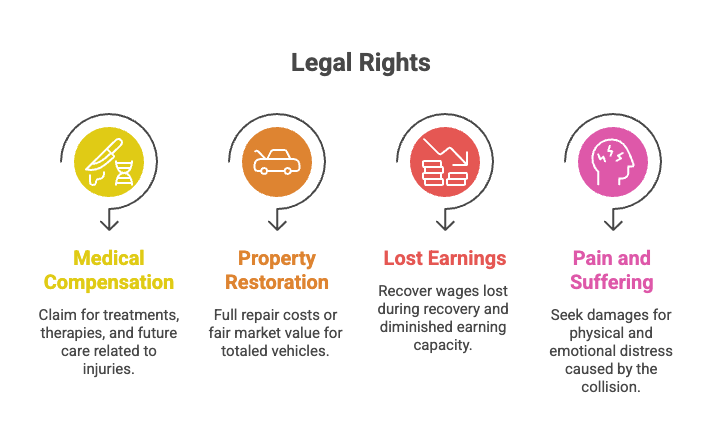
- Right to Medical Compensation – We can claim for all necessary treatments, therapies, and future care related to injuries.
- Right to Property Restoration – We’re entitled to full repair costs or fair market value for totaled vehicles.
- Right to Lost Earnings – We may recover wages lost during recovery and any diminished earning capacity.
- Right to Pain and Suffering – We can seek damages for physical and emotional distress caused by the collision.
Steps to Take After a Jacksonville Failure To Yield Accident
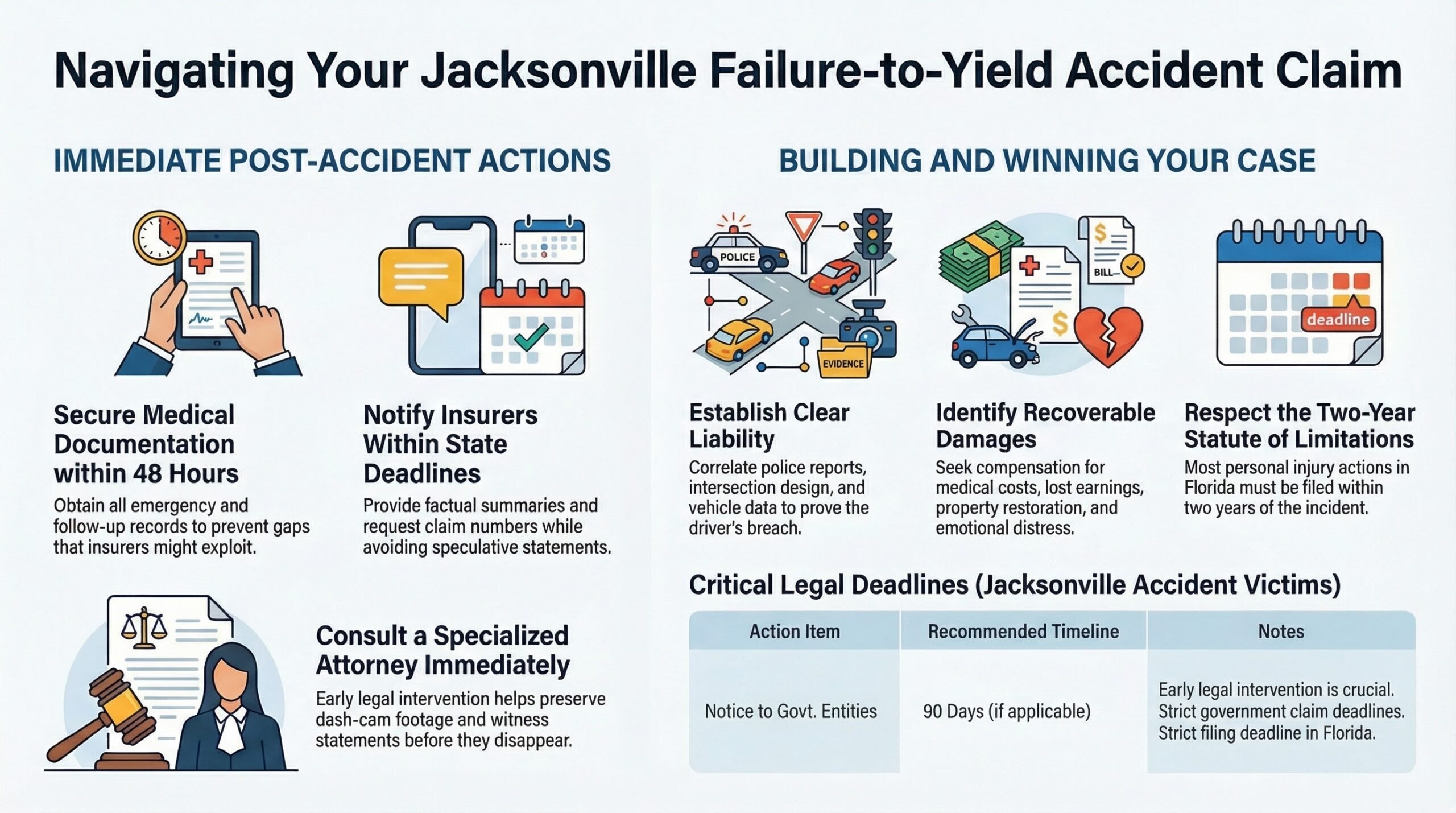
We should first secure thorough medical documentation to substantiate any injuries and treatment costs.
Next, we must promptly notify our insurance providers so the claim process can begin without delay.
Finally, consulting a focused attorney will help us protect our rights and navigate the intricacies of a failure‑to‑yield case.
Secure Medical Documentation
Following a Jacksonville failure‑to‑yield accident, securing thorough medical documentation should be among the first actions we take, as it forms the backbone of any credible personal‑injury claim.
We begin by obtaining every medical record related to the incident, from emergency‑room notes to follow‑up visits, ensuring each entry reflects symptoms, diagnoses, and treatments.
We then complete release forms authorizing providers to share these records with our legal team, enabling us to compile an exhaustive file.
Promptly requesting copies prevents gaps that insurers might exploit.
We also keep a chronological log of appointments, prescriptions, and therapy sessions, noting dates, providers, and outcomes.
This disciplined approach safeguards the evidence we need to demonstrate the accident’s impact and to advocate effectively for our clients.
Notify Insurance Providers
After a Jacksonville failure‑to‑yield accident, promptly notifying the involved insurance providers is essential to protect our clients’ rights and preserve the integrity of their claims.
We should gather the police report, photographs, and witness statements, then call each insurer within the state‑mandated claim deadlines.
During the call, we confirm the policy limits, provide a concise factual summary, and request a claim number for reference.
Written follow‑up, via email or certified mail, reinforces the verbal report and creates a documented trail.
We advise clients to keep copies of all correspondence and to avoid speculative statements that could jeopardize coverage.
By acting swiftly and accurately, we safeguard the client’s entitlement to full compensation while maintaining compliance with procedural requirements.
Consult a Specialized Attorney
When a Jacksonville failure‑to‑yield accident occurs, consulting a focused attorney should be one of the first actions we take.
We begin by gathering all accident documentation and then schedule a meeting with a specialized attorney who understands the nuances of traffic law.
The attorney will assess liability, advise on immediate steps, and coordinate medical referrals to guarantee proper treatment documentation.
We discuss fee structures early, clarifying contingency rates, retainer options, and any additional costs, so we can make informed decisions without surprise.
Throughout the process, the attorney advocates on our behalf, negotiating with insurers and protecting our rights.
By acting promptly and partnering with a qualified professional, we safeguard our recovery and support others who may face similar challenges.
How a Jacksonville Failure To Yield Accident Lawyer Can Help You
Handling a Jacksonville failure‑to‑yield accident can be overwhelming, but we’re here to guide you through each legal step.
We assess the scene, gather evidence, and apply driver education principles and intersection design analysis to strengthen your claim.
Our team works collaboratively to ensure your rights are protected as we pursue fair compensation.
- Document the incident – promptly collect photos, witness statements, and police reports.
- Analyze liability – evaluate how driver education gaps and flawed intersection design contributed to the crash.
- Negotiate with insurers – leverage our know‑how to secure a settlement that reflects medical costs, lost wages, and pain.
- Prepare for trial if needed – develop a compelling case strategy and present clear, factual evidence to a judge or jury.
We prioritize serving those affected, offering transparent communication and diligent advocacy. By combining legal skill with a commitment to public safety, we aim to reduce future failures and support your recovery.
Long-Term Effects of Jacksonville Failure To Yield Accident Injuries
We recognize that chronic pain often persists long after the initial collision, requiring ongoing management strategies that can remedy daily routines.
Over time, many victims experience reduced mobility, which may limit their ability to work, exercise, or perform routine tasks.
Additionally, the emotional strain and cognitive challenges that accompany these injuries can undermine mental health and overall quality of life.
Chronic Pain Management
Managing chronic pain after a Jacksonville failure‑to‑yield accident demands a thorough, evidence‑based approach that addresses both physical and psychological dimensions of injury.
We emphasize pain neuroscience to explain how neural pathways become sensitized, guiding patients toward strategies that modulate central sensitization.
Incorporating sleep hygiene is crucial, as restorative sleep reduces inflammatory markers and improves pain thresholds.
We advise consistent sleep schedules, limiting screen exposure before bedtime, and creating a cool, dark environment to enhance deep‑stage sleep.
Multimodal therapy—combining physical therapy, cognitive‑behavioral techniques, and appropriate pharmacology—provides balanced relief while preserving function.
By educating clients on these principles, we empower them to manage discomfort responsibly and sustain their capacity to serve others effectively.
Mobility Limitations Over Time
Although many victims initially regain basic function after a Jacksonville failure‑to‑yield accident, we often observe a gradual decline in mobility as chronic joint stress, muscle weakness, and scar tissue develop over months and years.
Over time, age-related changes compound these effects, reducing the range of motion and increasing reliance on assistive devices such as canes, braces, or walkers.
We observe that patients who engage in targeted physical therapy early can mitigate some of the loss, yet the cumulative impact of lingering inflammation often necessitates adaptive strategies.
Emotional and Cognitive Impact
When mobility declines after a Jacksonville failure‑to‑yield accident, the emotional toll often follows, manifesting as anxiety, depression, and diminished confidence in daily activities.
We recognize that these feelings can erode our capacity to support others, yet we can restore emotional resilience through structured support and targeted interventions.
Cognitive therapy offers a systematic approach to reframing negative thought patterns, helping us regain focus and clarity in decision-making.
By engaging in regular counseling sessions, we learn coping strategies that mitigate panic and foster a sense of control.
This process not only improves personal well‑being but also enhances our ability to serve family, friends, and clients with renewed patience and empathy.
Ultimately, sustained effort in mental health care restores both confidence and competence.
Proving Liability in Jacksonville Failure To Yield Accident Car Accident Cases
Establishing liability in Jacksonville failure‑to‑yield accidents requires us to demonstrate that the driver who failed to yield breached a specific traffic duty and that this breach directly caused the collision.
We begin by examining the intersection design, noting any signage, lane markings, or signal timing that clarifies right‑of‑way expectations.
When the layout is clear, a breach becomes easier to prove.
Next, we assess witness credibility, gathering statements from passengers, nearby motorists, and pedestrians who observed the event.
Consistent, detailed accounts strengthen our case, while discrepancies may undermine it.
We also collect police reports, dash‑cam footage, and vehicle data that reveal speed, braking, and steering inputs.
By correlating these elements, we establish a causal link between the violator’s failure to yield and the resulting damages.
This methodical approach guarantees we present a compelling, evidence‑based argument that upholds our commitment to serving victims and securing rightful compensation.
Dealing With Insurance Companies After a Jacksonville Failure To Yield Accident
If you’ve been injured in a Jacksonville failure‑to‑yield accident, steering the insurance landscape can be intimidating, but we’ll guide you through each step to protect your rights and maximize compensation.
First, we recommend documenting every conversation with the insurer, noting dates, representatives, and key points.
When the adjuster initiates policy negotiation, we advise staying calm and presenting clear evidence of damages, medical expenses, and lost wages.
This approach helps keep the dialogue factual and reduces the risk of lowball offers.
We also stress the importance of adhering to claim timelines; most policies impose strict deadlines for filing and responding to requests for information.
Missing these windows can jeopardize your ability to recover full compensation.
What to Expect During a Jacksonville Failure To Yield Accident Claim Process
We begin by filing the initial claim and gathering all relevant evidence, such as police reports, photos, and witness statements, to build a solid foundation for your case.
Next, we outline negotiation strategies that aim to secure a fair settlement while keeping the process transparent and efficient.
Finally, we set realistic expectations for the litigation timeline, explaining each phase from discovery to trial, so you know what to anticipate at every step.
Initial Claim Filing
When you initiate a Jacksonville failure‑to‑yield accident claim, we’ll first gather all essential documentation, including police reports, medical records, and witness statements, to establish a clear factual foundation.
Next, we assess nuances of the statute that affect liability and compensation, ensuring our approach aligns with Florida’s comparative‑fault rules.
We then prepare the claim filing, carefully noting claim deadlines that vary by insurer and jurisdiction, so no filing window closes prematurely.
Our team drafts a concise demand letter that outlines injuries, expenses, and lost earnings, while referencing supporting evidence to substantiate each element.
Throughout this stage, we keep you informed of procedural milestones, allowing you to focus on recovery while we steer the legal intricacies with precision and accountability.
Evidence Collection Tips
During a Jacksonville failure‑to‑yield accident claim, we’ll guide you through a systematic evidence‑collection process that begins with securing the police report, which often contains the officer’s initial assessment of fault and a timeline of events.
Next, we recommend obtaining witness statements promptly; their recollections can corroborate the report and fill gaps in the narrative.
We also emphasize photo documentation of vehicle damage, road conditions, and any visible injuries, as visual records strengthen credibility.
Preserve medical records and repair estimates, and make certain that all electronic communications related to the incident are saved.
Negotiation Strategies Overview
Our evidence‑collection steps lay the groundwork for a structured negotiation, and once the file is complete, we shift focus to the settlement phase.
We begin by reviewing the claim file together, identifying pivotal damages, liability factors, and supporting documentation that strengthen our position.
Then we outline Settlement tactics that balance fair compensation with the client’s long‑term wellbeing, emphasizing realistic offers and phased payment options.
Simultaneously, we conduct Mediation prep, rehearse arguments, anticipate counter‑offers, and establish clear communication protocols.
Throughout the process, we keep the client informed and invite their input on priorities and risk tolerance.
This collaborative approach ensures that every decision reflects both legal strategy and the client’s commitment to serving others responsibly.
Litigation Timeline Expectations
If you file a Jacksonville failure‑to‑yield claim, the litigation timeline typically unfolds in three distinct phases: initial pleadings, discovery, and trial preparation.
We begin by drafting and filing the complaint, then the defendant responds with an answer or motion, which sets the case’s early schedule.
During discovery, we exchange documents, take depositions, and gather expert testimony, allowing both sides to assess the strengths and weaknesses of the claim.
As we move to trial preparation, we file pre‑trial motions, organize evidence, and develop arguments, while also monitoring post‑trial deadlines that may affect settlement or judgment enforcement.
Should the verdict be unfavorable, we evaluate appeal options, ensuring that every procedural avenue is considered to protect our clients’ rights and interests.
Compensation for Jacksonville Failure To Yield Accident Damages
When a driver fails to yield in Jacksonville and causes an accident, we must assess the full scope of damages to determine appropriate compensation.
Our team evaluates medical expenses, property loss, lost wages, and future earning capacity, ensuring each element reflects the plaintiff’s actual burden.
We also consider comparative settlements, which allow parties to negotiate a fair amount based on liability percentages, often resulting in quicker, less contentious resolutions.
In cases where negotiations stall, we prepare for jury verdicts that can award substantial sums when fault is clear and damages are well documented.
Economic vs Non-Economic Damages in Jacksonville Failure To Yield Accident Cases
We’ll first outline the economic impact, covering medical bills, lost wages, and property damage, then identify non‑economic harms such as pain, emotional distress, and loss of enjoyment of life.
Next, we’ll explain how courts weigh these factors, including the severity of the injury, the duration of recovery, and the plaintiff’s earning capacity.
Economic Impact Overview
Evaluating the economic impact of a Jacksonville failure‑to‑yield accident requires distinguishing between measurable financial losses and the broader, non‑economic harms that victims endure.
We calculate medical expenses, lost wages, and property damage to quantify direct costs, then assess how these figures affect economic recovery for families and local businesses.
By aggregating individual losses, we reveal patterns that influence community resilience, highlighting the need for coordinated support services and efficient claim processing.
Our analysis also considers insurance premiums, legal fees, and rehabilitation expenses, which collectively shape the fiscal landscape of affected neighborhoods.
Understanding these components enables us to advise stakeholders on resource allocation, policy development, and preventive measures to strengthen Jacksonville’s overall economic health.
Non‑Economic Harm Types
Although the financial losses from a Jacksonville failure‑to‑yield accident are readily quantifiable, the non‑economic harms—such as pain and suffering, emotional distress, and loss of enjoyment of life—require a different evaluative approach.
We recognize that these impacts erode a victim’s quality of life and can create a profound loss of consortium for families.
In our practice, we assess how persistent pain limits daily activities, how anxiety and depression affect mental health, and how diminished social interaction reduces overall happiness.
We also consider the spouse’s altered relationship dynamics and the caregiver’s increased burden.
Compensation Calculation Factors
Determining compensation in a Jacksonville failure‑to‑yield accident requires separating economic from non‑economic damages and applying distinct calculation methods to each category.
We first conduct a damage apportionment, quantifying medical bills, property repair costs, and lost wages, and estimating future earnings.
This approach guarantees that the economic portion reflects both current and projected financial impact.
For non‑economic damages, we evaluate pain, suffering, emotional distress, and loss of enjoyment, using statutory multipliers or per‑injury rates that align with local precedent.
We then combine the two totals, adjusting for comparative negligence where applicable.
Our method prioritizes fairness and transparency, enabling victims to receive compensation that truly reflects their total loss and supports their long‑term recovery.
When a Jacksonville Failure To Yield Accident Case Goes to Trial vs Settlement
When a Jacksonville failure‑to‑yield accident case proceeds to trial rather than settling, we must first assess the strategic implications of each path.
In trial, our trial strategies focus on presenting compelling evidence, cross‑examining witnesses, and persuading a jury of liability and damages.
We allocate resources to expert testimony, detailed discovery, and persuasive opening statements, knowing that a verdict can exceed settlement offers but also carries risk.
Conversely, settlement dynamics prioritize negotiation leverage, timely resolution, and cost control.
We evaluate the plaintiff’s medical costs, insurance limits, and the defendant’s willingness to compromise, aiming to secure a fair recovery without the uncertainty of a courtroom.
Both routes demand careful cost‑benefit analysis; we weigh the client’s desire for swift closure against the potential for higher compensation through trial.
Ultimately, our recommendation aligns with the client’s priorities, risk tolerance, and the strength of the case.
The Statute of Limitations for Jacksonville Failure To Yield Accident Cases
If you’re pursuing a Jacksonville failure‑to‑yield accident claim, we must act promptly because Florida law imposes a two‑year statute of limitations on personal injury actions.
We consequently begin by acknowledging the nuances of the statute that can affect timing, including the date of injury, the date a claim is filed, and any tolling events that may extend the deadline.
Understanding filing exceptions is vital; for example, if the injured party is a minor or incapacitated, the limitation period may be tolled until the disability ends.
Likewise, claims against government entities often require a notice of intent within 90 days, creating a separate filing deadline that can impact the overall timeline.
By recognizing these nuances and exceptions early, we can protect the client’s right to recovery and avoid dismissal for untimeliness.
Our proactive approach guarantees that all procedural requirements are met, preserving the strength of the case for those we serve.
When to Contact a Jacksonville Failure To Yield Accident Lawyer After a Jacksonville Failure To Yield Accident
Having clarified the statutory deadlines, we now turn to the timing of legal representation.
In the post‑accident timing window, the sooner we engage an attorney consultation, the better we can preserve evidence, secure witness statements, and protect your rights.
We recommend contacting a Jacksonville Failure To Yield Accident Lawyer within 24 to 48 hours after the incident, before insurers begin their investigations and before essential details fade.
Early involvement allows us to assess liability, evaluate damages, and advise on medical documentation, ensuring a thorough case strategy.
If you experience delayed symptoms or discover hidden injuries, schedule a follow‑up attorney consultation promptly, as medical evidence can emerge weeks later.
Our proactive approach safeguards your claim, aligns with procedural requirements, and maximizes recovery potential.
By acting promptly, we demonstrate our commitment to serving your best interests as we navigate the intricacies of Jacksonville traffic law.
Why You Need an Experienced Jacksonville Failure To Yield Accident Lawyer
Because Jacksonville traffic laws are complex and insurance companies aggressively defend their interests, we must rely on an attorney who truly understands the nuances of failure‑to‑yield cases.
Our experience shows that nuances of the statute often determine liability, and a seasoned lawyer can interpret them to protect our clients’ rights.
We conduct thorough client interviews to gather facts, assess damages, and identify overlooked evidence that insurers may ignore.
By translating legal language into clear guidance, we empower victims to make informed decisions and pursue fair compensation.
An experienced attorney also anticipates procedural hurdles, files timely motions, and negotiates with adjusters who aim to minimize payouts.
Our commitment to serving others drives us to prioritize transparency, diligence, and strategic advocacy throughout the case.
Ultimately, partnering with a knowledgeable Jacksonville Failure To Yield Accident Lawyer guarantees that every legal avenue is explored and that justice is pursued with rigor and integrity.
How to Choose the Right Jacksonville Failure To Yield Accident Lawyer for Your Case
When selecting a Jacksonville failure‑to‑yield accident lawyer, we must evaluate both proficiency and track record to guarantee our case receives the strongest possible representation.
Evaluate proficiency and track record to ensure the strongest possible representation.
We begin by reviewing each attorney’s experience handling similar collisions, noting settlement amounts and trial outcomes.
Next, we schedule client interviews to assess communication style, empathy, and commitment to serving our interests.
During these meetings, we ask about legal fees to ensure the fee structure—whether contingency, hourly, or hybrid—aligns with our budget and expectations.
We also verify that the lawyer’s firm maintains transparent billing practices and provides written fee agreements.
Additionally, we check professional credentials, bar affiliations, and peer reviews to confirm credibility.
Finally, we compare how each candidate’s approach matches our desire to help others while protecting our rights.
By systematically weighing know-how, interview impressions, and fee transparency, we secure the most qualified advocate for our case.
About The Law Offices of Anidjar & Levine
The Law Offices of Anidjar & Levine have built a reputation for delivering results in personal injury and traffic law cases throughout Jacksonville.
We emphasize that our firm’s history reflects a steady commitment to advocacy, beginning with a modest practice that expanded through disciplined casework and community trust.
Our team collaborates closely with each client, ensuring that every strategy aligns with their needs and the broader goal of serving others.
Client testimonials consistently highlight our responsiveness, transparency, and tenacity in negotiations and courtroom proceedings.
By maintaining rigorous standards, we protect client rights while fostering a culture of mutual respect and accountability.
We recognize that personal injury matters demand both legal proficiency and compassionate guidance, so we prioritize clear communication and realistic expectations.
Our collective experience equips us to steer through intricate statutes and precedents, delivering outcomes that uphold justice and reinforce the confidence our clients place in us.
Frequently Asked Questions
Can I Claim for Emotional Distress After a Failure‑To‑Yield Crash?
Yes, you can claim emotional distress after a failure‑to‑yield crash.
We’ll demonstrate that the accident caused you mental anguish and that you incurred therapy costs directly linked to the incident.
Our approach includes gathering medical records, therapist statements, and evidence of how the crash disrupted your daily life.
By establishing a clear causal connection, we strengthen your claim for compensatory damages, ensuring you receive full restitution for the psychological impact.
Do I Need a Police Report to File a Claim?
We recommend obtaining police documentation before you start the claims process because most insurers and courts consider it vital evidence.
While you can sometimes file a claim without a report, lacking it may delay settlement or reduce compensation.
We’ll help you promptly request the report, verify its accuracy, and integrate it into your claim file, ensuring that all necessary details support your case and protect your rights.
Will My Claim Affect My Car Insurance Rates?
We’ll tell you that filing a claim can affect your insurance premiums, and a rate increase is possible.
We advise you to review your policy’s details, because many insurers consider claim frequency and severity when adjusting rates.
We recommend maintaining a clean driving record and exploring discounts to mitigate potential hikes.
We also suggest communicating with your adjuster promptly, providing accurate documentation to support a fair assessment of liability and costs.
Can I Sue a Government Agency for a Faulty Traffic Signal?
We can tell you that suing a government agency for a faulty traffic signal is possible, but it hinges on the agency’s sovereign immunity and whether it has waived that protection for negligence in signal maintenance.
We advise reviewing the jurisdiction’s statutes and any contractual obligations that might limit liability.
If the agency failed to uphold reasonable maintenance standards, you may pursue a claim, though procedural hurdles and notice requirements often apply.
Are There Caps on Damages for Wrongful Death in These Cases?
We can confirm that statutory limits often cap damages in wrongful‑death claims, but the exact amount varies by jurisdiction and the nature of the loss.
In many states, survivors may pursue survival actions to recover compensation for the decedent’s lost earnings, medical expenses, and pain before death, which are subject to those same statutory caps.
We advise reviewing local statutes and consulting counsel to determine the precise limits applicable to your case.
—————————
The Law Offices of Anidjar and Levine stands ready to protect your rights and secure the compensation you merit after a Jacksonville failure-to-yield accident.
Our proficiency in steering intricate liability issues, combined with a relentless commitment to client advocacy, guarantees that every facet of your claim is meticulously handled.
By partnering with us, you benefit from seasoned legal strategy, thorough investigation, and decisive negotiation, positioning you for the most favorable outcome possible.
For more information, visit our Jacksonville Car Accident Lawyer.