
The Law Offices of Anidjar and Levine, a Daytona Beach truck accident spinal cord lawyer, investigates liability, preserves driver, cargo, maintenance, and electronic records, and coordinates medical evidence to establish causation and long-term impairment.
Legal counsel may pursue compensation for emergency treatment, rehabilitation, lost income, reduced earning capacity, home modifications, and ongoing assistance.
A claim may involve trucking companies, insurers, and uninsured or underinsured motorist benefits.
For related legal guidance, visit the Daytona Beach Truck Accident Lawyer page.
Prompt legal guidance may also help protect deadlines and limit insurer communications.
Main Takeaways
- A Daytona Beach truck accident spinal cord lawyer can investigate liability, preserve evidence, and identify all potentially responsible parties.
- Evidence may include crash reports, vehicle data, electronic logs, witness statements, surveillance footage, medical records, and expert testimony.
- Compensation claims may address emergency treatment, rehabilitation, lost income, reduced earning capacity, home modifications, and ongoing personal assistance.
- An attorney can evaluate insurer offers, pursue uninsured or underinsured motorist benefits, and manage settlement negotiations on your behalf.
- Prompt legal guidance helps protect evidence, address Florida deadlines, and develop a claim reflecting long-term mobility and independence needs.


How We Can Help With Your Daytona Beach Truck Accident Spinal Cord Injury Claim
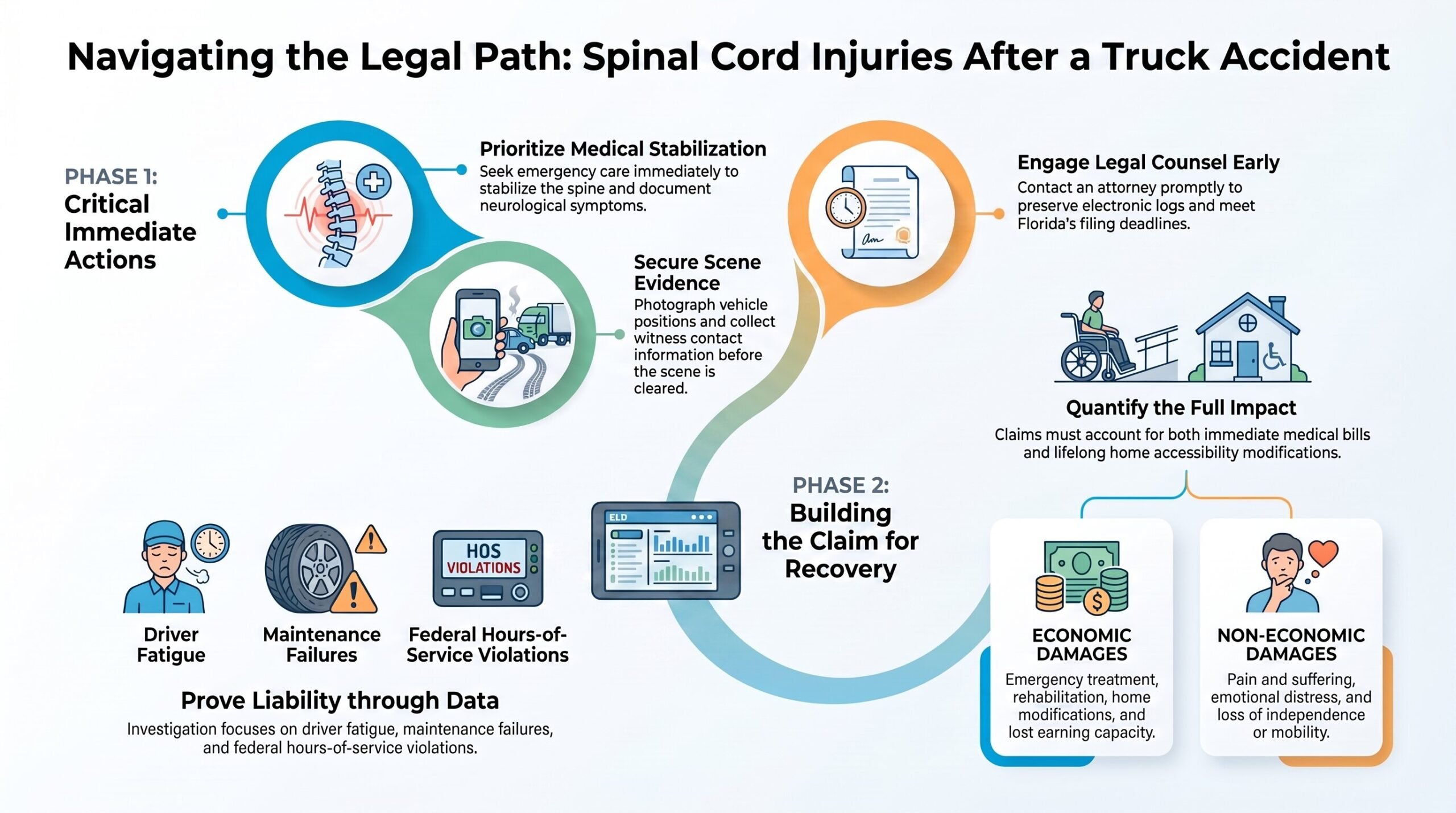
When a truck collision causes a spinal cord injury, qualified legal assistance can help protect the injured person’s rights and pursue appropriate compensation. A legal team can organize medical records, employment information, accident documentation, and other evidence relevant to the claim. This preparation supports Proving Damages, including emergency care, rehabilitation, lost income, reduced earning capacity, home modifications, and ongoing personal assistance.
Counsel can also communicate with insurers and manage Insurance Negotiations on the injured person’s behalf. By reviewing policy provisions, liability evidence, medical opinions, and projected future needs, the team can evaluate whether a settlement reflects the injury’s full impact. Attorneys may identify additional responsible parties, preserve important evidence, and address procedural deadlines that could affect recovery.
Throughout the process, legal representatives can provide clear updates, coordinate with medical and financial professionals, and pursue a resolution suited to the client’s circumstances. Their assistance allows the injured person and family to focus on treatment, stability, and long-term planning while the claim receives diligent attention.
OUR CONSULTATIONSARE FREE
START YOUR FREE CASE REVIEW

Understanding Daytona Beach Truck Accident Spinal Cord Injury Cases
Daytona Beach truck accident spinal cord injury cases often involve complex questions of liability, medical causation, and long-term damages. A legal evaluation typically examines how the collision occurred, whether applicable safety duties were breached, and how the injury affects mobility, independence, employment, and daily care. Evidence may include crash reports, vehicle data, witness accounts, medical records, diagnostic studies, and testimony from rehabilitation or life-care professionals.
Spinal cord harm can range from temporary impairment to permanent paralysis, with symptoms developing or changing after the initial trauma. Establishing causation requires connecting the truck accident to the diagnosed condition while addressing prior injuries and other potential explanations. Comparable issues may arise in a Motorcycle collision or cases involving pedestrian impacts, although the evidence and injury dynamics differ.
A careful case assessment also considers future treatment, assistive equipment, home modifications, lost earning capacity, and non-economic losses. Clear documentation helps protect accurate compensation and supports informed decisions throughout the legal process.
Common Causes of Daytona Beach Truck Accident Spinal Cord
Common causes of truck accidents resulting in spinal cord injuries include driver fatigue or distraction, speeding, and other reckless driving behaviors. Improper truck maintenance can contribute to mechanical failures, while overloaded or unsecured cargo may affect vehicle control and create additional hazards. Identifying the contributing cause is often important when evaluating liability and potential compensation.
Driver Fatigue and Distraction
Driver fatigue and distraction are significant contributors to commercial truck crashes that can cause spinal cord injuries in Daytona Beach. Extended shifts, insufficient rest, electronic devices, dispatch communications, and in-cab activities can reduce reaction time and impair judgment. Federal hours-of-service requirements address fatigue, but violations may occur when schedules, paperwork, or operational pressures encourage drivers to continue working while impaired.
Investigators may examine logbooks, electronic logging data, cellphone records, surveillance footage, and employer policies to determine whether preventable inattention contributed to a collision. Following a spinal cord injury, prompt medical care and documented treatment help establish the recovery timeline and future support needs. Legal representatives may also assess insurer conduct, including Insurance denial strategies, to protect access to benefits and preserve evidence needed for the injured person and family.
Speeding and Reckless Driving
Excessive speed and reckless driving can make a commercial truck collision more severe and increase the risk of spinal cord injury in Daytona Beach. A speeding truck requires greater distance to stop and produces stronger impact forces, potentially causing catastrophic harm to occupants and other road users. Unsafe lane changes, tailgating, aggressive passing, and failure to yield may further reduce reaction time and increase collision risks.
Drivers who disregard weather-related factors, including heavy rain, standing water, or reduced visibility, may lose control or fail to adjust speed appropriately. Traffic signal mistakes, such as running red lights or misreading changing signals, can create dangerous intersections. Identifying these behaviors may help injured individuals and their families understand how negligence contributed to the crash and pursue appropriate support and accountability.
Improper Truck Maintenance
Improper truck maintenance can also contribute to spinal cord injuries in Daytona Beach collisions, even when a driver’s speed and conduct appear appropriate. Brake system failures may prevent a truck from stopping or maintaining control, increasing the force of an impact with nearby vehicles. Worn brake components, leaking lines, or neglected inspections can create hazards that should have been identified and corrected before operation.
Similarly, tire blowouts may cause sudden swerving, loss of stability, or debris across active traffic lanes. These failures can result from inadequate maintenance, defective replacement parts, or pressure checks that were not performed as required. Maintenance records, inspection reports, repair invoices, and vehicle evidence may help clarify whether preventable neglect contributed to the collision. Careful investigation can support injured individuals seeking accountability and necessary assistance.
Overloaded or Unsecured Cargo
When cargo is overloaded or inadequately secured, a Daytona Beach truck may become difficult to control and create severe collision risks for surrounding motorists. Excessive Cargo Weight can affect braking, guidance, and stability, particularly during sudden turns or emergency stops. Shifting materials may cause a trailer to sway, increasing the possibility of a rollover or jackknife crash. Improper Securing Methods can also allow equipment, building materials, or other objects to fall onto nearby vehicles, creating immediate hazards for drivers and passengers.
Trucking companies and drivers have a responsibility to inspect loads, follow applicable weight limits, and use appropriate restraints before departure. When these duties are neglected, resulting spinal cord injuries may require extensive treatment, rehabilitation, and ongoing support. Legal review can help identify responsible parties and protect affected individuals.
Don’t Wait. Call Our Daytona Beach Truck Accident Lawyers Now.


Legal Rights of Daytona Beach Truck Accident Spinal Cord Injury Victims
Daytona Beach truck accident victims who suffer spinal cord injuries may have the legal right to pursue compensation from parties whose negligence caused or contributed to the collision. A claim may address immediate treatment, ongoing rehabilitation, lost income, reduced earning capacity, necessary equipment, and pain-related harm. An attorney can protect those rights while coordinating with medical professionals and family caregivers.
Potential legal protections include:
- Filing a personal injury claim within Florida’s applicable deadline.
- Identifying responsible parties and available insurance coverage.
- Seeking payment for past and anticipated medical expenses.
- Challenging an insurance claim denial through evidence and negotiation.
- Supporting damages with medical records retrieval, employment documentation, and expert opinions.
Victims may also have rights involving uninsured or underinsured motorist benefits, depending on applicable policies. Prompt legal guidance can preserve evidence, manage insurer communications, and prevent procedural mistakes. A qualified lawyer may provide a structured process that respects the victim’s circumstances and helps family members pursue fair compensation without unnecessary confrontation. Each case requires individualized evaluation of liability, damages, and available remedies.
Why Do Daytona Beach Truck Accident Spinal Cord Injuries Happen?
Spinal cord injuries in truck crashes often result from the extreme force generated by a commercial vehicle’s size, weight, and momentum. A tractor-trailer may crush a passenger vehicle, causing direct trauma, compression, or displacement of the spine. Rollover collisions, jackknifing, underride crashes, and cargo shifts can create additional forces that damage vertebrae and surrounding nerve tissue. Some injuries occur when occupants are thrown against interior surfaces or ejected during impact.
Driver fatigue, distraction, impaired driving, excessive speed, inadequate training, and unsafe following distances may increase collision risks. Mechanical failures, including defective brakes, worn tires, guidance problems, or improperly secured loads, can also contribute. A thorough Truck accident investigation may examine maintenance records, inspection reports, driver logs, surveillance footage, event data, and cargo documentation to identify contributing factors. Resulting spinal injury symptoms may include paralysis, weakness, numbness, severe back pain, impaired coordination, and loss of bladder or bowel control. Severity depends on the injury’s location and extent.
Don’t Wait. Call Our Daytona Beach Truck Accident Lawyers Now.
What Should You Do After a Daytona Beach Truck Accident Spinal Cord Injury?
After a Daytona Beach truck accident causes a suspected spinal cord injury, the individual should seek immediate medical care, even if symptoms initially appear minor. Accident details, medical records, photographs, witness information, and related expenses should be documented carefully. Contacting a truck accident lawyer can help protect legal rights and support an informed evaluation of potential compensation.
Seek Immediate Medical Care
Prompt medical evaluation is important when a truck collision may have caused a spinal cord injury, even if symptoms initially appear mild or absent. Affected individuals should remain still, avoid twisting or standing, and await emergency responders unless immediate danger requires movement. Paramedics can stabilize the spine, assess neurological function, and arrange transportation to an appropriate hospital.
An Emergency symptom checklist should include numbness, weakness, loss of coordination, severe neck or back pain, difficulty breathing, and changes in bladder or bowel control. Medical staff should receive a complete account of symptoms, medications, and relevant health conditions. Prompt care may limit complications and establish a clear clinical record. Following medical instructions, attending recommended follow-up appointments, and preserving injury evidence through healthcare documentation can support recovery and future care decisions.
Document The Accident
Once emergency medical care has been arranged, documenting the Daytona Beach truck accident can help preserve facts relevant to the injury and its cause. If physically able, the injured person or a trusted companion should photograph vehicle positions, roadway conditions, traffic signals, visible damage, and surrounding landmarks. Images should be taken from multiple angles without interfering with responders or evidence.
Names and contact information for eyewitnesses can support reliable Witness statements, particularly when memories may change. Any available dashcam footage, nearby business recordings, or mobile-phone videos should be identified and preserved promptly. A written account can record the time, location, weather, sequence of events, symptoms, and statements made at the scene. Medical records, discharge instructions, and related receipts should also be retained in an organized file for future reference.
Contact A Truck Accident Lawyer
When should legal counsel be contacted after a Daytona Beach truck accident spinal cord injury? A qualified truck accident lawyer should be contacted as soon as practical, preferably before statements are provided to insurers or evidence is lost. Early representation can support Evidence preservation, including vehicle data, driver records, photographs, witness accounts, and available surveillance footage. Counsel may also review insurance paperwork, identify applicable commercial policies, and communicate with adjusters while protecting the injured person’s interests.
Medical documentation is equally important because treatment records, diagnostic results, rehabilitation plans, and physician opinions can establish the injury’s seriousness and anticipated needs. A lawyer can coordinate these materials, investigate potential negligence, and pursue compensation for medical care, lost income, accessibility modifications, and future support. Prompt legal guidance also helps families make informed decisions while focusing on recovery and service to others.
Don’t Wait. Call Our Daytona Beach Truck Accident Lawyers Now.
Critical Evidence in a Daytona Beach Truck Accident Spinal Cord Injury Case
Establishing a spinal cord injury claim requires reliable evidence connecting the truck accident to the resulting harm and financial losses.
Essential sources may include:
- Accident scene documentation, including photographs, traffic records, and witness statements
- Truck driver records, such as logs, inspection reports, and electronic data
- Medical evidence documenting diagnosis, treatment, prognosis, and limitations
- Expert testimony addressing crash mechanics, liability, and long-term impairment
- Employment and financial records supporting lost income and future damages
A Daytona Beach truck accident spinal cord lawyer can assess, preserve, and present this evidence to support the injured person’s claim.
Accident Scene Documentation
Accident scene documentation can preserve critical evidence in a Daytona Beach truck accident involving spinal cord injuries. Photographs and video should capture vehicle positions, roadway conditions, traffic controls, debris, skid marks, lighting, and visible injuries before the scene changes. Images should include wide views and detailed perspectives, with dates and locations preserved when possible. Body language and immediate reactions may help convey pain, confusion, or limited movement, although medical professionals should evaluate injuries.
Independent witness statements can clarify the sequence of events and identify conditions that physical evidence does not show. Audio recordings, when lawfully obtained, may preserve spontaneous observations or statements. GPS data from devices or vehicles may help establish locations and timing. Prompt, respectful collection of this evidence supports accurate evaluation and service to injured individuals.
Truck Driver Records
Truck driver records may provide important evidence about the events leading to a Daytona Beach truck accident involving a spinal cord injury. These materials can include employment files, training documentation, licensing information, disciplinary history, and required Florida trucking background checks. They may reveal whether a carrier hired or retained a driver despite warning signs involving experience, qualifications, or prior safety violations.
Electronic logging data, dispatch messages, inspection reports, and hours-of-service records can help establish the driver’s activities before the collision. Investigators may identify driver log violations, fatigue indicators, missed rest periods, or pressure from a trucking company to meet unrealistic schedules. Maintenance and safety records can also clarify whether the carrier monitored compliance and responded to known risks. Preserving these records promptly helps protect accountability and supports a fair evaluation of the injured person’s claim.
Medical Evidence
Medical evidence is central to evaluating a spinal cord injury claim arising from a Daytona Beach truck accident. Emergency department notes, physician examinations, and treatment records can document symptoms, functional limitations, and the progression of impairment. Diagnostic imaging records, including magnetic resonance imaging and computed tomography scans, may reveal fractures, compression, swelling, or other damage affecting the spinal cord and surrounding structures.
These materials also help distinguish injuries caused by the collision from preexisting conditions or later complications. Spinal injury timelines should identify when pain, weakness, numbness, paralysis, and related limitations first appeared, how they developed, and which treatments followed. Rehabilitation records, medication histories, and surgical documentation can further establish the injury’s continuing impact. Organized medical evidence supports accurate claim evaluation and helps protect the injured person’s access to necessary care.
Expert Testimony
When the extent of a spinal cord injury is disputed, expert testimony can clarify how the collision caused the impairment and how the condition may affect the injured person’s future. Neurologists, neurosurgeons, rehabilitation experts, and life-care planners may explain diagnostic findings, treatment requirements, functional limitations, and anticipated costs. Accident reconstruction experts can connect vehicle forces, roadway conditions, and occupant movement to the reported injury, while vocational professionals may address diminished earning capacity.
Counsel typically coordinates this testimony with thorough Document evidence collection, including medical records, imaging, employment information, and trucking data. Early witness statement preservation can also protect accounts before memories change or evidence disappears. Clear, independent opinions help decision-makers distinguish preexisting conditions from trauma-related harm and evaluate the support needed for recovery, accessibility, and long-term care.
Long-Term Effects of Daytona Beach Truck Accident Spinal Cord Injuries
Long-term spinal cord injuries from Daytona Beach truck accidents may cause permanent mobility challenges that affect daily activities, employment, and independence. Ongoing medical treatment, rehabilitation, assistive equipment, and personal care may remain necessary for years or throughout the injured person’s life. These lasting needs can also create significant emotional and financial strain for the individual and the family.
Permanent Mobility Challenges
Permanent mobility challenges can arise when a Daytona Beach truck accident damages the spinal cord and disrupts the signals controlling movement, balance, and coordination. Depending on the injury’s location and severity, an individual may experience paralysis, weakness, impaired balance, or limited control of the arms and legs. These limitations can affect walking, transfers, driving, employment, and participation in community activities. Wheelchairs, walkers, braces, and other devices may support safer movement, while careful Assistive technology planning can help match equipment to changing functional needs.
Home accessibility modifications, such as ramps, widened doorways, roll-in showers, and adjusted countertops, may promote independence and reduce fall risks. Family members and caregivers often provide necessary assistance with daily tasks, transportation, and environmental safety while respecting the individual’s dignity, choices, and long-term goals.
Ongoing Medical Treatment
Following a Daytona Beach truck accident, spinal cord injuries may require ongoing medical treatment to manage symptoms, prevent complications, and preserve functional abilities. Care may include expert evaluations, physical and occupational therapy, medication management, assistive equipment, and procedures addressing pain, muscle spasms, bladder function, or skin protection. Treatment plans often change as a patient’s condition develops, making consistent follow-up vital. Medical providers can coordinate rehabilitation goals and teach caregivers safe techniques that support daily care.
Records should identify diagnoses, recommended services, treatment responses, and future medical needs. Prescription Coverage may depend on insurance terms, prior authorizations, and documented medical necessity. Patients and caregivers should also monitor Documentation Deadlines for referrals, benefit requests, and claim materials. Timely organization helps preserve continuity of care and supports accurate assessment of long-term treatment requirements.
Emotional And Financial Strain
Because spinal cord injuries often alter mobility, independence, employment, and family responsibilities, their effects may extend well beyond immediate medical concerns. Emotional strain can arise from grief, uncertainty, disrupted relationships, and the need to adjust to permanent limitations. Counseling, peer support, and compassionate assistance may help injured individuals and caregivers develop sustainable coping strategies.
Financial pressure may continue through medical equipment, rehabilitation, home modifications, transportation, and lost income. Care Coordination can connect families with appropriate providers, community resources, and disability services while reducing gaps in treatment. Careful financial planning may address current expenses, future support needs, insurance issues, and changes in earning capacity. Documentation of these burdens can help clarify the injury’s long-term consequences. Legal guidance may also assist families in evaluating available compensation and protecting access to necessary care and services.
Proving Liability in Daytona Beach Truck Accident Spinal Cord Injury Cases
Establishing liability in a Daytona Beach truck accident involving spinal cord injuries requires evidence that connects the truck driver’s conduct, the trucking company’s actions, or another responsible party to the collision and resulting harm. A thorough fault investigation may examine driver logs, electronic data, vehicle maintenance records, cargo loading, roadway conditions, and witness accounts. Evidence can reveal speeding, distraction, fatigue, inadequate training, defective equipment, or violations of federal and Florida safety requirements.
Medical documentation must clearly describe the spinal cord injury, treatment, prognosis, limitations, and relationship to the crash. These records help distinguish accident-related harm from prior conditions and demonstrate the extent of necessary care. Investigators may also identify ownership, employment relationships, maintenance responsibilities, and applicable insurance coverage. Preserving photographs, video, physical evidence, and communications is critical because trucking records can change or disappear. With liability and damages supported by reliable evidence, counsel can develop a settlement strategy that seeks accountability and protects the injured person’s long-term interests.
Dealing With Insurance Companies After a Daytona Beach Truck Accident Spinal Cord Injury
After a Daytona Beach truck accident causes a spinal cord injury, insurance companies may seek statements, medical records, and other information that can affect the value of a claim. An injured person may benefit from limiting discussions with adjusters until the extent of the injury, treatment needs, and financial losses are better understood. Early settlement offers may not account for rehabilitation, adaptive equipment, lost earning capacity, or long-term assistance.
A Daytona Beach spinal cord lawyer can review communications, identify disputed issues, and protect the claimant from statements that could be misconstrued. Negotiation strategies may include presenting organized medical documentation, calculating current and anticipated expenses, and addressing liability evidence without exaggeration. Counsel may also evaluate whether an insurer is requesting unnecessary releases or delaying meaningful discussions.
Settlement timelines vary according to medical stability, available records, and the intricacy of coverage. Careful preparation can support informed decisions while preserving the injured person’s ability to pursue fair compensation.
What to Expect During a Daytona Beach Truck Accident Spinal Cord Injury Claim Process
The claim process generally begins with an initial case evaluation, followed by a careful review of medical records and other evidence documenting the spinal cord injury. The parties then assess liability and damages, including medical expenses, lost income, long-term care needs, and related losses. Depending on the evidence and negotiations, the matter may conclude through a settlement or proceed to trial.
Initial Case Evaluation
During an initial case evaluation, a Daytona Beach truck accident spinal cord lawyer reviews the collision, the resulting injuries, available insurance coverage, and the evidence needed to determine whether a viable claim exists. The lawyer typically discusses accident reports, witness accounts, vehicle information, and potential responsible parties, including trucking companies or contractors. Evidence collection may include photographs, electronic records, communications, and documentation concerning safety compliance.
The evaluation also identifies deadlines, claim procedures, and possible obstacles, such as an Insurance denial or disputed responsibility. A lawyer may explain how medical documentation supports the claimed losses without conducting the detailed medical review addressed later. Based on the available facts, counsel can outline a realistic settlement strategy, explain litigation options, and recommend steps that protect the injured person’s interests while supporting a fair resolution.
Medical Evidence Review
Medical evidence review establishes how a spinal cord injury affects the claimant’s health, daily functioning, work capacity, and long-term needs. During this stage, counsel collects emergency records, imaging studies, surgical reports, rehabilitation notes, medication histories, and expert opinions. Each document is examined for consistency, diagnosis, treatment progress, permanency, and the likelihood of future medical requirements. Physicians may explain neurological limitations, pain, mobility restrictions, bladder or bowel complications, and necessary assistive equipment in clear terms.
Functional assessments can show how the injury affects personal care, household tasks, transportation, and employment duties. Attorneys may also arrange independent medical evaluations when clarification is required. This careful process supports impartial liability analysis and helps distinguish injury-related limitations from prior conditions. Witness interviews may provide additional context about observable changes, treatment participation, and everyday challenges.
Liability And Damages
Because a spinal cord injury claim involves both fault and substantial long-term losses, liability and damages must be evaluated in tandem. Investigators may examine driver conduct, vehicle maintenance, loading practices, employer supervision, and compliance with Trucking Regulations. Evidence can include crash reports, electronic logging data, inspection records, witness accounts, and company policies. Responsibility may extend beyond the driver when a carrier, maintenance provider, manufacturer, or other entity contributed to the collision.
Damages assessment addresses medical treatment, rehabilitation, assistive equipment, lost income, reduced earning capacity, and necessary future care. It may also account for home modifications, transportation needs, pain, loss of independence, and the impact on family support. Commercial Insurance policies and coverage limits can affect available resources, while qualified professionals may help project lifelong costs and document the injured person’s needs with accuracy and dignity.
Settlement Or Trial
When a Daytona Beach truck accident causes a spinal cord injury, the claim may resolve through settlement negotiations or proceed to trial if the parties cannot agree on fair compensation. During negotiations, counsel presents medical records, employment evidence, life-care projections, and other documentation establishing liability and long-term losses. The parties evaluate the Settlement vs verdict, considering litigation costs, timing, uncertainty, and the potential value of a jury award. Evidence strength can materially influence both bargaining power and trial strategy.
If negotiations fail, litigation includes discovery, depositions, expert testimony, motion practice, and trial preparation. A judge or jury then determines responsibility and damages based on admitted evidence. Throughout the process, the injured person’s legal team may prioritize informed decisions, accurate documentation, and practical support for ongoing medical and personal needs.
Compensation for Daytona Beach Truck Accident Spinal Cord Injury Damages
Compensation for a spinal cord injury after a Daytona Beach truck accident may include damages for medical treatment, rehabilitation, lost income, reduced earning capacity, and long-term care. A claim may also address necessary equipment, home modifications, attendant services, transportation, and other documented needs arising from the injury. Attorneys may work with medical and vocational professionals to establish how paralysis, impaired mobility, or other limitations affect future care and employment. Family members can provide important information about daily assistance and changes in the injured person’s responsibilities.
When a fatal spinal cord injury occurs, eligible relatives may pursue wrongful death claims for losses recognized under Florida law. In cases involving particularly reckless or intentional conduct, punitive damages recovery may be available, subject to statutory standards and evidentiary requirements. A careful evaluation should preserve medical records, employment documentation, expert assessments, and other proof supporting the requested compensation. Prompt legal guidance can help protect these claims and serve the injured family’s interests.
Economic vs Non-Economic Damages in Daytona Beach Truck Accident Spinal Cord Cases
Economic damages may include medical care, rehabilitation, lost income, and future costs resulting from a spinal cord injury. Non-economic damages address pain and suffering, emotional distress, loss of independence, and diminished quality of life. Calculating total compensation requires evaluating documented financial losses alongside the injury’s lasting personal impact.
Economic Damages
A spinal cord injury from a Daytona Beach truck accident can create considerable economic damages that extend far beyond immediate medical bills. Recoverable losses may include emergency treatment, hospitalization, surgery, medication, rehabilitation, medical equipment, home modifications, and transportation for ongoing care. Documentation from physicians, therapists, and financial professionals can help establish the injury’s expected treatment needs and costs. Future earning loss may represent a significant portion of a claim when paralysis or other enduring impairment limits work capacity, career advancement, or retirement benefits.
Vocational rehabilitation planning can evaluate transferable skills, retraining needs, workplace accommodations, and the difference between projected earnings before and after the collision. Careful economic analysis also may account for attendant services and replacement assistance, helping ensure that an injured person receives practical support without shifting those burdens to family members.
Non-Economic Damages
Beyond documented financial losses, a spinal cord injury claim may address non-economic damages arising from pain, emotional distress, loss of mobility, diminished independence, and reduced enjoyment of life. These losses can affect relationships, personal identity, daily routines, and the ability to participate in meaningful activities. Unlike medical bills or wage records, non-economic harm may not have a precise monetary measure. Evidence can include treatment records, testimony from family members, statements from caregivers, and accounts describing changes in functioning and quality of life.
Damages valuation requires careful consideration of the injury’s severity, permanence, and impact on future living. During insurance negotiation, an insurer may challenge subjective evidence or minimize its significance. A qualified legal professional can present the individual’s experience clearly while advocating for fair recognition of these harms.
Calculating Total Compensation
When calculating total compensation in a Daytona Beach truck accident spinal cord case, the claim generally combines economic and non-economic damages to reflect both measurable losses and the injury’s broader effects. Economic damages may include emergency treatment, rehabilitation, medication, medical equipment, lost wages, reduced earning capacity, home modifications, and projected lifelong care. Non-economic damages address pain, emotional distress, loss of independence, disfigurement, and diminished quality of life. Accurate valuation requires evidence collection, including medical records, employment documentation, expert life-care plans, and testimony from treating providers.
Liability proof also influences compensation because insurers may dispute fault, comparative negligence, or the truck operator’s responsibility. A careful review can identify future expenses that families might overlook. Legal professionals may coordinate with medical and financial experts to present a complete, service-focused claim supporting the injured person’s long-term needs.
When a Daytona Beach Truck Accident Spinal Cord Injury Case Goes to Trial vs Settlement
The decision to resolve a Daytona Beach truck accident spinal cord injury case through settlement or trial depends on the strength of the evidence, the extent of the injuries, and the parties’ willingness to accept financial and legal risk. Settlement can provide earlier financial support, greater privacy, and more certainty for an injured person and caregivers managing long-term needs. Negotiations may address medical expenses, lost income, rehabilitation, home modifications, and future assistance without requiring testimony in court.
A trial may become necessary when insurers deny responsibility, minimize impairment, or refuse a reasonable offer. Counsel typically reviews records, expert opinions, witness accounts, and projected care costs before advising on Trial Risk Assessment. The analysis considers possible recovery, litigation expenses, delay, public proceedings, and the uncertainty of a jury’s decision. Negotiation Deadlines may influence timing and strategy, but a proposed resolution should reflect the injured person’s actual needs rather than pressure to conclude quickly. A careful process allows families, advocates, and legal representatives to pursue a result that supports dignity, stability, and ongoing care.
Florida Laws That May Affect Your Daytona Beach Truck Accident Spinal Cord Case
Florida law can materially influence a Daytona Beach truck accident spinal cord case by governing liability, available damages, filing deadlines, and the evidence required to prove negligence.
Several legal considerations may guide responsible advocacy:
- Comparative negligence: A claimant’s assigned share of fault can reduce financial recovery.
- Commercial vehicle standards: Federal and state safety rules may establish duties for trucking companies, drivers, and maintenance providers.
- Damage categories: Compensation may address medical treatment, rehabilitation, lost income, reduced earning capacity, and long-term care.
- Evidence preservation: Promptly securing electronic logs, inspection records, camera footage, photographs, and witness information can protect critical facts.
- Medical documentation: Complete records can connect the collision to neurological limitations and demonstrate continuing care needs.
Florida deadlines require early attention, although specific limitation rules should be evaluated separately. Insurance disclosure requirements, statutory defenses, and liability allocation may also affect negotiation or litigation strategy. A careful legal review can help injured individuals and their families understand obligations, preserve evidence, and pursue accountability while supporting their recovery and future needs.
The Statute of Limitations for Daytona Beach Truck Accident Spinal Cord Injury Cases
Under Florida law, the statute of limitations sets a strict deadline for filing a lawsuit after a Daytona Beach truck accident causes spinal cord injuries. In many personal injury cases, an injured person generally has two years from the accident date to commence an action. Missing that deadline can permanently bar recovery, regardless of the severity of paralysis, rehabilitation needs, or financial losses.
Certain circumstances may alter the calculation. Claims involving a government vehicle can require earlier notice and different deadlines. A delayed discovery of an injury, a minor claimant, or a defendant’s absence from Florida may also affect timing, although these exceptions are narrowly applied. Wrongful death claims and medical negligence connected to treatment may follow separate rules.
The filing period does not eliminate the need to evaluate Comparative negligence rules or eligibility for punitive damages. Evidence should be preserved promptly because accident records, medical documentation, witness recollections, and trucking data can become difficult to obtain. Timely attention supports accountability and protects the injured person’s opportunity to pursue lawful compensation.
How a Daytona Beach Truck Accident Spinal Cord Lawyer Can Help You
When a truck collision causes a spinal cord injury, a Daytona Beach truck accident spinal cord lawyer can coordinate the legal, medical, and factual work required to pursue compensation.
The lawyer can serve the injured person and family by:
- Investigating Truck Accident Causes, including driver conduct, maintenance failures, loading problems, and roadway conditions.
- Preserving photographs, electronic records, inspection materials, and witness statements before evidence disappears.
- Conducting a Medical Records Review to clarify diagnosis, treatment, prognosis, and future care requirements.
- Consulting physicians, life-care planners, vocational professionals, and economists regarding lasting limitations and financial needs.
- Communicating with insurers and opposing parties while presenting a supported claim for medical costs, lost income, rehabilitation, and other legally recoverable losses.
The lawyer can also organize documentation, identify responsible individuals or companies, and explain procedural decisions in clear terms. This assistance allows the injured person to focus on treatment and meaningful recovery while counsel manages negotiations, evidence, and case preparation. A careful, service-oriented approach helps protect dignity, accountability, and access to resources needed for long-term support.
When to Contact a Daytona Beach Truck Accident Spinal Cord Lawyer
Prompt legal guidance is often important after a truck collision involving a spinal cord injury, particularly when the injury requires emergency treatment, hospitalization, or ongoing rehabilitation. A Daytona Beach truck accident spinal cord lawyer may be contacted as soon as the injured person is medically stable, especially before statements, recorded interviews, or settlement discussions with insurers occur.
Early involvement can support Evidence preservation, including securing photographs, medical records, vehicle data, witness information, and relevant trucking documents before materials are lost or altered. It can also help identify applicable deadlines and coordinate communications while the injured person and family focus on recovery.
Legal assistance may become increasingly important when an insurer requests a broad medical authorization, disputes responsibility, offers an early payment, or delays evaluation of the claim. Counsel may also help address continuing care, lost income, and changing medical needs during insurance negotiation. Prompt contact allows informed decisions without requiring an injured person to manage intricate claim demands alone.
Why You Need an Experienced Daytona Beach Truck Accident Spinal Cord Lawyer
The need for legal assistance often extends beyond the initial insurance claim, particularly when a spinal cord injury creates permanent impairments, extensive medical expenses, or reduced earning capacity. An experienced Daytona Beach truck accident spinal cord attorney can investigate the collision, identify responsible parties, and preserve evidence that may otherwise disappear. Commercial trucking cases may involve drivers, employers, contractors, maintenance providers, and multiple insurers, each presenting distinct legal issues.
Counsel can assess Insurance coverage limits against projected lifetime care, rehabilitation, home modifications, lost income, and related needs. Experienced representation also supports informed decisions when insurers use settlement negotiation tactics designed to minimize payment or obtain broad releases before the injury’s full impact is understood. A lawyer can coordinate medical documentation, consult qualified experts, and present damages in a structured manner that respects the injured person’s future needs. This assistance helps families protect stability and pursue accountability while focusing on recovery, caregiving, and vital long-term support.
How to Choose the Right Daytona Beach Truck Accident Spinal Cord Lawyer for Your Case
Selecting the right Daytona Beach truck accident spinal cord lawyer requires careful evaluation of experience, resources, and communication practices. A qualified attorney should demonstrate familiarity with commercial vehicle regulations, catastrophic injury claims, and the medical consequences of spinal cord trauma. Prospective clients should ask how the lawyer investigates crashes, identifies responsible parties, and coordinates evidence before it is lost.
The evaluation should also address Insurance negotiation strategies, including methods for responding to liability disputes and inadequate settlement offers. Effective representation requires organized preparation, particularly when extensive medical records, treatment histories, and projected care costs must be presented clearly. Questions about medical records organization can reveal whether the legal team has dependable systems for protecting accuracy and completeness.
Clients may compare consultations, fee structures, accessibility, and anticipated timelines. A lawyer who explains legal options plainly and treats clients with respect can better support informed decisions. Careful selection helps preserve a claimant’s interests while pursuing compensation that reflects long-term needs.
About The Law Offices of Anidjar & Levine
When spinal cord injuries result from commercial truck crashes, the Law Offices of Anidjar & Levine provides legal representation focused on investigating liability and pursuing appropriate compensation.
The firm evaluates collision evidence, driver conduct, trucking company practices, vehicle maintenance records, and applicable insurance coverage to develop a clear case strategy.
Its attorneys assist injured individuals and families while claims may involve extensive medical treatment, rehabilitation, lost income, and long-term care needs.
A client-centered consultation allows the legal team to understand each person’s circumstances, explain potential legal options, and identify the evidence needed to support a claim.
The firm also emphasizes Legal fee transparency, helping prospective clients understand payment arrangements and case-related costs before representation begins.
Frequently Asked Questions
Can I Still Work After a Truck Accident Spinal Cord Injury?
A person may still work after a truck accident spinal cord injury, depending on medical recovery, functional limitations, and job demands. Physicians and rehabilitation experts can evaluate work capacity and recommend restrictions or gradual reentry. Employer accommodations, such as modified duties, flexible scheduling, adaptive equipment, or remote work, may support continued employment. Legal guidance can help protect workplace rights, document losses, and pursue compensation for medical care, rehabilitation, and reduced earning ability.
How Are Spinal Cord Injuries Medically Classified?
Spinal cord injuries are medically classified by neurological level and completeness, describing where damage occurred and how much function remains below it. Clinicians use standardized classification systems, especially the ASIA Impairment Scale, ranging from complete injury, with no sensory or motor function preserved, to normal function. Additional severity levels may include sensory incomplete, motor incomplete, and varying paralysis patterns. These findings guide treatment, rehabilitation planning, prognosis, and supportive decisions for affected individuals and families.
Will I Need Home Modifications After My Spinal Cord Injury?
A person with a spinal cord injury may need home modifications, depending on mobility, balance, strength, and independence. An occupational therapist can assess the residence and recommend Accessibility upgrades, including ramp installation, widened doorways, lowered surfaces, and improved lighting. A wheelchair bathroom may require grab bars, a roll-in shower, and accessible fixtures. Careful home safety planning helps reduce falls, supports caregivers, and promotes dignified, reliable access throughout daily routines while rehabilitation progresses.
Can Family Members Receive Support for Caregiving Responsibilities?
Family members may receive support for caregiving responsibilities through Financial Assistance Programs, respite services, Medicaid waivers, veterans’ benefits, or disability-related grants. Eligibility depends on the injured person’s diagnosis, income, insurance coverage, and level of required assistance. Caregiver Legal Rights may include protected leave, workplace accommodations, training, and compensation under specific programs. A qualified advocate can identify available resources, document caregiving demands, and help the family pursue benefits while protecting the injured person’s long-term interests.
What Rehabilitation Services May Help With Spinal Cord Injury Recovery?
Rehabilitation services may support spinal cord injury recovery by addressing mobility, self-care, communication, and community participation. Inpatient rehab provides intensive, coordinated medical and therapeutic care during early recovery. Physical therapy focuses on strength, balance, transfers, wheelchair skills, and safe movement, while occupational therapy develops independence in dressing, bathing, work, and daily activities. Later, community reintegration programs help individuals adapt to home, employment, transportation, and social environments, with progress guided by an interdisciplinary team.
—————————
Truck accident spinal cord injuries in Daytona Beach can lead to significant medical, financial, and personal challenges.
Depending on the circumstances and available evidence, injured individuals may be entitled to compensation for medical treatment, lost income, rehabilitation, and ongoing care.
Prompt legal guidance can help preserve important records, evaluate liability, and address insurance negotiations.
The Law Offices of Anidjar and Levine evaluates these claims and advocates for injured individuals seeking a fair resolution that reflects the full impact of their injuries.
Learn more about your legal options with a Daytona Beach Truck Accident Lawyer.