The Law Offices of Anidjar and Levine help injured victims investigate Jacksonville car accidents involving unsafe pavement, poor drainage, missing signs, faded lane markings, debris, construction hazards, broken traffic signals, or negligent drivers. A Jacksonville Personal Injury Lawyer can help preserve photographs, witness statements, repair records, crash reports, medical documentation, and insurance correspondence. Careful investigation may help identify liability and available compensation. The sections below explain important rights, evidence, and next steps.
Main Takeaways
- A Jacksonville road conditions lawyer can investigate crashes involving potholes, poor drainage, faded markings, missing signs, or unsafe construction zones.
- Liability may involve government agencies, contractors, maintenance companies, or other drivers depending on roadway control and crash factors.
- Key evidence may include photos, crash reports, maintenance records, witness statements, vehicle data, and qualified roadway analysis.
- Unsafe highway conditions can affect visibility, stopping distance, vehicle control, and driver reaction time, increasing the risk of serious collisions.
- Victims may seek compensation for medical care, lost income, pain, vehicle damage, and other crash-related losses.


How We Can Help With Your Jacksonville Car Accident Road & Highway Conditions Injury Claim
When hazardous road or highway conditions contribute to a collision, a Jacksonville car accident injury claim often requires a focused investigation into factors beyond driver error. Legal assistance may include prompt Evidence preservation, such as securing photographs, repair records, roadway reports, and vehicle data before essential information is lost. A firm serving injured individuals can coordinate witness interviews to document what motorists, passengers, pedestrians, or nearby residents observed before and after the crash.
The process also involves a detailed liability investigation, reviewing whether negligent maintenance, unsafe design, missing warnings, poor lighting, debris, or construction activity contributed. Attorneys may work with qualified professionals to evaluate roadway conditions and identify responsible parties. Careful insurance documentation is also essential, including medical records, claim forms, correspondence, and proof of financial losses. Through organized advocacy, the injured person’s needs are presented clearly, allowing the claim to be pursued with diligence, accuracy, and respect for the broader community.
OUR CONSULTATIONSARE FREE
START YOUR FREE CASE REVIEW

Understanding Jacksonville Car Accident Road & Highway Conditions Injury Cases
Although many collisions are attributed to driver conduct, road and highway conditions can be a significant factor in Jacksonville car accident injury cases. These claims require careful review because liability may extend beyond the people driving. Roadway conditions can influence visibility, stopping distance, vehicle control, and a driver’s ability to react safely when hazards arise.
In these cases, attorneys often examine how the condition of the roadway affected the sequence of events and the resulting injuries. Evidence may include photographs, maintenance records, crash reports, witness statements, and expert analysis. This review can help distinguish between unsafe road conditions and unsafe conduct, such as sudden lane changes or distracted driving.
For injured people and those assisting them, understanding this distinction supports fair accountability. A well-prepared claim considers every contributing factor, identifies responsible parties, and helps ensure that the injured person’s needs are presented with accuracy, dignity, and purpose throughout the legal process.
Common Causes of Jacksonville Car Accident Road & Highway Conditions
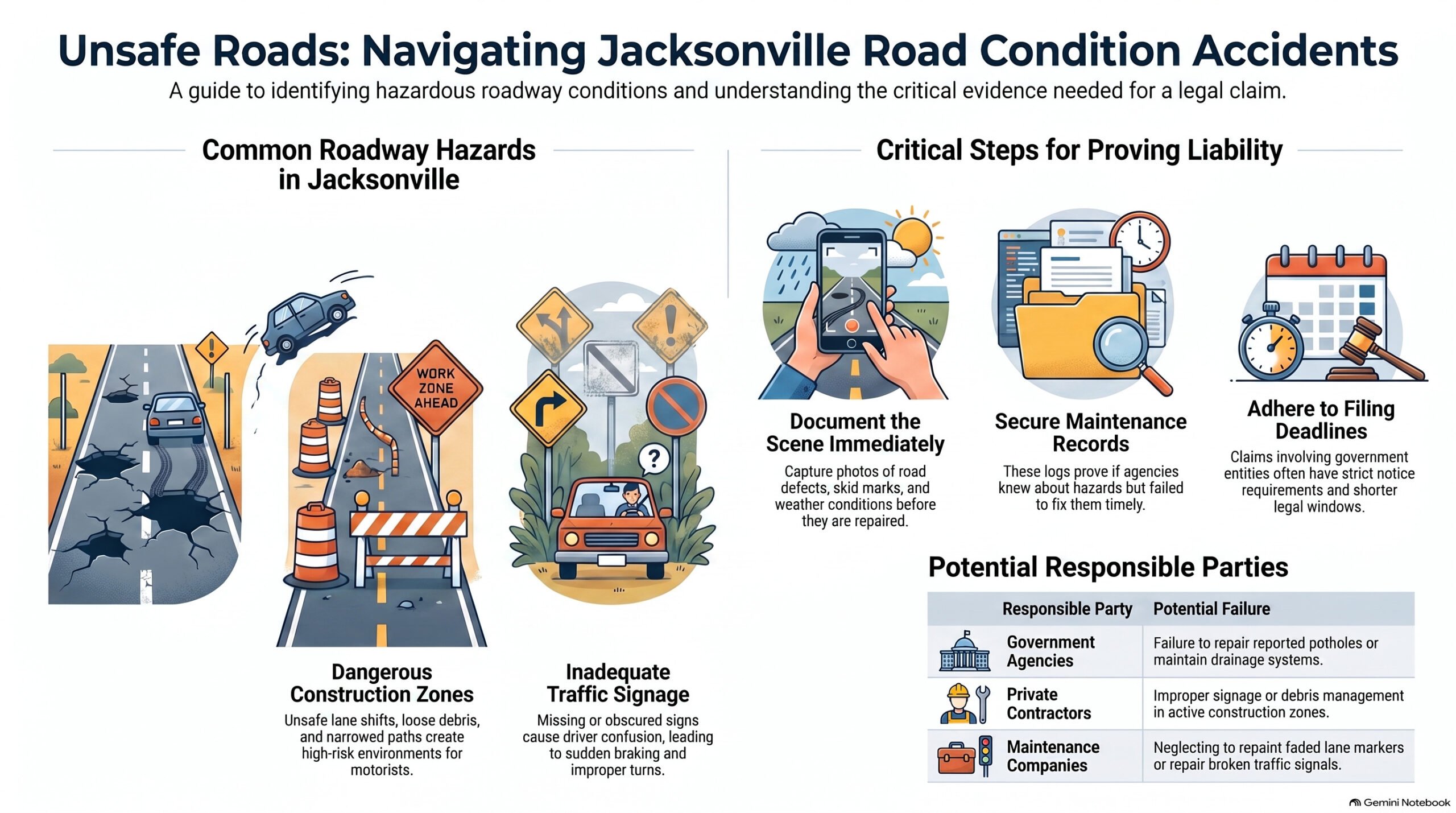
Common causes of Jacksonville car accidents linked to road and highway conditions often include poor road maintenance, dangerous construction zones, inadequate traffic signage, and weather-related hazards. These conditions can pose sudden risks to drivers, especially when responsible agencies or contractors fail to address foreseeable hazards. Identifying the specific roadway defect or hazard is a key step in evaluating liability and pursuing a potential injury claim.
Poor Road Maintenance
Poor road maintenance can turn routine travel on Jacksonville streets and highways into a serious safety risk, especially where deteriorating pavement, faded lane markings, or neglected shoulders reduce a driver’s ability to react safely. Potholes, uneven surfaces, standing water, and crumbling road edges may cause sudden swerves, tire damage, or loss of vehicle control. When proper lane marking is absent or difficult to see, motorists may drift, misjudge merging space, or enter opposing lanes. These hazards can compound Driver distraction, because unclear roadway guidance demands greater attention from people already processing traffic, pedestrians, and signals. Agencies responsible for public roads are expected to inspect, repair, and warn about known dangers. A careful review of maintenance records, complaints, and crash evidence can help determine whether neglect contributed to preventable harm.
Dangerous Construction Zones
Roadway dangers are not limited to neglected pavement or faded markings, as active construction zones can create rapidly changing conditions that increase the risk of serious collisions. In Jacksonville, lane shifts, uneven surfaces, loose debris, narrowed travel paths, and sudden equipment movement may expose drivers, passengers, pedestrians, and workers to preventable harm. A Maintenance backlog can intensify these hazards when temporary repairs, resurfacing, or utility work overlap with already strained road systems. Construction activity may also contribute to congestion near intersections, where traffic signal failures can leave motorists uncertain about the right of way and increase the potential for crashes. Careful planning, inspection, and coordination are crucial. When agencies or contractors disregard safety practices, injured individuals may need accountability measures that protect community members and promote safer public travel.
Inadequate Traffic Signage
Confused or missing traffic signs can turn routine driving decisions into dangerous moments of uncertainty, particularly on Jacksonville’s busy roads and highways. When lane markers, speed limits, merge warnings, or directional signs are obscured, damaged, poorly placed, or absent, motorists may react too late or make unsafe maneuvers. Road sign visibility is especially important near intersections, ramps, school zones, and construction changes, where clear guidance supports public safety and orderly movement.
Inadequate signage may create Driver confusion, leading to sudden braking, improper lane changes, missed exits, and hesitation in high-speed traffic. These conditions can place careful drivers, passengers, pedestrians, and service professionals at risk. A legal review may examine sign placement, maintenance records, prior complaints, and accident history to determine whether preventable roadway guidance failures contributed to a collision.
Weather-Related Road Hazards
Frequently, Jacksonville’s coastal climate creates weather-related road hazards that can make ordinary travel conditions considerably more dangerous. Heavy rain, coastal fog, sudden thunderstorms, and standing water may reduce visibility, limit tire traction, and increase stopping distances on major roads and neighborhood streets. When drainage systems are overwhelmed, pooled water can hide potholes, debris, or uneven pavement, placing attentive drivers and vulnerable road users at risk. Reduced Lane marking clarity during storms may also contribute to lane departures, sideswipe collisions, and confusion near intersections or construction zones. Public safety efforts often depend on prompt hazard reporting, careful road maintenance, and clear warnings. Weather-adaptive driving habits, including slower speeds, increased following distance, and headlights during low visibility, can help responsible motorists protect passengers, pedestrians, and the broader Jacksonville community.
Don’t Wait. Call Our Florida Personal Injury Lawyers Now!


Legal Rights of Jacksonville Car Accident Road & Highway Conditions Injury Victims
When unsafe road or highway conditions contribute to a crash, injured victims in Jacksonville may have the right to seek compensation from the party responsible for creating, ignoring, or failing to correct the hazard. These rights may apply when a Broken signal, unsafe construction zone, missing warning sign, or poorly maintained roadway places the public at risk.
Victims and their families may pursue claims that address medical care, lost income, pain, and related losses, while also encouraging safer public spaces for others.
- Identify responsible parties, including contractors, agencies, or private entities.
- Preserve evidence, such as photographs, reports, maintenance records, and witness accounts.
- Assess fault allocation, especially when several parties may share responsibility.
- Seek timely legal guidance, because notice rules and filing deadlines may affect recovery.
A careful legal review can help injured people protect their rights and promote accountability for preventable roadway dangers in Jacksonville following serious collisions.
Why Do Jacksonville Car Accident Road & Highway Conditions Injuries Happen?
Road and highway condition injuries in Jacksonville often happen because a driver encounters a hazard that should have been prevented, repaired, marked, or reasonably anticipated by those responsible for roadway safety. Dangerous conditions may include potholes, uneven pavement, missing guardrails, poor drainage, faded lane markings, obstructed signs, debris, unsafe construction zones, or malfunctioning traffic signals. When these hazards are present on busy roads, they can reduce reaction time and pose sudden risks to motorists, passengers, pedestrians, and workers.
In many cases, roadway dangers become more severe when combined with human factors. Driver fatigue may limit attention, judgment, and control, especially during long commutes or late-night travel. Driver distraction can also prevent a motorist from noticing lane changes, standing water, construction warnings, or damaged pavement in time to respond safely. These crashes often reflect multiple failures, including maintenance neglect, inadequate warnings, poor planning, or careless driving, each of which may contribute to preventable harm.
What Should You Do After a Jacksonville Car Accident Road & Highway Conditions Injury?
After a Jacksonville car accident involving unsafe road or highway conditions, an injured person should first seek prompt medical care, even when symptoms appear limited. The accident should then be reported to the appropriate authorities, creating an official record of the crash and surrounding conditions. Important evidence, including photographs, witness information, and roadway details, should be preserved as early as possible.
Prioritize Medical Care
Seek prompt medical evaluation for any injury connected to a Jacksonville car accident involving dangerous road or highway conditions, even if symptoms appear minor at the scene. A physician can identify hidden trauma, including concussions, soft tissue damage, spinal strain, or internal injuries that may worsen without care. Timely treatment also supports recovery, helping injured individuals return to family, work, and community responsibilities with greater stability. Aftercare treatment should be followed closely, including referrals, therapy, medication instructions, and follow-up appointments. Gaps in care may affect recovery and create questions about the injury’s cause or severity. The importance of documentation cannot be overstated, because medical records link symptoms, diagnoses, and treatment plans to the crash, providing clear evidence for any future injury claim or legal review.
Report The Accident
When a crash occurs because of unsafe road or highway conditions in Jacksonville, the accident should be reported to law enforcement as soon as it is safe to do so. A timely report creates an official record that may identify roadway hazards, involved drivers, and details of the emergency response. Those assisting an injured person should provide accurate information, avoid speculation, and cooperate respectfully with officers at the scene. If witnesses are present, their safety and witness-protection concerns should be respected while ensuring that officers know they observed the incident. The report may also note whether dashcam footage exists, without requiring anyone to evaluate it immediately. Later, the report can support insurance documentation, medical claims, and any review of whether public or private entities failed to maintain safe travel conditions.
Preserve Critical Evidence
A police report may establish the basic facts of a Jacksonville crash, but physical and digital evidence can quickly disappear unless it is preserved. The injured person should photograph vehicle damage, skid marks, debris, potholes, missing signs, poor lighting, and weather conditions when it is safe to do so. Witness identity verification is also important and should include names, phone numbers, and brief observations. Roadside video preservation should be requested promptly from nearby businesses, traffic cameras, or residential systems before recordings are overwritten. Medical record safeguarding helps connect injuries to the collision, so treatment notes, bills, prescriptions, and referrals should be kept organized. Insurance communications tracking is equally necessary and should include claim numbers, adjuster names, emails, letters, and call summaries. Careful preservation supports accurate accountability and helps protect those harmed by unsafe road or highway conditions.
Critical Evidence in a Jacksonville Car Accident Road & Highway Conditions Injury Case
Important evidence in a Jacksonville road or highway conditions injury case often determines whether unsafe infrastructure, poor maintenance, or environmental hazards contributed to the crash.
Essential forms of proof may include:
1. Accident Scene Photos, 2. Road Maintenance Records, 3. Weather And Visibility, and 4. Witness Statements. Each category can help establish fault, confirm hazardous conditions, and support a well-documented injury claim.
Accident Scene Photos
At the scene of a Jacksonville car accident involving unsafe road or highway conditions, photographs often provide the most direct visual record of what existed before cleanup, repairs, weather changes, or traffic movement altered the evidence. Images may show potholes, standing water, faded lane markings, obstructed signs, debris, shoulder drop-offs, lighting issues, or missing barriers. When collected carefully, they help attorneys, insurers, and investigators understand how conditions contributed to the crash and injuries.
Effective photo documentation guidelines include capturing wide views, close details, vehicle positions, skid marks, traffic controls, weather conditions, and surrounding landmarks. Time-stamped images can support Witness testimony by confirming what observers reported. For injured people and those assisting them, careful photographs may preserve truth, promote accountability, and help ensure that safety concerns receive proper attention.
Road Maintenance Records
Photographs may show what a dangerous road condition looked like after a Jacksonville crash, but road maintenance records can help establish what public agencies, contractors, or other responsible parties knew before the collision occurred. These records may include repair logs, inspection schedules, prior complaints, work orders, resurfacing notes, and contractor communications. They can show whether hazards were reported, ignored, delayed, or inadequately corrected, helping injured people and their advocates pursue accountability. A Traffic camera impact analysis may support timing, while safety audit records not relevant to road maintenance evidence should be separated carefully. A Mediation outcomes overview may later reflect the extent to which these documents influenced the resolution. Counsel also reviews Police report discrepancies beyond road conditions, ensuring the maintenance history remains focused, accurate, and useful in proving preventable roadway neglect.
Weather And Visibility
When weather changes quickly on Jacksonville roads, visibility evidence can help explain whether rain, fog, glare, standing water, darkness, or poor lighting contributed to a serious crash. Attorneys may review official weather data, roadway camera footage, crash scene photographs, and sunrise or sunset times to determine what drivers, maintenance crews, or public agencies reasonably should have anticipated. Records showing that rain delayed drainage, reduced lane markings, or increased the risk of hydroplaning may support a claim involving unsafe road conditions. Likewise, fog visibility measurements can clarify whether warning signs, lighting, or traffic controls were adequate for approaching motorists. This evidence helps establish whether preventable hazards were allowed to persist, placing families, workers, and community members at unnecessary risk while traveling Jacksonville’s roads and highways. Such proof can guide accountability decisions.
Witness Statements
Weather and visibility records may show the conditions present on Jacksonville roads, but witness statements can explain how those conditions appeared to drivers, passengers, pedestrians, road workers, or nearby residents in real time. These accounts may describe standing water, missing signs, faded lane markings, debris, poor lighting, or traffic patterns that contributed to the collision. In a road and highway conditions injury case, witness information can support Fact corroboration by connecting physical evidence with human observation. Statement credibility often depends on the witness’s location, opportunity to observe, consistency, and lack of bias. Prompt collection is important because memories fade and roadway conditions may change quickly. Careful evaluation of witness statements helps identify responsible parties and supports a fair assessment of how unsafe conditions harmed those traveling through Jacksonville.
Long-Term Effects of Jacksonville Car Accident Road & Highway Conditions Injuries
Long-term injuries from Jacksonville car accidents linked to unsafe road or highway conditions may create lasting challenges beyond the initial medical treatment. Chronic pain complications and reduced mobility issues can limit work capacity, daily activities, and overall independence. Emotional trauma impacts may also persist, requiring careful review when reviewing the full extent of harm.
Chronic Pain Complications
Although some crash injuries appear to repair within weeks, chronic pain can persist for months or years after a Jacksonville car accident involving unsafe road or highway conditions. Pain may arise from nerve irritation, soft tissue damage, spinal trauma, or poorly repaired fractures, requiring ongoing medical care and careful documentation. For injured residents, persistent pain can affect work, caregiving, sleep, and community responsibilities. In legal claims, insurers may rely on auto liability defenses to question whether road hazards, another driver, or prior health conditions caused the symptoms. Comparative fault disputes may also arise when parties dispute issues such as speed, attention, roadway maintenance, or warning signs. Thorough medical records, expert evaluations, and consistent treatment histories help connect chronic pain to the crash and support fair compensation for long-term suffering.
Reduced Mobility Issues
When roadway hazards or highway design defects contribute to a serious crash, reduced mobility may become a lasting consequence for injured Jacksonville residents. Spinal cord damage, fractures, joint injuries, or nerve trauma can limit walking, standing, driving, and basic household tasks. These limitations often require ongoing medical care, physical therapy, assistive devices, and coordinated support from family members, caregivers, and community service providers.
Mobility loss may also require home modifications, workplace changes, or accessibility accommodations that allow an injured person to function safely and with dignity. In some cases, an adaptive vehicle becomes necessary for transportation to medical appointments, employment, or essential activities. Careful documentation of these needs helps identify the full impact of the injury and supports claims for future care, equipment, and practical assistance.
Emotional Trauma Impacts
Serious crashes caused or worsened by dangerous road and highway conditions can leave Jacksonville residents with lasting emotional trauma that extends beyond physical injury. Survivors may experience anxiety, sleep disruption, depression, irritability, or fear of driving, especially when roadway defects, poor signage, or unsafe traffic patterns contributed to the collision. These effects can interfere with employment, family responsibilities, and the ability to assist others in daily life.
Long-term recovery often requires emotional recovery planning that recognizes both visible and invisible losses. Mental health counseling may help injured individuals process fear, grief, and guilt while rebuilding confidence. Legal evaluations should consider these consequences when documenting damages, because emotional harm can affect independence, judgment, and community participation. Careful attention to psychological needs supports dignity, stability, and responsible recovery after a serious accident.
Don’t Wait. Call Our Florida Personal Injury Lawyers Now!
Proving Liability in Jacksonville Car Accident Road & Highway Conditions Injury Cases
Because unsafe road or highway conditions may involve multiple responsible parties, proving liability in a Jacksonville car accident case requires a careful investigation of how the hazard developed, who had control over the roadway, and whether reasonable action should have been taken to prevent the crash. Evidence may include maintenance records, crash reports, photographs, witness statements, traffic camera footage, and expert review of roadway design or repair history.
Liability may rest with public agencies, contractors, construction companies, property owners, or negligent drivers whose Wrongful actions increased the danger. Investigators may also examine whether GPS navigation directed traffic into unsafe areas, whether distracted pedestrians contributed to the collision, or whether warning signs were missing or unclear. Although insurance conflicts may arise, the central task is to identify each party’s conduct and compare it with applicable safety duties. A thorough liability review helps protect injured people, supports accountability, and promotes safer roads for the Jacksonville community.
Dealing With Insurance Companies After a Jacksonville Car Accident Road & Highway Conditions Injury
After a crash caused by unsafe road or highway conditions, dealing with insurance companies can quickly become complicated, particularly when several parties may share responsibility. Adjusters may seek statements, records, or details before the injured person fully understands the source of the hazard, the extent of treatment, or the long-term effect on daily service to family, work, and community.
Careful organization supports fair evaluation. Records of medical expenses should be kept with billing statements, treatment notes, and pharmacy receipts. Insurance documentation requests should be reviewed closely, since broad demands may seek information unrelated to the injury. Mileage loss calculations may also matter when medical travel, missed work routes, or vehicle limitations create measurable financial harm.
Before responding to insurers, injured individuals often benefit from settlement negotiation prep that identifies damages, liability evidence, and unanswered questions. This approach helps protect the claim while encouraging accuracy, accountability, and responsible resolution.
What to Expect During a Jacksonville Car Accident Road & Highway Conditions Injury Claim Process
A Jacksonville car accident road and highway conditions injury claim often begins with an initial case evaluation, followed by a structured evidence collection process. The claim then requires careful review of liability and negligence, including whether unsafe road design, poor maintenance, or another party contributed to the crash. Depending on the strength of the evidence and the insurer’s position, the matter may proceed toward settlement negotiations or litigation.
Initial Case Evaluation
When a crash may have been caused by unsafe road or highway conditions, the initial case evaluation focuses on identifying how the roadway contributed to the collision and who may be legally responsible. Counsel may review the reported location, weather, traffic controls, construction activity, lighting, drainage, and known hazards to determine whether negligence may involve a public agency, contractor, maintenance provider, or another driver. This early review helps injured individuals understand possible claim paths while supporting decisions that may serve their recovery, family needs, and community safety. Evidence preservation is often addressed promptly, including steps to prevent loss of relevant records or roadway data. Witness interviews may also be considered to clarify what occurred, without replacing later investigation. The evaluation typically ends with practical guidance on deadlines, responsibilities, and next actions.
Evidence Collection Process
Gathering evidence in a road or highway conditions injury claim often begins with securing information that may change or disappear quickly, such as skid marks, debris patterns, traffic signal timing, construction signage, weather effects, and roadway surface conditions. Attorneys may coordinate photographs, measurements, maintenance records, police reports, witness statements, and vehicle damage documentation to preserve an accurate record. Surveillance video preservation may involve prompt requests to nearby businesses, government agencies, or traffic camera operators before routine deletion occurs. Forensic accident reconstruction can assist by evaluating impact points, vehicle movement, sightlines, and roadway defects. This process supports careful service to injured individuals by organizing facts with discipline, respect, and transparency. Medical records and repair estimates are also collected to connect physical harm and property loss with documented crash conditions.
Liability And Negligence
Liability in a Jacksonville car accident involving road or highway conditions depends on whether a person, business, contractor, or government entity failed to act with reasonable care under the circumstances. Negligence may involve ignored hazards, poor signage, unsafe construction zones, drainage failures, or delayed maintenance after notice of danger. Investigators assess who controlled the roadway area, who created the hazard, and whether reasonable corrective action was taken. Proof of government duty is often central when a public agency is involved, because responsibility must be tied to lawful duties, notice, and maintenance obligations. Comparative negligence analysis also matters, since driver conduct, speed, distraction, or failure to respond safely may affect responsibility. This review helps identify accountable parties while respecting the broader goal of protecting community safety.
Settlement Or Litigation
Although many Jacksonville road and highway condition injury claims resolve through settlement, each case typically begins with a detailed investigation of the crash scene, the roadway defect, the maintenance history, and the available insurance or government claim procedures. Claim representatives, public agencies, and defense counsel may evaluate fault, damages, notice issues, and repair records before meaningful negotiations occur. Evidence preservation planning helps protect photographs, surveillance footage, inspection logs, vehicle data, and witness accounts that might otherwise be lost. When settlement discussions fail to adequately address medical needs, lost income, and long-term harm, litigation may become necessary. Trial strategy planning then guides pleadings, discovery, expert review, and courtroom presentation. Throughout the process, careful advocacy supports accountability, promotes safer public travel, and serves injured individuals seeking lawful recovery with measured diligence and purpose.
Compensation for Jacksonville Car Accident Road & Highway Conditions Injury Damages
Compensation for injuries caused by unsafe road or highway conditions in Jacksonville may include payment for medical expenses, lost income, reduced earning capacity, property damage, and the physical and emotional effects of the crash. Recovery depends on proving how the hazardous condition, negligent driver conduct, or failed maintenance contributed to the collision and resulting harm.
A careful damages claim may draw from several responsible sources, including negligent motorists, contractors, government entities, or insurance policies. Comparative negligence defenses may reduce recovery if an injured person is alleged to share fault, making clear evidence vital. Photographs, repair records, crash reports, medical documentation, and witness statements can help establish responsibility and limit unfair blame.
When an at-fault driver lacks adequate insurance, UM/UIM coverage options may provide an additional path to recovery. Legal guidance can help injured individuals and families pursue fair compensation while preserving resources needed for recovery, stability, and continued service to others.
Economic vs Non-Economic Damages in Jacksonville Car Accident Road & Highway Conditions Cases
In Jacksonville car accident cases involving unsafe road or highway conditions, damages are typically categorized as economic and non-economic losses. Economic damages may include medical expenses, lost wages, and repair costs, while non-economic damages address pain and suffering, emotional distress, and diminished quality of life. Proving the value of each category requires clear documentation, credible evidence, and a careful assessment of how the roadway-related crash affected the injured person.
Economic Damage Examples
When a Jacksonville car accident is linked to dangerous road or highway conditions, economic damages generally refer to the measurable financial losses caused by the crash. These losses may include emergency treatment, hospital bills, surgery, rehabilitation, medication, and future medical care supported by Medical documentation. They may also include lost wages, reduced earning capacity, vehicle repair or replacement, towing, rental transportation, and necessary household assistance during recovery.
Clear records help connect each expense to the roadway-related collision, which can be important during insurance disputes. Although pain severity may influence treatment needs, economic damages focus on the cost of care and financial disruption. A careful settlement strategy should account for current bills, projected expenses, and employment losses, ensuring that responsible parties address the practical burdens placed on injured individuals.
Non-Economic Losses
Beyond documented bills and wage losses, a Jacksonville car accident caused by unsafe road or highway conditions may also produce non-economic losses that are harder to measure but still legally significant. These losses may include physical pain, emotional distress, anxiety while driving, sleep disruption, disfigurement, loss of enjoyment of daily life, and strain on family relationships. When crashes involve hazards such as traffic light malfunctions, poor maintenance, or dangerous roadway design, the human impact may extend well beyond financial records. A person committed to caring for others may find ordinary responsibilities limited by fear, discomfort, or reduced independence. In Florida, comparative negligence may affect recovery if conduct by multiple parties contributed to the crash. Non-economic damages recognize harms that affect dignity, wellbeing, and meaningful participation in community life.
Proving Damage Value
Although economic and non-economic damages are proven in different ways, both require clear evidence linking the unsafe road or highway condition to the claimed losses. Economic damages may be supported by medical bills, wage records, repair estimates, towing invoices, and Property Damage Documentation showing vehicle loss resulting from the crash. Non-economic damages require careful presentation of pain, emotional distress, reduced mobility, and loss of daily function. In Jacksonville road-condition cases, photographs, maintenance records, witness accounts, and expert opinions may help demonstrate how a pothole, missing sign, poor drainage, or defective shoulder caused harm. Accurate valuation serves injured people and their families by ensuring each proven loss is addressed. A lawyer may organize this evidence, challenge undervaluation, and present damages with discipline and credibility.
When a Jacksonville Car Accident Road & Highway Conditions Injury Case Goes to Trial vs Settlement
After a serious crash involving hazardous road or highway conditions, the decision to settle or proceed to trial often depends on the strength of the evidence, the disputed liability issues, and the full extent of the injured person’s damages. A careful case review may show whether settlement can provide timely support for medical needs, lost income, and long-term care, or whether trial is necessary to seek full accountability.
Trial strategy focuses on presenting roadway defects, maintenance failures, expert opinions, and witness testimony in a clear sequence. Jury persuasion requires showing how unsafe conditions caused preventable harm, without overstating the evidence. Settlement leverage often increases when documentation is organized, damages are well supported, and responsible parties face credible courtroom risk. Negotiation tactics may include structured demands, preparation for mediation, and firm responses to low offers. Each path should serve the injured person’s welfare while protecting the case’s value.
Don’t Wait. Call Our Florida Personal Injury Lawyers Now!
Florida Laws That May Affect Your Jacksonville Car Accident Road & Highway Conditions Case
When a crash involves unsafe road or highway conditions, Florida law can shape nearly every part of the claim, from identifying responsible parties to proving fault and meeting filing deadlines.
In Jacksonville, these rules may affect injured drivers, passengers, pedestrians, and families seeking accountability for preventable harm.
- Florida negligence rules may require proof that careless maintenance, design, inspection, or warning practices contributed to the collision.
- Comparative fault principles can reduce recovery when a driver, contractor, agency, or other party shares responsibility.
- Sovereign immunity claims may apply when a city, county, state agency, or public employee is accused of failing to keep roads reasonably safe.
- Notice and documentation duties often make photographs, reports, repair records, and witness accounts especially important.
Because these cases may involve public service decisions and community safety, careful legal evaluation helps determine whether the evidence supports a claim grounded in duty, breach, causation, and damages.
The Statute of Limitations for Jacksonville Car Accident Road & Highway Conditions Injury Cases
Because filing deadlines can determine whether an injured person may pursue compensation at all, the statute of limitations is a pivotal issue in Jacksonville car accident cases involving unsafe road or highway conditions. Florida generally imposes a limited period for filing personal injury lawsuits, and claims involving public roadway design, maintenance, or traffic control may be subject to additional notice requirements. These deadlines matter not only for legal compliance, but also for fair service to injured people who depend on timely accountability.
Road condition cases often require prompt attention to Evidence preservation timelines, including photographs, maintenance records, crash reports, and witness information. Delay may weaken the ability to show how a roadway hazard contributed to the collision. Comparative fault rules may also affect recovery when responsibility is shared among drivers, contractors, or government entities. Understanding the applicable filing period helps protect the claim before key rights expire and before critical proof becomes unavailable.
How a Jacksonville Car Accident Road & Highway Conditions Lawyer Can Help You
How can legal representation change the direction of a road or highway conditions injury claim in Jacksonville? A lawyer can organize the facts, identify responsible parties, and present the claim with care for the injured person and the wider community.
- Investigation: Counsel reviews crash reports, photographs, maintenance records, and roadway design issues to determine how unsafe conditions contributed to harm.
- Documenting damages: Medical bills, lost income, rehabilitation needs, and daily limitations are gathered to show the full impact of the injury.
- Witness credibility: Statements from drivers, passengers, responders, and nearby residents are evaluated, preserved, and compared with physical evidence.
- Claim presentation: A lawyer communicates with insurers, public entities, and opposing parties to seek accountability without placing additional burdens on the injured person.
Through steady advocacy, legal counsel helps transform confusion into a structured claim, allowing families to focus on recovery and service to others.
When to Contact a Jacksonville Car Accident Road & Highway Conditions Lawyer
After a crash involving unsafe road or highway conditions, legal guidance should be considered as soon as injuries, disputed fault, or questions about roadway maintenance arise. Early contact is especially important when potholes, missing signs, poor lighting, obstructed views, construction hazards, or inadequate drainage may have contributed to the collision.
A Jacksonville car accident road and highway conditions lawyer may be contacted before statements are given to insurers or public entities. Timely consultation can support Evidence preservation tips, including photographing the scene, locating witnesses, securing dashcam footage, and documenting weather or traffic conditions. Prompt action may also help identify responsible parties before repairs, cleanup, or routine maintenance alters the site.
Contact may also be appropriate when medical bills increase, liability is denied, or settlement discussions become difficult. Insurance dispute strategies can be considered when adjusters minimize roadway hazards or unfairly shift blame. Early attention allows injured people and their advocates to pursue accountability while serving community safety.
Why You Need an Experienced Jacksonville Car Accident Road & Highway Conditions Lawyer
When unsafe road or highway conditions contribute to a Jacksonville car accident, an experienced lawyer can help determine whether the crash resulted from more than ordinary driver error. Poor drainage, missing signs, faded lane markings, defective traffic signals, or negligent construction maintenance may shift responsibility toward public agencies, contractors, or other parties entrusted with public safety.
These cases require careful investigation, because evidence can change quickly after a roadway hazard is reported or repaired. A lawyer can preserve records, review maintenance histories, consult qualified experts, and address Negligence defenses that may be raised to reduce or deny recovery. This work supports injured people while also promoting safer roads for the community.
An experienced lawyer also evaluates the full extent of harm, including medical care, lost income, diminished earning capacity, and future damages. By presenting a complete claim, the lawyer helps ensure accountability reflects both immediate losses and long-term needs after a serious collision.
How to Choose the Right Jacksonville Car Accident Road & Highway Conditions Lawyer for Your Case
Selecting the right lawyer begins with evaluating whether the attorney has specific experience handling car accident claims involving unsafe road and highway conditions in Jacksonville. These cases may involve poor signage, damaged pavement, obstructed visibility, missing guardrails, or negligent maintenance by public or private entities. A suitable attorney should understand how to identify liable parties, preserve evidence, and work with qualified experts when road design or maintenance issues are disputed.
Potential clients should ask about Client communication expectations, including response times, case updates, and who will oversee daily questions. Clear communication builds trust, reduces confusion, and helps injured individuals focus on recovery and on serving their families and communities. A lawyer should also provide a case documentation checklist, outlining medical records, crash reports, photographs, repair estimates, witness information, and insurance correspondence needed for review. Careful selection helps ensure the claim is prepared with diligence, purpose, and accountability from the outset.
About The Law Offices of Anidjar & Levine
The Law Offices of Anidjar & Levine represents injured individuals in Jacksonville and throughout Florida in car accident claims, including cases involving dangerous road and highway conditions.
The firm assists clients harmed by unsafe intersections, poor signage, debris, defective traffic controls, and other hazards that may reflect Negligent maintenance by public agencies, contractors, or private parties.
Its legal team evaluates each case with careful attention to service, accountability, and practical support for those facing medical, financial, and personal burdens.
Attorneys review crash reports, roadway records, photographs, maintenance histories, and engineering concerns to identify responsible parties.
They also assess witness credibility, preserve evidence, and address insurer arguments that may reduce or deny fair compensation.
The firm’s approach emphasizes communication, preparation, and advocacy.
By managing legal demands on behalf of injured clients, The Law Offices of Anidjar & Levine helps them focus on recovery while pursuing accountability under Florida law.
Frequently Asked Questions
Can Road Construction Zones Affect My Jacksonville Car Accident Claim?
Yes, road construction zones can affect a Jacksonville car accident claim by changing obligations, evidence, and fault determinations. Investigators may review lane closures, signage, barriers, speed reductions, worker activity, and any Traffic Signal malfunction or temporary control problem. Liability Standards may apply to drivers, contractors, government agencies, or maintenance crews. A careful claim analysis supports accountability, protects injured persons, and helps ensure responsible parties address preventable harm.
Who Maintains Traffic Signals and Road Signs in Jacksonville?
Traffic signals and road signs in Jacksonville are generally maintained by the City of Jacksonville, the Florida Department of Transportation, or other local agencies, depending on Department responsibility and signal ownership. State roads are usually under FDOT control, while city streets are often handled by municipal traffic engineering departments. Those serving affected motorists should confirm the specific roadway authority, because maintenance records, repair history, and notice of defects may be essential.
Do Weather Conditions Impact Liability in Road Hazard Accidents?
Yes, weather conditions can affect liability in road hazard accidents. Courts may assess weather liability factors, including rain, fog, flooding, or glare, to determine whether drivers, agencies, or contractors acted reasonably. Reduced visibility negligence standards may require slower speeds, warnings, or timely hazard correction. Those responsible for public safety must anticipate foreseeable risks, maintain safe conditions, and respond appropriately when dangerous weather worsens roadway hazards for all travelers.
Can Pothole Damage Claims Include Vehicle Repair Costs?
Yes, pothole damage claims can include vehicle repair costs when the claimant presents Pothole evidence, documentation, and a clear Repair estimate, with proof linking the damage to the roadway defect. Photos, location details, witness statements, and maintenance records may support the claim. Those assisting injured or burdened drivers should preserve evidence promptly, because agencies or insurers often require timely notice, causation, and reliable cost records before compensation is considered.
Are Highway Design Defects Handled Differently Than Maintenance Issues?
Yes, highway design defects are often handled differently than maintenance issues. Design claims may require proof that the original plan was unreasonably dangerous, while maintenance claims focus on failure to repair or warn. Sovereign immunity laws may limit claims against public agencies, especially when discretionary planning decisions are involved. Comparative negligence can also reduce recovery if a driver’s conduct contributed. Careful investigation helps protect public safety and serve injured persons.
—————————
A Jacksonville car accident caused by unsafe road or highway conditions can leave victims with serious injuries, financial losses, and complex legal questions.
An experienced lawyer can investigate the cause, identify potentially liable parties, preserve critical evidence, and pursue appropriate compensation.
Jacksonville Personal Injury Lawyer: The Law Offices of Anidjar and Levine provides focused legal guidance for injured individuals and their families.
Prompt legal action may help protect a claim and support victims as they work toward recovery and financial stability.