
The Law Offices of Anidjar and Levine, a Jacksonville car accident head and brain lawyer, helps injured people protect claims involving concussions, traumatic brain injuries, skull fractures, and cognitive changes. Legal support may include insurer communication, evidence preservation, medical record organization, liability review, and negotiation for damages related to treatment, lost income, and long-term limitations. These cases often require careful proof of causation, symptoms, and future care needs. The sections below explain core rights, case factors, and when legal help may be needed. For additional support, visit our Jacksonville Personal Injury Lawyer page.
Main Takeaways
- A Jacksonville car accident head and brain injury lawyer can protect your claim and handle insurer communications early.
- Strong claims often require crash photos, police reports, witness statements, vehicle damage records, and medical imaging.
- Brain injury cases may involve concussions, traumatic brain injuries, skull fractures, cognitive changes, and delayed symptoms.
- Lawyers evaluate liability, causation, comparative fault, insurance coverage, injury severity, and long-term medical needs.
- Legal support helps pursue fair compensation through insurance negotiation and litigation readiness when settlement offers are undervalued.


How We Can Help With Your Jacksonville Car Accident Head & Brain Injury Claim
After a car accident causes a head or brain injury, a Jacksonville personal injury lawyer can help protect the injured person’s claim from the earliest stages. Counsel may coordinate communication with insurers, help document losses, and reduce the risk that an injured person’s statement is misused. This support allows families, caregivers, and service-minded advocates to focus on medical needs while the claim is handled with care.
A lawyer may provide evidence-preservation tips, including securing photographs, vehicle damage records, witness details, medical documentation, and any available video footage before it is lost. Careful organization of these materials can strengthen accountability and support a fair review of harm.
Effective Insurance negotiation strategies may include presenting clear proof of liability, explaining the practical impact of the injury, responding to undervalued offers, and preparing the claim as though litigation may be necessary. This disciplined approach helps pursue compensation with professionalism and purpose.
OUR CONSULTATIONSARE FREE
START YOUR FREE CASE REVIEW

Understanding Jacksonville Car Accident Head & Brain Injury Cases
When a Jacksonville car accident results in a head or brain injury, the case often involves medical, legal, and evidentiary issues that require careful evaluation. These claims may include concussions, traumatic brain injuries, skull fractures, or cognitive impairments that affect work, communication, and daily care needs. Because symptoms can develop gradually, medical documentation, diagnostic testing, and provider opinions often play a central role in proving the extent of harm.
A case evaluation typically considers liability, causation, prognosis, and the injured person’s long-term support requirements. Florida negligence standards may determine whether another party failed to act with reasonable care and whether that conduct caused the injury. Insurance coverage, comparative fault, and available evidence can also influence the claim’s direction. In some matters, damage caps or statutory limits may affect recovery. Careful legal assessment helps protect the injured person’s dignity while seeking resources needed for treatment, stability, and continued service to family and community.
Common Causes of Jacksonville Car Accident Head & Brain
Common causes of Jacksonville car accident head and brain injuries often involve conduct that increases the force, unpredictability, or severity of a collision. Distracted driving crashes, drunk driving collisions, high-speed rear-end impacts, and unsafe lane changes can all create conditions where occupants suffer direct blows, violent jolts, or rapid deceleration. Identifying the cause of the crash is essential because it helps establish liability and clarifies how the injury occurred.
Distracted Driving Crashes
Distracted driving can turn an ordinary trip through Jacksonville into a crash that causes serious head or brain trauma. When a driver looks away from the road, reaches for an object, adjusts navigation, or responds to a message, the vehicle may drift, fail to stop, or strike another road user. Cell phone distraction is especially dangerous because it can combine visual, manual, and mental inattention within seconds. This distracted driving behavior often reduces reaction time, making rear-end collisions, intersection crashes, and pedestrian impacts more likely. For injured people and those who serve them, identifying distraction can be vital to accountability. Phone records, witness statements, vehicle data, and traffic camera footage may help show how inattention contributed to the collision and resulting neurological harm. Evidence must be preserved promptly.
Drunk Driving Collisions
Although alcohol-impaired driving is entirely preventable, it remains a serious cause of Jacksonville crashes involving head and brain injuries. Impaired driving can reduce judgment, coordination, and reaction time, increasing the likelihood of forceful impacts that harm vehicle occupants, pedestrians, and cyclists. For injured individuals and those assisting them, prompt medical evaluation is critical because brain trauma may not be immediately obvious. Careful preservation of evidence may also support a clear account of what occurred, including police reports, witness statements, vehicle damage, and available surveillance footage. BAC testing can help establish intoxication levels near the time of the collision, which may influence accident liability. When alcohol use contributes to a crash, legal review can help identify responsible parties and support recovery efforts with diligence.
High-Speed Rear-End Impacts
When a rear-end collision occurs at high speed, the sudden transfer of force can cause the head and neck to move violently, increasing the risk of concussion, traumatic brain injury, and related neurological harm. In Jacksonville, these crashes may involve stopped traffic, highway congestion, or vehicles slowing for signals. Impact force physics explains how higher speed and greater vehicle mass increase the forces experienced by occupants, even when exterior damage appears limited. First responders, medical providers, and caregivers must recognize that symptoms may be delayed, including confusion, dizziness, headache, nausea, or memory problems. Emergency assessment procedures help identify urgent signs of brain trauma and determine whether imaging, observation, or expert care is needed. Careful documentation supports treatment, recovery planning, and accountability for injured individuals.
Unsafe Lane Changes
On Jacksonville roads, unsafe lane changes can cause side-swipe, angled, or secondary-impact collisions that expose occupants to sudden head movement and an increased risk of brain injury. These crashes often occur when a driver fails to check mirrors, ignores blind-spot warnings, or changes lanes without adequate space. Improper merging signals may also prevent nearby motorists from reacting in time, especially in congested corridors near bridges, exits, and commercial areas. The resulting impact can force the head to strike windows, pillars, or headrests, while rapid rotation may contribute to concussion or other traumatic brain injuries. Those serving injured individuals should recognize how small traffic decisions can produce serious harm. Careful investigation may examine vehicle positioning, signal use, witness accounts, and roadway conditions to determine how the unsafe maneuver occurred.
Don’t Wait. Call Our Florida Personal Injury Lawyers Now!


Legal Rights of Jacksonville Car Accident Head & Brain Injury Victims
After a serious collision, a Jacksonville car accident victim with a head or brain injury may have the right to pursue compensation from the party whose negligence caused the crash.
These rights can support recovery, protect dignity, and help families continue caring for loved ones during difficult changes.
- Medical expenses for emergency care, rehabilitation, medication, and long-term treatment may be recoverable.
- Lost income and Workplace Impacts may be addressed when symptoms limit employment or the ability to perform career duties.
- Pain, cognitive changes, emotional distress, and reduced quality of life may support additional damages.
- Disability Benefits may assist when an injury causes lasting impairment or prevents meaningful work.
- Wrongful Death claims may be available when a family loses a loved one due to traumatic brain injuries.
Legal action can reduce the financial burden on injured people, caregivers, and households. A claim may also promote accountability while helping victims secure resources for ongoing support.
Why Do Jacksonville Car Accident Head & Brain Injuries Happen?
Understanding legal rights is only one part of evaluating a Jacksonville head or brain injury claim, because the cause of the crash often determines who may be held responsible. These injuries may occur in rear-end collisions, side-impact crashes, rollovers, pedestrian accidents, or commercial vehicle collisions. The Biomechanics of impacts explains how sudden acceleration, deceleration, rotation, or blunt force can cause the brain to move within the skull, damaging delicate tissue even without visible trauma.
Negligent driving often creates these dangerous forces. Speeding, distraction, impairment, fatigue, unsafe lane changes, and failure to yield can convert a routine trip into a life-altering event. Poor vehicle maintenance, defective safety systems, hazardous road design, and inadequate visibility may also contribute. In some cases, missed concussion signs complicate the understanding of when symptoms began and how seriously the injury progressed. Careful analysis helps identify preventable conduct, supporting accountability for those harmed and communities seeking safer roads.
What Should You Do After a Jacksonville Car Accident Head & Brain Injury?
After a Jacksonville car accident involving a suspected head or brain injury, the injured person should seek immediate medical care, even if symptoms appear mild or delayed. Careful documentation of the accident, injuries, treatment, and related losses can help preserve important evidence. Prompt contact with a brain injury lawyer may also protect legal rights, especially when fault, insurance coverage, or long-term medical needs are disputed.
Seek Immediate Medical Care
Following a Jacksonville car accident, any sign of head trauma or possible brain injury should be treated as a medical emergency, even when symptoms appear mild or delayed. A prompt evaluation can identify concussions, bleeding, swelling, or other conditions that may worsen without timely care. Emergency responders, hospital staff, and treating physicians serve an important role by stabilizing the injured person and guiding appropriate treatment.
Emergency medical follow-up is equally important after discharge, especially when headaches, confusion, dizziness, nausea, vision changes, or memory problems continue. Consistent medical care supports recovery and helps caregivers understand needed restrictions, referrals, and monitoring. Brain injury documentation created through examinations, imaging, and clinical notes also provides a clear record of the injury, treatment needs, and ongoing limitations for responsible decision-making.
Document The Accident
At the accident scene, careful documentation can preserve important details before vehicles are moved, debris is cleared, or memories begin to fade. If it is safe, Photographing scenes from several angles may help record vehicle positions, road conditions, skid marks, traffic signals, weather, visible injuries, and property damage. These images can later support a clearer account of how the crash occurred.
Building witness logs is also important. Names, phone numbers, email addresses, and brief statements from bystanders, passengers, or nearby workers may help confirm what happened. A person assisting an injured victim should also note the time of the crash, responding agencies, ambulance transport, and any symptoms reported at the scene. Organized documentation helps protect facts, supports accurate reporting, and serves those working to understand the injury’s full impact.
Contact A Brain Injury Lawyer
When should legal guidance become a priority after a Jacksonville car accident involving a suspected head or brain injury? It should become a priority once urgent medical needs are addressed and the injured person is stable. A brain injury lawyer can help protect the individual’s rights, preserve evidence, and communicate with insurers while family members focus on care and recovery. Early legal support is especially important when car accident symptoms, such as confusion, dizziness, memory problems, headaches, or personality changes, appear hours or days later. Counsel may also help ensure that medical records, emergency reports, and brain injury testing results are properly obtained and reviewed. By acting promptly, the injured person and caregivers can pursue needed resources, reduce avoidable burdens, and support a responsible path toward accountability.
Don’t Wait. Call Our Florida Personal Injury Lawyers Now!
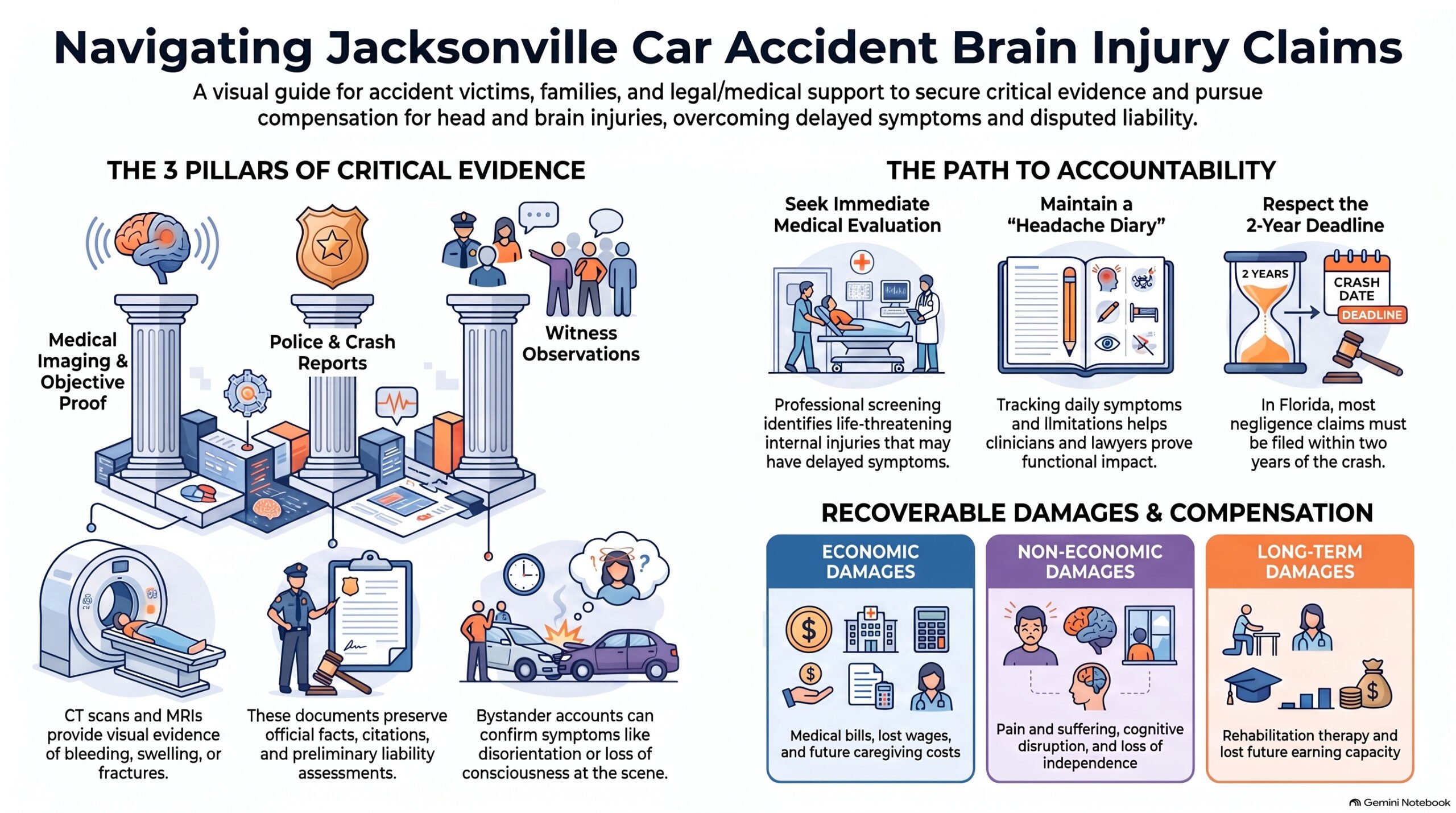
Critical Evidence in a Jacksonville Car Accident Head & Brain Injury Case
Critical evidence in a Jacksonville car accident head and brain injury case helps establish fault, injury severity, and the connection between the crash and the resulting harm.
A careful review may include:
- Police crash reports
- Medical imaging records
- Witness statements
- Vehicle damage evidence
- Emergency response documentation
When properly preserved and analyzed, these materials can greatly strengthen the injured party’s claim.
Police Crash Reports
After a serious collision, the police crash report often becomes one of the first structured records used to evaluate a Jacksonville head or brain injury claim. It identifies drivers, vehicles, insurance information, roadway conditions, citations, and the officer’s preliminary assessment of how the crash occurred. For those seeking to serve an injured person responsibly, this report helps preserve facts before memories fade or evidence changes. Impact damage documentation may support the determination of the force and direction of the collision, while witness contact verification allows counsel to locate individuals who observed key events. Although the report may not conclusively determine fault, it can guide further investigation, reveal inconsistencies, and help establish timelines. A careful review ensures that errors, omissions, or unclear statements are addressed promptly and professionally in the claims process.
Medical Imaging Records
In a Jacksonville car accident head or brain injury claim, medical imaging records often provide the most objective evidence of trauma, progression, and clinical concern. CT scans, MRIs, and related radiology reports may reveal bleeding, swelling, skull fractures, diffuse axonal injury, or changes that support ongoing symptoms. These records help treating physicians guide care and allow attorneys, insurers, and retained experts to evaluate causation and severity with greater precision. When imaging is compared over time, it may show whether injuries improved, worsened, or required additional intervention. Independent medical exams may rely heavily on these materials, particularly when disputed symptoms lack visible outward signs. During deposition testimony, radiologists, neurologists, or treating providers may explain the findings, linking documented trauma to the crash and the patient’s care needs.
Witness Statements
While medical imaging can document the physical effects of trauma, witness statements often explain how the collision occurred and how the injured person appeared immediately afterward. In head and brain injury cases, bystanders may describe confusion, disorientation, loss of consciousness, slurred speech, imbalance, or unusual behavior before emergency care arrived. These observations can support the timing and seriousness of symptoms, especially when the injured person cannot clearly recall events.
Witness statement accuracy depends on prompt collection, careful documentation, and comparison with other available evidence. Attorneys may identify drivers, passengers, pedestrians, first responders, or nearby workers who saw the incident or its aftermath. They may also seek help in preserving recorded footage from businesses, residences, or traffic sources, so statements can be evaluated against reliable visual context. Accurate accounts serve justice.
Vehicle Damage Evidence
Because head and brain injuries can occur even without dramatic exterior damage, vehicle damage evidence must be evaluated with care in a Jacksonville car accident case. Damage patterns may help explain the direction of impact, force involved, and movement of occupants inside the vehicle. Photographs, repair estimates, airbag deployment records, and vehicle inspection details can help investigators link the collision to reported neurological harm. Tire tread marks may also reveal braking, swerving, or loss of control before impact, supporting a clearer reconstruction of events. A careful review can prevent insurers from minimizing injuries based only on visible damage. When preserved and interpreted properly, this evidence serves injured individuals by helping present a truthful account, supporting fair evaluation, and promoting responsible resolution of serious head and brain injury claims.
Long-Term Effects of Jacksonville Car Accident Head & Brain Injuries
Long-term head and brain injuries from Jacksonville car accidents may affect cognitive function, memory, and the ability to manage daily responsibilities. Some individuals also experience emotional or behavioral changes, including mood instability, irritability, anxiety, or impaired judgment. Ongoing medical care, rehabilitation, and careful documentation may be necessary to address these effects and evaluate the full extent of damages.
Cognitive And Memory Issues
After a Jacksonville car accident, cognitive and memory problems may emerge immediately or develop gradually as the brain responds to trauma. Injured individuals may struggle with concentration, word retrieval, planning, and short-term recall, making work, school, caregiving, and daily responsibilities more difficult. These impairments can be worsened by Neck pain, whiplash, Sleep disturbances, fatigue, or persistent headaches, all of which may reduce mental stamina and slow processing speed. Careful observation by family members, employers, and medical providers can help document changes that might otherwise be overlooked. Neuropsychological testing, imaging, and consistent treatment records may clarify the extent of impairment. When these issues affect independence or the ability to serve others, a legal evaluation may support claims for medical care, lost income, and long-term assistance after a collision.
Emotional And Behavioral Changes
Emotional and behavioral changes may become one of the most disruptive long-term effects of a Jacksonville car accident head or brain injury, especially when they alter judgment, impulse control, mood stability, or interpersonal relationships. Survivors may experience Emotional outbursts, sudden irritability, withdrawal, or reduced patience, placing strain on families, caregivers, coworkers, and community support systems. These changes may appear inconsistent, yet they can reflect injury-related disruption rather than intentional misconduct. Mood instability can affect decision-making, cooperation, and trust, while cognitive decline may intensify frustration when tasks once handled easily become difficult. Anger management concerns may also emerge, requiring compassionate structure, clear communication, and accountability. For those serving injured individuals, recognizing these behavioral effects helps preserve dignity while addressing the practical burdens created by lasting neurological harm.
Ongoing Medical Care
Ongoing medical care often becomes a central concern when a Jacksonville car accident causes a head or brain injury with lasting effects. Physicians may establish a Treatment timeline that includes emergency evaluation, neurological follow-up, rehabilitation, medication management, and periodic imaging when appropriate. For those supporting an injured person, consistent appointments help protect health, promote stability, and clarify the long-term prognosis. Care teams may also recommend therapy for speech, balance, memory, mood, or daily functioning, depending on observed limitations. Accurate medical documentation remains essential because records connect symptoms, treatment needs, work restrictions, and future care planning. Symptom tracking can further assist providers by identifying changes in headaches, dizziness, confusion, sleep disruption, or behavioral concerns. Together, these practices help ensure that ongoing needs are recognized, addressed, and responsibly communicated.
Proving Liability in Jacksonville Car Accident Head & Brain Injury Cases
When a Jacksonville car accident results in a head or brain injury, proving liability requires a careful analysis of how the collision occurred and whose conduct caused the harm. Evidence may include police reports, witness statements, traffic camera footage, vehicle damage, medical records, and expert reconstruction of the crash. These materials help establish whether a driver violated a traffic law, failed to yield, followed too closely, drove distracted, or acted with unreasonable care.
Because head and brain injuries can affect memory, communication, and daily functioning, a thorough investigation serves both the injured person and those supporting recovery. Liability proof must also address any comparative negligence defense, which may attempt to reduce responsibility by blaming the injured party. Counsel can evaluate fault arguments, preserve essential evidence, and prepare the claim with Insurance negotiation tactics in mind, without allowing liability questions to be shaped by speculation. Strong proof creates a reliable foundation for accountability and fair compensation.
Dealing With Insurance Companies After a Jacksonville Car Accident Head & Brain Injury
After a Jacksonville car accident involving a head or brain injury, insurance companies often begin evaluating the claim before the full medical picture is clear. Adjusters may question symptoms that develop gradually, challenge treatment needs, or request recorded statements before the injured person understands the extent of cognitive, emotional, or physical harm.
A careful documentation strategy can help protect the injured person’s dignity and future care needs. Medical records, expert evaluations, therapy notes, work restrictions, and observations from family or caregivers may show how the injury affects daily service, employment, and independence. These materials can also address coverage disputes when insurers question policy terms, causation, or the necessity of continued treatment.
Insurance denial may arise from incomplete records, inconsistent statements, or disputes over preexisting conditions. For this reason, communications with insurers should be measured, accurate, and supported by evidence, especially when the injury affects memory, concentration, or decision-making.
What to Expect During a Jacksonville Car Accident Head & Brain Injury Claim Process
A Jacksonville car accident head and brain injury claim typically begins with immediate medical evaluation, followed by careful evidence collection to document the injury and its cause. The insurance claim process may involve medical records, accident reports, witness information, and negotiations with the insurer. If a fair resolution cannot be reached, the claim may proceed toward settlement discussions or litigation.
Immediate Medical Evaluation
Following a Jacksonville car accident involving a suspected head or brain injury, immediate medical evaluation is often the first crucial step in both treatment and documentation. Prompt care helps identify concussions, skull fractures, bleeding, swelling, or cognitive changes that may not appear obvious at the scene. An Emergency room assessment may include neurological screening, imaging studies, medication review, and observation for worsening symptoms. When symptoms persist or findings raise concern, a consultation with a neurologist may be recommended to evaluate memory, balance, vision, speech, and other brain functions. Medical providers also establish treatment plans, referral needs, work restrictions, and follow-up schedules. For injured individuals and those assisting them, timely evaluation supports health, safety, and informed decision-making throughout the claim process while promoting continuity of care.
Evidence Collection Steps
When a head or brain injury is suspected in a Jacksonville car accident claim, evidence collection typically begins with preserving the facts that connect the crash, the medical condition, and the resulting losses. Investigators may gather police reports, scene photographs, images of vehicle damage, witness statements, medical records, and documentation of missed work or daily limitations. If a commercial driver or rideshare vehicle is involved, preservation of logs, dispatch records, onboard data, and maintenance materials may be important. Prompt action can help prevent spoliation of evidence, including the loss, alteration, or destruction of materials that may clarify fault or the severity of an injury. Careful evidence collection serves the injured person, family members, medical providers, and decision makers by creating an accurate record that supports fair evaluation and responsible accountability.
Insurance Claim Process
Because head and brain injuries can evolve over time, the insurance claim process after a Jacksonville car accident often requires careful documentation, measured communication, and close attention to medical findings. An injured person may first seek benefits through No Fault Coverage, including medical expense payments and wage-loss support, while providers document symptoms, test results, and treatment needs. Insurers may request statements, records, and proof of crash-related impairment, so accuracy remains critical. Claim Denials can occur when causation, timing, or coverage is disputed, requiring review of medical evidence and policy language. Available recovery may depend on Policy Limits, liability findings, and whether an Underinsured Motorist claim applies. Throughout this process, service-focused guidance helps protect the injured person’s dignity, stability, and access to appropriate care.
Settlement Or Litigation
As medical findings become clearer, the path toward settlement or litigation in a Jacksonville car accident head and brain injury claim often depends on the severity of the injury, the strength of the evidence, and the insurer’s willingness to fairly evaluate the loss. A settlement may provide timely compensation for treatment, caregiving needs, and reduced earning ability, while sparing the injured person added stress. When offers do not reflect lasting impairment, counsel may recommend filing suit to protect the claim’s value. Trial strategy then focuses on medical testimony, crash evidence, daily limitations, and the future support required for stability. Litigation can increase pressure, yet it also involves delay, cost, and the Risk of appeal. Each decision should advance accountability, dignity, and practical care for the injured person.
Compensation for Jacksonville Car Accident Head & Brain Injury Damages
After a serious Jacksonville car accident, compensation for head and brain injury damages may include far more than immediate medical bills. A claim may require careful assessment of medical needs, rehabilitation requirements, assistive care, and the practical consequences of impaired thinking, memory, balance, or communication. Attorneys serving injured individuals often coordinate with physicians, life care planners, and vocational professionals to document the full scope of harm.
Strong claims also depend on timely Evidence preservation strategies. Vehicle data, crash reports, witness statements, photographs, treatment records, and employer documentation may help establish causation and the extent of injury. During Florida insurance negotiations, insurers may question whether symptoms are related to the collision, especially when imaging is unclear or symptoms develop gradually. Thorough documentation can help protect the injured person from undervaluation. In appropriate cases, compensation may also address the long-term support needed to preserve dignity, stability, and family responsibility after traumatic injury.
Economic vs Non-Economic Damages in Jacksonville Car Accident Head & Brain Cases
In Jacksonville car accident head and brain injury cases, damages are often divided into economic and non-economic categories. Economic damages may include medical cost recovery and lost income claims, while non-economic damages address pain and suffering caused by the injury’s impact. This distinction helps evaluate both measurable financial losses and the broader personal consequences of traumatic harm.
Medical Cost Recovery
For individuals with head or brain injuries after a Jacksonville car accident, medical cost recovery often begins with identifying the full financial impact of the injury and separating economic damages from non-economic damages. Economic damages may include emergency care, hospitalization, imaging studies, neurology visits, rehabilitation, medication, assistive devices, and ongoing Pain Management. Non-economic damages address human losses, including discomfort, cognitive disruption, emotional strain, and reduced enjoyment of daily life. Careful documentation helps attorneys, medical providers, and families serve the injured person with accuracy and dignity. During Insurance Negotiations, clear records can demonstrate why treatment was necessary, how expenses relate to the crash, and what future care may be required. This organized approach supports fair evaluation while respecting the seriousness of brain trauma claims in Jacksonville.
Lost Income Claims
Lost income claims often extend the financial analysis beyond medical bills, because a Jacksonville head or brain injury may interrupt employment, reduce earning capacity, or prevent a return to prior work duties. These claims may include missed wages, lost bonuses, diminished business income, or reduced future earnings when symptoms limit sustained performance. Documentation is crucial and includes payroll records, tax returns, employer statements, and professional evaluations. Medical Treatment records can connect the injury to absences, while physician-issued Work Restrictions may explain why modified duties, reduced hours, or leave became necessary. For injured individuals who serve families, clients, patients, or communities, this loss can affect both financial stability and vocational purpose. Careful calculation helps distinguish measurable economic harm from other damages addressed separately in a Jacksonville car accident claim.
Pain And Suffering
After a serious Jacksonville car accident, pain and suffering damages address the human impact of a head or brain injury that cannot be measured through invoices, wage statements, or receipts. These non-economic losses may include chronic headaches, memory problems, sleep disruption, personality changes, anxiety, depression, and the loss of ordinary daily independence. Unlike medical bills or lost income, pain and suffering require careful documentation of how the injury changes a person’s life, relationships, and capacity to serve family or community. Evidence may include medical records, caregiver observations, journals, and testimony from those who see the struggle firsthand. In head and brain injury cases, emotional recovery and long-term rehabilitation often shape the value of these damages, especially when symptoms persist or future limitations remain uncertain.
Don’t Wait. Call Our Florida Personal Injury Lawyers Now!
When a Jacksonville Car Accident Head & Brain Injury Case Goes to Trial vs Settlement
When a Jacksonville car accident head or brain injury claim cannot be resolved through negotiations, the case may proceed toward trial, where liability, causation, and damages are presented to a judge or jury. Settlement may still be possible before trial, but unresolved disputes over medical evidence, future care, lost earning capacity, or fault may require litigation.
Insurance settlement timelines often depend on treatment progress, records collection, expert review, and the insurer’s readiness to value the injury responsibly. For those supporting an injured person, patience and organized support can help preserve evidence and reduce avoidable stress.
Trial preparation may include witness interviews, physician testimony, accident reconstruction, imaging review, and a clear presentation of damages. A trial preparation checklist can help ensure medical bills, employment records, caregiving needs, and daily limitations are documented. Settlement offers should be weighed against trial risks, expected costs, and the injured person’s long-term needs, not merely immediate financial pressure or convenience.
Florida Laws That May Affect Your Jacksonville Car Accident Head & Brain Case
Florida law can shape a Jacksonville car accident head or brain injury case long before settlement discussions or trial preparation reach their final stages.
These rules influence medical coverage, fault assessment, claim value, and the evidence needed to serve an injured person with diligence and care.
- No-Fault Insurance Rules may require an injured person to seek initial benefits through personal injury protection coverage, regardless of who caused the crash.
- Serious head or brain injuries may support claims beyond basic insurance benefits when legal thresholds are met.
- Comparative Negligence can reduce compensation if the injured person is found partly responsible for the collision.
- Medical documentation, witness statements, and crash evidence help clarify responsibility and the true impact of neurological harm.
- Insurance carriers may rely on statutory rules to limit payment, making careful legal review important.
A knowledgeable legal team can evaluate how these laws affect recovery and help protect the injured person’s interests.
The Statute of Limitations for Jacksonville Car Accident Head & Brain Injury Cases
Because strict filing deadlines apply to personal injury claims, the statute of limitations is a significant issue in Jacksonville car accident head and brain injury cases. In Florida, most negligence claims arising from vehicle collisions must be submitted within two years from the date of the crash. Missing this deadline can prevent an injured person from seeking compensation, regardless of the severity of a traumatic brain injury or long-term cognitive impairment.
Certain circumstances may affect the filing period, including claims involving government entities, minors, or delayed discovery of injury-related complications. Families who are caring for an injured person often play a pivotal role by maintaining records, noting changes in symptoms, and helping ensure timely action. The deadline also influences Jury vs settlement considerations, as unresolved claims may require formal filing before negotiations conclude. If a case proceeds beyond trial, separate appellate timelines may apply, requiring careful attention to post-judgment deadlines.
How a Jacksonville Car Accident Head & Brain Lawyer Can Help You
Timely filing is only one part of protecting a claim after a head or brain injury caused by a Jacksonville car accident.
A lawyer helps organize the case so that the injured person, family, and caregivers can focus on recovery and supporting one another.
- Coordinates medical records, diagnostic findings, and provider opinions to show the full impact of the injury.
- Guides evidence preservation, including crash reports, photographs, vehicle data, and witness information.
- Evaluates lost income, future care needs, and daily limitations with careful attention to human dignity.
- Develops a Negotiation strategy that reflects liability, damages, and the long-term effects of trauma.
- Handles insurance negotiation to address low offers, coverage disputes, and incomplete claim reviews.
Through structured advocacy, counsel can present a clear account of harm and responsibility. This support promotes fairness, reduces unnecessary burdens, and helps protect resources needed for treatment, stability, and ongoing care.
When to Contact a Jacksonville Car Accident Head & Brain Lawyer
After a collision involving a suspected head or brain injury, legal guidance should be pursued as soon as the injured person’s immediate medical needs are addressed. Early contact allows a Jacksonville car accident head and brain lawyer to help preserve information while memories, records, and scene details remain available.
This timing is especially important when symptoms appear gradually, such as confusion, headaches, dizziness, mood changes, or memory problems. Documenting symptoms from the beginning may support accurate medical care and later claim review. Families, caregivers, and advocates should also keep copies of emergency notifications, hospital records, discharge instructions, and treatment follow-ups.
A lawyer should be contacted promptly if the injured person cannot work, needs ongoing care, receives conflicting medical opinions, or faces insurance denial. Timely action helps meet deadlines and ensures communication is handled carefully while the injured person focuses on recovery, stability, and supporting those who depend on them.
Why You Need an Experienced Jacksonville Car Accident Head & Brain Lawyer
Once medical needs are stabilized and legal concerns are identified, the quality of representation can greatly affect how a head or brain injury claim is developed. Experienced counsel understands that these injuries may alter memory, mood, judgment, mobility, and the ability to work, even when symptoms appear subtle. A Jacksonville car accident head and brain lawyer can help document medical findings, preserve evidence, evaluate liability, and communicate the full impact of the injury to insurers or opposing parties.
Effective Client Communication is especially important when injured individuals and families are managing treatment, appointments, and uncertainty. Clear guidance allows them to focus on recovery while informed decisions are made. An experienced lawyer also develops a Settlement Strategy based on medical needs, lost income, future care, and the lasting effects of trauma. This structured approach supports fair compensation and helps protect resources needed for stability, dignity, and continued service to others.
How to Choose the Right Jacksonville Car Accident Head & Brain Lawyer for Your Case
The right Jacksonville car accident head and brain lawyer should have specific experience with traumatic brain injuries, post-concussion conditions, and the medical evidence often needed to prove their effects. Selection should begin with a review of prior case focus, familiarity with neurologists and rehabilitation providers, and ability to explain long-term damages with precision. A suitable attorney will understand how cognitive, emotional, and physical symptoms affect daily service to family, work, and community.
Client consultation fit also matters. The lawyer should listen carefully, answer questions directly, and show respect for the injured person’s goals, limitations, and responsibilities. Clear communication helps clients participate wisely without carrying unnecessary burdens.
Clarity of the fee structure is another important factor. Prospective clients should understand contingency fees, litigation costs, and payment obligations before representation begins. They should also consider whether the lawyer has the resources to investigate the crash, preserve evidence, manage insurers, and pursue fair compensation with steady professional judgment.
About The Law Offices of Anidjar & Levine
For individuals facing the effects of a car accident-related head or brain injury, The Law Offices of Anidjar & Levine provides legal representation focused on both case development and client support.
The firm assists injured people in Jacksonville by evaluating claims, identifying liable parties, and pursuing compensation that may address medical care, lost income, and long-term needs.
Its Personal injury intake process is structured to gather key facts, medical details, insurance information, and accident evidence early in the matter.
This approach helps the legal team understand how the injury has affected the client’s life and ability to function.
From there, attorneys develop a legal case strategy based on liability, damages, available coverage, and the anticipated arguments from insurers or opposing parties.
The firm’s work reflects a service-oriented purpose, helping injured clients manage legal burdens so they can focus on treatment, recovery, and family responsibilities.
Each case receives practical attention and consistent communication throughout the process.
Frequently Asked Questions
Can Delayed Brain Injury Symptoms Appear Days After a Jacksonville Crash?
Yes, delayed brain injury symptoms can appear days after a Jacksonville crash, even when initial signs seem minor. A delayed symptom timeline may include worsening headaches, confusion, dizziness, nausea, memory problems, mood changes, or sleep disruption. Caregivers, responders, and concerned community members should recognize these brain injury warning signs promptly. Medical evaluation is important because early identification supports proper treatment, protects health, and helps document trauma-related complications.
Should I Keep a Headache Diary After My Accident?
Yes, a headache diary is strongly advisable after an accident. Consistent headache tracking records timing, intensity, triggers, medications, vision changes, nausea, sleep disruption, and activity limits. This information supports accurate communication with doctors, helps clinicians identify concerning patterns, and guides treatment decisions. A person serving others should also note any missed duties or caregiving limitations, as these details indicate functional impact. Sudden worsening, confusion, weakness, or repeated vomiting warrants urgent medical evaluation.
Can Children Show Different Concussion Symptoms After a Car Accident?
Yes, children can show different concussion symptoms after a car accident. Child symptom variability may include headache, vomiting, balance problems, confusion, sleep changes, irritability, or declining school performance. Concussion onset differences also matter, because signs may appear immediately or develop hours later. Caregivers, teachers, and health professionals should observe closely, document changes, and seek prompt medical evaluation, supporting the child’s recovery while reducing the risk of missed or delayed diagnosis.
Will a Prior Concussion Affect My Jacksonville Injury Claim?
Yes, a prior concussion may affect an injury claim, but it does not automatically defeat recovery. Evidentiary proof is vital to distinguish old symptoms from new harm. Medical records, a clear concussion timeline, and treatment documentation can show whether the crash aggravated a preexisting condition. A careful review helps protect fair compensation, supports truthful advocacy, and assists those serving injured people with accuracy, diligence, and professional responsibility.
Can I Switch Lawyers During My Head Injury Case?
Yes, an injured person may switch lawyers during a head injury case, and may yes hire another attorney if representation no longer serves the client’s interests. The lawyer replacement process typically involves signing a new fee agreement, notifying prior counsel, and transferring the case file. Any fee dispute is usually resolved between attorneys. The client should act carefully, ensuring that continuity, deadlines, and evidence preservation are maintained throughout the handover.
—————————
A Jacksonville car accident head and brain injury claim requires careful evidence review, medical documentation, and an informed legal strategy.
Injured victims may face long-term treatment, lost income, and substantial personal disruption, making timely legal guidance critical.
A qualified Jacksonville car accident head and brain lawyer can protect the victim’s rights, manage negotiations, and pursue appropriate compensation.
The Law Offices of Anidjar and Levine provide focused representation for those seeking accountability after serious collision-related brain injuries.
For additional legal guidance, consult a Jacksonville Personal Injury Lawyer.