The Law Offices of Anidjar and Levine, a Jacksonville car accident spine, back, and neck lawyer, helps injured victims preserve evidence, document medical harm, and pursue compensation when negligence causes a collision. These claims may involve herniated discs, nerve compression, fractures, whiplash, chronic pain, or reduced mobility. A lawyer may collect crash reports, medical records, imaging, witness statements, and insurance information while protecting the claimant from settlement pressure. Learn more from a Jacksonville Personal Injury Lawyer about important rights, proof requirements, deadlines, and available case-support options.
Main Takeaways
- A Jacksonville car accident spine, back, and neck lawyer can preserve crash reports, medical records, photos, videos, and witness statements.
- These claims often involve herniated discs, whiplash, nerve compression, fractures, soft tissue injuries, or worsening preexisting conditions.
- Prompt medical care and consistent documentation help connect pain, numbness, stiffness, or radiating symptoms to the crash.
- A lawyer can identify liable parties, including negligent drivers, vehicle owners, employers, and others who contributed to the collision.
- Compensation may include medical bills, lost income, reduced earning ability, future care needs, and pain and suffering.
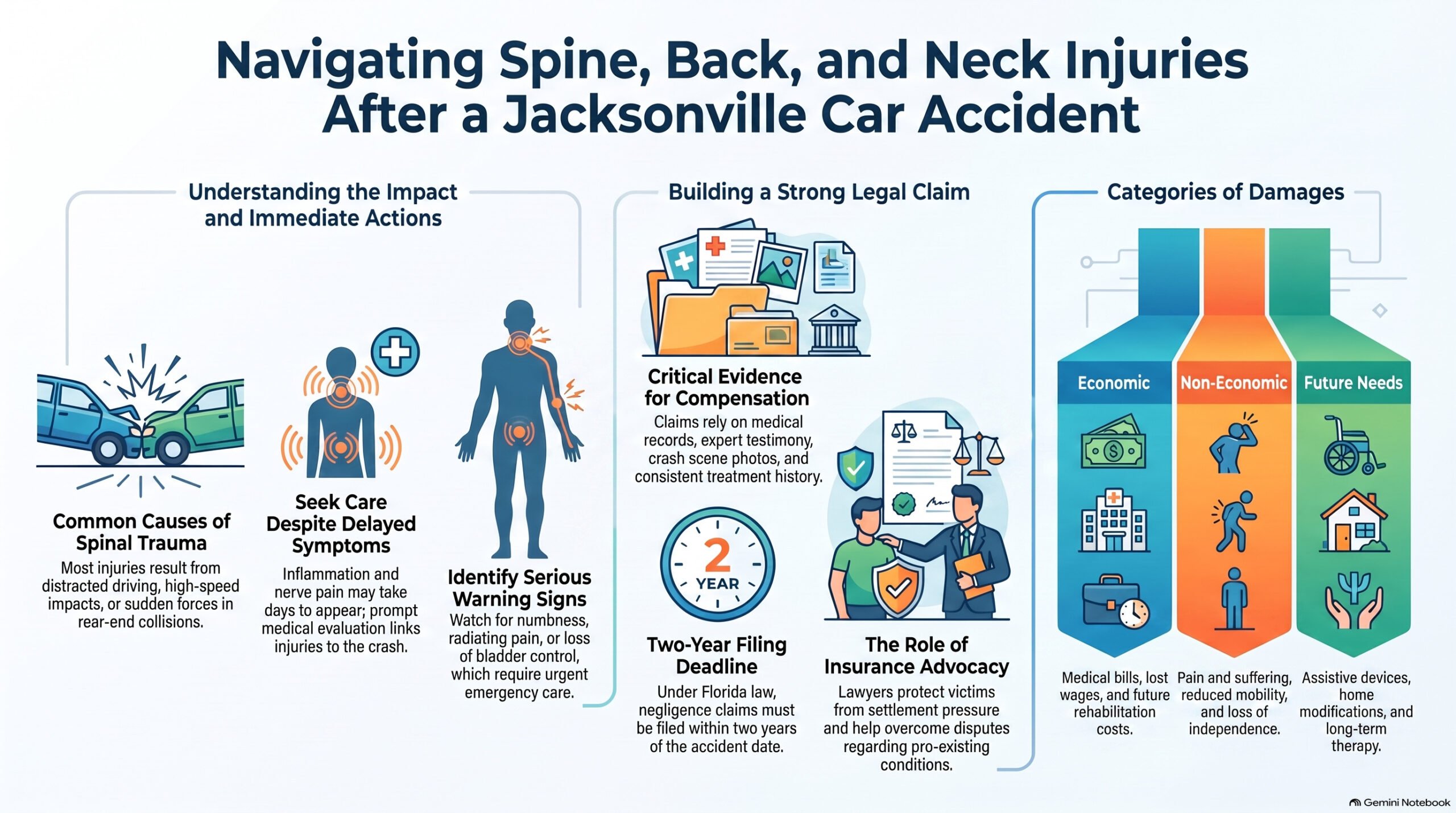


How We Can Help With Your Jacksonville Car Accident Spine, Back & Neck Injury Claim
After a crash causes spine, back, or neck injuries, a Jacksonville car accident lawyer can help protect the injured person’s claim from the earliest stages. The firm may gather crash reports, medical records, witness statements, photographs, and available video before key evidence disappears. It can also communicate with insurers, reducing pressure on the injured person and allowing family members to focus on care, transportation, and daily support.
Legal help may include identifying all responsible parties, such as drivers, vehicle owners, employers, or others whose safety violations contributed to the harm. In cases involving a Bike lane, safety violations may show how poor driving or disregard for vulnerable road users caused severe injury. The lawyer can evaluate damages, document treatment needs, and pursue fair compensation through negotiation or litigation. If a crash results in Wrongful death, wrongful conduct must be examined with care, while the family receives steady guidance through each required legal step.
OUR CONSULTATIONSARE FREE
START YOUR FREE CASE REVIEW

Understanding Jacksonville Car Accident Spine, Back & Neck Injury Cases
When a Jacksonville car accident causes spine, back, or neck trauma, the resulting claim often depends on both medical proof and a clear account of how the collision occurred. These cases may involve herniated discs, nerve compression, soft tissue damage, fractures, or chronic pain that limits work, caregiving, and daily service to family or community. A careful evaluation considers emergency records, diagnostic imaging, expert opinions, therapy notes, and future treatment needs.
Because symptoms may worsen over time, consistent medical care is important. Delays can make it harder to connect the injury to the crash. Surgery outcomes may also affect the value and direction of a claim, particularly when recovery is incomplete or long-term limitations remain. Proper insurance documentation helps show the nature of the injury, the cost of care, lost income, and continuing needs. Strong case preparation helps injured people seek support with dignity, accuracy, and purpose.
Common Causes of Jacksonville Car Accident Spine, Back & Neck
Spine, back, and neck injuries after Jacksonville car accidents often result from forces that abruptly strain or compress the body. Common causes include distracted driving crashes, rear-end collisions, drunk driving accidents, and high-speed impacts, each presenting distinct risks for serious injury. Understanding these causes helps clarify how negligence may contribute to painful, lasting harm.
Distracted Driving Crashes
Distracted driving is a frequent cause of Jacksonville car accidents involving spine, back, and neck injuries because even a brief lapse in attention can prevent a driver from braking, guiding, or reacting in time. Phone distractions, including texting, using navigation, or handling calls, may cause lane deviations, unsafe turns, or delayed recognition of traffic signals. When a vehicle drifts or changes course, occupants may experience sudden forces that strain the cervical, thoracic, or lumbar regions. These injuries can limit mobility, interrupt caregiving duties, and reduce a person’s ability to serve family, patients, clients, or community members. Legal evaluation often focuses on phone records, witness statements, video evidence, and crash patterns to determine whether distraction contributed to the collision and resulting harm. Early documentation supports accurate claims.
Rear-End Collisions
Although often described as minor crashes, rear-end collisions in Jacksonville can cause serious spine, back, and neck injuries because the body may be forced forward and backward with little warning. This sudden motion may damage discs, strain ligaments, irritate nerves, or worsen existing conditions that were previously manageable. Victims who serve families, clients, coworkers, or community members may find daily responsibilities disrupted by pain, stiffness, headaches, or reduced mobility.
Rear-end liability often depends on following distance, speed, roadway conditions, and whether the front driver acted reasonably. Medical documentation, evidence of vehicle damage, witness statements, and crash reports may help clarify fault and the severity of injuries. During insurance negotiation, careful presentation of treatment needs, lost income, and long-term limitations can support a fair evaluation of the claim.
Drunk Driving Accidents
When an impaired driver causes a crash in Jacksonville, the resulting impact may produce severe spine, back, and neck injuries that require immediate medical attention and careful legal evaluation. Alcohol and drugs can slow reaction time, reduce judgment, and prevent a driver from recognizing hazards, placing passengers, pedestrians, and other motorists at serious risk. Sobriety checkpoints and BAC testing may help establish whether intoxication contributed to the collision. Evidence of DUI negligence can support a claim for medical costs, lost income, rehabilitation, and long-term care needs. Impaired driving penalties may also influence related proceedings, although an injury claim remains focused on the harm suffered by the victim. Legal review can help injured individuals protect their rights while seeking accountability, safety, and responsible service to the community.
High-Speed Impacts
High-speed impacts, like impaired driving crashes, can place extraordinary force on the spine, back, and neck, often causing injuries that are not immediately obvious at the scene. When vehicles collide at highway speed, the body may be thrown forward, backward, or sideways with little protection from sudden motion. These impact forces can strain ligaments, damage discs, fracture vertebrae, or aggravate preexisting spinal conditions. Victims may initially focus on helping passengers, speaking with officers, or arranging transportation, while stiffness, numbness, or radiating pain develops later. In Jacksonville, prompt medical evaluation after a severe crash can support both health and documentation. Careful diagnosis helps connect symptoms to the collision, guides treatment, and supports accountability when another driver’s speed caused preventable harm to others within the community.
Don’t Wait. Call Our Florida Personal Injury Lawyers Now!


Legal Rights of Jacksonville Car Accident Spine, Back & Neck Injury Victims
Because spine, back, and neck injuries can affect every part of an accident victim’s daily life, Jacksonville car accident victims should understand the legal rights available to them under Florida law.
These rights may support recovery, accountability, and dignified care for those harmed through another party’s negligence.
- Victims may seek medical care, including pain treatment options, and document how injuries affect work, mobility, and service to family or community.
- They may request a review of insurance coverage to identify available benefits, policy limits, and potential sources of compensation.
- They may pursue damages for medical bills, lost income, reduced earning capacity, and pain and suffering when the evidence supports the claim.
- They may obtain legal representation to handle insurers, preserve records, and file claims within Florida’s deadlines.
These protections help injured people make informed decisions while focusing on recovery, stability, and continued responsibility to those who depend on them after a serious crash.
Why Do Jacksonville Car Accident Spine, Back & Neck Injuries Happen?
Why do spine, back, and neck injuries occur so often in Jacksonville car accidents? These injuries often result from sudden force transferred through the body during a crash. Even at moderate speeds, a collision can cause the head, shoulders, and torso to move in different directions, straining muscles, ligaments, discs, and joints. Whiplash mechanisms are especially common in rear-end impacts, where the neck may rapidly flex and extend beyond its normal range.
Other crashes, including side-impact and rollover collisions, can compress or twist the spine. Seat belts, airbags, and vehicle structures may reduce the risk of fatal injury, yet the body can still absorb damaging energy. Injury symptom timing also varies because inflammation, nerve irritation, and soft-tissue trauma may worsen hours or days later. Understanding these causes helps caregivers, families, and advocates recognize why careful evaluation and informed support matter after serious Jacksonville collisions and protect the injured person’s long-term well-being.
What Should You Do After a Jacksonville Car Accident Spine, Back & Neck Injury?
After a Jacksonville car accident involving spine, back, or neck injuries, prompt action can protect both health and legal rights. An injured person should seek immediate medical care, carefully document symptoms and treatment, and preserve any evidence related to the crash. Consulting a Jacksonville lawyer can help secure that claims are handled properly, deadlines are met, and available compensation is pursued.
Seek Immediate Medical Care
Seek immediate medical attention whenever a Jacksonville car accident may have caused a spine, back, or neck injury, even if symptoms seem mild at first. Prompt evaluation protects health, supports timely Back Treatment, and helps identify conditions that may worsen without care. Medical professionals can assess pain, numbness, weakness, dizziness, limited movement, or radiating symptoms that may signal serious trauma. Certain signs, such as loss of bladder control, difficulty walking, severe headache, or progressive tingling, should be treated as an Emergency Warning requiring urgent care. A person dedicated to family, work, or community service can better continue those responsibilities by addressing injuries early. Delays may allow inflammation, nerve compression, or instability to progress. Immediate care also creates a responsible path toward recovery under qualified medical guidance after a crash.
Document Your Injuries
When a spine, back, or neck injury follows a Jacksonville car accident, careful documentation can preserve important details about symptoms, treatment, and physical limitations. Injury documentation should include medical records, imaging results, prescriptions, discharge instructions, and therapy recommendations. The injured person should also keep copies of appointment summaries and note any missed work, reduced household duties, or limits on caregiving responsibilities.
Pain log keeping can help show how injuries affect daily life over time. Entries should record pain levels, stiffness, numbness, headaches, sleep disruption, mobility problems, and activities that worsen symptoms. Photographs of visible bruising, assistive devices, or vehicle damage may also support the record. Organized documentation allows healthcare providers, insurers, and others reviewing the matter to understand the injury’s progression accurately and respectfully.
Contact a Jacksonville Lawyer
Legal guidance can help an injured person understand how a Jacksonville car accident claim may be affected by medical evidence, insurance communications, and Florida filing deadlines. A lawyer may review Accident documentation, including crash reports, photographs, witness details, treatment records, and work restrictions, to identify gaps that could weaken a claim. This review can support a clearer presentation of spine, back, or neck injuries and their effect on daily service, employment, and caregiving duties.
Counsel may also manage insurance negotiations, helping protect the injured person from statements or settlement pressure that undervalue future care. Prompt contact allows evidence to be preserved and deadlines monitored. For those focused on serving family, community, or workplace responsibilities, legal support can provide structure while recovery and treatment remain primary.
Critical Evidence in a Jacksonville Car Accident Spine, Back & Neck Injury Case
Essential evidence can shape the outcome of a Jacksonville car accident spine, back, and neck injury case by connecting the crash to the claimant’s medical condition and losses.
Essential proof often includes:
1. Medical Records, 2. Accident Scene Evidence, 3. Witness Statements, and 4. Expert Medical Testimony.
Each category helps establish liability, causation, and the full extent of injury-related damages.
Medical Records
In a Jacksonville car accident case involving spine, back, or neck injuries, medical records often serve as the foundation for proving the nature, severity, and progression of the injury. These records may include emergency evaluations, diagnostic imaging, physician notes, therapy plans, prescriptions, surgical reports, and follow-up assessments. When organized carefully, they help show how the condition affected mobility, work capacity, caregiving duties, and daily service to others. They also support damage calculations by documenting treatment costs, future care needs, and lasting limitations. Although medical records do not establish Independent liability on their own, they link the collision to the claimed physical harm. A consistent treatment history can strengthen credibility, while gaps or conflicting notes may require careful explanation by qualified medical and legal professionals.
Accident Scene Evidence
When a collision causes spine, back, or neck injuries, accident scene evidence can help explain how the impact occurred and why the resulting forces were capable of causing serious harm. Skid marks, vehicle resting positions, debris fields, roadway defects, traffic signals, and weather conditions may clarify speed, direction, and point of contact. Photographic documentation taken soon after the crash can preserve details that cleanup, repairs, or changing conditions may erase. In a Jacksonville injury case, such evidence may connect visible damage to the medical findings and support a careful evaluation of liability. It can also assist with insurance negotiation by showing the severity of the crash in objective terms. Prompt collection helps protect the injured person’s interests and supports a fair, service-focused pursuit of accountability.
Witness Statements
Physical evidence from the crash scene often gains greater meaning when paired with reliable witness statements. In Jacksonville spine, back, and neck injury cases, witnesses may describe the vehicle’s speed, the impact direction, traffic signals, driver behavior, or visible pain immediately after the collision. These accounts can support a careful reconstruction of events and help clarify disputed facts for insurers, judges, or juries.
Attorneys serving injured clients evaluate eyewitness credibility by examining consistency, vantage point, lighting, distractions, and any relationship to the parties. Prompt interviews preserve details before memories fade, while written or recorded statements may guide later deposition preparation. When witnesses appear sincere, observant, and unbiased, their testimony can strengthen accountability and help present a truthful, service-focused claim for compensation after a serious crash.
Expert Medical Testimony
Because spinal and neck injuries are often complicated, professional medical testimony can be essential in proving how a Jacksonville car accident caused or worsened a claimant’s condition. Physicians, surgeons, radiologists, and medical experts may explain diagnoses, imaging results, treatment needs, pain limitations, and future care requirements. Their opinions can help connect trauma to herniated discs, nerve damage, chronic pain, or reduced mobility, especially when insurers dispute causation.
Expert witness selection should focus on credentials, clinical experience, and the ability to communicate clearly to a jury. Careful deposition preparation also helps make sure the expert presents findings accurately, addresses preexisting conditions, and responds to defense challenges with confidence. When developed responsibly, this testimony supports fair compensation and helps injured people access the resources needed for recovery and daily stability.
Long-Term Effects of Jacksonville Car Accident Spine, Back & Neck Injuries
Spine, back, and neck injuries from Jacksonville car accidents may produce lasting consequences, including chronic pain that interferes with daily function and work capacity. Reduced mobility can develop over time, particularly when soft-tissue damage, disc injuries, or nerve involvement limit movement and physical endurance. Future medical needs may include ongoing treatment, rehabilitation, medication, or expert care, making long-term impact a central issue in evaluating these claims.
Chronic Pain Complications
Chronic pain can become one of the most serious long-term complications after a Jacksonville car accident involving the spine, back, or neck. Persistent pain may continue for months or years, affecting sleep, concentration, employment, and a person’s ability to care for family or serve the community. When symptoms remain after initial treatment, medical evaluation helps identify whether nerve irritation, disc injury, soft tissue damage, or joint trauma is contributing to ongoing suffering.
For legal and medical purposes, pain duration should be carefully tracked through treatment records, physician notes, therapy reports, and personal journals. This documentation can help demonstrate how the condition developed, persisted, and required continuing care. Clear records also support fair assessment of future treatment needs, lost income, and the broader impact of chronic pain.
Reduced Mobility Risks
Reduced mobility is a serious long-term risk after a Jacksonville car accident involving spine, back, or neck injuries. Limited movement may affect walking, lifting, driving, working, and assisting family or community members who depend on reliable support. Stiffness, nerve irritation, muscle weakness, and reduced range of motion can make ordinary tasks difficult, even when pain levels vary from day to day. These limitations may also increase the risk of falls, reduce independence, and place additional strain on caregivers.
Vehicle safety behaviors, including proper seat position, consistent restraint use, and attentive driving, may help reduce the chance of severe trauma. After an injury, recovery planning steps should address mobility limits, daily responsibilities, workplace demands, and transportation challenges. Careful documentation helps show how reduced function affects service, livelihood, and quality of life.
Future Medical Needs
Mobility limits often reveal only part of the lasting burden created by Jacksonville car accident spine, back, and neck injuries. Ongoing pain, nerve damage, reduced strength, and recurring inflammation may require years of medical attention, even after initial treatment ends. Future care planning helps injured individuals, families, and advocates identify necessary physician visits, imaging studies, medication management, injections, assistive devices, and possible surgical care. These needs should be evaluated with care, because overlooked treatment can place added strain on caregivers and community support systems. Rehabilitation costs may also continue through physical therapy, occupational therapy, work conditioning, and home modification services. When long-term medical needs are clearly documented, those serving the injured can more effectively pursue resources that protect health, dignity, stability, and daily functioning over time.
Don’t Wait. Call Our Florida Personal Injury Lawyers Now!
Proving Liability in Jacksonville Car Accident Spine, Back & Neck Injury Cases
When a Jacksonville car accident causes spine, back, or neck injuries, proving liability requires a careful showing of how the collision occurred and why another party should be held legally responsible. Evidence may include police reports, witness statements, photographs, medical records, and expert analysis explaining vehicle movement, impact forces, and injury patterns. For those committed to serving injured people, this process helps ensure accountability is based on facts, not assumptions.
Comparative negligence may also affect recovery if the injured person is found partly responsible for the crash. In disputed cases, a jury can determine fault, credibility, and the weight of competing evidence. Causation proof is especially important with spinal, back, and neck conditions, because the record must connect the collision to the diagnosed injury. Once responsibility is established, damages calculation considers medical care, lost income, physical limitations, and the broader effect on daily life and future well-being.
Dealing With Insurance Companies After a Jacksonville Car Accident Spine, Back & Neck Injury
After a Jacksonville car accident results in spine, back, or neck injuries, insurance companies often begin evaluating the claim before the injured person fully understands the medical prognosis. Adjusters may request recorded statements, seek broad medical authorizations, or question whether symptoms are related to the crash. Because these injuries can affect mobility, work capacity, and daily service to family or community, communications should be handled with care and accuracy.
Property damage discussions may also shape how insurers view the injury claim, even when vehicle damage does not reflect the force placed on the body. Medical insurance denials can further complicate access to treatment, especially when diagnostic testing, therapy, or consultation care is delayed. A lawyer can help ensure that insurers receive the necessary information without allowing speculation, incomplete records, or misunderstood comments to weaken the claim. Careful guidance supports a fair evaluation while protecting the injured person’s dignity, recovery, and financial stability.
What to Expect During a Jacksonville Car Accident Spine, Back & Neck Injury Claim Process
A Jacksonville car accident spine, back, and neck injury claim typically begins with an initial medical evaluation, followed by careful evidence collection and documentation. The process often includes insurance claim negotiations, where liability, treatment costs, lost income, and long-term impairment may be disputed. If a fair settlement is not reached, the claim may proceed toward litigation, where the injured person’s damages are presented through formal legal channels.
Initial Medical Evaluation
During the initial medical evaluation, a Jacksonville car accident victim is typically assessed for spine, back, and neck injuries that may not be fully apparent immediately after the collision. Medical providers may review pain levels, range of motion, neurological symptoms, and functional limitations to identify conditions requiring prompt care. This evaluation can include physical examination, imaging referrals, and questions about numbness, headaches, stiffness, or radiating pain.
For those serving the injured person, careful attention to symptom tracking helps communicate changes clearly and supports appropriate treatment planning. Providers may recommend follow-up appointments to monitor recovery, adjust care, and determine whether additional clinicians are needed. Early evaluation also helps reduce the risk of overlooked injuries, allowing the victim to pursue healing with informed guidance and timely medical support.
Evidence And Documentation
When a spine, back, or neck injury claim is being developed, evidence and documentation help establish what happened, how the collision caused harm, and the extent of the injured person’s losses. Medical records, diagnostic imaging, physician notes, prescriptions, and therapy reports may show the nature of the injury and the care required. Photographic evidence of vehicle damage, visible injuries, roadway conditions, and safety hazards can preserve details that may later fade or change. Timeline documentation is also important and should include the date of the crash, symptom progression, treatment visits, missed work, and daily limitations. Witness statements, police reports, and employment records may further support the claim. Careful organization allows advocates to present the injured person’s experience accurately and respectfully, with the diligence needed to serve justice.
Insurance Claim Negotiations
After the evidence has been gathered and the medical picture is better understood, insurance claim negotiations often become the next major stage in a Jacksonville car accident spine, back, or neck injury matter. During this phase, adjusters review treatment records, wage information, crash reports, and any Disputed liability evidence that may affect fault. A lawyer may present the claim in a structured demand letter, explaining how the injury limits daily activities, employment, caregiving, and community responsibilities. Insurers may respond with questions, lower evaluations, or stated reasons for coverage denial, all of which require careful review. The process often involves clarifying medical causation, addressing prior conditions, and correcting assumptions in incomplete claims. Thorough negotiation helps protect the injured person’s dignity while pursuing fair compensation through documented, disciplined advocacy. Counsel also monitors deadlines and communications.
Settlement Or Litigation
If negotiations do not resolve the claim, the injured person and counsel may evaluate whether settlement remains reasonable or litigation is necessary. This decision often turns on liability disputes, medical proof, available insurance, and the long-term effect of spine, back, or neck injuries. A careful Trial settlement strategy helps determine whether filing suit may increase accountability or whether further dialogue can protect the client’s recovery.
During this stage, negotiation and evidence preparation remain crucial. Counsel may organize treatment records, expert opinions, wage loss documentation, and witness accounts to show how the crash changed daily life and caregiving responsibilities. Litigation can involve pleadings, discovery, depositions, mediation, and, if needed, trial. Each step should serve a clear purpose, preserving dignity while pursuing fair compensation.
Compensation for Jacksonville Car Accident Spine, Back & Neck Injury Damages
Because spine, back, and neck injuries can affect nearly every part of an accident victim’s daily life, compensation in a Jacksonville car accident claim may extend well beyond the initial emergency room bill. A careful claim may cover ambulance care, diagnostic imaging, expert visits, medications, therapy, injections, surgery, assistive devices, and necessary household support. It may also address reduced earning capacity when pain, limited mobility, or neurological symptoms prevent a return to prior work.
Calculating future losses requires attention to medical opinions, recovery timelines, work history, and the likelihood of ongoing care. For those committed to helping injured people rebuild, this process supports decisions grounded in evidence rather than assumption. Proving non-economic damages may involve documenting daily limitations, sleep disruption, loss of independence, and the effect of pain on family responsibilities. Thorough records, consistent treatment, and credible testimony can help present the full measure of harm caused by the collision.
Economic vs Non-Economic Damages in Jacksonville Car Accident Spine, Back & Neck Cases
In Jacksonville car accident spine, back, and neck injury cases, damages are often divided into economic and non-economic categories. Economic damages may include medical bills, rehabilitation expenses, and lost income claims for time away from work. Non-economic damages address less tangible harm, including pain and suffering, physical limitations, and the broader impact on daily life.
Medical Bills And Costs
Calculating damages in a Jacksonville car accident spine, back, or neck case requires a clear distinction between economic losses and non-economic harm. Medical bills and related costs fall within economic damages because they can be documented through records, invoices, and provider statements. These expenses may include emergency care, diagnostic imaging, surgery, hospitalization, medication, physical therapy, injections, assistive devices, and future treatment planning. Accurate documentation helps attorneys present the financial burden with precision and accountability. In settlement negotiations, verified medical costs can support fair compensation discussions and reduce uncertainty. In trial strategy, organized billing evidence may help explain the extent of necessary care without relying on speculation. This careful approach serves injured individuals by seeking recovery for measurable losses, while respecting the broader purpose of responsible legal advocacy.
Pain And Suffering
Medical bills can document the financial cost of a spinal, back, or neck injury, but they do not fully capture the personal impact of ongoing pain, physical limitation, and diminished daily function. In Jacksonville car accident cases, pain and suffering damages address these non-economic harms with careful attention to evidence and context. Chronic discomfort, reduced mobility, sleep disruption, and emotional distress may affect a person’s ability to care for family, assist others, or participate in community life. When an injury results in long-term disability, the assessment may consider how persistent limitations affect independence, dignity, and ordinary routines. Attorneys and insurers often review medical records, physicians’ opinions, therapy notes, and credible personal accounts to evaluate these losses fairly and distinguish them from direct economic costs.
Lost Income Claims
When a spine, back, or neck injury prevents an injured person from working, lost income claims may become a significant part of the economic damages analysis. These claims may include missed wages, reduced hours, lost bonuses, diminished earning capacity, or lost self-employment income. Claim documentation is critical and includes pay records, tax returns, employer statements, medical restrictions, and evidence showing how the injury limited job duties. For those who serve families, clients, patients, or the community, time away from work can create financial strain while interrupting important responsibilities. A Jacksonville car accident attorney may evaluate employment history, medical opinions, and future work limitations to present a clear damages calculation. Accurate proof supports settlement negotiation and helps distinguish measurable income losses from non-economic harms such as pain, discomfort, and emotional distress.
Don’t Wait. Call Our Florida Personal Injury Lawyers Now!
When a Jacksonville Car Accident Spine, Back & Neck Injury Case Goes to Trial vs Settlement
Although many Jacksonville car accident spine, back, and neck injury claims resolve through settlement, some cases require trial when liability, causation, or the value of damages remains disputed. Settlement factors often include medical evidence, diagnostic imaging, treatment history, expert opinions, lost income, pain and limitations, and the insurance carrier’s risk evaluation. A careful resolution can spare injured individuals added stress while still honoring their need for fair support.
When settlement discussions do not yield a just outcome, litigation may proceed to trial. The Trial timeline may include filing suit, discovery, depositions, medical examinations, mediation, pretrial motions, and courtroom presentation. Throughout this process, attorneys assess whether a trial serves the injured person’s long-term interests or whether continued negotiation may provide greater stability. Trial can offer accountability when an insurer undervalues serious spinal harm, but it also involves uncertainty, time, and emotional strain. Each path requires disciplined preparation.
Florida Laws That May Affect Your Jacksonville Car Accident Spine, Back & Neck Case
Because Florida law controls many parts of a Jacksonville car accident spine, back, and neck injury claim, an injured person’s rights may depend on strict deadlines, insurance rules, and fault determinations.
These laws can shape how medical bills, lost income, and long-term care needs are evaluated after a serious collision.
- No-fault benefits may provide initial payment for necessary treatment, regardless of who caused the crash.
- Insurance coverage limits can affect available compensation, especially when spinal injuries require ongoing therapy or surgery.
- Comparative negligence may reduce recovery if the injured person is found partly responsible for the accident.
- Serious injury rules may influence whether a claim can proceed beyond personal injury protection benefits.
A careful legal review helps ensure that evidence, medical records, and witness accounts are presented accurately. For those committed to serving injured people, understanding these rules supports fair advocacy and responsible case preparation.
The Statute of Limitations for Jacksonville Car Accident Spine, Back & Neck Injury Cases
After a Jacksonville car accident causes a spine, back, or neck injury, the statute of limitations sets a strict deadline for filing a lawsuit. In Florida, most negligence claims arising from motor vehicle crashes must be filed within two years of the accident date. Missing this deadline can prevent recovery, even when injuries are serious and service to an injured person’s household or community has been disrupted.
Timely action also supports the preservation of evidence, including crash reports, witness statements, vehicle data, and medical records. These materials may affect Comparative negligence issues, where fault is divided among the parties. Delays can also complicate damage calculation, especially when ongoing treatment, lost income, reduced mobility, and future care needs must be evaluated. Accurate medical billing records are important because they help show the cost of treatment and the financial effect of the injury. Deadline awareness protects a claim’s value and supports orderly resolution.
How a Jacksonville Car Accident Spine, Back & Neck Lawyer Can Help You
Meeting legal deadlines is only one part of protecting a spine, back, or neck injury claim after a Jacksonville car accident. A lawyer can coordinate the evidence, medical documentation, and financial details needed to present the claim carefully, especially when an injured person is focused on recovery and family responsibilities.
- Case investigation: The lawyer reviews crash reports, witness accounts, vehicle damage, and medical records to identify fault and preserve helpful evidence.
- Medical documentation: Care providers’ findings are organized to support the evaluation of pain, treatment needs, physical limitations, and the long-term effects of the injury.
- Damages calculation: Lost income, medical bills, future care, reduced function, and daily hardships are measured accurately and supported by records.
- Insurance advocacy: The lawyer develops settlement strategies, builds negotiation leverage, responds to insurer defenses, and seeks a resolution that reflects the harm done while serving the client’s future stability.
When to Contact a Jacksonville Car Accident Spine, Back & Neck Lawyer
When pain, stiffness, numbness, or mobility problems develop following a Jacksonville car accident, legal guidance should be considered as soon as the injury is recognized. Early contact is important because post-accident symptoms involving the spine, back, or neck may appear gradually, then interfere with work, caregiving, and daily responsibilities. A prompt consultation can help injured individuals protect their records, understand reporting deadlines, and avoid unnecessary delays in insurance claims.
Legal contact is especially appropriate when medical care is ongoing, diagnostic testing is recommended, symptoms spread into the arms or legs, or headaches and limited motion persist. The pain escalation timeline should be documented carefully, including when discomfort began, how it changed, and how it affected service to family, patients, clients, or the community. If an insurer requests statements, questions treatment, or delays communication, timely legal guidance may help preserve the person’s ability to pursue appropriate recovery under Florida law.
Why You Need an Experienced Jacksonville Car Accident Spine, Back & Neck Lawyer
Prompt legal contact can protect an injured person’s position, but the quality of that guidance often determines how effectively a spine, back, or neck injury claim is developed. Experienced counsel understands how these injuries may affect mobility, work, caregiving, and daily service to family or community. That perspective helps connect medical findings, treatment needs, and long-term limitations to the legal claim.
A seasoned Jacksonville lawyer also recognizes Insurance negotiation tactics that may minimize pain, delay treatment approval, or dispute causation. Skilled representation can respond with organized medical records, expert input, and careful documentation of losses. Early evidence-preservation steps, including securing crash reports, witness accounts, vehicle damage records, and any available video, can prevent key facts from disappearing.
Spine, back, and neck cases often require disciplined claim development because symptoms may evolve over time. Experienced advocacy helps ensure the injured person’s needs are presented clearly, responsibly, and with the seriousness the injury merits.
How to Choose the Right Jacksonville Car Accident Spine, Back & Neck Lawyer for Your Case
Although many attorneys handle car accident claims, a spine, back, or neck injury case often requires a lawyer with focused experience in serious injury litigation, medical documentation, and contested causation issues. The right attorney should understand how these injuries affect mobility, work, caregiving duties, and daily service to family or community. Careful evaluation of prior case experience, trial readiness, and familiarity with orthopedic, neurologic, and diagnostic evidence can help identify qualified counsel.
Prospective clients should also consider Client communication, including whether the lawyer explains the case strategy, provides regular updates, and responds with respect during difficult recovery periods. Fee transparency is equally important, since injured individuals should know how costs, contingency fees, and litigation expenses may be handled before making decisions. A suitable Jacksonville lawyer should show organized case preparation, compassion without overpromising, and a commitment to pursuing compensation that supports medical care, stability, and continued ability to serve others.
About The Law Offices of Anidjar & Levine
Selecting counsel for a serious spine, back, or neck injury case often leads injured individuals to review firms with a clear record in car accident litigation and client-focused representation.
The Law Offices of Anidjar & Levine serves Jacksonville clients by providing organized legal support after collisions that cause life-altering injuries.
The firm’s work commonly begins with a Client consultation, where attorneys assess medical concerns, liability issues, insurance coverage, and immediate needs.
Its attorneys develop a case strategy tailored to each claimant’s circumstances, with attention to treatment history, lost income, and long-term limitations.
Evidence gathering may include crash reports, medical records, witness statements, photographs, and expert evaluations.
The firm also clearly addresses attorney fees, helping clients understand financial expectations before representation proceeds.
Through structured communication and diligent advocacy, the firm aims to reduce burdens on injured people, allowing them and their families to focus on recovery, stability, and continued service to their communities.

Frequently Asked Questions
Can Chiropractic Treatment Affect My Jacksonville Spine Injury Claim?
Yes, chiropractic treatment can affect a Jacksonville spine injury claim. Chiropractic documentation may help demonstrate injury severity, symptom length, and functional restrictions when supported by clear medical proof. Treatment consistency is important because gaps in care may allow insurers to question causation or the need for recovery. A person seeking fair compensation should follow prescribed care, record changes accurately, and ensure records reflect how the injury affects daily responsibilities and service to others.
Should I See a Specialist for Neck or Back Pain?
Yes, a person with persistent neck or back pain should see a medical expert promptly. To serve health, family, and community responsibilities, he or she should choose a clinician, such as an orthopedist, neurologist, or spine physician, when symptoms radiate, worsen, or limit daily function. A clinician can document injuries, order appropriate imaging, aid recovery, and identify serious conditions that general care may not address in a timely and precise manner.
Can Pre-Existing Spine Conditions Impact My Case?
Yes, pre-existing spine conditions can impact a case, but they do not necessarily prevent recovery. The central issue is medical causation, including whether the crash aggravated or worsened prior problems. Strong injury documentation helps distinguish old symptoms from new harm. Comparative fault may also affect compensation, depending on the facts. Available insurance coverage further shapes recovery options, so careful evaluation supports responsible advocacy and fair service to the injured person.
How Long Do Car Accident Back Injuries Take to Heal?
Car accident back injuries may mend within weeks, yet serious strains, disc injuries, or nerve involvement can require months. Typical recovery depends on diagnosis, medical imaging, symptom progression, and adherence to the treatment timeline. A careful provider documents pain, mobility limits, and response to therapy, helping others understand needed care. Delayed or worsening symptoms require prompt evaluation, since early treatment often preserves function and supports a clearer assessment of recovery.
What if My Symptoms Appeared Days After the Crash?
Symptoms appearing days after a crash may still be related, because delayed symptom onset is common with soft tissue, disc, or nerve injuries. The injured person should seek prompt medical care, document each symptom, and avoid assumptions that pain is minor. A second injury assessment may help identify worsening conditions or intervening harm. Careful evaluation supports treatment, protects others from added risk, and preserves accurate records for any claim.
—————————
Spine, back, and neck injuries after a Jacksonville car accident can lead to serious medical, financial, and legal challenges.
A qualified Jacksonville Personal Injury Lawyer can evaluate liability, document damages, address insurance disputes, and pursue appropriate compensation under Florida law.
The Law Offices of Anidjar and Levine provide focused representation for injured victims seeking accountability and recovery.
Prompt legal guidance may help protect important rights, preserve evidence, and support a stronger claim during a difficult and consequential period.