Florida’s roads are most dangerous when the celebrations are loudest. If a July 4th crash disrupted your life, we move quickly to protect your rights and preserve the evidence that matters most.
Independence Day in Florida is marked by vibrant celebrations, from sun-soaked afternoons on Clearwater Beach and Key West to spectacular evening fireworks displays over downtown Miami, Orlando, and Jacksonville. However, because the Sunshine State is a premier holiday destination, our roadways and pedestrian corridors become some of the most hazardous in the nation during the July 4th holiday period. The volatile combination of heavy out-of-state tourist traffic, crowded coastal thoroughfares, and late-night festivities unfortunately leads to a predictable spike in severe car crashes and tragic pedestrian accidents.
If you or a loved one has been hurt in a car or pedestrian accident during the July 4th holiday, taking immediate, deliberate action is critical. Navigating Florida’s unique insurance statutes and establishing liability requires a swift response. Knowing exactly what to do can protect your health and safeguard your right to financial recovery.
Seeking guidance from an experienced advocate, like the legal team at The Law Offices of Anidjar & Levine, can make all the difference in the trajectory of your claim.
Contact one of our Florida Personal Injury Lawyers today!
Florida July 4th Accident Statistics: Why Holiday Roads Are Among the Deadliest
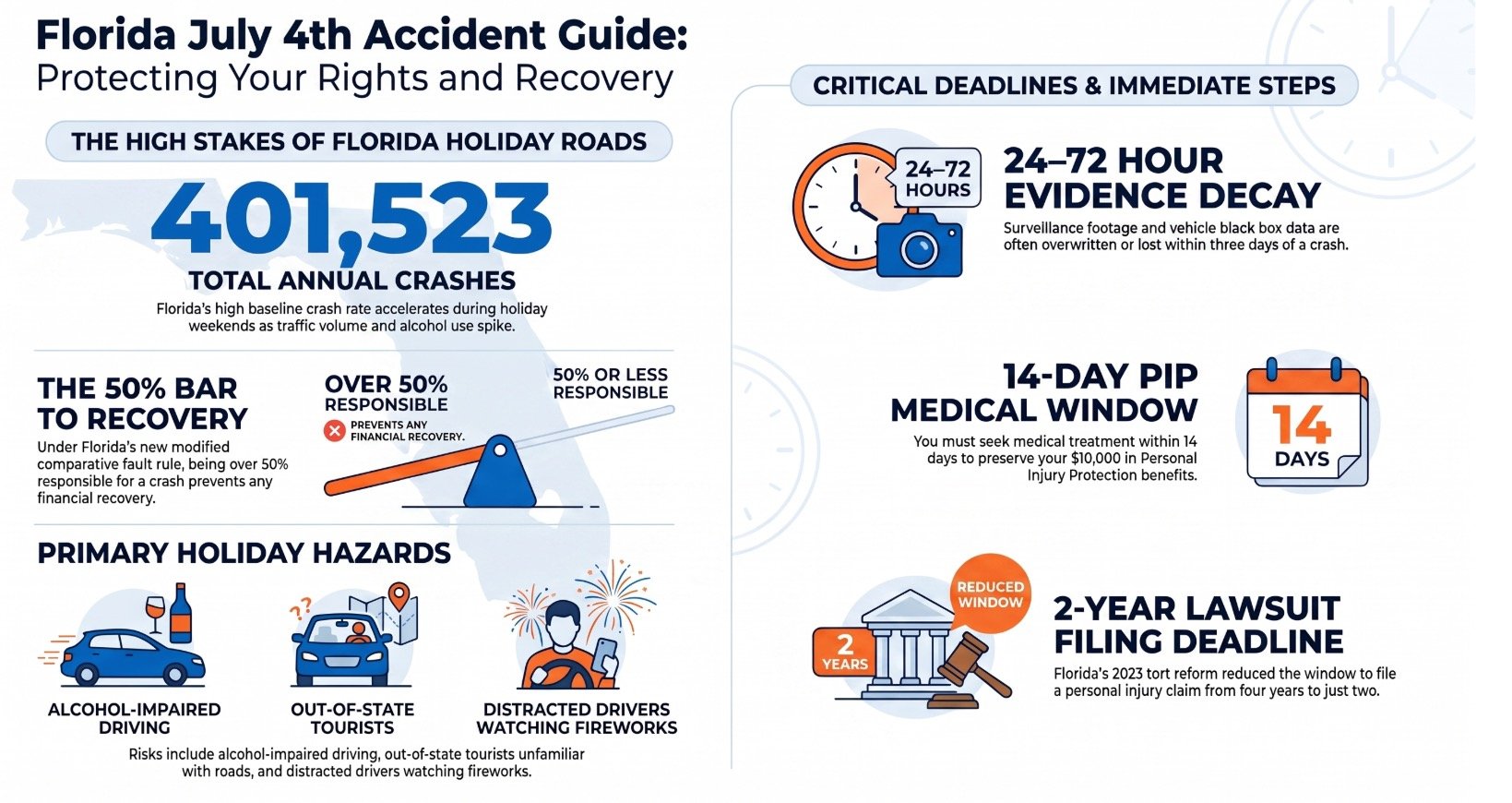
The numbers behind the July 4th crash risk in Florida tell a sobering story. According to the FLHSMV 2022 Florida Traffic Crash Facts, Florida recorded 401,523 total crashes statewide in 2022, resulting in more than 253,888 documented injuries and 3,535 fatalities. The July 4th holiday period consistently ranks among the most dangerous times of the year nationally. NHTSA data shows 3,308 people died in distracted driving crashes in 2022 alone, and the July 4th weekend combines peak distraction with heavy alcohol consumption — a particularly dangerous combination.
According to the Insurance Institute for Highway Safety (IIHS), approximately 30% of all U.S. traffic fatalities involve alcohol-impaired drivers, and that percentage spikes significantly during major holiday weekends. For injured people in Florida, two additional legal deadlines make acting quickly non-negotiable: PIP benefits require treatment within 14 days of the crash, and Florida’s 2023 tort reform (HB 837) reduced the personal injury lawsuit filing window to just 2 years.
Why the 4th of July is Exceptionally Dangerous on Florida Roads
Statistically, the Fourth of July weekend is consistently ranked by the National Safety Council (NSC) among the deadliest holiday periods on American roads.
In Florida, these risks are compounded by specific regional and demographic factors:
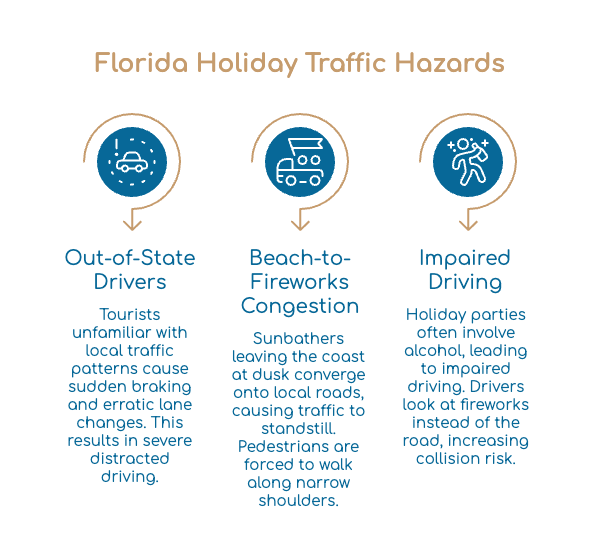
- Influx of Out-of-State Drivers: Florida welcomes millions of holiday tourists who are unfamiliar with local traffic patterns, complex highway splits, and changing lane configurations. This unfamiliarity frequently results in sudden braking, erratic lane changes, and severe distracted driving.
- The “Beach-to-Fireworks” Congestion: As sunbathers leave the coastline at dusk and converge onto local causeways, bridges, and city grids to view fireworks, traffic reaches a standstill. Pedestrians are frequently forced to walk along narrow shoulders or cross poorly lit coastal roadsides, placing them directly in the path of oncoming traffic.
- Impaired Driving After Dark: Holiday cookouts and beach parties often involve alcohol. When drivers get behind the wheel impaired — while simultaneously looking up at fireworks displays rather than focusing on the road ahead — the risk of a catastrophic high-speed collision or a devastating pedestrian impact skyrockets.
If you find yourself facing the aftermath of a holiday collision, remember that you do not have to fight the insurance companies alone. Reaching out to The Law Offices of Anidjar & Levine early ensures that critical evidence is preserved before it disappears.
Critical Steps to Take Immediately After a Florida Holiday Accident
The minutes and hours following an accident are chaotic, but establishing a clear record of the event is vital for your subsequent personal injury claim.
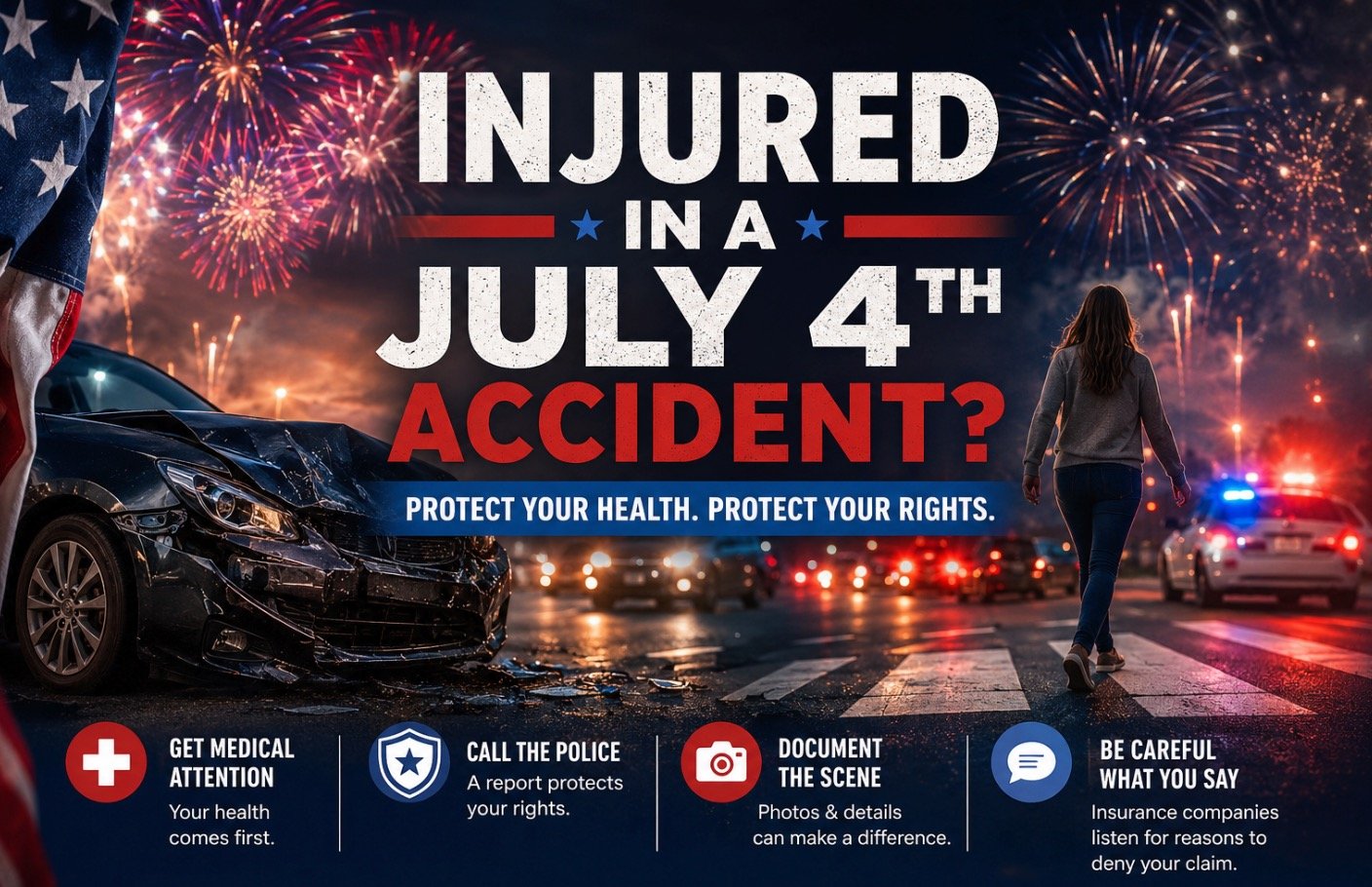
Adhere to the following steps to protect your physical and financial well-being:
1. Seek Immediate Medical Attention (The 14-Day PIP Window)
Your health is the absolute priority. Due to the rush of adrenaline during a crash, severe injuries like whiplash, internal bleeding, soft tissue tears, or concussions may not manifest symptoms until hours or days later. From a legal standpoint, Florida operates under a strict no-fault insurance system. You must receive a formal medical evaluation within 14 days of the crash to utilize your Personal Injury Protection (PIP) benefits. Failing to do so can forfeit your medical coverage entirely.
For a full explanation of how Florida’s no-fault system works and what your PIP covers, read: Florida PIP Insurance Explained.
2. Contact Law Enforcement Immediately
Always dial 911 to bring local police, county sheriffs, or the Florida Highway Patrol (FHP) to the scene. A formal police report provides an objective, third-party narrative of the incident, documenting vehicle positioning, road conditions, citations issued, and initial determinations of fault. This report serves as a cornerstone of your legal counsel when negotiating with stubborn insurance adjusters.
3. Document the Scene and Gather Evidence
If you are physically able, use your smartphone to capture extensive photographic and video evidence. Photograph vehicle damage, skid marks, traffic signals, crosswalk configurations, lighting conditions, and your visible injuries. Additionally, collect the names, phone numbers, and insurance details of all drivers involved, as well as contact information from any independent bystanders who witnessed the event.
For guidance on why complete documentation protects your claim, read: Why Medical Records Matter in Personal Injury Cases.
4. Watch Your Words
Avoid apologizing, expressing guilt, or making casual statements like “I did not see the other car” or “I think I am okay.” Insurance adjusters routinely use these statements later to shift liability or argue that your injuries were not serious. Direct all substantive communications to your attorney as soon as possible.
5. Preserve Vehicle Event Data Recorder (EDR) Evidence
Most passenger vehicles manufactured after 2012 contain an Event Data Recorder (EDR) — commonly called a black box — that captures speed, braking, throttle position, and seatbelt status in the seconds before impact. In July 4th accidents where an insurer claims you were speeding, accelerating, or did not brake, the EDR of the at-fault vehicle can prove exactly what that driver was doing at the moment of the crash. This data can be overwritten once the ignition is cycled, so preservation letters must be sent immediately to the vehicle owner, their insurer, and any towing or repair facility.
For more on how this evidence protects your claim, read: How Black Box Data Can Help Your Car Accident Case.
Contact one of our Florida Personal Injury Lawyers today!
Understanding Florida’s Complex Insurance Rules
Navigating an accident claim in Florida requires an understanding of how insurance coverage interacts with state law, particularly during a high-volume holiday weekend:
The “Serious Injury” Threshold: Because Florida is a no-fault state, your own PIP coverage is designed to pay for the first 80% of your necessary medical expenses and 60% of lost wages, capped at $10,000. However, holiday accidents often cause catastrophic injuries that easily exceed this limit. To step outside the no-fault system and file a third-party personal injury lawsuit against the at-fault driver for full pain and suffering damages, your injuries must meet Florida’s legal definition of “serious” — such as a permanent injury, significant and permanent scarring, or the loss of an important bodily function.
Modified Comparative Fault (HB 837): Florida follows a modified comparative fault rule. If an insurance company can prove that you were partially to blame for the accident — for example, if a pedestrian was walking outside a designated crosswalk or wearing dark clothing at night, or if a driver was traveling slightly over the speed limit — your total compensation will be reduced by your percentage of fault. If you are found to be more than 50% at fault, you are completely barred from recovering any damages from the other party. This makes securing skilled legal representation essential to fight back against unfair blame-shifting tactics. For a full breakdown of how compensation is calculated in Florida accident cases, read: Average Car Accident Settlement in Florida.
About The Law Offices of Anidjar & Levine
Founded in 2005 by Marc Anidjar and Glen Levine, the firm began as a two-person operation working out of a construction office conference room. Over the past 20 years, that modest start has grown into one of Florida’s most recognized personal injury practices — with more than $1 billion recovered in settlements for injury clients across the state. We bring that same determination and depth of experience to every case we handle.
The Law Offices of Anidjar & Levine represents injured people across Florida with a focus on responsive service, thorough case preparation, and strong advocacy. We understand that a holiday accident can disrupt your health, finances, and family stability all at once. Our team handles insurance communication, evidence preservation, medical documentation, and claim preparation so you can focus entirely on your recovery. We are available to guide you through every stage of the process, from your first call through final resolution.
Past results do not guarantee a similar outcome in future cases. Each case is evaluated individually based on its unique facts and circumstances.
Real Reviews From Our Clients!
Evan Cadet ★★★★★
“After my accident, I had no idea what to do or where to turn. Anidjar & Levine took over from the very beginning — they handled the insurance company, kept me informed at every step, and made sure I received the care I needed. I could not have navigated this without them. Truly exceptional representation.”
Stephen P. ★★★★★
“The team at Anidjar & Levine was professional, compassionate, and thorough. They worked hard to build my case and never stopped fighting for a fair result. Every time I had a question, someone was available to answer it. I highly recommend them to anyone dealing with a car accident claim in Florida.”
Anna T. ★★★★★
“I was seriously hurt and overwhelmed by the process. Anidjar & Levine handled everything — the medical documentation, the insurance negotiations, and the legal strategy. They treated me like a priority, not a case number. The outcome exceeded my expectations, and I am grateful for everything they did.”
Frequently Asked Questions
What Should I Do If I Am Hurt in a Florida July 4th Car Accident?
Seek medical attention immediately — even if your injuries seem minor, adrenaline can mask serious trauma. Call 911 so law enforcement creates an official crash report. Document the scene with photos, collect driver and witness information, and avoid making any statements about fault. Contact an attorney as soon as possible to preserve time-sensitive evidence like surveillance footage and vehicle EDR data, which can disappear within 24 to 72 hours.
Can I Recover Compensation If a Drunk Driver Hit Me on July 4th in Florida?
Yes. If a drunk driver caused your injuries, you may recover compensation beyond Florida’s PIP no-fault limits by pursuing a claim against the at-fault driver directly. Because impaired driving is a serious safety violation, the evidence of intoxication — including the crash report, field sobriety results, BAC readings, and witness statements — can significantly strengthen your liability case. An experienced attorney can help preserve this evidence and pursue full compensation for medical bills, lost income, and pain and suffering.
What Is Florida’s 14-Day PIP Rule and Why Does It Matter After a Holiday Crash?
Florida’s Personal Injury Protection (PIP) law requires that you seek medical treatment within 14 days of your accident to preserve your coverage benefits. If you wait longer, you may lose access to your $10,000 in PIP benefits entirely — even if your injuries were real and documented. After a July 4th crash, emergency rooms are busy, and delays are common, making it critical to be seen by a licensed provider as quickly as possible and to document your visit properly.
What Evidence Should I Preserve After a July 4th Pedestrian Accident?
Preserve as much physical and digital evidence as possible, immediately. This includes photographs of the scene, your injuries, skid marks, crosswalk markings, and vehicle damage. Request contact information from all witnesses before they disperse. Ask your attorney to send preservation letters to nearby businesses, traffic agencies, and parking facilities for surveillance recordings, which are typically overwritten on 24 to 72-hour cycles. Your clothing and footwear may also be relevant evidence — preserve them unchanged.
Can I Sue for Pain and Suffering After a July 4th Accident in Florida?
Yes, but only if your injuries meet Florida’s serious injury threshold. Florida’s no-fault system limits most accident victims to recovering economic losses through their own PIP coverage. To file a personal injury lawsuit against the at-fault driver for pain and suffering, your injuries must constitute a permanent injury, significant and permanent scarring or disfigurement, or death. If your injuries meet that threshold, you may pursue full non-economic damages, including pain, suffering, emotional distress, and loss of enjoyment of life.
How Long Do I Have to File a July 4th Accident Lawsuit in Florida?
Under Florida’s 2023 tort reform law (HB 837), most personal injury lawsuits must be filed within 2 years of the date of the accident. Missing this deadline permanently eliminates your right to compensation, regardless of how serious your injuries are. Surveillance footage, witness memories, and vehicle data deteriorate quickly — contacting an attorney promptly after a July 4th accident is essential to protecting your claim.
How Does Florida’s Modified Comparative Fault Rule Affect My July 4th Accident Claim?
Under Florida HB 837 (2023), if you are found 50% or more responsible for your accident, you are completely barred from recovering any compensation. If your fault is below 50%, your recovery is reduced by your fault percentage. In July 4th accidents — where insurers may argue that a pedestrian was outside a crosswalk, walking while distracted, or wearing dark clothing — this rule is especially consequential. An attorney can challenge unfair blame-shifting with physical evidence, witness accounts, and lighting documentation.


Call The Law Offices of Anidjar & Levine for Experienced Legal Guidance
If you or a loved one was hurt in a car or pedestrian accident during the July 4th holiday, dealing with aggressive insurance adjusters, complex medical records, and tight legal deadlines can be overwhelming. The dedicated team at The Law Offices of Anidjar & Levine understands the intricacies of Florida personal injury law and is prepared to lift the legal burden off your shoulders.
We provide comprehensive, responsive legal representation to ensure you get the medical care you need and the maximum financial compensation you deserve. We will thoroughly investigate your holiday accident, secure local surveillance or dashcam footage, interview witnesses, and build a robust case on your behalf, so you can focus entirely on your physical recovery.
Do not let a day meant for celebration disrupt your long-term financial security.
Contact The Law Offices of Anidjar & Levine today for a free, no-obligation consultation to learn how we can help you get your life back on track.
Contact one of our Florida Personal Injury Lawyers today!