The Law Offices of Anidjar and Levine help Jacksonville car accident victims preserve evidence, establish fault, document medical expenses, and pursue compensation from insurers or other responsible parties. This may involve reviewing police reports, photographs, witness statements, medical records, vehicle damage, and communications with insurance adjusters. A Jacksonville Personal Injury Lawyer can also address Florida comparative fault rules, future medical needs, lost income, pain and suffering, and emotional harm. The sections below explain key rights, claim steps, and available legal support.
Main Takeaways
- A Jacksonville car accident lawyer can organize your claim, preserve evidence, and communicate with insurance representatives.
- Compensation may cover medical bills, future care, lost income, vehicle damage, pain, suffering, and other measurable losses.
- Strong claims rely on police reports, medical records, witness statements, photos, vehicle damage, and traffic or surveillance footage.
- Florida comparative negligence rules may reduce compensation if you share responsibility for causing the crash.
- Avoid making speculation or recorded statements to insurers until you understand your rights and the potential legal consequences.


How We Can Help With Your Jacksonville Car Accident Claims & Compensation Injury Claim
After a serious crash, a Jacksonville car accident claims and compensation lawyer can provide structured guidance for injured individuals facing medical bills, lost income, insurance disputes, and uncertainty about the value of their claim. Legal support often begins with careful listening, organized intake, and a clear plan that respects the client’s recovery needs. The lawyer may coordinate Evidence preservation, including photographs, vehicle data, witness information, police reports, and communications with insurers, so important details are not lost. A focused medical cost review can also help identify treatment expenses, projected care needs, and documentation gaps that may affect compensation. For those committed to helping others, this process reflects service through diligence, patience, and accountability. The lawyer’s role includes managing deadlines, preparing claim materials, communicating with insurance representatives, and reducing avoidable burdens on the injured person. With disciplined advocacy, the claim can be presented completely, accurately, and in a timely manner.
OUR CONSULTATIONSARE FREE
START YOUR FREE CASE REVIEW

Understanding Jacksonville Car Accident Claims & Compensation Injury Cases
A clear understanding of Jacksonville car accident claims begins with the legal and factual issues that determine responsibility, injury value, and available compensation. Each case requires careful review of the collision record, witness accounts, vehicle damage, and the conduct of all involved parties. Liability proof must connect careless action to the injuries and losses claimed, while also addressing any comparative fault issues under Florida law.
Evidence preservation is critical because photographs, surveillance footage, repair records, and roadway conditions may influence the outcome. Medical documentation also plays a central role, since treatment records help establish the nature, extent, and future impact of the injuries. In many cases, insurance negotiations depend on the strength, timing, and organization of this information. A well-developed claim allows injured persons, their families, and those assisting them to seek fair compensation with order, diligence, and a service-minded commitment to restoring stability after a serious accident.
Common Causes of Jacksonville Car Accident Claims & Compensation
Jacksonville car accident claims often arise from preventable conduct, including distracted driving accidents, drunk driving crashes, speeding, and reckless driving. Poor road conditions may also contribute to collisions, particularly when hazards are not properly addressed by responsible parties. Identifying the cause of a crash is crucial because it can affect liability, available compensation, and the strength of an injury claim.
Distracted Driving Accidents
Often, distracted driving accidents occur when a motorist diverts attention from the road to a phone, navigation system, passenger, food, or another activity that interferes with safe operation of the vehicle. In Jacksonville, these crashes may cause severe injuries because distracted drivers often fail to notice traffic signals, pedestrians, cyclists, or slowing vehicles. Evidence may include texting violations, call logs, surveillance footage, witness statements, and vehicle data. Smartphone negligence can be especially important when it shows a driver was reading, typing, or using an application at the moment of impact. For injured individuals and families, careful investigation helps establish accountability and supports a claim for medical expenses, lost income, pain, and related losses. Legal guidance can help preserve evidence, coordinate care documentation, and pursue fair compensation.
Drunk Driving Crashes
When an impaired driver gets behind the wheel, the risk of a serious or fatal collision increases sharply due to delayed reaction time, poor judgment, and reduced vehicle control. In Jacksonville, drunk driving crashes often leave injured people, families, and responding helpers facing immediate medical, financial, and emotional burdens. Alcohol impairment may be shown through police observations, breath or blood testing, field sobriety results, witness statements, and video footage from nearby locations. Prompt evidence preservation can be critical because surveillance recordings, vehicle data, and physical roadway evidence may disappear quickly. These claims may involve medical expenses, lost income, pain and suffering, and, in tragic cases, wrongful death damages. A careful legal review helps identify responsible parties and supports fair compensation for those harmed by impaired driving.
Speeding And Reckless Driving
Because excessive speed reduces reaction time and increases crash force, speeding and reckless driving remain frequent causes of serious car accident claims in Jacksonville. These behaviors may include aggressive lane changes, tailgating, racing, distracted acceleration, or ignoring traffic signals. When drivers choose urgency over public safety, they place families, pedestrians, and other motorists at substantial risk. Severe collisions may cause traumatic injuries, permanent disability, or Wrongful Death, requiring careful investigation of police reports, witness statements, vehicle damage, and available video evidence. Claims often examine whether the at-fault driver violated traffic laws or acted with conscious disregard for others. Insurance Badfaith may arise when carriers delay, undervalue, or deny valid claims despite clear liability. Compassionate legal guidance helps injured people pursue accountability while supporting their recovery and protecting the community.
Poor Road Conditions
Although many collisions involve driver error, poor road conditions can also contribute to serious car accident claims in Jacksonville. Potholes, missing signage, faded lane markings, uneven pavement, and inadequate lighting may pose hazards that even careful drivers cannot reasonably avoid. Faulty intersection design can increase confusion, limit visibility, and place vehicles, cyclists, and pedestrians in unsafe conflict points. Hazardous construction zones may also cause crashes when lane shifts, debris, equipment, or warning devices are poorly managed. In these cases, responsibility may extend beyond individual drivers to contractors, maintenance companies, or government entities charged with protecting public travel. Lawyers evaluating such claims often review inspection records, design plans, prior complaints, and crash history. This careful review helps injured people pursue compensation while promoting safer roads for the broader community.
Don’t Wait. Call Our Florida Personal Injury Lawyers Now!


Legal Rights of Jacksonville Car Accident Claims & Compensation Injury Victims
After a car accident in Jacksonville, injury victims have important legal rights that may allow them to seek compensation for medical expenses, lost income, pain and suffering, and other losses caused by another party’s negligence. These rights help protect people recovering from harm, while supporting families, caregivers, and community members who serve them.
- Right to pursue accountability: Negligence basics require showing that another party owed a duty of care, breached that duty, and caused injuries through careless conduct.
- Right to fair compensation: Damages calculation may include treatment costs, future care needs, reduced earning capacity, property damage, and the human impact of pain, limitations, and emotional distress.
- Right to legal guidance: Victims may seek counsel to preserve evidence, communicate with insurers, evaluate settlement offers, and file claims within applicable deadlines.
These protections promote fairness and help injured individuals rebuild stability with dignity, structure, and informed support.
Why Do Jacksonville Car Accident Injuries Happen?
Understanding an injured person’s legal rights also requires examining why Jacksonville car accident injuries occur in the first place. Many collisions result from preventable conduct, including speeding, impaired driving, distracted driving, unsafe lane changes, and failure to yield. These actions can endanger drivers, passengers, pedestrians, bicyclists, and others who depend on careful roadway behavior.
Other crashes may involve broader safety failures. Negligent supervision can contribute when an employer, parent, or organization fails to control or monitor a driver entrusted with a vehicle. Commercial carriers may create risks by allowing fatigued, unqualified, or poorly trained drivers on Jacksonville roads. In some cases, product defects, such as faulty brakes, defective tires, or malfunctioning airbags, may worsen injuries or cause a collision outright.
Road design, inadequate maintenance, poor lighting, and hazardous construction zones may also play a role. Identifying these causes helps clarify responsibility and supports fair compensation for those harmed by preventable negligence.
What Should You Do After a Jacksonville Car Accident Claims & Compensation Injury?
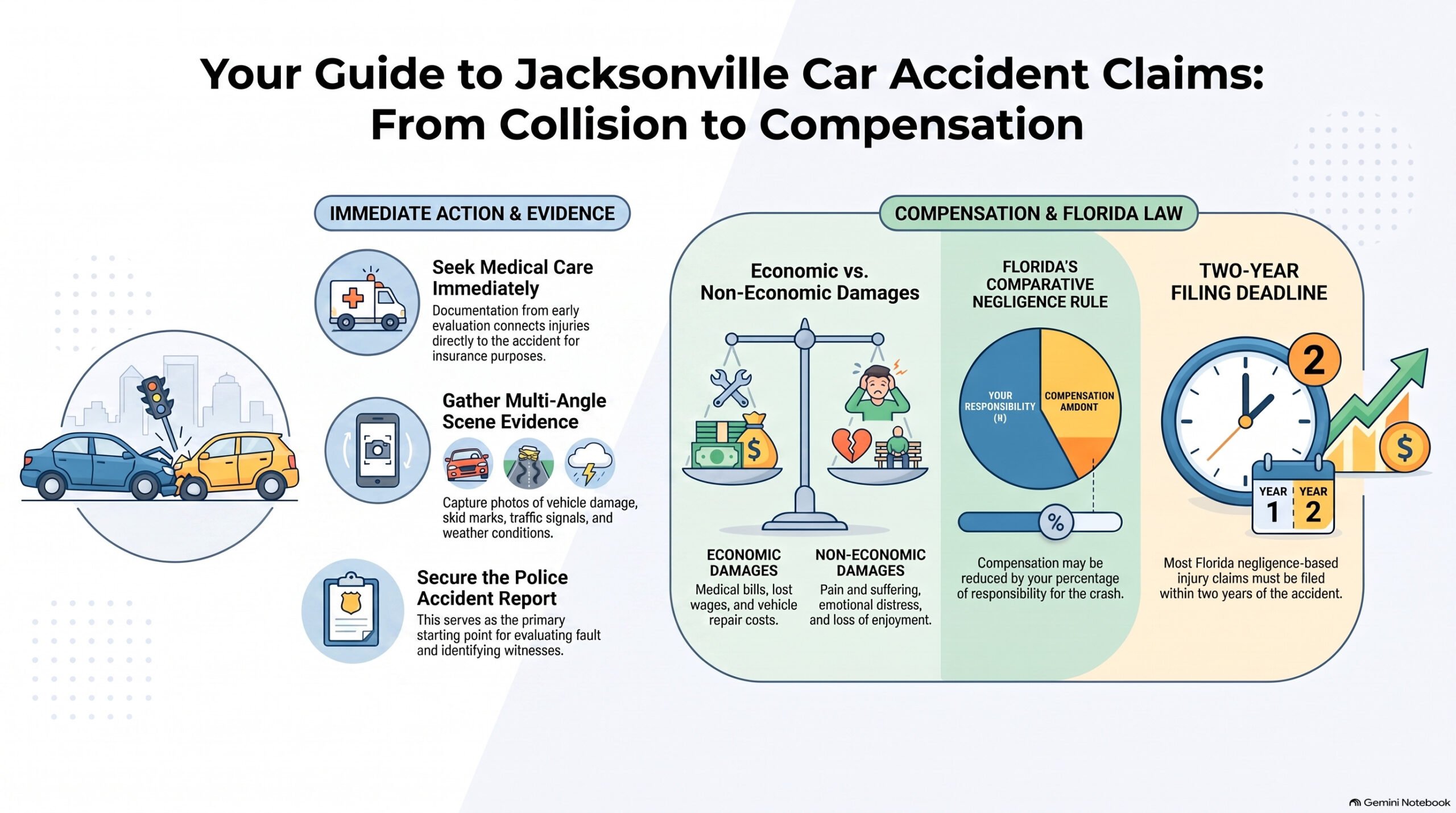
After a car accident in Jacksonville, prompt action can protect both health and a potential compensation claim. An injured person should seek immediate medical care, document the accident scene when possible, and preserve any evidence related to the crash. Contacting a lawyer early can help ensure deadlines are met, communications are handled properly, and available legal options are clearly understood.
Seek Immediate Medical Care
In the moments following a car accident in Jacksonville, prompt medical evaluation is one of the most important steps an injured person can take. Even when symptoms appear minor, conditions such as concussions, internal injuries, or soft tissue damage may worsen without timely care. Seeking emergency treatment protects health, supports recovery, and allows medical professionals to identify concerns that may not be immediately visible.
Timely care also creates medical documentation that can help connect injuries to the collision. This record may include diagnoses, treatment plans, prescribed limitations, and follow-up recommendations. For those assisting an injured person, encouraging evaluation demonstrates responsible care and helps preserve important information for a future claim. Delays in treatment can raise questions about the cause or severity of injuries, making prompt attention critical.
Document The Accident Scene
At the accident scene, careful documentation can preserve details that may later become important to a Jacksonville car accident claim. If safety permits, an injured person or trusted helper should gather clear photos of the incident location, including traffic signals, skid marks, road conditions, debris, weather, and vehicle positions. These images can help explain how the collision occurred and may support accurate review by insurers or investigators.
Vehicle damage documentation should include multiple angles, close-up views of impact points, license plates, and any visible deployment of safety equipment. It is also prudent to note the time, nearby landmarks, and names of responding officers. Witness contact information should be recorded respectfully, without pressuring anyone. Such organized records serve the truth, protect all involved, and help preserve a fair account.
Contact A Lawyer
When should legal counsel be contacted following a Jacksonville car accident injury? Prompt consultation is advisable once medical needs are addressed and the scene is secure. An attorney can guide injured persons through insurance communications, deadlines, and evidence preservation, helping protect the integrity of photographs, witness information, vehicle data, and medical records. This support is especially important when injuries affect family responsibilities, employment, or the ability to serve others in daily life. Legal counsel may also evaluate liability, estimate recoverable damages, and prepare for settlement negotiations with insurers that may seek to limit payment. Early representation can reduce procedural mistakes and promote organized claim development. For those assisting an injured person, encouraging timely legal review helps preserve rights while allowing the person to focus on recovery.
Critical Evidence in a Jacksonville Car Accident Claims & Compensation Injury Case
Critical evidence often determines how fault, injury severity, and compensation are evaluated in a Jacksonville car accident claim.
Key materials typically include:
- Police accident reports and medical treatment records
- Crash scene evidence, including vehicle damage, road conditions, and debris patterns
- Witness statements and photos that help confirm how the collision occurred
Police Accident Reports
Although not the only evidence in a Jacksonville car accident claim, a police accident report often serves as an important starting point for evaluating fault, injuries, insurance issues, and the sequence of events. It may identify drivers, passengers, witnesses, vehicle positions, citations, road conditions, and preliminary observations made by the responding officer. For those seeking to serve injured people with care and diligence, this report helps organize the facts before important decisions are made. It may also point to additional evidence, including bodycam footage, dashcam footage, photographs, 911 records, or nearby surveillance footage. While the report can be persuasive, it is not always complete or final. Statements may be limited, diagrams may be imperfect, and conclusions may require careful review alongside independent investigation and follow-up with witnesses.
Medical Treatment Records
Medical treatment records are among the most important forms of evidence in a Jacksonville car accident injury claim because they connect the collision to the physical harm, diagnosis, treatment plan, and long-term medical outlook. These records show when care began, what symptoms were reported, and how providers assessed the injuries. Diagnosis documentation may support the seriousness of conditions such as fractures, spinal trauma, concussions, or soft tissue damage. A clear treatment timeline also helps demonstrate consistency, medical necessity, and the injured person’s commitment to recovery. Attorneys, insurers, and courts may review emergency records, imaging results, physician notes, therapy records, and prescribed restrictions. Accurate records help ensure that losses are evaluated fairly, allowing those responsible for resolving claims to serve the injured person with diligence, accountability, and respect.
Crash Scene Evidence
When a collision occurs, evidence at the crash scene can provide some of the clearest insight into how the accident happened and who may be legally responsible. Skid marks, vehicle resting positions, debris patterns, traffic signal timing, roadway defects, and weather conditions may help establish speed, direction, and impact forces. In Jacksonville injury claims, this information can support fair accountability and assist professionals who serve injured individuals with careful case preparation. Surveillance footage from nearby businesses, intersections, or residences may capture vehicle movement before impact, while dashcam analysis can clarify lane position, braking, and evasive actions. Prompt preservation is important because physical conditions change quickly, and video may be erased. A careful review of crash-scene evidence helps connect responsible conduct to measurable harm.
Witness Statements And Photos
Because details can fade quickly after a collision, witness statements and photographs often become crucial evidence in a Jacksonville car accident claim. Neutral witnesses may describe vehicle speeds, traffic signals, lane positions, weather, and driver behavior before impact. Their accounts can support injured persons, guide insurers, and help legal advocates serve the community through fair resolution. Eyewitness credibility depends on proximity, attention, consistency, and absence of bias, so statements should be collected promptly and accurately. Photos may document vehicle damage, skid marks, road hazards, injuries, debris fields, and visibility conditions. Photo authenticity matters because images must reflect the scene without alteration, misleading angles, or uncertain timing. Along with this, reliable statements and verified photographs can strengthen liability analysis, clarify disputed facts, and preserve evidence for negotiations or litigation.
Don’t Wait. Call Our Florida Personal Injury Lawyers Now!
Long-Term Effects of Jacksonville Car Accident Claims & Compensation Injuries
Long-term injuries from Jacksonville car accidents may involve chronic pain complications, reduced mobility, and ongoing limitations that affect daily life and employment. Emotional trauma can also persist, influencing sleep, concentration, relationships, and overall well-being. Future medical costs, including treatment, therapy, medication, and professional care, often become a central issue in evaluating fair compensation.
Chronic Pain Complications
After a serious collision, chronic pain may become one of the most disruptive and contested consequences of a Jacksonville car accident injury claim. Persistent neck, back, shoulder, or nerve pain can limit mobility, reduce stamina, and interfere with daily service to family, work, and community. Medical records, diagnostic findings, therapy notes, and physicians’ opinions are often critical in demonstrating that pain is not temporary or exaggerated. Treatment may involve injections, physical therapy, expert care, or long-term prescriptions, making Medication Side Effects relevant to damages and future care needs. When pain prevents lifting, standing, driving, or repetitive movement, Work Restrictions may affect earning capacity and job security. A careful claim should document functional limits, ongoing expenses, and the continuing need for compassionate support and practical assistance.
Emotional Trauma Impact
In the months following a serious Jacksonville collision, emotional trauma may become a lasting injury that affects judgment, relationships, sleep, and the ability to resume normal routines. Survivors may experience emotional distress through anxiety while driving, irritability, withdrawal, depression, or intrusive memories of the crash. These effects can limit work performance, caregiving, community involvement, and the steady presence many victims aim for to provide for others. For claims purposes, this harm should be documented carefully, including counseling records, personal journals, witness observations, and changes in daily functioning. Emotional trauma can also complicate long-term recovery when fear, grief, or reduced confidence slows physical rehabilitation and decision-making. A compensation claim can address psychological harm as part of the broader human impact of an accident.
Future Medical Costs
Emotional trauma is only one part of the lasting harm that may follow a severe Jacksonville car accident, as many injuries also require medical care far beyond the initial emergency treatment. Future medical costs may include surgeries, rehabilitation, pain management, mobility devices, prescriptions, and follow-up evaluations. These expenses can place heavy strain on injured individuals and on families committed to supporting their recovery. In a compensation claim, careful documentation is required because medical billing records, physician opinions, and treatment plans help establish the expected cost of ongoing care. Courts and insurers often apply strict proof requirements, so estimates must be reasonable, medically supported, and connected to the crash-related injuries. Accurate projections help ensure that needed care is not reduced or overlooked during settlement negotiations.
Proving Liability in Jacksonville Car Accident Claims & Compensation Injury Cases
Because liability determines whether an injured person can recover compensation, proving fault is central to Jacksonville car accident claims. Evidence must show that another driver owed a duty of care, breached that duty, and caused injuries that produced measurable losses. Police reports, witness statements, photographs, medical records, vehicle damage, and available traffic camera footage may help establish how the collision occurred.
A careful investigation also considers road conditions, impaired driving, speeding, distraction, unsafe turns, or failure to yield. In cases involving shared fault, Florida’s comparative negligence rules may reduce recovery according to the injured person’s percentage of responsibility. Proper documentation supports fair evaluation before Filing Deadlines expire and helps service-minded advocates present a claim with accuracy and dignity.
Although Insurer Negotiations may address payment later, liability must first be supported by organized proof. Clear evidence allows decision-makers to determine responsibility, protect the injured person’s rights, and pursue appropriate compensation.
Dealing With Insurance Companies After a Jacksonville Car Accident Claims & Compensation Injury
Managing communications with insurance companies after a Jacksonville car accident requires caution, organization, and a clear understanding of how claims are evaluated. Adjusters may appear helpful, yet their role is to protect the insurer’s financial interests. Injured persons should provide accurate basic information, avoid speculation, and refrain from recorded statements until they understand the legal effect of their words.
Careful preparation supports fair treatment and responsible advocacy for all affected parties. Police report tips include reviewing the report for accuracy, noting witness information, and correcting documented errors through proper channels. Evidence preservation tips include saving photographs, repair estimates, medical records, correspondence, and any damaged personal property. Consistent documentation helps prevent confusion and supports credible communication.
Insurance discussions should remain respectful, factual, and limited to necessary details. A Jacksonville car accident claims and compensation lawyer may assist by handling communications, protecting sensitive information, and ensuring that negotiations reflect documented losses rather than insurer convenience.
What to Expect During a Jacksonville Car Accident Claims & Compensation Injury Claim Process
A Jacksonville car accident injury claim generally follows a structured process, beginning with reporting the accident and documenting the circumstances surrounding the collision. The claimant must gather essential evidence, including medical records, witness information, and proof of financial losses, before negotiations with insurers can meaningfully proceed. Resolution may occur through settlement discussions or, when necessary, further legal action to pursue appropriate compensation.
Reporting The Accident
After a Jacksonville car accident, reporting the crash is one of the first steps that can affect both an insurance claim and any later injury compensation request. Florida law generally requires drivers to report collisions involving injuries, death, apparent property damage, or impaired driving concerns. Calling 911 allows Emergency Response personnel to assist the injured, manage roadway hazards, and create an official record through law enforcement involvement. That report may later help clarify when and where the collision occurred, and which parties were identified at the scene.
Insurance Notification should also occur promptly, consistent with policy requirements. A driver should provide basic facts, avoid speculation, and refrain from accepting blame. Timely reporting supports orderly claim handling and helps preserve the injured person’s ability to seek appropriate compensation.
Gathering Key Evidence
Once the accident has been reported, gathering pivotal evidence becomes essential to documenting how the collision occurred and the extent of the resulting harm. Evidence may include photographs of vehicle damage, roadway conditions, skid marks, traffic signs, and visible injuries. Witness names, contact information, and brief statements can also help preserve observations before memories fade. Medical records, repair estimates, and proof of missed work further connect the crash to measurable losses. Video evidence from dash cameras, nearby businesses, traffic cameras, or residential security systems may clarify speed, direction, and fault. Why do insurance representatives request these materials? They rely on documentation to evaluate responsibility and claimed damages. Careful evidence collection supports an organized claim and helps advocates serve injured individuals with accuracy, diligence, and respect throughout the process.
Negotiating With Insurers
When sufficient evidence has been assembled, negotiations with insurance companies typically become a central stage in the claim process. At this point, representatives evaluate liability, medical treatment, wage loss, and the continuing effects of injury. A lawyer may present a structured demand, supported by records and factual analysis, to protect the injured person’s ability to recover fair compensation. Negotiation tactics often include responding to low initial offers, correcting selective interpretations of the evidence, and emphasizing damages that affect daily functioning in family, work, and community. Insurer leverage may arise from disputed fault, treatment gaps, policy limits, or financial pressure on the claimant. Careful advocacy helps reduce that imbalance. Throughout this stage, communications should remain documented, measured, and focused on the claim’s full value.
Resolving Your Claim
Resolving a car accident claim in Jacksonville typically involves either reaching a settlement agreement or preparing the case for further legal action if negotiations fail. At this stage, the injured person’s representatives review medical records, wage losses, future care needs, and evidence of liability to determine whether the offer reflects the full extent of the harm suffered. Insurance negotiation may continue until both sides reach terms that fairly address damages, policy limits, and disputed facts. When settlement is achieved, release documents are carefully reviewed before funds are distributed, ensuring that obligations are understood and protected. If the insurer refuses a reasonable outcome, litigation may become necessary. Throughout this process, careful guidance helps preserve evidence, support accountability, and pursue compensation that can restore stability for the injured person and those they serve.
Don’t Wait. Call Our Florida Personal Injury Lawyers Now!
Compensation for Jacksonville Car Accident Claims & Compensation Injury Damages
Calculating compensation after a Jacksonville car accident requires a careful review of the injured person’s medical needs, financial losses, and long-term physical limitations. The process should account for treatment history, physician recommendations, rehabilitation demands, and the practical effect of injuries on daily responsibilities. A lawyer may review the basics of insurance coverage to determine available benefits, policy limits, exclusions, and the order in which coverage may apply.
Reliable proof supports a fair evaluation. Medical records, imaging results, prescriptions, therapy notes, employment records, and repair estimates can help establish the scope of harm. Pain recovery documentation may also clarify how symptoms progress, how treatment affects mobility, and whether the person can resume work, caregiving, or community service.
In Jacksonville claims, careful preparation helps prevent undervaluation. By organizing evidence, addressing insurer questions, and identifying future care needs, legal guidance can support a compensation demand that reflects documented injuries and responsible recovery planning.
Economic vs Non-Economic Damages in Jacksonville Car Accident Claims & Compensation Cases
Car accident compensation in Jacksonville generally falls into two categories: economic damages and non-economic damages. Economic damages cover measurable financial losses, while non-economic damages compensate for personal harms that are harder to quantify. Proving these losses requires clear documentation, credible evidence, and a careful presentation of how the accident affected the injured person’s life.
Economic Damages Explained
When a Jacksonville car accident causes measurable financial loss, economic damages are the category of compensation tied to verifiable expenses and lost income. These damages may include emergency treatment, hospitalization, rehabilitation, prescription costs, medical equipment, lost wages, reduced earning capacity, and necessary vehicle repair or replacement. Careful documentation helps protect injured individuals, especially when caregivers, employers, or service providers must confirm the practical impact of the crash.
Economic damages also require attention to insurance claim timelines, because delayed notice or incomplete records may affect payment. Medical billing disputes can further complicate recovery, particularly when providers, insurers, and patients disagree about charges or responsibility. A thorough claim organizes invoices, employment records, repair estimates, and future care projections so losses can be presented accurately and fairly.
Non-Economic Damages Explained
After financial losses are identified through bills, records, and wage documentation, a Jacksonville car accident claim must also account for harms that do not come with a fixed invoice. Non-economic damages address the human effects of an injury, including Pain and suffering, loss of enjoyment of life, inconvenience, and physical limitations that alter daily responsibilities. These losses may affect how an injured person serves family, supports coworkers, participates in community life, or maintains dignity during recovery. Emotional distress impacts may include anxiety, fear while driving, sleep disruption, or frustration caused by lasting pain and uncertainty. Unlike economic damages, these harms are not measured by receipts, yet they can be central to fair compensation when an accident changes health, independence, and quality of life.
Proving Your Losses
Because compensation depends on proof as much as injury severity, a Jacksonville car accident claim should present economic and non-economic damages through clear, organized evidence. Economic losses may be shown through medical bills, wage records, repair estimates, receipts, and insurance documentation that confirms out-of-pocket costs and future financial needs. Non-economic harm requires careful support through medical narratives, pain journals, therapy records, and statements from family members or caregivers who observe daily limitations. A thorough damages valuation connects these materials to the injury’s actual effect on work, household duties, mobility, and personal dignity. When evidence is complete, adjusters and courts can better assess the full scope of loss. Careful preparation also serves the injured person by promoting fairness, accountability, and a more reliable path toward recovery.
When a Jacksonville Car Accident Claims & Compensation Injury Case Goes to Trial vs Settlement
Although many Jacksonville car accident injury claims resolve through settlement, some cases proceed to trial when the parties cannot agree on liability, the severity of injuries, or the value of compensation. Settlement may provide injured individuals with a more predictable resolution, reduced delay, and privacy, while allowing resources to remain focused on recovery, caregiving, and community responsibilities.
A trial may become necessary when insurance negotiation fails to reflect medical evidence, lost income, pain, or long-term limitations. Attorneys may reassess settlement strategy as new records, expert opinions, and deposition testimony clarify the strengths and risks of the case. Witness credibility can strongly influence whether a claim settles or proceeds to trial, especially when accounts of the crash conflict. Trial witnesses, including medical providers, accident investigators, and people who observed the collision, may help explain disputed facts. A careful comparison of likely outcomes helps determine the most responsible path forward.
Don’t Wait. Call Our Florida Personal Injury Lawyers Now!
Florida Laws That May Affect Your Jacksonville Car Accident Claims & Compensation Case
Florida law can shape nearly every stage of a Jacksonville car accident claim, from initial insurance coverage to the final calculation of compensation. These rules matter to injured people, families, caregivers, and advocates seeking fair resources for recovery.
Florida law can guide coverage decisions, fault analysis, and compensation in a Jacksonville car accident claim.
- No Fault Threshold: Florida’s no-fault system generally requires injured parties to use personal injury protection first. A claim against another driver may depend on meeting the No Fault Threshold through serious or lasting injury.
- Insurance Coverage Limits: Compensation may be affected by Insurance Coverage Limits, including available bodily injury coverage, uninsured motorist protection, and policy exclusions. These limits can influence settlement value and recovery options.
- Comparative Negligence: Under Comparative Negligence, fault is apportioned based on liability percentages. If an injured person shares responsibility, compensation may be reduced in proportion to their assigned share.
Careful legal evaluation helps determine how these laws apply and whether available evidence supports a meaningful recovery.
The Statute of Limitations for Jacksonville Car Accident Claims & Compensation Injury Cases
Time limits can be as important as fault rules and insurance coverage when evaluating a Jacksonville car accident claim. In Florida, most negligence-based injury claims arising from vehicle collisions must be filed within two years from the date of the crash. Missing this deadline can bar recovery, even when injuries are serious, and liability appears clear.
This period should be considered alongside medical treatment, evidence preservation, and insurance communications. Delays may affect witness availability, record collection, and the documentation needed to support pain and damages claims. For those serving injured families, timely awareness helps protect a person’s opportunity to seek lawful compensation.
Comparative negligence may also influence the value of a claim, but it does not extend the filing deadline. A person partly at fault must still act within the required time. Certain circumstances may alter limitation periods, so each case should be evaluated promptly and with careful attention to Florida law.
Don’t Wait. Call Our Florida Personal Injury Lawyers Now!
How a Jacksonville Car Accident Claims & Compensation Lawyer Can Help You
A Jacksonville car accident claims and compensation lawyer can evaluate the crash, identify available insurance coverage, and determine how Florida law may affect the injured person’s right to recover damages. This support can help families, caregivers, and community-minded individuals protect a harmed person’s stability while promoting fair accountability.
- Case assessment: The lawyer reviews medical records, crash reports, wage information, and liability facts to estimate recoverable losses with practical accuracy.
- Evidence preservation guidance: The lawyer may direct efforts to secure photographs, vehicle data, witness statements, treatment documentation, and other materials before they are altered or lost.
- Insurance negotiation strategies: The lawyer can address the insurer’s arguments, present organized evidence of damages, and pursue compensation that reflects medical needs, lost income, and lasting limitations.
Through structured advocacy, the injured person receives informed representation, while those assisting them gain a clearer path for responsible decision-making.
When to Contact a Jacksonville Car Accident Claims & Compensation Lawyer
After understanding how legal representation can support a claim, the next consideration is when that guidance should begin. An injured person should consider contacting a Jacksonville car accident claims and compensation lawyer as soon as medical needs are stabilized, especially when fault is disputed, injuries appear significant, or insurers request recorded statements.
Early contact may assist with Injury Evidence Preservation, including photographs, witness information, medical records, repair documentation, and available crash data. Prompt guidance can also help prevent missed deadlines, incomplete paperwork, or communications that may weaken a valid claim.
Legal consultation is also appropriate when symptoms are delayed, treatment becomes ongoing, wages are lost, or settlement offers seem insufficient. When Car Insurance Denials occur, a timely review may clarify whether the denial is based on policy language, disputed liability, or missing documentation. For those committed to protecting family responsibilities and serving others, early action helps preserve stability while the claim is evaluated.
Why You Need an Experienced Jacksonville Car Accident Claims & Compensation Lawyer
Because car accident claims often involve disputed facts, medical documentation, insurance policy limits, and strict procedural rules, experienced legal guidance can be critical to protecting a claimant’s position. A Jacksonville car accident claims and compensation lawyer can evaluate liability, organize evidence, and present losses in a manner that supports fair consideration. This service is particularly important when injured individuals are focused on recovery, family responsibilities, and meeting the needs of others who depend on them.
Experienced counsel understands how Insurance negotiations may affect the value and timing of a claim. Insurers may question fault, minimize injuries, or challenge treatment needs. A careful review of medical documentation, wage records, repair estimates, and witness accounts helps build a stronger foundation for the claim. Legal guidance also helps guarantee deadlines are observed, and communications are handled with care. By providing structure and advocacy, a lawyer can help an injured person pursue compensation with dignity, purpose, and informed confidence after a serious collision.
How to Choose the Right Jacksonville Car Accident Claims & Compensation Lawyer for Your Case
Selecting the right Jacksonville car accident claims and compensation lawyer requires careful review of experience, communication practices, and case strategy. A strong candidate should demonstrate knowledge of Florida injury law, insurance negotiations, medical documentation, and damages related to lost income, pain, and long-term care. This allows injured individuals and their families to receive guidance that supports recovery, stability, and responsible decision-making.
Prospective clients should ask about prior results in comparable vehicle collision cases, while recognizing that past outcomes do not guarantee future results. Client communication expectations should also be discussed early, including update frequency, preferred contact methods, and who will answer questions during the case. Clear communication helps clients focus on recovery and caring for loved ones.
Contingency fee transparency is equally important. A lawyer should explain fees, litigation costs, and payment obligations in writing. Careful selection promotes trust, accountability, and diligent advocacy throughout the claims process for those seeking fair compensation.
About The Law Offices of Anidjar & Levine
For individuals seeking guidance after a collision, The Law Offices of Anidjar & Levine provides legal representation in Jacksonville car accident claims involving insurance disputes, injury documentation, and compensation for financial and personal losses.
The firm assists injured clients by reviewing crash details, gathering evidence, communicating with insurers, and identifying damages that may affect recovery.
Its approach reflects a client-focused strategy, emphasizing attentive communication, organized case preparation, and respect for each client’s circumstances.
This service model can support individuals and families seeking to restore stability while meeting medical, employment, and household responsibilities.
The firm also offers Local legal guidance informed by Florida injury law, Jacksonville traffic conditions, and regional court practices.
By managing legal tasks and protecting deadlines, the attorneys help clients concentrate on well-being, caregiving, and community obligations.
The Law Offices of Anidjar & Levine positions its services around advocacy, accountability, and practical support after serious collisions.
Frequently Asked Questions
Can Tourists File Car Accident Claims in Jacksonville?
Yes, tourists may file car accident claims in Jacksonville when another party’s negligence causes harm. A Guest injury should be reported promptly, with careful claim documentation, including medical records, police reports, and witness details. Travel limitations may affect access to treatment or communication, so coordination is important. An out-of-state policy may still provide coverage, but Florida rules can affect recovery, making organized assistance crucial to a fair resolution.
What if My Accident Involved a Rideshare Driver?
If an accident involved a rideshare driver, liability may depend on the driver’s app status, conduct, and available Insurance Coverage. Rideshare Liability can involve the driver, the rideshare company, or another motorist. The Florida Threshold may affect recovery for pain and suffering. A Driver Background issue could support further inquiry. Those assisting injured tourists should promptly preserve records, trip details, police reports, and medical documentation.
Are Jacksonville Car Accident Consultations Free?
Yes, many Jacksonville car accident consultations are free, though each firm sets its own policy on free consultations. During the consultation, an attorney typically reviews the crash facts, injuries, insurance issues, and potential compensation options. This meeting helps injured individuals make informed choices, protect their rights, and secure guidance that supports recovery. Those serving families or dependents should ask about fees, timelines, and next steps before proceeding.
Can I Switch Lawyers During My Car Accident Claim?
Yes, a person may switch lawyers during a car accident claim. Changing Legal Representation is permitted when communication, trust, or service no longer meets reasonable requirements. Client-Attorney Choice remains a fundamental principle, allowing the injured person to select counsel who can better support the claim. Before making the change, the person should review any fee agreement, confirm lien issues, and ensure the case file transfers promptly and appropriately.
Will My Car Accident Claim Affect My Insurance Rates?
A car accident claim may affect insurance rates, depending on fault, policy terms, claim history, and state rules. An insured person should compare insurance impacts before deciding how to proceed, especially when property damage or injuries are significant. Prompt notice remains important because reporting claim timing can influence coverage rights. Those serving injured parties should encourage accurate documentation, honest reporting, and careful review of insurer communications before accepting any decision.
—————————
Car accident claims in Jacksonville require careful evaluation, timely action, and a clear understanding of Florida law.
Injury victims may face medical expenses, lost income, vehicle damage, and lasting physical limitations.
A qualified Jacksonville car accident claims and compensation lawyer can assess liability, document losses, negotiate with insurers, and pursue fair recovery.
The Law Offices of Anidjar and Levine provide experienced legal support for injured clients seeking accountability and appropriate compensation after a serious collision.
Learn more from a Jacksonville Personal Injury Lawyer.