The Law Offices of Anidjar and Levine helps Daytona Beach truck accident victims investigate fault, preserve crash evidence, and identify potentially responsible parties, including drivers, trucking companies, maintenance providers, and manufacturers.
A claim may seek compensation for medical expenses, rehabilitation, lost income, property damage, pain and suffering, permanent limitations, and future care.
Counsel can review driver logs, electronic data, maintenance records, photographs, witness statements, and insurance issues while protecting filing deadlines.
Learn more from a Daytona Beach Truck Accident Lawyer about the claims process, evidence requirements, and selecting qualified legal representation.
Main Takeaways
- A Daytona Beach T-bone truck accident lawyer evaluates fault, injuries, medical evidence, and all resulting financial losses.
- Potentially responsible parties may include the truck driver, trucking company, maintenance providers, or other negligent entities.
- Important evidence includes crash reports, photographs, witness accounts, vehicle data, driver logs, and electronic logging device records.
- Claims may seek compensation for medical expenses, rehabilitation, lost income, pain, permanent limitations, and diminished earning capacity.
- Prompt medical care, evidence preservation, and legal advice can protect your rights before deadlines or critical evidence becomes an issue.


How We Can Help With Your Daytona Beach T-Bone Truck Accident Injury Claim
A Daytona Beach T-bone truck accident claim requires a careful evaluation of fault, medical evidence, and the full extent of the injured party’s losses. A legal team can help preserve available evidence, identify responsible parties, and communicate with insurers on the claimant’s behalf. This assistance may include reviewing crash reports, photographs, vehicle data, witness accounts, and applicable traffic rules without prematurely overstating the evidence.
Medical expense documentation is critical to showing the treatment already received and the care that may reasonably be required later. Counsel can organize bills, records, provider opinions, wage information, and other proof of financial impact. A structured Settlement value calculation can then consider medical costs, lost income, permanent limitations, property damage, and other legally recognized losses. Throughout the process, a representative can explain procedural requirements, protect deadlines, and provide informed guidance while the injured person focuses on recovery. The objective is a thorough, service-oriented presentation of the claim supported by accurate documentation and responsible evaluation.
OUR CONSULTATIONSARE FREE
START YOUR FREE CASE REVIEW

Understanding Daytona Beach T-Bone Truck Accident Injury Cases
Understanding Daytona Beach T-bone truck accident injury cases begins with examining how the collision occurred, which parties may bear responsibility, and how the injuries have affected the victim’s life. A careful review may involve crash reports, medical records, photographs, witness accounts, and applicable commercial transportation regulations.
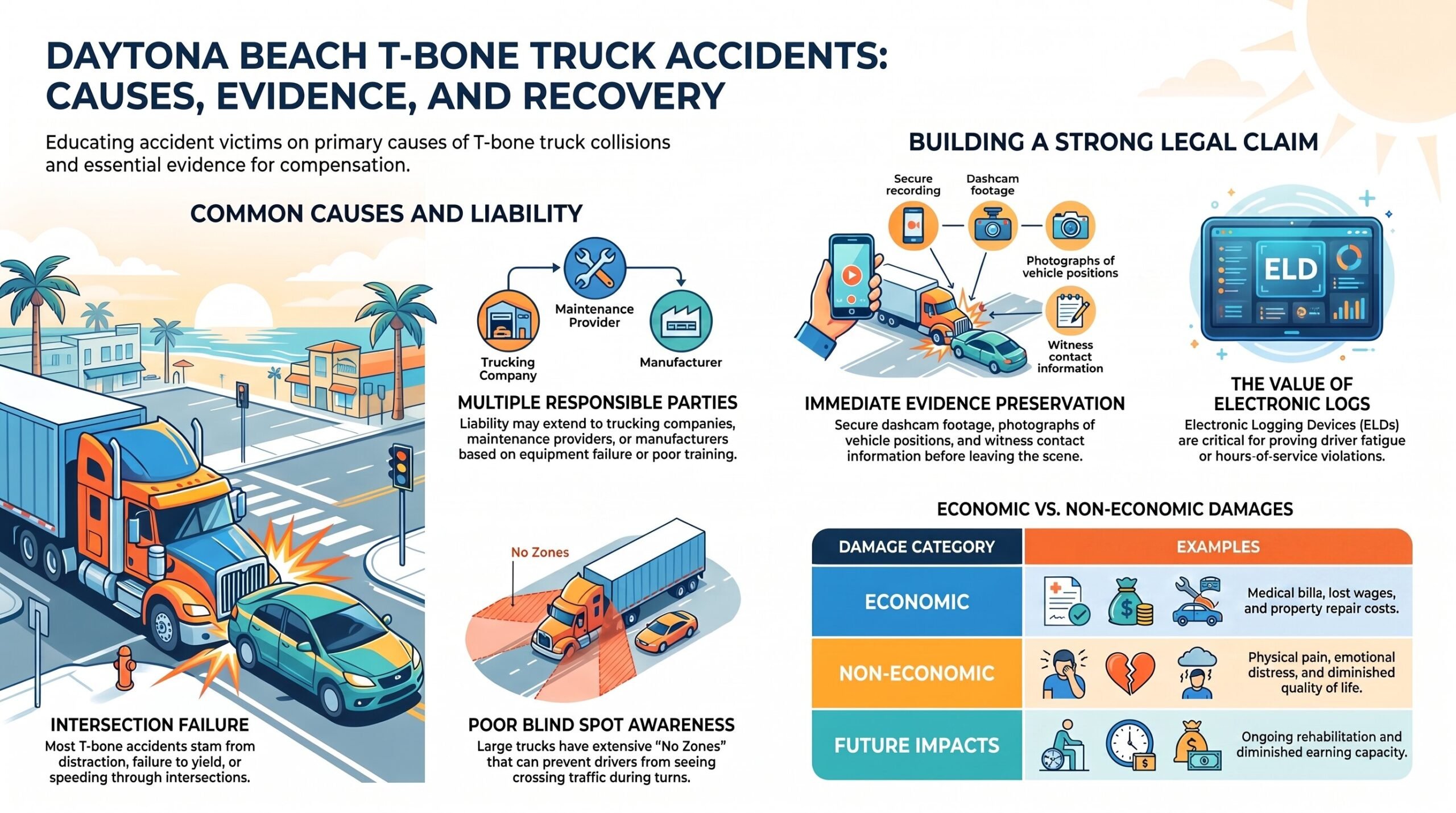
Liability can extend beyond the truck driver. Evidence may establish trucking company liability when an employer contributed to the incident through negligent supervision, unsafe policies, inadequate training, or failure to maintain required records. Other potentially responsible parties may include vehicle owners, maintenance providers, manufacturers, or insurers, depending on the available evidence.
Comparative fault disputes can arise when an opposing party alleges that the injured person contributed to the collision or worsened the resulting harm. Such disputes may affect financial recovery and require precise documentation of medical treatment, lost income, permanent limitations, and future care needs. A thorough evaluation helps protect the injured person’s interests while supporting a fair resolution.
Common Causes of Daytona Beach T-Bone Truck Accident
Common causes of Daytona Beach T-bone truck accidents include driver distraction, failure to yield, and speeding through intersections. Poor blind spot awareness may also prevent truck drivers from seeing nearby vehicles before turning or crossing traffic. Identifying these contributing factors can help clarify how the collision occurred and who may bear responsibility.
Truck Driver Distraction
Truck driver distraction is a significant cause of Daytona Beach T-bone truck accidents, particularly when a commercial driver fails to monitor an intersection or yield to crossing traffic. Distracted driving habits may include texting, adjusting navigation systems, handling dispatch equipment, eating, or engaging with passengers while the vehicle is moving. These activities can divert visual, manual, or mental attention during moments when traffic conditions change quickly. Overlooked traffic signals may result when a driver looks away from the roadway or fails to recognize a changing light.
Large trucks require substantial space and time to respond, increasing the potential severity of a side-impact collision. Investigators may examine electronic records, witness accounts, vehicle data, and surrounding surveillance footage to determine whether distraction contributed to the crash and to support affected individuals seeking appropriate assistance.
Failure to Yield
Failure to yield is a frequent cause of Daytona Beach T-bone truck accidents, particularly when a commercial driver enters an intersection without giving the right of way to crossing vehicles. Drivers may turn across oncoming lanes, proceed from a stop sign without checking cross traffic, or misjudge another vehicle’s distance. In some cases, obstructed views, unfamiliar roads, or unclear intersection traffic signals contribute to an unsafe maneuver. Commercial operators are expected to understand and follow right-of-way rules, including requirements governing left turns, stop signs, and controlled crossings.
When those obligations are ignored, the truck’s size and position can produce severe side-impact injuries. Witness statements, signal timing records, vehicle data, and nearby camera footage may help clarify which driver entered unlawfully. Careful investigation can support affected individuals seeking appropriate assistance and accountability.
Speeding Through Intersections
Speeding through intersections is a significant cause of Daytona Beach T-bone truck accidents, particularly when a commercial driver approaches a signal, stop sign, or crossing at an unsafe speed. Excessive speed reduces the time available to recognize changing traffic conditions, stop safely, or respond to a vehicle entering the truck’s path. A heavily loaded truck may require substantial distance to brake, increasing the force of a side-impact collision.
Impaired driving can further compromise judgment, reaction time, and compliance with traffic controls. Likewise, distracted pedestrians may enter a crosswalk unexpectedly, creating conditions that demand immediate caution from approaching drivers. Investigators may review traffic-camera footage, electronic vehicle data, witness accounts, and roadway conditions to determine whether speed contributed to the crash and identify measures that support affected individuals.
Poor Blind Spot Awareness
When commercial drivers fail to recognize the limits of their vehicle’s blind spots, they may enter an intersection without seeing an approaching passenger vehicle. Large trucks have extensive areas beside, behind, and immediately in front of the cab that mirrors cannot fully reveal. Inadequate mirror adjustment, missed shoulder checks, and distractions can prevent drivers from identifying a vehicle traveling in a crossing lane.
Intersection signal timing may further complicate visibility when traffic begins moving at the same time or a truck turns across several lanes. In addition, cargo securement violations can shift a load, requiring sudden corrections that increase the risk of striking an unseen motorist. Careful observation, proper mirror use, and deliberate scanning procedures help commercial drivers protect other road users and reduce preventable Daytona Beach T-bone collisions at busy intersections.
Don’t Wait. Call Our Daytona Beach Truck Accident Lawyers Now.


Legal Rights of Daytona Beach T-Bone Truck Accident Injury Victims
Individuals injured in Daytona Beach T-bone truck accidents may have legal rights to seek compensation when another party’s negligence caused the collision. A claim may address medical expenses, rehabilitation, pain, diminished earning capacity, and other documented losses. An injured person also has the right to consult counsel, communicate through a representative, and make informed decisions without accepting an inadequate settlement.
Potential legal protections include:
- Evidence preservation: Prompt collection of photographs, witness information, medical records, vehicle data, and surveillance footage may support liability and damages.
- Insurance denial appeals: A claimant may challenge an insurer’s refusal to pay by reviewing policy terms, submitting supporting documentation, and pursuing available legal remedies.
- Post-accident wage loss and medical billing disputes: Records can substantiate missed income, while legal assistance may help address inaccurate charges, coverage disagreements, or improper payment demands.
Victims may also have deadlines for filing claims, which vary according to applicable law and circumstances. A qualified attorney can evaluate the evidence, identify responsible parties, protect procedural rights, and help coordinate recovery efforts with medical providers and insurers.
Don’t Wait. Call Our Daytona Beach Truck Accident Lawyers Now.
Why Do Daytona Beach T-Bone Truck Accident Injuries Happen?
Daytona Beach T-bone truck accident injuries often occur because a truck enters an intersection without yielding, fails to recognize a traffic signal, or turns across another vehicle’s path. These collisions can be especially severe because a truck’s mass and height expose occupants to substantial force along the side of a passenger vehicle.
Driver fatigue causes slower reaction times, impaired judgment, and missed warnings, particularly during long routes or overnight operations. Distracted driving, speeding, improper lane changes, and inadequate training may also prevent a truck operator from identifying a developing hazard. Weather, poor visibility, and unfamiliar roads can further increase intersection risks.
Vehicle maintenance lapses may contribute when defective brakes, worn tires, malfunctioning lights, or wheel issues limit a truck’s ability to stop or navigate. Improperly secured cargo can also affect balance and handling. Understanding these contributing conditions helps clarify how preventable conduct, equipment failures, and roadway circumstances may combine to produce serious injuries for those sharing Daytona Beach streets.
What Should You Do After a Daytona Beach T-Bone Truck Accident Injury?
After a Daytona Beach T-bone truck accident injury, the injured person should seek immediate medical care, even if symptoms initially appear minor. Documenting the crash scene, including vehicle damage, roadway conditions, and witness information, may help preserve important evidence. Contacting a truck accident lawyer promptly can support the protection of legal rights and the evaluation of potential claims.
Seek Immediate Medical Care
Prompt medical evaluation is essential following a Daytona Beach T-bone truck accident, even when an injured person believes the condition is minor. Some injuries, including internal bleeding, concussions, and spinal damage, may not produce immediate symptoms. A prompt examination can identify hidden harm, establish appropriate treatment, and reduce the risk of complications. The injured person should follow emergency responders’ instructions and obtain care at an emergency department, urgent-care facility, or physician’s office based on the apparent severity.
Medical providers should receive accurate information about pain, dizziness, numbness, breathing difficulty, and changes in mobility. Keeping follow-up appointments and following prescribed restrictions can support recovery. Awareness of bike lane safety and intersection visibility may also help explain how impact-related injuries occurred without assigning conclusions prematurely. Personal health should remain the immediate priority.
Document The Crash Scene
Preserving accurate evidence at the crash scene can help clarify how a Daytona Beach T-bone truck accident occurred and identify the conditions that contributed to the collision. If safety permits, an injured person or witness should photograph vehicle positions, road markings, traffic signals, visible injuries, property damage, weather conditions, and nearby hazards. Images should include wide views and detailed shots, while preserving the original files and recording when they were taken.
Witnesses can provide names and contact information, along with brief, factual accounts of what they observed. The truck’s company markings, license plate, and driver information may also be relevant. Dashcam Video Preservation can protect recordings before automatic deletion. Such evidence may help reveal Negligent Hiring Practices, inadequate training, maintenance failures, or other contributing factors.
Contact A Truck Accident Lawyer
Contacting a Daytona Beach truck accident lawyer can help an injured person protect legal rights and evaluate potential claims before pivotal evidence is lost. Counsel may investigate traffic signals, vehicle damage, driver logs, loading records, and available surveillance footage. Early representation also helps Preserve Your Evidence, including photographs, medical records, witness information, repair estimates, and clothing or equipment involved in the collision.
The injured person should seek appropriate medical care and follow prescribed treatment, while avoiding social media posts that could misrepresent the injury’s impact. It is also important to Avoid Recorded Statements to insurers or trucking companies until legal guidance is obtained. A lawyer can communicate with involved parties, identify potentially responsible entities, explain deadlines, and pursue compensation for medical expenses, lost income, rehabilitation, and other documented damages.
Don’t Wait. Call Our Daytona Beach Truck Accident Lawyers Now.
Critical Evidence in a Daytona Beach T-Bone Truck Accident Injury Case
Important evidence can establish how the Daytona Beach T-bone truck accident occurred and who may be legally responsible. Police accident reports, truck driver logs, vehicle damage evidence, and witness statements can clarify traffic conditions, driver conduct, and the force of impact.
Preserving these records promptly may help support an injury claim and address disputes over liability.
- Police reports may document citations, road conditions, diagrams, and initial statements.
- Driver logs can indicate hours of service, fatigue concerns, and compliance with regulations.
- Damage photographs, repair records, and witness accounts may corroborate the collision sequence and injury allegations.
Police Accident Reports
When a Daytona Beach T-bone truck accident occurs, the responding officers’ police accident report may provide important evidence about how the collision happened and who may bear responsibility. The report commonly records the roadway location, vehicle positions, visible damage, weather, lighting, witness statements, and citations issued at the scene. Officers may also document apparent right-of-way violations, injuries, debris patterns, and whether a driver offered an explanation.
Investigators can compare these observations with traffic signal timing, intersection design, surveillance recordings, and dashcam footage availability. Although a report is not conclusive proof of fault, it can preserve early observations before conditions change or memories fade. A careful review may identify inconsistencies, additional witnesses, or evidence requiring further investigation. Such documentation can help injured individuals and their families pursue an informed, fair resolution.
Truck Driver Logs
Beyond the police accident report, truck driver logs may help establish whether the commercial driver complied with federal and state hours-of-service requirements before the Daytona Beach T-bone collision. Electronic logging device data can reveal driving periods, required rest breaks, duty-status changes, and possible violations that may indicate fatigue. Investigators may compare those entries with delivery schedules, fuel receipts, dispatch communications, and toll records to identify inconsistencies.
Cellphone records can help determine whether the driver was communicating or using a device during the relevant period, subject to applicable legal procedures. Intersection cameras may provide an independent timeline for the truck’s arrival and movements, allowing log entries to be assessed against objective evidence. Preserving these materials promptly can assist counsel in presenting a careful, service-oriented account of the injured person’s circumstances.
Vehicle Damage Evidence
Vehicle damage evidence can help reconstruct how a truck entered an intersection, where the impact occurred, and the forces involved in a Daytona Beach T-bone collision. Photographs, repair estimates, and inspection reports may show the direction of travel, point of impact, and severity of the crash. Crush patterns can help clarify whether the truck struck the side of another vehicle or was hit after crossing a traffic lane.
Investigators may compare physical damage with Brake light footage to evaluate braking, timing, and vehicle movement before impact. Vehicle maintenance logs can also reveal whether defective brakes, tires, lighting, or steering components contributed to the collision. Preserving damaged parts and obtaining documentation promptly can prevent crucial evidence from being altered, discarded, or overlooked during a careful injury claim investigation.
Witness Statements
Witness statements can provide crucial evidence in a Daytona Beach T-bone truck accident injury case by explaining what occurred before, during, and immediately after the collision. Independent witnesses may describe traffic signals, vehicle speeds, lane positions, visibility, and the truck driver’s actions. Their observations can clarify whether a failure to yield, distraction, unsafe turn, or other conduct contributed to the impact. Passengers, nearby motorists, pedestrians, and business employees may also identify changes in the parties’ condition or statements made at the scene.
Investigators can compare these accounts with photographs, electronic data, Crew log accuracy, and driver training records to evaluate consistency and responsibility. Promptly identifying witnesses helps preserve reliable recollections, particularly when roadway conditions or memories change. A careful legal review can organize testimony and address conflicting accounts.
Long-Term Effects of Daytona Beach T-Bone Truck Accident Injuries
Long-term injuries from Daytona Beach T-bone truck accidents may cause chronic pain, permanent disability, or reduced ability to work and perform daily activities. Emotional and psychological trauma, including anxiety, depression, and post-traumatic stress, can also persist after physical wounds have recovered. Ongoing medical expenses may include rehabilitation, medication, assistive equipment, and future treatment required to manage these lasting effects.
Chronic Pain and Disability
Chronic pain and disability are among the most consequential long-term effects of injuries sustained in a Daytona Beach T-bone truck accident. Victims may experience persistent neck, back, shoulder, or joint pain, reduced mobility, nerve symptoms, and limitations affecting ordinary activities. Some injuries require continuing medical care, physical therapy, medication management, assistive devices, or surgical treatment. Whiplash recovery options may include supervised rehabilitation, targeted exercises, diagnostic evaluation, and coordinated care from qualified providers.
When impairments affect employment, workplace return planning can help identify modified duties, reduced hours, ergonomic adjustments, or vocational retraining. A careful assessment of future medical needs, lost earning capacity, and required assistance may be important when documenting the accident’s lasting consequences. Supportive legal guidance can help families pursue resources that protect independence and promote practical, long-term care.
Emotional and Psychological Trauma
Emotional and psychological trauma can develop after a Daytona Beach T-bone truck accident, particularly when injuries disrupt a person’s sense of safety, independence, or ability to work. Survivors may experience persistent fear, irritability, sadness, difficulty concentrating, or distress when passing the crash location. Insomnia triggers can include pain, recurring memories, nighttime anxiety, and concerns about another collision.
These symptoms may interfere with relationships, employment, and daily responsibilities, even after visible injuries improve. A qualified mental health professional can evaluate trauma-related conditions and recommend counseling, coping strategies, or anxiety treatment suited to the individual’s circumstances. Support from family, trusted friends, and compassionate caregivers may also promote stability and recovery. Prompt attention to emotional symptoms can help survivors regain confidence, communicate their needs, and participate more fully in important aspects of life.
Ongoing Medical Expenses
A Daytona Beach T-bone truck accident can create ongoing medical expenses when injuries require continued treatment after the initial emergency care. Survivors may need surgeries, rehabilitation, prescription medications, mobility equipment, diagnostic testing, or specialized care for months or years. These costs can continue even when symptoms appear manageable, particularly when spinal, orthopedic, or traumatic brain injuries affect daily functioning. Accurate records of treatment, medical recommendations, invoices, and projected care can help demonstrate the full financial impact.
Bill coverage may depend on health insurance, automobile policies, or available truck liability coverage, each with different limits and requirements. Insurance disputes may arise over necessity, causation, or future treatment. A careful legal evaluation can help identify responsible parties and pursue compensation for reasonable, accident-related medical expenses while protecting access to crucial care.
Proving Liability in Daytona Beach T-Bone Truck Accident Injury Cases
When a truck driver’s failure to yield, improper lane change, or other negligent conduct causes a T-bone collision in Daytona Beach, the injured party must establish liability through reliable evidence. Relevant proof may include crash reports, traffic-camera recordings, vehicle damage patterns, witness statements, photographs, and electronic data from the truck. Driver logs, dispatch records, maintenance files, and company safety policies can also clarify whether fatigue, distraction, inadequate training, or equipment failures contributed to the collision.
A thorough investigation should identify every responsible party, including the trucking company, maintenance provider, or vehicle manufacturer when supported by the facts. Medical records and expert opinions can connect the crash to documented injuries and anticipated treatment. The defense may raise comparative fault defenses, arguing that the injured person contributed to the accident. Evidence should address those claims carefully and preserve credibility. Legal counsel can also evaluate whether insurer conduct suggests Insurance bad faith, while keeping liability analysis separate from later claim-resolution discussions.
Dealing With Insurance Companies After a Daytona Beach T-Bone Truck Accident Injury
Insurance companies often begin evaluating a Daytona Beach T-bone truck accident claim soon after the collision, sometimes before the injured person understands the full extent of the injuries. Adjusters may request recorded statements, medical authorizations, photographs, and employment information. Injured individuals should provide accurate information while avoiding speculation, admissions, or statements that minimize pain and limitations. A careful record of treatment, expenses, communications, and missed work supports Claim timeline tracking and helps identify inconsistencies in an insurer’s position.
Settlement offers should be reviewed carefully because early payments may not account for continuing care, rehabilitation, lost earning capacity, or permanent impairment. An insurer’s Wrongful denial letters may misstate policy provisions, dispute medical causation, or overlook evidence concerning the truck driver and trucking company. Legal counsel can communicate with adjusters, preserve relevant documentation, and challenge unsupported conclusions while protecting the injured person’s interests. Prompt, organized responses also help serve family members and communities affected by serious commercial-vehicle collisions without sacrificing accuracy or fairness.
What to Expect During a Daytona Beach T-Bone Truck Accident Injury Claim Process
A Daytona Beach T-bone truck accident injury claim typically begins with an initial case evaluation to assess liability, injuries, and potential damages. The process may include collecting crash reports, medical records, witness statements, and other evidence before insurance negotiations commence. If the parties cannot reach a fair settlement, the claim may proceed to trial for judicial resolution.
Initial Case Evaluation
The initial case evaluation establishes whether a Daytona Beach T-bone truck accident injury claim has a viable legal and factual basis. During this consultation, a legal professional reviews the reported collision, injuries, treatment status, and potential responsibility of the truck driver, carrier, or other parties. The discussion also considers deadlines, anticipated damages, and Insurance coverage options that may affect recovery. The claimant can expect questions about medical care, employment consequences, communications with insurers, and immediate financial concerns.
Counsel may explain evidence preservation steps without conducting the detailed collection process addressed later. This meeting also helps identify conflicts, practical challenges, and appropriate next actions. A careful evaluation allows the legal team to determine whether representation can advance the injured person’s interests and support a fair, orderly claim process.
Evidence Collection Process
After the initial evaluation, the evidence collection process begins to establish how the Daytona Beach T-bone truck accident occurred, who may be responsible, and how the injuries affected the claimant. Investigators may obtain crash reports, photographs, traffic-camera footage, vehicle data, and witness statements. Medical records, treatment bills, employment documentation, and expert evaluations can help demonstrate the claimant’s physical, financial, and practical losses. Trucking-company records, including driver logs, inspection reports, maintenance files, and training materials, may reveal whether safety rules were followed. Evidence is preserved promptly because vehicles may be repaired, footage may be overwritten, and memories may fade. Insurance claim timelines can affect when documents and notices must be submitted. Florida comparative fault is also examined to assess whether each involved party contributed to the collision or resulting harm.
Insurance Negotiations
Once the available evidence is organized, insurance negotiations typically begin with a demand that explains the claimant’s injuries, financial losses, liability position, and requested compensation. The insurer assigns an adjuster to review medical records, crash reports, photographs, witness statements, and applicable policy limits. The adjuster may question treatment, challenge projected expenses, or request additional documentation before evaluating the claim. Negotiations should address both current damages and reasonably supported future needs, including rehabilitation, lost earnings, and necessary assistance.
Insurers may raise negligence defenses, such as disputed traffic signals, visibility, or truck-driver conduct. They may also assert comparative fault, alleging that the injured person contributed to the collision or worsened the harm. A representative can organize responses, protect confidential information, and communicate accurately while maintaining a service-focused approach to the claimant’s recovery and lawful interests.
Settlement Or Trial
When insurance negotiations do not produce a fair resolution, the injured party may consider whether to accept a settlement or pursue the Daytona Beach T-bone truck accident claim in court. A settlement can provide compensation sooner and reduce litigation uncertainty, but its terms should reflect medical expenses, lost income, future care, and other documented damages. Counsel may use Negotiation Strategies based on evidence, liability analysis, and projected losses.
If an insurer delays payment, misrepresents coverage, or refuses a reasonable claim without justification, Insurance Bad Faith may require separate evaluation. Trial preparation involves discovery, expert testimony, depositions, and presentation before a judge or jury. The decision should consider risk, timing, financial needs, and the strength of available proof. Careful legal guidance helps protect the injured party’s interests while pursuing a fair outcome.
Compensation for Daytona Beach T-Bone Truck Accident Injury Damages
Compensation for injuries sustained in a Daytona Beach T-bone truck accident may include medical expenses, lost income, reduced future earning capacity, property damage, and pain and suffering. The recoverable amount depends on documented losses, injury severity, treatment needs, and the conduct of each responsible party.
A claim may address emergency care, hospitalization, rehabilitation, prescription costs, and necessary future treatment. Lost wages and diminished work capacity can also be evaluated when injuries interfere with employment or career plans. Vehicle repairs or replacement may be included when the collision damages transportation.
Insurers may raise Comparative fault defenses, alleging that the injured person contributed to the crash or failed to reduce losses. Prompt legal guidance can help identify responsible drivers, trucking companies, maintenance providers, or other entities. Evidence preservation timelines are important because electronic records, vehicle data, surveillance footage, and inspection materials may be lost or overwritten. A careful claim assessment supports fair compensation and helps injured individuals protect their recovery while serving their families and communities.
Economic vs Non-Economic Damages in Daytona Beach T-Bone Truck Accident Cases
Economic damages may include medical expenses, lost wages, property damage, and other documented financial losses arising from a T-bone truck collision. Non-economic losses address less tangible harm, such as pain and suffering, emotional distress, and diminished quality of life. Calculating total compensation requires evaluating both categories alongside the available evidence and the accident’s lasting effects.
Economic Damage Categories
A Daytona Beach T-bone truck accident may create several categories of economic damages, each tied to a measurable financial loss caused by the collision. Recoverable amounts may include emergency transportation, hospital care, surgery, medication, rehabilitation, and follow-up treatment. Future medical expenses can also be calculated when physicians document continuing care or necessary accommodations. Lost wages may cover time missed during recovery, while diminished earning capacity may apply when lasting physical restrictions reduce future income.
Property damage commonly includes vehicle repair or replacement, towing, storage, and personal items damaged in the crash. Insurance claim documentation, including bills, pay records, estimates, and receipts, helps establish these losses. A witness credibility assessment may strengthen disputed facts concerning the collision, employment interruption, or financial consequences for the injured person and family.
Non-Economic Losses
Beyond documented financial losses, non-economic damages address the personal impact of a Daytona Beach T-bone truck accident. These losses may include physical pain, emotional distress, mental anguish, disfigurement, loss of enjoyment, and diminished quality of life. Unlike medical bills or lost wages, they do not have fixed dollar amounts. Evidence may include treatment records, personal journals, testimony from family members, and professional opinions describing how injuries affect daily activities and relationships.
A pain severity assessment can help explain the intensity, duration, and progression of physical discomfort, while documentation may demonstrate anxiety, sleep disruption, or trauma-related symptoms. During a compensation calculation, the individual’s recovery course, permanent limitations, and effect on meaningful activities may be considered. Careful evaluation supports fair recognition of losses while preserving dignity for those affected.
Calculating Total Compensation
Determining total compensation in a Daytona Beach T-bone truck accident case requires evaluating documented financial losses alongside the personal harm caused by the injuries. Economic damages may include emergency treatment, rehabilitation, prescriptions, lost wages, reduced earning capacity, property damage, and anticipated medical care. Thorough medical bill documentation, employment records, repair estimates, and expert projections help establish these amounts and support a reliable insurance claim.
Non-economic damages address pain, emotional distress, disability, disfigurement, loss of enjoyment, and disruption of family relationships. Unlike economic losses, these harms lack fixed invoices, so their value depends on injury severity, recovery duration, daily limitations, and persuasive evidence. Insurance claim timelines can affect negotiations, required notices, and filing deadlines. Careful calculation enables fair service to injured individuals while accounting for available coverage, comparative negligence, and the long-term consequences of the collision.
When a Daytona Beach T-Bone Truck Accident Injury Case Goes to Trial vs Settlement
When liability, damages, and available insurance coverage remain disputed, a Daytona Beach T-bone truck accident injury case may proceed to trial rather than conclude through settlement. Settlement negotiations can resolve a claim more efficiently, provide greater certainty, and reduce the burdens associated with testimony and court appearances. The injured person generally retains decision-making authority, while counsel evaluates whether an offer fairly reflects medical expenses, lost income, future care, and related losses.
A damages timeline can organize treatment records, recovery progress, employment effects, and projected needs. This evidence may strengthen negotiations or reveal uncertainties that make trial less predictable. Trial preparation includes gathering documents, identifying witnesses, consulting qualified experts, preparing the injured person for questioning, and developing a clear presentation of fault and harm.
At trial, a judge or jury determines the outcome, and recovery is not guaranteed. A settlement may occur before or during trial if the parties reach acceptable terms. Careful evaluation helps protect the injured person’s interests and supports a resolution consistent with long-term needs.
Florida Laws That May Affect Your Daytona Beach T-Bone Truck Accident Case
Florida laws may affect nearly every aspect of a Daytona Beach T-bone truck accident case, including fault, insurance coverage, filing deadlines, and the damages an injured person may recover. Florida’s modified comparative negligence rules can reduce compensation when an injured party shares responsibility. Evidence may also establish whether a trucking company violated safety duties or engaged in negligent hiring.
Relevant issues may include:
- Federal and state trucking regulations governing driver qualifications, hours, cargo, and inspections.
- Maintenance standards requiring carriers to identify and correct unsafe brakes, tires, lights, and alignment systems.
- Commercial insurance requirements and available coverage for bodily injury, property damage, and related losses.
Florida law may permit recovery for medical expenses, lost income, reduced earning capacity, pain, and diminished quality of life when supported by evidence. Employer responsibility may depend on agency principles, direct negligence, and the driver’s employment relationship. Preserving vehicle data, inspection records, dispatch communications, photographs, and witness statements can help clarify compliance and accountability. A qualified attorney may evaluate these issues while protecting an injured person’s interests.
The Statute of Limitations for Daytona Beach T-Bone Truck Accident Injury Cases
A statute of limitations sets the deadline for filing a Daytona Beach T-bone truck accident injury lawsuit, and missing that deadline may result in the loss of the right to pursue compensation. In Florida, the applicable period depends on factors such as the accident date, the parties involved, and whether a government entity may bear responsibility. Recent changes to Florida law may also affect claims arising from newer crashes, making the incident date especially important.
An injured person should identify the governing deadline promptly and preserve medical records, crash reports, witness information, and evidence of financial losses. Waiting can complicate proof, especially when trucking records, surveillance footage, or electronic data are routinely replaced or lost. The filing deadline applies even while parties are negotiating insurance claims; settlement discussions generally do not extend it. Comparative negligence defenses may also affect recovery, but they do not eliminate the need to file timely. Because exceptions and deadlines vary, prompt legal evaluation helps protect a claimant’s opportunity to seek fair compensation and support affected families.
How a Daytona Beach T-Bone Truck Accident Lawyer Can Help You
Prompt legal guidance can help protect a claim after a Daytona Beach T-bone truck accident, particularly when filing deadlines, trucking records, and insurance requirements may influence the case. A lawyer can investigate the collision, preserve evidence, and identify every responsible party, including a driver, carrier, maintenance provider, or vehicle owner. The lawyer may also:
Prompt legal guidance can preserve evidence, identify responsible parties, and protect a Daytona Beach truck accident claim.
- Review traffic signal compliance, right-of-way evidence, and witness accounts.
- Examine lane change violations, electronic logs, dispatch records, and camera footage.
- Assess medical documentation, lost income, property damage, and long-term needs.
Counsel can communicate with insurers, challenge incomplete investigations, and pursue compensation supported by reliable evidence. In serving an injured person’s interests, the lawyer may coordinate with medical providers and other professionals while maintaining organized records for negotiations or litigation. Legal representation also helps ensure that relevant trucking regulations and company practices receive appropriate scrutiny. This process can promote accountability and support a fair resolution without shifting investigative and procedural burdens onto the injured individual.
When to Contact a Daytona Beach T-Bone Truck Accident Lawyer
When should someone contact a Daytona Beach T-bone truck accident lawyer? Ideally, the injured person or family should seek legal guidance promptly after emergency medical needs are addressed. Early contact can help protect important evidence, clarify immediate responsibilities, and reduce the risk of missed deadlines. A lawyer may advise the person to preserve surveillance footage from nearby businesses, traffic cameras, vehicles, and residences before recordings are overwritten.
The person should also avoid recorded statements to trucking companies, insurers, or other representatives until receiving legal guidance, because incomplete or uncertain comments may be interpreted unfavorably. Contact is especially important when injuries require ongoing treatment, a fatality occurred, fault is disputed, or multiple vehicles and commercial entities are involved. Prompt communication also allows witnesses to be identified while memories remain fresh and documents to be organized. Seeking assistance early supports informed decisions and helps preserve the person’s ability to pursue appropriate compensation while focusing on recovery and family responsibilities.
Why You Need an Experienced Daytona Beach T-Bone Truck Accident Lawyer
Experienced legal representation can be particularly important in a Daytona Beach T-bone truck accident because these collisions often involve complex evidence, serious injuries, and multiple parties. An experienced lawyer can examine crash reports, vehicle damage, medical records, witness accounts, and available roadway or commercial-vehicle data to establish responsibility. Trucking cases may also involve employers, contractors, insurers, maintenance providers, and manufacturers, creating disputes over liability and coverage.
Skilled counsel can identify Insurance claim denial reasons, challenge unsupported findings, and protect an injured person from accepting an inadequate offer before the full impact of injuries is understood. Representation also helps preserve evidence, communicate with insurers, and coordinate claims while treatment continues. Understanding Florida settlement timelines can assist families in making informed decisions without unnecessary pressure. By managing these demanding responsibilities, an experienced attorney can help injured individuals and their families pursue fair compensation, address medical and financial needs, and focus on recovery while serving their communities.
How to Choose the Right Daytona Beach T-Bone Truck Accident Lawyer for Your Case
Selecting the right Daytona Beach T-bone truck accident lawyer requires careful evaluation of the attorney’s qualifications, investigative resources, and approach to client communication. A suitable attorney should understand commercial vehicle regulations, collision dynamics, insurance procedures, and the medical documentation needed to establish injury-related losses.
Potential clients can review licensing information, professional experience, case results, and disciplinary history through reliable sources. During an initial consultation, the attorney should explain possible legal strategies, realistic timelines, fee arrangements, and responsibilities in understandable terms. Consistent Client communication helps injured individuals and their families make informed decisions while focusing on recovery and service to others.
The lawyer should also demonstrate a clear plan for evidence preservation. This may include securing vehicle data, driver logs, maintenance records, photographs, surveillance footage, witness statements, and accident reports before materials disappear or become altered. A firm with access to qualified investigators and relevant experts may evaluate liability more thoroughly. Careful comparison of these factors can help identify representation suited to the case’s needs.
About The Law Offices of Anidjar & Levine
The Law Offices of Anidjar & Levine represents individuals and families pursuing compensation after serious motor vehicle collisions, including Daytona Beach T-bone truck accidents.
The firm focuses on helping injured people and their families understand available legal options after a collision disrupts health, employment, and financial security.
Its attorneys evaluate accident circumstances, identify potentially responsible parties, and develop a case strategy suited to each client’s needs.
Evidence gathering may include reviewing crash reports, medical records, vehicle data, photographs, witness accounts, and applicable trucking documentation.
This process can help clarify how the impact occurred and support claims for medical expenses, lost income, property damage, and other legally recoverable losses.
Client communication remains an important part of the firm’s approach. Attorneys and staff provide case updates, answer questions, and explain significant developments in understandable terms.
They also monitor legal deadlines and procedural requirements, helping protect a client’s ability to pursue compensation.
The firm’s service-oriented representation emphasizes preparation, accountability, and informed decision-making throughout the claim.
Frequently Asked Questions
What Types of Trucks Are Commonly Involved in Daytona Beach T-Bone Collisions?
Daytona Beach T-bone collisions commonly involve commercial vehicles with substantial size and weight differences from passenger cars. A Step van or delivery truck may strike vehicles while traversing intersections, loading zones, or congested streets. A dump truck can create severe side-impact forces because of its elevated chassis and heavy cargo. A construction rig may also be involved near work zones, where changing traffic patterns, equipment movement, and limited visibility increase collision risks for all road users.
How Do T-Bone Truck Accidents Differ From Other Truck Crashes?
T-bone truck accidents differ because they strike a vehicle’s side, leaving occupants less structural protection than in many rear-end or front-impact crashes. Common impact angles often produce severe intrusion, rapid occupant movement, and intricate injury patterns. They also frequently arise at intersections, where traffic signals, turning movements, visibility limits, and commercial-driver decisions must be examined. Intersection fault patterns can involve multiple parties, requiring careful evidence collection, witness interviews, vehicle inspections, and timely support for affected individuals.
Can Passengers File Separate Claims After a Daytona Beach Truck Accident?
Yes, passengers can often pursue Separate passenger claims after a Daytona Beach truck accident, particularly when their injuries, medical expenses, and losses differ from the driver’s. Each passenger’s legal rights depend on fault, available evidence, and applicable insurance coverage options. Claims may involve the truck operator, trucking company, vehicle owner, or other responsible parties. Prompt medical documentation and independent legal guidance help protect each passenger’s interests while supporting a fair, orderly resolution for everyone involved.
What Medical Specialists Treat Injuries Caused by T-Bone Truck Accidents?
T-bone truck accident injuries may require care from several medical doctors. Emergency physicians stabilize urgent conditions, while orthopedic surgeons conduct an orthopedic evaluation for fractures, joint damage, and spinal injuries. Neurologists provide neurologic assessment for nerve or spinal-cord complications. Neurosurgeons and rehabilitation experts may address traumatic brain care and functional recovery. Pain management physicians treat persistent discomfort, while physical and occupational therapists help restore mobility, strength, and independence through structured treatment plans.
Can a T-Bone Truck Accident Affect My Ability to Return to Work?
A T-bone truck accident can affect an individual’s ability to return to work by causing fractures, neurological symptoms, chronic pain, or psychological trauma. Medical professionals may recommend a Work restriction, modified duties, reduced hours, or temporary leave while recovery continues. Documentation should connect limitations to the collision and describe expected duration. Surveillance evidence may be used to challenge reported impairments, making consistent treatment and truthful communication with providers especially important throughout the claim and rehabilitation process.
—————————
T-bone truck collisions can result in severe injuries, complex liability disputes, and significant financial losses for victims in Daytona Beach.
Prompt legal guidance may help preserve evidence, identify responsible parties, and pursue compensation for medical expenses, lost income, and other damages.
An experienced Daytona Beach Truck Accident Lawyer can evaluate your claim, handle negotiations, and prepare for litigation when necessary.
The Law Offices of Anidjar and Levine provide focused representation to help protect injured clients’ rights throughout the legal process.