The Law Offices of Anidjar and Levine’s Daytona Beach Truck Accident Lawyer can investigate how an underride collision occurred, identify potentially liable drivers, trucking companies, manufacturers, or maintenance providers, and preserve evidence such as crash reports, surveillance footage, vehicle data, and medical records.
Legal counsel may pursue compensation for medical treatment, lost income, property damage, pain and suffering, and future needs while addressing comparative fault and filing deadlines.
Early consultation can help protect crucial evidence and clarify available insurance or litigation options.
Further information explains common causes, legal rights, and potential next steps.
Main Takeaways
- A Daytona Beach underride truck accident lawyer investigates driver conduct, trucking-company practices, equipment defects, maintenance, and roadway conditions.
- Counsel preserves crash reports, photographs, vehicle data, witness statements, surveillance footage, maintenance records, and electronic trucking data.
- Potentially liable parties may include truck drivers, motor carriers, manufacturers, maintenance providers, cargo handlers, and other negligent entities.
- Victims may seek compensation for medical expenses, rehabilitation, lost income, reduced earning capacity, pain, suffering, and property damage.
- Prompt legal review helps protect evidence, address comparative fault, evaluate insurance offers, and comply with Florida filing deadlines.


How We Can Help With Your Daytona Beach Underride Truck Accident Injury Claim
When a Daytona Beach underride truck accident causes serious injuries, an experienced legal team can help identify liable parties, preserve essential evidence, and pursue compensation for medical treatment, lost income, property damage, and other losses. Counsel can provide steady guidance while an injured person focuses on recovery and family responsibilities. The legal team may collect crash reports, photographs, vehicle data, witness accounts, and available surveillance footage to support the claim. It can also communicate with insurers, evaluate settlement proposals, and explain Insurance claim timelines so key deadlines are not overlooked.
Working with medical providers and financial professionals, counsel may organize medical cost estimates, document continuing treatment, and assess how injuries affect employment and daily activities. A careful review of available coverage can help determine potential sources of recovery. Through respectful, client-centered service, the team seeks to reduce administrative burdens, protect the claimant’s interests, and pursue a fair resolution based on documented losses and applicable law.
OUR CONSULTATIONSARE FREE
START YOUR FREE CASE REVIEW

Understanding Daytona Beach Underride Truck Accident Injury Cases
Understanding a Daytona Beach underride truck accident injury case requires examining how the crash occurred, which parties may bear responsibility, and how the injuries affect the claimant’s life. A careful evaluation may involve driver conduct, trucking-company practices, vehicle equipment, roadway conditions, and available evidence, without assuming liability before the facts are established.
Potentially responsible parties can include commercial carriers, drivers, manufacturers, maintenance providers, or other entities. Medical records, employment documentation, photographs, witness accounts, and expert analysis may help establish causation, damages, and future needs. Injuries can involve extensive treatment, lasting disability, reduced earning capacity, and emotional strain, making a complete assessment crucial.
Florida comparative negligence may reduce compensation if the injured person shares responsibility. The statute’s timeline also requires prompt attention because filing deadlines can affect the right to pursue relief. A qualified legal team can help preserve evidence, communicate with insurers, and pursue accountability while treating the claimant and family with dignity, respect, and practical support.
Common Causes of Daytona Beach Underride Truck Accident
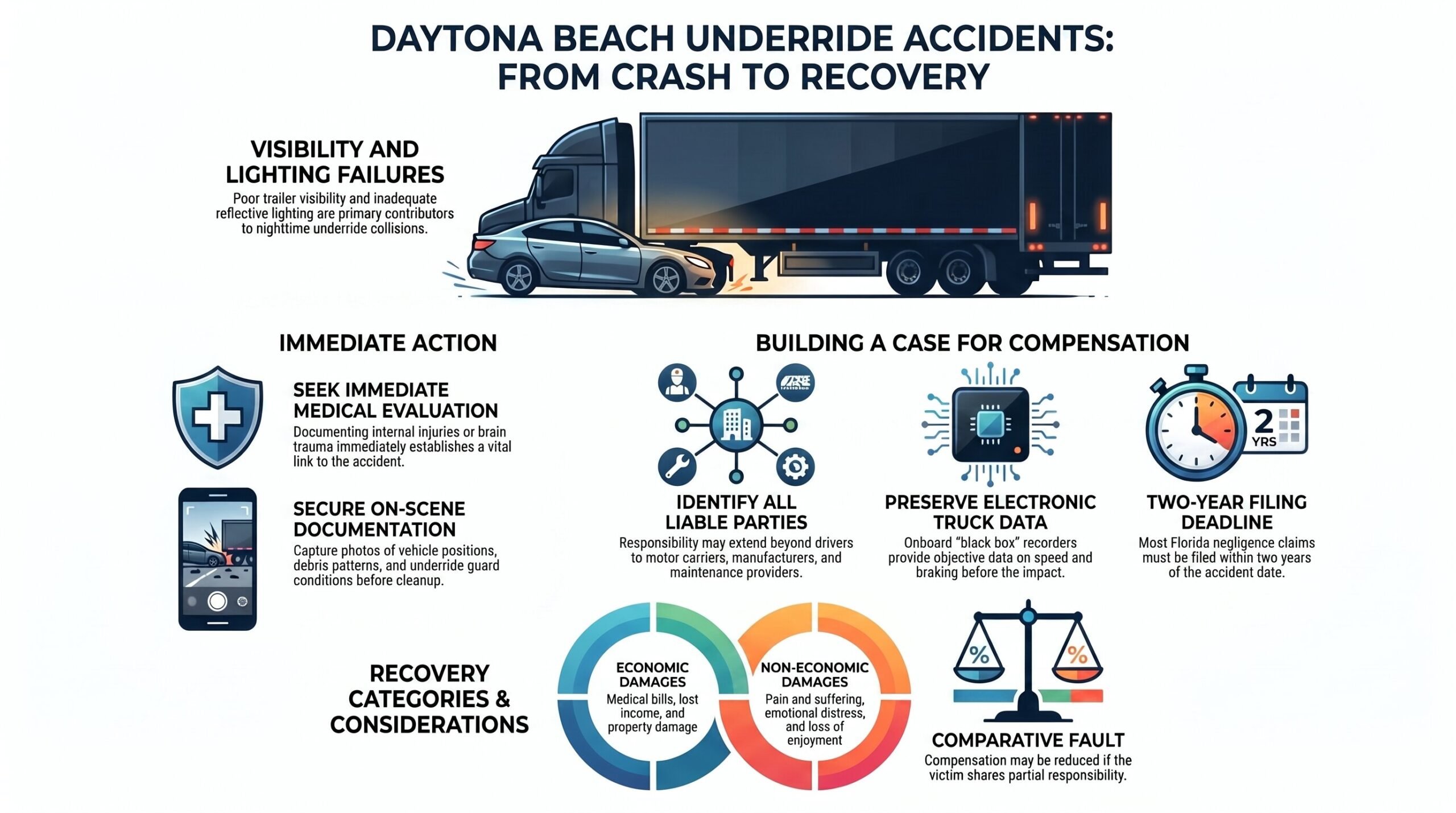
Common causes of Daytona Beach underride truck accidents include poor trailer visibility and inadequate lighting, which can make a truck difficult to recognize, particularly at night or in adverse weather. Sudden truck stops may leave following motorists with insufficient time to react, while improper lane changes can place passenger vehicles dangerously close to a trailer. Evaluating these contributing factors is crucial when examining responsibility and potential negligence.
Poor Trailer Visibility
Poor trailer visibility is a significant factor in Daytona Beach underride truck accidents because passenger vehicles may approach a trailer without recognizing its presence, dimensions, or distance in time to stop safely. Trailer blindspots can obscure portions of the trailer from nearby drivers, particularly when traffic merges, changes lanes, or travels alongside a large commercial vehicle.
A trailer’s shape and height may also be difficult to judge against dark road surfaces, distracting backgrounds, or congested traffic. These conditions can create nighttime hazards when drivers have less time to identify a trailer and accurately estimate closing distance. Drivers who serve others on the road should remain attentive, maintain safe following distances, and avoid lingering beside commercial vehicles. Trucking companies must also consider visibility risks during route planning, inspections, and operational training to help prevent foreseeable collisions.
Inadequate Lighting
When a commercial trailer lacks adequate lighting, its presence and dimensions may be difficult for approaching drivers to identify, particularly at night, in rain, or on poorly illuminated roads. Missing, damaged, or improperly maintained clearance lamps, taillights, and reflective devices can reduce Nighttime Visibility and make the trailer appear narrower or farther away than it is. A tractor-trailer may also become difficult to distinguish from surrounding darkness, especially where roadway lighting is limited. These conditions can reduce the time available for a following motorist to recognize the trailer and respond safely.
Driver Fatigue may further impair attention and visual processing, increasing the likelihood that inadequate lighting will go unnoticed. Investigators may review maintenance records, inspection reports, roadway conditions, and witness accounts when evaluating whether lighting deficiencies contributed to an underride collision.
Sudden Truck Stops
Sudden truck stops can create a serious underride hazard when a commercial vehicle decelerates faster than following drivers reasonably anticipate. A truck may stop abruptly because of a roadway obstruction, mechanical problem, traffic emergency, or an improperly secured load. Brake System Failures, including worn components or inadequate maintenance, can also cause unpredictable stopping behavior. When a passenger vehicle cannot stop in time, it may slide beneath the trailer, placing occupants at severe risk.
Sudden Stops Liability may depend on whether the driver acted reasonably, whether the carrier followed inspection requirements, and whether maintenance records reveal preventable defects. Investigators typically examine electronic data, brake components, witness accounts, and roadway conditions. Careful documentation can help clarify responsibility and support injured individuals seeking appropriate medical care, compensation, and accountability after a Daytona Beach collision.
Improper Lane Changes
Improper lane changes can create a serious underride risk when a commercial truck moves into an adjacent lane without adequate clearance or fails to detect a nearby passenger vehicle. A truck’s size can obscure vehicles traveling alongside it, particularly when mirrors are misaligned or blind spots are not carefully checked. Driver distraction, fatigue, or inadequate signaling may cause a truck to enter another lane unexpectedly, leaving a smaller vehicle little time to react.
Poor road markings, construction zones, and congested traffic can further complicate lane positioning and increase collision risks. When a passenger vehicle becomes trapped beside or beneath a trailer, injuries may be severe or fatal. Careful driving, appropriate mirror use, and timely signals help protect all road users. Evidence from the scene may clarify how the lane change occurred.
Don’t Wait. Call Our Daytona Beach Truck Accident Lawyers Now.


Legal Rights of Daytona Beach Underride Truck Accident Injury Victims
Daytona Beach underride truck accident injury victims generally have the right to pursue compensation from parties whose negligence contributed to the collision, including truck drivers, motor carriers, manufacturers, or maintenance providers. Available damages may include medical expenses, lost income, rehabilitation costs, pain and suffering, and other documented losses. A timely legal review can identify responsible entities and applicable filing deadlines.
Underride truck accident victims may pursue compensation for medical expenses, lost income, pain and suffering, and other documented damages.
Victims and their families may benefit from understanding these protections:
- They may seek compensation through insurance claims or civil litigation.
- They can request preservation of vehicle data, inspection records, photographs, and witness information.
- An evidence preservation strategy may protect materials needed to establish liability and damages.
- Comparative fault rules may reduce recovery if a victim is assigned partial responsibility.
Legal counsel can communicate with insurers, evaluate settlement proposals, and coordinate with medical professionals while protecting the claimant’s interests. Serving injured individuals requires careful attention to dignity, informed decision-making, and access to resources that support physical and financial recovery. Each claim depends on its facts, evidence, and governing law.
Why Do Daytona Beach Underride Truck Accident Injuries Happen?
Don’t Wait. Call Our Daytona Beach Truck Accident Lawyers Now.
Understanding potential legal claims also requires examining how underride collisions occur. These crashes happen when a smaller vehicle slides beneath a commercial truck or trailer, often because the truck’s rear or side guard fails to prevent the vehicle from passing underneath. The resulting impact can direct the truck’s structure into the passenger compartment, causing severe or fatal injuries.
Several conditions may contribute. Vehicle brake failure can prevent a truck operator from stopping or slowing before a collision, while inadequate following distance may reduce available reaction time. Poorly maintained, missing, or improperly installed underride guards can increase the likelihood of catastrophic intrusion. Limited visibility, nighttime driving, rain, and insufficient trailer lighting may make a truck difficult to recognize.
Driver fatigue factors can also impair attention, judgment, and response speed. Unsafe lane changes, sudden stops, speeding, and distracted driving create additional risks. In some cases, defective equipment, cargo problems, or roadway conditions contribute, requiring careful evaluation of all responsible parties.
Don’t Wait. Call Our Daytona Beach Truck Accident Lawyers Now.
What Should You Do After a Daytona Beach Underride Truck Accident Injury?
After a Daytona Beach underride truck accident, the injured person should seek immediate medical care, even if symptoms initially appear minor. They should document the accident by preserving photographs, witness information, medical records, and other relevant evidence. Contacting an experienced truck accident lawyer can help protect legal rights and support a thorough evaluation of potential claims.
Seek Immediate Medical Care
Prompt medical evaluation should be obtained immediately after an underride truck accident, even when visible injuries appear minor or absent. A qualified clinician can identify internal bleeding, traumatic brain injuries, spinal damage, and other conditions that may develop without immediate symptoms. Medical records also establish the timing, nature, and progression of reported injuries, supporting continuity of care and protecting the injured person’s interests. Emergency responders should be informed of every symptom, including pain, dizziness, numbness, confusion, or breathing difficulty.
Treatment recommendations should be followed carefully, and prescribed follow-up appointments should not be missed. The injured person should avoid minimizing discomfort or declining care because symptoms seem manageable. Prompt evaluation prioritizes recovery and helps family members, caregivers, and advocates coordinate appropriate support while preserving reliable medical information for later legal review.
Document The Accident
Accurate documentation should begin as soon as the injured person is medically stable and able to do so safely. A trusted individual may photograph the vehicles, roadway, traffic signs, lighting, weather conditions, debris, and visible injuries from several angles. Images should be preserved in their original form, with the date and time recorded when possible. The injured person or a support person should write a detailed account of what occurred, including travel direction, vehicle positions, sounds, and immediate symptoms, while memories remain clear.
Names, contact information, and brief descriptions should be collected from available witnesses, and Witness statements should be recorded accurately without speculation. A person assisting with the case may also note nearby businesses or intersections that could retain traffic camera footage before routine recording systems overwrite it.
Contact A Truck Accident Lawyer
Contacting a Daytona Beach truck accident lawyer can help protect the injured person’s legal rights after an underride collision. An attorney can evaluate medical records, crash evidence, vehicle damage, and applicable trucking regulations to identify responsible parties. Early legal guidance also helps preserve evidence that could otherwise be lost or altered. The lawyer may file insurance claims with the trucking company’s insurer and the injured person’s coverage provider, while handling communications that might affect potential compensation.
When liability is supported by evidence, counsel can negotiate settlement options designed to address medical expenses, lost income, rehabilitation needs, and other documented damages. If negotiations do not produce a fair resolution, the attorney can prepare a personal injury lawsuit. Prompt consultation allows the injured person and family to make informed decisions while focusing on recovery and supporting one another.
Critical Evidence in a Daytona Beach Underride Truck Accident Injury Case
Critical evidence can establish how an underride collision occurred, identify responsible parties, and demonstrate the resulting harm. A Daytona Beach underride truck accident lawyer may evaluate physical evidence, vehicle data, and medical documentation to build a well-supported injury claim.
Important evidence may include:
- Crash Scene Documentation: Photographs, measurements, traffic-camera footage, witness statements, and police reports may clarify vehicle positions, road conditions, visibility, and impact dynamics.
- Underride Guard Inspection: Examination of the truck’s rear or side guard may reveal damage, design defects, inadequate maintenance, or noncompliance with applicable safety requirements.
- Electronic Truck Data: Event data recorders, electronic logging devices, GPS records, and onboard systems may provide information about speed, braking, hours of service, and driver activity.
- Medical Treatment Records: Emergency reports, diagnostic testing, treatment notes, and physician opinions may connect the collision to specific injuries and document their severity, duration, and financial impact.
Crash Scene Documentation
When an underride truck collision occurs in Daytona Beach, prompt documentation of the crash scene can preserve evidence that may otherwise disappear or become altered. Investigators may photograph vehicle positions, roadway marks, lighting conditions, traffic controls, debris, and surrounding property before cleanup or weather changes the scene. Measurements and diagrams can help establish travel paths, impact angles, visibility, and the sequence of events. Nearby surveillance footage, dashboard recordings, and electronic data may also provide valuable context if secured quickly.
Investigators can identify potential witnesses and obtain post-collision witness statements while recollections remain fresh. Those accounts may clarify driver behavior patterns, traffic conditions, warnings, and actions immediately before impact. Careful documentation supports an objective reconstruction and helps protect injured individuals seeking accountability, compensation, and dependable assistance during recovery.
Underride Guard Inspection
An inspection of the truck’s underride guard can reveal whether its design, condition, installation, or maintenance contributed to the collision. Qualified professionals may photograph and measure the guard, examine attachment points, and document bending, fractures, corrosion, or missing components. They can compare findings with applicable federal requirements and manufacturer specifications. This evidence may help determine whether the carrier followed required safety compliance programs or overlooked defects that increased the risk of severe injury.
Records concerning inspections, repairs, and replacement parts may also clarify when a problem developed and who had responsibility for addressing it. Investigators may assess whether truck driver training covered pre-trip equipment checks and reporting procedures. Preserving the vehicle before repairs or disposal is critical. A timely inspection can protect accurate findings and support accountability for affected road users.
Electronic Truck Data
Electronic truck data can provide an objective account of vehicle operation before and during a Daytona Beach underride truck accident. Commercial vehicles may record speed, braking activity, engine performance, throttle position, and other information through electronic control systems. Properly preserved black box downloads can help establish whether the truck driver braked promptly, maintained reasonable speed, or continued operating after detecting a developing hazard. Investigators may also review ECM fault codes for indications of mechanical problems affecting braking, lighting, or other safety systems.
Because data can be overwritten, altered, or lost during repairs, qualified professionals generally seek preservation quickly and document the collection process. This evidence may assist families, attorneys, and investigators in evaluating responsibility and promoting accountability while serving injured people and their communities.
Medical Treatment Records
Medical treatment records provide pivotal evidence in a Daytona Beach underride truck accident injury case by documenting the nature, severity, and progression of a person’s injuries. Emergency department reports, diagnostic images, surgical notes, therapy records, and physician opinions can establish when symptoms began and how the collision affected daily functioning. Consistent documentation may connect injuries to the crash while addressing claims that treatment was unrelated or delayed. Records also help evaluate future medical needs, permanent limitations, lost earning capacity, and reasonable compensation.
With appropriate authorizations, counsel can organize these materials into a clear chronology for insurers, opposing counsel, and the court. They may also be compared with Electronic blackbox review findings and evidence concerning Underride guard compliance, helping clarify causation, injury severity, and the truck’s role in producing harm.
Long-Term Effects of Daytona Beach Underride Truck Accident Injuries
Underride truck accident injuries may cause chronic pain conditions that limit mobility, work capacity, and daily activities long after initial treatment. Survivors may also experience emotional trauma, including anxiety, depression, or post-traumatic stress related to the crash. Ongoing medical care, lost income, and reduced earning capacity can create substantial financial challenges for injured individuals and their families.
Chronic Pain Conditions
Chronic pain may develop after a Daytona Beach underride truck accident, particularly when victims sustain spinal damage, nerve injuries, fractures, or extensive soft-tissue trauma. Persistent symptoms can restrict mobility, interfere with sleep, and make routine activities difficult. Some individuals require physical therapy, pain management, or assistive equipment to preserve independence and participate in family or community responsibilities. Workplace rehabilitation may help an injured person pursue modified duties, retraining, or a gradual return to employment when medically appropriate.
Disability benefits can provide financial support when chronic limitations prevent consistent work. Physicians may recommend pain medication, injections, or other treatments, although ongoing monitoring is important. Severe conditions may also require long-term caregiving for bathing, transportation, household tasks, or medical appointments. Documented diagnoses, treatment records, and functional limitations can clarify future care needs and related losses.
Emotional Trauma
Following a Daytona Beach underride truck accident, emotional trauma may persist long after visible injuries have begun to recover. Survivors may experience anxiety, depression, nightmares, irritability, or heightened alertness when traveling near commercial vehicles. Some may avoid driving altogether, while others struggle with concentration, sleep, or relationships. These reactions can arise even when physical recovery appears substantial, and they should not be dismissed as weakness or overreaction.
Mental health professionals can evaluate symptoms and recommend counseling, trauma-focused therapy, or other appropriate care. Consistent routines, supportive communication, relaxation exercises, and other emotional coping strategies may help survivors regain stability. Family members, caregivers, and community organizations can provide victim support resources, encouraging treatment without pressure. Prompt attention may reduce lasting psychological effects and help individuals pursue recovery with dignity, patience, and informed support.
Financial Challenges
Financial challenges can continue well after a Daytona Beach underride truck accident, particularly when injuries require ongoing medical care or limit a person’s ability to work. Medical bills may accumulate through hospital treatment, prescriptions, rehabilitation, and follow-up appointments. Injury therapy can also require transportation, adaptive equipment, or assistance with daily activities, creating costs that are difficult to anticipate.
Reduced income may compound these burdens when a person cannot return to the same occupation or work schedule. Insurance paperwork often involves detailed records, deadlines, and disputed valuations, requiring careful organization. Settlement planning should account for current expenses, future treatment, lost earning capacity, and related financial needs. By preserving documentation and seeking informed guidance, affected individuals and their families can better evaluate available resources and support responsible long-term recovery.
Proving Liability in Daytona Beach Underride Truck Accident Injury Cases
Establishing liability in a Daytona Beach underride truck accident requires evidence showing that a truck driver, trucking company, vehicle manufacturer, or other responsible party failed to meet a legal duty and that the failure caused the injuries. Investigators may examine police reports, photographs, traffic-camera footage, vehicle damage, roadway conditions, and witness accounts. Rear-end evidence can help demonstrate whether the truck lacked properly maintained underride guards, warning lights, reflective markings, or other required safety equipment.
Driver records, electronic logging data, inspection reports, maintenance histories, and company training materials may reveal negligent conduct or regulatory violations. In some cases, engineering analysis can determine whether a design defect or manufacturing problem contributed to the collision. Liability Disputes may involve comparative fault, conflicting testimony, or uncertainty about vehicle positions and timing. Attorneys typically preserve physical evidence, consult qualified experts, and reconstruct the event to connect each proven violation with the resulting harm, supporting a fair resolution for the injured person.
Dealing With Insurance Companies After a Daytona Beach Underride Truck Accident Injury
Insurance companies often begin evaluating a Daytona Beach underride truck accident claim before liability evidence is complete, making early communication a significant concern for an injured person. Adjusters may request recorded statements, medical authorizations, or explanations of prior conditions. An injured person should provide accurate information while avoiding speculation, unnecessary detail, or admissions that could be misunderstood.
Dealing With Liability requires careful preservation of photographs, vehicle data, police materials, medical records, and communications with the trucking company or its insurer. The condition of the truck, trailer, underride guards, lighting, and roadway may be central to the evaluation. Promptly identifying Supporting Witness Statements can help preserve accounts from motorists, passengers, emergency personnel, and other observers before memories change.
A qualified attorney may handle insurer communications, review proposed releases, and assess whether an initial settlement reflects documented losses. Injured individuals should avoid signing broad releases or accepting payment before understanding how it may affect medical expenses, lost income, rehabilitation needs, and other damages. Such assistance promotes informed decisions while protecting the person’s ability to serve family and community.
What to Expect During a Daytona Beach Underride Truck Accident Injury Claim Process
A Daytona Beach underride truck accident injury claim generally begins with an initial case evaluation to assess liability, injuries, and potential damages. The process may then involve collecting evidence, negotiating with insurers, and addressing applicable legal requirements. Depending on the parties’ positions and the strength of the claim, resolution may occur through a settlement or proceed to trial.
Initial Case Evaluation
During an initial case evaluation, a Daytona Beach truck accident attorney examines the circumstances of the underride collision, the severity of the injuries, and the evidence available to support the claim. The attorney discusses medical treatment, work limitations, long-term concerns, and the client’s immediate needs without making unsupported promises about results. This meeting also identifies potential legal issues, including vehicle maintenance, trailer visibility, roadway conditions, and applicable filing deadlines.
Counsel may explain Evidence Preservation responsibilities, such as retaining records and avoiding statements that could impair the claim, while reserving detailed collection for the appropriate stage. Insurance Communication is addressed carefully, since insurers may seek recorded statements or early settlements before the injury’s full impact is understood. The evaluation concludes with recommended next steps, possible representation terms, and guidance designed to protect the injured person’s interests.
Evidence Collection Process
Once representation is established, the evidence collection process begins with identifying and preserving information that may clarify how the underride collision occurred and the extent of the resulting injuries. Investigators may document the roadway, lighting, traffic controls, vehicle positions, and visible damage before conditions change. Crash Scene Photos can show impact points, guard clearance, debris patterns, and safety equipment performance. Driver Statement Collection may preserve accounts from truck and passenger-vehicle operators while memories remain reliable.
Witness interviews, dispatch records, surveillance footage, electronic logs, maintenance files, and inspection histories may also be requested. Medical records and treatment documentation help connect the collision to diagnosed injuries, ongoing limitations, and necessary care. The process is conducted carefully to protect accuracy, respect affected individuals, and support a complete understanding of the incident.
Insurance Negotiation Steps
Insurance negotiations begin after the available evidence and medical documentation provide a reliable basis for evaluating the claim. The injured person’s representative typically prepares a demand package describing liability, treatment, ongoing limitations, lost income, and documented expenses. For surviving relatives, Wrongful death claims may require death records, funeral costs, lost support, and the family’s relationship with the deceased.
The insurer reviews these materials and may request additional records, statements, or authorization forms. Its initial response can identify disputed facts, question treatment, or present a valuation that does not reflect the documented harm. Counsel may respond with supporting evidence, a reasoned counterproposal, and clarification of applicable coverage. In severe cases involving reckless conduct, punitive damages may require separate factual development and legal analysis. Throughout the process, accurate records, timely communication, and careful evaluation help protect the claimant’s interests.
Settlement Or Trial
A settlement may resolve a Daytona Beach underride truck accident claim without the uncertainty, expense, and delay of a trial. The process commonly includes Insurance evidence gathering, medical documentation, vehicle inspections, and evaluation of liability and damages. Counsel may also prioritize witness testimony preservation before memories fade or evidence changes. If negotiations produce fair compensation, the injured person can accept an agreement and conclude the claim, subject to required approvals. When insurers dispute responsibility, minimize injuries, or offer inadequate payment, litigation may become necessary.
Trial preparation can involve depositions, expert analysis, discovery, and presentation of evidence concerning truck maintenance, visibility, speed, and driver conduct. A judge or jury then determines liability and damages. Throughout either path, careful guidance helps protect the injured person’s interests and supports a resolution that serves long-term recovery.
Compensation for Daytona Beach Underride Truck Accident Injury Damages
Compensation in a Daytona Beach underride truck accident claim may address the full scope of an injured person’s losses, including medical expenses, lost income, reduced future earning capacity, and pain and suffering. A careful claim may also account for rehabilitation, necessary transportation, in-home assistance, and other accident-related needs supported by reliable records. An attorney can investigate the collision, identify responsible parties, and present evidence showing how the underride event caused the injuries.
This work may include reviewing photographs, vehicle data, maintenance records, medical documentation, and preserving witness statements. It can also involve responding to Insurance denial strategies, incomplete investigations, or efforts to shift responsibility onto the injured person. Settlement discussions should reflect the documented consequences rather than an insurer’s initial offer. When negotiations do not provide fair relief, prepared evidence may support litigation. A legal representative can help protect the injured person’s interests while pursuing accountability and practical support for recovery and family responsibilities.
Economic vs Non-Economic Damages in Daytona Beach Underride Truck Accident Cases
Underride truck accident claims may include economic damages, such as medical expenses, lost income, and future treatment costs. Non-economic damages address less measurable harm, including pain, emotional distress, and diminished quality of life. Comparing these compensation types helps clarify how the full impact of an injury may be evaluated.
Economic Damages Explained
When an underride truck collision causes injury, economic damages represent the measurable financial losses resulting from the crash. These damages may include emergency transportation, hospital services, surgery, medication, rehabilitation, medical equipment, and ongoing treatment. They can also cover wages lost during recovery, reduced future earning capacity, property damage, and necessary household or caregiving assistance.
Documentation is crucial. Medical records, invoices, employment statements, tax documents, repair estimates, and expert evaluations can help establish the amount and connection to the collision. A careful Insurance negotiation strategy should organize these losses, address disputed charges, and present evidence supporting full reimbursement. Settlement timeline planning also helps account for continuing treatment and future expenses before resolution. An attorney may coordinate with providers, employers, and financial professionals to develop a reliable damages calculation.
Non-Economic Damages Overview
Beyond documented financial losses, non-economic damages address the personal effects of an underride truck collision that do not have a fixed dollar value. These damages may reflect physical pain, emotional distress, anxiety, loss of enjoyment, disfigurement, and diminished quality of life. They can also account for the disruption of family relationships and the continuing psychological effects of serious injuries. Courts and insurers may evaluate medical records, testimony from relatives, treatment history, and documented changes in daily activities when determining these harms.
A careful evidence collection timeline can help preserve information showing how the collision affected the injured person over time. During an insurance negotiation strategy, counsel may present this evidence in an organized, respectful manner that recognizes the person’s suffering and supports a fair evaluation of the claim without relying solely on financial documentation.
Comparing Compensation Types
Economic and non-economic damages serve different purposes in Daytona Beach underride truck accident cases, although both may be necessary to reflect the full extent of an injured person’s losses. Economic damages compensate measurable costs, including medical expenses, rehabilitation, property damage, lost wages, and diminished future earnings. Documentation such as invoices, employment records, and expert projections can help establish these amounts.
Non-economic damages address less tangible effects, including pain, emotional distress, disfigurement, disability, loss of enjoyment, and disruption of family relationships. Their value cannot be calculated solely through receipts, so evidence describing daily limitations and lasting consequences may be important. A fair claim may include both categories, because financial reimbursement alone may not acknowledge the human impact. Careful evaluation helps protect injured individuals and supports responsible advocacy for their recovery.
When a Daytona Beach Underride Truck Accident Injury Case Goes to Trial vs Settlement
In a Daytona Beach underride truck accident case, the decision to pursue settlement or proceed to trial depends on the strength of the evidence, the severity of the injuries, and the parties’ willingness to accept a fair resolution. Settlement may provide a predictable outcome, reduce stress, and deliver compensation sooner. The settlement timeline can vary according to medical treatment, document collection, expert review, and negotiations.
A trial may become necessary when liability or damages remain disputed, or when an insurer refuses to offer reasonable compensation. Trial strategy typically includes presenting accident evidence, medical documentation, witness testimony, and expert opinions in a coherent manner. Jury selection can influence how facts are evaluated, although no outcome is guaranteed.
Negotiation leverage often increases when the injured person’s evidence is well organized and future needs are clearly documented. A Daytona Beach truck accident lawyer may compare the risks, costs, timing, and potential outcomes of each path before recommending a decision that supports the injured person’s long-term well-being.
Florida Laws That May Affect Your Daytona Beach Underride Truck Accident Case
Florida laws may affect nearly every stage of a Daytona Beach underride truck accident case, including the deadline for filing a claim, the proof required to establish negligence, and the method used to calculate recoverable damages. Florida’s comparative negligence rules may reduce compensation when an injured person shares responsibility. Evidence may include crash reports, vehicle inspections, driver records, and testimony concerning Federal trucking regulations.
Florida law shapes deadlines, negligence proof, comparative fault, and damages in Daytona Beach underride truck accident claims.
- Liability may involve the truck driver, carrier, maintenance contractor, manufacturer, or other responsible parties.
- Florida’s no-fault insurance system may address certain initial medical expenses, while severe injuries can support a negligence claim.
- Damages may include medical care, lost income, reduced earning capacity, property damage, and non-economic losses.
- Punitive damages limits and heightened proof requirements may apply when conduct reflects intentional misconduct or gross negligence.
A careful investigation can preserve evidence and clarify which legal theories support the claim. Counsel may also coordinate with medical professionals and family representatives to present the injured person’s needs accurately, promoting accountability and protecting available recovery.
The Statute of Limitations for Daytona Beach Underride Truck Accident Injury Cases
Although the circumstances of an underride truck accident may require extensive investigation, a Daytona Beach injury claim must generally be filed within the deadline established by Florida’s statute of limitations. For many negligence claims, Florida law provides two years from the accident date, although exceptions may alter the deadline. Claims involving a government entity, a deceased victim, or a minor may involve different notice requirements or limitation periods. Missing the applicable deadline can prevent recovery, regardless of the severity of the injuries or the strength of the evidence.
Prompt attention also helps preserve crucial proof. Vehicle data, photographs, maintenance records, and roadway conditions may change or disappear. The importance of witness testimony is especially significant when visibility, lighting, braking, or truck positioning is disputed. Insurance company tactics may include requesting statements, emphasizing delays, or challenging the claim before the filing period expires. A timely, carefully documented claim supports accountability and protects access to compensation for medical care, lost income, and continuing needs.
How a Daytona Beach Underride Truck Accident Lawyer Can Help You
When an underride truck accident causes serious injuries, a Daytona Beach underride truck accident lawyer can investigate the collision, identify responsible parties, and pursue compensation under applicable Florida law. The lawyer may coordinate Evidence preservation, obtain vehicle data, and examine inspection, maintenance, and loading records. Investigators can document roadway conditions, lighting, signage, and truck stop locations that may clarify the truck’s movements or safety practices.
The lawyer can also:
- Interview witnesses and preserve witness testimony before memories change.
- Compare eyewitness accounts with photographs, video, and vehicle damage.
- Consult qualified professionals regarding visibility, braking, design, and crash dynamics.
- Communicate with insurers while protecting the injured person’s legal interests.
A lawyer may calculate medical expenses, rehabilitation costs, lost income, and other legally recognized damages. By organizing reliable evidence and presenting a clear claim, counsel helps families, caregivers, and community supporters seek accountability without placing investigative burdens on an injured person. This representation also promotes careful treatment of witnesses and responsible handling of sensitive information.
When to Contact a Daytona Beach Underride Truck Accident Lawyer
After an underride truck accident, prompt legal consultation can help preserve evidence and clarify the available options before critical information is lost. Contact should occur as soon as practical, particularly when injuries require emergency treatment, a vehicle is severely damaged, or fault may be disputed. Early guidance can help identify important records, photographs, witness accounts, and electronic data that might otherwise disappear or become difficult to obtain.
Why immediate documentation matters should be understood by every affected person and family seeking to support recovery and accountability. A lawyer can help organize accident reports, medical records, employment information, and insurance communications without interfering with ongoing treatment or official investigations.
Medical evidence preservation is especially important because diagnostic findings, treatment recommendations, and documented symptoms may establish the nature and progression of injuries. Consultation may also be appropriate before providing detailed statements to insurers or accepting a settlement. Prompt assistance allows informed decisions while protecting the person’s ability to pursue available remedies and support those depending on them.
Why You Need an Experienced Daytona Beach Underride Truck Accident Lawyer
Experienced legal representation is important in an underride truck accident because these cases often involve severe injuries, disputed liability, and complex evidence. An experienced Daytona Beach attorney can examine roadway conditions, vehicle damage, lighting, safety equipment, maintenance records, and driver logs to establish how the collision occurred. Legal counsel may also identify Reckless driving patterns, regulatory violations, inadequate training, or negligent fleet supervision that contributed to the crash.
Truck insurers and other defendants may contest responsibility or minimize the value of an injured person’s losses. An attorney familiar with commercial transportation claims can preserve essential evidence, consult qualified experts, and address Insurance fraud tactics or misleading documentation when they arise. This support helps protect medical, financial, and legal interests while allowing injured individuals and their families to focus on recovery and service to one another. Skilled advocacy also promotes accountability and encourages safer practices, benefiting other motorists who share Daytona Beach roads.
How to Choose the Right Daytona Beach Underride Truck Accident Lawyer for Your Case
Choosing the right Daytona Beach underride truck accident lawyer requires careful consideration of the attorney’s experience, investigative resources, and record handling complex commercial vehicle claims. A qualified lawyer should understand federal trucking regulations, preserve vehicle evidence, examine driver records, and consult appropriate accident reconstruction or medical professionals. Prospective clients should ask how the attorney evaluates liability involving carriers, contractors, manufacturers, and other responsible parties.
Clear Client communication is equally important. The lawyer should explain developments, legal options, and potential risks in understandable terms while remaining responsive to reasonable questions. Discussion of contingency fees should identify the percentage charged, litigation expenses, and any costs owed if the case does not succeed.
An effective attorney should also provide realistic settlement timelines without promising a specific result. During an initial consultation, the lawyer should explain the approach to damage valuation, including medical treatment, lost income, future needs, and non-economic harm. Comparing qualifications, resources, communication practices, and fee agreements can help families select representation committed to protecting their interests.
About The Law Offices of Anidjar & Levine
The Law Offices of Anidjar & Levine represents individuals and families injured in serious motor vehicle collisions, including underride truck accidents in Daytona Beach.
The firm’s attorneys evaluate crash circumstances, identify potentially responsible parties, and explain legal options in terms clients can understand.
Their work may include examining vehicle damage, roadway conditions, driver conduct, maintenance records, and available insurance coverage.
For individuals seeking practical information, the firm addresses common Truck accident FAQs, including questions about deadlines, evidence, medical documentation, and negotiations with insurers.
Attorneys also consider Florida evidence rules when preserving and presenting photographs, electronic records, witness statements, accident reports, and expert opinions.
These requirements can influence how effectively a claim is supported.
The firm’s approach emphasizes attentive communication, careful preparation, and service to injured clients and their families.
By investigating each matter individually, the attorneys seek to protect legal rights and pursue compensation for medical expenses, lost income, property damage, pain, and other accident-related losses.
Frequently Asked Questions
Can Family Members File a Wrongful Death Claim After a Fatal Underride Accident?
Family members may file a wrongful death claim after a fatal underride accident, but eligibility depends on state law and the claimant’s relationship to the deceased. A personal representative often brings the action for surviving beneficiaries, seeking funeral costs, lost income, and loss of companionship. The Wrongful Death Timeline governs filing deadlines, while a Survival Damages Calculation may address damages the deceased sustained before death. Legal guidance helps preserve evidence and rights.
Are Underride Guards Required on All Commercial Trucks in Florida?
Not every commercial truck in Florida is subject to identical underride-guard requirements. Florida underride laws generally operate alongside federal guard standards, which require qualifying trailers and semitrailers to have rear impact guards meeting specified performance criteria. Certain vehicles, configurations, and older equipment may fall within exceptions. Compliance depends on the truck’s classification, manufacture date, and operation. A qualified investigator can review inspection records, photographs, and applicable regulations to identify potential safety violations.
What Happens if the Truck Driver Was Working for a Rideshare or Delivery Company?
If the truck driver worked for a rideshare or delivery company, responsibility may extend beyond the driver to the employer, contractor, vehicle owner, or insurer. Rideshare employment contracts can define whether the driver was an employee or independent contractor and identify applicable coverage during each trip. Delivery driver liability depends on company control, vehicle ownership, operating policies, and whether the driver acted within assigned duties. Evidence should be preserved promptly.
Can I Still Pursue Compensation if I Was Not Wearing a Seat Belt?
A person may still pursue compensation despite not wearing a seat belt. Under Florida’s Comparative Negligence principles, an insurer or court may reduce recovery if the failure contributed to the injuries, but it does not automatically bar a claim. Evidence of Seatbelt Use, medical records, crash reconstruction, and testimony may influence the outcome. Because underride collisions can involve severe forces, an attorney can assess liability, damages, and applicable defenses while protecting the injured person’s rights.
Will My Medical Bills Be Paid While My Underride Accident Claim Is Pending?
Medical bills are not automatically paid while an underride accident claim is pending. The injured person may need health insurance, medical-payment coverage, or personal funds to maintain care. Providers sometimes accept healthcare liens, agreeing to receive payment from a future settlement. The insurer’s timeline can vary substantially, particularly when liability, injuries, or damages remain disputed. A qualified attorney can coordinate with providers, protect treatment access, and explain potential reimbursement obligations before settlement.
—————————
Underride truck crashes can cause catastrophic injuries, substantial financial losses, and complex liability disputes.
Victims in Daytona Beach may benefit from prompt legal guidance to preserve evidence, identify responsible parties, and pursue appropriate compensation.
An experienced Daytona Beach Truck Accident Lawyer can assess the circumstances, handle insurance negotiations, and, when necessary, present the claim in court.
The Law Offices of Anidjar and Levine evaluates each case carefully and helps injured individuals understand their legal options.