The Law Offices of Anidjar and Levine help injured victims of impaired or distracted driving crashes in Florida establish negligence, identify responsible parties, and pursue compensation for medical expenses, lost income, pain and suffering, and long-term limitations. Evidence may include crash reports, witness statements, medical records, photographs, vehicle data, phone records, and surveillance footage. A lawyer can address comparative fault, preserve key evidence, communicate with insurers, and evaluate future damages before settlement. Learn more from a Florida Personal Injury Lawyer about legal rights, claim strategy, and selecting qualified representation.
Main Takeaways
- A Florida impaired-driving lawyer can investigate alcohol, drugs, texting, passengers, and other distractions causing the crash.
- Victims must prove duty, breach, causation, and damages using crash reports, witness statements, medical records, photographs, and vehicle data.
- Potentially responsible parties may include the negligent driver, employers, vehicle owners, or other liable entities.
- Comparative fault can reduce compensation, making careful evidence collection and insurer communications especially important.
- Legal guidance can help pursue medical expenses, lost income, pain and suffering, and reasonably anticipated long-term losses.


How We Can Help With Your Florida Car Accident Impaired & Distracted Driving Injury Claim
When a Florida car accident involves an impaired or distracted driver, an experienced personal injury lawyer can help establish liability and pursue compensation for the injured party. Counsel can explain Personal Injury Basics, identify potentially responsible parties, and organize evidence supporting the claim. This may include crash reports, medical records, witness accounts, photographs, vehicle data, and available communications or surveillance footage.
A lawyer can also communicate with insurers, evaluate documented losses, and help protect an injured person from statements or settlement proposals that may undervalue the harm. Depending on the circumstances, recoverable damages may involve medical expenses, lost income, property damage, and non-economic losses. Counsel can explain Common Settlement Types and assess whether a proposed resolution reasonably addresses present and anticipated needs.
Through careful preparation, the legal team can help the injured party and family understand available options, meet applicable deadlines, and make informed decisions. The objective remains fair compensation and a process conducted with diligence, respect, and accountability.
OUR CONSULTATIONSARE FREE
START YOUR FREE CASE REVIEW

Understanding Florida Car Accident Impaired & Distracted Driving Injury Cases
Impaired and distracted driving injury cases arise when alcohol, drugs, fatigue, mobile-device use, or other conduct interferes with a driver’s ability to operate a vehicle safely. These claims require a careful examination of how the incident occurred, whether the driver breached a legal duty, and how that breach caused measurable harm.
Florida’s Liability standards generally require proof of negligence, including a duty, violation, causation, and damages. Evidence may include crash reports, witness accounts, medical records, vehicle data, and available communications or surveillance footage. The injured person’s conduct and comparative fault may also affect recovery.
A sound courtroom strategy organizes evidence into a clear account of responsibility and injury. It may address disputed facts, challenge unsupported defenses, and present medical consequences in terms understandable to judges and juries. Because treatment, income loss, and long-term limitations can develop over time, an evaluation should consider both current losses and reasonably anticipated needs. Legal guidance can help preserve evidence, communicate with insurers, and protect the injured person’s interests.
Common Causes of Florida Car Accident Impaired & Distracted Driving
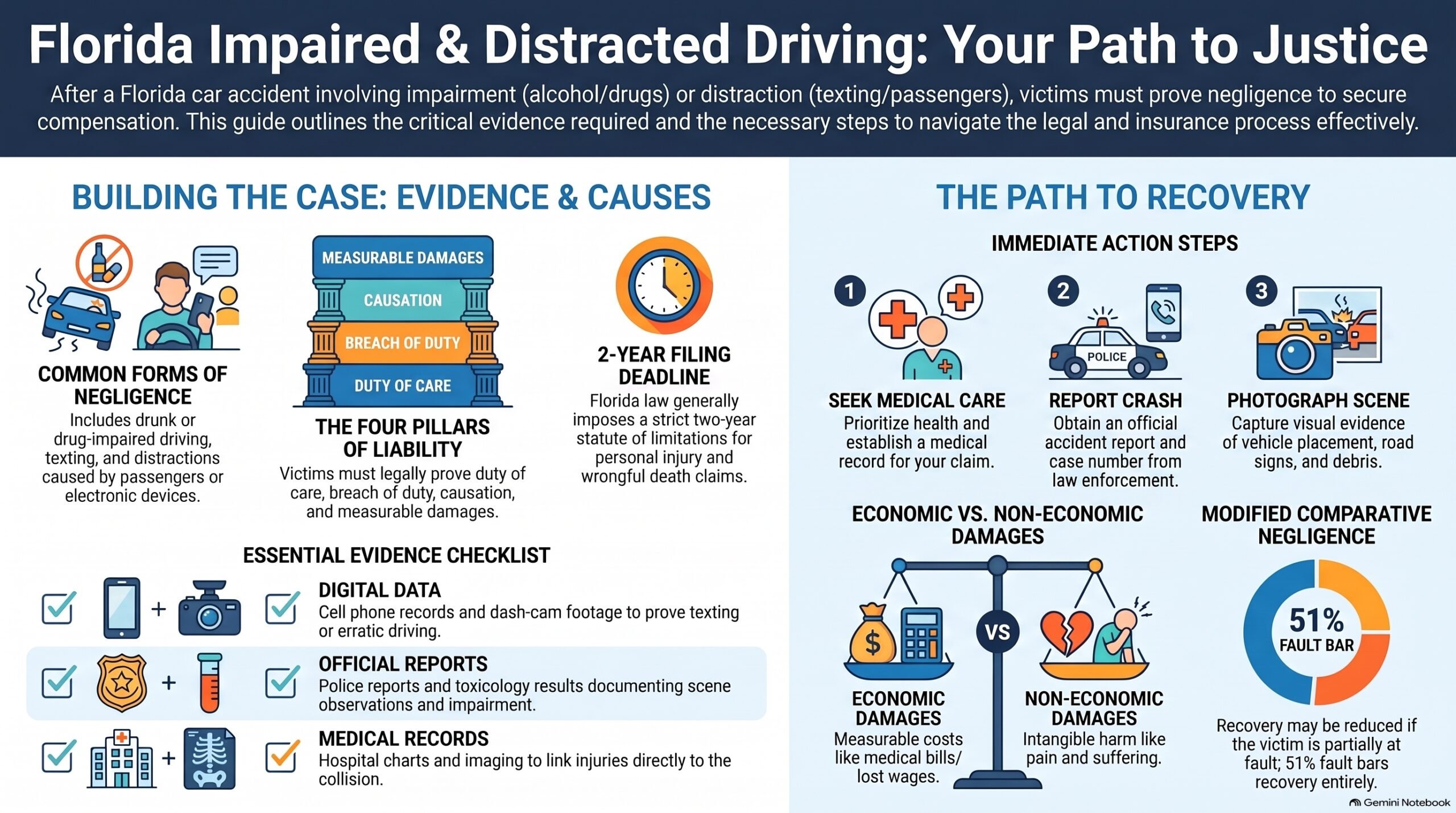
Common causes of impaired and distracted driving collisions include drunk driving, drug-impaired driving, texting while driving, and distractions caused by passengers. Each behavior can reduce attention, impair judgment, or delay a driver’s ability to respond to changing traffic conditions. Identifying the cause of a crash may be important when evaluating liability and potential legal claims.
Drunk Driving
Drunk driving remains a serious cause of Florida car accidents because alcohol impairs judgment, reaction time, coordination, and the ability to evaluate traffic conditions accurately. Drivers under the influence may speed, disregard signals, drift across lanes, or fail to recognize pedestrians and other motorists. These decisions can produce severe injuries, particularly in nighttime crashes and Rideshare collisions involving passengers, drivers, and nearby vehicles. Florida law imposes serious penalties for impaired driving, yet victims may still face medical expenses, lost income, and lasting emotional harm. A careful investigation can identify alcohol-related conduct, preserve evidence, and clarify responsibility. Legal professionals serving injured individuals may also distinguish legitimate enforcement from a DUI wrongful arrest when evaluating related circumstances. Prompt assistance helps protect victims’ rights while supporting accountability and informed recovery after a collision.
Drug-Impaired Driving
Although some medications are lawfully prescribed, drug-impaired driving can greatly increase the risk of a Florida car accident by reducing alertness, coordination, judgment, and reaction time. Prescription pain relievers, sedatives, sleep medications, and certain antihistamines may impair driving even when taken as directed. Combining medication with alcohol or other substances can intensify these effects and create serious dangers for passengers, pedestrians, and other motorists. Evidence may include prescriptions, pharmacy records, witness observations, medical documentation, and statements concerning dosage or timing. Prescription drug evidence can help establish whether impairment contributed to a collision, although lawful use does not automatically prove negligence. Toxicology testing may identify drugs in blood, urine, or other samples, but interpretation generally requires qualified medical or forensic professionals. Careful investigation helps injured individuals pursue accountability and appropriate support.
Texting While Driving
Texting while driving is a significant form of distracted driving that diverts a motorist’s visual attention, manual control, and mental focus from the roadway. Reading or composing a message can prevent a driver from recognizing traffic signals, pedestrians, slowing vehicles, or changing road conditions. Even brief phone use may cause lane departure, delayed braking, reduced following distance, or a collision with another vehicle. Florida motorists have a responsibility to maintain attentive control and protect everyone sharing the roadway. After a crash, investigators may examine witness accounts, vehicle damage, electronic data, and Cell phone records to determine whether texting contributed to the event. Documentation can help injured individuals and their families understand what occurred, preserve relevant evidence, and pursue appropriate support while promoting accountability for preventable driving behavior.
Distracted By Passengers
Passengers can contribute to distracted driving when conversations, arguments, physical interactions, or requests for the driver’s attention interfere with safe operation of the vehicle. Drivers may turn to address occupants, reach for items, or respond to disruptive behavior, reducing visual attention, manual control, and reaction time. Passenger-related distractions can become especially dangerous in congested traffic, near intersections, or during adverse weather. Individuals injured in the resulting collisions should prioritize seeking emergency assistance and a medical evaluation, even if symptoms initially appear minor. Medical documentation can support claims involving pain treatment, lost income, and other accident-related losses. Evidence preservation may include photographs, vehicle information, surveillance requests, and witness contacts. A careful record of passenger conduct, driver responses, and surrounding conditions can assist insurers, investigators, and courts in evaluating responsibility while protecting the injured person’s ability to seek appropriate compensation.
Don’t Wait. Call Our Florida Personal Injury Lawyers Now!


Legal Rights of Florida Car Accident Impaired & Distracted Driving Injury Victims
Florida car accident victims injured by impaired or distracted drivers may have the right to pursue compensation for medical expenses, lost income, property damage, pain and suffering, and other related losses. Florida law may support claims against responsible drivers, although recovery depends on evidence, causation, and applicable deadlines.
Victims should consider these protections:
- The right to obtain crash reports, medical records, witness information, and other evidence supporting liability.
- The right to seek payment through an insurance claim or personal injury lawsuit.
- The right to understand Insurance claim deadlines before submitting required documentation.
- The right to challenge a comparative negligence defense that alleges the injured person contributed to the collision.
Prompt medical evaluation and careful documentation can help preserve a claim’s value. A qualified attorney may communicate with insurers, assess available coverage, and protect the victim from premature settlements. Legal guidance also helps families pursue fair treatment while allowing injured individuals to focus on recovery and critical responsibilities.
Why Do Florida Car Accident Impaired & Distracted Driving Injuries Happen?
Why do impaired and distracted driving injuries occur so frequently on Florida roads? Several preventable conditions contribute to these collisions, including alcohol, drugs, fatigue, and divided attention. Impairment can slow reaction time, weaken judgment, and reduce coordination, making it difficult for a driver to recognize hazards or respond appropriately.
Distraction creates similar dangers. Cellphone Notifications, text messages, navigation systems, conversations, and other electronic activity can draw a driver’s eyes, hands, or thoughts away from traffic. Even brief inattention may prevent timely braking when vehicles stop suddenly, pedestrians enter a roadway, or traffic patterns change.
Unsafe driving decisions can also interfere with Lane Control. An impaired or distracted motorist may drift across markings, miss an exit, follow too closely, or make an improper turn. Florida’s heavy tourism, congested highways, changing weather, and diverse roadway conditions can magnify these mistakes. Understanding these causes helps communities promote safer behavior and recognize how careless choices can cause serious, life-altering injuries to others.
What Should You Do After a Florida Car Accident Impaired & Distracted Driving Injury?
After an impaired or distracted driving crash, the injured person should seek immediate medical care, even when symptoms initially appear minor. The crash should be reported to law enforcement, and medical records, photographs, witness information, and other relevant documentation should be preserved. These steps can support recovery and help establish the circumstances and resulting injuries.
Seek Immediate Medical Care
Prompt medical evaluation should be obtained following a car accident involving suspected impaired or distracted driving, even when the injured person believes the condition is minor. Adrenaline can temporarily mask pain, while concussions, internal injuries, and soft-tissue damage may develop gradually. A person experiencing confusion, severe pain, bleeding, difficulty breathing, weakness, or loss of consciousness requires emergency assistance without delay. Emergency roadside care may stabilize immediate conditions and help determine whether transport to an emergency department is necessary. Medical providers should receive an accurate account of symptoms and any changes after the collision. Follow-up appointments should be maintained, and treatment instructions should be documented carefully. If the injured person cannot communicate effectively, companions should call trusted witnesses who can help identify observed symptoms and support timely care decisions.
Report the Crash
When a Florida car accident may involve impaired or distracted driving, the crash should be reported to law enforcement as soon as it is safe to do so. A driver, passenger, or witness should call law enforcement and provide the collision location, injuries observed, and any immediate hazards. Emergency dispatchers can coordinate medical assistance and officers who can assess the roadway and address suspected impairment. Individuals should avoid confronting, accusing, or attempting to restrain another motorist, particularly if that person appears agitated or impaired. De-escalation at the scene may reduce further danger; calm communication and physical distance are important while awaiting authorities. If leaving the vehicle is unsafe, occupants should remain secured inside when possible and follow dispatcher instructions. Officers can manage traffic, separate involved parties, and explain necessary next steps.
Preserve Evidence and Documentation
Once law enforcement has addressed immediate safety concerns, the injured person should preserve evidence and create a thorough record of the Florida car accident. Photographs should document vehicle positions, roadway conditions, traffic signals, visible injuries, property damage, and relevant surroundings before changes occur. The person should retain medical records, discharge instructions, prescriptions, repair estimates, insurance communications, and receipts for accident-related expenses. Clothing or personal items damaged during the collision should be stored without washing or alteration. Witness coordination can help identify individuals who observed driver behavior, phone use, impairment indicators, or the crash itself. Their names, contact information, and brief recollections should be recorded promptly, without coaching or pressuring them. Evidence preservation also includes securing available dash-camera, surveillance, and electronic records through appropriate legal requests. This organized documentation may support accurate investigations and protect the injured person’s rights.
Don’t Wait. Call Our Florida Personal Injury Lawyers Now!
Critical Evidence in a Florida Car Accident Impaired & Distracted Driving Injury Case
Critical evidence can establish whether impairment or distraction caused the Florida collision and support the injured party’s claim.
- Police reports; 2. Medical records; 3. Witness statements; and 4. Video and phone data should be preserved and evaluated for consistency.
Together, these sources may clarify liability, document injuries, and reveal conduct that is not apparent from the accident scene alone.
Police Reports
Police reports often provide an initial, objective account of a Florida car accident involving suspected impaired or distracted driving. Officers may document roadway conditions, vehicle positions, visible damage, statements, citations, and observations made during roadside investigations. Such details can help establish how the collision occurred and whether conduct such as texting, alcohol use, or drug impairment appeared relevant. Reports may also identify available witnesses and preserve information supporting later witness credibility assessments. However, an officer’s report is not automatically conclusive. It may contain preliminary impressions, incomplete statements, or disputed conclusions, particularly when witnesses leave before officers arrive. Attorneys can compare the report with photographs, video, vehicle data, and other evidence while identifying inconsistencies. Promptly obtaining the report helps preserve essential facts and supports a careful evaluation of potential claims.
Medical Records
Medical records provide essential evidence in a Florida car accident injury case involving suspected impaired or distracted driving. They document reported symptoms, diagnostic findings, treatment recommendations, and the patient’s progress after the collision. Consistent records can help establish medical causation by connecting injuries to the crash and distinguishing new conditions from prior complaints. Evidence preservation should begin promptly and include hospital charts, emergency records, imaging, prescriptions, therapy notes, and billing information. Documentation requests may be directed to every healthcare provider involved, with appropriate authorizations and attention to privacy requirements. Treatment timelines are particularly important because delays, gaps, or changes in care may affect how insurers evaluate injury severity and causation. Accurate records also help clarify future medical needs, lost function, and the services required to support recovery and continued well-being.
Witness Statements
When available, witness statements can provide valuable independent evidence in a Florida car accident injury case involving suspected impaired or distracted driving. Witnesses may describe the driver’s behavior before impact, including swerving, delayed reactions, speeding, or apparent attempts to use a device. Their observations can help establish what occurred when the injured person cannot clearly recall the collision. Statements should be collected promptly because memories can change, and contact information may become difficult to obtain. The impact of dashcam footage, if observed by a witness, may also help explain vehicle movements or the sequence of events without replacing the witness’s account. Attorneys should evaluate witness credibility issues, including distance, visibility, attention, consistency, and possible bias. A careful interview preserves relevant details while respecting each witness’s role in assisting in the pursuit of accountability for an injured person.
Video And Phone Data
Video and phone data can provide critical evidence in a Florida car accident injury case involving suspected impaired or distracted driving. Dashcam footage, traffic cameras, surveillance recordings, and witness videos may show vehicle movement, driver behavior, roadway conditions, and the sequence of events. A driver’s phone records can help establish whether calls, texts, navigation, or social media applications were active near the collision. App crash reports may preserve timing, location, speed, braking, or impact information that supports reconstruction efforts. Investigators can also examine device activity, access records, and data from connected vehicles, subject to applicable privacy requirements. Preservation requests are often important because recordings and digital logs may be overwritten quickly. A qualified attorney can coordinate lawful collection, authentication, and analysis while protecting the injured person’s interests throughout the claim.
Long-Term Effects of Florida Car Accident Impaired & Distracted Driving Injuries
Impaired or distracted driving injuries may produce chronic pain, lasting disability, and limitations on a person’s ability to work or perform daily activities. Emotional and psychological trauma, including anxiety, depression, or post-traumatic stress, may also persist long after physical wounds have recovered. These consequences can create substantial financial burdens and require significant changes to established lifestyles.
Chronic Pain And Disability
Chronic pain and disability can become enduring consequences of injuries caused by impaired or distracted driving in Florida. Fractures, spinal damage, nerve injuries, and traumatic joint conditions may limit mobility, employment, household responsibilities, and participation in ordinary activities. Some survivors require ongoing surgery, rehabilitation, prescription management, mobility equipment, or assistance with personal care. Medical professionals may need to document prognosis, functional restrictions, treatment duration, and anticipated future expenses. This evidence can support a realistic assessment of long-term recovery and the assistance required to preserve dignity and independence. During settlement negotiations, damages may include past and future medical costs, lost income, reduced earning capacity, home modifications, and continuing care. A Florida car accident lawyer can coordinate records and qualified evaluations so an injured person’s lasting needs are presented accurately and responsibly.
Emotional And Psychological Trauma
Emotional and psychological trauma may persist long after physical injuries from an impaired or distracted driving crash have stabilized. Survivors may experience anxiety, depression, sleep disruption, intrusive memories, or fear of driving. Some develop post-traumatic stress disorder, while others struggle with concentration, trust, or ordinary social interactions. These symptoms can affect relationships and emotional stability even when medical examinations show limited physical impairment. Professional counseling and psychiatric care may help identify symptoms, establish treatment goals, and support recovery. Documentation from qualified providers can also clarify the trauma’s duration and severity. When legal claims address these injuries, mediation options may provide a structured setting for respectful resolution. A careful settlement strategy should account for ongoing treatment and credible evidence without reducing psychological harm to a financial calculation. Supportive advocacy helps survivors pursue recognition and appropriate relief.
Financial And Lifestyle Consequences
When injuries from an impaired or distracted driving crash continue to affect a person’s health, the financial consequences may extend well beyond initial medical costs. Ongoing treatment, rehabilitation, prescriptions, and necessary home or vehicle modifications can create persistent financial pressure. Reduced mobility may limit employment, caregiving, education, and household responsibilities, causing lost wages and diminished future earning capacity. Lifestyle changes may also require assistance with transportation, personal care, and daily activities. Victim mental health can suffer when financial uncertainty compounds pain, disability, or dependence on others. A carefully developed Settlement negotiations strategy should address documented expenses, projected medical needs, lost income, and non-economic harm. Legal counsel may help identify responsible parties, preserve evidence, and present reliable medical and financial records. These efforts support fair compensation and help affected individuals pursue stability, dignity, and meaningful recovery.
Proving Liability in Florida Car Accident Impaired & Distracted Driving Injury Cases
Proving liability in an impaired or distracted driving case requires evidence that connects the driver’s unsafe conduct to the collision and resulting injuries. Investigators may examine crash reports, witness statements, vehicle data, surveillance footage, and cellphone records to determine whether alcohol, drugs, texting, or another distraction affected the driver’s decisions. Medical records and testimony can establish the nature, duration, and seriousness of the injuries, while accident reconstruction may clarify speed, positioning, and reaction time.
A legal team serving injured people must organize these facts into a coherent account of what occurred before, during, and after impact. Cross-examination strategy can test inconsistent statements, challenge unsupported explanations, and expose gaps in the opposing account. Effective jury persuasion tactics rely on credible evidence rather than exaggeration, helping jurors understand how a specific unsafe act caused measurable harm. Florida’s comparative negligence rules may also make evidence concerning each party’s conduct important when responsibility is disputed in court.
Dealing With Insurance Companies After a Florida Car Accident Impaired & Distracted Driving Injury
After a Florida car accident involving suspected impaired or distracted driving, insurance companies may request statements, medical records, employment information, and other evidence while evaluating the claim. An insurance adjuster may also ask about symptoms, treatment, prior injuries, and the collision’s circumstances. Injured individuals should provide accurate information, avoid speculation, and refrain from minimizing limitations or authorizing broad releases without careful review. Insurers may employ denial tactics, including disputing fault, questioning medical necessity, attributing injuries to preexisting conditions, or arguing that treatment was delayed. Preserving photographs, witness information, crash reports, medical bills, and wage documentation can support a complete claim presentation. Communication should remain factual and measured, particularly when suspected intoxication, drug use, phone use, or other distraction is involved. A qualified Florida attorney can communicate with the insurer, protect the injured person’s interests, and identify unfair requests or inadequate settlement positions while ensuring that available evidence is responsibly presented.
What to Expect During a Florida Car Accident Impaired & Distracted Driving Injury Claim Process
A Florida impaired or distracted driving injury claim generally begins with an initial case evaluation to assess liability, injuries, and available insurance coverage. The process may include collecting crash reports, medical records, witness statements, phone data, and other evidence, followed by negotiations with the insurance companies. If the parties cannot reach an acceptable settlement, the claim may proceed to trial.
Initial Case Evaluation
During an initial case evaluation, a Florida car accident lawyer examines the collision, the client’s injuries, and the available evidence to determine whether an impaired or distracted driving claim may be viable. The consultation generally addresses the accident’s circumstances, medical treatment, insurance communications, and the client’s recovery needs. A police report review may reveal reported observations, citations, statements, or indications of impairment, although it does not independently establish liability. The lawyer may also perform a witness credibility assessment by considering each person’s opportunity to observe the crash, consistency, neutrality, and recollection. The client can expect questions about symptoms, missed work, and ongoing limitations. Counsel then explains potential legal theories, deadlines, responsible parties, and practical options. This evaluation helps determine whether representation can responsibly advance the client’s interests and support fair compensation.
Evidence Collection Process
Once representation is secured, the Florida car accident lawyer begins gathering and preserving evidence to clarify how the collision occurred and who should be held responsible. The process may include obtaining crash reports, photographs, medical records, witness statements, and available surveillance footage. Counsel may also seek vehicle damage documentation, cellphone records, event data recorder information, and toxicology results when impairment or distraction is suspected. Early contact with witnesses can help preserve accurate recollections before details fade. Formal preservation requests may be sent to relevant parties, including vehicle owners, employers, businesses, and technology providers. These measures address the risk of spoliation and support the preservation of data when electronic evidence could be altered or deleted. Investigators may inspect vehicles and accident locations, while attorneys organize the evidence to identify responsible conduct and strengthen the injury claim.
Insurance Claim Negotiations
When negotiations begin, a Florida car accident lawyer typically presents the insurer with evidence establishing liability, impairment or distraction, and the claimant’s resulting damages. This submission may include police reports, medical records, witness statements, photographs, vehicle data, and Texting Evidence when available. Liability Proof connects the other driver’s conduct to the collision and explains how that conduct caused specific injuries. The demand generally details treatment, lost income, property damage, ongoing limitations, and documented expenses. Insurers may review the materials, request clarification, or challenge causation, treatment necessity, or claimed losses. Counsel responds with organized records and reasoned explanations while protecting the injured person from premature statements or unfair interpretations. Throughout the process, accurate documentation, timely communication, and careful evaluation help ensure that the claim receives serious, informed consideration.
Settlement Or Trial
After insurance negotiations, the claim may be resolved through a settlement or proceed to trial if the parties cannot agree on fair compensation. A settlement concludes the matter without a courtroom verdict. The injured person typically reviews the proposed payment, releases related claims, and receives compensation in accordance with the agreement’s terms. Before accepting, counsel may evaluate medical expenses, lost income, future care, liability evidence, and insurance coverage.
If insurance negotiation fails, litigation may follow. During discovery, each side exchanges documents, interviews witnesses, and examines expert opinions. Evidence preservation remains critical, particularly for vehicle data, photographs, medical records, communication logs, and impairment-related information. At trial, counsel presents evidence and arguments, while a judge or jury determines liability and damages. Serving others responsibly requires informed decisions, realistic expectations, and careful preparation at every stage.
Compensation for Florida Car Accident Impaired & Distracted Driving Injury Damages
Florida car accident victims injured by impaired or distracted drivers may pursue compensation for losses resulting from the collision, provided that liability and damages can be established. A claim may address physical injuries, necessary medical care, lost income, and other consequences connected to the crash. The injured person must generally show that the driver’s conduct, such as intoxication or cellphone use, breached a duty of care and caused the harm.
Available recovery may also include pain and suffering, such as physical discomfort, emotional distress, reduced enjoyment of life, and lasting limitations. Documentation from medical providers, employers, witnesses, and accident investigators can help establish the injury’s effects and support a fair demand. When a victim dies, surviving relatives may have a wrongful death claim for legally recognized losses arising from the fatal collision. Insurance coverage, comparative fault, and statutory deadlines can influence the amount and availability of compensation. An attorney can help preserve evidence, communicate with insurers, and pursue accountability while protecting the claimant’s interests throughout the process.
Economic vs Non-Economic Damages in Florida Car Accident Impaired & Distracted Driving Cases
Economic damages generally cover measurable losses such as medical expenses, lost income, and property damage resulting from an impaired or distracted driver’s conduct. Non-economic damages address less tangible harm, including pain and suffering, emotional distress, and diminished quality of life. Proving these losses typically requires medical records, financial documentation, testimony, and evidence establishing the driver’s impairment or distraction.
Economic Damages Explained
When an impaired or distracted driver causes a Florida car accident, the injured party may pursue economic damages for objectively measurable financial losses. These damages commonly include emergency treatment, hospital services, medication, rehabilitation, and future medical care supported by qualified evidence. They may also cover lost wages, diminished earning capacity, property repair or replacement, transportation expenses, and other documented out-of-pocket costs resulting from the collision. Counsel may gather bills, pay records, repair estimates, medical opinions, and employment documentation to establish the amount and causal connection of each loss. Insurance coverage basics should be examined early, including applicable liability limits, personal injury protection, and potentially uninsured or underinsured motorist coverage. An accident timeline review can help connect treatment, missed work, expenses, and the driver’s conduct to the claimed financial losses.
Non-Economic Damages Overview
Non-economic damages address the personal effects of a Florida car accident that cannot be established solely through bills, pay records, or repair estimates. They may include physical pain, emotional distress, mental anguish, inconvenience, disability, disfigurement, and reduced enjoyment of life. Unlike economic damages, these losses lack a fixed market price and require a fact-specific assessment of how injuries affect daily living, relationships, and personal independence. In impaired or distracted driving cases, the conduct’s circumstances may provide important context, although compensation remains tied to the claimant’s injuries and consequences. Evidence preservation, including medical documentation and consistent accounts of limitations, can support a complete damages presentation. During insurance negotiations, a clear explanation of non-economic harm helps distinguish legitimate personal losses from unsupported demands. Florida law and the evidence determine recoverability and valuation.
Proving Impaired Driving Losses
In Florida impaired or distracted driving cases, proving losses requires separating documented financial harm from the personal consequences of the crash. Economic damages may include emergency treatment, rehabilitation, medication, property repairs, lost wages, reduced earning capacity, and anticipated medical care. Records, invoices, pay statements, employment documentation, and expert projections can help establish these amounts.
Non-economic damages address pain, emotional distress, disability, disfigurement, loss of enjoyment, and diminished quality of life. Medical observations, treatment histories, testimony from family members, and the injured person’s account may support these losses, even though they lack fixed prices.
Evidence concerning liability can strengthen the overall claim. Police reports, witness statements, field sobriety tests, and blood alcohol evidence may demonstrate impairment, while phone records or surveillance can support distracted-driving allegations. Careful documentation allows attorneys to present losses accurately and pursue fair compensation for affected individuals and families.
Don’t Wait. Call Our Florida Personal Injury Lawyers Now!
When a Florida Car Accident Impaired & Distracted Driving Injury Case Goes to Trial vs Settlement
A Florida car accident injury case involving impaired or distracted driving may resolve through settlement or proceed to trial, depending on the evidence, the parties’ willingness to negotiate, and the severity of the claimed damages. Settlement can provide a predictable resolution, reduce litigation expenses, and deliver compensation sooner. Negotiations may address medical costs, lost income, property damage, pain, and ongoing care, while allowing the injured person to avoid the uncertainty of trial.
Trial becomes more likely when liability, causation, or the extent of damages remains disputed, or when settlement offers do not reasonably reflect the documented losses. Preparation generally includes Common Evidence Preservation, such as securing photographs, witness information, vehicle data, medical records, and available communication records. Thorough Damages Documentation can clarify treatment, functional limitations, financial effects, and anticipated needs.
A trial places the decision with a judge or jury after testimony and evidence are presented. Counsel can evaluate the case’s strengths, risks, and the injured person’s priorities before recommending a resolution strategy.
Florida Laws That May Affect Your Florida Car Accident Impaired & Distracted Driving Case
Because liability in an impaired or distracted driving crash depends on specific legal requirements, Florida statutes may materially affect how an injury claim is investigated and pursued. Relevant provisions may include:
Florida law may significantly shape how impaired or distracted driving injury claims are investigated, evaluated, and pursued.
- Traffic Laws: Evidence of speeding, careless driving, texting, or failing to obey signals can help establish a breach of duty.
- DUI Statutes: Chemical-test results, field observations, and criminal charges may support allegations of impairment, although criminal and civil proceedings remain separate.
- Comparative Negligence: Florida’s modified comparative negligence rules may reduce recovery when an injured person is partly responsible. A claimant found more than fifty percent responsible may be barred from recovering damages.
- Evidence Requirements: Medical records, witness statements, vehicle data, photographs, and law-enforcement reports can clarify causation and damages.
Insurance duties, mandatory coverage rules, and negligent-entrustment principles may also influence available remedies. Careful legal analysis helps protect injured individuals, families, and communities while ensuring that claims are presented accurately and responsibly.
The Statute of Limitations for Florida Car Accident Impaired & Distracted Driving Injury Cases
Florida law imposes strict deadlines for filing personal injury claims arising from impaired or distracted driving crashes. Generally, an injured person has two years from the date of the accident to bring a negligence action. If the crash causes death, Florida’s wrongful-death statute may require filing within two years of the death. Claims against governmental entities can involve shorter notice and filing periods, making prompt attention especially important.
Missing the applicable deadline can permanently bar recovery, regardless of the severity of the injuries or the strength of the evidence. Certain circumstances may toll, or temporarily pause, the limitations period, but those exceptions are narrow and fact-dependent. Florida’s modified comparative negligence rule can also reduce compensation when an injured party bears responsibility for the collision. In addition, damages caps may affect recoverable amounts in particular claims, especially those involving governmental defendants. Preserving medical records, crash reports, witness information, and other evidence before the deadline supports accurate evaluation and protects the interests of those seeking accountability.
How a Florida Car Accident Impaired & Distracted Driving Lawyer Can Help You
When impaired or distracted driving causes a collision, legal counsel can protect an injured person’s rights while establishing how the crash occurred and who is responsible. A Florida attorney may coordinate the claim, communicate with insurance adjusters, and pursue compensation based on documented losses rather than unsupported assumptions.
A Florida attorney can investigate impaired or distracted driving crashes, manage insurance communications, and pursue compensation for documented injuries and losses.
- Investigating police reports, witness accounts, vehicle damage, and available surveillance can clarify the driver’s conduct.
- Managing evidence retention helps preserve phone records, toxicology information, photographs, electronic data, and other materials that may establish impairment or distraction.
- Evaluating medical records, employment information, and future care needs can provide a thorough measure of financial and personal harm.
- Negotiating with insurers or presenting a well-supported claim can help protect an injured person from unfair denials or inadequate settlement offers.
Counsel can also explain procedural requirements, organize communications, and coordinate with medical and investigative professionals. This assistance allows injured individuals and their families to focus on recovery while their legal interests receive careful, responsible attention.
When to Contact a Florida Car Accident Impaired & Distracted Driving Lawyer
Prompt consultation with a Florida car accident impaired and distracted driving lawyer may be appropriate after any collision involving suspected intoxication, drug use, texting, phone activity, or another form of driver inattention. Early legal guidance can help an injured person understand reporting duties, filing deadlines, and available sources of compensation. Consultation is particularly important when injuries appear serious, symptoms develop later, a fatality occurred, or multiple vehicles and insurers are involved. A lawyer may also assist when fault is disputed, the other driver lacks sufficient coverage, or an insurance company requests a recorded statement before medical information is complete. Evidence preservation steps can include securing photographs, witness contacts, surveillance information, vehicle data, medical records, and relevant communication records. Legal assistance may be useful for handling insurance denials, delayed payments, disputed medical expenses, or settlement documents that could affect future claims. Prompt attention allows case information to be organized while records and recollections remain available.
Why You Need an Experienced Florida Car Accident Impaired & Distracted Driving Lawyer
Experience matters in impaired and distracted driving cases because liability may depend on evidence that is difficult to obtain and subject to dispute. An experienced Florida car accident lawyer can investigate collision scenes, preserve electronic records, identify witnesses, and examine police reports for inconsistencies. These steps may clarify whether alcohol, drugs, mobile-device use, fatigue, or another distraction contributed to the crash.
Skilled representation also helps address Negligence defenses, including allegations that an injured person caused or increased the harm. Counsel can organize medical documentation, employment records, and other evidence needed to accurately explain damages. The lawyer may also evaluate insurance coverage, identify applicable policies, and communicate with insurers while protecting the client’s interests.
For individuals committed to serving others, informed legal assistance offers a practical way to support injured people and their families during difficult circumstances. Experienced counsel can pursue accountability, preserve crucial evidence, and seek compensation that reflects medical needs, financial losses, and lasting effects without making unsupported promises.
How to Choose the Right Florida Car Accident Impaired & Distracted Driving Lawyer for Your Case
Selecting the right Florida car accident impaired and distracted driving lawyer requires careful review of the attorney’s experience, investigative resources, and approach to client communication. A qualified lawyer should understand impairment evidence, phone records, witness interviews, traffic footage, and medical documentation that may establish liability and damages. Reviewing prior case results can help evaluate whether the attorney has handled comparable collisions and pursued meaningful recovery for injured clients.
Client communication tips include asking how frequently updates will be provided, who will answer questions, and how urgent concerns will be addressed. Clear explanations and respectful listening are necessary when a client is focused on recovery and supporting family members. Prospective clients should also discuss contingency fee considerations, including the percentage charged, case expenses, and whether fees apply before or after costs are deducted. A written representation agreement should explain these terms, responsibilities, and potential outcomes. Comparing several attorneys can help identify a professional whose skills, transparency, and service-oriented approach align with the client’s needs.
About The Law Offices of Anidjar & Levine
The Law Offices of Anidjar & Levine represents individuals injured in Florida car accidents, including collisions involving impaired or distracted drivers.
The firm evaluates each claim by reviewing crash evidence, medical documentation, insurance coverage, and the circumstances that contributed to the collision.
Its attorneys seek to protect clients’ legal rights while pursuing compensation for treatment costs, lost income, property damage, and other eligible losses.
Clients may receive guidance throughout negotiations with insurers, settlement evaluations, and litigation.
The firm emphasizes clear communication so injured individuals and families can better understand case developments, potential outcomes, and available legal options.
Counsel may also assist with Fair payout timelines by monitoring claims and addressing unreasonable delays when appropriate.
When disputes continue after a decision, the firm has experience handling legal appeals and related proceedings.
Its work is directed toward accountable representation, careful preparation, and practical support for people facing the consequences of serious roadway injuries.
Prospective clients can discuss their circumstances during a case evaluation before deciding how to proceed.
Frequently Asked Questions
Can I Recover Damages if I Was Partially Distracted During the Florida Accident?
A person may recover damages even if partially distracted, though compensation can be reduced under Florida’s Comparative Negligence rules. The court may assign each party a percentage of responsibility and decrease recovery accordingly. Evidence Gathering is crucial and includes photographs, witness statements, phone records, medical documentation, and crash reports. Because fault allocation depends on specific facts, an injured person should promptly consult qualified counsel, preserve evidence, and avoid statements that could unnecessarily increase assigned responsibility.
Does Impaired Driving Include Prescription Medications or Over-The-Counter Drugs in Florida?
Yes. Florida impaired driving laws can apply when Prescription medication or over-the-counter drugs impair a person’s normal faculties, including judgment, coordination, vision, or reaction time. The law does not require an illegal substance; impairment may result from lawful medication, misuse, or interactions between substances. Evidence may include admissions, drug-recognition evaluations, toxicology results, and witness observations. A qualified attorney can assess causation, liability, and available compensation for affected individuals.
Can Passengers or Pedestrians File Claims After Impaired or Distracted Driving Crashes?
Passengers and pedestrians may file claims after impaired or distracted driving crashes when they suffer injuries or losses caused by another party’s negligence. Insurance Coverage may provide compensation, although policy limits and comparative fault can affect recovery. In Florida, filing deadlines and procedural requirements apply. Pedestrian Liability depends on roadway conduct and evidence. Prompt Evidence Collection, including medical records, witness statements, photographs, and toxicology results, can help establish responsibility and damages.
What Happens if the At-Fault Driver Was Uninsured or Underinsured?
When the at-fault driver lacks insurance, an injured person may pursue an Uninsured motorist claim through applicable personal auto policies. If coverage exists but is insufficient, underinsured coverage may help address damages exceeding the driver’s policy limits. Recovery depends on available benefits, exclusions, evidence, and applicable deadlines. The claims process typically requires prompt notice, medical documentation, crash reports, and careful evaluation of losses. Legal guidance may clarify coverage and protect the claimant’s rights.
Can a Wrongful Death Claim Arise From an Impaired or Distracted Driving Accident?
Yes, a wrongful death claim may arise when impaired or distracted driving causes a fatal accident. The decedent’s personal representative may pursue damages for medical expenses, funeral costs, lost income, and surviving family members’ losses, subject to Florida law. Comparative fault can reduce recovery if the evidence shows shared responsibility. Prompt Evidence preservation, including collision reports, toxicology results, phone records, surveillance footage, and witness accounts, can be crucial to establishing negligence, causation, and damages.
—————————
Victims of impaired or distracted driving crashes may face substantial medical expenses, lost income, and lasting physical or emotional harm.
Establishing liability requires a thorough investigation, preservation of evidence, and careful evaluation of damages under Florida law.
An experienced Florida car accident lawyer can protect a victim’s rights, address insurance disputes, and pursue appropriate compensation.
The Law Offices of Anidjar and Levine provides informed legal guidance while seeking accountability from negligent drivers and meaningful recovery for injured clients.
For additional support, consult a Florida Personal Injury Lawyer.