The Law Offices of Anidjar and Levine investigates whether inadequate screening, licensing checks, training, supervision, or retention contributed to a truck collision.
A Daytona Beach Truck Accident Lawyer may examine employment applications, driving records, drug and alcohol testing, qualification files, company policies, and crash evidence.
An attorney can identify responsible parties, preserve crucial records, address insurer scrutiny, and pursue compensation for medical expenses, lost income, property damage, pain, and long-term limitations.
Further information explains potential claims, evidence, and legal options.
Main Takeaways
- A Daytona Beach negligent truck hiring lawyer can investigate whether inadequate screening, licensing checks, training, or supervision contributed to the crash.
- Important evidence may include employment applications, motor vehicle records, drug-testing documents, training materials, safety histories, and company policies.
- Potentially responsible parties may include the truck driver, trucking company, vehicle owner, maintenance providers, or other negligent entities.
- Injured victims may seek compensation for medical expenses, lost income, reduced earning capacity, property damage, and collision-related pain.
- After a crash, seek medical care, document the scene, preserve records, identify witnesses, and consult a lawyer promptly about insurance and deadlines.


How We Can Help With Your Daytona Beach Negligent Truck Hiring Accident Injury Claim
When a trucking company negligently hires an unqualified, inadequately trained, or improperly licensed driver, injured individuals may have grounds for a claim beyond the driver’s conduct alone. A dedicated legal team can help preserve evidence, identify responsible parties, and communicate with insurers while the injured person focuses on recovery. Counsel may review employment applications, licensing materials, training records, safety histories, and company policies to determine whether the hiring process met applicable standards.
The team can also organize Independent medical records, consult appropriate professionals, and document treatment, limitations, and anticipated care needs without overstating the evidence. Clear communication helps clients understand available options, significant deadlines, and potential challenges. Attorneys may evaluate liability and damages, prepare persuasive supporting documentation, and pursue negotiations designed to protect the client’s interests. Settlement timeline planning provides a structured approach to decisions about medical progress, claim valuation, litigation readiness, and resolution. Throughout the process, compassionate representation supports informed choices and meaningful access to justice for affected individuals and families.
OUR CONSULTATIONSARE FREE
START YOUR FREE CASE REVIEW

Understanding Daytona Beach Negligent Truck Hiring Accident Injury Cases
Understanding a Daytona Beach negligent truck hiring accident injury case begins with identifying how the trucking company selected, screened, and retained the driver involved. The inquiry generally examines employment applications, motor vehicle records, licensing history, drug and alcohol testing, training documentation, and prior safety-related information. These records may show whether the company followed reasonable hiring practices or overlooked warning signs before placing the driver behind the wheel.
A case may also consider the company’s ongoing oversight, including required recordkeeping and screening compliance. Patterns of driver turnover can raise questions about whether hiring decisions were rushed or whether retention practices prioritized staffing needs over public safety. Evidence may come from company policies, personnel files, electronic communications, and testimony from managers or coworkers.
For injured individuals and families, understanding these issues helps clarify responsibility and preserve relevant evidence. A careful legal assessment can connect documented hiring failures to the resulting injuries while supporting a fair claim for medical costs, lost income, and other legally recognized damages.
Common Causes of Daytona Beach Negligent Truck Hiring Accident
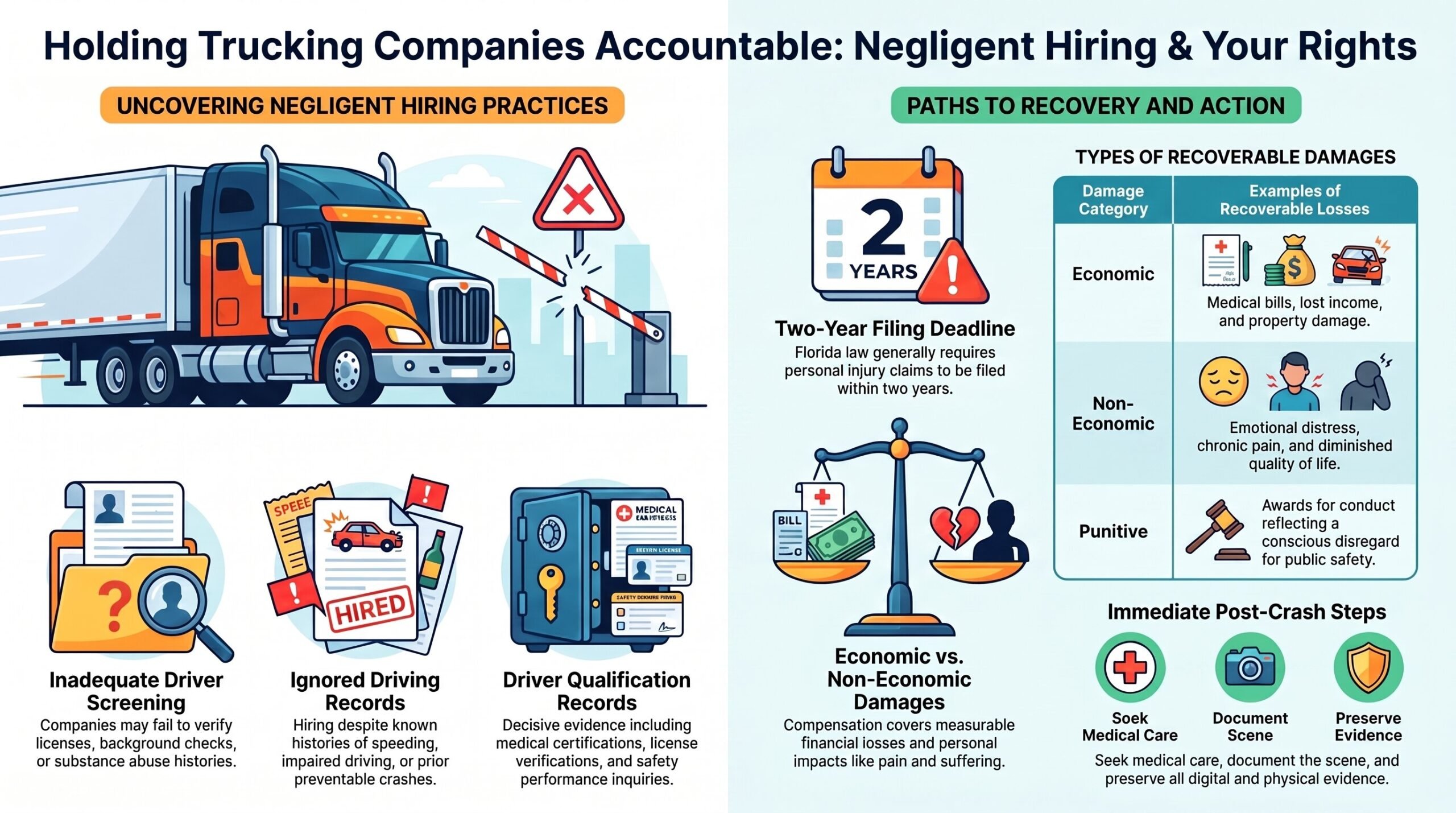
Common causes of Daytona Beach negligent truck hiring accidents include inadequate driver screening and the failure to review relevant driving records. Employers may also fail to verify a driver’s experience, qualifications, or training before assigning commercial responsibilities. Pressure to fill positions quickly can further lead to hiring decisions that overlook these crucial safety checks.
Inadequate Driver Screening
Inadequate driver screening occurs when a trucking company fails to properly investigate an applicant’s qualifications, driving history, employment record, or substance-abuse history before assigning that person to operate a commercial vehicle. Effective screening requires documented background checks, verification of commercial licenses, confirmation of training, and careful review of information supplied by applicants. Employers that rush this process may place inexperienced or unsafe drivers behind the wheel, increasing risks for motorists, passengers, and communities.
Proper hiring compliance helps companies meet regulatory duties and demonstrate responsible decision-making before entrusting a driver with a large, potentially dangerous vehicle. When screening procedures are incomplete, victims may face serious injuries caused by preventable employer negligence. A Daytona Beach attorney can examine hiring records, policies, and investigative steps to determine whether inadequate screening contributed to a collision.
Ignored Driving Records
Ignored driving records can indicate negligent truck hiring when a carrier receives clear warnings about an applicant’s unsafe driving history yet proceeds with employment. A responsible employer should obtain and review a complete background check before placing a commercial driver behind the wheel. That review may reveal repeated speeding violations, impaired-driving convictions, license suspensions, preventable crashes, or other conduct suggesting an unacceptable safety risk.
Disregarding those findings, failing to address serious discrepancies, or treating violations as insignificant can support an argument that the carrier ignored foreseeable dangers. Careful evaluation of a driver’s driving history helps protect motorists, passengers, and communities that depend on safe commercial transportation. When a carrier knowingly overlooks documented warning signs, injured individuals may examine whether that decision contributed to the collision and resulting losses.
Insufficient Experience Verification
How thoroughly did the carrier verify the applicant’s commercial driving experience before assigning responsibility for a large truck? Insufficient verification can allow an applicant’s limited training, unfamiliar routes, or inadequate experience with specific equipment to remain undiscovered. A responsible carrier should review employment histories, licensing records, safety qualifications, and documented performance with prior employers. Background checks that merely confirm identity or criminal history may not reveal whether the driver safely handled comparable vehicles or complied with operating requirements.
Effective hiring compliance requires consistent documentation, direct reference inquiries, and confirmation that qualifications match the vehicle and duties assigned. When these steps are incomplete, the carrier may place an inexperienced driver in a position that exceeds demonstrated abilities. Such failures can increase crash risks and complicate efforts to protect injured road users.
Pressure To Hire Quickly
When a carrier faces staffing shortages or urgent delivery demands, it may accelerate hiring procedures and assign a commercial vehicle before the applicant’s qualifications are fully confirmed. This pressure can cause managers to overlook employment references, driving histories, medical requirements, or appropriate safety training. Employee onboarding delays may further limit supervision, leaving a new driver without clear instruction regarding company procedures, route expectations, or equipment operation.
In some cases, the desire to keep freight moving may take priority over careful screening and documented evaluation. Over time, repeated shortcuts can contribute to a safety culture decline, particularly when employees believe production goals outweigh public protection. A carrier serving customers and communities has a responsibility to maintain consistent hiring standards, even during periods of operational strain, because preventable gaps may increase crash risks and legal exposure.


Legal Rights of Daytona Beach Negligent Truck Hiring Accident Injury Victims
Daytona Beach negligent truck hiring accident injury victims may have the right to pursue compensation from the trucking company and other responsible parties when inadequate screening, training, supervision, or retention contributes to a crash. Legal rights may include recovering damages for medical treatment, lost income, reduced earning capacity, property damage, and pain related to the collision.
Inadequate truck driver hiring, training, or supervision may support injury claims against trucking companies and other responsible parties.
Victims should preserve records, identify witnesses, and obtain relevant employment and safety information through appropriate legal procedures.
A qualified representative can help protect these rights by evaluating insurance coverage, filing deadlines, and available claims.
- A victim may seek compensation through settlement negotiations or a civil lawsuit.
- Evidence may include hiring records, driving histories, training materials, company policies, and crash reports.
- Negligent hiring defenses may challenge the employer’s knowledge, duty, or connection to the injuries.
Comparative fault rules can reduce recovery if a victim is assigned a portion of responsibility. Prompt guidance may help families serve injured loved ones by preserving evidence, communicating accurately, and pursuing accountability from each responsible party.
Why Do Daytona Beach Negligent Truck Hiring Accident Injuries Happen?
Negligent truck hiring accident injuries often happen because a trucking company fails to investigate an applicant’s driving history, qualifications, medical fitness, or prior safety violations before placing that person behind the wheel. Employers may also overlook incomplete applications, falsified credentials, substance-abuse concerns, or inadequate commercial driving experience when staffing urgently. These failures can place motorists, passengers, and pedestrians at risk of preventable collisions. Poor supervision and insufficient training may further increase danger after hiring, particularly when a driver operates large vehicles without understanding safety requirements.
Insurance coverage misconceptions can complicate perceptions of responsibility, since an available policy does not necessarily eliminate an employer’s potential liability for negligent hiring. Likewise, company policy disputes may arise when internal hiring standards differ from claimed practices or when records are missing. Injuries thus often reflect systemic failures rather than a single driving mistake, underscoring the importance of responsible employment practices that protect the broader Daytona Beach community and those who depend on safe transportation.
What Should You Do After a Daytona Beach Negligent Truck Hiring Accident Injury?
After a Daytona Beach negligent truck hiring accident injury, the injured person should seek immediate medical care, even if symptoms initially appear minor. Documenting the accident scene, including injuries, vehicle damage, and available witness information, can help preserve important evidence. Consulting a truck injury lawyer may also clarify potential claims and protect the person’s legal rights.
Seek Immediate Medical Care
Prompt medical evaluation should be obtained immediately following an injury in a Daytona Beach truck crash, even when symptoms initially appear minor. A person should call emergency services when severe pain, bleeding, breathing difficulty, confusion, or loss of consciousness occurs. Qualified responders can provide First aid steps, stabilize the injured individual, and determine whether transportation to an emergency department is necessary. Even seemingly modest injuries may worsen later, particularly when adrenaline temporarily masks symptoms.
Medical professionals can identify internal trauma, concussions, spinal injuries, and other conditions requiring prompt treatment. The injured person should follow discharge instructions, attend recommended appointments, and preserve medical records. Medical consent forms should be reviewed carefully before signing, with assistance requested when language, impairment, or confusion creates difficulty. Prompt care protects health and supports recovery.
Document the Accident Scene
When circumstances permit, the injured person or a reliable witness should document the Daytona Beach truck accident before vehicles, debris, or road conditions change. Photographs should show vehicle positions, damage, skid marks, traffic signs, lane markings, lighting, weather, and visible injuries, while avoiding interference with emergency operations. A written record should identify the date, time, location, involved vehicles, apparent conditions, and events observed before and after impact.
The Witness statements checklist should include names, contact information, independent observations, and any statements made at the scene. Digital evidence preservation requires retaining original photographs, videos, dashcam files, phone records, and relevant messages without editing or deleting them. Copies should be stored securely, with timestamps maintained. These steps can help preserve accurate information for those evaluating the injury and supporting affected individuals.
Consult a Truck Injury Lawyer
A truck injury lawyer should be consulted promptly after a Daytona Beach negligent truck hiring accident, particularly when the carrier’s hiring, screening, training, or supervision practices may have contributed to the collision. Counsel can assess potential claims, identify responsible parties, and explain available legal protections while the injured person focuses on medical recovery and supporting loved ones. A lawyer may coordinate a Workplace investigation, review driver qualification files, examine company policies, and determine whether prior violations or inadequate training indicate negligent hiring.
Early representation also supports evidence preservation, including vehicle data, inspection records, surveillance footage, electronic logs, communications, and witness statements. The attorney can communicate with insurers, prevent damaging recorded statements, and pursue appropriate compensation for treatment, lost income, rehabilitation, and other accident-related losses through a carefully documented claim.
Critical Evidence in a Daytona Beach Negligent Truck Hiring Accident Injury Case
Critical evidence in a Daytona Beach negligent truck hiring injury case may establish whether the trucking company acted reasonably before and during employment.
Key sources include:
- Driver qualification records and employment screening documents;
- Trucking company policies concerning hiring, training, and supervision; and
- Crash scene evidence, including photographs, vehicle data, witness statements, and investigative reports.
Together, these materials can clarify responsibility and support an injured party’s claim.
Driver Qualification Records
Driver qualification records can provide decisive evidence in a Daytona Beach negligent truck hiring accident injury case by showing whether a motor carrier properly investigated and evaluated the driver before employment. These records may include license verification, required medical certifications, safety performance inquiries, and documentation confirming compliance with federal qualification standards. They can reveal missing reviews, unresolved restrictions, or failures to maintain current information.
After a collision, preserving these materials helps clarify whether the carrier met its duty to protect motorists and communities. Such evidence may also support emergency incident response by identifying responsible parties and guiding timely preservation requests. Because insurance company tactics may minimize corporate responsibility, an attorney can examine records for omissions, altered entries, or inconsistent dates. Careful review strengthens accountability and supports a fair recovery for injured individuals and families.
Employment Screening Documents
When a trucking company hires an unsafe or unqualified operator, employment screening documents may provide critical evidence in a Daytona Beach negligent truck hiring accident injury case. These records can show whether the company investigated an applicant’s qualifications before allowing commercial vehicle operation. Relevant materials may include completed applications, résumés, criminal history checks, motor vehicle reports, prior employment records, drug and alcohol testing results, and reference contact verification.
They may also reveal inconsistencies, omitted information, or warnings that should have prompted further investigation. Preserving these documents can help establish what the company knew, when it knew it, and whether reasonable hiring care was exercised. For an injured person and the community served by responsible transportation, this evidence may clarify accountability and support a fair evaluation of resulting medical, financial, and personal harms.
Trucking Company Policies
Beyond employment screening documents, a trucking company’s written policies may show the standards it established for hiring, qualification, supervision, and continued evaluation of commercial drivers. These policies can identify required license verification, medical qualification reviews, background checks, and procedures for addressing disqualifying information. They may also establish driver training, orientation, performance monitoring, and retraining requirements. When company practices depart from written standards, the discrepancy may help clarify whether management neglected foreseeable safety risks.
Policies addressing hiring compliance can further indicate who held responsibility for reviewing records and approving drivers for service. A careful review may reveal whether safeguards existed on paper but were inconsistently applied. Such evidence can support an objective evaluation of organizational responsibility while helping injured individuals and their families pursue accountability through appropriate legal channels.
Crash Scene Evidence
Although physical conditions at a crash site can change quickly, photographs, measurements, vehicle positions, roadway marks, and debris patterns may preserve important evidence in a Daytona Beach negligent truck hiring accident injury case. Photos and timestamps can help establish where vehicles rested, when conditions were documented, and whether later changes affected the investigation. Images should capture traffic signals, lighting, signage, weather, damage, skid marks, and nearby surveillance cameras. Independent measurements may clarify distances, sightlines, and impact locations.
Witness statement reliability also requires careful evaluation because recollections can differ after a traumatic event. Investigators may compare accounts with physical evidence, electronic data, dispatch records, and video footage. Promptly preserving the scene and systematically documenting evidence can support a fair assessment of driver conduct, company responsibility, and the injured person’s needs.
Long-Term Effects of Daytona Beach Negligent Truck Hiring Accident Injuries
Daytona Beach negligent truck hiring injuries may produce chronic pain, permanent disability, and lasting limitations on daily activities. Emotional and psychological trauma, including anxiety, depression, or post-traumatic stress, may also persist long after physical wounds have recovered. These ongoing effects can create substantial financial hardship through medical expenses, reduced earning capacity, and continued care needs.
Chronic Pain and Disability
When a negligent truck hiring accident causes serious bodily harm, the resulting injuries may produce chronic pain and lasting disability that disrupt a person’s ability to work, move independently, and manage ordinary daily activities. Some victims require ongoing medical treatment, physical therapy, prescription medication, or assistive devices to control symptoms and preserve function. Limited mobility may affect transportation, household responsibilities, personal care, and participation in previously routine activities.
Work restrictions can reduce earning capacity, prevent a return to the prior occupation, or require costly vocational adjustments. Pain flare-ups may occur without warning, making consistent attendance and physical performance difficult. Documentation from physicians, therapists, and employers can help establish the injury’s continuing effects. A legal evaluation may address medical expenses, lost income, future care needs, and compensation for permanent functional limitations.
Emotional and Psychological Trauma
Emotional and psychological trauma may persist alongside chronic pain and physical disability after a Daytona Beach negligent truck hiring accident. Survivors may experience anxiety, depression, irritability, sleep disruption, or difficulty trusting others, particularly when reminders of the collision trigger distress. PTSD symptoms can include intrusive memories, nightmares, emotional numbness, avoidance, and heightened alertness. These effects may interfere with relationships, daily responsibilities, and the ability to participate confidently in community or service-oriented activities.
A qualified mental health professional can evaluate symptoms and recommend appropriate treatment, including Trauma counseling, cognitive behavioral therapy, or other evidence-based interventions. Supportive family members, friends, and caregivers may help by encouraging treatment without judgment and respecting the survivor’s pace. Documenting psychological changes can also assist healthcare providers in coordinating consistent, compassionate care over time.
Long-Term Financial Hardship
Although some injured parties recover enough to resume ordinary routines, others face long-term financial hardship after a Daytona Beach negligent truck hiring accident. Persistent pain, reduced mobility, and necessary medical care may limit employment opportunities and create expenses that continue for years. An injured person may require rehabilitation, assistive equipment, transportation, or in-home support, while household income declines because of missed work or permanent impairment. Careful documentation of medical bills, employment records, and anticipated treatment can clarify the financial consequences.
Budgeting assistance may help a household prioritize important expenses while benefits or compensation claims are evaluated. Professional wage loss planning can address past earnings, diminished future capacity, and retirement impacts. Attorneys and support professionals may help affected families pursue responsible parties and connect them with services that promote stability, dignity, and informed financial decisions.
Proving Liability in Daytona Beach Negligent Truck Hiring Accident Injury Cases
Proving liability in a Daytona Beach negligent truck hiring injury case requires evidence that the trucking company failed to use reasonable care when selecting, screening, or retaining the driver. Relevant proof may include employment applications, driving records, license information, background checks, training materials, disciplinary histories, and safety evaluations. These records can show whether the company knew, or reasonably should have known, that a driver presented an unacceptable risk.
A claim may also involve negligent supervision when management failed to monitor conduct, address violations, or respond to warning signs after hiring. Establishing employer negligence generally requires connecting the company’s decisions to the collision and resulting injuries. Witness testimony, accident reports, electronic logging data, maintenance records, and qualified professional analysis may help establish that connection. The injured person must typically demonstrate a duty of care, a breach of that duty, causation, and legally recognized damages. Preserving evidence promptly can assist the investigation and support a fair evaluation of responsibility for the harm.
Dealing With Insurance Companies After a Daytona Beach Negligent Truck Hiring Accident Injury
Insurance companies may scrutinize a Daytona Beach negligent truck hiring accident claim by reviewing the collision, the driver’s employment history, and the trucking company’s hiring practices. Their representatives may request statements, medical authorizations, employment information, and records concerning lost income. An injured person should provide accurate information while avoiding speculation, admissions, or recorded statements before obtaining informed legal guidance.
Evidence preservation tips include saving photographs, medical records, repair estimates, wage documentation, witness contacts, and communications with insurers. Promptly preserving electronic evidence, such as vehicle data, surveillance footage, and dispatch records, may also help protect the claim. The trucking company’s insurer may attempt to minimize damages or shift responsibility, making organized documentation important for fair treatment.
Independent claim options may exist when multiple insurance policies, employers, vehicle owners, or responsible contractors are involved. A qualified Daytona Beach attorney can communicate with insurers, identify applicable coverage, and safeguard the injured person’s interests while relatives and caregivers focus on recovery and necessary support.
What to Expect During a Daytona Beach Negligent Truck Hiring Accident Injury Claim Process
A Daytona Beach negligent truck hiring accident claim typically begins with an initial evaluation of liability, injuries, and available insurance coverage. The evidence-gathering process may include reviewing employment records, driver qualifications, accident reports, medical documentation, and witness accounts before negotiating appropriate truck accident damages. If settlement efforts fail, the claimant may need to prepare for trial through formal discovery, expert testimony, and presentation of evidence.
Initial Claim Evaluation
During an initial claim evaluation, a Daytona Beach negligent truck hiring accident lawyer examines the circumstances of the crash, the trucking company’s hiring and supervision practices, and the injured person’s resulting losses. The lawyer may begin with a police report review to understand reported violations, collision dynamics, and statements recorded at the scene. Witness statement collection can clarify how the truck was operated and whether concerns about the driver were previously apparent.
The evaluation also considers medical treatment, work limitations, property damage, and other documented consequences. By organizing these issues, the lawyer can identify potentially responsible parties and assess whether negligent hiring, retention, training, or supervision contributed to the injury. The process is intended to provide injured individuals and their families with informed guidance, realistic expectations, and a responsible path toward seeking accountability.
Evidence Gathering Process
After an initial claim evaluation, the evidence-gathering process focuses on preserving and organizing information that may establish how the truck crash occurred and whether the trucking company negligently hired, retained, trained, or supervised the driver. Counsel may obtain crash reports, photographs, medical records, witness statements, electronic logging data, vehicle maintenance files, and available video footage. Records concerning applications, background checks, licensing, safety violations, disciplinary history, and training can help assess Negligent hiring standards.
Evidence preservation tips include keeping damaged property unchanged when possible, saving communications, documenting symptoms and treatment, and avoiding social-media posts about the incident. Subpoenas or formal requests may be necessary when a carrier controls relevant materials. Investigators can also identify witnesses and examine roadway conditions, ensuring evidence remains reliable and useful throughout the claim process.
Negotiating Truck Accident Damages
Once the available evidence has been organized, negotiations typically focus on the full value of the injured person’s losses and the trucking company’s potential liability for negligent hiring or related misconduct. Counsel may present medical records, wage documentation, repair invoices, and expert assessments to support evidence-backed damage estimates. Damages can include current and future treatment, lost income, reduced earning capacity, property loss, and the effects of lasting impairment.
Settlement leverage strategies may involve demonstrating inconsistent hiring practices, regulatory violations, inadequate supervision, or insurance coverage issues. The insurer may respond with questions, comparative-fault arguments, or a lower valuation. Careful review of each offer helps determine whether it reasonably reflects documented harm and foreseeable needs. Negotiations may conclude with a settlement agreement, but approval should follow informed evaluation of its scope and consequences.
Preparing For Trial
Trial preparation in a Daytona Beach negligent truck hiring accident claim involves organizing admissible evidence, identifying witnesses, and establishing how the trucking company’s hiring, retention, or supervision practices contributed to the collision. Counsel may obtain employment files, qualification records, safety histories, dispatch communications, and applicable company policies. Medical documentation, accident reconstruction findings, and photographs can clarify the injury’s extent and the collision’s causes.
During witness preparation, each witness reviews expected questions, testimony boundaries, and courtroom procedures without being coached to alter facts. Jury selection allows attorneys to evaluate prospective jurors for impartiality, relevant experiences, or potential biases. The injured person may testify about the crash, treatment, limitations, and daily consequences. Preparation also includes motions, exhibit organization, and settlement discussions, helping present a clear case that supports accountability and fair compensation.
Compensation for Daytona Beach Negligent Truck Hiring Accident Injury Damages
Compensation for Daytona Beach negligent truck hiring accident damages may cover medical expenses, lost income, reduced earning capacity, property damage, and the physical pain and emotional distress caused by the collision. A careful damages calculation should account for current bills, anticipated treatment, rehabilitation needs, employment records, and documented effects on daily responsibilities. Evidence may include medical records, wage statements, repair estimates, expert assessments, and testimony from individuals familiar with the injured person’s condition.
A lawyer can investigate whether the trucking company failed to verify qualifications, review driving history, or provide appropriate supervision, then connect that conduct to the collision. During insurance negotiations, counsel may present organized documentation and a demand that reflects the full impact of the injury. Settlement discussions should be evaluated carefully rather than accepted solely for immediate financial relief. If negotiations do not produce a fair resolution, litigation may provide a structured process for seeking accountability and compensation. The injured person’s needs should remain central throughout each stage.
Economic vs Non-Economic Damages in Daytona Beach Negligent Truck Hiring Accident Cases
Damages may include economic losses such as medical expenses, lost income, property damage, and future care needs. Non-economic damages address less measurable harm, including pain, emotional distress, disability, and diminished quality of life. Establishing either category generally requires organized documentation, credible testimony, and evidence connecting the losses to the negligent truck hiring conduct.
Economic Damage Categories
Financial recovery in Daytona Beach negligent truck hiring cases generally includes economic and non-economic damages, each addressing a different type of harm caused by the collision. Economic damage categories are measurable financial losses supported by records, invoices, and employment documentation. Medical treatment costs may include emergency services, hospitalization, medication, rehabilitation, consultant appointments, and reasonably anticipated future care. Proof of wage loss can establish missed work, reduced earning capacity, lost benefits, or diminished income during recovery.
Necessary transportation, home assistance, adaptive equipment, and property-related expenses may also qualify when connected to the crash. Pain therapy documentation can help verify treatment-related expenditures, although broader personal suffering belongs to a separate damages analysis. Organized evidence assists those serving injured individuals, particularly when insurance claim disputes arise over causation, necessity, or the amount of claimed economic losses.
Non-Economic Harm Valuation
Unlike economic losses, non-economic harm reflects the personal impact of a Daytona Beach truck collision rather than a readily itemized financial expense. This category may include bodily pain, psychological distress, reduced enjoyment of life, inconvenience, disfigurement, and loss of companionship. Its value depends on the severity and length of the injury, the disruption to daily activities, and the expected effect on future well-being. Florida law does not assign a universal price to these experiences, so careful evaluation considers the individual’s circumstances rather than relying on a formula.
Evidence preservation remains important because medical records, treatment histories, and personal narratives may document lasting consequences. The statute of limitations also requires timely attention to deadlines governing injury claims. A compassionate legal assessment helps ensure that personal suffering receives serious, dignified consideration alongside financial losses.
Proving Damage Claims
When a Daytona Beach truck collision results from negligent hiring, proving the claim requires separating measurable economic losses from less tangible non-economic harm. Economic damages may include emergency treatment, rehabilitation, medication, lost wages, reduced earning capacity, property damage, and anticipated future care. A thorough Medical expenses calculation should rely on itemized bills, medical records, expert projections, and evidence connecting treatment to the crash. Non-economic damages address pain, emotional distress, disability, disfigurement, and diminished enjoyment of life.
Testimony from the injured person, relatives, physicians, and mental-health professionals may help establish these effects. Counsel also examines Insurance coverage limits, employer responsibility, and available commercial policies when evaluating recovery. Organized documentation, consistent medical care, and credible testimony can clarify damages and support a fair result for the injured individual and family.
When a Daytona Beach Negligent Truck Hiring Accident Injury Case Goes to Trial vs Settlement
A Daytona Beach negligent truck hiring accident injury case may proceed to trial or resolve through settlement, depending on the strength of the evidence, the parties’ willingness to negotiate, and the extent of the injured person’s damages. Settlement discussions can begin before a lawsuit is filed or continue after litigation starts. Effective negotiation may provide compensation sooner, reduce uncertainty, and spare witnesses from the demands of courtroom testimony. However, settlement timing depends on medical evaluations, document exchange, and the parties’ assessment of potential outcomes.
A trial may become necessary when the parties disagree about responsibility, damages, or the value of the claim. Each side presents evidence, questions witnesses, and makes legal arguments before the court. A jury decision then determines disputed factual issues and may establish the amount awarded. Although trial can provide a formal resolution, it also involves greater expense, delay, and uncertainty. Careful preparation helps protect the injured person’s interests while supporting a fair, informed resolution.
Florida Laws That May Affect Your Daytona Beach Negligent Truck Hiring Accident Case
Florida laws may greatly affect how a Daytona Beach negligent truck hiring accident claim is investigated, filed, and resolved. Several legal principles can guide evidence collection, responsibility assessments, and efforts to protect injured people.
Florida law shapes Daytona Beach truck accident claims, from investigating negligent hiring to preserving evidence and pursuing accountability.
- Florida generally applies modified comparative negligence. A claimant’s recovery may be reduced according to the claimant’s percentage of fault, making the contributory negligence impact important when examining conduct, medical records, and accident evidence.
- Employers may face liability for negligent hiring, retention, supervision, or entrustment when reasonable screening or oversight was lacking. Employer immunity rules, workers’ compensation provisions, and the relationship between the driver and company can influence available claims and defenses.
- Federal motor-carrier safety standards may supplement Florida requirements concerning licensing, qualifications, drug testing, vehicle operation, and recordkeeping. Violations can provide valuable evidence, although they do not automatically establish negligence.
Preserving dash-camera footage, employment files, dispatch records, witness statements, and inspection materials can support a fair evaluation. A qualified legal professional can help injured individuals and families understand applicable duties while pursuing accountability and service to the community.
The Statute of Limitations for Daytona Beach Negligent Truck Hiring Accident Injury Cases
Timely action is essential in Daytona Beach negligent truck hiring accident injury cases because Florida law imposes deadlines for filing civil claims. Under Florida law, personal injury claims generally must be filed within two years after the accident, although specific circumstances may alter that period. Claims involving wrongful death, government entities, minors, or delayed discovery can involve different rules and shorter notice requirements. Missing the applicable deadline may permanently bar recovery, regardless of injury severity or the employer’s hiring practices.
Potential claimants should identify all responsible parties promptly, including the trucking company, driver, and insurers. Early evidence preservation is essential because employment files, background checks, training records, electronic logs, surveillance footage, and vehicle data may be lost or routinely overwritten. Comparative fault may also affect the amount recoverable if the injured person is found partially responsible. Because deadlines and exceptions are fact-specific, careful attention to dates and legal requirements supports informed decisions and protects the interests of those seeking accountability and assistance.
How a Daytona Beach Negligent Truck Hiring Accident Lawyer Can Help You
Effective legal representation can help an injured person investigate whether a trucking company negligently hired, retained, or supervised a driver who caused a Daytona Beach collision. A lawyer may examine employment applications, driving records, training materials, disciplinary files, and company policies to identify evidence supporting accountability.
A Daytona Beach negligent truck hiring accident lawyer can assist by:
- Preserving electronic records, vehicle data, witness statements, and medical documentation relevant to the claim.
- Identifying responsible parties and calculating damages, including treatment costs, lost income, rehabilitation needs, and diminished quality of life.
- Developing a Negotiation strategy that presents persuasive evidence while evaluating settlement timelines and litigation risks.
Counsel can communicate with insurers and defense representatives, reducing pressure on an injured person and helping protect the interests of the wider community. If negotiations do not produce fair compensation, the lawyer may prepare pleadings, manage discovery, consult qualified experts, and present the evidence in court. This structured advocacy allows a claimant to pursue accountability while focusing on recovery and service to others affected by preventable trucking negligence.
When to Contact a Daytona Beach Negligent Truck Hiring Accident Lawyer
Contacting a Daytona Beach negligent truck hiring accident lawyer soon after a collision can help preserve evidence and clarify whether the trucking company failed to investigate, train, supervise, or retain the driver responsibly. Early guidance may protect a person’s ability to pursue accountability while allowing time-sensitive records to be identified and secured.
Immediate documentation should include photographs, medical records, witness information, police reports, employment details, and notes describing symptoms and financial losses. A lawyer can help identify whether driver qualifications, background checks, training records, disciplinary history, or company policies require preservation before they are altered or lost.
Legal advice is also valuable before giving recorded statements, signing releases, or accepting settlement proposals. Insurance communication may involve multiple carriers, adjusters, and representatives whose requests could affect the claim’s evaluation. Prompt consultation can help organize information, meet applicable deadlines, and direct communications appropriately. Individuals should seek assistance when injuries, disputed responsibility, commercial insurance, or suspected hiring failures complicate the collision’s aftermath.
Why You Need an Experienced Daytona Beach Negligent Truck Hiring Accident Lawyer
An experienced Daytona Beach negligent truck hiring accident lawyer can examine the collision beyond the immediate driving error and determine whether the trucking company contributed through inadequate screening, training, supervision, or retention. This review may uncover whether Driver background checks were completed properly, including verification of licensing, prior crashes, substance violations, and employment history. Counsel can also assess Company hiring policies to determine whether the carrier followed reasonable standards or ignored warning signs to place an unsafe driver on the road.
An experienced lawyer understands how these records may be preserved, obtained, and connected to the company’s conduct. The investigation can include personnel files, safety records, training materials, dispatch information, and applicable regulatory requirements. This focused analysis helps identify all responsible parties and supports a fair claim for injured individuals and their families. By addressing institutional failures as well as the collision itself, legal representation can promote accountability, protect public safety, and help affected people pursue appropriate compensation for medical needs, lost income, and lasting harm.
How to Choose the Right Daytona Beach Negligent Truck Hiring Accident Lawyer for Your Case
When selecting a Daytona Beach negligent truck hiring accident lawyer, injured individuals should evaluate the attorney’s experience with both commercial vehicle collisions and negligent hiring claims. A qualified lawyer should understand how employers may be responsible for inadequate Driver background checks, incomplete qualification reviews, or failure to investigate prior safety violations.
Potential clients should ask whether the attorney can identify missing records, analyze employment files, and consult professionals who understand trucking regulations. Experience with Safety policy training may also help establish whether a company provided meaningful instruction, monitored compliance, and responded appropriately to known risks. The lawyer should communicate clearly, explain available legal options, and provide realistic information about evidence, deadlines, and potential recovery.
It is also important to assess the attorney’s resources, case preparation methods, and commitment to client service. A careful evaluation can help families choose counsel prepared to protect their interests while pursuing accountability for unsafe hiring practices and preventable truck collisions.
About The Law Offices of Anidjar & Levine
The Law Offices of Anidjar & Levine represents individuals and families pursuing compensation after serious truck collisions, including cases involving negligent hiring or inadequate driver screening.
The firm examines whether a trucking company followed lawful hiring, training, supervision, and retention practices.
Its legal team may collect employment records, safety histories, inspection reports, electronic data, and witness accounts to clarify how a collision occurred and who may be responsible.
A Local resources overview can help injured individuals identify medical providers, reporting agencies, and other community services available after a Daytona Beach crash.
The firm’s attorneys also explain insurance procedures, potential claims, and deadlines that may affect recovery.
Attorney consultation benefits include an individualized evaluation, guidance regarding evidence preservation, and communication with insurers or opposing parties.
These services can help families make informed decisions while concentrating on medical care and household responsibilities.
The Law Offices of Anidjar & Levine serves clients seeking accountability and practical support throughout the legal process.
Frequently Asked Questions
Can I Pursue a Claim if the Truck Driver Was an Independent Contractor?
Yes, an injured person may pursue a claim when a truck driver is an independent contractor, although liability depends on the evidence and applicable law. Independent Contractor Liability can arise when a trucking company controlled safety practices, assigned work, or negligently selected or supervised the driver. Negligent Hiring Standards require reasonable screening of qualifications, licensing, experience, and safety history. A qualified attorney can evaluate contracts, records, and accident evidence to identify responsible parties.
What Happens if the Trucking Company Destroys or Loses Important Records?
If a trucking company destroys or loses important records, the outcome may depend on whether it had a duty to preserve them and acted unreasonably. Spoliation evidence can support an inference that missing materials would have harmed the company’s position, although courts often require proof of intentional or negligent destruction and likely relevance. Counsel may promptly issue a preservation demand, seek court sanctions, and investigate state preservation requirements concerning electronic logs, personnel files, and maintenance records.
Can Family Members File Claims After a Fatal Negligent Hiring Truck Accident?
Family members may file claims after a fatal negligent hiring truck accident, but eligibility depends on state law and the relationship to the deceased. Wrongful death eligibility commonly extends to a spouse, children, or other surviving next of kin, while personal representatives may pursue claims on behalf of the estate. Potential damages can include lost financial support, medical and funeral expenses, and loss of companionship. Prompt legal guidance helps preserve evidence and identify all responsible parties.
Are Punitive Damages Available in Negligent Truck Hiring Cases?
Punitive damages may be available in negligent truck hiring cases when the employer’s conduct reflects conscious disregard for public safety, such as knowingly employing an unqualified or dangerous driver. They are not automatic and generally require clear evidence beyond ordinary negligence. Vicarious Liability Theories may establish responsibility for compensatory damages but do not necessarily support punishment. Insurance Coverage Limits often exclude or restrict punitive damages, making legal evaluation important for protecting injured families’ interests.
Can Multiple Trucking Companies Share Responsibility for My Accident?
Yes, multiple trucking companies may share responsibility when their combined conduct contributed to the accident. Shared employer liability can arise if companies jointly controlled a driver, vehicle, hiring decision, training, or dispatch operations. A joint venture trucking arrangement may also create responsibility when businesses collaborate for mutual benefit while sharing management or risk. Investigators typically examine contracts, safety records, supervision, insurance coverage, and operational control to identify each company’s legal role.
—————————
Victims of negligent truck hiring accidents may face extensive medical treatment, lost income, and lasting uncertainty.
Establishing an employer’s failure to investigate, train, or supervise a driver requires careful review of records, witness accounts, and applicable regulations.
A Daytona Beach Truck Accident Lawyer can assess liability, protect evidence, and pursue appropriate compensation.
The Law Offices of Anidjar and Levine provides experienced guidance throughout the claims process, helping injured individuals understand their rights and legal options.