The Law Offices of Anidjar and Levine help build a strong claim after a texting-while-driving crash by preserving phone records, crash evidence, witness statements, and medical documentation.
Legal counsel can address insurer tactics, document losses such as medical bills and missed income, and evaluate fault under Florida law.
Early guidance also helps protect evidence, support treatment records, and improve claim preparation for settlement or trial.
The sections below explain the process, available damages, and crucial steps that can affect recovery. Learn more from a Miami Car Accident Attorney.
Main Takeaways
- Seek immediate medical care and document all symptoms, treatment, and follow-up visits to protect both your health and injury claim.
- Preserve evidence by photographing the scene, collecting witness information, saving dashcam footage, and identifying nearby surveillance cameras.
- A Miami texting while driving accident lawyer can obtain phone records, crash reports, and expert analysis to prove distraction and liability.
- Legal counsel can handle insurers, organize evidence of damages, and pursue compensation for medical bills, lost income, pain, and long-term impacts.
- After the crash, prioritize safety, call emergency services for serious injuries, and move to a secure location if conditions allow.


How We Can Help With Your Miami Texting While Driving Accident Injury Claim
Guide the claims process with informed legal support designed to protect the injured person’s rights after a Miami texting while driving accident. A dedicated legal team can organize evidence, preserve records, and manage insurer communications so the claimant can focus on recovery and service to family and community. Counsel can also explain available options in clear terms, helping decision makers act with care and integrity.
Practical assistance often includes gathering crash reports, securing witness statements, documenting losses, and coordinating post-accident counseling resources when emotional strain affects daily responsibilities. Attorneys may prepare demand materials, answer procedural questions, and monitor settlement timelines with disciplined attention, reducing avoidable delay.
They can identify gaps in documentation, address unfair tactics, and advocate for fair compensation through negotiation or, when necessary, litigation. Throughout the matter, support remains structured, respectful, and mission-focused, enabling injured people and those who care for them to move forward with stability and confidence.
OUR CONSULTATIONSARE FREE
START YOUR FREE CASE REVIEW

Understanding Miami Texting While Driving Accident Injury Cases
Intricacy often characterizes Miami texting-while-driving accident injury cases, because liability, causation, and damages must be established through clear and well-supported evidence. Courts and insurers closely examine whether driver distraction contributed to the collision, and whether that distraction directly caused identifiable injuries and losses. Evidence may include phone records, witness statements, surveillance footage, vehicle data, medical documentation, and expert analysis.
These matters also require careful application of legal standards governing negligence, comparative fault, and recoverable damages under Florida law. A thorough evaluation considers the sequence of events, the severity of injuries, treatment needs, and the effect on a person’s ability to work, care for family, and serve the community.
Because every case turns on specific facts, objective investigation and organized documentation are indispensable. A clear presentation of evidence can strengthen accountability, support fair compensation, and help injured individuals secure resources needed for recovery, stability, and continued service to others.
Common Causes of Miami Texting While Driving Accidents
Several recurring factors contribute to Miami texting-while-driving accidents, beginning with visual distractions that cause motorists to look away from the road at crucial moments. These interruptions often produce delayed reaction times, reducing a driver’s ability to respond promptly to changing traffic conditions. They also increase the likelihood of traffic signal violations and rear-end collisions, both of which frequently result from inattention and impaired judgment.
Visual Distraction Risks
At a glance, visual distraction occurs when a driver looks away from the roadway to read or send a text, check a notification, or view a phone screen for any reason. Even brief glances can undermine safe vehicle control in Miami’s dense traffic and pedestrian areas.
This risk increases when phone notifications illuminate the screen, prompt curiosity, and draw the eyes from surrounding vehicles, cyclists, signals, and crossing pedestrians. Similar visual competition can arise from roadside advertising, especially along busy corridors where multiple signs, lights, and storefront displays already demand attention.
A distracted driver may miss lane markings, work zones, stopped traffic, or a person entering a crosswalk. For individuals and families committed to protecting others, understanding visual distraction helps foster safer habits and reinforces the importance of maintaining full visual attention on the road.
Delayed Reaction Times
Reducing reaction time is essential to safe driving, yet texting commonly delays a driver’s response to changing traffic conditions in Miami. When attention shifts to a phone, even briefly, a measurable reaction delay can follow. That delay may prevent timely braking, guiding, or hazard recognition, increasing the likelihood of harm to passengers, pedestrians, and other motorists.
Texting also creates a cognitive lag, in which the mind remains focused on the message rather than the roadway. As a result, drivers may need extra moments to process sudden movement, slowing vehicles, or unexpected obstacles. In densely traveled areas, those lost seconds can carry serious consequences. A community committed to protecting others’ benefits when drivers understand how delayed reaction times undermine safe decision-making and place vulnerable road users at risk every day on busy Miami roads.
Traffic Signal Violations
Overlooked traffic signals often result from texting while driving in Miami, where even a brief glance at a phone can cause a driver to miss a changing light, a stop requirement, or a protected turn phase. Such violations place other motorists, cyclists, and pedestrians at serious risk, especially at busy intersections designed to manage heavy traffic flow safely.
When attention shifts to a screen, crucial details such as signal timing, lane control arrows, and pedestrian detection systems may go unnoticed. A driver may enter an intersection unlawfully, fail to yield during a turn, or proceed after a signal has changed. These preventable errors undermine roadway order and community safety. Careful driving protects vulnerable road users and reflects the shared responsibility every Miami driver owes to the public.
Rear-End Collision Causes
Distraction is a leading factor in rear-end collisions caused by texting while driving in Miami, because even a momentary shift in attention can prevent a driver from noticing that traffic ahead has slowed or stopped. When a driver looks down to read or send a message, braking distance is reduced, and impact risk rises sharply.
Other conditions may worsen the danger. Adverse weather can limit visibility and increase stopping time, making a distracted driver even less able to respond safely. In some cases, a vehicle malfunction, such as faulty brakes or worn tires, contributes to the crash sequence. Heavy congestion, sudden lane changes, and closely following other vehicles also increase the likelihood of a rear-end impact. Careful attention to road conditions helps protect passengers, pedestrians, and fellow motorists from preventable harm.


Legal Rights of Miami Texting While Driving Accident Injury Victims
Accountability becomes central when a texting while driving crash causes injury in Miami, because Florida law allows victims to pursue compensation from the negligent driver for medical expenses, lost income, property damage, and pain and suffering. These rights exist to restore stability and support families and communities affected by preventable harm, while balancing privacy concerns during claims and litigation.
Florida law holds texting drivers accountable when preventable crashes in Miami cause injury, loss, and lasting harm.
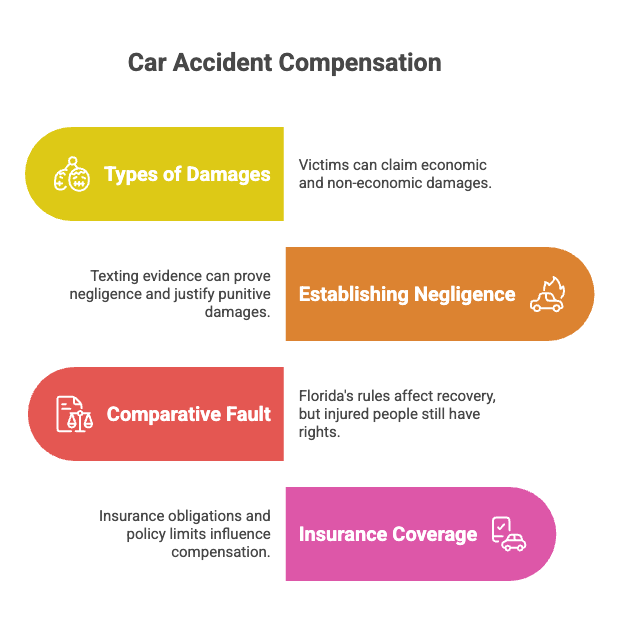
- Victims may seek economic and non-economic damages when another driver’s distraction causes measurable loss.
- Evidence of texting can establish negligence, and severe misconduct may justify punitive damages in limited cases.
- Florida’s comparative fault rules can affect recovery, yet injured people still retain rights even when fault is shared.
- Insurance obligations, policy limits, and uninsured motorist coverage may shape the compensation available.
A qualified legal evaluation helps clarify liability, available damages, and the duties owed by insurers. This framework encourages responsible driving and promotes fair outcomes for those harmed through another person’s careless decision-making on Miami roads.
Steps to Take After a Miami Texting While Driving Accident Injury
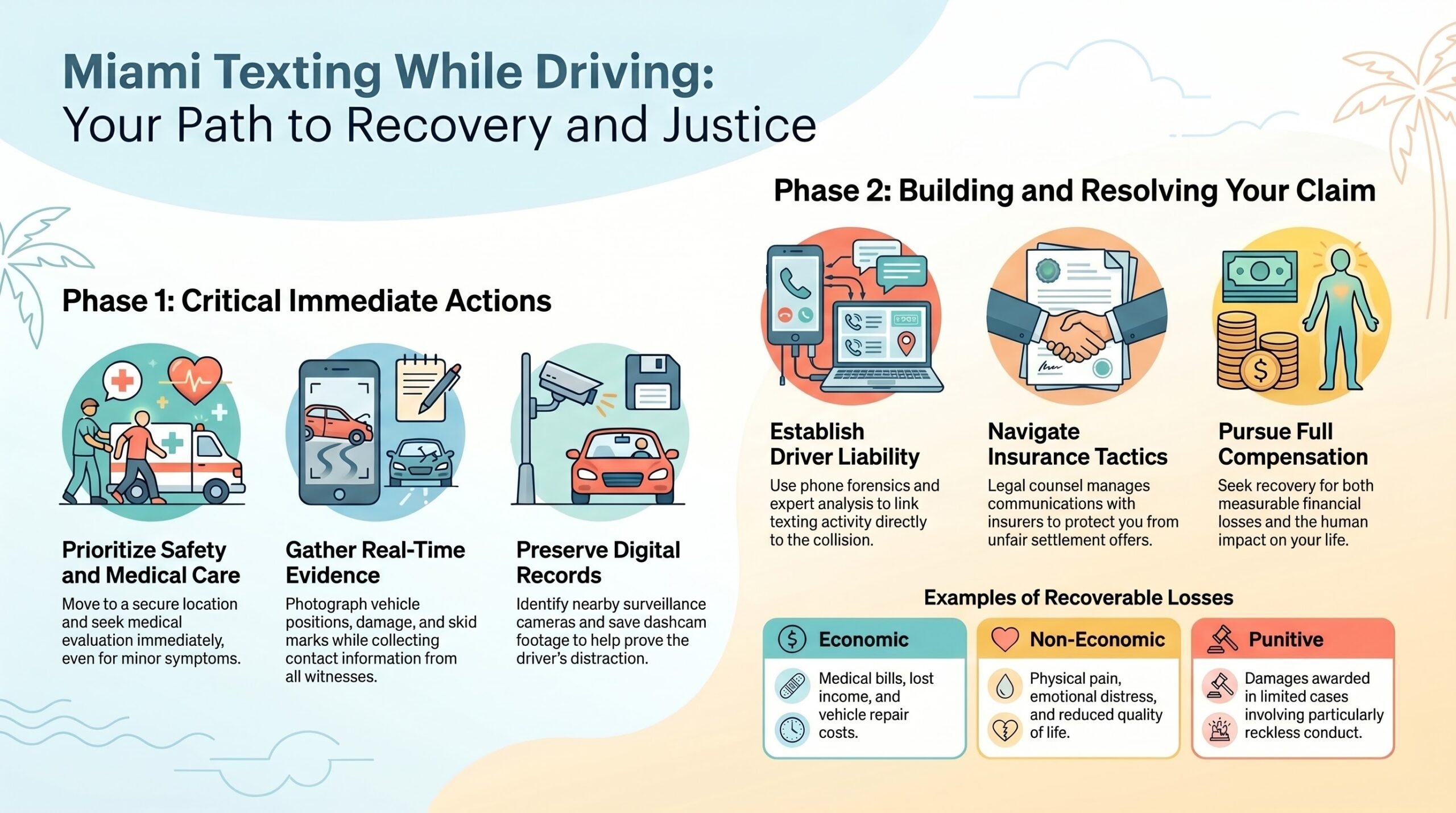
After a Miami texting while driving accident injury, immediate action can affect both personal safety and any future legal claim. Priority should be given to ensuring safety, then to gathering crucial evidence from the scene, including photographs, witness statements, and police details. Prompt medical attention is also vital, as timely evaluation supports both physical recovery and accurate documentation of the injury.
Ensure Safety First
Prioritizing safety must be the immediate concern following a Miami texting while driving accident injury. Those involved should assess immediate dangers, remain calm, and move to a secure location if conditions allow. A practical safety checklist includes checking for injuries, turning on hazard lights, and avoiding traffic lanes or fire risks.
If anyone appears seriously hurt, emergency services should be contacted without delay, and unnecessary movement should be avoided to prevent further harm. When safe, passenger intervention may help by guiding others away from danger, comforting injured occupants, or communicating urgent needs to first responders. Drivers and passengers should also remain attentive to surrounding hazards, including leaking fuel, broken glass, and oncoming vehicles. Thoughtful, prompt action protects lives and reflects a responsible commitment to the well-being of everyone at the scene.
Gather Critical Evidence
At the scene, careful documentation can preserve facts that may later prove pivotal in a Miami texting while driving injury claim. Photographs of vehicle positions, damage, skid marks, roadway conditions, traffic signals, and visible distractions may help establish how the collision occurred. Names, contact details, and insurance information should be gathered accurately, while statements should remain measured and factual.
When possible, witness interviews can clarify whether the other driver appeared distracted, looked down repeatedly, or held a device before impact. Nearby businesses or residences may also have surveillance footage that needs to be identified quickly.
In appropriate cases, legal counsel may later pursue phone forensics to determine whether texting, app use, or other cellphone activity coincided with the crash. Preserving receipts, dashcam footage, and repair estimates can further support an informed evaluation of the claim later.
Seek Medical Attention
In the immediate aftermath of a Miami texting while driving collision, prompt medical evaluation is crucial, even when injuries appear minor. Adrenaline may conceal pain, and some conditions, including concussions, internal injuries, and soft tissue damage, may worsen without timely emergency evaluation by qualified experts.
Seeking treatment also protects the well-being of others who depend on the injured person’s recovery and stability. Medical records created soon after the crash can document symptoms, establish causation, and guide appropriate follow-up care. Physicians may recommend imaging, medication, therapy, or referrals to consultants based on evolving symptoms.
Consistent attendance at appointments demonstrates a responsible commitment to recovery and public safety. When injuries are addressed early, the injured person is better positioned to recuperate fully and make informed decisions about next steps.
How a Miami Texting While Driving Accident Injury Lawyer Can Help You
Following a texting-while-driving collision, a Miami accident injury lawyer can provide essential guidance by evaluating the facts of the crash, identifying liable parties, and explaining the legal options available to an injured person. Counsel often gathers phone records, witness statements, camera footage, and medical documentation to build a clear claim.
This assistance supports accountability, pedestrian safety, and a fuller understanding of whether other parties, including device manufacturers, may share responsibility.
- Investigates the collision thoroughly and preserves vital evidence before it is lost.
- Communicates with insurers and opposing counsel, allowing the injured person to focus on recovery and family responsibilities.
- Calculates present losses carefully, including medical bills, missed income, property damage, and other measurable harms.
- Represents the client in settlement negotiations or court, seeking fair compensation and promoting safer conduct within the community.
Through disciplined advocacy, legal counsel helps injured people pursue justice while encouraging responsible driving practices throughout Miami.
Long-Term Effects of Miami Texting While Driving Accident Injuries
Texting while driving accidents in Miami can produce injuries that extend far beyond the initial emergency, affecting a person’s health and daily functioning for years. Many victims face chronic pain challenges and lasting brain trauma, both of which may interfere with work capacity, independence, and overall quality of life. Emotional recovery struggles are also common, as persistent anxiety, depression, and psychological distress can complicate the broader recovery process.
Chronic Pain Challenges
Persistence often defines chronic pain after a Miami texting while driving accident, as symptoms may continue long after fractures mend, soft-tissue injuries appear stable, or emergency treatment ends. Some individuals experience daily discomfort that limits mobility, interrupts sleep, and reduces their ability to work, care for family, or assist others in their communities.
These ongoing conditions may also produce chronic fatigue, emotional strain, and dependence on extended medical support. Effective pain management often requires coordinated care, including physical therapy, medication oversight, lifestyle adjustments, and consistent follow-up. Because symptoms can fluctuate, recovery may be uneven and frustrating, even when diagnostic findings appear modest. A careful legal evaluation may help document the full burden of persistent pain, including treatment costs, lost earning capacity, and the broader effect on long-term quality of life and independence.
Lasting Brain Trauma
Uncertainty often surrounds lasting brain trauma after a Miami texting while driving accident, because cognitive and neurological symptoms may not be fully apparent in the immediate aftermath of a collision. Survivors may later experience persistent headaches, concentration deficits, slowed processing, balance problems, speech disruptions, or traumatic amnesia that interferes with daily responsibilities and community service. In more serious cases, brain injuries diminish judgment, memory retention, and the ability to complete familiar tasks safely.
These limitations can affect employment, caregiving, and independent living, creating ongoing needs for structured support. Prompt neurological evaluation, imaging, and consistent follow-up help identify complications and guide appropriate treatment plans. Many individuals benefit from cognitive rehabilitation, which can strengthen attention, problem solving, and functional skills over time. Early documentation also helps families, advocates, and care teams coordinate informed assistance.
Emotional Recovery Struggles
Emotional recovery can become one of the most difficult long-term consequences after a Miami texting while driving accident, particularly when physical injuries, pain, and disrupted routines continue for months or years. Survivors may face anxiety, depression, sleep disruption, and persistent mood swings that affect family relationships, work performance, and community involvement. In many cases, emotional resilience does not mend quickly, especially when financial stress and uncertainty about recovery remain unresolved.
Structured coping strategies, including support groups, routine rebuilding, and healthy communication, often help restore stability over time. Trauma counseling may also provide important guidance by addressing fear, grief, and changes in self-identity after serious injury. When these struggles are recognized early, injured individuals are better positioned to protect their well-being and continue serving others with steadiness and compassion.
Proving Liability in Miami Texting While Driving Accident Injury Cases
Establishing liability in a Miami texting while driving accident injury case requires clear evidence that the at-fault driver was distracted and that this distraction directly caused the collision. Useful evidence often includes phone records, surveillance footage, crash-scene photographs, witness statements, and data from vehicle systems that help reconstruct driver behavior before impact.
Attorneys and investigators may also rely on expert testimony to connect the timing of texting activity with braking patterns, lane departures, or delayed reactions. Police reports can support the claim when officers note cellphone use, admissions, or citations issued at the scene. Medical records, vehicle damage, and roadway markings may further demonstrate how the crash occurred and whether the victim’s injuries are consistent with a distracted driving event.
In service to injured people and their families, a careful liability analysis helps identify responsibility, preserve essential evidence, and build a strong factual foundation for pursuing accountability under Florida law.
Dealing With Insurance Companies After a Miami Texting While Driving Accident Injury
After a Miami texting while driving accident injury, dealings with insurance companies often become a central part of the recovery process, as insurers typically begin evaluating the claim soon after notice of the crash. Injured individuals are often asked for statements, medical authorizations, and documentation regarding losses. Careful communication is important because early remarks may influence how insurers assess responsibility, damages, and available coverage.
A service-minded approach emphasizes honesty, organization, and respect while still protecting the injured person’s interests. Records of treatment, expenses, missed work, and correspondence can support clear discussions with adjusters. Attention to claim timelines also helps prevent avoidable delays or disputes over required submissions.
In many situations, policy negotiation becomes necessary when coverage limits, exclusions, or valuation differences arise. Professional guidance can help interpret policy language, respond to settlement offers, and maintain focus on fair compensation. Thoughtful preparation often improves efficiency and reduces unnecessary stress for everyone involved overall.
What to Expect During a Miami Texting While Driving Accident Injury Claim Process
A Miami texting-while-driving accident injury claim generally begins with an initial case evaluation, during which the facts, injuries, and potential damages are assessed. The process then focuses on gathering evidence, establishing liability, and negotiating insurance claims to pursue fair compensation. If negotiations do not produce an acceptable resolution, the claim may proceed toward settlement discussions or trial.
Initial Case Evaluation
At the outset of a Miami texting-while-driving accident injury claim, the initial case evaluation typically focuses on whether the available facts support liability, causation, and compensable damages. During this stage, counsel often offers a free consultation to review the collision, the reported injuries, medical treatment, and the practical impact on the injured person’s family and daily responsibilities.
The evaluation also addresses insurance coverage, immediate legal concerns, and anticipated case timelines, so the claimant can make informed decisions that protect personal and community well-being. Attorneys generally explain how communication will proceed, what records may be needed, and whether the matter appears suitable for settlement discussions or formal litigation. This early assessment helps establish realistic expectations, promotes organized next steps, and supports thoughtful service to those affected by the crash.
Evidence And Liability
Clarity becomes especially important during the evidence and liability phase, when the claim turns on whether persuasive proof shows that a driver was texting, failed to use reasonable care, and caused the collision in question. Attorneys often gather phone records, crash reports, photographs, surveillance footage, and vehicle data to build a reliable timeline.
In some matters, forensic reconstruction helps explain speed, braking, lane position, and impact angles with objective detail. Careful attention is also given to witness credibility, since consistent statements can support the account of how distraction affected driver behavior. Medical records may help link the collision to the claimed injuries. Throughout this stage, the focus remains on establishing facts that can guide accountability, support injured people, and promote a just outcome grounded in documented evidence and responsible analysis.
Insurance Claim Negotiations
In the next phase, insurance claim negotiations often determine whether an injured person receives fair compensation without the delay of litigation. Insurers review medical records, wage loss documentation, repair estimates, and liability evidence before responding. Their Settlement tactics may include delaying communication, disputing treatment, or minimizing pain and limitations. A careful Negotiation strategy addresses these efforts with organized proof and clear damage calculations.
Attention is also given to available Policy limits, since coverage boundaries can shape the practical value of a claim. If an insurer ignores evidence, misrepresents coverage, or fails to investigate reasonably, those actions may suggest Bad faith. Throughout this stage, disciplined advocacy helps protect the injured person, encourages responsible claims handling, and supports an outcome that honors both accountability and the need to restore stability after preventable harm.
Settlement Or Trial
Whether a texting while driving injury claim ends in settlement or proceeds to trial usually depends on the strength of the evidence, the seriousness of the injuries, and the insurer’s willingness to offer reasonable compensation. Settlement often provides faster relief, lower costs, and greater privacy for those seeking resources to support recovery and family stability.
If fair payment is denied, a trial may become necessary to pursue accountability and fuller damages. During litigation, both sides exchange evidence, question witnesses, and present expert opinions. Jury dynamics can shape how fault, credibility, and damages are viewed, especially when distracted driving is disputed. The timing of verdicts is difficult to predict because court schedules, motions, and deliberations vary. A careful legal strategy helps injured people make informed decisions while protecting their interests and promoting a just outcome for everyone involved.
Compensation for Miami Texting While Driving Accident Injury Damages
Because texting while driving often causes sudden, high-impact collisions, injured parties in Miami may be entitled to recover compensation for a broad range of damages tied to the accident. Such compensation is intended to help restore stability, address serious losses, and support families as they move forward after another person’s careless choices caused preventable harm.
Depending on the facts, compensation may include losses connected to medical care, rehabilitation, diminished earning ability, long-term disability, property damage, and other accident-related consequences. In especially severe cases, surviving relatives may pursue a wrongful death claim when a texting driver causes a fatal crash.
Courts may also consider punitive damages in limited situations involving particularly reckless conduct, where deterrence and accountability are central concerns. A Miami texting while driving accident injury lawyer may evaluate the circumstances, preserve evidence, and pursue compensation that reflects the full extent of the harm suffered, while advancing the injured person’s interests with diligence, integrity, and focused legal advocacy.
Economic vs Non-Economic Damages in Miami Texting While Driving Accident Cases
In Miami texting-while-driving accident cases, damages are generally divided into economic and non-economic categories, each addressing a different type of loss. Economic damages typically include measurable financial harm, such as medical expenses, lost income, and other documented costs, while non-economic losses concern pain and suffering, emotional distress, and diminished quality of life. Because the value of these damages often depends on records, testimony, and other supporting evidence, proving their full extent is a central issue in any injury claim.
Economic Damages Explained
Clarity is vital when evaluating damages after a Miami texting while driving accident, particularly when distinguishing economic losses from non-economic harm. Economic damages refer to measurable financial losses that can be proven through records, invoices, estimates, and employment documentation. They often include medical expenses for emergency care, hospitalization, rehabilitation, medications, and ongoing treatment needs.
They also include lost wages when injuries prevent a person from working during recovery. In more serious cases, compensation may address reduced earning capacity and future earnings if long-term limitations affect employment. Property loss is another component, covering vehicle repair or replacement and other damaged personal items. By identifying these concrete losses carefully, injured individuals and those assisting them can pursue compensation that supports stability, accountability, and practical recovery after a preventable texting-related crash in Miami.
Non-Economic Losses Overview
Financial records may show the full extent of measurable losses after a Miami texting while driving crash, yet they do not capture every form of harm an injured person may suffer. Non-economic losses address the human impact of an injury, including physical pain, emotional distress, inconvenience, trauma, disfigurement, and reduced enjoyment of daily life.
In many cases, these damages reflect how an accident alters relationships, independence, and the ability to participate in family, community, and service-oriented activities. While economic damages focus on bills and income, non-economic losses recognize suffering that lacks a clear invoice.
Concepts such as pain valuation and loss quantification are often discussed when describing these harms, but the central concern remains the injured person’s diminished quality of life. This category helps present a more complete picture of the consequences endured.
Proving Damage Value
Valuation of damages requires more than listing losses, because each category must be supported by evidence that shows both its existence and its extent. In Miami texting-while-driving cases, economic damages are often proven through medical bills, wage records, repair estimates, and expert opinions regarding future loss. Non-economic damages, including pain, emotional distress, and diminished quality of life, require careful documentation from treatment providers, family observations, and the injured person’s own account.
Courts and insurers may use comparative valuation to assess whether the claimed amount is reasonable when measured against the severity, duration, and impact of the injuries. A disciplined presentation helps guarantee that compensation reflects actual harm, while also promoting accountability and support for those affected by another driver’s distraction and preventable negligence on the road.
When a Miami Texting While Driving Accident Injury Case Goes to Trial vs Settlement
In many Miami texting-while-driving accident injury claims, the decision to proceed to trial or resolve the case through settlement depends on the strength of the evidence, the extent of the injuries, and the parties’ willingness to negotiate in good faith. A careful review of phone records, witness statements, medical findings, and financial losses often shapes the path forward.
Settlement negotiations may benefit injured people by reducing delays, limiting stress, and providing dependable compensation without the uncertainty of a jury trial. However, when an insurer disputes liability, minimizes harm, or refuses to pay a fair amount, trial may be the more responsible course. In court, each side presents evidence, expert opinions, and testimony so a judge or jury can decide fault and damages.
The choice should reflect what best protects the injured person’s recovery, future needs, and dignity. Thoughtful legal preparation helps families pursue accountability while seeking an outcome that supports mend and long-term stability.
The Statute of Limitations for Miami Texting While Driving Accident Injury Cases
After a Miami texting while driving crash, the time allowed to file an injury claim becomes a pivotal legal issue because missing the applicable deadline can prevent recovery altogether. Florida law generally imposes a limited period for negligence actions, and that timeframe may govern claims arising from distracted driving collisions in Miami.
Several statute nuances can affect the calculation. The date of the crash usually starts the clock, but exceptions may apply when injuries are not immediately discovered, when a minor is involved, or when a wrongful death claim follows the accident. Claims against government entities may involve shorter notice requirements and added procedural rules.
A careful filing strategy thus supports accountability, preserves evidence, and protects the injured person’s ability to seek fair compensation. For families focused on helping a loved one recover and move forward, understanding these deadlines is an important step in serving everyone affected by the crash with diligence, stability, and respect.
When to Contact a Miami Texting While Driving Accident Injury Lawyer
For many injured motorists, contacting a Miami texting while driving accident injury lawyer as soon as possible can materially affect the strength of a claim. Early action may support immediate consultation after emergency treatment, especially when facts are unclear, witnesses are uncontacted, or insurers have already requested statements. Prompt legal contact can also help families coordinate next steps while focusing on recovery and service to loved ones.
A timely call is often important when evidence could disappear quickly. Phones may be repaired, messages deleted, surveillance footage overwritten, and vehicle data lost without careful preservation of documents. Seeking guidance soon after the collision may also help preserve medical records, photographs, repair estimates, and witness information in an organized manner.
If injuries worsen days later, or fault becomes disputed, contacting counsel without delay remains prudent. Even where liability appears obvious, early communication can reduce avoidable mistakes and promote a more orderly claims process for everyone involved, including supportive caregivers and community members.
Why You Need an Experienced Miami Texting While Driving Accident Injury Lawyer
Beyond the immediate disruption caused by a texting-while-driving crash, the value of experienced legal representation often becomes apparent when liability, evidence, and damages are closely examined. An experienced Miami texting-while-driving accident injury lawyer understands how Distracted judgment affects roadway decisions and how that misconduct can be proven through records, witness statements, crash reports, and digital evidence.
Skilled counsel also helps protect injured people from Legal pitfalls that may reduce recovery or delay indispensable support. Insurance carriers often challenge causation, minimize injuries, or shift blame to avoid full accountability. A seasoned lawyer evaluates medical documentation, future care needs, lost income, and non-economic harm with disciplined attention to detail. That guidance can relieve families and caregivers who are focused on recuperation and serving one another during a difficult period.
In serious cases, experienced representation supports fairness, preserves pivotal evidence, and advances a claim with the structure, timing, and advocacy necessary to pursue meaningful compensation.
How to Choose the Right Miami Texting While Driving Accident Injury Lawyer for Your Case
Selecting the right Miami texting while driving accident injury lawyer can materially affect the strength, efficiency, and ultimate value of a claim. An appropriate evaluation often begins with the lawyer’s experience handling distracted driving cases, familiarity with Florida injury law, and record of negotiating with insurers while preparing matters for trial when necessary.
A careful selection process should also consider whether the attorney listens closely, explains options clearly, and aligns strategy with the client’s priorities. Communication expectations merit equal attention because timely updates and prompt responses often reduce confusion and help families make informed decisions. It is also prudent to review professional reputation, courtroom readiness, and available resources for investigating electronic evidence, witness statements, and medical documentation.
Fee structure, case management practices, and the attorney’s willingness to provide candid guidance should be examined before any agreement is signed. Thoughtful selection helps injured people pursue accountability, protect their recovery, and support those who depend on their care each day.
About The Law Offices of Anidjar & Levine
Client-focused representation remains a defining feature of The Law Offices of Anidjar & Levine in Miami, in texting-while-driving accident cases.
The firm is known for helping injured people pursue compensation while maintaining consistent communication, providing practical guidance, and respecting each client’s circumstances.
Its attorneys and staff emphasize responsive service, careful case preparation, and advocacy aimed at reducing burdens on families during difficult periods.
The firm’s history reflects sustained work on personal injury matters throughout Florida, including motor vehicle collision claims involving distracted driving.
This background supports a disciplined approach to investigating liability, documenting losses, and negotiating with insurers.
Publicly available client testimonials often describe attentive service, accessibility, and a commitment to achieving fair outcomes.
For individuals who value service to others, the firm’s model presents a structured legal resource centered on accountability, compassion, and diligence.
That combination can be especially important when a texting while driving crash creates medical, financial, and personal hardship.
Frequently Asked Questions
Can Deleted Text Messages Be Recovered After a Miami Crash?
Yes, deleted text messages can sometimes be recovered after a crash in Miami. Recovery depends on the phone, carrier policies, backup settings, and how much time has passed. Investigators may use data recovery tools and metadata analysis to identify message activity, timestamps, and recipients, even when content is missing. Those seeking to protect others and serve injured parties should preserve devices promptly and request a qualified forensic review as early as possible.
Do Hands-Free Voice Texts Still Count as Distracted Driving?
Yes, hands-free voice texts can still qualify as distracted driving. Although voice commands reduce manual and visual interference, they do not eliminate cognitive distraction, which can impair judgment, reaction time, and awareness of surrounding traffic. Safety-focused analysis recognizes that a driver may remain legally and practically distracted even without touching a device. Those who seek to protect others should understand that hands-free technology offers convenience, not complete safety, on the road.
Can Passengers Be Liable for Encouraging a Driver to Text?
Yes, passengers can be liable if they actively encourage a driver to text and that conduct contributes to a crash. Courts may examine passenger liability when a passenger urges, pressures, or assists distracted behavior despite obvious risk. In some cases, accomplice negligence may apply if the passenger’s actions helped create foreseeable harm. Liability depends on specific facts, including the passenger’s influence, the driver’s choices, and whether that encouragement materially increased danger.
Are Commercial Drivers Penalized Differently for Texting While Driving?
Yes, commercial drivers are often penalized more severely for texting while driving. Commercial penalties commonly include higher fines, license disqualification, and regulatory consequences under federal and state safety rules. Employer policies may also impose suspension, termination, or mandatory retraining, especially when public safety is at risk. Because commercial drivers operate larger vehicles and serve the public, regulators and employers generally apply stricter standards to protect others from preventable harm.
Can Social Media Activity Affect My Accident Injury Claim?
Yes, social media activity can affect an accident injury claim. Posts, photos, comments, and location data may carry evidentiary value when insurers or opposing counsel assess injury severity, credibility, and daily functioning. Even content intended to support others can be misunderstood or taken out of context. Privacy concerns also arise because private accounts are not always beyond discovery. Careful, service-minded restraint online generally helps protect the integrity of a pending claim.
—————————
Victims of texting while driving accidents in Miami often face significant physical, financial, and legal challenges.
A clear understanding of their rights, the claims process, and the value of timely legal action can materially affect the outcome of a case.
With experienced representation from the Law Offices of Anidjar & Levine, injured parties may pursue compensation more effectively and protect their interests throughout the process.
Those seeking accountability and recovery can benefit from the informed guidance of a Miami Car Accident Attorney.