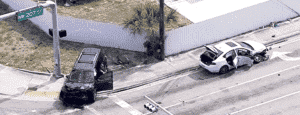
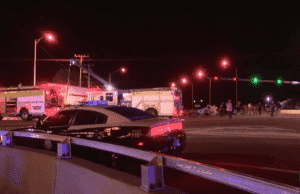
A Miami Car Accident Attorney at the Law Offices of Anidjar and Levine helps injured victims protect evidence, document medical harm, and build a claim that shows how excessive speed caused the collision and resulting losses.
Counsel typically reviews crash reports, witness statements, vehicle data, treatment records, and insurance coverage, while managing insurer communications and deadlines.
Legal guidance also supports recovery of medical costs, lost income, and pain and suffering.
The sections below explain the process, rights, and practical next steps.
Main Takeaways
- Seek immediate medical care and preserve records linking your injuries to the Miami speeding crash.
- Photograph the scene, vehicle damage, skid marks, injuries, and gather witness, police, and insurance information.
- A Miami speeding-car accident lawyer can investigate speed, braking, impact forces, and liability using expert testimony and electronic evidence.
- Your lawyer can handle insurers, organize medical and wage-loss documents, and protect you from harmful recorded statements.
- Compensation may include medical bills, lost income, pain and suffering, and future care, reduced by Florida comparative negligence rules.


How We Can Help With Your Miami Speeding Car Accident Injury Claim
After a speeding collision in Miami, a personal injury lawyer can provide structured guidance from the outset of the claim. Counsel often begins by listening carefully, identifying immediate needs, and helping injured people make informed choices that protect recovery, stability, and service to their families and communities.
A firm may coordinate post-accident counseling, assist with organizing medical records, and communicate with insurers so clients can focus on recovery. It can gather crash reports, photographs, witness statements, employment information, and treatment updates, then present them in a clear and reliable form. Lawyers also track deadlines, explain each step, and answer questions with consistent professionalism.
When transportation, documentation, or scheduling problems arise, staff can help reduce avoidable strain through practical support. This guidance is valuable for those who want to keep caring for others while their own needs are addressed responsibly. The overall goal is orderly claim management, clear communication, and steady advocacy during a demanding period.
OUR CONSULTATIONSARE FREE
START YOUR FREE CASE REVIEW

Understanding Miami Speeding Car Accident Injury Cases
Beyond the practical support a lawyer may provide, it is helpful to understand how Miami speeding-car-accident injury cases are evaluated under Florida law. These cases often turn on whether evidence shows a driver breached the duty to operate a vehicle with reasonable care, and whether that breach directly caused measurable harm to another person.
Courts and insurers commonly review police reports, witness statements, vehicle data, medical records, and expert analysis. In serious claims, speeding dynamics may help explain stopping distance, impact force, and loss of control. Injury biomechanics may also be used to link collision forces to specific physical injuries, thereby strengthening causation when liability is disputed.
Florida’s comparative negligence framework can affect recovery if multiple parties share fault. Damages may include medical expenses, lost income, pain and suffering, and future care needs. A careful legal assessment helps families and community-minded individuals pursue accountability while protecting the resources needed for recovery and service to others.
Common Causes of Miami Speeding Car Accidents
Several recurring factors contribute to Miami speeding car accidents, often increasing both the likelihood of a collision and the severity of resulting injuries. Distracted driving, aggressive driving behavior, and impaired decision-making frequently lead motorists to misjudge speed, traffic conditions, and stopping distance. Poor weather conditions can further reduce visibility and vehicle control, creating dangerous circumstances in which speeding becomes especially hazardous.
Distracted Driving Risks
Distracted driving remains a significant factor in many Miami speeding car accidents, because it reduces a driver’s ability to recognize hazards, judge distance, and respond in time to changing traffic conditions. When attention shifts from the road to texting, pedestrians, in-car infotainment systems, roadside billboards, or food and drink handling, even a brief delay can produce devastating consequences. Speed amplifies those risks by shortening the stopping distance and increasing impact force.
From a public safety perspective, distracted driving endangers passengers, nearby motorists, cyclists, and pedestrians who depend on attentive conduct. Responsible roadway use requires consistent focus, visual awareness, and free hands whenever possible. By understanding how everyday distractions contribute to severe collisions, individuals and families can better support safer driving habits that protect others and strengthen community well-being.
Aggressive Driving Behavior
Aggressive driving frequently plays a central role in Miami speeding car accidents because it combines excessive speed with deliberate or impulsive behaviors that increase the likelihood of a crash. Such conduct often includes unsafe lane changes, abrupt braking, failure to yield, and attempts to overtake traffic without sufficient space or caution.
These actions place surrounding drivers, passengers, pedestrians, and cyclists at heightened risk, especially on crowded Miami roads. Road rage can further intensify dangerous choices, turning routine traffic delays into preventable emergencies. Tailgating incidents are also common, reducing reaction time and increasing the force of rear-end collisions.
From a public safety perspective, aggressive driving reflects a disregard for shared responsibility on the roadway. Careful legal evaluation may help injured individuals identify how reckless conduct contributed to the collision and the resulting harm suffered.
Impaired Driver Decisions
Impaired driver decisions also contribute markedly to Miami speeding car accidents, particularly when alcohol, drugs, or certain medications affect judgment, coordination, and reaction time. When drivers misjudge distance, overestimate control, or respond too slowly, speeding becomes far more dangerous to everyone sharing the road. Alcohol judgment failures often lead motorists to ignore traffic signals, tailgate, or take reckless risks that place families and pedestrians in harm’s way.
Prescription impairment can produce similar consequences, even when a medication is lawfully obtained and properly used. Drowsiness, blurred focus, and delayed perception may prevent a driver from recognizing hazards or reducing speed in time. Communities devoted to protecting others benefit when impaired driving is identified early, prevented responsibly, and addressed through accountability measures that support safety, recovery, and public well-being.
Poor Weather Conditions
During periods of heavy rain, standing water, or reduced visibility, poor weather conditions become a significant factor in Miami car accidents. Wet pavement weakens tire traction and extends stopping distance, leaving drivers with less control when traveling above safe speeds. Even a brief loss of contact between tires and the roadway can create a serious risk of hydroplaning.
In service to community safety, it is important to recognize how weather amplifies the consequences of speeding. Reduced visibility limits the time available to identify brake lights, lane changes, disabled vehicles, or pedestrians. Storm conditions also increase roadway unpredictability, especially near intersections, curves, and flooded areas. Drivers who fail to slow down in rain or on pooled water place others at unnecessary risk, often causing preventable injuries that deeply affect families and neighborhoods.


Legal Rights of Miami Speeding Car Accident Injury Victims
Under Florida law, victims of Miami speeding car accidents have the right to pursue compensation when another driver’s excessive speed causes injury or loss. These rights are designed to restore stability, protect dignity, and support families affected by preventable harm.
In many cases, injured parties may seek damages for medical costs, lost income, property damage, pain and suffering, and other related losses under applicable insurance and negligence laws.
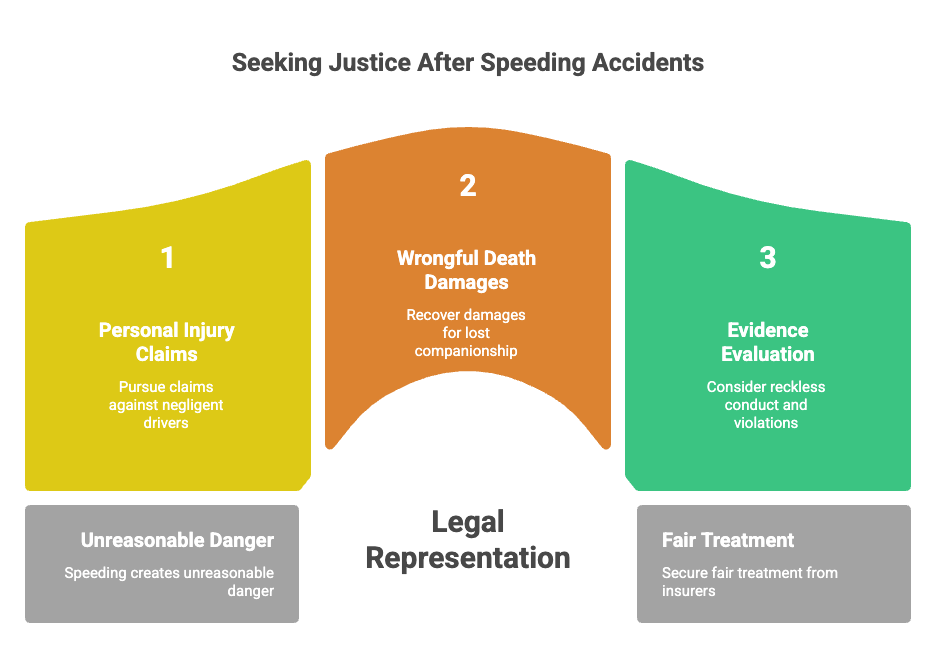
- Victims may pursue personal injury claims against negligent drivers whose speeding created unreasonable danger.
- Families may recover wrongful death damages when a fatal crash deprives loved ones of companionship and support.
- Courts may consider evidence of reckless conduct, traffic violations, and civil penalties when evaluating liability.
- Legal representation often strengthens victim advocacy, helping injured people secure fair treatment from insurers and opposing parties.
Florida law also preserves rights involving comparative fault, deadlines for filing claims, and access to evidence that may clarify how the collision occurred.
Steps to Take After a Miami Speeding Car Accident Injury
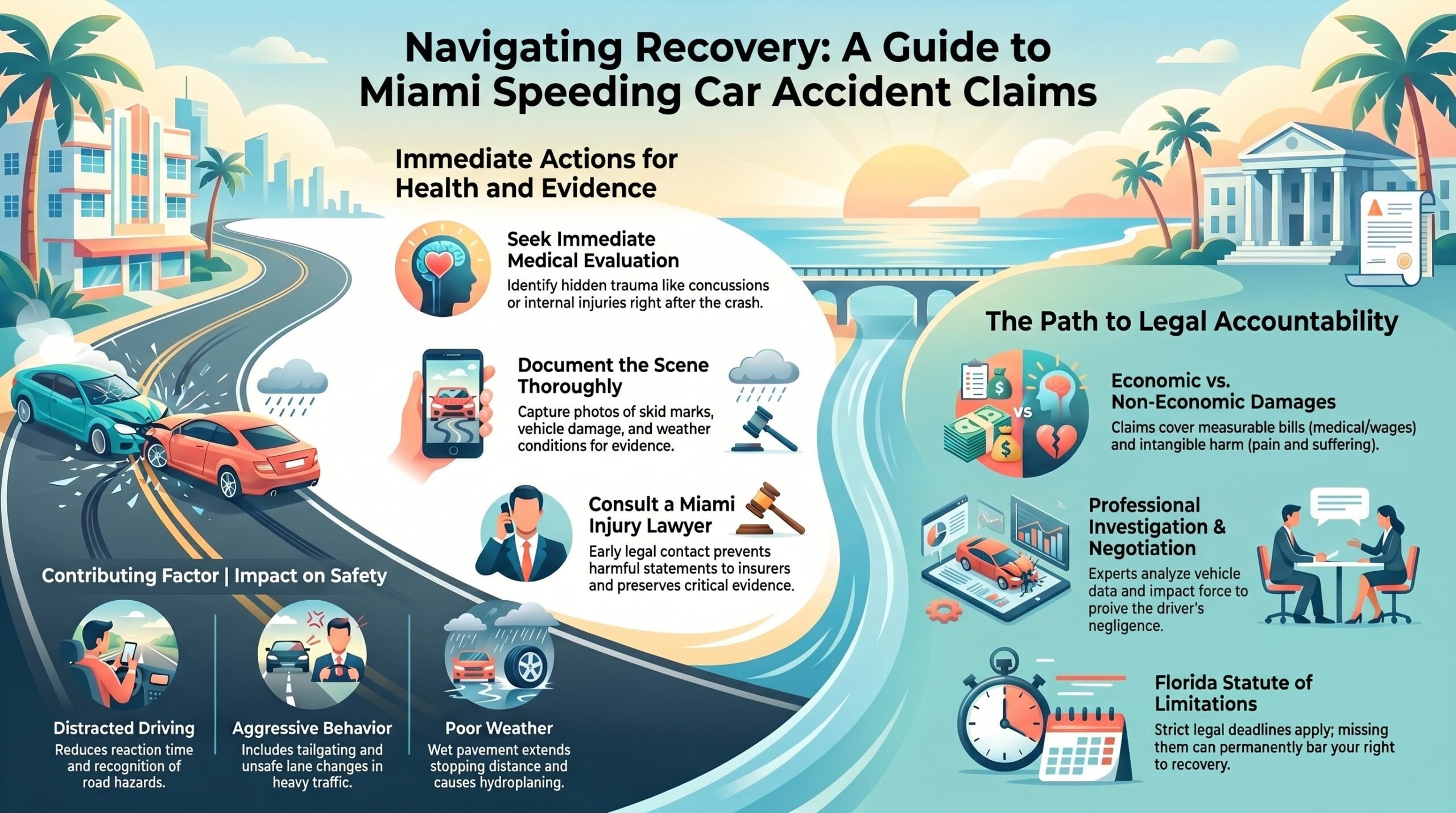
After a speeding car accident in Miami, certain actions can protect both health and a potential legal claim. Immediate medical care is often the first priority, followed by collecting evidence at the crash scene when conditions permit. Early contact with a Miami lawyer can also help preserve rights, organize documentation, and guide the next steps.
Seek Immediate Medical Care
Because injuries from a speeding car accident may not be immediately apparent, prompt medical evaluation is vital to protecting both health and any future injury claim. An urgent assessment can identify internal trauma, concussion symptoms, soft tissue damage, or delayed pain that a person focused on others may overlook in the immediate aftermath.
Medical providers also create records that connect symptoms to the collision, which can help establish the extent and timing of harm. Consistent follow-up monitoring is equally important, since some conditions worsen over hours or days and require additional treatment.
Seeking timely care demonstrates a responsible commitment to personal recovery, family stability, and the well-being of those who depend on that individual. It also supports informed decisions about treatment, rehabilitation, and any legal steps that may follow.
Gather Crash Scene Evidence
Crash-scene evidence can play a decisive role in showing how a speeding collision in Miami occurred and who may be legally responsible. If an injured person is physically able, careful information gathering may preserve facts that later become harder to confirm. Photograph documentation should capture vehicle positions, skid marks, roadway debris, traffic signs, weather conditions, visible injuries, and surrounding intersections from multiple angles. Time-stamped images can strengthen reliability.
It is also helpful to identify eyewitnesses and politely request their names and contact details so that witness statements can be obtained later. Notes about the other driver’s behavior, statements, and signs of impairment can also matter. A copy of the police report number, along with insurance and vehicle information, should be secured. These practical steps support accountability and may help protect the well-being of everyone affected.
Contact A Miami Lawyer
In the days following a Miami speeding collision, prompt contact with a qualified car accident lawyer can help protect an injured person’s legal and financial interests. Early legal guidance may preserve evidence, clarify deadlines, and prevent statements that insurers could misuse. A timely legal consultation also helps identify available compensation for medical treatment, lost income, and future care needs.
A lawyer can evaluate police reports, witness accounts, and medical records while advising the injured person on responsible next steps. Counsel may also explain the fee structure at the outset, promoting transparency and reducing uncertainty during recovery. By seeking informed representation, injured individuals are better positioned to pursue accountability, support their families, and secure the resources needed to continue serving others and to rebuild stability after a serious crash.
How a Miami Speeding Car Accident Injury Lawyer Can Help You
After a speeding collision, a Miami speeding car accident injury lawyer can provide essential guidance by evaluating the facts of the case, identifying liable parties, and protecting the injured person’s right to pursue compensation. Through careful legal advocacy and consistent client communication, counsel helps families and communities pursue accountability while preserving dignity throughout the claims process. An attorney often assists by:
A Miami speeding car accident injury lawyer helps protect compensation rights through careful guidance, accountability, and compassionate advocacy.
- Investigating crash reports, witness statements, medical records, and roadway evidence to build a clear, supportable claim.
- Calculating damages, including medical expenses, lost income, property losses, and other documented financial harm.
- Handling insurers, opposing counsel, and procedural deadlines to reduce stress and prevent harmful mistakes.
- Negotiating settlement terms or preparing for trial when fair compensation is not offered.
This support allows injured people to focus on recovery and service to those who depend on them. By providing structure, informed advice, and steady representation, a lawyer advances a claim with professionalism, compassion, and purpose.
Long-Term Effects of Miami Speeding Car Accident Injuries
Speeding car accident injuries in Miami can produce long-term physical limitations that affect mobility, pain levels, and a person’s ability to work or manage daily activities. These injuries may also lead to emotional and cognitive consequences, including anxiety, depression, memory problems, and reduced concentration. Over time, the combined effects often create substantial financial pressure and lifestyle disruption, particularly when ongoing medical care and diminished earning capacity are involved.
Lasting Physical Limitations
Crash-related injuries often extend beyond the initial emergency, leaving accident victims with lasting physical limitations that affect mobility, strength, and routine daily function. Severe fractures, spinal trauma, nerve damage, and joint injuries may restrict walking, lifting, bending, or standing for extended periods. Many individuals require mobility aids, ongoing rehabilitation, or home modifications to complete necessary tasks safely.
These limitations can interfere with employment, caregiving responsibilities, household duties, and participation in community service. Chronic pain may further reduce endurance and make once-routine movements difficult. In more serious cases, victims face permanent impairment, reduced independence, and a continuing need for medical support. A careful legal evaluation helps document these long-term losses, so families and those assisting them can pursue compensation that reflects the full extent of physical harm and future care needs.
Emotional And Cognitive Impact
Beyond the visible injuries, a serious Miami speeding car accident may leave lasting emotional and cognitive consequences that are less apparent but equally disruptive. Survivors may experience anxiety, irritability, depression, sleep disturbance, and persistent fear during routine travel, affecting relationships and daily interactions.
Head trauma can also alter memory, concentration, and judgment. Some individuals face post-traumatic amnesia, causing confusion about events before or after the crash. Others develop decision-making impairment, which can interfere with making safe choices, communicating, and following familiar tasks. These changes may emerge gradually, making them easy for others to misunderstand.
Caregivers, advocates, and legal professionals who serve injured people should recognize these symptoms as genuine injuries that require careful evaluation, documented treatment, and compassionate, informed support over time to support long-term recovery.
Financial And Lifestyle Strain
In the months and years after a Miami speeding car accident, injured individuals often face financial pressure that extends well beyond initial medical treatment. Lost income, reduced earning capacity, recurring therapy costs, transportation needs, and home modifications may steadily erode household stability. Families who prioritize caregiving frequently absorb added burdens, including missed work and disrupted routines.
These long-term losses often require practical planning and community-minded support. Budget counseling can help injured people and their families organize expenses, identify available benefits, and preserve resources for ongoing care. Lifestyle adjustments may also become necessary, affecting employment, recreation, mobility, and daily responsibilities.
When physical limitations persist, even ordinary tasks may require assistance, equipment, or changes to the schedule. A careful legal evaluation may help secure compensation that protects dignity, stability, and future well-being for all involved.
Proving Liability in Miami Speeding Car Accident Injury Cases
Establishing liability in a Miami speeding car accident case requires clear evidence that a driver’s excessive speed caused or substantially contributed to the collision and the resulting injuries. Courts and investigators often examine skid marks, vehicle damage, roadway conditions, surveillance footage, and electronic data to determine how fast a vehicle was traveling before impact.
Witness statements may help explain traffic flow, driver behavior, and whether speeding reduced the ability to avoid harm. Police reports can identify citations, observations, and scene measurements that support a finding of negligence. In some cases, speedometer calibration records become relevant when a driver disputes the recorded speed.
Expert testimony from accident reconstruction authorities may also assist in linking speed to braking distance, impact force, and foreseeable injury patterns. When the evidence shows that speeding posed an unreasonable risk to others and directly caused the crash, liability becomes easier to prove in the service of accountability and recovery for injured people.
Dealing With Insurance Companies After a Miami Speeding Car Accident Injury
After a speeding car accident in Miami, dealing with insurance companies often becomes an essential part of the injury claim process. Insurers may request recorded statements, medical authorizations, and extensive documentation soon after the collision. A careful, service-minded approach helps protect the injured person’s rights while preserving accurate information for those affected, including family members and caregivers.
Clear communication, organized records, and attention to claim timelines can reduce avoidable disputes. Insurance adjusters often evaluate fault, injuries, treatment, and losses with close scrutiny. Because early offers may not reflect the full impact of harm, thoughtful policy negotiation is often necessary. Supporting materials, such as medical bills, repair estimates, wage records, and physicians’ opinions, can strengthen the presentation of the claim.
Consistency in statements also matters, since minor discrepancies may be used to challenge credibility. Professional guidance can help injured individuals respond respectfully, comply with reasonable requests, and avoid agreements that limit fair recovery needed to serve their households and communities.
What to Expect During a Miami Speeding Car Accident Injury Claim Process
A Miami speeding car accident injury claim generally begins with filing the claim and gathering the records needed to support it. The process then moves into an investigation of the accident, followed by discussions about settlement offers and the value of the injuries. If a fair resolution is not reached through negotiation, the case may proceed toward a final resolution through further legal action.
Filing The Injury Claim
In the wake of a Miami speeding car accident, filing an injury claim generally begins with a careful review of the crash, the resulting medical treatment, and the available insurance coverage. Counsel typically helps organize records, confirm notice requirements, and establish a filing timeline that protects the injured person’s rights under Florida law.
The claim is then prepared with medical bills, wage-loss information, and other documentation showing how the injuries affected daily life and the ability to meet family, work, and community responsibilities. Insurance communications are handled with care so statements remain accurate and complete. A thoughtful settlement strategy is often developed early, balancing present losses with future treatment needs. Throughout this stage, the process emphasizes order, prompt action, and responsible advocacy intended to support recovery and long-term stability for all involved.
Investigating The Accident
Once the claim has been organized and notice requirements have been addressed, the investigation phase typically begins with a close examination of how the speeding crash occurred and which facts can be proven. Attorneys and investigators gather police reports, photographs, electronic data, medical records, and roadway evidence. They may consult experts in forensic reconstruction to measure speed, braking, sightlines, and impact forces with care and objectivity.
The process also includes locating witnesses, testing witness credibility, and comparing statements against physical evidence. Surveillance footage, vehicle damage, and phone records may reveal whether distraction, impairment, or reckless choices contributed to the collision. Throughout this stage, the legal team seeks reliable facts that honor the injured person’s needs and support accountability. A thorough investigation helps clarify liability and preserves evidence that may otherwise be lost over time.
Negotiating Settlement Offers
With the factual record taking shape, settlement discussions often begin through exchanges with the insurer regarding liability, medical treatment, lost income, and the broader effect of the speeding collision on the injured person’s life. During this stage, counsel typically presents supporting records, evaluates damages, and develops a settlement strategy grounded in documented losses and future needs.
Insurers may respond with questions, requests for clarification, or initial offers that do not fully reflect the claim’s value. Effective negotiation tactics focus on accuracy, consistency, and a clear explanation of how the crash disrupted the injured person’s ability to work, care for family, and serve the community. Patience is often necessary because multiple rounds of communication may occur before meaningful progress is made. Careful preparation helps protect the injured person’s interests and dignity throughout negotiations.
Resolving The Case
At the resolution stage, a Miami speeding-car accident injury claim may conclude through a negotiated settlement or proceed to trial if the parties remain divided on liability, causation, or damages. During this phase, counsel evaluates evidence, witness credibility, medical records, and projected losses to shape a practical settlement strategy. If an agreement is reached, the claimant reviews the release terms, resolves liens, and receives compensation, thereby allowing meaningful case closure and financial stability.
If settlement efforts fail, preparation intensifies for court. Attorneys organize exhibits, prepare testimony, address motions, and present the claim before a judge or jury. Throughout the process, informed guidance helps injured individuals make decisions that protect household needs and future care. A disciplined approach to resolution supports accountability, encourages responsible conduct, and seeks an outcome that serves both recovery and broader community safety.
Compensation for Miami Speeding Car Accident Injury Damages
Accountability often begins with a careful assessment of the full extent of a victim’s losses after a speeding car accident in Miami. Compensation may address immediate medical needs, ongoing treatment, rehabilitation, lost wages, reduced future earnings, property damage, and other accident-related burdens that disrupt daily life and family stability. In especially egregious cases, punitive damages may also be sought to reinforce community safety and deter similar misconduct.
A thorough claim reflects more than bills alone. It considers how injuries affect a person’s ability to work, fulfill responsibilities, and continue serving loved ones and the broader community. Lawyers often gather medical records, employment information, expert opinions, and repair estimates to present a complete picture of harm.
This careful documentation supports negotiations with insurers and, when necessary, litigation in court. By identifying the full scope of losses, legal counsel helps protect the injured person’s interests while advancing accountability, fairness, and resources needed for recovery, stability, and dignified long-term support.
Economic vs Non-Economic Damages in Miami Speeding Car Accident Cases
In Miami speeding car accident cases, damages generally fall into two primary categories: economic losses and non-economic harm. Economic damages typically include measurable financial costs, such as medical expenses, lost income, and property damage, while non-economic damages address pain and suffering, emotional distress, and diminished quality of life. The value of either category often depends on medical records, employment documentation, expert analysis, and other evidence that supports the extent of the claimant’s losses.
Economic Damage Categories
Under Florida law, economic damages in a Miami speeding car accident case refer to the measurable financial losses caused by the collision, while non-economic damages address the more personal, intangible effects of the injury.
These losses commonly include emergency care, hospital bills, rehabilitation costs, prescription expenses, and reasonably foreseeable future medical treatment. Economic damages also cover lost wages when injuries prevent a person from working, as well as diminished earning capacity if long-term limitations affect future employment.
In addition, property damage may include vehicle repair or replacement, rental transportation, and the value of personal items harmed in the crash. Careful documentation, including invoices, wage records, estimates, and expert evaluations, helps establish these amounts. This structure supports fair recovery and promotes responsible assistance for injured individuals and their families after serious collisions.
Non-Economic Losses
Pain, disruption, and diminished quality of life often form the basis of non-economic losses in a Miami speeding car accident case. These damages address human consequences that do not appear on bills or wage statements, yet still affect daily living in substantial ways.
Non-economic losses may include pain and suffering, emotional distress, anxiety, inconvenience, and loss of enjoyment of ordinary activities. They also recognize the strain an injury can place on relationships, independence, sleep, and the ability to participate fully in family, work, or community life. For people committed to caring for others, these harms can be especially profound when injuries interfere with service, connection, and purpose.
In serious speeding collisions, non-economic damages help acknowledge the full personal impact of harm beyond direct financial loss and support meaningful accountability for recovery.
Proving Damage Value
Accuracy is central to proving damage value in a Miami speeding car accident case, because the strength of any claim depends on showing both the existence of harm and the reasonable amount of compensation tied to it. Economic damages are commonly established through damage documentation, including medical bills, wage records, repair invoices, and future care estimates. These materials help demonstrate measurable financial loss and support fair recovery for those affected.
Non-economic damages require a different showing. Pain, emotional distress, disability, and reduced quality of life are often explained through treatment records, testimony, and expert valuation. A careful presentation connects daily limitations to the collision and helps insurers, judges, or juries assess reasonable compensation. Thorough proof serves injured individuals, families, and the broader goal of accountability after preventable speeding crashes in Miami.
When a Miami Speeding Car Accident Injury Case Goes to Trial vs Settlement
Although many Miami speeding-car accident injury claims are resolved through settlement, some proceed to trial when the parties cannot agree on liability, the extent of the injuries, or the value of damages. In settlement discussions, counsel often weighs medical records, witness credibility, and insurance limits to reach a practical outcome that supports an injured person’s recovery and stability.
When a trial becomes necessary, the trial strategy focuses on presenting clear evidence, expert testimony, and persuasive arguments that explain how speeding caused harm. A judge or jury then determines fault and awards damages based on the proof presented. Trials may offer fuller compensation in disputed cases, yet they also involve greater cost, time, uncertainty, and emotional strain for those seeking justice.
Settlements, by contrast, provide earlier resolution and more control over the result. After trial, post-judgment issues may arise, including Verdict appeals, which can further extend the process. Each path requires careful evaluation of risks, needs, and community-centered goals.
The Statute of Limitations for Miami Speeding Car Accident Injury Cases
In Florida, the statute of limitations sets a strict deadline for filing a Miami speeding car accident injury lawsuit, and missing that deadline can bar recovery regardless of the claim’s underlying substance. For those seeking to protect injured people and support family stability, careful attention to filing deadlines is vital. A delayed claim may be dismissed even when speeding clearly caused substantial harm.
Several nuances of the statute can affect how the deadline is calculated. The time period may differ depending on whether the matter involves personal injury, wrongful death, or a claim against a government entity. Certain facts, such as the delayed discovery of injuries or the legal status of a minor, may also influence timing in limited situations. Court rules and notice requirements can further complicate compliance.
Because these time limits exist to promote fairness and orderly resolution, injured individuals and those assisting them benefit from prompt documentation, organized records, and a clear understanding of the applicable legal timetable.
When to Contact a Miami Speeding Car Accident Injury Lawyer
After a Miami speeding car accident, contacting a lawyer as early as possible is often the most effective way to protect a potential injury claim. Early legal contact can help preserve records, identify witnesses, and guide injured individuals through immediate decisions with care and clarity. It may also support families who are focused on serving and helping an injured loved one during recovery.
A lawyer should generally be contacted soon after emergency medical needs are addressed, especially when injuries, disputed fault, or significant property damage are involved. Prompt action can reduce mistakes in statements, document collection, and insurance timing. It can also help an injured person understand reporting duties, available benefits, and practical next steps.
In some situations, post-accident counseling is also valuable, particularly when emotional distress affects communication and decision-making. Waiting too long may complicate evidence collection and create avoidable obstacles for all parties involved later in the claims process.
Why You Need an Experienced Miami Speeding Car Accident Injury Lawyer
Steering through a speeding car accident claim often requires more than submitting forms and responding to insurance inquiries, particularly when serious injuries, disputed liability, or long-term losses are involved. An experienced Miami speeding car accident injury lawyer helps protect injured people and their families by identifying damages, preserving evidence, and addressing legal nuances that may affect recovery.
Seasoned counsel also understands how speeding crashes can create intricate medical, financial, and procedural issues. That background supports accurate claim valuation, stronger negotiations, and, when necessary, effective courtroom advocacy. In matters involving catastrophic harm or wrongful death, experience can help guarantee that future care needs and lost earning capacity are not overlooked.
For those committed to helping others rebuild after preventable harm, informed legal representation serves a practical and compassionate purpose. While client testimonials may reflect satisfaction with prior results, the greater value lies in disciplined case preparation, strategic judgment, and consistent protection of the injured person’s interests.
How to Choose the Right Miami Speeding Car Accident Injury Lawyer for Your Case
Selecting the right Miami speeding car accident injury lawyer can shape the course of a claim as much as the underlying evidence itself. A careful choice often begins with reviewing the lawyer’s experience handling speeding-related collisions, courtroom readiness, and knowledge of Florida injury law. Past results may offer context, though no outcome can be guaranteed.
Client interviews can help assess whether the lawyer listens carefully, explains options clearly, and treats injured people with dignity. Communication practices matter, especially when families need steady updates while focusing on recovery and service to others. Fee transparency is equally important because clear terms reduce confusion and allow informed decisions from the start.
A prudent evaluation also considers investigative resources, negotiation ability, and willingness to challenge insurers that minimize harm. Professional reputation, responsiveness, and organized case management can further indicate whether the lawyer is prepared to pursue fair compensation with competence, integrity, and sustained attention to the client’s needs.
About The Law Offices of Anidjar & Levine
The Law Offices of Anidjar & Levine presents a client-focused approach to personal injury representation, including matters involving speeding car accidents in Miami.
The firm emphasizes responsive communication, careful case preparation, and practical guidance for injured people and their families.
Its attorneys and staff aim to reduce burdens so clients can focus on recovery, stability, and the well-being of those who depend on them.
The firm’s history reflects sustained work in personal injury law and a commitment to accessible legal support across Florida.
Through organized advocacy and attention to evidence, the office seeks fair compensation for medical costs, lost income, and other accident-related losses.
Client testimonials often describe professionalism, compassion, and consistent follow-through, qualities that matter when serious injuries disrupt daily life.
By combining legal knowledge with service-oriented representation, the Law Offices of Anidjar & Levine positions itself as a resource for individuals seeking accountability, protection, and informed assistance after a speeding collision in Miami.
Frequently Asked Questions
Can I Recover Damages if I Wasn’t Wearing a Seatbelt?
Yes, damages may still be recoverable if a seatbelt was not worn. In many jurisdictions, comparative fault governs, meaning compensation can be reduced only to the extent the omission worsened injuries. Courts generally reject seatbelt myths and require proof, not assumption. Contributory negligence rules in some states may limit recovery more sharply. Insurance offsets may also affect payment calculations, so careful legal review remains crucial for those seeking fair compensation.
How Do Pre-Existing Injuries Affect My Speeding Accident Claim?
Pre-existing injuries do not bar a speeding accident claim, but they can affect valuation and proof. A claimant with a prior injury may still recover when the crash aggravated that condition or caused distinct harm. Medical records, expert opinions, and clear timelines often determine comparative recovery, especially where insurers dispute causation. Careful documentation helps guarantee compensation reflects the accident’s true impact while supporting fair treatment for all parties involved.
Can Social Media Posts Hurt My Car Accident Injury Case?
Yes, social media posts can damage a car accident injury case. Insurers and defense counsel may use photos, comments, location tags, and metadata risks to challenge reported pain, limitations, or credibility. Even strong privacy settings do not guarantee protection, because shared content can be copied or subpoenaed. A careful claimant serves the process best by avoiding posts, asking others not to tag them, and preserving consistency across all communications.
What if the Speeding Driver Was Uninsured or Underinsured?
If the speeding driver was uninsured or underinsured, recovery may still be available through the injured person’s own policy. Uninsured motorist benefits can help cover medical costs, lost income, and other damages when the at-fault driver lacks insurance. Underinsured coverage may apply when the driver’s policy limits are insufficient. Careful review of all available coverage supports a more complete claim and helps protect the injured person’s financial stability.
Are Punitive Damages Available in Miami Speeding Accident Cases?
Yes, punitive awards may be available in speeding accident cases when the driver’s conduct rises beyond negligence to reckless or intentional misconduct. Florida courts generally require clear evidence of gross negligence, such as extreme speeding, racing, or conscious disregard for public safety. These exemplary damages are not automatic and must meet statutory pleading standards. Their purpose is to punish serious wrongdoing and deter similar conduct, thereby protecting others in the community.
—————————
A Miami speeding car accident injury claim often involves serious losses, disputed liability, and strict legal deadlines.
Victims benefit from understanding their rights, preserving evidence, and seeking legal guidance as early as possible.
With informed representation, they may pursue compensation for medical expenses, lost income, and other damages.
A Miami Car Accident Attorney from the Law Offices of Anidjar & Levine provides experienced support to those navigating these intricate cases, helping clients protect their interests and move forward with greater confidence.