We help Jacksonville taxi‑accident victims preserve evidence, secure medical records, and prove liability while steering intricate insurance negotiations.
The Law Offices of Anidjar and Levine coordinates scene investigation, expert reconstruction, and detailed damage assessment to build a compelling claim.
We protect your right to fair compensation for medical expenses, lost wages, and non‑economic losses, and we guide you through statutory deadlines and settlement strategies.
Continue to discover how our experience as a Jacksonville Car Accident Lawyer translates into stronger advocacy and better outcomes.
Main Takeaways
- Hire a Jacksonville taxi accident lawyer experienced in preserving crash scenes, gathering dash‑cam footage, and securing witness statements promptly.
- Ensure the attorney can conduct a thorough investigation, including reviewing police reports, taxi company policies, and medical records to establish liability.
- Choose a lawyer who can quantify damages such as medical expenses, lost wages, pain and suffering, and future care needs.
- Verify the attorney’s ability to negotiate with insurers or pursue litigation, using comparative negligence analysis and local statutes.
- Confirm the lawyer provides clear guidance on statutory deadlines, claim rights, and protects against premature settlement offers.


How We Can Help With Your Jacksonville Taxi Accident Claim
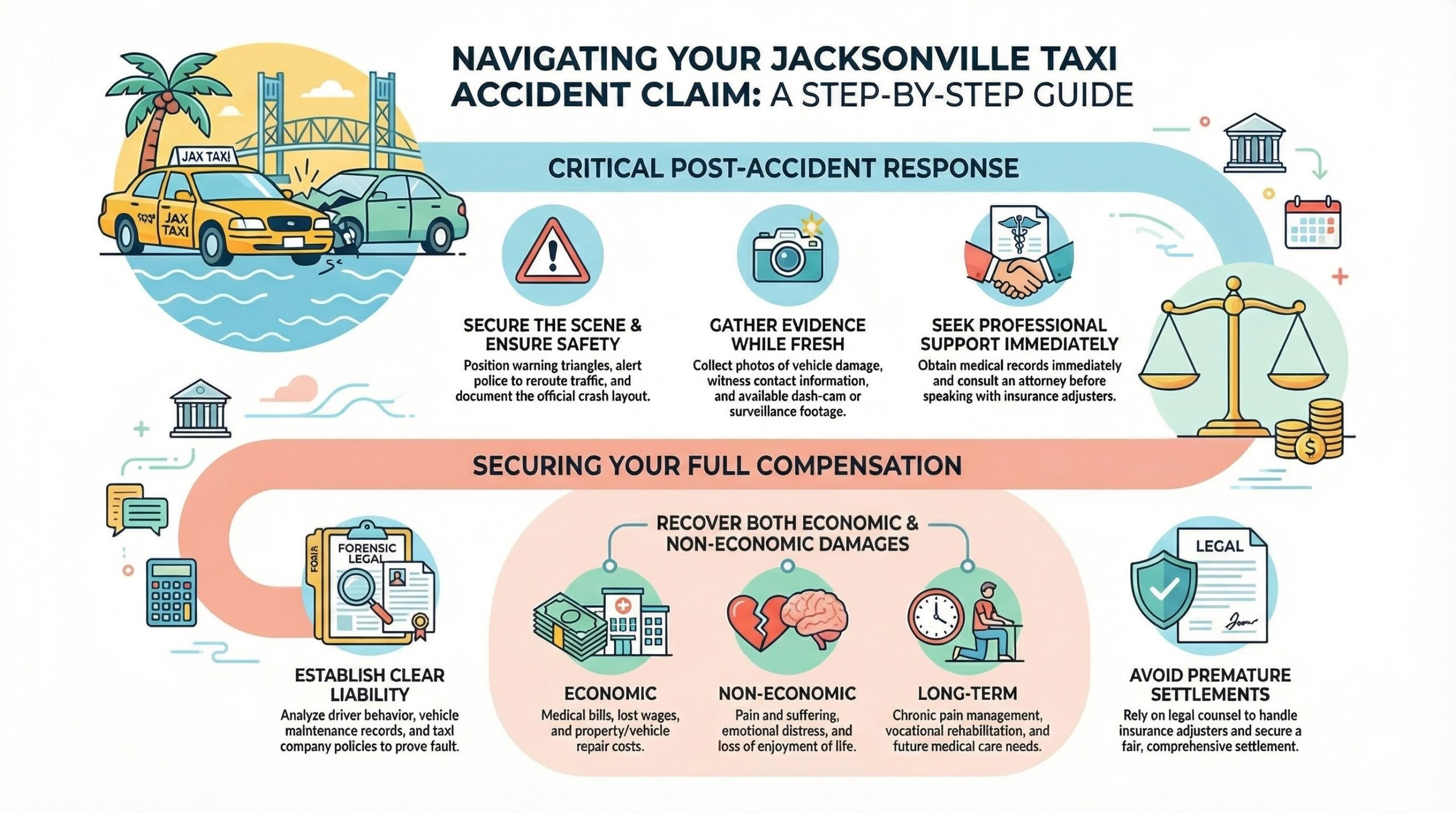
We begin by conducting a thorough review of the accident scene, police reports, medical records, and taxi company policies to identify every liable party and the full extent of your damages.
Our team then coordinates with medical and accident reconstruction experts to substantiate each element of each claim, ensuring that no loss—whether physical, emotional, or financial—is overlooked.
Our experts verify every claim—physical, emotional, financial—so nothing is missed.
We prioritize transparent communication, keeping you informed of progress and outlining realistic settlement timelines that reflect the intricacy of taxi‑related injuries.
When negotiation stalls, we prepare for litigation, leveraging our deep knowledge of local statutes and precedent to protect your interests.
Throughout the process, we provide farewell resources that guide you through post‑injury recovery, counseling, and financial planning, reinforcing our commitment to service‑oriented advocacy.
OUR CONSULTATIONSARE FREE
START YOUR FREE CASE REVIEW

Understanding Jacksonville Taxi Accident Cases
Our thorough review of accident scenes, police reports, medical records, and taxi company policies naturally leads to a broader view of how Jacksonville taxi accident cases unfold.
We examine the sequence of events, liability allocations, and the impact of regulatory frameworks on each claim.
By comparing ride-share operations with traditional taxi operations, we identify distinct procedural nuances that affect insurance coverage and fault determinations.
We also address fare disputes that often arise when passengers contest charges following an incident, ensuring contractual obligations are honored and compensation reflects actual losses.
Our analysis highlights how driver training standards, vehicle maintenance records, and dispatch protocols contribute to case outcomes.
We present this information to empower readers who serve others, offering clear guidance on steering intricate legal terrain while maintaining professional rigor and accountability throughout the investigative process.
Common Causes of Jacksonville Taxi Accidents
We’ll examine the most frequent causes of taxi accidents in Jacksonville, starting with distracted drivers who fail to give full attention to the road.
Poor vehicle maintenance and inadequate driver training also contribute greatly, while weather‑related hazards can quickly turn a routine trip into a dangerous situation.
Understanding these factors helps us identify liability and protect victims more effectively.
Distracted Drivers
When drivers divert their attention from the road, the risk of a taxi collision rises dramatically, and we see this pattern repeatedly in Jacksonville’s busy streets.
We observe that smartphone use, especially texting or scrolling, pulls eyes and minds away from traffic cues, creating blind spots that can intersect a taxi’s path. Passenger distractions also play a role; a client’s sudden movement or conversation can cause a driver to look away or adjust controls at an unsafe moment.
In our experience, these behaviors compromise reaction time and decision‑making, leading to rear‑end, side‑impact, and intersection crashes involving taxis. By recognizing these patterns, we can better advocate for victims and promote safer driving practices throughout the community.
Poor Vehicle Maintenance
If a taxi’s brakes, tires, or guiding components aren’t properly maintained, the likelihood of a crash escalates dramatically on Jacksonville’s congested roadways.
We see driver accidents caused by worn brake pads, under‑inflated tires, and corrosion of components, all of which compromise directional stability. Regular inspection records reveal patterns of neglect that owners and operators often overlook, allowing hazards to accumulate.
When we review a taxi’s maintenance history, we check for timely brake service, tire rotation, and rust‑free suspension parts. Failure to address these issues can lead to reduced traction, delayed stopping, and loss of control, endangering passengers and pedestrians alike.
Weather‑Related Hazards
Even with meticulous maintenance, Jacksonville taxis remain vulnerable to weather‑related hazards that can trigger accidents despite a driver’s best efforts.
We see rain‑slick streets, sudden downpours, and fog that create reduced visibility, forcing drivers to rely on instinct and caution.
When thunderstorms flood low‑lying roads, municipal authorities often issue road closures, compelling taxis to detour through unfamiliar neighborhoods, increasing the risk of misjudging lane positioning.
We grasp that serving passengers safely requires anticipating these conditions, adjusting speed, and maintaining a safe following distance.
By monitoring real‑time weather alerts and communicating changes to riders, we mitigate exposure to hazardous environments.
Our proactive approach guarantees that, even when nature conspires against us, we uphold the highest standards of passenger protection.
Inadequate Driver Training
Because many taxi operators prioritize rapid onboarding over thorough instruction, drivers often hit the streets of Jacksonville without mastering vital defensive‑driving techniques, vehicle‑handling fundamentals, or situational awareness.
We’ve seen that inadequate screening and a weak training curriculum leave drivers unprepared for intricate traffic patterns, sudden pedestrian crossings, and adverse weather.
When drivers lack proper instruction, they may misjudge speed, fail to maintain safe following distances, and react poorly to emergency situations.
This gap in preparation directly increases the likelihood of collisions, endangering passengers and the public.


Legal Rights of Jacksonville Taxi Accident Victims
When a taxi collision occurs in Jacksonville, victims immediately gain a set of legal protections that safeguard their rights to compensation and medical care.
We must understand that passenger rights extend beyond immediate medical care; they include the right to a thorough investigation, access to insurance information, and the ability to pursue damages for pain and suffering, as well as lost wages.
Our duty is to guide victims through settlement timelines that balance prompt resolution with the need for exhaustive evidence gathering.
By staying informed, we empower clients to make strategic decisions and avoid premature settlements that could undervalue their claims.
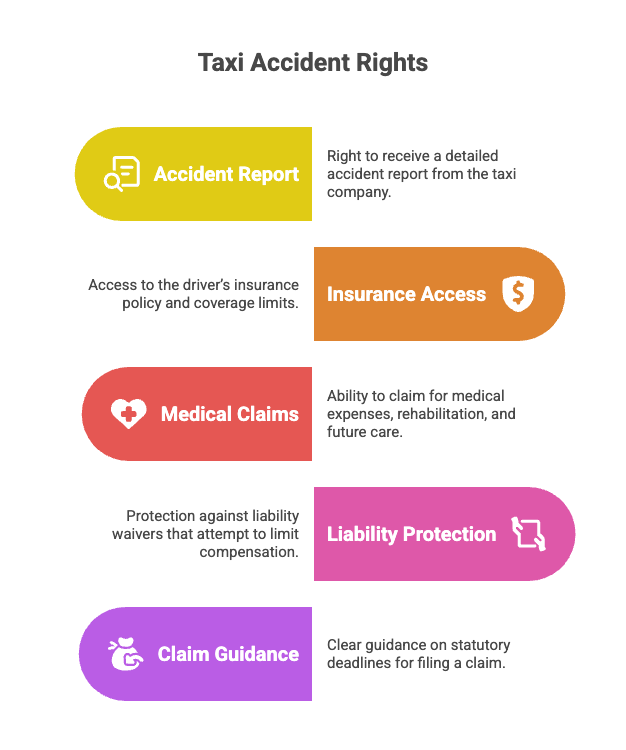
- Right to receive a detailed accident report from the taxi company.
- Access to the driver’s insurance policy and coverage limits.
- Ability to claim for medical expenses, rehabilitation, and future care.
- Protection against liability waivers that attempt to limit compensation.
- Clear guidance on statutory deadlines for filing a claim.
Steps to Take After a Jacksonville Taxi Accident
We should first secure the scene to protect everyone involved and prevent further hazards.
Next, we promptly gather evidence, documenting the taxi’s condition, taking photos, and collecting witness statements while the details are fresh.
Finally, we contact legal representation without delay to ensure our rights are protected and that we receive proper guidance through the claims process.
Secure the Scene
After a taxi collision, we must act swiftly to preserve evidence and protect everyone’s safety. First, we secure the scene by positioning warning triangles and flashing lights to alert onlookers and prevent further accidents.
We then request traffic diversion from police, ensuring that emergency vehicles and additional traffic are rerouted away from the hazardous area. While waiting for officials, we keep witnesses at a safe distance, discouraging them from moving any debris or vehicles that could compromise the preservation of the scene.
We also safeguard any personal items that may be needed for later identification, without disturbing the crash layout. These steps maintain order, reduce risk, and lay a solid foundation for the investigation that follows.
Gather Evidence Promptly
If we act quickly, we can preserve vital evidence before it deteriorates or is unintentionally altered. We should first secure any available surveillance or dash‑cam footage, preserving it by requesting copies from nearby businesses, the taxi company, and law enforcement agencies.
While the scene remains fresh, we interview witnesses, documenting their statements and contact information for follow‑up. Collect photographs of vehicle positions, damage, and road conditions, and note weather or lighting factors that could affect later analysis.
Obtain medical records promptly, as they corroborate injuries sustained. Keep all physical items, such as broken parts or debris, in a safe location to prevent loss. By acting decisively, we safeguard the factual foundation needed for a strong claim.
Contact Legal Representation
When a taxi collision occurs, promptly securing a qualified attorney is vital to protecting our rights and preserving the integrity of our claim. We should reach out to a Jacksonville taxi accident lawyer who offers a free consultation, so we can discuss the details without financial pressure.
During this meeting, we can evaluate the lawyer’s experience, communication style, and commitment to client welfare. It’s indispensable to confirm that the firm works under contingency agreements, ensuring we pay legal fees only if we recover compensation.
How a Jacksonville Taxi Accident Lawyer Can Help You
We’ll guide you through the elaborate process of securing compensation after a taxi collision, explaining how a Jacksonville taxi accident lawyer can protect your rights and maximize your recovery.
Your guide to securing compensation after a taxi collision with expert Jacksonville legal support.
We’ll explain how we navigate complex taxi regulations and address Fare disputes, ensuring insurers honor liability and that any lost earnings are fully reinstated.
Our team coordinates with medical experts, accident reconstruction specialists, and insurance adjusters to build a comprehensive case.
By handling documentation, negotiations, and courtroom representation, we relieve you of the burden so you can focus on recuperation.
- Conduct thorough investigations of the crash scene and vehicle records.
- Analyze Taxi regulations to identify violations and liability.
- Resolve Fare disputes that affect compensation calculations.
- Secure medical evidence and expert testimony for injury valuation.
- Negotiate with insurers for a fair settlement or pursue litigation when necessary.
Long-Term Effects of Jacksonville Taxi Accident Injuries
We recognize that chronic pain often requires ongoing management, and we’ll explain how this can affect daily activities and medical costs.
We also address the emotional and psychological impact, noting that anxiety, depression, and PTSD may develop after a traumatic collision.
Finally, we consider long‑term disability issues, outlining how lasting impairments can influence future earnings and the need for thorough compensation.
Chronic Pain Management
Typically, survivors of Jacksonville taxi accidents experience chronic pain that persists long after the initial injury, and this lingering discomfort can markedly impair daily functioning.
We recognize that effective pain coping requires a comprehensive plan that integrates physical therapy, targeted exercise, and evidence‑based modalities such as acupuncture or cognitive‑behavioral techniques.
We also advise exploring opioid alternatives, including non‑opioid analgesics, anti‑inflammatory agents, and nerve‑block procedures, to reduce dependence on high‑risk medications.
By collaborating with multidisciplinary experts, we help clients maintain mobility, improve sleep quality, and sustain their ability to serve others.
Our approach emphasizes individualized treatment schedules, regular progress assessments, and education on self‑management strategies, ensuring that each survivor regains functional independence while minimizing long‑term health risks.
Emotional and Psychological Impact
Chronic pain often coexists with profound emotional distress, and survivors of Jacksonville taxi accidents frequently develop anxiety, depression, and post‑traumatic stress that can linger for years. We recognize that these psychological wounds affect daily functioning and diminish the capacity to serve others.
By acknowledging the link between physical trauma and emotional upheaval, we can guide clients toward thorough care that includes grief counseling and evidence‑based therapy. Our approach emphasizes early intervention, regular mental‑health assessments, and coordination with licensed professionals who focus on post‑traumatic stress.
We also advise clients to document emotional symptoms for legal purposes, ensuring that compensation reflects the full scope of their suffering. Ultimately, our commitment is to restore both physical well‑being and psychological resilience, empowering survivors to reclaim purposeful lives.
Long‑Term Disability Considerations
When the injuries from a Jacksonville taxi accident persist beyond the initial recovery period, they often evolve into long‑term disabilities that can alter a survivor’s ability to work, manage daily tasks, and maintain independence.
We must assess how chronic pain, limited mobility, or cognitive impairment affect employability, and we guide clients toward vocational rehabilitation programs that retrain skills and match them with suitable roles.
Simultaneously, we advise thorough financial planning to protect income, cover medical expenses, and secure future benefits.
By coordinating medical documentation with insurance claims, we help survivors establish a sustainable livelihood.
Our approach integrates expert legal counsel with practical support, ensuring that each client receives the resources needed to rebuild stability and maintain dignity.
Proving Liability in Jacksonville Taxi Accident and Car Accident Cases
If a taxi collides with another vehicle in Jacksonville, we must first determine who breached the duty of care expected on the road. We examine the taxi driver’s adherence to industry standards, including licensing, vehicle maintenance, and compliance with traffic signals. Evidence of speed, distraction, or failure to yield can demonstrate a breach.
Simultaneously, we assess comparative negligence, recognizing that fault may be shared among parties. By gathering police reports, witness statements, and dash‑cam footage, we reconstruct the sequence of events and allocate responsibility proportionally.
We also review the taxi company’s policies, driver training records, and dispatch instructions to determine if systemic issues contributed to the accident. In Jacksonville courts, the comparative negligence rule reduces recovery by the plaintiff’s own percentage of fault, so precise quantification is vital.
Our thorough approach ensures liability is clearly defined, enabling victims to pursue fair compensation while upholding road safety standards.
Dealing With Insurance Companies After a Jacksonville Taxi Accident
After establishing liability, our next focus is steering the insurance process that follows a Jacksonville taxi accident. We advise clients to document every interaction with the insurer, noting dates, names, and the substance of each conversation.
Effective claim tactics begin with a written demand letter that outlines medical expenses, lost wages, and non‑economic damages, supported by clear evidence. When the adjuster contacts us, we assess adjuster timing carefully; we avoid premature settlements and request sufficient time to gather thorough records.
We also recommend requesting the adjuster’s written report to verify their assessment aligns with our findings. Throughout negotiations, we maintain a professional demeanor, emphasizing the claim’s factual basis while protecting the client’s interests.
What to Expect During a Jacksonville Taxi Accident Claim Process
We’ll start by reviewing the initial police report and filing the insurance claim, ensuring that every detail is accurately recorded.
Next, we’ll gather and examine all medical documentation to substantiate your injuries and related expenses.
Finally, we’ll employ strategic settlement negotiations, leveraging the compiled evidence to secure a fair resolution.
Initial Police Report
When a taxi collision occurs in Jacksonville, the initial police report becomes the cornerstone of our claim strategy, and we’ll guide you through every step of its preparation and review.
We first make certain that officers follow proper police procedures, documenting scene photographs, witness statements, and vehicle identification numbers. Our team advises you to request a copy promptly, respecting report timelines that typically require issuance within 30 days.
We then scrutinize the narrative for accuracy, confirming that the taxi’s license plate, driver’s name, and any contributing factors are correctly recorded. By cross‑checking this data with our own investigation, we can identify discrepancies early, strengthen liability arguments, and preserve crucial evidence for subsequent negotiations or litigation.
Insurance Claim Filing
We’ll begin by assembling the necessary documentation and filing the claim with the taxi’s insurance carrier, a step that sets the timeline for the entire process.
We gather police reports, witness statements, photos of vehicle damage, and medical bills, then organize this claim documentation into a concise package.
Next, we submit the package to the insurer, noting policy timelines that dictate response windows and settlement deadlines.
Throughout, we monitor the insurer’s acknowledgments, respond promptly to requests for additional information, and keep detailed notes of every communication.
By maintaining a clear, organized approach, we make certain the claim proceeds efficiently, protecting our client’s rights while adhering to the carrier’s procedural requirements.
This methodical strategy minimizes delays and maximizes the likelihood of a fair resolution.
Medical Documentation Review
After filing the claim, the next pivotal phase is a thorough review of medical documentation. We’ll request every physician’s note, diagnostic report, and physical therapy log to ensure that medical recordkeeping reflects the full extent of injuries.
Our team cross‑checks each entry against the accident timeline to confirm that treatments are directly related to the incident. We also scrutinize billing statements for discrepancies, flagging any overcharges or unrelated procedures that could undermine the claim’s value.
Settlement Negotiation Strategies
If you’re guiding a Jacksonville taxi accident claim, you’ll soon encounter the settlement negotiation phase, where insurers propose compensation and we evaluate its adequacy.
We begin by reviewing the offer against medical costs, lost wages, and future care, and then we outline our settlement leverage, highlighting evidence of liability and policy limits.
Throughout the negotiation timeline, we maintain regular communication with the client and adjust strategy as new information emerges.
We present counter‑offers that reflect the full scope of damages, emphasizing documented injuries and the impact on the client’s livelihood.
By setting realistic expectations and explaining each step, we help the client understand why a firm stance may be necessary.
Our goal is to secure a fair, timely resolution while preserving the client’s best interests.
Compensation for Jacksonville Taxi Accident Damages
Maneuvering the aftermath of a taxi collision in Jacksonville requires a clear understanding of the compensation available for the damages you’ve sustained. We explain the categories of recoverable losses, beginning with medical expenses, vehicle repair costs, and lost wages, all of which can be quantified and pursued through insurance claims or litigation.
When a taxi driver was operating under surge pricing, the higher fare may affect liability calculations, but it doesn’t diminish your right to full restitution. We also address property damage to personal belongings, including items lost during farewell tours that were in the vehicle at the time of the crash.
Our guidance ensures you gather documentation, such as medical records, repair estimates, and employment verification, to substantiate each element of each claim. By presenting a comprehensive loss inventory, we strengthen our negotiating position and help secure the maximum compensation warranted by law.
Economic vs Non-Economic Damages in Jacksonville Taxi Accident Cases
We’ll outline how medical compensation types form the core of economic damages and explain how non‑economic loss is evaluated in taxi accidents.
Our discussion will address the statutory limits that apply to damage claims in Jacksonville, ensuring you understand both the quantifiable and intangible impacts.
Medical Compensation Types
When a Jacksonville taxi accident results in injuries, the compensation we pursue falls into two distinct categories: economic and non‑economic damages.
Economic damages cover quantifiable expenses, such as medical bills, rehabilitation costs, and lost wages, which we meticulously document to guarantee full recovery.
We also consider alternative therapies, including acupuncture and chiropractic treatment, when they’re prescribed by qualified professionals and contribute to the plaintiff’s recovery.
Non‑economic damages address intangible losses, such as pain, suffering, and diminished enjoyment of life, which we evaluate based on the severity of the injury and its impact on daily activities.
By presenting a thorough, evidence‑based claim, we aim to secure adequate compensation that reflects both the financial burden and the personal hardship our clients have endured.
Non‑Economic Loss Evaluation
Quantifying non‑economic loss requires us to translate intangible hardships—such as chronic pain, emotional distress, and loss of enjoyment—into a monetary figure that a jury can understand.
We assess pain valuation by reviewing medical records, therapist notes, and the victim’s own testimony about daily suffering.
Our team also examines life adjustment, considering how the accident alters the person’s ability to engage in hobbies, work, and family activities.
By comparing these factors to precedent cases, we craft a compelling narrative that demonstrates the full scope of non‑economic damages.
This approach guarantees the jury sees the true impact beyond medical bills, allowing us to secure compensation that reflects both physical and emotional harm.
Taxicab Accident Damage Limits
Because Jacksonville taxi accidents involve both vehicle owners and passengers, the state imposes specific caps on recoverable damages, separating economic losses from non‑economic harms. We explain how fare caps and municipal regulations shape those limits.
Economic damages cover medical bills, lost wages, and property repair; they’re generally uncapped but must be documented and reasonable.
Non‑economic damages—pain, suffering, and emotional distress—are subject to statutory ceilings that vary by case severity and fault level. In Jacksonville, the municipal code restricts compensation for loss of enjoyment and mental anguish, often capping them at a fixed amount per incident.
Understanding these distinctions helps us advocate effectively for victims while respecting the legal framework that governs taxi operations.
When a Jacksonville Taxi Accident Case Goes to Trial vs Settlement
If a Jacksonville taxi accident case proceeds to trial rather than a settlement, we must carefully evaluate the strategic implications, evidentiary requirements, and potential outcomes.
In a trial, jury dynamics become pivotal; we must anticipate how jurors interpret fault, injury severity, and comparative negligence. Presenting compelling testimony and clear medical documentation can sway a jury toward a favorable verdict, yet the unpredictability of collective decision‑making introduces risk.
By contrast, settlement leverage allows us to negotiate based on the strength of our evidence, avoiding the uncertainty of a courtroom and often reducing costs and emotional strain for the client. We assess the insurer’s willingness to settle, the plaintiff’s financial needs, and the likelihood of a jury award exceeding the offer.
Balancing these factors, we guide clients toward the option that maximizes compensation while respecting their desire for a swift, dignified resolution. Our approach remains client‑centered, data‑driven, and ethically grounded.
The Statute of Limitations for Jacksonville Taxi Accident Cases
When a Jacksonville taxi accident occurs, we must act promptly because Florida’s statute of limitations imposes a strict deadline for filing a personal injury claim. In Florida, the general filing deadline for personal‑injury actions is two years from the date of the accident, and this rule applies to taxi‑related injuries as well. We advise clients to begin the claims process immediately, because any delay can jeopardize the right to recover compensation.
Certain tolling exceptions may extend the deadline, such as when the injured party is a minor, incapacitated, or when the defendant’s liability isn’t discoverable until after the accident. Understanding these exceptions is crucial, as they can add months or even years to the filing window.
When to Contact a Jacksonville Taxi Accident Lawyer After a Jacksonville Taxi Accident
The statute of limitations sets a firm deadline, but meeting that deadline is only part of protecting your rights. We recommend contacting a Jacksonville taxi accident lawyer as soon as you can safely do so after the collision.
Immediate reporting to law enforcement and your insurance company creates an official record, while early legal counsel ensures no crucial evidence is lost. We advise you to gather medical documentation promptly, including emergency room reports, physician notes, and any prescribed treatments, because these records substantiate the extent of your injuries.
When you reach out, we can evaluate the facts, preserve witness statements, and advise on preserving any physical evidence, such as photographs of vehicle damage. Acting quickly also allows us to file necessary pleadings within the statutory period, preventing procedural bars that could jeopardize your claim. Our proactive approach safeguards your interests while you focus on recovery.
Why You Need an Experienced Jacksonville Taxi Accident Lawyer
Because taxi accidents often involve multiple parties, complicated insurance policies, and stringent regulatory standards, we need an experienced Jacksonville taxi accident lawyer who can guide these complications on our behalf.
We understand that navigating taxi regulation requires a lawyer who is familiar with the specific statutes, licensing requirements, and municipal ordinances governing commercial vehicles. Our team’s expertise ensures that every claim complies with those rules while protecting our rights.
We also prioritize client confidentiality, safeguarding personal information throughout negotiations and litigation. By leveraging seasoned counsel, we avoid common pitfalls such as misfiled paperwork or missed deadlines that can jeopardize compensation.
The lawyer’s ability to coordinate with insurers, medical providers, and regulatory agencies streamlines the process, allowing us to focus on recovery rather than procedural hurdles. Ultimately, an experienced attorney translates intricate legal frameworks into actionable strategies, delivering the results our clients merit.
How to Choose the Right Jacksonville Taxi Accident Lawyer for Your Case
Managing the complexities of taxi accident claims is only half the battle; selecting a lawyer who can navigate them effectively determines the outcome. We begin by reviewing each attorney’s track record in transportation‑related personal injury cases, focusing on settlements and verdicts that reflect deep proficiency.
Next, we evaluate client communication practices, ensuring the lawyer offers timely updates, clear explanations, and a responsive contact method that respects our need for transparency. We also scrutinize the fee structure, preferring arrangements that outline costs up front, avoid hidden charges, and align the lawyer’s compensation with the case’s success.
In addition, we consider the firm’s resources, such as access to accident reconstruction experts and medical experts, which can strengthen our claim. Finally, we verify licensing and professional standing, confirming that the attorney maintains good standing with the Florida Bar.
About The Law Offices of Anidjar & Levine
We’ve built The Law Offices of Anidjar & Levine on a foundation of extensive experience handling transportation‑related personal injury cases, especially those involving taxi accidents.
Our firm’s history dates back to the early 1990s, when we first specialized in representing victims of roadway mishaps and have since expanded to cover all facets of personal injury law.
We appreciate that clients seek not only compensation but also compassionate advocacy, and we endeavor to meet those expectations through diligent case preparation and strategic negotiation.
Client testimonials consistently highlight our responsiveness, transparency, and relentless pursuit of justice, reinforcing the trust we’ve earned in the Jacksonville community.
By integrating seasoned trial attorneys with a dedicated support staff, we guarantee that every detail of a taxi accident claim is examined and presented effectively.
Our commitment to service, combined with proven results, positions us as a reliable partner for those navigating the intricacies of personal injury litigation.
Frequently Asked Questions
Do Taxi Drivers Need Special Insurance for Accidents?
Yes, taxi drivers need special insurance for accidents because they operate under commercial policies that differ from personal coverage. These policies address higher liability limits and the use of vehicles for business purposes.
Employer liability also applies when drivers are employees, requiring the company to carry additional coverage to protect both the driver and the business. We recommend reviewing both commercial and employer liability policies to ensure comprehensive protection and regulatory compliance.
Can I Claim Damages for Lost Vacation Time After a Taxi Crash?
We can affirm that you may claim damages for lost vacation time after a taxi crash, provided you demonstrate that the incident caused you to miss scheduled leave and that the loss is quantifiable.
Your claim should include documentation of the cancelled trip, evidence of expenses incurred, and proof of lost wages.
Additionally, you may recover for emotional distress if the crash materially affected your mental well‑being, supported by medical or psychological records.
What if the Taxi Driver Was Under the Influence?
If the taxi driver was under the influence, we’ll argue driver intoxication and pursue employer liability.
We’ll gather police reports, toxicology results, and employment records to establish negligence.
We’ll also examine whether the employer failed to screen or supervise the driver, which can create vicarious liability.
Are Rideshare Drivers Covered Under Taxi Accident Laws?
We confirm that rideshare drivers are generally covered under taxi accident laws, but the extent varies by jurisdiction.
Rideshare liability typically follows the same principles as traditional taxi liability, holding drivers and their employers responsible for negligent conduct.
However, platform immunity may shield the rideshare company from direct liability, leaving the driver and the insurance policy as the primary sources of compensation.
We advise reviewing local statutes and insurance terms to guarantee proper coverage.
Do I Need a Medical Diagnosis to File a Claim?
We don’t require a formal medical diagnosis before filing, but we strongly advise obtaining complete medical records promptly.
Those documents substantiate the extent of your injuries and support the claim’s credibility.
Expert testimony often relies on detailed records to quantify pain, suffering, and future treatment needs.
—————————
We stand ready to protect your rights and secure the compensation you merit after a Jacksonville taxi accident.
The Law Offices of Anidjar and Levine are here to guide you through every step, from gathering evidence to negotiating with insurers and, if necessary, litigating on your behalf.
By choosing us, you benefit from proven know-how, personalized attention, and a relentless commitment to achieving the best possible outcome for your claim.
Trust our team to handle your case with the professionalism and dedication it requires.
For more information, visit our Jacksonville Car Accident Lawyer.