The Law Offices of Anidjar & Levine helps injured people preserve evidence, document medical care, review insurance coverage, and address insurer tactics after unsafe lane changes, merges, turns, or backing operations.
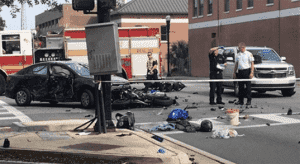
These cases often require police reports, witness statements, photos of vehicle damage, dashcam footage, and medical records to prove fault and damages.
Legal guidance from a Florida Car Accident Lawyer can help protect the claim’s value while recovery remains the priority.
The sections below explain crucial considerations regarding rights, evidence, and claims.
Main Takeaways
- A Florida blind spot car accident lawyer can help preserve evidence, review insurance coverage, and communicate with insurers.
- Liability often depends on lane position, timing, signaling, speed, visibility, witness accounts, and vehicle damage.
- Important evidence includes police reports, photos, dashcam footage, repair records, medical records, and witness information.
- Florida PIP benefits may apply regardless of fault, while liability claims require proof of negligence and qualifying injuries.
- Legal support can help address disputed fault, recorded statements, early settlement offers, and undervalued future medical needs.
How We Can Help With Your Florida Blind Spot Car Accident Injury Claim
After a blind spot collision disrupts a person’s health, income, and daily routine, a Florida car accident injury lawyer can provide focused legal guidance from the earliest stages of the claim. The lawyer may coordinate medical documentation, review available coverage, and communicate with insurers so the injured person and family can focus on recovery and practical needs. Careful representation also includes evidence-preservation tips, such as securing photographs, repair records, dash-camera footage, witness statements, and written notes about pain, limitations, and treatment. These steps help protect the truth before records are lost or memories fade.
A lawyer may also identify insurance claim pitfalls, including recorded statements, premature settlement offers, disputed medical care, and requests that exceed what is necessary. By managing deadlines, evaluating damages, and presenting a well-supported demand, legal counsel serves the client’s long-term welfare while promoting accountability, order, and responsible resolution after a serious roadway event.
Understanding Florida Blind Spot Car Accident Injury Cases


A blind-spot car accident in Florida often occurs when a driver changes lanes, merges, turns, or backs up without detecting a nearby vehicle, motorcycle, bicyclist, or pedestrian. These cases require careful review because visibility limitations do not excuse unsafe driving, yet fault may depend on timing, positioning, and available warnings. Injured people may face medical treatment, lost income, and practical burdens that affect their ability to care for their families and serve their communities.
OUR CONSULTATIONSARE FREE
START YOUR FREE CASE REVIEW

A well-prepared claim examines police reports, witness accounts, vehicle damage, medical records, and, when available, dashcam evidence. This information helps clarify how the collision occurred and whether the injured person’s losses are supported by reliable proof. Florida’s comparative negligence rules may also affect recovery, making accurate documentation especially important. During insurance adjuster negotiations, organized evidence can counter efforts to minimize injury severity, dispute responsibility, or undervalue future needs. Each case should be evaluated with steady attention to fairness and accountability.
Florida Blind Spot Crash — Statistics and Why They Matter
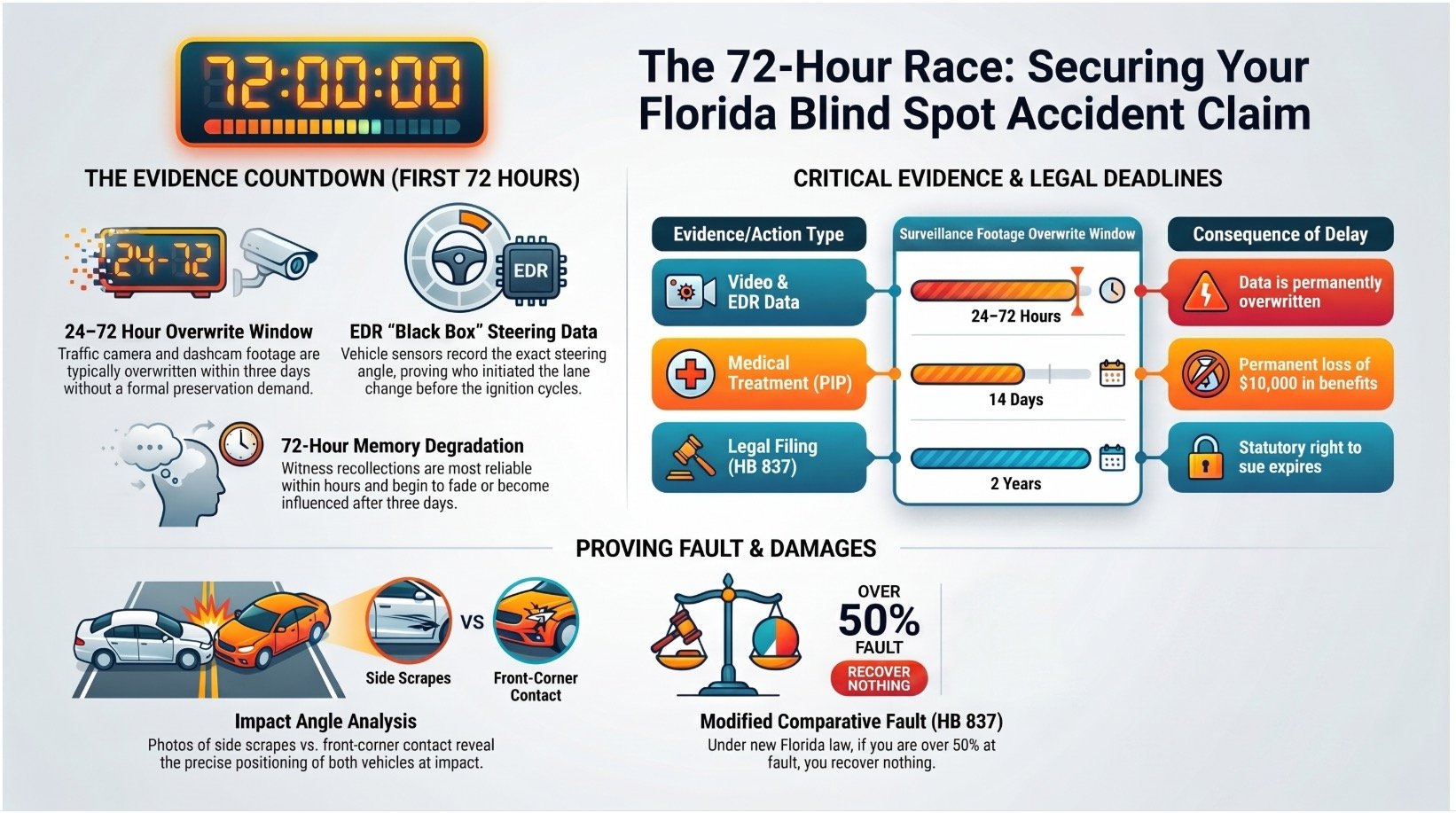
According to the FLHSMV 2022 Florida Traffic Crash Facts, Florida recorded more than 401,523 crashes in 2022, resulting in 3,535 fatalities and more than 253,888 documented injuries. Unsafe lane changes and improper merging are consistently among the most common contributing factors in Florida multi-vehicle crashes, particularly on highways and bridge corridors where traffic moves at speed. In blind-spot collision cases, the evidence that determines who moved where — dashcam footage, vehicle EDR data, and traffic camera recordings — typically exists on an overwrite cycle of just 24 to 72 hours.


Without a formal legal preservation demand, that evidence can be permanently erased before an attorney is even retained. Florida’s filing deadline of two years under HB 837 (2023) may feel distant, but the evidence window closes within days. Prompt legal involvement is the most effective way to lock in the facts that decide these cases.
Florida Blind Spot Crash — The 4 Evidence Windows That Decide Fault
In blind spot disputes, both drivers claim the other moved unsafely. The outcome depends on which evidence survived — and which was lost before anyone sent a preservation demand.
Florida HB 837 (2023) impact on blind spot crash claims: Before March 24, 2023, Florida’s pure comparative fault system allowed recovery even when the injured person shared some blame for the crash. HB 837 converted this to modified comparative fault — if a court finds the injured person more than 50% at fault, they recover nothing. In blind spot cases where both drivers dispute who moved first, insurers now have a direct financial incentive to build a record assigning the injured driver majority fault. Camera footage, EDR steering data, and witness accounts preserved in the first 72 hours are the most effective defense against that strategy.
Common Causes of Florida Blind Spot Car Accidents
Common causes of Florida blind-spot car accidents include improper lane changes, distracted driving, poor mirror adjustment, and limited visibility around large vehicles. These factors can prevent a driver from identifying nearby traffic before merging, turning, or shifting lanes. Understanding these causes helps clarify how negligence may contribute to serious collisions and resulting injury claims.
Improper Lane Changes
Improper lane changes frequently contribute to Florida blind-spot car accidents because a driver may move into an adjacent lane without confirming the space is clear. These incidents often occur on highways, bridges, and multi-lane roads, where traffic patterns shift quickly, and vehicles travel in close proximity. Driver speed mismatch can increase the danger, particularly when a faster vehicle approaches from behind or a slower vehicle enters a lane abruptly. Unsafe merging also poses serious risks when drivers fail to yield, signal, or maintain adequate spacing. For those committed to protecting others on the road, careful lane discipline reflects responsible conduct. A proper lane change requires mirror checks, shoulder checks, and measured timing, reducing preventable collisions and supporting safer travel for Florida motorists and passengers.
Distracted Driver Behavior
Distracted driver behavior often contributes to Florida blind-spot car accidents when attention shifts away from surrounding traffic at the exact moment a lane change, merge, or speed change requires careful judgment. A brief glance at a phone, dashboard screen, navigation device, or roadside event can prevent a driver from recognizing a vehicle traveling beside them. Text message distraction is especially dangerous because it combines visual, manual, and mental inattention, reducing the ability to respond safely. Driver fatigue may also impair focus, slow reaction time, and cause drifting awareness during routine traffic movements. In community-focused injury cases, these behaviors matter because preventable inattention can place passengers, cyclists, motorcyclists, and nearby motorists at serious risk. Careful investigation may reveal patterns of distraction, helping injured people pursue accountability.
Poor Mirror Adjustment
On Florida roads, poor mirror adjustment can contribute to blind spot car accidents by limiting a driver’s view of adjacent lanes during merging, lane changes, and turns. When side mirrors are angled too far inward, they often reflect the vehicle’s own body rather than traffic beside it. If angled too far outward, they may reduce awareness of nearby vehicles approaching from behind. Proper mirror visibility supports safer decisions, especially when drivers must quickly and responsibly evaluate surrounding traffic. Lane positioning also affects what mirrors reveal, since drifting within a lane can expand or narrow blind areas. Drivers who fail to check and adjust mirrors before travel may overlook motorcycles, passenger cars, cyclists, or emergency responders. Careful mirror use helps protect others and supports safer roadway conduct.
Large Vehicle Blindness
Because commercial trucks, buses, and other large vehicles have extended blind zones, drivers may fail to see smaller vehicles traveling beside, behind, or directly in front of them. These visibility gaps become especially dangerous during lane changes, turns, merging, and sudden braking. In Florida traffic, large-vehicle blindness can place motorists, cyclists, and pedestrians at serious risk when professional drivers fail to use mirrors, cameras, signals, and careful observation. Driver fatigue may further reduce attention, reaction time, and judgment, increasing the chance that a nearby vehicle remains unnoticed. When a car is hidden beneath or near a truck’s rear or side area, underride collisions can occur, often causing severe injury. Responsible operation requires constant awareness, proper training, and a duty to protect everyone sharing the road.
Legal Rights of Florida Blind Spot Car Accident Injury Victims
When a blind-spot collision causes injury, Florida law provides injured people with several avenues to seek compensation and protect their interests. These rights may support medical recovery, wage replacement, and accountability when another driver’s conduct caused preventable harm.
- Insurance benefits: Injured persons may seek available personal injury protection benefits, regardless of fault, subject to policy limits and statutory requirements.
- Liability claims: When injuries meet Florida’s serious injury threshold, injured persons may pursue damages against a negligent driver, provided evidence satisfies applicable causation standards.
- Damages recovery: Compensation may include medical expenses, lost income, reduced earning capacity, pain, suffering, and other losses supported by records and testimony.
- Litigation rights: If a fair resolution is not reached, trial preparation may preserve witness accounts, expert opinions, and documentation for court.
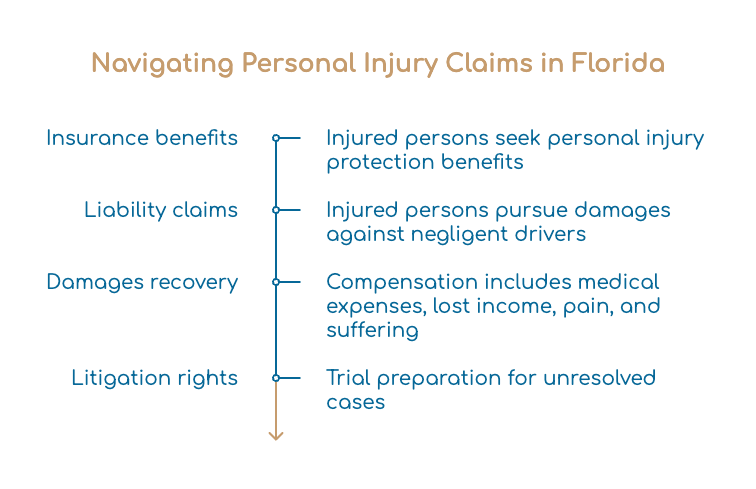
These protections help injured people restore stability while ensuring that responsible parties are held accountable through lawful, service-centered advocacy.
Why Do Florida Blind Spot Car Accident Injuries Happen?
Although blind-spot collisions are often described as sudden, they usually result from identifiable driving errors, limited visibility, or poor roadway judgment. In Florida traffic, these injuries often occur when drivers change lanes without careful mirror use, fail to signal, or assume nearby vehicles have cleared. Larger vehicles, including trucks, vans, and SUVs, create wider hidden zones, placing smaller cars, motorcycles, cyclists, and pedestrians at greater risk.
Other contributing factors may include distracted driving, speeding, fatigue, aggressive merging, and improper use of driver-assistance technology. Poor weather, glare, heavy congestion, and unfamiliar roads can further reduce awareness. A disciplined safety checklist, including mirror adjustment, shoulder checks, signaling, and controlled lane movement, helps prevent these collisions and protects others on the road.
When injuries occur, the cause may later be evaluated through vehicle damage, witness accounts, roadway conditions, and medical documentation, which can help clarify how the collision affected the injured person.
What Should You Do After a Florida Blind Spot Car Accident Injury?
After a Florida blind-spot car accident, an injured person should seek immediate medical care, even if symptoms appear minor. The crash should also be documented through photographs, witness information, police reports, and other evidence that may help establish fault. Because insurance and liability issues can become complicated, contacting a lawyer promptly may help protect the injured person’s rights and the value of the claim.
Seek Immediate Medical Care
Following a Florida blind spot car accident, immediate medical care is essential, even if injuries appear minor at the scene. A prompt evaluation helps identify concussions, internal injuries, soft tissue damage, and delayed pain that may worsen without treatment. Bystanders or caregivers assisting an injured person should follow an emergency response checklist, including calling 911, keeping the person still when serious injury is suspected, and monitoring breathing until help arrives. Safety equipment guidance should also be respected, especially when removing helmets, seat belts, or child restraints could aggravate trauma.
Medical providers create a record of symptoms, diagnosis, and recommended care, which supports both recovery and accountability. Delaying treatment can endanger health and make it harder to connect injuries to the crash. Early care serves the injured person’s long-term well-being.
Document the Crash
At the crash scene, careful documentation can preserve important details before vehicles are moved, debris is cleared, or witnesses leave. An injured person, when safely able, should photograph the vehicle positions, blind spots, skid marks, traffic signals, lane markings, mirrors, damage, weather conditions, and visible injuries. Roadside evidence preservation also includes preserving damaged personal items, dashcam footage, and insurance information exchanged between drivers.
Witness identification tips include requesting names, phone numbers, email addresses, and brief observations from anyone who saw the lane change, merge, or impact. A calm, respectful approach may encourage cooperation, especially when bystanders want to help those who have been harmed. Notes should record the time, location, responding agency, and officer names. These details can support accurate reporting and clarify how the blind-spot collision occurred.
Contact a Lawyer
Once the crash has been documented and immediate medical needs have been addressed, an injured person should consider contacting a Florida blind-spot car accident injury lawyer as promptly as possible. Legal guidance can help protect the injured person’s interests while allowing family members, caregivers, or advocates to focus on support and recovery. A lawyer may assess liability, identify available insurance coverage, and explain practical insurance claim tips before statements or forms are submitted.
Early representation also supports the preservation of evidence, including vehicle data, witness accounts, traffic camera footage, photographs, and repair records. These materials may become harder to obtain as time passes. A lawyer can communicate with insurers, track deadlines, and help ensure that the claim reflects medical needs, lost income, and long-term effects of the injury.
Critical Evidence in a Florida Blind Spot Car Accident Injury Case
Critical evidence can determine how fault is evaluated after a Florida blind spot car accident, especially when lane position, visibility, and driver conduct are disputed. Key materials often include: (1) Police Crash Reports, (2) Vehicle Damage Photos, (3) Witness Statements, (4) Traffic Camera Footage. Each item may help establish the sequence of events, support injury claims, and address allegations raised by insurers or opposing parties.
Police Crash Reports
When a blind-spot collision occurs, the police crash report is often among the first documents used to evaluate how the accident happened and who may be responsible. In Florida, this report may identify drivers, witnesses, roadway conditions, citations, and the officer’s observations. For injured people and those assisting them, it can guide early decisions about care, claims, and accountability. The report may support proof of damages when paired with medical records, employment information, and other reliable documentation. Because crash reports can contain protected personal details, access may be limited under privacy laws during certain periods. They also play a practical role in insurance reporting, helping carriers open claims and assess fault. Although not conclusive, a police crash report can provide a structured foundation for further investigation.
Vehicle Damage Photos
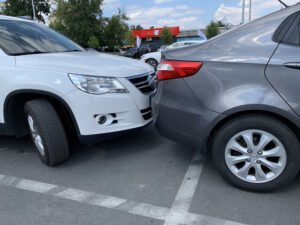
Vehicle damage photos can strengthen or challenge the account reflected in a police crash report by showing the physical consequences of the impact in a clear, visual form. In a Florida blind-spot collision, images of scrapes, dents, crushed panels, mirror damage, and paint transfer may help clarify vehicle positioning, direction of travel, and the severity of the contact. These photographs often support a negligence claim by linking observable damage to an unsafe lane change or a failure to maintain awareness. They also help identify liability factors, including impact angle, point of contact, and whether both vehicles were moving in a manner consistent with the reported events.
Prompt, organized photography can preserve details before repairs occur. For injured individuals seeking a fair resolution, this evidence can help legal representatives present facts accurately and responsibly in a claim or lawsuit.
Witness Statements
Because blind-spot collisions often involve competing accounts of lane position and driver awareness, witness statements can provide important context that physical evidence alone may not fully capture. Neutral observers may describe signaling, speed, merging behavior, evasive actions, or statements made immediately after impact. Their accounts can help clarify whether a driver checked their mirrors, drifted out of their lane, or failed to yield adequate space.
Eyewitness credibility depends on factors such as vantage point, attention, consistency, and freedom from bias. Promptly obtained recorded statements may preserve details before memories fade or outside influences affect recollection. In a Florida injury case, carefully documented witness information can support a fair evaluation of fault, assist insurers, and help legal representatives serve injured individuals with accuracy, diligence, and respect for the truth.
Traffic Camera Footage
At busy intersections, highway ramps, and commercial corridors, traffic camera footage may provide a clear visual record of how a blind spot collision occurred. This evidence can show lane position, turn signals, speed changes, braking, and whether a driver failed to check before merging or changing lanes. In Florida injury claims, surveillance footage may also confirm the timing of the crash and identify nearby vehicles or roadway conditions that affected safety.
Prompt action is often necessary because agencies, businesses, or transportation departments may retain recordings for limited periods. An attorney may request and preserve footage before it is overwritten. When reviewed alongside police reports, vehicle damage, and witness statements, camera evidence can support an accurate determination of liability and help injured persons pursue fair compensation with integrity and care.
Long-Term Effects of Florida Blind Spot Car Accident Injuries
Florida blind spot car accidents may cause lasting injuries that extend well beyond the initial medical treatment and insurance claim. Chronic pain complications, reduced mobility, and emotional trauma can interfere with employment, daily activities, and overall quality of life. These long-term effects often require careful documentation, medical evaluation, and legal consideration when judging the full value of an injury claim.
Chronic Pain Complications
After a blind spot collision, chronic pain may become one of the most disruptive long-term complications for injured motorists, passengers, bicyclists, or pedestrians. What first appears to be short-term pain can persist when soft tissues, joints, discs, or nerves do not heal properly. In Florida injury claims, these symptoms may require careful documentation because ongoing pain can affect employment, caregiving duties, and the ability to serve family or community responsibilities. According to the Mayo Clinic, traumatic brain injuries — which can occur in side-impact blind spot collisions — may produce cognitive difficulties, mood changes, headaches, and fatigue that persist well beyond the initial treatment period.
Chronic pain complications may include headaches, back pain, neck pain, radiating limb pain, and nerve damage, which can cause burning, tingling, or hypersensitivity. Physicians may recommend imaging, medication, injections, therapy, or specialist care to manage symptoms. A legal evaluation may consider future treatment needs, pain severity, and the lasting effect on daily stability.
Reduced Mobility
Reduced mobility can greatly limit a person’s independence after a blind-spot collision, particularly when injuries affect the spine, hips, knees, ankles, shoulders, or major muscle groups. Daily service-oriented tasks, such as caregiving, transportation, household maintenance, and volunteer commitments, may become difficult or impossible without assistance. Medical records, rehabilitation plans, mobility evaluations, and physician statements often help clarify the lasting impact of these limitations. In a Florida injury claim, settlement negotiation tactics may address future therapy, assistive devices, home modifications, and reduced work capacity.
However, insurers may dispute the extent of impairment, especially when surveillance or activity records appear inconsistent. Witness credibility issues can also influence how limitations are perceived, making accurate documentation by caregivers, employers, and treatment providers vital to clearly presenting reduced mobility.
Emotional Trauma Effects
In the months following a blind spot collision, emotional trauma may persist long after physical injuries begin to recover. Survivors may experience anxiety, sleep disruption, depression, irritability, or fear of driving, limiting their ability to work, care for family, and serve others consistently. These effects can strain relationships and reduce participation in community, faith, or volunteer responsibilities. When crashes cause catastrophic harm, families pursuing wrongful death claims may also confront grief, guilt, and ongoing distress tied to sudden loss. Emotional injuries often contribute to long-term financial losses through missed work, therapy costs, reduced productivity, and diminished earning capacity. Careful documentation of counseling, diagnoses, medications, and daily limitations can help show how psychological harm affects recovery, stability, and future needs after a Florida blind spot accident.
Proving Liability in Florida Blind Spot Car Accident Injury Cases
Because blind spot crashes often involve conflicting accounts of lane position, speed, and visibility, proving liability in a Florida injury case requires a careful review of the available evidence. Investigators may examine police reports, vehicle damage, roadway markings, traffic camera footage, dash camera recordings, and witness statements to determine whether a driver failed to check mirrors, signal, or maintain a safe lane change.
Accident reconstruction may help clarify how the collision occurred, especially when comparative fault disputes arise between drivers. A careful legal review can identify whether negligence involved distracted driving, speeding, unsafe merging, or failure to yield. Medical records also support the connection between the crash and the injured person’s losses.
For those committed to serving injured individuals, strong evidence protects fairness and accountability. Well-organized proof may strengthen settlement leverage strategies by clearly demonstrating responsibility, preserving critical facts, and reducing uncertainty about how the blind-spot collision caused harm.
Dealing With Insurance Companies After a Florida Blind Spot Car Accident Injury
Once liability evidence is organized, the focus often shifts to how insurance companies evaluate the claim and respond to requests for compensation. Adjusters may review medical records, repair estimates, photographs, witness statements, and policy limits to seek grounds to reduce payment. A careful presentation can help ensure that the injured person’s losses are fully considered, including treatment needs, lost wages, pain, and long-term limitations.
Insurers may request an independent medical evaluation, especially when injuries are disputed or ongoing care appears costly. Such examinations should be approached with accuracy and preparation, since findings may influence settlement discussions. Claims involving safety equipment failure, such as defective mirrors, sensors, cameras, or warning systems, may also require additional documentation to show how the failure contributed to the crash.
Those assisting an injured person should encourage consistent communication, the preservation of records, and cautious responses to recorded statements, because insurance representatives serve the carrier’s financial interests rather than the claimant’s recovery.
Florida No-Fault Insurance and Blind Spot Crash Claims
Florida requires all registered vehicles to carry at least $10,000 in personal injury protection (PIP) coverage. PIP benefits apply regardless of who caused the crash, providing 80% of medical bills and 60% of lost wages — but only when the injured person seeks treatment within 14 days of the accident. In blind spot cases where fault may be disputed for weeks or months, PIP is typically the only immediate source of medical payment while the liability fight between competing insurers plays out.
Both drivers in a blind-spot collision file PIP claims with their own insurers first. If injuries meet Florida’s serious injury threshold — permanent injury, significant and permanent disfigurement, or death — the injured person may step outside the no-fault system and pursue a direct liability claim against the at-fault driver. When the at-fault driver is underinsured or uninsured, the injured person’s own uninsured motorist coverage may provide an additional avenue for recovery. An attorney can help identify which policies apply, ensure the 14-day PIP deadline is met, and protect access to all available coverage sources from the outset.
Event Data Recorder Evidence in Florida Blind Spot Crash Cases
Most vehicles manufactured after 2012 contain an event data recorder (EDR), commonly called a black box, that captures speed, braking force, throttle position, steering angle, and seat-belt status in the seconds before and during a collision. In blind-spot cases, EDR steering-angle data is particularly valuable — it can reconstruct exactly who initiated the lane change, directly resolving the “he said / she said” dispute that these crashes typically produce. The National Highway Traffic Safety Administration (NHTSA) maintains detailed guidance on EDR regulations and the specific data parameters these devices record.
EDR data can be silently overwritten the next time the vehicle’s ignition is turned on after the crash. If the vehicle is drivable and moved from the scene by either driver, or if a tow operator starts the engine during recovery, the recording may be lost permanently. We send formal preservation demands immediately upon being retained and work with certified EDR specialists to extract recordings before they are overwritten or the vehicle is repaired. In blind spot cases where fault is fiercely disputed, EDR evidence often provides the most decisive and objective resolution available.
What to Expect During a Florida Blind Spot Car Accident Injury Claim Process
A Florida blind spot car accident injury claim typically begins with an initial evaluation of liability, damages, and available insurance coverage. The process then moves through evidence collection, including crash reports, medical records, witness statements, and vehicle damage documentation, followed by structured negotiations with the insurer. If a fair settlement cannot be reached, the claim may proceed toward litigation, where fault and compensation are addressed through the court process.
Initial Claim Evaluation
During the initial claim evaluation, a Florida blind spot car accident injury lawyer reviews the collision facts, available evidence, injury details, and insurance coverage to determine the strength and likely direction of the claim. This assessment helps identify responsible parties, applicable policy limits, and immediate legal concerns that may affect recovery. The lawyer also considers whether the injured person received timely medical treatment, since consistent care often supports both wellness and claim credibility. Bills and documentation are reviewed to understand current financial losses and anticipate future needs. In service to the injured client, the evaluation should clarify priorities, reduce uncertainty, and guide informed decisions. It also allows the lawyer to explain potential challenges, reasonable expectations, and the next steps without overstating outcomes or delaying necessary action.
Evidence Collection Process
Because blind-spot collisions often involve disputed lane positions and driver awareness, the evidence collection process typically begins by securing materials that show how the crash occurred. This may include police reports, scene photographs, vehicle damage images, surveillance footage, dash camera recordings, and witness statements. An attorney may also review roadway markings, traffic controls, and vehicle safety features to clarify visibility issues. Medical documentation is gathered to connect the collision to the claimant’s injuries, treatment needs, and functional limitations.
This record may include emergency care notes, diagnostic results, therapy reports, and physician opinions. Organized evidence helps present the claim responsibly, supporting fair evaluation before insurance negotiations begin. Careful collection also serves the broader purpose of accountability, helping protect injured people and encouraging safer conduct on Florida roads.
Insurance Negotiation Steps
Once the evidence has been organized, insurance negotiation usually begins with notice of the claim and a careful presentation of liability, injuries, and damages. The insurer reviews police reports, medical records, photographs, repair estimates, and witness statements to evaluate responsibility and loss. In a Florida blind spot collision, the adjuster may examine lane position, turn signals, mirror use, and comparative fault. Counsel may then submit a demand package identifying medical expenses, lost income, future care needs, and applicable bodily injury coverage.
The insurer may request clarification, seek recorded statements, or issue a lower evaluation. Each response should be measured, accurate, and supported by documentation. The settlement timeline often depends on medical stability, coverage limits, and the insurer’s review practices, requiring patience, diligence, and disciplined communication throughout the claim.
Settlement or Litigation
If negotiations do not yield a fair resolution, a Florida blind-spot car accident injury claim may proceed to litigation to preserve the injured person’s right to pursue compensation. Litigation may begin with filing a complaint, serving the defendant, and exchanging evidence through discovery. The court process can clarify fault determination, especially when lane changes, mirror use, vehicle positioning, and witness accounts are disputed. Insurance negotiation may still continue after a lawsuit is filed, because settlement discussions often progress as evidence becomes stronger. A lawyer may evaluate medical records, crash reports, expert opinions, and damages to advise whether settlement serves the client’s interests. If a fair agreement remains unavailable, the case may proceed to mediation, hearings, or trial, where a judge or jury determines liability and compensation.
Compensation for Florida Blind Spot Car Accident Injury Damages
After a blind spot collision in Florida, an injured person may seek compensation for losses that can be proven through medical records, financial documentation, expert analysis, and evidence of how the crash occurred. Compensation may cover emergency care, follow-up treatment, rehabilitation, lost income, reduced work capacity, vehicle damage, and other documented consequences resulting from the collision.
A lawyer may evaluate liability by reviewing lane-change behavior, mirror use, turn-signal timing, camera footage, witness accounts, and crash reconstruction findings. This review can determine whether a driver, trucking company, rideshare operator, or other party failed to exercise reasonable care. Accurate documentation helps preserve accountability and recovery rights. Results may vary. Prior results do not guarantee a similar outcome.
Economic vs. Non-Economic Damages in Florida Blind Spot Car Accident Cases
In Florida blind spot car accident cases, damages are generally divided into economic losses and non-economic harms. Economic damages address measurable financial losses, while non-economic damages account for the human impact of injuries, such as pain, suffering, and reduced quality of life. Proving both categories requires clear documentation, credible evidence, and a careful presentation of how the crash affected the injured person’s life.
Economic Damages Explained
When a blind-spot crash causes injury, economic damages are the measurable financial losses resulting from the accident. These losses may include emergency care, hospital bills, surgery, rehabilitation, prescription costs, medical equipment, and future treatment needs. They may also include lost wages, reduced earning capacity, transportation expenses, and necessary household assistance during recovery. In Florida cases, careful documentation of medical treatment helps link each expense to the crash, allowing insurers, attorneys, and courts to evaluate the claim accurately. The insurance claim timeline can affect how quickly bills, wage records, and repair estimates must be gathered and submitted. For those committed to helping injured people regain stability, identifying economic damages with precision supports fair compensation and preserves resources needed for health, work, and daily obligations.
Non-Economic Damages Explained
Although economic losses can be demonstrated through bills and wage records, non-economic damages address the personal harm that cannot be measured with receipts alone. In Florida blind-spot collision cases, these damages may include pain, emotional distress, loss of enjoyment of life, inconvenience, and the burden on family relationships. Such harm often affects how an injured person serves relatives, coworkers, and the wider community, especially when daily activities become limited. Non-economic damages are not determined by a simple invoice; their value depends on the severity, duration, and effects of the injury. Insurance claim timelines may influence when these losses are evaluated, while comparative fault disputes can affect the amount ultimately recoverable. A thorough review helps ensure intangible suffering is treated with dignity and legal seriousness.
Proving Florida Damages
For Florida blind spot car accident claims, proving damages requires more than showing that a crash occurred. Injured people must document how the collision changed health, income, mobility, and daily responsibilities. Medical records link injuries to the event, while bills, wage statements, and repair estimates document economic losses in measurable detail. Non-economic harm, including pain, emotional strain, and reduced quality of life, may require testimony from physicians, caregivers, or family members who observed the impact.
Careful documentation also supports proving negligence, because damages must relate to the at-fault driver’s unsafe conduct. Florida claimants must remain attentive to insurance timelines, reporting requirements, and deadlines that can affect recovery. A well-prepared damages presentation helps insurers, judges, and juries understand the full extent of the loss.
When a Florida Blind Spot Car Accident Injury Case Goes to Trial vs. Settlement
Resolution of a Florida blind spot car accident injury case depends on the strength of the evidence, the severity of the injuries, the available insurance coverage, and the willingness of each party to accept a fair outcome. Many cases settle when medical records, witness statements, vehicle damage, and expert opinions clearly establish liability and support a reliable calculation of damages. Settlement can reduce delay, protect injured people from uncertainty, and allow caregivers or family members to focus on recovery and service to the household.
Trial may become necessary when an insurer disputes fault, minimizes injuries, or relies on comparative negligence to reduce responsibility. A trial allows a judge or jury to evaluate testimony, review exhibits, and decide disputed issues. The process can provide accountability, but it often requires more time, preparation, and emotional endurance. Careful legal evaluation helps determine whether settlement discussions or trial presentation best serves the injured person’s long-term needs and interests.
Florida Laws That May Affect Your Florida Blind Spot Car Accident Case
Because blind spot collisions often involve disputed lane changes, merging movements, and driver visibility, several Florida laws can shape the outcome of an injury claim. These rules help determine responsibility, available compensation, and the evidence needed to support an injured person’s recovery fairly.
Florida blind-spot crashes often hinge on lane safety, visibility, and evidence of who had the right to move.
- Comparative negligence: Florida allows fault to be apportioned among the parties involved. If an injured person shares responsibility, compensation may be reduced according to that percentage.
- Traffic lane duties: Drivers must change lanes only when it is safe. Signals, mirrors, speed, and surrounding traffic may all be reviewed.
- Insurance requirements: Florida’s no-fault system may require initial medical benefits through personal injury protection, though serious injuries can support claims against the at-fault driver.
- Damage caps: Most standard car accident claims are not subject to broad damage caps, but certain claims or defendants may be subject to limits. Careful legal review can protect the injured party’s interests.
The Statute of Limitations for Florida Blind Spot Car Accident Injury Cases
When a blind-spot collision causes injuries in Florida, the statute of limitations imposes a strict deadline for filing a lawsuit against the responsible party. For most negligence-based car accident injury cases, Florida generally allows two years from the date of the crash to begin a personal injury action under the tort reform provisions of Florida HB 837, effective March 24, 2023. Missing this deadline can prevent an injured person from seeking compensation through the courts, regardless of the severity of the harm.
This filing period is separate from insurance deadlines, which may require prompt notice, documentation, and cooperation. Insurance claim denials do not usually extend the time to file a lawsuit, so delay can create serious consequences. Comparative negligence may also affect the value of a claim if the injured person is alleged to share fault for the blind spot crash. Those assisting injured individuals should recognize that timely action protects legal rights, preserves evidence, and supports a fair evaluation of responsibility under Florida law.
How a Florida Blind Spot Car Accident Injury Lawyer Can Help You
After a blind-spot collision, a Florida car accident injury lawyer can help evaluate liability, identify available insurance coverage, and protect the injured person’s claim against early mistakes.
This guidance supports fair treatment while helping families focus on recovery, service, and practical responsibilities.
- Investigating fault: The lawyer may review crash reports, vehicle damage, witness statements, and camera footage to determine whether unsafe lane changes, speeding, or distraction contributed.
- Managing insurance issues: Counsel can monitor insurance claim timelines, prepare required documentation, and respond to insurer requests without weakening the claim.
- Valuing damages: A lawyer may assess medical expenses, lost income, reduced earning ability, pain, and future care needs with careful attention to evidence.
- Pursuing resolution: Using a negotiation strategy grounded in case facts, counsel can communicate with insurers, address disputed liability, and seek compensation that reflects the injured person’s losses and long-term needs.
When to Contact a Florida Blind Spot Car Accident Injury Lawyer
Timely legal guidance can make a significant difference in a blind-spot accident claim, particularly when fault, insurance coverage, or medical recovery remains uncertain. An injured person should consider contacting a Florida blind spot car accident injury lawyer soon after receiving emergency care, reporting the crash, and notifying the insurer. Early contact may help preserve traffic camera evidence, vehicle damage records, and roadway details before they are lost or altered.
Prompt assistance is also important when insurance claim timelines are approaching, injuries require ongoing treatment, or the insurer requests recorded statements. A lawyer may help organize medical documentation requirements so treatment, diagnoses, and limitations are clearly supported. Contact is especially appropriate when multiple drivers dispute responsibility, a commercial vehicle is involved, or an insurer questions the seriousness of the injuries. Early review may also support the assessment of witness credibility, allowing helpful accounts to be identified while memories remain reliable and service to the injured person remains focused.
Why You Need an Experienced Florida Blind Spot Car Accident Injury Lawyer
Because blind-spot collisions often involve disputed lane changes, incomplete witness accounts, and conflicting insurance narratives, experienced legal representation can be important in protecting an injured person’s claim. A Florida blind spot car accident injury lawyer can evaluate crash facts, review police reports, locate roadway or vehicle evidence, and address insurer efforts to shift blame onto the injured driver.
Experience also matters when injuries affect a person’s ability to work, care for family, or serve the community. A lawyer can connect liability evidence with detailed medical records, helping show how the collision caused specific injuries and future needs. This careful documentation may support claims for medical expenses, lost income, pain, and reduced quality of life.
Insurance coverage limits can also shape recovery strategy. When available coverage is limited, counsel may examine multiple policies, uninsured motorist benefits, commercial coverage, or other responsible parties. This focused advocacy helps preserve the claim and pursue fair compensation under Florida law.
How to Choose the Right Florida Blind Spot Car Accident Injury Lawyer for Your Case
When selecting a Florida blind spot car accident injury lawyer, an injured person should look for counsel with specific experience handling lane-change collisions, disputed liability, and insurance defense tactics. The right attorney should understand how blind spot crashes occur, how to evaluate vehicle positions, and how to use police reports, witness statements, photographs, and expert analysis to build a reliable claim.
A careful choice also involves reviewing communication practices, case preparation, and willingness to address the client’s broader needs with respect and diligence. Comparative fault considerations are especially important in Florida because insurers may argue that the injured person shared responsibility. A qualified lawyer should explain these risks clearly and prepare evidence to reduce unfair blame.
Effective settlement strategy planning is another significant factor. Counsel should assess medical records, lost income, future care needs, and pain-related losses before negotiations begin. This disciplined approach helps protect the injured person’s interests and supports a just recovery.
About The Law Offices of Anidjar & Levine
Founded in 2005 by Marc Anidjar and Glen Levine, the firm began as a two-person operation working out of a construction office conference room. Over the past 20 years, that modest start has grown into one of Florida’s most recognized personal injury practices — with more than $1 billion recovered in settlements for injury clients across the state. We bring that same determination and depth of experience to every case we handle.
The Law Offices of Anidjar & Levine represents injured people throughout Florida in motor vehicle accident claims, including cases involving blind spot collisions, unsafe lane changes, and disputed fault. The firm’s attorneys investigate crashes, gather evidence, communicate with insurers, and pursue compensation for medical expenses, lost income, property damage, and pain and suffering.
As a local legal team, the firm understands Florida traffic laws, insurance practices, and the practical burdens accident clients may face after a collision. Its approach emphasizes compassionate representation, clear communication, and attentive case management for clients who need guidance during a difficult period.
The firm also assists clients by arranging medical care, tracking case deadlines, reviewing settlement offers, and preparing claims for litigation when necessary. Through disciplined advocacy and service-focused support, The Law Offices of Anidjar & Levine seeks to protect injured clients’ rights while helping them move toward recovery with confidence and dignity after serious crashes.
Frequently Asked Questions
Can Blind Spot Accidents Involve Rideshare Drivers in Florida?
Yes, blind spot accidents can involve rideshare drivers in Florida. Such crashes may occur when Uber or Lyft drivers merge, change lanes, or pick up passengers without proper observation. Rideshare liability depends on driver status, app activity, and available insurance coverage. Florida traffic laws require careful lane changes and reasonable vigilance. Those assisting injured individuals should document evidence, identify the applicable policies, and evaluate whether the driver, the company, or another motorist bears responsibility.
Do Blind Spot Monitoring Systems Affect Accident Claims?
Yes, blind spot monitoring systems can affect accident claims by shaping evidence regarding lane-change timing, driver perception, and reasonable care. Their alerts may support or weaken accounts of negligence, depending on data, visibility, and driver response. They do not replace safe driving duties. In cases involving traffic signal failures, intersection negligence, or merging conflicts, investigators may review system records to serve injured parties through accurate fault analysis and responsible accountability.
Can Truck Blind Spots Make Cases More Complicated?
Yes, truck blind spots can complicate cases because visibility gaps often create legal evidence challenges and disputed liability for lane changes. Investigators may need driver logs, camera data, witness accounts, and expert analysis. Trucking regulations can affect fault, especially when the use of mirrors, training, or safety procedures is questioned. Insurance negotiations may become more difficult, requiring careful documentation so injured people and those assisting them can pursue fair accountability.
Are Motorcycle Riders More Vulnerable in Blind Spot Crashes?
Yes, motorcycle riders are more vulnerable to blind-spot crashes because they lack structural protection and are harder for drivers to detect. Impact injuries may include fractures, head trauma, spinal harm, and severe road rash. Those assisting injured riders should understand that visibility, driver caution, lane positioning, and vehicle size affect legal liability. Careful review of the evidence helps determine whether a driver failed to check mirrors, signal, or yield safely.
Can Dashcam Footage Help Prove a Blind Spot Accident?
Yes, dashcam footage can help prove a blind spot accident by showing lane position, signaling, speed, and the moments before impact. Its value is strongest when the recording clearly captures vehicle movement and driver conduct. As insurance evidence, it may support fault analysis and challenge inaccurate statements. Those assisting injured people should promptly preserve the video, document its source, and provide it to qualified legal or claims professionals.
Does Florida PIP Insurance Cover Injuries in a Blind Spot Accident?
Yes. Florida’s personal injury protection (PIP) coverage applies regardless of fault, including blind spot crashes where fault is disputed. PIP covers 80% of reasonable medical expenses and 60% of lost wages, up to the $10,000 minimum. Treatment must begin within 14 days of the accident. When injuries meet Florida’s serious injury threshold — permanent injury, significant and permanent disfigurement, or death — a separate liability claim against the at-fault driver may also be available. An attorney can help identify which policies apply and ensure PIP deadlines are met.
Can a Vehicle’s Black Box (EDR) Help Prove Fault in a Blind Spot Crash?
Yes. Most vehicles manufactured after 2012 contain an event data recorder (EDR) that captures pre-crash speed, braking, steering angle, throttle position, and seat-belt status. In blind-spot cases, EDR steering data can precisely reconstruct who initiated the lane change — directly resolving disputes about which driver moved unsafely. EDR data can be overwritten the next time the ignition is turned on after the crash, so formal preservation demands must be sent immediately. Attorneys work with certified EDR specialists to extract the recording before it is lost.
Blind spot collisions can leave injured motorists facing medical costs, lost income, and significant uncertainty. A Florida Car Accident Lawyer can evaluate liability, protect the injured person’s rights, and pursue compensation through insurance claims or litigation. Timely legal guidance may help preserve evidence and strengthen the case.
The Law Offices of Anidjar & Levine can provide knowledgeable representation to injured motorists seeking accountability and financial recovery after a serious blind-spot accident in Florida. Results may vary. Prior results do not guarantee a similar outcome.