A Daytona Beach Home Depot truck accident lawyer can investigate liability, preserve evidence, and pursue compensation for injured victims. Potentially responsible parties may include the driver, employer, contractor, vehicle owner, or insurer.
The Law Offices of Anidjar and Levine can help obtain collision reports, photographs, witness accounts, maintenance records, driver logs, medical documentation, and other evidence.
Representation may also address denied claims, lost income, property damage, future care, and comparative negligence.
For additional information, visit an experienced Daytona Beach Truck Accident Lawyer to learn about legal rights, immediate steps, and available assistance.
Main Takeaways
- A Daytona Beach Home Depot truck accident lawyer can investigate liability involving the driver, employer, contractor, vehicle owner, and insurers.
- Legal support may include preserving accident evidence, reviewing reports and photographs, and obtaining witness statements, surveillance, maintenance records, and driver logs.
- Potential compensation may cover medical expenses, lost income, property damage, pain and suffering, and other collision-related losses.
- Seek medical attention promptly, document scene conditions and injuries, preserve witness information, and avoid altering relevant evidence.
- An attorney can address disputed fault, insurance denials, comparative negligence issues, and potential wrongful death claims for eligible families.
How We Can Help With Your Daytona Beach Home Depot Truck Accident Injury Claim
When a truck accident occurs at or near a Daytona Beach Home Depot, an experienced personal injury attorney can help determine who is legally responsible and protect the injured person’s right to seek compensation. Legal counsel can organize medical records, incident reports, photographs, witness statements, and other evidence needed to present a clear injury claim. The attorney may communicate with insurers, employers, contractors, and their representatives, allowing the injured person to focus on treatment and recovery.
If an insurance claim denial occurs, counsel can review the stated reasons, identify supporting policy provisions, and pursue an appropriate response. Representation may also help account for medical expenses, lost income, property damage, and other legally recognized losses without making unsupported demands. Through careful preparation and settlement negotiation tactics, the attorney can seek a fair resolution while evaluating whether further legal action is necessary. This service reflects a commitment to protecting injured community members and helping them work through a difficult process with informed, responsible guidance.
Understanding Daytona Beach Home Depot Truck Accident Injury Cases


Daytona Beach Home Depot truck accident injury cases often involve multiple parties, overlapping insurance policies, and questions about how the collision occurred. A case may include the injured person, commercial drivers, employers, contractors, vehicle owners, insurers, and other entities with potential legal responsibilities. Determining which parties may be accountable requires careful review of employment relationships, delivery arrangements, vehicle ownership, and applicable contracts.
OUR CONSULTATIONSARE FREE
START YOUR FREE CASE REVIEW

Medical documentation is central to evaluating injuries, treatment needs, lost income, and possible long-term limitations. Witness accounts, photographs, surveillance footage, collision reports, electronic records, and vehicle data may also clarify the events and support liability. Prompt evidence preservation, including requests for business and transportation records, can help prevent important information from being lost or altered.
An effective Insurance claim strategy considers coverage limits, competing claims, recorded statements, and settlement timing. The process should also account for the injured person’s immediate needs and future care. Careful legal evaluation helps present the claim accurately while protecting the individual’s opportunity to pursue appropriate compensation.
Common Causes of Daytona Beach Home Depot Truck Accident


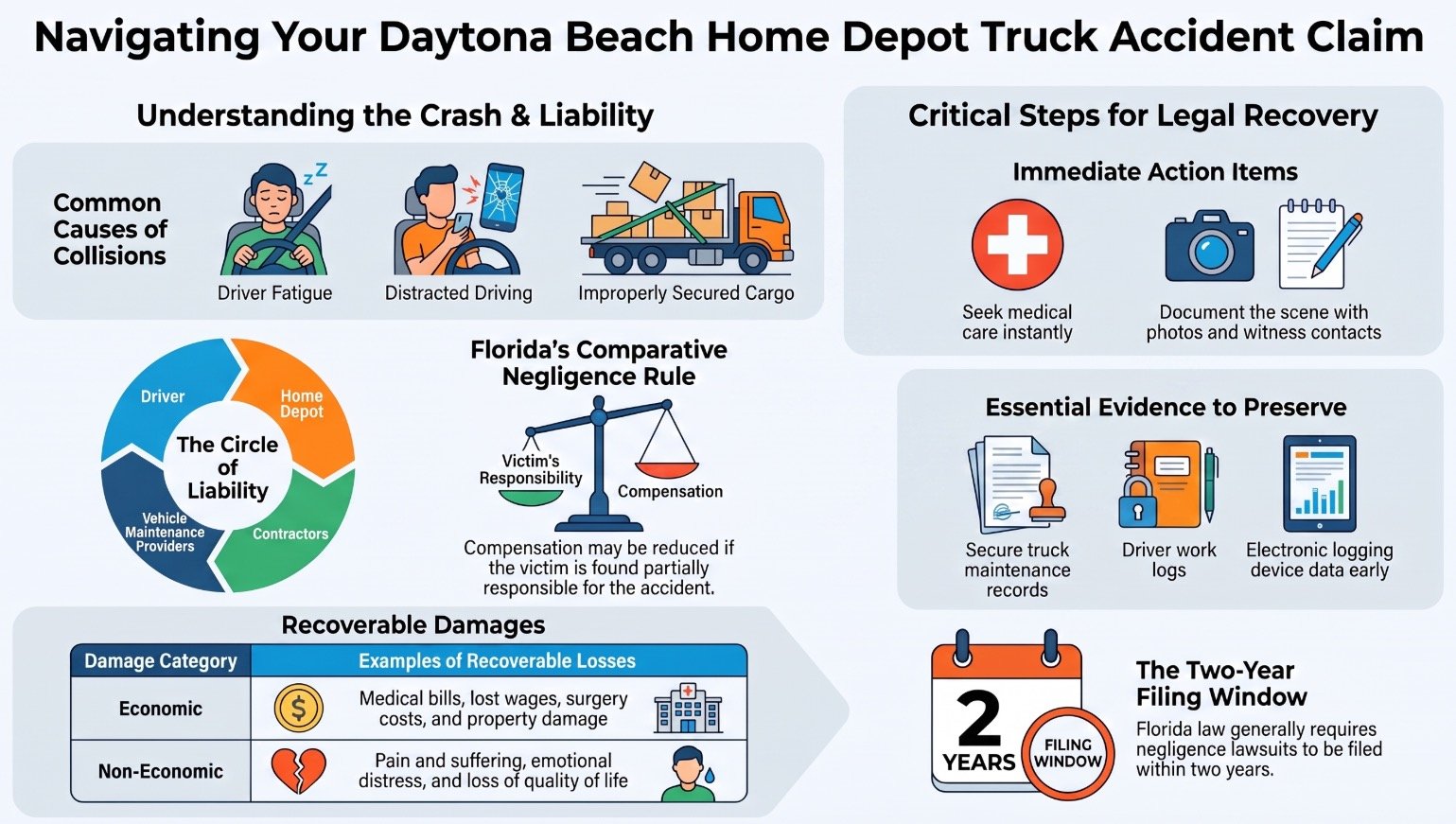
Common causes of Daytona Beach Home Depot truck accidents include driver fatigue or distraction, which can impair judgment and reaction time. Improperly secured loads may shift or fall, while blind spots and limited visibility can prevent drivers from detecting nearby vehicles or pedestrians. Negligent vehicle maintenance, including inadequate inspections or repairs, may also contribute to dangerous roadway failures.
Driver Fatigue and Distraction
Driver fatigue and distraction frequently contribute to Home Depot truck accidents in Daytona Beach by impairing a driver’s alertness, judgment, and ability to react to changing traffic conditions. Long shifts, inadequate rest, demanding delivery schedules, mobile-device use, and other interruptions can increase the risk of missed signals, delayed braking, lane departures, and collisions. Employers may address these dangers through effective Driver training programs that emphasize fatigue recognition, defensive driving, route planning, and compliance with applicable hours-of-service requirements. Supervisors can also promote reporting practices that allow drivers to identify unsafe levels of exhaustion without fear of retaliation.
Although Cargo loading standards primarily concern preparation and handling procedures, consistent operational policies can reduce pressure on drivers and support safer deliveries. Evidence of schedules, communications, training records, and rest periods may help clarify how fatigue or distraction affected an accident.
Improperly Secured Loads
Improperly secured loads can cause serious Home Depot truck accidents in Daytona Beach when materials shift, fall, or extend into adjacent lanes during transport. Cargo securement standards require appropriate restraints, weight distribution, and inspections before departure and throughout a trip. Driver loading oversights, including failing to verify straps, chains, blocking, or load limits, may allow lumber, appliances, or construction materials to move unexpectedly. Shipping documentation errors can also misstate cargo weight, dimensions, or handling requirements, increasing the risk of improper placement and restraint. When unsecured materials cause collisions or roadway hazards, investigators may examine loading procedures, inspection records, and responsible parties.
Violations can result in Enforcement penalties, citations, insurance disputes, and civil liability. Injured individuals may benefit from prompt medical care, evidence preservation, and guidance from qualified legal professionals.
Blind Spots and Limited Visibility
When visibility is restricted around a Home Depot truck, blind spots can prevent the driver from detecting passenger vehicles, pedestrians, or cyclists in adjacent lanes and nearby areas. These limitations become particularly hazardous during turns, lane changes, backing operations, and departures from busy retail entrances. Large mirrors do not eliminate areas that remain difficult to observe, especially when traffic approaches from the truck’s sides or rear. Traffic signal timing may further increase risk if a truck enters an intersection while nearby road users are crossing or changing direction. Congested access roads can also reduce pedestrian walkway access, forcing individuals closer to moving vehicles. Drivers and surrounding motorists must exercise heightened caution, verify conditions before operating, and respect vulnerable road users whose safety depends on adequate observation and careful coordination.
Negligent Vehicle Maintenance
Negligent vehicle maintenance can make a Home Depot truck accident more likely by allowing mechanical defects to remain undetected or uncorrected. Worn brakes, underinflated tires, defective direction-control components, and damaged lights may impair a truck’s ability to stop, navigate, or remain visible. Maintenance responsibilities can involve the vehicle owner, a commercial operator, contractors, or service providers, depending on the applicable agreements and operating practices. Vehicle defect liability may arise when a party knew, or reasonably should have known, about a dangerous condition and failed to address it. Following a collision, inspection record evidence, repair invoices, driver reports, and electronic maintenance data may help establish whether required inspections occurred.
Preserving these materials can assist injured individuals and their families in evaluating accountability, supporting safety improvements, and pursuing appropriate legal remedies.
Legal Rights of Daytona Beach Home Depot Truck Accident Injury Victims
Daytona Beach Home Depot truck accident injury victims may have legal rights to pursue compensation for medical expenses, lost income, property damage, pain and suffering, and other losses caused by the collision.
A careful claim review can help affected individuals understand available remedies and protect their interests.
- Victims may seek damages from responsible parties, including a driver, employer, contractor, or insurer.
- Comparative Negligence may reduce recovery if an injured person is found partly responsible, although the effect depends on Florida law and the evidence.
- Families may pursue a Wrongful Death claim when a collision causes a loved one’s death, subject to statutory requirements and deadlines.
- Prompt medical documentation, incident records, witness information, and insurance communications can support a fair evaluation.
An attorney may investigate liability, calculate current and future losses, negotiate with insurers, and pursue litigation when necessary. Serving injured community members requires informed guidance, respectful communication, and attention to filing deadlines that could affect the value or availability of a claim.
Why Do Daytona Beach Home Depot Truck Accident Injuries Happen?
Home Depot truck accident injuries can arise from driver error, inadequate vehicle maintenance, unsafe loading practices, or hazardous roadway conditions. Distracted driving, including phone use, inattention, or fatigue, can prevent a commercial driver from recognizing traffic changes and reacting safely. Speeding, impaired driving, unsafe lane changes, and failure to yield may further increase collision risks.
Maintenance failures can involve defective brakes, worn tires, faulty lights, or steering problems. When inspections or repairs are neglected, a vehicle may become difficult to control, particularly in heavy traffic or poor weather. Improperly secured merchandise can shift or fall, creating hazards for nearby motorists and pedestrians.
Road design, construction zones, standing water, and limited visibility may also contribute to crashes. In some cases, delivery schedules or inadequate training can encourage unsafe decisions. Medical negligence is generally distinct from the collision itself, but it may worsen injuries when post-crash treatment falls below accepted standards. These combined factors can produce serious physical, financial, and emotional consequences for affected individuals and families.
What Should You Do After a Daytona Beach Home Depot Truck Accident Injury?
After a Daytona Beach Home Depot truck accident injury, the injured person should seek immediate medical care, even when symptoms initially appear minor. The accident scene should be documented through photographs, witness information, and relevant reports when circumstances permit. Consulting a truck accident lawyer can help protect legal rights and assess potential claims against responsible parties.
Seek Immediate Medical Care
Because some injuries are not immediately apparent, anyone involved in a Daytona Beach Home Depot truck accident should obtain prompt medical care, even if the initial symptoms seem minor. A qualified clinician can identify concussions, internal trauma, soft-tissue damage, and other conditions that may worsen without treatment. Medical personnel should receive a complete account of symptoms, medications, and relevant health concerns so they can establish appropriate testing and aftercare. Adhering to medical instructions may support recovery and reduce the risk of complications. Depending on the injury, treatment can include expert referrals, Recovery services, prescribed exercises, and pain management plans.
Keeping scheduled appointments also helps healthcare providers evaluate progress and adjust treatment. Prompt attention prioritizes the injured person’s well-being and provides a responsible foundation for continued recovery.
Document The Accident Scene
At the accident scene, the injured person or a designated companion should document conditions that may help establish how the Daytona Beach Home Depot truck accident occurred. Photographs should capture vehicle positions, visible damage, traffic signals, lane markings, debris, skid marks, and surrounding property. Images should be taken from multiple distances without interfering with emergency personnel or creating additional danger. Witness statements can preserve observations about the truck’s movement, driver conduct, and events immediately before impact. Names, telephone numbers, and email addresses should be recorded while memories remain fresh.
Notes should identify the date, time, location, lighting, and weather conditions, including rain, wind, or poor visibility. Any damaged personal property should also be photographed. Records should be stored securely and preserved without alteration for later reference.
Consult A Truck Accident Lawyer
A person injured in a Daytona Beach Home Depot truck accident should consult a qualified truck accident lawyer as soon as reasonably possible, particularly when injuries require medical treatment or the crash involves disputed fault. A lawyer can help preserve evidence, identify responsible parties, and explain legal options without interfering with medical recovery. Counsel may investigate driver qualifications, vehicle maintenance, loading procedures, and trucking company records that could clarify how the collision occurred. The lawyer can also communicate with insurers, evaluate settlement offers, and protect the injured person from statements that may undermine a claim.
Insurance claim deadlines and Florida’s applicable filing periods require prompt attention. Early legal guidance supports informed decisions, helps coordinate necessary documentation, and allows an injured person to pursue fair compensation while focusing on recovery and assisting family members.
Critical Evidence in a Daytona Beach Home Depot Truck Accident Injury Case
Critical evidence can clarify liability, identify regulatory violations, and document the full extent of an injured person’s losses.
Critical materials include:
- Accident scene photos
- Truck maintenance records
- Driver work logs
- Medical treatment documentation
Together, these records can help establish how the Daytona Beach Home Depot truck accident occurred and support a claim for compensation.
Accident Scene Photos
Photographs taken at a Daytona Beach Home Depot truck accident scene can preserve evidence that may otherwise disappear as vehicles are moved, debris is removed, or road conditions change. Images should document vehicle positions, impact points, skid marks, scattered cargo, traffic controls, lighting, weather, and visible injuries. Wide views can establish context, while close photographs may capture damage, broken parts, and roadway conditions. A careful Photo preservation strategy includes maintaining original files, recording when and where each image was taken, and avoiding edits that could affect authenticity.
Witness statement collection should occur promptly, because observers may recall details that photographs cannot show, including sounds, vehicle movements, and driver behavior. Properly organized images can assist investigators, insurers, and legal representatives in evaluating causation, responsibility, and the injuries sustained.
Truck Maintenance Records
Truck maintenance records can provide key evidence in a Daytona Beach Home Depot truck accident injury case by showing whether the vehicle was inspected, serviced, and kept in safe operating condition. These documents may identify recurring brake, tire, guidance, lighting, or loading problems and reveal whether repairs were completed before the collision. Service invoices, inspection reports, defect notices, and repair schedules can help establish whether negligent maintenance contributed to the injuries.
A legal representative may promptly request these materials from the trucking company, owner, or contractor before records are altered or destroyed. Such preservation is important because spoliation of evidence can complicate liability determinations and damage a party’s credibility. Records supporting unsafe conditions may also strengthen settlement demand letters by providing objective proof of preventable mechanical risks and corporate oversight failures.
Driver Work Logs
Driver work logs can provide important evidence in a Daytona Beach Home Depot truck accident injury case by documenting a commercial driver’s hours, rest periods, and compliance with applicable service limits. These records may reveal fatigue risks, inaccurate entries, or pressure to meet delivery schedules. Investigators can compare log information with dispatch messages, fuel receipts, GPS data, toll records, and electronic logging device reports to identify inconsistencies. Such comparisons may clarify whether a driver exceeded permitted hours or operated without required rest. Liability investigation strategies often include obtaining original records before they are altered, overwritten, or discarded. The information can support analysis of negligence, employer oversight, and regulatory violations. It also helps explain How we build damages by connecting documented conduct to the severity and circumstances of the collision.
Medical Treatment Documentation
Medical treatment documentation provides a detailed record of the injuries, symptoms, diagnoses, and care arising from a Daytona Beach Home Depot truck accident. Emergency department records, physician notes, imaging results, prescriptions, therapy reports, and billing statements can establish the nature and progression of harm. Consistent documentation may connect reported symptoms to the collision and demonstrate the treatment required for recovery. Records involving a Traumatic Brain injury should identify cognitive changes, headaches, dizziness, memory problems, and recommended neurological care.
A Documentation Checklist can help preserve discharge instructions, expert referrals, work restrictions, diagnostic studies, and follow-up appointments. Prompt, complete reporting of symptoms is important because delayed documentation may create questions about causation or severity. Medical providers should accurately record limitations, prognosis, and continuing care needs to support informed legal evaluation.
Long-Term Effects of Daytona Beach Home Depot Truck Accident Injuries
Long-term injuries from a Daytona Beach Home Depot truck accident may cause chronic pain, permanent disability, and lasting limitations on daily activities. Emotional and psychological trauma, including anxiety, depression, or post-traumatic stress, may also affect recovery and quality of life. These consequences can produce substantial financial burdens and require significant changes to employment, household responsibilities, and personal routines.
Chronic Pain and Disability
When injuries from a Daytona Beach Home Depot truck accident fail to recover fully, victims may experience chronic pain, reduced mobility, and permanent disability that affect nearly every aspect of daily life. Ongoing symptoms can limit walking, lifting, driving, working, and personal care, creating substantial medical and financial burdens. Treatment may require Medication management, physical therapy, assistive devices, injections, or corrective procedures. Pain flare ups can disrupt sleep and make ordinary tasks unpredictable, while coping strategies may help individuals conserve energy, follow treatment plans, and maintain safe routines.
Detailed disability documentation can establish functional limitations, treatment history, work restrictions, and future care needs. Medical records, employment evaluations, and physician opinions may also clarify whether limitations are temporary, permanent, or expected to worsen, supporting informed assistance and appropriate compensation.
Emotional and Psychological Trauma
Emotional and psychological trauma can persist long after physical injuries from a Daytona Beach Home Depot truck accident have stabilized. Survivors may experience anxiety, depression, nightmares, irritability, or heightened fear around commercial vehicles and busy roads. These symptoms can disrupt concentration, sleep, relationships, and confidence, even when medical examinations show physical improvement. Post-accident support from trusted relatives, community organizations, and qualified professionals can reduce isolation and encourage recovery. Helpful coping strategies may include maintaining regular routines, practicing relaxation techniques, documenting symptoms, and following recommended treatment plans.
Mental health providers can offer therapy referrals when particularized care is appropriate, including counseling for trauma-related conditions. Trauma-informed care recognizes the survivor’s experiences, promotes safety, and avoids practices that may intensify distress. Prompt attention can support lasting emotional recovery and informed legal decisions.
Financial and Lifestyle Changes
Although physical recovery may progress, injuries from a Daytona Beach Home Depot truck accident can produce lasting financial and lifestyle changes. Medical expenses, reduced earning capacity, transportation needs, and assistance with daily activities may continue long after treatment ends. Families often must revise household responsibilities, postpone education, or reconsider housing arrangements to accommodate disability-related limitations. Budgeting after settlement requires careful planning so compensation supports future medical care, rehabilitation, accessibility modifications, and ordinary living costs rather than providing only temporary relief.
Some injured workers may require workplace retraining programs when permanent restrictions prevent a return to prior duties. Vocational counselors can identify suitable employment, evaluate transferable skills, and coordinate adaptive equipment. Supportive relatives, employers, and community organizations can help preserve dignity and independence while the injured individual adjusts to changed financial obligations and long-term routines.
Proving Liability in Daytona Beach Home Depot Truck Accident Injury Cases
Proving liability in a Daytona Beach Home Depot truck accident injury case requires establishing who caused the collision and demonstrating that the responsible party’s conduct violated a legal duty. A careful investigation may examine driver decisions, vehicle maintenance, loading procedures, roadway conditions, and company policies. Potentially responsible parties can include the truck driver, a motor carrier, a maintenance provider, or another entity involved in operations.
Evidence preservation techniques are critical because surveillance footage, electronic driving data, inspection records, delivery logs, and witness recollections may disappear or change. Photographs of vehicle damage, skid marks, injuries, and the surrounding scene can help reconstruct events. Qualified investigators may review police reports, traffic regulations, and expert analyses to identify unsafe conduct and establish causation.
Comparative negligence arguments may arise if another person’s actions allegedly contributed to the crash. Florida’s negligence rules can affect recovery when fault is divided, making precise factual development important. Legal professionals can organize evidence and present a clear account that supports accountability and community safety.
Dealing With Insurance Companies After a Daytona Beach Home Depot Truck Accident Injury
After liability evidence has been identified and preserved, the injured person must also address the insurance companies involved in the Daytona Beach Home Depot truck accident. Communications should remain accurate, limited, and consistent with available medical documentation. Adjusters may request statements, records, or authorizations that could affect how injuries and responsibility are evaluated. An injured person should avoid speculation, minimize no symptoms, and refrain from accepting a settlement before understanding the full financial impact of treatment and recovery.
A careful review of policy coverage can identify applicable liability limits, commercial policies, employer coverage, and any potentially available uninsured or underinsured motorist benefits. Each policy may contain conditions, exclusions, and reporting requirements that influence available compensation. A disciplined Negotiation strategy relies on organized evidence, documented expenses, medical opinions, and a clear account of the accident’s consequences. Legal guidance can help protect the injured person during communications, preserve important rights, and promote a fair resolution while treating every involved party with professionalism and respect.
What to Expect During a Daytona Beach Home Depot Truck Accident Injury Claim Process
A Daytona Beach Home Depot truck accident injury claim typically begins with an initial evaluation of the circumstances, injuries, and potential liability. The process may then involve gathering evidence, conducting an investigation, and pursuing settlement negotiations with the responsible parties or their insurers. If negotiations do not produce a fair resolution, trial preparation may follow before the claim reaches its final disposition.
Initial Claim Evaluation
How does the initial evaluation of a Daytona Beach Home Depot truck accident claim begin? A legal professional typically conducts a confidential consultation to understand the collision, reported injuries, medical treatment, employment impact, and immediate financial concerns. The claimant may provide insurance information, accident reports, photographs, medical records, wage documentation, and communications received from insurers. Insurance coverage verification helps identify potentially responsible parties, applicable policies, liability limits, and procedural requirements before meaningful negotiations begin. The evaluation also addresses deadlines, including Florida’s limitations periods, and considers whether the circumstances support a personal injury claim. Counsel explains the process, potential challenges, and available options in clear terms so the injured person can make informed decisions. Early guidance emphasizes the importance of evidence preservation, including protecting relevant records and avoiding statements that could undermine the claim.
Evidence And Investigation
When a Daytona Beach Home Depot truck accident claim proceeds, evidence gathering and investigation establish how the collision occurred, who may be responsible, and the extent of the claimant’s losses. Counsel may collect police reports, photographs, vehicle data, medical records, employment documentation, and surveillance footage. Witness statements can clarify traffic conditions, driver conduct, and events immediately before impact. Evidence preservation is important because video recordings, electronic logs, and physical vehicle conditions may change or disappear. Insurance adjusters may request information, inspect damage, and assess the reported facts, but their conclusions require careful review.
Investigative timelines can vary according to injury severity, available records, agency responses, and the number of involved parties. A structured investigation helps protect accurate information and supports a fair, service-oriented evaluation of the injured person’s needs and legal position.
Settlement Negotiations
Settlement negotiations in a Daytona Beach Home Depot truck accident claim generally begin after the available evidence, medical records, and losses have been reviewed. The injured person’s representative may present liability evidence, including delivery records, vehicle data, photographs, surveillance footage, and witness statements, to explain how the collision occurred and who may be responsible. A demand typically outlines medical expenses, lost income, anticipated treatment, property damage, and the effect of injuries on daily responsibilities. The insurer may accept the demand, request additional documentation, or respond with a lower offer.
Each proposal should be evaluated against the documented losses and potential future needs rather than urgency alone. Clear communication helps preserve accuracy and ensures that decisions reflect the injured person’s welfare, recovery, and long-term financial interests.
Trial Preparation And Resolution
If settlement negotiations do not produce a fair resolution, the claim may proceed toward trial or another formal resolution. During trial preparation, the legal team organizes medical records, employment documentation, photographs, witness statements, and evidence concerning the Home Depot truck, driver, and responsible parties. A focused Discovery strategy may identify maintenance failures, delivery procedures, insurance coverage, and communications relevant to liability. Depositions can preserve testimony from drivers, witnesses, supervisors, and medical providers. Expert testimony may explain collision dynamics, safety violations, future medical needs, or diminished earning capacity.
The injured person may need to participate in preparation meetings, medical evaluations, and deposition questioning. Counsel then presents arguments and evidence to a judge or jury. Resolution may occur through a verdict, mediation, arbitration, or a court-approved settlement, with the client informed throughout.
Compensation for Daytona Beach Home Depot Truck Accident Injury Damages
Compensation for injuries sustained in a Daytona Beach Home Depot truck accident may include medical expenses, lost income, reduced earning capacity, and damages for pain and suffering. A careful claim should account for ambulance services, emergency treatment, rehabilitation, prescription medication, follow-up care, and reasonably anticipated future treatment. Documentation such as medical records, invoices, wage statements, and employment evaluations can help establish the extent of the losses.
Insurance coverage options may include the trucking company’s policy, Home Depot’s applicable coverage, a contractor’s insurance, and other responsible parties’ policies. Determining available coverage requires reviewing contracts, vehicle ownership, driver employment status, and policy limits. A Daytona Beach damages calculation may also consider the injury’s duration, required assistance, and effect on household responsibilities.
A lawyer serving injured community members can investigate the collision, preserve evidence, identify responsible parties, and present a detailed demand. Prompt action helps protect the claimant’s interests while insurers evaluate liability and settlement.
Economic vs Non-Economic Damages in Daytona Beach Home Depot Truck Accident Cases
Economic damages may include medical expenses, lost income, property damage, and other measurable financial costs arising from the collision. Non-economic losses, such as pain and suffering, emotional distress, and reduced quality of life, address harms that lack fixed dollar amounts. Calculating total compensation requires evaluating both categories, supporting documentation, and the accident’s lasting effects on the injured person.
Economic Damage Categories
Economic damages in a Daytona Beach Home Depot truck accident case are intended to reimburse an injured person for documented financial losses caused by the collision. Recoverable categories may include emergency transportation, hospital treatment, surgery, medication, rehabilitation, and follow-up medical care. Records can also support reimbursement for property damage, vehicle repairs, rental transportation, and other accident-related expenses.
If the injury prevents employment, damages may include lost wages, reduced earning capacity, and missed employment benefits, provided evidence establishes the financial impact. A careful assessment should distinguish expenses already incurred from reasonably expected future costs. Medical bills, pay records, repair estimates, expert opinions, and employment documentation may help establish value. Insurance policy limits can affect available recovery, while a settlement negotiation strategy should account for evidence, projected expenses, and responsible parties.
Non-Economic Losses Explained
Although financial losses are calculated from documented expenses, non-economic damages address the personal effects of a Daytona Beach Home Depot truck accident that do not have a fixed price. These losses may include physical pain, emotional distress, mental anguish, diminished enjoyment of life, disfigurement, and permanent limitations. They can affect relationships, independence, sleep, and the ability to participate in meaningful daily activities.
Unlike medical bills or lost wages, these injuries require careful evaluation of testimony, medical records, and the circumstances surrounding the collision. Liability evidence remains important because the seriousness of the harm must be connected to the responsible party’s conduct. Florida Comparative negligence may also affect recovery when an injured person shares responsibility for the accident. Legal guidance can help present these personal losses accurately and respectfully.
Calculating Total Compensation
A total compensation assessment in a Daytona Beach Home Depot truck accident case generally combines economic and non-economic damages to reflect both measurable financial harm and personal losses. Economic damages may include medical expenses, rehabilitation, lost wages, reduced future earning capacity, property damage, and necessary out-of-pocket costs. Insurance documentation, billing statements, employment records, and expert evaluations can help establish these amounts. Non-economic damages address pain, emotional distress, diminished quality of life, disability, disfigurement, and loss of companionship. Because these losses lack fixed prices, their value depends on the injury’s severity, duration, prognosis, and effect on daily responsibilities.
A careful assessment should account for future treatment and continuing limitations rather than focusing only on immediate bills. Counsel may organize supporting evidence to present a fair, extensive claim while protecting the injured person’s long-term interests.
When a Daytona Beach Home Depot Truck Accident Injury Case Goes to Trial vs Settlement
When a Daytona Beach Home Depot truck accident injury case cannot be resolved through negotiations, the parties may proceed to trial, where a judge or jury evaluates liability, damages, and the credibility of the evidence. Settlement may provide a faster, more predictable resolution, allowing an injured person to receive compensation without the uncertainty, expense, and delay associated with courtroom proceedings.
Negotiation strategies can include presenting medical documentation, employment records, witness statements, and expert opinions that support the claimed losses. Both sides may assess the strengths and weaknesses of their positions before agreeing to payment terms. A settlement, however, may require accepting less than the full amount requested and generally ends the dispute.
At trial, courtroom evidence is introduced under formal procedures, and witnesses may testify or face cross-examination. The decision-maker determines whether the evidence establishes responsibility and the extent of recoverable harm. Legal counsel can explain these alternatives, protect the injured person’s interests, and support a resolution that serves long-term recovery and fairness.
Florida Laws That May Affect Your Daytona Beach Home Depot Truck Accident Case
Florida law can considerably affect how a Daytona Beach Home Depot truck accident claim is evaluated, including the deadlines for filing, the standards used to establish fault, and the damages that may be recovered. Central considerations may include:
Florida law shapes Daytona Beach Home Depot truck accident claims through filing deadlines, fault standards, and available compensation.
- Florida No Fault: Personal injury protection coverage may address initial medical expenses and lost income, subject to policy limits and statutory requirements.
- Comparative Negligence: A claimant’s recovery can be reduced when evidence shows that the claimant contributed to the collision or resulting injuries.
- Fault Allocation: Responsibility may be assigned among drivers, trucking companies, contractors, vehicle owners, or other negligent parties, depending on the evidence.
- Available Damages: A claim may seek compensation for medical treatment, lost earnings, property damage, disability, and pain-related losses when legally supported.
These rules help determine how insurers, courts, and attorneys evaluate evidence while protecting an injured person’s interests. Careful documentation and professional guidance can support a fair resolution and help affected families make informed decisions while serving their long-term needs.
The Statute of Limitations for Daytona Beach Home Depot Truck Accident Injury Cases
Timely action is important in Daytona Beach Home Depot truck accident injury cases because Florida law imposes strict deadlines for filing a lawsuit. Under Florida law, the general deadline for negligence claims is usually two years from the accident date. Certain circumstances can shorten or extend that period, including claims involving government entities, wrongful death, or injuries discovered later. Missing the applicable deadline may permanently bar recovery, regardless of the seriousness of the harm.
Potential claimants should identify all responsible parties promptly, since different defendants may be governed by different filing periods. Comparative Negligence may also affect the amount recoverable if an injured person is found partly responsible. Early Evidence Preservation is important because vehicle data, surveillance recordings, driver logs, maintenance records, and witness recollections can disappear or change over time. Medical documentation should likewise be maintained to connect treatment with the collision. Determining the controlling deadline requires careful attention to the facts and applicable Florida law, particularly when multiple parties or legal theories are involved.
How a Daytona Beach Home Depot Truck Accident Lawyer Can Help You
A Daytona Beach Home Depot truck accident lawyer can help identify the parties responsible for a collision, evaluate available insurance coverage, and protect the injured person’s legal rights before applicable filing deadlines expire. The lawyer may support an injured person and family through several practical services:
- Investigating driver conduct, vehicle maintenance, loading practices, employer policies, and roadway conditions.
- Coordinating evidence preservation, including photographs, surveillance footage, electronic records, witness accounts, and medical documentation.
- Preparing legal documentation that accurately presents injuries, financial losses, treatment needs, and liability theories.
- Addressing Insurance denials and developing a negotiation strategy based on documented damages, applicable policies, and the collision’s circumstances.
Counsel can communicate with insurers and opposing parties, reducing pressure on injured individuals who should remain focused on recovery and family responsibilities. When negotiations do not produce a fair resolution, the lawyer can prepare the claim for litigation and present evidence in an organized manner. This assistance helps promote accountability while ensuring that a person’s interests are represented with diligence, clarity, and respect throughout the legal process.
When to Contact a Daytona Beach Home Depot Truck Accident Lawyer
When should someone contact a Daytona Beach Home Depot truck accident lawyer? Contact should occur as soon as possible after a collision, particularly when injuries, disputed fault, or significant property damage are involved. Early legal assistance can help protect the injured person’s interests while necessary information remains available.
Immediate communication is especially important if medical treatment is ongoing, an insurance representative requests a recorded statement, or a vehicle may require inspection. A lawyer may also provide Emergency evidence preservation guidance, including steps concerning surveillance footage, delivery records, vehicle data, photographs, and scene conditions. Prompt action can reduce the risk that relevant materials disappear or become difficult to obtain.
Contact is also appropriate when witnesses have not been identified, contact information has changed, or accounts of the event conflict. Maintaining accurate witness contact updates can support organized communication and help preserve reliable observations. Individuals should avoid discussing fault publicly and should document medical care, expenses, and correspondence while seeking timely professional assistance.
Why You Need an Experienced Daytona Beach Home Depot Truck Accident Lawyer
An experienced Daytona Beach Home Depot truck accident lawyer understands the distinct legal and factual issues these collisions can present. Commercial vehicles may involve delivery contractors, corporate policies, maintenance records, and multiple insurance carriers, making responsibility more difficult to establish.
Such counsel can coordinate Evidence preservation before surveillance footage, electronic data, vehicle components, or employment records disappear. A lawyer can also evaluate insurance tactics, including premature settlement offers, disputed medical causation, and attempts to shift blame to an injured driver. Determining traffic signal duty may require examining intersection design, timing records, driver visibility, and applicable regulations rather than relying on initial assumptions.
Accurate witness testimony can clarify vehicle movements, warnings, lighting, and the sequence of impact. An experienced advocate can organize these facts into a coherent claim while communicating respectfully with all affected parties. This careful approach helps protect injured individuals, supports fair accountability, and advances the interests of families and community members who need dependable assistance after a serious crash.
How to Choose the Right Daytona Beach Home Depot Truck Accident Lawyer for Your Case
Selecting the right Daytona Beach Home Depot truck accident lawyer requires more than reviewing advertisements or settlement claims. A careful selection process helps injured individuals and families identify counsel prepared to serve their interests responsibly.
Clients should compare local legal strategies, focusing on how each attorney investigates commercial vehicle records, insurance coverage, workplace procedures, and potential liability. They should evaluate attorney credentials, including relevant truck accident experience, professional standing, trial preparation, and communication practices. A lawyer’s ability to explain complicated issues clearly can be especially important when clients face medical, financial, and emotional pressures.
It is also prudent to assess fee arrangements before representation begins. Written explanations should address contingency percentages, litigation expenses, and any costs that could remain the client’s responsibility. Finally, prospective clients should review case timelines, including investigation stages, negotiations, filing deadlines, and possible trial preparation. Selecting counsel through informed comparison promotes accountability and supports a more organized path toward pursuing appropriate compensation and protecting the client’s long-term interests.
About The Law Offices of Anidjar & Levine
The Law Offices of Anidjar & Levine represents individuals and families pursuing compensation after serious accidents, including collisions involving Home Depot trucks and other commercial vehicles. Its attorneys assess the circumstances of each claim, identify potentially responsible parties, and explain legal options in clear, practical terms. Their work may address medical expenses, lost income, property damage, long-term care needs, and other losses supported by the evidence.
The firm also examines Insurance Coverage Options that may apply to the driver, trucking company, contractor, vehicle owner, or other involved entities. Because commercial accident claims can involve substantial records and competing accounts, counsel may assist with Evidence Preservation Tips, including documenting injuries, securing photographs, obtaining witness information, and protecting vehicle or roadway evidence. The firm’s approach emphasizes preparation, communication, and client service throughout the legal process. Individuals seeking assistance can discuss their circumstances with the firm to understand potential claims, deadlines, and available legal remedies.
Frequently Asked Questions
Can I File a Claim if the Home Depot Truck Driver Fled the Accident Scene?
A claim may remain possible if a Home Depot truck driver fled, although prompt action is critical. The injured person should File report with law enforcement and seek medical care. Investigators may establish liability proof through witnesses, surveillance footage, vehicle records, and photographs. Counsel can help determine driver whereabouts and identify insurance options, including commercial coverage or uninsured-motorist benefits. Deadlines vary, so preserving evidence and obtaining legal guidance promptly can protect available remedies.
Will My Immigration Status Affect My Daytona Beach Truck Accident Claim?
Immigration status generally does not prevent an injured person from pursuing a Daytona Beach truck accident claim. Eligibility usually depends on proving negligence, injuries, and damages, not citizenship or documentation. A qualified attorney can protect Confidential Evidence, explain available remedies, and address concerns about information sharing. Translation Services may be arranged so the claimant understands every legal decision and proceeding. Prompt medical care and timely evidence preservation remain important.
Can Family Members Pursue Damages After a Fatal Home Depot Truck Accident?
Yes. In a fatal truck accident, eligible family members may pursue wrongful death damages, while the decedent’s personal representative may bring estate claims for losses incurred before death. Florida law identifies wrongful beneficiaries through statutory relationships, often including a surviving spouse, children, or parents, depending on the circumstances. Recoverable damages may include lost financial support, funeral expenses, medical costs, and loss of companionship. Prompt legal guidance helps protect each beneficiary’s rights.
What Happens if Multiple Vehicles Contributed to My Home Depot Truck Accident?
When multiple vehicles contribute to a Home Depot truck accident, investigators assess each driver’s conduct, vehicle condition, roadway factors, and applicable company policies. Insurance liability may be divided among several parties rather than assigned to one driver. Under comparative fault rules, each party generally pays according to its percentage of responsibility, although deadlines and state-specific doctrines can affect recovery. A careful evidence review helps protect injured individuals and support fair compensation for medical care, lost income, and other damages.
Can Social Media Posts Affect My Daytona Beach Truck Accident Lawsuit?
Social media posts can materially affect a Daytona Beach truck accident lawsuit. Photos, comments, location data, or discussions about injuries may be presented as evidence, even when taken out of context. The claimant should avoid posting, deleting, or altering accident-related content and should preserve relevant messages through proper Evidence Preservation. Violating court orders or concealing information can lead to Social Media Penalties, weakened credibility, reduced compensation, or dismissal. Legal guidance helps protect fair representation.
—————————
Victims of Home Depot truck accidents in Daytona Beach may suffer serious injuries, significant expenses, and challenging insurance disputes. Understanding your legal rights and acting promptly can help preserve evidence and protect potential compensation. An experienced Daytona Beach Truck Accident Lawyer can investigate the crash, identify responsible parties, and pursue damages for medical care, lost income, and other losses. The Law Offices of Anidjar and Levine provides informed guidance to injured individuals seeking a fair and accountable resolution.