The Law Offices of Anidjar and Levine help injured drivers, riders, and delivery workers pursue compensation after Jacksonville crashes involving delivery routes, app-based work, commercial vehicles, or negligent motorists. These claims may involve workers’ compensation, personal injury insurance, platform coverage, employer liability, and comparative fault issues. A Jacksonville Personal Injury Lawyer can help preserve delivery logs, app data, medical records, and witness evidence while coordinating communications with insurers. The sections below explain essential rights, case factors, and claim strategies.
Main Takeaways
- A Jacksonville delivery and courier accident lawyer can identify insurance, workers’ compensation, and third-party recovery options.
- Evidence such as crash reports, medical records, delivery logs, app data, and witness statements can support liability and damages.
- Compensation may include medical expenses, lost wages, reduced earning capacity, pain, and future treatment needs.
- Employment status, active delivery role, vehicle ownership, and platform policies can affect the claims available.
- Florida comparative negligence rules may reduce compensation if multiple parties share fault for the crash.


How We Can Help With Your Jacksonville Car Accident Delivery & Courier Injury Claim
When a delivery or courier driver is injured in a Jacksonville car accident, the claim may involve more than a standard collision case. Legal guidance can help identify available coverage, preserve evidence, document losses, and protect the injured worker from statements that may weaken the claim. A lawyer can review crash reports, medical records, employment details, delivery logs, and witness accounts to build a clear presentation of liability and damages.
For individuals whose work centers on serving customers, an injury can disrupt both income and the ability to meet daily responsibilities. Counsel can coordinate communication with insurers, employers, and other involved parties while the injured person focuses on recovery. Effective insurance negotiations require organized proof, careful valuation of medical expenses, lost earnings, pain, and future needs. A thoughtful Settlement strategy may pursue fair compensation without delay, while preparing for litigation if responsible parties refuse to act reasonably.
OUR CONSULTATIONSARE FREE
START YOUR FREE CASE REVIEW

Understanding Jacksonville Car Accident Delivery & Courier Injury Cases
Understanding Jacksonville car accident delivery and courier injury cases requires attention to the worker’s role, the purpose of the trip, and the applicable insurance policies. These cases often involve drivers moving goods, medical supplies, meals, or documents for customers who depend on timely service. When an injury occurs, the legal review may examine whether the driver was an employee, an independent contractor, or performing a task outside assigned duties.
A careful claim evaluation also considers the impact of workplace policies, including delivery deadlines, vehicle-use rules, safety training, and reporting requirements. These details may affect which parties bear responsibility and how available coverage is identified. A comparative fault strategy may also be important, because Florida law can reduce recovery when an injured person shares responsibility. For service-focused workers and families, understanding these issues helps protect medical stability, income continuity, and accountability after a serious delivery or courier crash in Jacksonville.
Common Causes of Jacksonville Car Accident Delivery & Courier
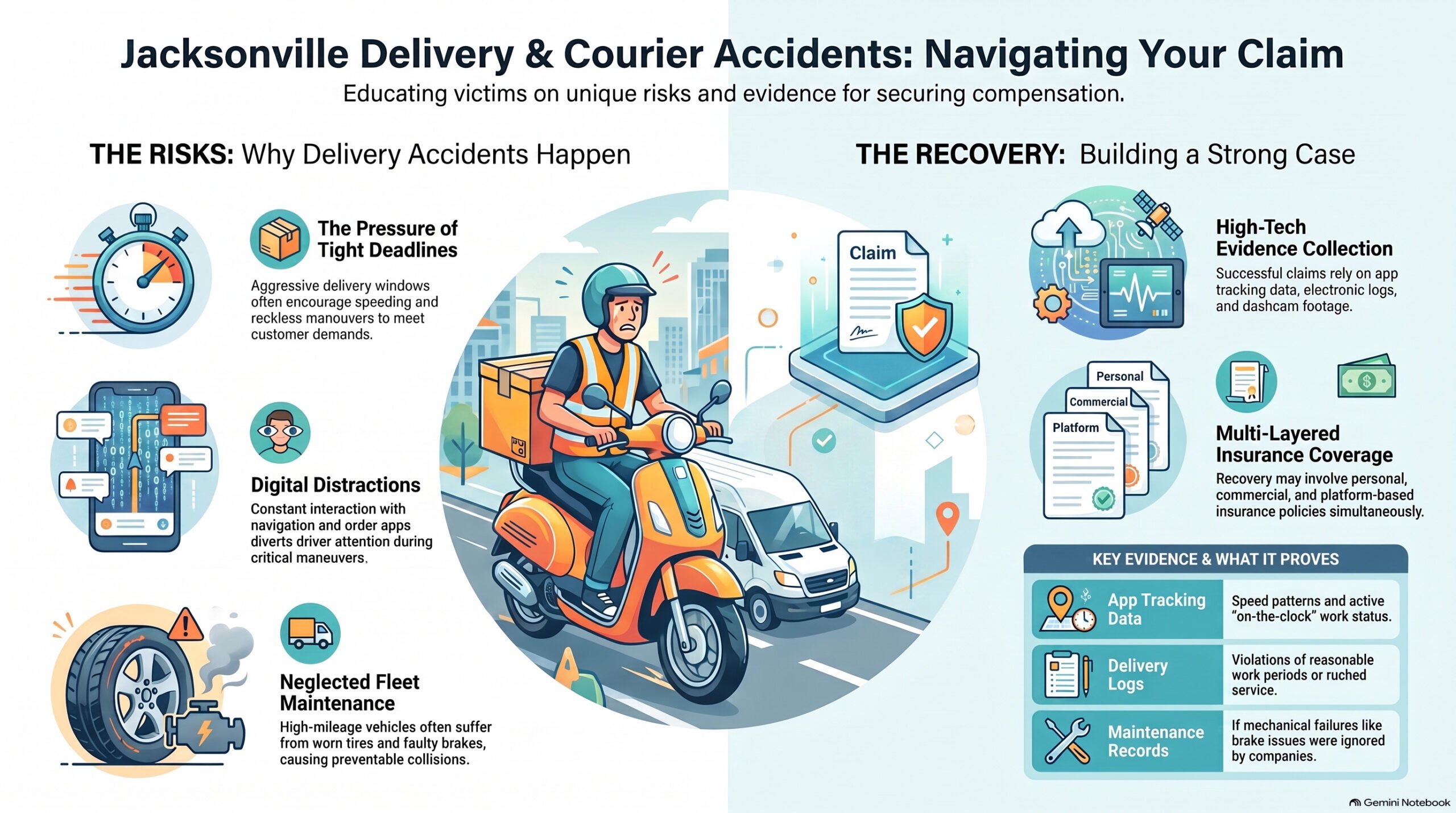
Delivery and courier accidents in Jacksonville often stem from predictable risk factors, including distracted driving, tight delivery deadlines, unsafe vehicle maintenance, and heavy traffic. These pressures can increase the likelihood of sudden stops, unsafe lane changes, rear-end collisions, and other preventable crashes. Understanding these common causes helps clarify how negligence may contribute to serious injuries in delivery-related car accident cases.
Distracted Delivery Driving
As courier and delivery services move quickly through Jacksonville’s busy roads, distracted driving can become a significant factor in preventable collisions. Drivers may glance at navigation systems, confirm addresses, scan order details, or respond to dispatch messages while operating a vehicle. Cellphone distraction is especially dangerous because it can take a driver’s eyes, hands, and attention off the road at the same time. For workers focused on serving customers, delivery pressure may also encourage unsafe multitasking, even when the intent is to remain helpful and dependable. These distractions can reduce reaction time near intersections, crosswalks, parking lots, and residential streets. When a delivery or courier vehicle strikes another motorist, cyclist, or pedestrian, investigating distraction can be critical to understanding fault and promoting accountability. In many cases.
Tight Delivery Deadlines
When strict delivery windows control a driver’s schedule, speed and urgency can begin to replace careful judgment. Couriers serving Jacksonville residents, businesses, hospitals, and families may feel pressure to complete each stop quickly, especially when delays affect customers relying on timely assistance. This pressure can lead to speeding, unsafe lane changes, rolling stops, or following too closely in traffic. Employers and delivery platforms can reduce these risks through Efficient route planning, realistic scheduling, and clear expectations that service never requires reckless conduct. Safety-first delivery policies also help drivers understand that protecting others on the road is more important than meeting an aggressive deadline. When companies reward speed without accountability, preventable collisions may occur, placing drivers, pedestrians, cyclists, and motorists in serious danger.
Unsafe Vehicle Maintenance
Time pressure is not the only factor that can make courier and delivery operations dangerous on Jacksonville roads. Unsafe vehicle maintenance can turn a routine delivery route into a serious hazard for drivers, customers, pedestrians, and other motorists. Companies that serve the public through transportation should regularly inspect vehicles, repair known defects, and remove unsafe vans, cars, or trucks from service. Worn tires can cause blowouts, especially when vehicles carry heavy loads or travel long daily routes. Neglected brakes may lead to brake system failures, reducing a driver’s ability to stop safely near homes, businesses, or intersections. Poor lighting, handling issues, and overdue fluid service may also increase the risk of crashes. Careful maintenance reflects responsibility, protects the community, and supports safer delivery practices throughout Jacksonville.
Heavy Traffic Conditions
Heavy traffic conditions often increase the risk of delivery and courier accidents on Jacksonville roads, particularly in commercial areas, near bridges, and along major corridors such as I-95, I-10, and J. Turner Butler Boulevard. Drivers serving customers under tight schedules may face sudden stops, limited following distance, and crowded merge zones. These conditions can lead to rear-end collisions, sideswipes, and unsafe lane changes at junctions, especially when delivery vehicles must enter loading areas or locate unfamiliar addresses. Weather-related hazards, including rain, glare, and reduced visibility, can further complicate dense traffic patterns. Couriers and delivery companies are expected to plan routes, maintain safe speeds, and exercise caution despite service demands. When preventable negligence contributes to a crash, injured parties may require careful legal evaluation.
Don’t Wait. Call Our Florida Personal Injury Lawyers Now!


Legal Rights of Jacksonville Car Accident Delivery & Courier Injury Victims
Delivery and courier drivers injured in Jacksonville car accidents may have legal rights that differ from those of other crash victims because their claims often involve employment status, commercial insurance, third-party negligence, and workers’ compensation issues. These rights may allow recovery for medical care, lost income, reduced earning ability, and pain-related losses, depending on the facts. Comparative negligence can affect compensation if multiple parties share fault. Nuances in insurance coverage also matter, especially when a driver uses a personal vehicle for deliveries or works through an app-based platform.
Delivery crash claims often depend on work status, insurance coverage, fault, and whether the driver was actively completing an assignment.
- The injured driver may pursue benefits through an employer’s workers’ compensation policy.
- A negligent motorist, company, or vehicle owner may be legally responsible.
- Commercial or platform-based coverage may apply during active delivery periods.
- Documentation of routes, assignments, and communications can support the claim.
For those who serve the public through timely deliveries, legal protections help preserve financial stability and access to care.
Why Do Jacksonville Car Accident Delivery & Courier Injuries Happen?
In Jacksonville, car accident injuries among delivery and courier drivers often occur because these drivers spend long hours on busy roads, make frequent stops, and operate under strict pickup or drop-off expectations. Their work may require maneuvering congested highways, unfamiliar neighborhoods, loading zones, and commercial entrances while remaining attentive to schedules and customer needs. These conditions can increase the risk of fatigue, distraction, unsafe lane changes, rear-end collisions, and pedestrian or bicycle conflicts.
Employers, contractors, and delivery platforms may also contribute to unsafe conditions when they fail to support Workplace Safety through reasonable routing, vehicle maintenance, training, and supervision. Negligent Hiring can further increase risk when companies place unqualified, poorly screened, or unsafe drivers behind the wheel. Injuries may also arise from overloaded vehicles, improper cargo securement, pressure to meet unrealistic deadlines, or inadequate communication systems. In this setting, preventable crashes can affect workers, customers, and the broader Jacksonville community.
What Should You Do After a Jacksonville Car Accident Delivery & Courier Injury?
After a Jacksonville car accident involving a delivery or courier injury, prompt action can recover both health and any potential legal claim. The injured person should seek immediate medical care, document the accident scene, and report the incident to the appropriate parties. Preserving evidence, including photos, witness information, and delivery records, can help clarify liability and support the claim process.
Seek Immediate Medical Care
Seek medical attention as soon as possible following a delivery or courier-related car accident, even when injuries appear minor at the scene. Prompt evaluation helps identify conditions that may worsen after adrenaline fades, including soft tissue damage, concussion symptoms, or internal injuries. For drivers, riders, and service workers committed to helping others, receiving care also supports a safer return to responsibilities. Emergency responders, urgent care providers, or primary physicians can assess pain, mobility, dizziness, and other concerns. Minor Roadside Safety should never replace a medical assessment, because brief self-checks may miss serious harm. Follow-up appointment planning is equally important, as ongoing treatment records can show the course of recovery, address complications, and guide work limitations after a Jacksonville delivery or courier collision for future care.
Document The Accident Scene
When it is safe to do so, accident scene documentation should begin before vehicles are moved or evidence is lost. A delivery or courier driver may photograph vehicle positions, damage, skid marks, debris, traffic signs, and visible injuries from multiple angles. Notes should include weather conditions, lighting, traffic flow, and any road hazards that may have contributed to the crash. If bystanders observed the collision, Witness statements may help clarify how events unfolded, provided they are gathered calmly and respectfully. Obtaining names and contact information from witnesses, involved drivers, and nearby businesses can support later review. This careful documentation helps protect injured workers, customers, and other community members by preserving an accurate account of the scene while memories remain fresh and physical details are still visible.
Report And Preserve Evidence
Once the immediate scene has been documented, the accident should be reported to the appropriate parties without unnecessary delay. A delivery or courier driver should notify law enforcement, the employer or dispatch provider, and any applicable insurance carrier. Prompt reporting supports accurate records and helps those responsible for care, safety, and service respond properly.
Evidence should then be preserved with diligence. Vehicle damage, delivery logs, route data, app records, dash camera footage, medical records, and repair estimates may become important. A Witness statement should be requested when possible, while memories remain clear. The injured person should avoid altering records or discarding damaged property. Understanding the basics of liability can help determine whether another driver, a company, or another party may share responsibility for the collision and resulting harm.
Don’t Wait. Call Our Florida Personal Injury Lawyers Now!
Critical Evidence in a Jacksonville Car Accident Delivery & Courier Injury Case
In a Jacksonville delivery or courier accident claim, crucial evidence often determines whether liability, negligence, and damages can be proven with precision:
- Delivery driver logs
- Crash scene photos
- Vehicle maintenance records
- App tracking data
These records may clarify the driver’s route, timing, vehicle condition, and conduct before the collision.
Delivery Driver Logs
Because delivery and courier vehicles often operate under strict schedules, driver logs can become critical evidence in a Jacksonville car accident injury case. These records may show when a driver began a route, accepted assignments, made stops, or exceeded reasonable work periods. An Electronic route can help determine whether the company encouraged rushed service or failed to adjust to traffic and safety demands. Logs may also reveal gaps, timestamp errors, or entries inconsistent with dispatch data. When injuries occur, careful review may uncover log tampering or patterns of driver discipline tied to late deliveries, skipped breaks, or unsafe performance expectations. For individuals harmed while seeking accountability, these records can clarify responsibility, support fair evaluation of conduct, and promote safer delivery practices across the community.
Crash Scene Photos
When a delivery or courier vehicle is involved in a Jacksonville collision, crash scene photos may preserve details that disappear quickly after cleanup, towing, or weather changes. Images can document vehicle positions, skid marks, debris fields, traffic signals, road conditions, lighting, signage, and visible injuries. For injured workers, customers, pedestrians, or other motorists, these photographs can help explain how the crash occurred and who may bear responsibility. Each camera angle should be considered carefully, because distance and perspective can clarify impact points or reveal hazards overlooked in written reports. Missing evidence may weaken a claim, especially when commercial drivers, dispatch pressures, or delivery routes are disputed. Prompt photo collection supports fair evaluation, protects community members, and helps legal counsel present the facts accurately and with purpose.
Vehicle Maintenance Records
Crash scene photos may show the visible aftermath of a delivery or courier collision, but vehicle maintenance records can reveal whether preventable mechanical problems contributed to the crash. These records may include repair invoices, brake service logs, tire replacement history, recall notices, and vehicle inspection results. For delivery companies serving Jacksonville residents, proper maintenance is a duty tied directly to public safety. When records show delayed repairs or ignored warnings, they may support a claim that the company placed efficiency over reasonable care. Investigators may compare maintenance timelines with driver statements, dispatch records, and guidance on obtaining police reports to confirm crucial details. Preserving these documents quickly is important because companies may control access, and routine retention policies can limit availability after a serious collision.
App Tracking Data
In many delivery and courier collision cases, app tracking data can provide a detailed timeline of the driver’s movements before, during, and after the crash. These records may show the Delivery route, assigned stops, arrival times, speed patterns, and whether the driver was actively engaged with the platform. When reviewed with care, this information can help clarify whether a driver was hurrying to meet a deadline, deviating from instructions, or acting within the scope of work. App data may become important evidence of liability for injured individuals seeking accountability and safer practices. However, the analysis must account for GPS inaccuracies, delayed location updates, or gaps in data transmission. Attorneys may compare app records with police reports, witness statements, and vehicle data to build a complete, reliable picture.
Long-Term Effects of Jacksonville Car Accident Delivery & Courier Injuries
Delivery and courier workers injured in Jacksonville car accidents may face long-term consequences that extend well beyond immediate medical treatment. Chronic pain conditions can limit daily function, while reduced physical capacity may affect future earnings and job stability. Emotional trauma, including anxiety, fear of driving, or stress-related symptoms, can also influence recovery and overall quality of life.
Chronic Pain Conditions
Although some injuries appear to improve after the initial treatment period, chronic pain can develop weeks or months after a Jacksonville car accident involving a delivery or courier worker. Persistent neck, back, shoulder, or nerve pain may interfere with daily service duties, caregiving responsibilities, and ordinary movement. Medical providers may evaluate whether damaged soft tissue, spinal trauma, inflammation, or nerve irritation is contributing to ongoing discomfort. Pain management options may include physical therapy, medication, injections, activity modification, or referral to experts. Careful documentation supports chronic symptoms management by connecting continued complaints to the crash, treatment history, and functional limits. For delivery and courier workers, consistent follow-up care is especially important because untreated pain may worsen and complicate recovery, mobility, and long-term physical stability after the accident.
Lost Earning Capacity
Persistent pain and lasting physical limitations can reduce a delivery or courier worker’s ability to earn a living long after a Jacksonville car accident. When lifting, driving, walking routes, or meeting strict schedules becomes difficult, future income may decline even if employment continues. Lost earning capacity considers the worker’s prior wages, job duties, training, age, and likely career path. Medical documentation helps show how injuries restrict service-based work, including limitations on carrying packages, entering homes, or completing urgent deliveries for customers who depend on timely help. Vocational assessments and wage records may further clarify the financial loss. A careful settlement strategy should account for reduced hours, missed advancement, job changes, and permanent work restrictions, so any recovery reflects the long-term impact on the worker’s ability to provide dependable service.
Emotional Trauma Impacts
After a serious Jacksonville car accident, the emotional effects on delivery and courier workers may continue well beyond the physical recovery period. Persistent anxiety, sleep disruption, depression, and fear of returning to traffic can reduce a worker’s ability to serve customers, meet deadlines, and maintain safe driving habits. These conditions may require counseling, medication, or long-term support, particularly when the worker’s route involved the crash scene or similar hazards. A careful legal review can connect emotional trauma to medical records, witness accounts, and proof of negligence. This evidence helps establish how the collision changed daily functioning and future work capacity. However, recovery may also depend on insurance coverage limits, making thorough documentation crucial when seeking compensation for psychological harm. Such care supports dignity and responsible restoration.
Proving Liability in Jacksonville Car Accident Delivery & Courier Injury Cases
When a delivery or courier driver causes a crash in Jacksonville, proving liability often requires more than showing that the driver made a careless mistake. A careful review focuses on the elements of negligence: duty, breach, causation, and damages. Investigators may examine route data, delivery deadlines, vehicle maintenance records, phone use, witness statements, and traffic camera footage to determine whether unsafe conduct occurred.
Evidence preservation is especially important because digital records, dashcam video, and app-based location data can disappear quickly. Prompt action helps protect the facts needed to serve injured people accurately and fairly. Courier safety standards may also show whether a company trained drivers properly, monitored risky behavior, or encouraged schedules that made safe driving difficult.
Comparative negligence may affect recovery if another party claims the injured person shared fault. A clear liability analysis helps identify each responsible party and supports a principled claim for the harm caused.
Dealing With Insurance Companies After a Jacksonville Car Accident Delivery & Courier Injury
Because delivery and courier crashes often involve multiple insurance policies, dealing with insurers can become complicated very soon after a Jacksonville car accident. A driver’s personal coverage, a commercial policy, the delivery platform’s insurance, and another motorist’s insurer may all seek to limit liability. Injured couriers and public servants who rely on transportation for their work should avoid making recorded statements, granting broad medical permissions, or accepting quick settlements before the full impact of their injuries is understood.
Insurance representatives may appear helpful, yet their role is to protect company interests. Careful documentation helps address Unfair Claim Practices, including delayed responses, undervalued losses, or disputed coverage. Evidence Preservation Strategies may include saving delivery records, photographs, repair estimates, medical notes, and communications with insurers. A Jacksonville car accident delivery and courier lawyer can manage these communications, help prevent harmful errors, and work to ensure that injured workers and families are treated with fairness and respect.
What to Expect During a Jacksonville Car Accident Delivery & Courier Injury Claim Process
A Jacksonville delivery or courier injury claim typically begins with promptly reporting the accident, then determining which drivers, employers, insurers, or other parties may be legally responsible. The process also requires organized evidence of injury, including medical records, crash documentation, witness statements, and proof of work-related losses. Once liability and damages are supported, negotiations focus on securing compensation that reflects medical expenses, lost income, pain and suffering, and other recoverable losses.
Reporting The Accident
After a delivery or courier crash in Jacksonville, promptly reporting the accident lays the foundation for any injury claim that may follow. The driver, injured person, or supervising company should ensure law enforcement is notified, especially when injuries, vehicle damage, or commercial activity are involved. Accurate reports help preserve timeline accuracy, confirm basic facts, and support later insurance documentation. Witness statements should be gathered when possible, including names, contact information, and clear descriptions of what was observed. Medical attention should also be documented without delay, because a medical record review may later connect injuries to the crash. For those committed to serving the public through delivery work, careful reporting helps restore health, employment concerns, and access to needed benefits while maintaining an orderly claims process.
Identifying Liable Parties
Once the accident has been reported and the basic facts documented, the next step in a Jacksonville delivery or courier injury claim is to determine who may be legally responsible. Liability may rest with the delivery driver, a courier company, another motorist, a vehicle owner, or a business that controlled the route or schedule. Under a Driver negligence theory, the claim may focus on speeding, distraction, unsafe lane changes, or failure to yield. In a common crash involving several vehicles, responsibility may be shared if multiple acts contributed to the harm. Florida’s comparative fault rules require careful attention to contributory conduct, including the injured person’s actions. Identifying each liable party helps protect recovery options and supports a claim built to serve the injured person’s needs.
Gathering Injury Evidence
When liability has been preliminarily assessed, the claim typically turns to evidence showing the nature, cause, and extent of the injuries. Medical records, diagnostic images, treatment plans, work restrictions, and pharmacy records may help establish a connection between the collision and the harm suffered. For delivery and courier workers, documentation may also include shift logs, route data, incident reports, and communications with dispatch. Witness statement collection can preserve observations from passengers, bystanders, coworkers, or first responders while memories remain reliable. Photographs of injuries, vehicle damage, road conditions, and delivery equipment may further support the record. Careful organization matters, because gaps or inconsistent details may contribute to an Insurance claim denial. A well-documented file helps present the injured worker’s needs clearly and respectfully, with appropriate attention to future care.
Negotiating Claim Compensation
As the injury record becomes clearer, compensation negotiations generally focus on the documented losses and the strength of the liability evidence. For a delivery or courier injury claim in Jacksonville, this may include medical expenses, lost income, reduced work capacity, vehicle damage, and the practical impact of pain on daily service responsibilities. Insurers often review treatment consistency, work records, evidence preservation efforts, and witness statements before making or revising settlement offers. A lawyer may respond with organized records, legal arguments, and a demand that reflects both immediate needs and future care. Negotiations can take time, especially when commercial insurance, employer responsibility, or disputed fault is involved. The goal is a resolution that supports recovery while recognizing the injured person’s role in serving others.
Compensation for Jacksonville Car Accident Delivery & Courier Injury Damages
Although delivery and courier drivers often face demanding schedules and constant road exposure, compensation after a Jacksonville car accident depends on the specific facts of the crash, the driver’s work status, and the available insurance coverage. A careful claim evaluation may consider whether the driver was logged into an app, completing an assigned delivery, operating a company vehicle, or traveling between service calls.
For injured drivers committed to serving customers, prompt documentation can support a stronger recovery path. Medical records review helps connect injuries to the collision, identify required care, and address disputes raised by insurers. Future treatment planning may also be important when injuries require therapy, follow-up appointments, medication, or expert care. Counsel may examine police reports, employment records, witness statements, and insurance policies to determine potential sources of payment. This process helps injured delivery and courier workers pursue appropriate compensation while maintaining focus on recovery, family responsibilities, and continued service to the community.
Economic vs Non-Economic Damages in Jacksonville Car Accident Delivery & Courier Cases
In Jacksonville delivery and courier crash claims, damages are generally divided into economic losses, such as medical bills and lost income, and non-economic losses, including pain and suffering and emotional harm. This distinction matters because each category requires different forms of proof, from wage records and treatment invoices to testimony about daily limitations. Careful documentation after a crash can help establish the full scope of injury-related losses.
Medical Bills And Lost Income
When a delivery or courier driver is injured in a Jacksonville car accident, medical bills and lost income often become the most immediate financial concerns. Economic damages may include emergency care, surgery, therapy, prescriptions, mileage to appointments, and future treatment needs. Lost income can include missed wages, reduced hours, lost routes, or diminished earning capacity when injuries limit the ability to drive, lift, or provide timely service to customers. A careful review may consider Workers’ Compensation, available auto coverage, employer policies, and third-party liability. Policy Limits can affect how much compensation is practically recoverable, even when documented losses are substantial. Accurate records, pay statements, medical invoices, and work restrictions help show the financial impact. This evidence supports a claim aimed at restoring stability and protecting the driver’s ability to continue serving others.
Pain And Emotional Harm
Financial losses tell only part of the harm a delivery or courier driver may face after a Jacksonville car accident. Non-economic damages address pain, emotional distress, anxiety, loss of enjoyment, and the strain of returning to service-oriented work after trauma. A driver who once served customers with patience may struggle with sleep disruption, fear of traffic, irritability, or grief over a loss of independence. Treating PTSD can become a central part of recovery, especially when crashes involve serious injury or repeated roadway exposure. Appropriate therapy options may include counseling, trauma-focused treatment, or physician-guided care. Healthy coping mechanisms and stress management strategies can support daily function, family stability, and renewed confidence. These harms are personal, but they are also legally significant when evaluating fair compensation after a crash.
Proving Damages After Crashes
Proving damages after a Jacksonville car accident requires more than showing that a delivery or courier driver was hurt. The claim must link the losses to the crash with reliable evidence. Economic damages may include medical bills, rehabilitation costs, lost income, vehicle damage, and reduced earning capacity. Medical documentation helps establish treatment needs, work limits, and future care. Non-economic damages address pain, emotional distress, inconvenience, and loss of normal life, which often require careful explanation.
Evidence preservation is crucial, especially when delivery logs, app data, photographs, and vehicle records may clarify what occurred. Witness testimony can support accounts of how the crash happened and how injuries affected daily duties. During an insurance investigation, organized records help protect the injured worker’s dignity, role in service, and right to fair compensation.
Don’t Wait. Call Our Florida Personal Injury Lawyers Now!
When a Jacksonville Car Accident Delivery & Courier Injury Case Goes to Trial vs Settlement
Although many Jacksonville delivery and courier accident claims resolve through negotiated settlement, a case may proceed to trial when liability, damages, insurance coverage, or the value of future losses remains disputed. Settlement may offer a controlled path, allowing injured drivers, passengers, pedestrians, or families to secure compensation without the public burden of courtroom proceedings. Trial becomes more likely when an insurer undervalues medical needs, wage loss, vehicle-related harms, or the long-term effect on a person’s ability to serve loved ones and the community.
The Trial Timeline generally includes pleadings, discovery, expert review, mediation, pretrial motions, Jury Selection, evidence presentation, deliberation, and verdict. Each stage requires preparation, reliable documentation, and clear communication of how the crash changed daily responsibilities. A lawyer evaluates whether settlement protects the client’s future or whether trial is necessary to pursue full accountability. The decision should reflect the strength of the evidence, risk tolerance, and the practical needs of those affected.
Florida Laws That May Affect Your Jacksonville Car Accident Delivery & Courier Case
When a delivery or courier crash occurs in Jacksonville, several Florida laws can directly affect fault, insurance coverage, compensation, and the deadlines for bringing a claim. These rules help determine whether a driver, company, contractor, or insurer must respond to losses suffered by injured people and families.
Key legal issues may include:
- Florida traffic statutes governing speed, right-of-way, distracted driving, lane changes, and safe following distances.
- Insurance requirements that may involve personal policies, commercial coverage, rideshare-style endorsements, or employer-provided protection.
- Comparative negligence rules, which can reduce compensation if an injured person shares responsibility for the crash.
- Employment and agency principles that may decide whether a courier company is accountable for a driver’s conduct.
Because delivery work often serves homes, businesses, medical providers, and vulnerable community members, operating lawfully carries a serious public responsibility. Careful review of these laws can clarify liability and support a well-prepared injury claim.
The Statute of Limitations for Jacksonville Car Accident Delivery & Courier Injury Cases
In Jacksonville delivery and courier accident cases, the statute of limitations sets the legal deadline for filing a lawsuit after an injury occurs. Under Florida law, most negligence claims arising from vehicle collisions must be filed within two years of the crash. This deadline applies to injured drivers, passengers, pedestrians, and workers harmed by delivery vans, courier vehicles, or app-based service drivers.
Missing the filing deadline can prevent recovery, even when injuries are severe, and fault appears clear. Comparative negligence may also affect the value of a claim, but it does not extend the time allowed to file suit. Certain tolling exceptions may pause or extend the deadline in limited circumstances, such as when the injured person is a minor or the responsible party cannot be located. Because delivery and courier crashes often involve service duties and risks on public roadways, prompt attention to legal deadlines helps preserve accountability and supports those harmed while serving others.
How a Jacksonville Car Accident Delivery & Courier Lawyer Can Help You
After filing deadlines are identified and preserved, the focus often shifts to building a claim that accurately reflects fault, damages, and available sources of compensation. A Jacksonville car accident delivery and courier lawyer may evaluate the driver’s employment status, involvement with the delivery platform, route details, and the layers of insurance involved in the crash. This review helps protect injured people who serve the community through transportation, deliveries, caregiving, or public-facing work.
A lawyer’s role may include:
- Applying evidence preservation methods to secure vehicle data, app records, photos, witness accounts, and crash reports.
- Reviewing medical records, wage loss, future care needs, and service-related disruptions.
- Developing Insurance negotiation strategies that address commercial policies, personal coverage, and disputed liability.
- Coordinating communications with insurers, employers, and opposing parties to reduce pressure on the injured person.
Through organized investigation and claim presentation, counsel can help pursue compensation with accuracy, dignity, and disciplined advocacy.
When to Contact a Jacksonville Car Accident Delivery & Courier Lawyer
Why should legal guidance be considered promptly after a delivery or courier crash in Jacksonville? Early contact helps protect injured motorists, passengers, pedestrians, and working drivers while they focus on recovery and responsibilities to others. A lawyer may be contacted soon after emergency care, police reporting, and immediate safety needs are addressed, especially when injuries, commercial vehicles, app-based delivery work, or disputed fault are involved.
Prompt consultation is also important because Insurance claim timelines can begin quickly, and missed notices may affect available benefits. Delivery and courier crashes often involve employers, contractors, insurers, vehicle owners, or digital platform records, making early organization critical. An evidence preservation checklist may include photographs, crash reports, witness names, medical records, delivery logs, dashcam footage, app data, and repair estimates. When these materials are gathered before they disappear, the claims process may proceed with greater accuracy, discipline, and respect for everyone affected by the collision.
Why You Need an Experienced Jacksonville Car Accident Delivery & Courier Lawyer
Because delivery and courier crashes often involve layered insurance coverage, employment questions, and fast-moving evidence, an experienced Jacksonville car accident lawyer can provide structure that a standard claim may not address. These cases may involve commercial policies, personal auto coverage, app-based delivery platforms, subcontractors, or company vehicles. Clear legal guidance helps protect injured people while allowing families, caregivers, and community members to focus on recovery and continued service to others.
A lawyer’s role includes investigating negligence through driver records, dispatch data, delivery timelines, vehicle inspections, witness statements, and roadway evidence. This work supports establishing causation by linking unsafe conduct to specific injuries, medical needs, lost income, and other losses. Experience also matters when insurers dispute responsibility or attempt to minimize harm. By organizing evidence, identifying liable parties, and accurately presenting damages, counsel can pursue accountability with discipline and care, especially when an injured person’s well-being affects those who depend on them.
How to Choose the Right Jacksonville Car Accident Delivery & Courier Lawyer for Your Case
The right Jacksonville car accident delivery and courier lawyer should have specific experience with commercial driving claims, app-based delivery disputes, and crashes involving company vehicles or independent contractors. A careful selection process helps injured people and their families find counsel prepared to protect their interests while they focus on recovery and community responsibilities.
Key factors include Client communication, fee structure, trial experience, and case strategy. A qualified lawyer should explain legal options clearly, provide timely updates, and answer questions with patience and respect. The fee structure should be transparent, including whether representation is offered on a contingency basis. Trial experience matters because insurers may evaluate claims differently when counsel is prepared to present evidence in court. A sound case strategy should address liability, insurance coverage, medical documentation, lost income, and long-term needs. The lawyer should also show diligence, organization, and a service-minded approach to guiding clients through each stage of the claim.
About The Law Offices of Anidjar & Levine
For injured people seeking guidance after a crash, the Law Offices of Anidjar & Levine provides legal representation focused on personal injury claims, including car accidents involving delivery drivers, couriers, and commercial vehicles, as well as complex insurance issues.
The firm assists clients by evaluating liability, identifying available coverage, and pursuing compensation for medical costs, lost income, property damage, and other losses.
Its approach emphasizes service, communication, and careful preparation.
Attorneys and staff work to reduce burdens on injured clients, allowing them to focus on recovery while legal matters proceed.
Through Evidence Review, the firm may examine crash reports, medical records, witness statements, photographs, driver histories, and insurance documents to understand the full circumstances of a collision.
A tailored Case Strategy may then guide negotiations with insurers or, when necessary, litigation.
The firm’s role is to advocate diligently, protect clients’ interests, and help injured people seek accountability under Florida law.

Frequently Asked Questions
Can Delivery App Data Help Identify the At-Fault Driver?
Yes. Delivery app logs can help identify at-fault evidence by showing driver location, route, speed patterns, order timing, and app activity near the collision. This information may confirm whether a courier was working, distracted, delayed, or deviating from assigned duties. When reviewed with police reports, witness statements, and vehicle data, these records can support fair accountability, helping injured people and service-focused advocates pursue accurate, responsible outcomes.
Are Courier Companies Responsible for Negligent Hiring or Training?
Yes, courier companies may be responsible when negligent hiring, inadequate training supervision, or ignored policy violations contribute to harm. A company serving the public must review each driver’s employment background, driving history, and safety qualifications with reasonable care. If it fails to screen, train, or monitor workers properly, and that failure leads to unsafe conduct, liability may extend beyond the driver to the company that enabled the risk.
What if the Delivery Driver Was Using a Personal Vehicle?
If a delivery driver used a personal vehicle, liability may depend on personal-auto coverage, the driver’s employment status, and whether the driver was acting within the scope of employment. Personal auto policies often exclude commercial delivery work, while employer or platform coverage may apply during active assignments. Those seeking accountability should preserve trip records, insurance details, and communications, allowing responsible parties to be identified and harmed persons to receive proper support.
Can I Sue if a Courier Hit My Parked Car?
Yes, a vehicle owner may sue if a courier hit a parked car, especially when negligence caused property damage or related losses. Comparative Negligence may affect recovery if disputed parking or roadway conduct contributed. Evidence Preservation is important and includes photographs, repair estimates, witness details, and delivery company information. A careful claim can help restore losses efficiently, supporting those who rely on safe transportation to serve their families, customers, and communities.
Do Delivery Drivers Have Special Insurance Requirements in Florida?
Yes, delivery drivers in Florida may need special insurance when using a vehicle for work. Personal auto policies often exclude business use, so commercial coverage or rideshare-style endorsements may be required. Applicable coverage thresholds depend on the driver’s role, employer, and platform. Gig worker rules can affect when company coverage applies. Those serving injured parties should verify policy status, work activity, and available coverage before evaluating responsibility or damages.
—————————
Delivery and courier accident claims in Jacksonville often involve complex liability questions, insurance disputes, and substantial financial losses.
Injured victims may benefit from prompt legal guidance, careful preservation of evidence, and a clear understanding of their rights.
A qualified Jacksonville car accident delivery and courier lawyer can evaluate fault, pursue fair compensation, and handle communications with insurers.
The Law Offices of Anidjar and Levine offer focused representation for victims seeking accountability, recovery, and informed legal support after a serious crash.
Learn more from a Jacksonville Personal Injury Lawyer.