A Jacksonville car accident at-fault parties lawyer at The Law Offices of Anidjar and Levine helps determine who caused a crash, preserve evidence, and manage insurance claims involving disputed responsibility. The lawyer may review police reports, witness statements, photographs, medical records, vehicle damage, and available coverage to identify liable drivers, owners, employers, or other parties. Legal support can also address comparative negligence arguments, delayed insurer responses, and settlement offers that overlook long-term harm. For assistance with a collision claim, visit our Jacksonville Personal Injury Lawyer page. The sections below explain these issues in greater detail.
Main Takeaways
- A Jacksonville car accident lawyer helps identify all at-fault parties, including drivers, vehicle owners, employers, or government entities.
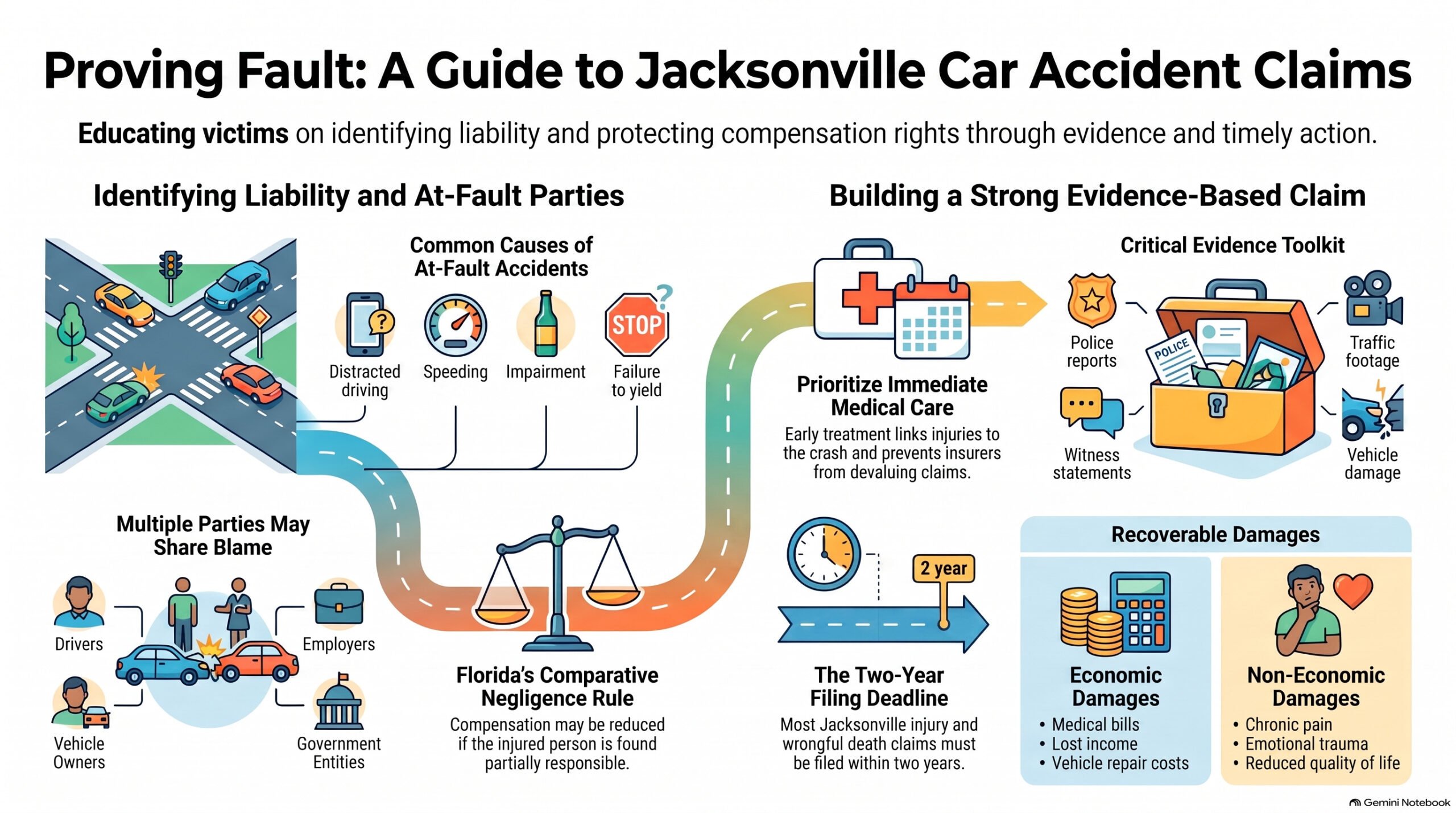
- Fault may be proven through crash reports, photos, witness statements, vehicle damage, medical records, and video footage.
- A lawyer can manage insurer communications to prevent statements or early settlements from weakening your injury claim.
- Comparative negligence arguments may reduce compensation, so evidence must clearly connect conduct, causation, and harm.
- Legal support may include coverage review, medical coordination, settlement evaluation, negotiation, and litigation if needed.


How We Can Help With Your Jacksonville Car Accident At-Fault Parties Injury Claim
After a collision, determining who is legally responsible can affect every part of an injury claim, including medical expenses, lost income, vehicle damage, and compensation for pain and suffering. A Jacksonville car accident at-fault-party lawyer may assist by organizing the claim, identifying legal deadlines, and communicating with insurers, so the injured person can focus on recovery and service to family, work, and community.
Careful Evidence Handling supports a reliable presentation of the claim. This may include preserving crash reports, photographs, medical records, witness statements, repair estimates, and available video footage. Counsel can also review insurance coverage, coordinate with medical providers, and evaluate whether settlement offers reflect the full impact of the injuries.
Proving Damages requires a clear connection between the collision and the losses claimed. Through documentation, expert input when appropriate, and structured negotiation, the lawyer helps present a complete account of harm while protecting the claimant’s rights throughout the process.
OUR CONSULTATIONSARE FREE
START YOUR FREE CASE REVIEW

Understanding Jacksonville Car Accident At-Fault Parties Injury Cases
When a traffic collision occurs in Jacksonville, an at-fault parties injury case centers on identifying each person or entity whose conduct contributed to the crash and the resulting harm. This assessment may involve drivers, vehicle owners, employers, government agencies, or other responsible parties, depending on the available evidence. For injured individuals and families seeking stability, careful fault analysis helps ensure that responsibility is directed where it belongs.
These cases often call for review of police reports, witness accounts, medical records, vehicle data, photographs, and insurance communications. Comparative negligence defenses may arise when an insurer argues that the injured person shares some responsibility, potentially reducing available compensation. A lawyer evaluates those claims in light of the evidence and Florida law.
Insurance bad faith patterns can also affect how claims are handled, especially when carriers delay, undervalue, or deny valid claims. Understanding these issues supports fair treatment and helps protect those who need recovery resources.
Common Causes of Jacksonville Car Accident At-Fault Parties
Common causes of Jacksonville car accident at-fault parties often include distracted driving, speeding and recklessness, impaired driving, and failure to yield. Each of these behaviors can create dangerous roadway conditions, increase the likelihood of collisions, and affect liability determinations. Identifying the cause of a crash is important because fault may depend on traffic laws, driver conduct, and the evidence available after the accident.
Distracted Driving
Distracted driving is a frequent cause of car accidents in Jacksonville because it reduces a driver’s ability to observe traffic conditions, react to hazards, and maintain proper control of the vehicle. Common distractions include texting, handheld calls, navigation adjustments, eating, grooming, or conversations that draw attention from the roadway. Phone distraction hazards are especially serious because visual, manual, and cognitive attention may be divided simultaneously. When a collision occurs, evidence of distracted driving may help identify an at-fault party and support accountability. Such evidence can include phone records, vehicle data, witness statements, camera footage, and police observations. Careful review of these materials serves injured individuals, families, and the broader community by encouraging safer conduct and responsible driving in Jacksonville.
Speeding And Recklessness
Because excessive speed reduces reaction time and increases crash severity, speeding is a major factor in many Jacksonville car accidents involving at-fault parties. Drivers who ignore posted limits, race through traffic, or approach intersections too quickly may place passengers, pedestrians, cyclists, and other motorists at serious risk. Speeding evidence may include skid marks, vehicle damage patterns, surveillance footage, event data recorders, and witness statements. When combined with aggressive lane changes, tailgating, or disregard for road conditions, excessive speed may also support an argument for reckless intent. Careful evaluation helps identify responsible parties and supports those seeking accountability for preventable harm. In service-centered legal work, establishing how speed contributed to a crash can help injured individuals pursue recovery while promoting safer conduct throughout the Jacksonville community.
Impaired Driving
Impaired driving remains one of the most serious causes of Jacksonville car accidents involving at-fault parties, as alcohol, illegal drugs, and certain prescription medications can diminish judgment, coordination, reaction time, and hazard awareness. When a driver operates a vehicle while impaired, other motorists, passengers, pedestrians, and cyclists may face preventable harm. Investigations may consider police observations, alcohol breath tests, toxicology results, dash camera footage, and witness statements to determine whether impairment contributed to the collision. Sobriety checkpoints may also identify impaired drivers before they cause serious injuries. For those committed to serving injured people and promoting safer roads, impaired driving cases require careful attention to accountability, medical needs, and long-term consequences. Establishing fault helps victims seek compensation and supports broader community efforts to deter dangerous driving behavior.
Failure To Yield
Failure to yield is another common cause of Jacksonville car accidents involving at-fault parties, particularly at intersections, highway merges, parking lot exits, crosswalks, and left-turn situations. When a driver ignores traffic signs, misjudges another vehicle’s approach, or fails to respect crosswalk right-of-way, the resulting impact can place pedestrians, passengers, and nearby motorists in serious danger. These collisions often occur because a driver prioritizes speed or convenience over the duty to proceed with care. In injury claims, investigators may review traffic signals, witness statements, vehicle positions, and camera footage to determine whether Failure to yield caused the crash. Establishing fault can help injured individuals seek accountability, obtain support for recovery, and promote safer conduct that protects the broader Jacksonville community and roadways for everyone.
Don’t Wait. Call Our Florida Personal Injury Lawyers Now!


Legal Rights of Jacksonville Car Accident At-Fault Parties Injury Victims
After a serious collision in Jacksonville, injury victims have legal rights that may allow them to pursue compensation even when fault is disputed or shared among multiple parties. Florida law permits injured people to seek recovery for medical care, lost income, pain, and other losses, while insurers may raise comparative negligence defenses to reduce payment. Victims may also have uninsured motorist claims when a responsible driver lacks adequate coverage.
- Right to investigate fault: Evidence may be gathered to identify all liable drivers, owners, employers, or insurers involved.
- Right to challenge blame: An injured person may contest unfair fault assignments through records, witness statements, and expert analysis.
- Right to pursue available coverage: Claims may proceed through bodily injury policies, personal injury protection, or other applicable insurance.
These rights help protect injured individuals while supporting families, caregivers, and communities affected by preventable roadway harm in Jacksonville.
Why Do Jacksonville Car Accident At-Fault Party Injuries Happen?
Why do at-fault party injuries occur in Jacksonville car accidents when most drivers understand basic roadway safety? These injuries often arise because safe intentions do not always overcome poor judgment, distraction, fatigue, or impatience. A driver may misread traffic patterns, follow too closely, speed through congestion, or make an unsafe lane change, thereby placing everyone nearby at risk.
Other causes may involve circumstances that responsible community members should recognize. The Impact of weather can be significant, especially when heavy rain, standing water, glare, or reduced visibility affects stopping distance and vehicle control. Jacksonville’s busy roads, bridges, and intersections can magnify these hazards when drivers fail to adjust.
In some collisions, vehicle defects also contribute to injuries to the at-fault party. Faulty brakes, worn tires, defective steering components, or malfunctioning lights may prevent a driver from avoiding harm. Understanding these causes helps identify preventable risks and supports safer choices for all road users.
What Should You Do After a Jacksonville Car Accident At-Fault Party Injury?
After a car accident in Jacksonville, the injured person should seek medical care promptly, even if symptoms appear minor. Clear documentation of the accident, including photographs, witness information, and insurance details, may help preserve important evidence. Consulting a lawyer can also help identify at-fault parties, protect legal rights, and pursue available compensation.
Seek Medical Care
Prompt medical care is important when a person suffers injuries in a Jacksonville car accident, even when symptoms appear minor or delayed. A prompt evaluation helps identify conditions such as concussions, internal injuries, soft tissue damage, or fractures that may worsen without treatment. It also supports recovery, allowing the injured person to regain stability and continue serving family, work, and community responsibilities.
Medical Records created soon after the crash can connect injuries to the collision and show the need for ongoing care. These records may become Proper Evidence when determining how an at-fault party’s conduct caused harm. Following medical advice, attending appointments, and completing recommended treatment demonstrate responsible action. Delays in care may give insurers an opportunity to question the injury’s cause, severity, or connection to the accident.
Document The Accident
When safety permits, documenting the accident scene can preserve important information that may later clarify how the Jacksonville crash occurred and who bears responsibility. Scene safety should remain the first concern, including moving from traffic when possible and avoiding hazards. A person assisting an injured driver may photograph vehicle positions, roadway conditions, skid marks, traffic signals, debris, and visible property damage. It is also important to document injuries through photographs and written notes, especially when symptoms appear or change. Those present should note witnesses by recording names, contact information, and brief observations, without pressuring anyone to give opinions. Receipts, medical paperwork, damaged personal items, and repair estimates should be kept to preserve evidence. Careful records can support accurate reporting and help protect all affected individuals.
Contact A Lawyer
For anyone injured in a Jacksonville car accident involving disputed fault, contacting a lawyer early can help protect legal rights and prevent avoidable mistakes. Legal counsel can review the crash facts, identify potentially responsible parties, and preserve evidence before it becomes unavailable. This support is especially important when collecting witness proof, securing camera footage, or responding to insurer questions. A lawyer may also monitor Insurance claim timelines, ensuring required notices, filings, and communications occur without delay. For individuals focused on caring for family, passengers, or others affected by the collision, legal guidance can reduce confusion and promote responsible decision-making. Early representation may also help prevent statements or incomplete records from being used unfairly. Prompt consultation provides the injured person with a clearer path to accountability, compensation, and stability.
Critical Evidence in a Jacksonville Car Accident At-Fault Parties Injury Case
Critical evidence can determine how fault is assigned in a Jacksonville car accident injury case, especially when multiple parties dispute liability.
Critical proof may include:
1. police crash reports, 2. witness statements and traffic camera footage, and 3. vehicle damage evidence.
Each category can help clarify the sequence of events, support injury claims, and strengthen the injured party’s position during settlement negotiations or litigation.
Police Crash Reports
Although fault may remain disputed after a Jacksonville car accident, the police crash report often provides one of the first structured accounts of how the collision occurred. This report may identify involved drivers, vehicle positions, traffic controls, citations, road conditions, and the officer’s preliminary observations. For those assisting injured people, the report can guide a focused review of responsibility while preserving compassion and practical direction. It may also help locate physical evidence, compare statements with dashcam footage, and support later medical record review by linking reported impact details to documented injuries. However, the report is not always final proof of fault. Errors, omissions, or limited on-scene information may affect its value. Careful legal evaluation helps determine how the report fits into the broader body of evidence needed for recovery.
Witness Statements
Beyond the police crash report, witness statements may provide independent details that clarify how a Jacksonville car accident occurred and who may be legally responsible. Neutral bystanders, passengers, nearby workers, or responding citizens may describe vehicle speed, lane position, signals, driver conduct, weather, and immediate statements made after impact. Attorneys evaluate these accounts through witness credibility assessment, considering consistency, opportunity to observe, distance, lighting, and whether the witness has any relationship to the parties. Eyewitness bias considerations are also important, because stress, limited memory, assumptions, or sympathy can affect accuracy. Promptly recorded statements often carry greater value, especially when they support physical evidence and medical timelines. In an injury case, careful witness evaluation helps preserve truth, assign fault fairly, and support responsible service to harmed individuals.
Traffic Camera Footage
When a collision occurs at or near a monitored intersection, traffic camera footage can provide objective evidence that helps determine fault in a Jacksonville car accident injury case. These recordings may show traffic signal timing, lane position, turning movements, speeding, or a driver’s failure to yield. Surveillance footage from nearby businesses, parking areas, or public facilities may also clarify how the crash occurred and whether another party contributed to the harm. Because many systems overwrite recordings quickly, evidence preservation must be addressed promptly. An attorney may send preservation requests to government agencies, private property owners, or other custodians to help protect relevant video. This evidence can support a fair review of responsibility, helping injured individuals pursue accountability while promoting safer conduct within the community.
Vehicle Damage Evidence
Because vehicle damage often reflects the mechanics of a collision, it can serve as important physical evidence in a Jacksonville car accident injury case involving disputed fault. Dents, crush patterns, broken lights, deployed airbags, and scrape marks may help identify points of impact, vehicle positions, and the force involved. Careful photo documentation should be completed before repairs, salvage, or disposal occur, so the condition of each vehicle remains preserved for review.
A prompt vehicle inspection may also reveal hidden structural damage, tire marks, or mechanical issues relevant to fault. Crash reconstruction professionals can compare damage patterns with roadway evidence, witness accounts, and medical findings. Property damage records, repair estimates, and total-loss evaluations may further support a clear, service-focused effort to determine responsibility and protect injured parties.
Long-Term Effects of Jacksonville Car Accident At-Fault Parties Injuries
Long-term injuries from Jacksonville car accidents may extend beyond initial treatment, particularly when chronic pain complications interfere with daily function. Lasting mobility limitations can affect employment, household responsibilities, and overall independence, often requiring ongoing medical care or rehabilitation. Emotional trauma impacts, including anxiety, sleep disruption, and fear of driving, may also influence the full value of an injury claim.
Chronic Pain Complications
Although some crash injuries appear to stabilize after emergency treatment, chronic pain can develop weeks or months later and interfere with nearly every part of an injured person’s life. Persistent neck, back, joint, or nerve pain may require repeated evaluations, diagnostic testing, therapy, and careful Medication management. These conditions can affect sleep, concentration, work reliability, family responsibilities, and the ability to participate in service-oriented roles. For Jacksonville crash victims, consistent insurance documentation is essential because insurers may question pain that is not immediately visible or easily measured. Medical records, treatment notes, prescriptions, pain journals, and provider opinions can help connect ongoing symptoms to the collision. When pain becomes a lasting complication, responsible parties may be held accountable for treatment costs, reduced earning capacity, and diminished quality of life.
Lasting Mobility Limitations
Chronic pain can also contribute to lasting mobility limitations, especially when injuries affect the spine, hips, knees, ankles, shoulders, or major muscle groups. After a Jacksonville collision, reduced range of motion, weakness, balance problems, or impaired coordination may limit walking, lifting, driving, and daily caregiving responsibilities. These restrictions can affect a person’s ability to work, attend medical appointments, assist family members, or participate in community service.
Rehab planning helps identify needed therapy, assistive devices, home modifications, and transportation support. Medical providers may document whether limitations are temporary, progressive, or permanent. Future mobility planning can also address long-term costs, including continued treatment, mobility equipment, and accessible living arrangements. When at-fault parties cause disabling injuries, these practical needs may become central to evaluating the full impact of the crash.
Emotional Trauma Impacts
After a serious Jacksonville car accident, emotional trauma may persist well beyond the initial physical recovery period. Survivors may experience anxiety, sleep disruption, irritability, depression, or fear of driving, each of which can limit work, caregiving, and community involvement. These effects may also strain family relationships, especially when pain, medical appointments, and financial pressure remain unresolved. Post-accident counseling can help document symptoms, support recovery, and provide structured care when emotional harm affects daily function. In claims involving at-fault parties, mental health records may become important evidence of damages. Careful handling of insurance disputes is often necessary when insurers minimize trauma or separate it from the collision. A thorough legal review can help connect emotional injuries to the crash, supporting fair compensation and stability.
Proving Liability in Jacksonville Car Accident At-Fault Parties Injury Cases
When a Jacksonville car accident results in injury, proving liability requires more than identifying who received a citation or who appeared careless at the scene. A careful review must connect conduct, causation, and harm through reliable proof. Identifying fault may involve roadway conditions, vehicle positions, traffic signals, driver distractions, and whether multiple parties contributed to the crash.
For injured people and those helping them recover, proving negligence depends on disciplined preservation of evidence. Photographs, crash reports, vehicle damage, medical records, surveillance footage, and electronic data can show how the collision occurred and why responsibility should attach. Prompt action often protects details that may otherwise be lost.
Witness credibility is also central. Statements should be consistent, timely, and compared with physical evidence. A Jacksonville car accident at-fault parties injury case becomes stronger when each fact is organized to serve the injured person’s needs while presenting a clear, principled account of responsibility before a court.
Don’t Wait. Call Our Florida Personal Injury Lawyers Now!
Dealing With Insurance Companies After a Jacksonville Car Accident At-Fault Parties Injury
Because insurance companies begin evaluating exposure soon after a collision, communications following a Jacksonville car accident should be handled with care and precision. Adjusters may request statements, authorizations, or early settlement discussions while injured individuals are still appraising pain, mobility, and financial strain. A measured response helps protect truthful information from being misunderstood or from being used to evade responsibility.
An at-fault party’s lawyer may guide communications by reviewing policy positions, preserving consistent facts, and limiting unnecessary disclosures. Medical records should be organized carefully, since they connect injuries to the crash and help document treatment needs. A sound Negotiation strategy also considers liability evidence, available coverage, wage loss, and the long-term effect of the injury on daily service to family, work, and community.
Careful handling of insurer contact supports fair evaluation without hostility. It allows the injured person’s needs to be presented firmly and respectfully, supported by documentation that reflects the full impact of the collision.
What to Expect During a Jacksonville Car Accident At-Fault Parties Injury Claim Process
A Jacksonville car accident at-fault party’s injury claim typically begins with an initial case review, in which the facts, injuries, and available evidence are assessed. The process then moves to fault investigation steps, insurance claim negotiations, and evaluation of available compensation. Depending on the insurers’ response and the disputed liability issues, the matter may be resolved through settlement or proceed to litigation.
Initial Case Review
During an initial case review, a Jacksonville car accident at-fault parties lawyer evaluates the available facts to determine who may be legally responsible for the crash and resulting injuries. This review often includes the client’s account, police reports, photographs, witness information, medical documentation, and any communication from insurers. The lawyer also considers the Insurance timeline, including notice requirements, coverage issues, and important response deadlines that may affect recovery. With a service-focused approach, the review helps identify immediate client needs, such as ongoing treatment, wage-loss concerns, and protection against premature settlement pressure. The lawyer may explain potential claim paths, available compensation categories, and practical next steps. This early assessment provides structure, helps preserve options, and allows the injured person to proceed with confidence and information.
Fault Investigation Steps
After the initial case review, the fault investigation typically focuses on collecting and testing evidence to determine how the Jacksonville car accident occurred and which parties contributed to it. Investigators may review crash reports, scene photographs, vehicle damage, roadway conditions, witness accounts, and medical records to understand the forces involved and the harm caused. Digital evidence, including traffic camera footage, dashcam recordings, phone data, and vehicle event data, may help confirm speed, braking, distraction, or lane position. The legal team may also build an accident timeline to connect each fact in a clear sequence. This careful process supports fair accountability, protects injured people, and helps identify all responsible parties, including drivers, vehicle owners, employers, or entities responsible for unsafe road conditions.
Insurance Claim Negotiations
Once liability evidence and medical documentation are developed, insurance claim negotiations may begin with a structured demand to the at-fault party’s insurer or multiple insurers. The demand typically outlines the collision facts, injuries, treatment course, lost income, future care needs, and the legal basis for responsibility. Adjusters review the submission, assess causation, compare damages to Policy limits, and may request clarification or additional records. A careful settlement strategy considers available coverage, comparative fault arguments, lien obligations, and the injured person’s long-term needs. Communication should remain organized, respectful, and evidence-based, reflecting a commitment to fair service for those harmed. Negotiations may involve several exchanges, with each response measured against documented losses and applicable Florida law, while protecting the claimant from avoidable concessions or undervaluation during review.
Settlement Or Litigation
If negotiations produce a fair offer, the claim may resolve through a settlement agreement that releases the at-fault party and applicable insurers in exchange for payment. This outcome can provide timely resources for medical care, family stability, and restored independence. Settlement timelines depend on treatment progress, documentation, insurance review, and the strength of liability evidence. A measured Negotiation strategy considers future expenses, comparative fault issues, and policy limits before accepting any offer.
When an insurer denies responsibility or undervalues harm, litigation may become necessary. Filing a lawsuit allows formal discovery, sworn testimony, expert review, and court supervision. Many cases still settle after suit is filed, often when evidence becomes clearer. If trial is required, the injured person seeks a judgment assigning fault and damages under Florida law.
Compensation for Jacksonville Car Accident At-Fault Parties Injury Damages
How can compensation be determined when several parties may share fault for a Jacksonville car accident? A careful review begins with the available evidence, including police reports, witness accounts, vehicle damage, traffic data, and medical records. When fault is divided among drivers, vehicle owners, employers, or other responsible entities, each party’s conduct may affect the recovery available to an injured person.
An effective Insurance settlement strategy requires identifying every liable source of coverage, preserving deadlines, and presenting a well-supported claim. Medical expense documentation is especially important because it helps connect the collision to treatment needs, rehabilitation, and ongoing care requirements. Clear records also assist insurers, courts, and opposing parties in evaluating the seriousness of the injury.
A Jacksonville car accident at-fault-party lawyer may organize evidence, communicate with insurers, and pursue compensation in a way that supports accountability while helping injured individuals regain stability with dignity and practical care after serious harm.
Economic vs Non-Economic Damages in Jacksonville Car Accident At-Fault Parties Cases
In Jacksonville car accident at-fault-party cases, damages are generally divided into economic losses and non-economic harm. Economic losses may include medical expenses, lost income, and repair costs, while non-economic harm addresses pain, emotional distress, and reduced quality of life. Proving at-fault damages requires clear documentation, credible evidence, and a careful valuation of how the crash affected the injured party.
Calculating Economic Losses
Calculating economic losses in a Jacksonville car accident case requires a careful review of the financial harm directly connected to the crash, including medical expenses, lost income, reduced earning capacity, property damage, and other documented out-of-pocket costs. Attorneys and claims professionals often begin by verifying insurance coverage to identify available benefits, policy limits, and responsible carriers. Medical billing documentation then helps confirm treatment charges, payment adjustments, and balances that may affect recovery. Wage records, tax returns, employer statements, repair estimates, rental invoices, and receipts can further establish measurable losses. When future medical care or diminished work ability is involved, qualified experts may provide projections grounded in reliable data. This disciplined process supports fair accountability, helping injured individuals pursue resources needed to restore stability and meet practical responsibilities after a collision.
Valuing Non-Economic Harm
Financial records can show measurable losses after a Jacksonville car accident, but they do not fully capture the personal harm caused by pain, physical limitations, emotional distress, or loss of daily enjoyment. Non-economic damages address these human consequences, recognizing how an injury can alter routines, family roles, work capacity, and community involvement. Their value may depend on the nature of the injury, the duration of recovery, permanency, and the extent to which daily life has changed. Careful documentation of pain severity may help describe ongoing discomfort, treatment response, and functional limitations in a structured manner. Emotional distress proof may also reflect anxiety, sleep disruption, fear of driving, or strained relationships. A fair assessment considers dignity, service to others, and the injured person’s restored ability to participate meaningfully in life.
Proving At-Fault Damages
After a Jacksonville car accident, proving at-fault damages requires evidence that connects the responsible party’s conduct to both economic and non-economic losses. Economic damages may include medical bills, lost wages, rehabilitation costs, vehicle repairs, and future care needs. Non-economic damages address pain, emotional anguish, reduced mobility, and loss of daily independence. A careful presentation often relies on treatment records, employment documentation, repair estimates, photographs, and expert opinions. Witness credibility proof can strengthen the account of how the crash occurred and how injuries affected the injured person’s life. For those focused on serving others, accurate documentation helps ensure accountability without overstating harm. An effective insurance negotiation strategy should clearly organize these losses, anticipate disputes, and support fair compensation with consistent, verified evidence tied to the at-fault party’s actions.
When a Jacksonville Car Accident At-Fault Parties Injury Case Goes to Trial vs Settlement
Choosing between trial and settlement in a Jacksonville car accident at-fault parties injury case depends on the strength of the evidence, the number of liable parties, the severity of the injuries, and the willingness of insurers to offer fair compensation. A thoughtful settlement strategy can conserve time, reduce conflict, and help injured people obtain resources needed for care, stability, and family support. A trial may become necessary when responsibility is disputed, damages are undervalued, or an insurer refuses to account for lasting medical, financial, and personal losses.
Trial vs arbitration considerations may also affect how evidence is presented and how decisions are reached, though each path requires careful preparation. Strong attorney-client communication helps ensure that goals, risks, and practical needs remain clear throughout negotiations or courtroom proceedings. When settlement offers do not reflect proven losses, a trial may provide a structured opportunity to seek accountability from all responsible parties.
Florida Laws That May Affect Your Jacksonville Car Accident At-Fault Parties Case
Because Florida law shapes both liability and compensation, a Jacksonville car accident at-fault parties case must be evaluated under rules that determine who may be held responsible, how fault is allocated, and what damages may be recovered.
These rules guide injured people, caregivers, and community-minded advocates seeking fair accountability after preventable harm.
- Florida no-fault basics generally require injured occupants to first use personal injury protection benefits, regardless of who caused the crash, before pursuing certain claims against an at-fault driver.
- Comparative negligence rules may reduce compensation when an injured person shares responsibility for the collision, making careful review of the evidence critical.
- Additional liability may arise when employers, vehicle owners, rideshare companies, contractors, or negligent maintenance providers contributed to unsafe conditions.
A lawyer reviewing these laws can identify responsible parties, preserve supporting evidence, and pursue recovery in a manner that supports both the injured person and those depending on meaningful assistance.
The Statute of Limitations for Jacksonville Car Accident At-Fault Parties Injury Cases
Time limits also shape a Jacksonville car accident at-fault parties injury case, since even a well-supported claim may be barred if it is not filed within the period required by law. In Florida, most negligence-based injury claims arising from motor vehicle collisions must be filed within two years from the date of the crash. If the injured person dies, a wrongful death claim generally must also be filed within two years, measured from the date of death.
These deadlines encourage prompt action, which serves injured people, families, witnesses, and the broader interest in reliable justice. Early attention also supports Comparative negligence analysis, because responsibility may be shared among drivers, employers, vehicle owners, or other parties. Delays can weaken that assessment as memories fade and records disappear. Evidence preservation deadlines may apply to vehicle data, surveillance footage, maintenance records, and insurance materials. Missing a filing deadline can prevent recovery, regardless of the injury’s severity or the need.
Don’t Wait. Call Our Florida Personal Injury Lawyers Now!
How a Jacksonville Car Accident At-Fault Parties Lawyer Can Help You
After a serious collision, a Jacksonville car accident at-fault parties lawyer can help identify every person or entity whose conduct may have contributed to the crash. This assistance supports injured individuals who wish to protect their families, honor responsibilities, and pursue accountability without unnecessary confusion.
- Investigating fault: Counsel may review police reports, witness statements, crash data, roadway conditions, and vehicle maintenance issues to determine whether multiple parties share responsibility.
- Managing documentation: A lawyer can assist with organizing medical records, treatment summaries, wage information, and evidence of damages, helping to present a clear account of the losses caused by the collision.
- Handling insurers: Legal representation may monitor Insurance claim timelines, communicate with adjusters, respond to requests, and challenge efforts to shift blame or undervalue harm.
Through structured case management, the lawyer helps align legal action with the client’s practical needs, while preserving evidence and presenting claims with discipline, accuracy, and purpose.
When to Contact a Jacksonville Car Accident At-Fault Parties Lawyer
In the days immediately following a collision, an injured person may benefit from contacting a Jacksonville car accident at-fault parties lawyer, especially when fault is disputed, injuries are significant, or more than one driver may be involved. Early consultation can help clarify responsibilities, protect legal deadlines, and reduce confusion during a stressful period for the injured person and those assisting with care.
Prompt contact is also important when vehicles were towed, witnesses may become difficult to locate, or insurance representatives begin requesting recorded statements. Evidence preservation can depend on timely action, including securing photographs, crash reports, medical records, and available video footage before it is lost or overwritten.
A lawyer may also explain how the Settlement timeline can be affected by medical treatment, liability disputes, and insurance review. By seeking guidance early, an injured person and supportive family members can make informed decisions while focusing on recovery, stability, and practical needs.
Why You Need an Experienced Jacksonville Car Accident At-Fault Parties Lawyer
When liability is uncertain or multiple parties may share responsibility, an experienced Jacksonville car accident at-fault parties lawyer can provide critical guidance in identifying who may be legally accountable. This support is especially important when injured individuals, families, caregivers, or advocates seek fair outcomes while focusing on recovery and service to others. A lawyer can examine crash reports, witness accounts, vehicle damage, roadway conditions, and insurer communications to determine whether drivers, employers, vehicle owners, manufacturers, or government entities may bear responsibility.
Experienced counsel can also coordinate medical bill review, helping connect documented injuries with necessary treatment and related expenses. When insurers dispute fault, minimize damages, or refuse payment, legal guidance may support Insurance denial appeals through organized evidence and timely responses. This careful approach helps protect claim value, reduces unnecessary burdens on those assisting the injured, and promotes accountability among all responsible parties involved in the collision and aftermath.
How to Choose the Right Jacksonville Car Accident At-Fault Parties Lawyer for Your Case
How should an injured person evaluate legal representation when fault may be disputed or divided among several parties? The selection should begin with a careful review of the lawyer’s experience handling comparative fault, insurance defenses, and multi-party crash investigations in Jacksonville. A qualified attorney should explain how evidence will be gathered, how liability may be apportioned, and how the client’s interests will be protected throughout negotiations or trial.
The injured person should also seek clear communication, sound judgment, and respectful guidance to support informed decisions. Fee transparency and contingency agreements should be discussed early, including costs, deductions, and payment responsibilities. Counsel should provide a realistic Case timeline, litigation strategy, and explain what may affect progress, such as medical treatment, expert review, or disputed coverage.
The right lawyer will combine careful preparation with service-minded advocacy, helping the injured person pursue accountability while reducing avoidable confusion and stress.
About The Law Offices of Anidjar & Levine
Selecting counsel often leads injured people to look for firms with a strong local presence, organized case management, and a record of handling contested liability claims.
The Law Offices of Anidjar & Levine serves Jacksonville clients by investigating crash circumstances, identifying responsible parties, and developing Liability proof through records, witness accounts, expert input, and physical evidence.
The firm’s work often includes reviewing police reports, medical documentation, vehicle damage, traffic laws, and available surveillance to clarify how negligence occurred.
Its attorneys also address Insurance tactics, including delayed responses, disputed fault, undervalued injuries, and pressure to accept early settlements.
By managing communications and deadlines, the firm helps clients focus on recovery and family responsibilities.
For those who value service, accountability, and careful advocacy, the firm’s approach reflects organized support during a difficult period.
Its role is to pursue fair compensation while treating each case with disciplined attention, professional judgment, and respect for the client’s broader needs.
Frequently Asked Questions
Can Multiple Parties Share Fault in a Jacksonville Car Accident?
Yes, multiple parties can share fault in a Jacksonville car accident. Florida applies comparative negligence, meaning responsibility may be divided among drivers, vehicle owners, employers, manufacturers, or other negligent actors. Each party’s percentage of shared fault can affect financial recovery. Those assisting injured persons should preserve evidence, identify all contributors, and seek careful liability analysis, since accurate fault allocation helps protect accountability, fairness, and critical support for those harmed.
What if the At-Fault Driver Was Working During the Crash?
If the at-fault driver was working at the time of the crash, the employer may share responsibility if the employee was acting within the scope of their job duties. Employer Liability can apply to deliveries, service calls, or business errands, depending on the degree of control and the purpose. Worker Protection concerns may also arise if unsafe schedules, inadequate training, or defective vehicles contributed to the incident. A careful review helps identify responsible parties, supports fair recovery for those harmed, and promotes accountable service practices.
Can a Vehicle Owner Be Liable if Someone Else Was Driving?
Yes, a vehicle owner can be liable when another person drives, depending on vicarious liability rules, the facts of vehicle ownership, and any driver negligence involved. Liability may arise if the owner entrusted the vehicle to an unsafe driver, permitted its use, or had an agency relationship with the driver. Insurance responsibility often follows the vehicle, though policy terms matter. Careful review helps protect injured people and promote accountable service to others.
Are Rideshare Companies Responsible for Jacksonville Car Accident Injuries?
Rideshare companies may be responsible for accident injuries when the driver was logged into the app, carrying passengers, or acting within the platform’s scope. Responsibility depends on insurance coverage, driver status, and a careful analysis of negligence. Those assisting injured individuals should review trip records, police findings, and company policies. Liability may also extend to the rideshare driver, another motorist, or other parties whose conduct caused the collision.
Can Poor Road Design Make the City Partially at Fault?
Yes, poor road design can make a city partially at fault when it contributes to a collision. Poorly designed intersections, unsafe signal placement, or inadequate lane markings may create foreseeable hazards for careful drivers, cyclists, and pedestrians. Investigators may examine maintenance records, prior complaints, crash history, and engineering standards to determine responsibility. Those serving injured individuals should consider whether public entities shared fault, subject to notice requirements and statutory limits.
—————————
Determining fault after a Jacksonville car accident can be complicated, particularly when multiple parties, insurers, and legal deadlines are involved.
An experienced at-fault parties lawyer can investigate the crash, preserve evidence, identify liable parties, and pursue compensation for medical expenses, lost income, and other related losses.
The Law Offices of Anidjar and Levine offers knowledgeable guidance to injured victims through its Jacksonville Personal Injury Lawyer services, helping protect their rights while they focus on recovery and the challenges that follow a serious collision.