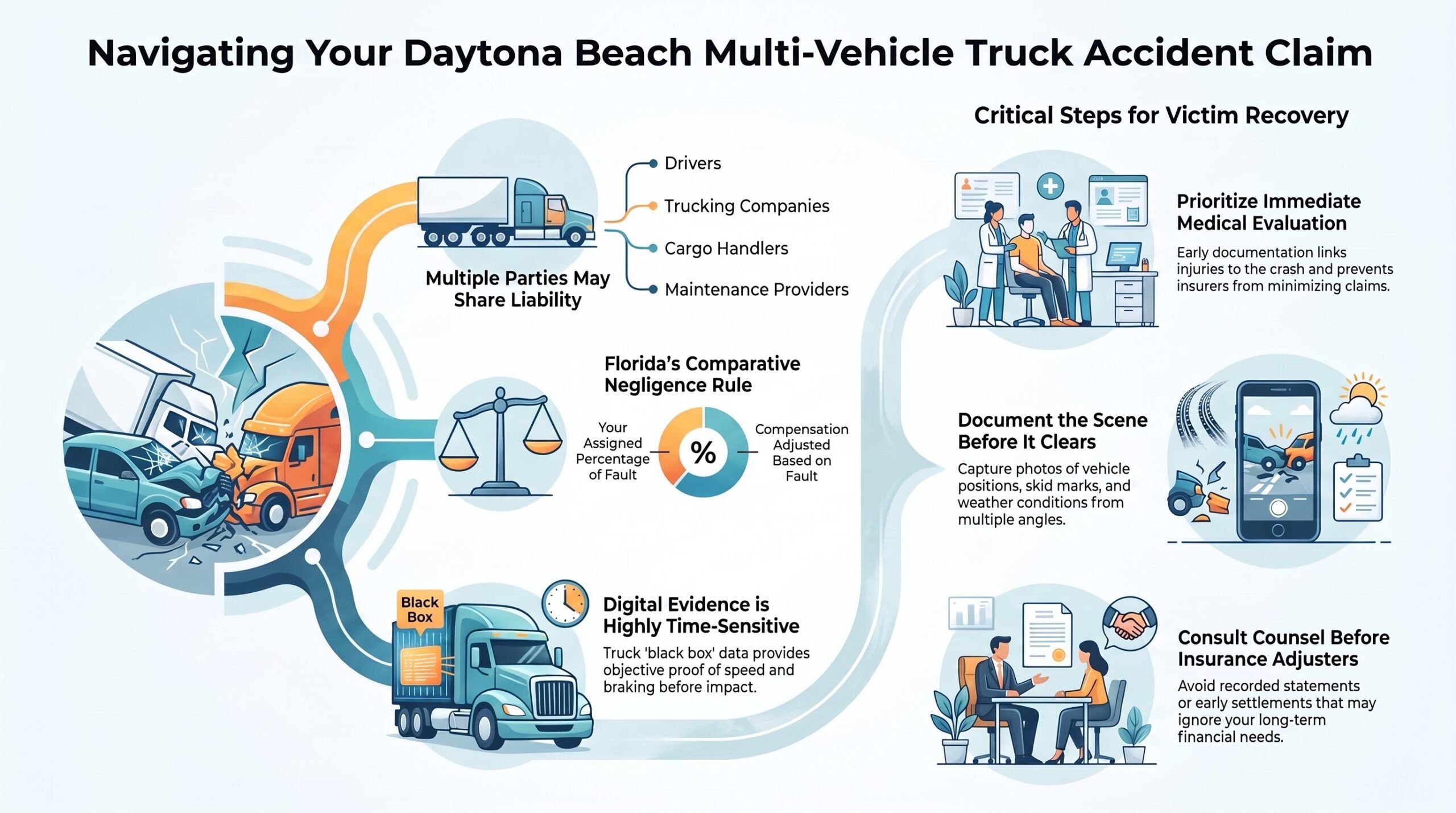
A Daytona Beach multi-vehicle truck accident lawyer from The Law Offices of Anidjar and Levine investigates all potentially responsible parties, including drivers, trucking companies, cargo handlers, and insurers.
The lawyer preserves black box data, driver logs, maintenance records, photographs, witness statements, and surveillance footage before evidence disappears.
Legal counsel also coordinates medical documentation, evaluates present and future losses, addresses comparative negligence, and negotiates with insurers to avoid inadequate settlements.
After urgent medical care, prompt legal guidance from a Daytona Beach Truck Accident Lawyer can help protect a victim’s rights.
Further information explains the process and available options.
Main Takeaways
- A Daytona Beach multi-vehicle truck accident lawyer investigates every potentially responsible party, including drivers, trucking companies, cargo handlers, and maintenance providers.
- Attorneys preserve critical evidence, including black-box data, driver logs, photographs, surveillance footage, vehicle records, and witness statements.
- Lawyers evaluate comparative negligence and build liability arguments based on evidence rather than vehicle positions after the collision.
- Legal counsel calculates medical expenses, lost income, property damage, future care needs, and applicable insurance coverage.
- After seeking immediate medical attention, contact a truck accident lawyer before speaking with insurers or accepting a settlement offer.


How We Can Help With Your Daytona Beach Multi-Vehicle Truck Accident Injury Claim
When a multi-vehicle truck accident occurs in Daytona Beach, an experienced truck accident lawyer can help an injured person pursue a claim against every potentially responsible party. The lawyer can organize a Settlement strategy based on medical needs, lost income, property damage, and the available insurance policy limits. Early review of applicable policies may clarify potential coverage and prevent an injured person from accepting an inadequate offer.
Counsel can also manage legal documentation, including claim forms, medical records, wage information, correspondence, and settlement materials. Careful preparation promotes accurate communication with insurers and supports a more complete evaluation of damages. Evidence preservation is another critical service.
The lawyer may identify photographs, vehicle data, maintenance records, driver logs, witness statements, and surveillance footage that could become unavailable over time. By coordinating these efforts, counsel can reduce administrative burdens and help an injured person make informed decisions. The representation remains focused on accountability, fair treatment, and practical support throughout the claim process.
OUR CONSULTATIONSARE FREE
START YOUR FREE CASE REVIEW

Understanding Daytona Beach Multi-Vehicle Truck Accident Injury Cases
Multi-vehicle truck accident injury cases in Daytona Beach often involve multiple drivers, trucking companies, insurers, and other parties whose conduct may have contributed to the collision. Because several vehicles and impact points may be involved, injury claims require careful reconstruction of events, medical documentation, and evaluation of each person’s legal responsibility.
Investigators may examine police reports, vehicle damage, electronic data, witness statements, and Surveillance footage to establish the sequence of impacts. Medical records help connect reported injuries to the crash and document treatment, limitations, and anticipated care. Employment information may also be relevant when injuries affect earning capacity or daily responsibilities.
Florida’s comparative negligence rules can affect recovery when more than one party shares responsibility. Accordingly, fault determination requires a detailed assessment of evidence rather than assumptions based on the final vehicle position. A legal professional may coordinate communications with insurers, preserve relevant records, and present a claim that accurately reflects the injured person’s losses and continuing needs.
Common Causes of Daytona Beach Multi-Vehicle Truck Accident
Common causes of multi-vehicle truck accidents in Daytona Beach include distracted truck drivers, speeding, and other forms of reckless driving. Improper lane changes can also create sudden hazards, particularly when large trucks have limited visibility or require greater stopping distances. Hazardous weather conditions, including heavy rain and reduced visibility, may further increase the risk of collisions involving multiple vehicles.
Distracted Truck Drivers
Distracted truck drivers pose a serious risk in Daytona Beach because the size and weight of commercial vehicles leave little margin for error during sudden traffic changes. Distractions may include mobile phone use, dashboard technology, eating, conversations, or attempts to locate paperwork while operating a large vehicle. Text messaging violations are particularly dangerous because reading or composing a message diverts visual, manual, and cognitive attention from surrounding traffic.
Fatigue can create similar impairment, reducing awareness and slowing responses even when a driver remains behind the wheel. Responsible carriers may use fatigue awareness programs, hands-free policies, regular training, and supervisory monitoring to reduce these hazards. When distraction contributes to a collision, investigators may examine phone records, onboard data, witness accounts, and company safety practices to identify preventable conduct and protect affected road users.
Speeding And Reckless Driving
Excessive speed and reckless driving can turn a routine traffic hazard into a chain-reaction collision involving several vehicles. Truck drivers traveling too fast have less time to recognize stopped traffic, debris, or changing road conditions, while the vehicle’s substantial weight increases stopping distance and crash force. Aggressive acceleration, tailgating, and driving under the influence can further endanger motorists who cannot reasonably anticipate sudden hazards.
Nighttime Visibility may be limited by darkness, glare, weather, or inadequate lighting, making excessive speed especially dangerous on Daytona Beach roads. Lack of Training may also leave a commercial driver unprepared to manage speed safely under difficult conditions. Investigating these factors can help establish accountability and support injured people seeking medical care, financial recovery, and protection from similar harm. Families and witnesses may provide valuable evidence about dangerous conduct.
Improper Lane Changes
When a commercial truck changes lanes without adequate clearance or warning, nearby vehicles may be forced into sudden evasive movements that trigger a multi-vehicle collision. Large trucks require greater space and time to merge, making improper positioning especially dangerous on busy Daytona Beach roads. Lane change violations may involve failing to signal, ignoring blind spots, crossing marked boundaries, or moving before confirming that another vehicle is clear. Drivers who overlook mirrors, improperly adjust them, or rely on incomplete visibility can strike adjacent cars or push them toward surrounding traffic.
Such conduct may reflect traffic control neglect when a trucking company fails to provide effective training, supervision, or safety procedures. Careful investigation can identify vehicle positions, witness accounts, surveillance footage, and electronic records, helping affected individuals pursue appropriate support and accountability after a crash.
Hazardous Weather Conditions
Hazardous weather conditions can substantially increase the risk of a multi-vehicle truck accident in Daytona Beach by reducing visibility, traction, and a driver’s ability to respond to changing traffic conditions. Heavy rain can create standing water and hydroplaning hazards, while strong winds may destabilize trailers or push commercial vehicles across lanes. Fog, glare, and sudden storms can obscure stopped traffic, making rear-end collisions more likely on congested roads.
Drivers who continue at unsafe speeds or follow too closely may worsen these dangers. Road rage incidents can further compromise safety when motorists make aggressive moves despite limited visibility or slippery pavement. Poor vehicle maintenance, including worn tires, defective brakes, or malfunctioning lights, can prevent a truck from responding effectively. Careful driving and responsible fleet oversight help protect all roadway users.
Don’t Wait. Call Our Daytona Beach Truck Accident Lawyers Now.


Legal Rights of Daytona Beach Multi-Vehicle Truck Accident Injury Victims
Victims of multi-vehicle truck accidents in Daytona Beach may have legal rights to seek compensation for medical expenses, lost income, property damage, pain and suffering, and other accident-related losses. Those rights may extend to claims against negligent drivers, trucking companies, employers, manufacturers, or other responsible parties, depending on the evidence.
Key protections may include:
- The right to investigate the collision and preserve records, photographs, medical documentation, and witness accounts.
- The right to negotiate with insurers or pursue a civil action within applicable Florida deadlines.
- The right to challenge unfair claim practices, including Insurance Bad Faith, when an insurer improperly delays or denies benefits.
Comparative Fault may affect recovery if an injured person is assigned partial responsibility, but it does not necessarily eliminate a claim. A qualified attorney can evaluate liability, calculate present and future losses, communicate with insurers, and protect the victim from premature settlements. Legal guidance also helps families understand procedural requirements while focusing on medical care and long-term stability.
Don’t Wait. Call Our Daytona Beach Truck Accident Lawyers Now.
Why Do Daytona Beach Multi-Vehicle Truck Accident Injuries Happen?
Multi-vehicle truck accident injuries in Daytona Beach often result from a combination of driver error, hazardous road conditions, and the substantial size and weight of commercial trucks. Common contributing factors include speeding, distracted driving, fatigue, impaired judgment, unsafe lane changes, and following too closely. Truck drivers may also lose control while carrying improperly secured or overloaded cargo. Mechanical failures, inadequate maintenance, poor visibility, roadway construction, and standing water can further increase collision risks.
When one truck crashes, its momentum and limited stopping ability may trigger a chain reaction involving several vehicles, creating severe or fatal injuries. Investigations may examine driver training, hours-of-service compliance, employer supervision, maintenance records, and shipping practices. These facts can affect insurance evaluations, commercial liability defenses, and wrongful death claims. Recognizing the underlying causes helps injured people, surviving relatives, and community advocates understand how accountability may be assessed while promoting safer transportation practices for everyone traveling through Daytona Beach.
What Should You Do After a Daytona Beach Multi-Vehicle Truck Accident Injury?
After a Daytona Beach multi-vehicle truck accident, injured individuals should seek immediate medical care, even if symptoms initially appear minor. They should document the crash scene by photographing vehicle damage, road conditions, visible injuries, and relevant identifying information. Promptly contacting a truck accident lawyer can help preserve evidence, assess potential liability, and protect their legal interests.
Seek Immediate Medical Care
Because injuries from a Daytona Beach multi-vehicle truck accident may worsen without immediate attention, anyone involved should obtain prompt medical treatment, even when symptoms initially appear minor. Emergency room visits can identify internal trauma, head injuries, spinal conditions, and other problems that may not be immediately apparent. An injured person should follow medical instructions, attend recommended follow-up appointments, and avoid minimizing pain or other physical changes.
Documenting symptoms after the collision can help medical professionals evaluate developments and support continuity of treatment. Records should include prescriptions, referrals, diagnoses, and restrictions affecting daily activities. Preserving medication receipts and related healthcare documentation may also help establish treatment costs. If transportation is needed, a trusted person should assist, allowing the injured individual to focus on recovery and comply with professional medical guidance.
Document The Crash Scene
If conditions permit, those involved should document the Daytona Beach truck accident scene before vehicles or debris are moved, unless doing so would create a safety risk. Photographs and video can show vehicle positions, roadway conditions, traffic controls, skid marks, property damage, visible injuries, and relevant weather or lighting conditions. Images should be taken from multiple angles without entering active traffic lanes or interfering with emergency personnel. Names, telephone numbers, and brief descriptions from witnesses may support witness statements preservation while memories remain fresh.
Each person should record observations separately and avoid speculation about fault. Reviewing any available dashcam footage may identify the sequence of impacts and surrounding traffic activity. Copies of recordings, photographs, and notes should be stored securely, with original files preserved and their creation dates documented for reliable later reference.
Contact A Truck Accident Lawyer
When should an injured person contact a truck accident lawyer after a Daytona Beach multi-vehicle collision? Contact should occur as soon as medical needs are addressed, preferably before making detailed statements to insurers. A lawyer can help the injured person identify critical facts, collect witness statements, and explain how Florida law may affect potential claims. Early guidance also supports evidence preservation, including vehicle data, camera recordings, maintenance records, photographs, and medical documentation that could otherwise disappear or become difficult to obtain.
Counsel can coordinate communication with trucking companies, insurers, and other involved parties while protecting the injured person’s interests. A lawyer also evaluates responsibility among drivers, carriers, and contractors, then monitors applicable legal deadlines. Prompt legal assistance enables an informed, orderly response and helps preserve options for recovery and service to affected families.
Don’t Wait. Call Our Daytona Beach Truck Accident Lawyers Now.
Critical Evidence in a Daytona Beach Multi-Vehicle Truck Accident Injury Case
Critical evidence can establish how the Daytona Beach multi-vehicle truck collision occurred, who may be responsible, and the extent of resulting injuries.
Key sources commonly include:
- Crash scene photographs, videos, reports, and vehicle damage documentation
- Truck black box data and driver record evidence, including logs and licensing history
- Medical treatment records connecting the collision to diagnosed injuries and ongoing care
Preserving these materials promptly helps protect the accuracy and strength of an injury claim.
Crash Scene Documentation
Crash scene documentation can preserve evidence that may otherwise disappear before a multi-vehicle truck accident claim is investigated. Photographs should show vehicle positions, roadway damage, skid marks, debris patterns, traffic signals, lane markings, lighting, weather, and nearby obstructions. Measurements and diagrams can clarify distances and points of impact when vehicles are moved or repairs begin. Witness statement preservation is also crucial, since recollections may change and contact information can become unavailable.
Investigators may document statements promptly, identify consistent observations, and distinguish firsthand knowledge from assumptions. In an intersection crash reconstruction, these materials can help establish vehicle movements, visibility, timing, and potential contributing conduct. Medical responders, law enforcement records, nearby business video, and photographs from multiple perspectives may further support an accurate account and help protect injured individuals’ rights.
Black Box Data
Black box data can provide objective evidence in a Daytona Beach multi-vehicle truck accident injury case by recording information about speed, braking, control, acceleration, and other vehicle conditions before and during the collision. This information may help clarify the truck’s movements, the timing of driver responses, and the force involved in an impact. Qualified professionals can preserve and interpret the electronic records while protecting their accuracy and evidentiary value.
Black box findings may be compared with crash scene documentation, dashcam footage, vehicle damage, and witness statements to develop a consistent account of events. Because data can be overwritten, altered, or lost when a vehicle is repaired, prompt legal action may be important. Reliable evidence can assist injured people, families, insurers, and courts in evaluating responsibility and pursuing fair compensation.
Driver Record Evidence
When a truck driver’s qualifications, employment history, or prior violations are disputed, driver record evidence may help establish whether negligent conduct or inadequate screening contributed to a Daytona Beach multi-vehicle truck accident injury case. Motor carrier qualification files may reveal licensing status, required endorsements, safety training, medical certifications, disciplinary actions, and previous crashes. Federal and state inspection records can provide additional information about driving history and regulatory compliance.
Investigators may compare these records with company policies, dispatch records, Vehicle maintenance logs, and witness statement collection to determine whether warning signs were overlooked or unsafe conduct was tolerated. Preserving this evidence promptly can support a fair evaluation of responsibility, especially when multiple commercial vehicles and potentially responsible parties are involved. It may also clarify whether negligent hiring, supervision, or retention contributed.
Medical Treatment Records
Medical treatment records provide significant evidence of the injuries sustained in a Daytona Beach multi-vehicle truck accident and the care required afterward. These records may include emergency evaluations, diagnostic imaging, physician opinions, prescriptions, therapy notes, and documented restrictions. Together, they establish the connection between the collision and the claimant’s physical limitations, pain, and anticipated recovery needs. Consistent treatment also helps address arguments that an injury resulted from a prior condition or unrelated event.
Complete records support Damages Documentation by showing medical expenses, lost functioning, and future care considerations. They can strengthen Settlement Negotiations, particularly when Liability Challenges complicate fault assessment among multiple drivers, trucking companies, or insurers. Medical evidence may also clarify whether available Policy Limits reasonably address the claimant’s current and projected losses.
Long-Term Effects of Daytona Beach Multi-Vehicle Truck Accident Injuries
Long-term injuries from Daytona Beach multi-vehicle truck accidents may cause chronic pain, reduced mobility, and permanent disability that affect daily activities and earning capacity. Survivors may also experience emotional and psychological trauma, including anxiety, depression, or post-traumatic stress. Continuing treatment, rehabilitation, medication, and related care can create substantial ongoing medical expenses.
Chronic Pain and Disability
A multi-vehicle truck accident can leave an injured person with chronic pain, reduced mobility, and permanent disability long after emergency treatment has ended. These conditions may affect walking, lifting, driving, personal care, and the ability to return to former employment. Some individuals require surgeries, medication management, assistive devices, or continuing physical therapy to preserve function and limit further deterioration. Treatment documentation can establish the injury’s progression, ongoing limitations, recommended care, and expected future needs.
Vocational rehabilitation may help evaluate transferable skills, identify suitable workplace accommodations, or determine whether retraining is necessary. A thorough assessment may also address projected medical costs, lost earning capacity, attendant care, and modifications to a home or vehicle. Careful evidence preserves the injured person’s opportunity to obtain resources supporting long-term independence and necessary daily needs.
Emotional and Psychological Trauma
After a multi-vehicle truck accident in Daytona Beach, emotional and psychological trauma may persist even after physical injuries have stabilized. Survivors may experience anxiety, depression, sleep disturbances, irritability, or fear when traveling near trucks and congested highways. Some develop post-traumatic stress disorder, including intrusive memories, avoidance, emotional detachment, and heightened alertness. These effects can disrupt employment, family relationships, and ordinary responsibilities, even when others cannot see the injury.
Post-crash counseling may help identify symptoms, establish coping strategies, and connect survivors with qualified mental health professionals. Consistent treatment and supportive relationships can contribute to PTSD restoration, although progress differs among individuals. Legal representatives may document psychological harm through clinical records and professional evaluations, helping ensure that a survivor’s emotional suffering receives appropriate consideration alongside other accident-related injuries.
Ongoing Medical Expenses
Medical care following a Daytona Beach multi-vehicle truck accident may continue for months or years, particularly when survivors sustain traumatic brain injuries, spinal damage, fractures, or permanent nerve impairment. Ongoing expenses may include surgeries, rehabilitation, prescription medication, diagnostic testing, assistive equipment, home modifications, and transportation to professionals. Some individuals also require attendant care or future procedures as their conditions develop. Thorough Truck accident documentation can help identify the frequency, cost, and medical necessity of these services.
Treatment records, provider statements, receipts, and life-care projections may establish anticipated financial needs. A Daytona Beach multi-vehicle truck accident lawyer may use this evidence in a Settlement negotiation strategy that accounts for both current bills and reasonably foreseeable care. Accurate projections help protect survivors and support responsible planning for their continued recovery, independence, and critical quality of life.
Proving Liability in Daytona Beach Multi-Vehicle Truck Accident Injury Cases
Several factors determine liability in a Daytona Beach multi-vehicle truck accident, including driver conduct, vehicle conditions, road conditions, and the actions of trucking companies or other responsible parties. Establishing responsibility requires a methodical investigation of how the collision occurred and how each vehicle contributed to the resulting injuries.
Witness statement collection can clarify traffic movements, signals, speed, lane changes, and driver behavior before impact. Investigators may also examine photographs, surveillance footage, electronic logging data, event data recorders, maintenance records, inspection reports, and police documentation. Evidence preservation is critical because vehicles may be repaired, roadway conditions may change, and digital records may be overwritten.
Prompt legal action can help secure relevant materials and identify all potentially liable parties, including employers, maintenance providers, cargo loaders, or manufacturers. Accident reconstruction professionals may analyze physical evidence and vehicle damage to explain the sequence of impacts. A careful liability assessment supports injured individuals and families seeking accountability while ensuring that claims are based on reliable, documented facts.
Dealing With Insurance Companies After a Daytona Beach Multi-Vehicle Truck Accident Injury
Insurance companies often respond quickly to Daytona Beach multi-vehicle truck accident claims, but their early involvement does not guarantee a fair evaluation of the injured person’s losses. Adjusters may request recorded statements, medical authorizations, photographs, and employment information before responsibility and damages are fully documented. An injured individual may benefit from providing accurate information while avoiding speculation, minimizing symptoms, or accepting a settlement before treatment and financial effects are understood.
Because multiple vehicles and commercial policies may be involved, several insurers could review the same incident. Coverage questions, comparative fault allegations, and disputed medical charges can complicate communication. Billing dispute timelines should be monitored carefully, particularly when providers seek payment before liability is resolved. Records of calls, correspondence, expenses, and treatment can help preserve clarity.
A qualified representative may assist with policy limits negotiation and evaluate whether available coverage reasonably addresses the harm. This support can protect an injured person’s interests while allowing attention to recovery and family responsibilities.
What to Expect During a Daytona Beach Multi-Vehicle Truck Accident Injury Claim Process
A Daytona Beach multi-vehicle truck accident injury claim typically begins with an initial assessment of the injuries, liability issues, and available legal remedies. The evidence collection process may include accident reports, medical records, witness statements, vehicle data, and other documentation needed to establish responsibility and damages. After reviewing the claim, the parties generally proceed through insurance company negotiations, with settlement or trial remaining the primary potential outcomes.
Initial Claim Assessment
When a Daytona Beach multi-vehicle truck accident claim is initially assessed, the legal team typically examines the crash report, medical records, photographs, witness statements, and available commercial vehicle evidence. This preliminary review helps clarify liability, identify potentially responsible parties, and determine whether trucking companies, insurers, or other entities may share responsibility. Counsel may discuss the injured person’s treatment, work limitations, property losses, and ongoing needs without pressuring a premature settlement.
A damages calculation then considers medical expenses, lost income, reduced earning capacity, pain, and future care requirements. The assessment also evaluates applicable insurance coverage, policy limits, and potential defenses. During insurance negotiation, representatives use this analysis to present a supported demand and respond to carrier positions. The process is designed to protect the claimant’s interests while promoting fair resolution.
Evidence Collection Process
Building on the initial claim assessment, evidence collection establishes the factual record needed to evaluate liability and damages in a Daytona Beach multi-vehicle truck accident. The process may include obtaining crash reports, vehicle inspection records, electronic logging data, maintenance histories, roadway surveillance, and applicable commercial safety records. Witness statement timing is important because memories can change, and early interviews may preserve observations about vehicle positions, traffic signals, speed, and driver conduct.
Photo evidence preservation also matters; photographs of vehicles, roadway conditions, debris, injuries, and visible markings should be retained in their original form with dates and source information. Medical records, treatment notes, employment documentation, and expert assessments can help establish injury consequences. Investigators may organize this material into a chronological file while protecting privacy and maintaining reliable documentation for all affected individuals.
Insurance Company Negotiations
How insurance companies respond can greatly influence the progress and value of a Daytona Beach multi-vehicle truck accident injury claim. After a collision, adjusters typically review police reports, medical records, vehicle damage, and available proof of liability. They may request recorded statements, employment information, authorizations, or photographs while evaluating responsibility among multiple drivers, trucking companies, and insurers. Claimants should provide accurate information but should avoid speculation or statements that could be misunderstood.
An attorney may manage communications, organize documentation, and explain how comparative fault rules could affect compensation. Witness statements, electronic logs, inspection records, and crash reconstruction findings may help clarify disputed events. Adjusters may question treatment, causation, or the extent of losses, making consistent medical care and complete records important. Careful negotiation protects the claimant’s interests throughout the evaluation process.
Settlement Or Trial
A Daytona Beach multi-vehicle truck accident injury claim may conclude through a negotiated settlement or proceed to trial if the parties cannot resolve liability and damages. During settlement discussions, counsel evaluates medical records, lost income, property damage, insurance coverage, and long-term care needs. Negotiation strategies may include presenting organized evidence, identifying comparative-fault issues, and explaining the risks each side faces at trial. If negotiations fail, trial preparation becomes critical.
Attorneys may interview witnesses, consult accident-reconstruction and medical experts, and develop a clear presentation for the court. Evidence disputes can involve surveillance footage, electronic trucking records, photographs, or expert opinions, requiring timely legal responses. The court may address motions before jury selection, during which attorneys evaluate impartiality and potential bias. A verdict then determines responsibility and compensation based on the evidence presented.
Compensation for Daytona Beach Multi-Vehicle Truck Accident Injury Damages
When a multi-vehicle truck accident occurs in Daytona Beach, injured parties may pursue compensation for the full range of losses caused by the collision. Recovery may depend on establishing fault among truck drivers, trucking companies, maintenance providers, or other responsible parties. Liability coverage can involve multiple policies, including commercial truck insurance and applicable excess coverage. An attorney may examine policy limits, endorsements, and evidence before identifying available sources of payment.
Florida law may affect damage caps in certain claims, particularly when public entities or specific statutory protections are involved. Settlement timelines vary according to medical treatment, investigation intricacy, insurer cooperation, and the number of injured claimants. A careful evaluation should account for ongoing care, permanent limitations, lost earning capacity, property damage, and pain and suffering without prematurely resolving the claim. Legal professionals can coordinate with medical providers, preserve evidence, communicate with insurers, and help families pursue fair compensation while protecting their rights throughout negotiations or litigation.
Economic vs Non-Economic Damages in Daytona Beach Multi-Vehicle Truck Accident Cases
Economic damages in a Daytona Beach multi-vehicle truck accident case may include medical expenses, lost wages, property damage, and future financial losses. Non-economic losses can address pain and suffering, emotional distress, diminished quality of life, and other harms that lack a fixed monetary value. Calculating total compensation requires evaluating both categories in light of the injuries, evidence, and long-term effects involved.
Economic Damages Explained
In Daytona Beach multi-vehicle truck accident cases, economic damages refer to the measurable financial losses caused by the collision. These losses commonly include Medical Bills for emergency treatment, hospitalization, surgery, medication, rehabilitation, and necessary follow-up care. They may also include Lost Income when injuries prevent an individual from working, reduce hours, or limit future earning capacity. Wage Verification, such as payroll records, tax documents, and employer statements, can help establish the amount of employment-related loss.
Property Damage may cover repairs or replacement of a vehicle, personal belongings, and other items damaged in the crash. Documentation is important because insurers and courts generally require evidence connecting each expense to the collision. A careful accounting of receipts, invoices, employment records, and professional estimates can support a fair financial recovery for affected individuals.
Non-Economic Losses Considered
Beyond documented financial losses, a Daytona Beach multi-vehicle truck accident may cause non-economic losses that do not have a fixed price. These losses can reflect physical discomfort, reduced quality of life, and limitations affecting ordinary activities. Pain impacts may continue after visible wounds recover, particularly when severe injuries involve the spine, brain, or other critical areas. A person may also experience emotional trauma, including anxiety, depression, sleep disruption, or fear of driving.
Non-economic damages may recognize the effects on relationships, independence, dignity, and enjoyment of meaningful pursuits. Family members and caregivers may observe personality changes or diminished participation in daily life. Evidence can include medical observations, personal accounts, and statements from people familiar with the injured person’s condition, helping present these human consequences clearly and respectfully.
Calculating Total Compensation
Determining total compensation in a Daytona Beach multi-vehicle truck accident requires evaluating economic and non-economic damages combined. Economic damages may include emergency treatment, rehabilitation, medication, property damage, lost wages, reduced earning capacity, and future medical needs. Documentation such as bills, employment records, expert evaluations, and repair estimates helps establish these measurable losses. Non-economic damages address pain, emotional distress, disability, disfigurement, loss of enjoyment, and the effect on family relationships.
Because these harms lack fixed prices, damages calculation methods may consider injury severity, recovery duration, medical prognosis, and comparable case outcomes. A careful Insurance negotiation strategy should present organized evidence while accounting for shared fault, policy limits, and multiple liable parties. Serving injured individuals requires evaluating present and anticipated losses objectively, then pursuing compensation that supports recovery without overstating or minimizing legitimate needs.
When a Daytona Beach Multi-Vehicle Truck Accident Injury Case Goes to Trial vs Settlement
When a multi-vehicle truck accident occurs in Daytona Beach, the injured parties may resolve their claims through settlement or proceed to trial. Settlement can provide a defined recovery, reduced uncertainty, and earlier access to funds for medical care and household needs. Trial may become necessary when liability, damages, or responsibility among multiple parties remains disputed.
A Trial timeline can extend through discovery, expert evaluations, motions, and jury selection before testimony begins. During this process, jury expectations may influence how evidence, witness credibility, and injury effects are presented. A case’s strength, documentation, and willingness to proceed can create settlement leverage, while a careful negotiation strategy may encourage a fair resolution without courtroom exposure.
If settlement discussions fail, trial allows each side to present arguments and evidence before a jury. The outcome may exceed or fall short of proposed settlement terms, and no result is guaranteed. Legal guidance can help injured individuals evaluate timing, risks, and practical consequences while preserving their interests.
Florida Laws That May Affect Your Daytona Beach Multi-Vehicle Truck Accident Case
Florida law may affect nearly every aspect of a Daytona Beach multi-vehicle truck accident case, including fault, available damages, filing deadlines, and the conduct of insurance claims.
Several legal principles may shape how responsibility is evaluated and how an injured person is supported.
- Comparative negligence rules may reduce compensation when a claimant shares responsibility, making careful evidence review essential.
- Florida trucking regulations may establish safety duties involving driver qualifications, vehicle maintenance, hours of service, cargo securement, and commercial insurance.
- Vicarious liability principles may place responsibility on an employer for qualifying acts performed by its driver, while negligent hiring or supervision may create additional issues.
Other laws can govern uninsured or underinsured motorist coverage, evidence preservation, medical documentation, and the calculation of economic and noneconomic losses. Multiple insurers and defendants may assert conflicting positions, particularly when several vehicles contributed to the collision. A knowledgeable legal team can help clarify these rules, protect affected families from unfair treatment, and pursue an orderly evaluation of each potentially responsible party.
The Statute of Limitations for Daytona Beach Multi-Vehicle Truck Accident Injury Cases
Alongside rules governing fault and insurance, strict filing deadlines may determine whether a Daytona Beach multi-vehicle truck accident injury claim can proceed. In Florida, an injured person generally has two years from the accident date to file a negligence lawsuit. Different periods may apply in wrongful-death cases, claims involving governmental entities, or situations involving minors, so the controlling deadline requires careful evaluation.
Missing the statute of limitations can permanently bar recovery, even when injuries, liability, and damages are well supported. Comparative negligence impacts may also affect the amount recoverable, but shared fault does not ordinarily extend the filing period. Because truck crashes often involve multiple drivers, employers, insurers, and potentially defective equipment, identifying all responsible parties before the deadline is important.
An evidence preservation timeline should begin promptly. Medical records, vehicle data, photographs, witness accounts, maintenance documents, and electronic logs may become unavailable or altered over time. Timely attention helps protect information needed to present a fair, service-oriented claim while respecting Florida’s procedural requirements.
How a Daytona Beach Multi-Vehicle Truck Accident Lawyer Can Help You
A Daytona Beach multi-vehicle truck accident lawyer can provide structured guidance from the initial investigation through settlement negotiations or trial. The lawyer may coordinate with investigators, review crash reports, examine vehicle data, and identify every potentially responsible party, including drivers, trucking companies, maintenance contractors, and cargo handlers.
Key support may include:
- Taking evidence preservation steps, such as sending litigation notices, securing surveillance footage, and documenting vehicle damage before repairs.
- Addressing Common liability defenses, including claims that another driver caused the collision or that shared fault reduces recovery.
- Challenging insurance denial tactics through policy analysis, medical documentation, and settlement negotiation strategies supported by verified losses.
The lawyer can also organize medical records, calculate income and future-care impacts, and communicate with insurers so an injured person can focus on recovery and family responsibilities. If negotiations fail, counsel can prepare pleadings, manage discovery, consult qualified experts, and present a coherent case in court. This representation promotes accountability while protecting the interests of individuals affected by intricate truck collisions.
When to Contact a Daytona Beach Multi-Vehicle Truck Accident Lawyer
Timely contact with a Daytona Beach multi-vehicle truck accident lawyer can protect evidence and clarify legal options before insurance companies shape the initial account of the collision. A consultation is appropriate as soon as medical needs are addressed, particularly when several vehicles, commercial drivers, or serious injuries are involved. Early guidance can help injured people and their families avoid Insurance communication mistakes, including recorded statements, premature settlements, or comments that unintentionally minimize harm.
A lawyer can explain Evidence preservation steps, such as obtaining medical records, photographing vehicles and roadway conditions, identifying witnesses, and requesting available surveillance or electronic data. Prompt contact also allows counsel to track filing deadlines and coordinate communications while treatment continues. Even when fault appears obvious, liability in a chain-reaction crash may involve multiple parties and disputed accounts. Seeking assistance early supports orderly fact gathering and helps protect the interests of everyone affected, including dependents who may need reliable information about available compensation and next steps.
Why You Need an Experienced Daytona Beach Multi-Vehicle Truck Accident Lawyer
Because multi-vehicle truck crashes often involve disputed facts and multiple sources of liability, an experienced Daytona Beach multi-vehicle truck accident lawyer is essential to developing a reliable claim. Such counsel can preserve evidence, review collision data, interview witnesses, and coordinate reconstruction analysis before important information disappears. Trucking cases may involve drivers, carriers, maintenance contractors, cargo handlers, or manufacturers, making responsibility difficult to establish without organized investigation.
An experienced lawyer can also evaluate whether violations of Federal FMCSA safety requirements contributed to the collision. These rules may concern driver qualifications, hours of service, inspections, loading, and vehicle maintenance. Applying them to the evidence requires careful legal and factual analysis.
Comparative Fault presents another significant concern. Insurers may argue that an injured person or another motorist caused part of the crash, potentially reducing compensation. Skilled representation helps identify unsupported allegations, present documented facts, and protect the interests of injured individuals and families seeking fair accountability. This support allows clients to focus on recovery and serving their households.
How to Choose the Right Daytona Beach Multi-Vehicle Truck Accident Lawyer for Your Case
Selecting the right Daytona Beach multi-vehicle truck accident lawyer requires careful consideration of the attorney’s experience, investigative resources, and record handling complex liability disputes. A qualified lawyer should understand commercial trucking regulations, identify every potentially responsible party, and coordinate evidence preservation before important information disappears.
Prospective clients should ask how the attorney approaches collision reconstruction, driver records, vehicle maintenance histories, insurance coverage, and witness interviews. The lawyer’s case strategy should reflect the accident’s specific circumstances rather than rely on generalized assumptions. Clear Client communications also matter. The firm should explain developments promptly, answer questions accurately, and establish realistic expectations about procedure, timing, and possible outcomes.
Reviewing professional credentials, relevant results, and client feedback can help evaluate competence and reliability. During an initial consultation, attention should be given to whether the lawyer listens carefully and explains legal options in understandable terms. A suitable advocate combines thorough preparation, ethical judgment, and a commitment to protecting injured individuals and their families.
About The Law Offices of Anidjar & Levine
The Law Offices of Anidjar & Levine represents individuals and families injured in multi-vehicle truck collisions in Daytona Beach and throughout Florida.
The firm focuses on understanding each client’s circumstances, identifying responsible parties, and pursuing appropriate legal remedies after a serious crash.
Its attorneys examine collision reports, vehicle maintenance records, driver qualifications, company policies, and available witness accounts.
This process can clarify how negligence contributed to the incident and whether multiple parties share responsibility.
Because Florida’s Comparative Negligence rules may affect recovery, the firm evaluates allegations that an injured person contributed to the collision.
The legal team also helps clients document medical treatment, lost income, property damage, and lasting limitations.
This Damages Evidence supports efforts to establish the financial and personal consequences of an injury.
By coordinating with investigators, medical professionals, and other relevant sources, the firm seeks to present a well-supported claim.
Its representation is designed to help injured people and families pursue accountability while managing the legal process with informed, diligent guidance.
Frequently Asked Questions
Can I Still Recover Damages if I Was Partially at Fault?
A claimant may still recover damages when partially at fault, depending on the jurisdiction’s comparative fault rules. The total award is generally reduced according to the claimant’s percentage of responsibility, creating proportional damages. Recovery may be barred or limited if fault exceeds a statutory threshold. Insurance liability may involve multiple drivers, trucking companies, or insurers. Strong evidence of fault, including reports, photographs, witness accounts, and medical records, can materially affect the outcome.
What Happens if Multiple Injured Victims File Claims Against Limited Insurance Coverage?
When multiple injured victims file claims against limited insurance coverage, available proceeds may not fully compensate everyone. Coverage Limits generally cap the insurer’s total obligation, regardless of the number of claimants. Claim Prioritization can depend on state law, settlement timing, policy provisions, and whether a court supervises distribution. An attorney may investigate additional liable parties, applicable policies, and personal assets while seeking an equitable resolution that protects each victim’s legitimate interests.
Can Family Members Pursue Compensation After a Fatal Multi-Vehicle Truck Accident?
Family members may pursue compensation after a fatal multi-vehicle truck accident through a Wrongful death action, provided they possess legal standing under applicable state law. The decedent’s next of kin, such as a spouse, children, or parents, may qualify, depending on statutory priorities. Potential compensation claims can address funeral expenses, lost income, medical costs, and loss of companionship. Because deadlines and eligibility rules vary, prompt legal guidance helps protect surviving relatives’ rights.
Will My Case Involve Federal Trucking Regulations or Electronic Logging Device Records?
Yes, the case may involve federal trucking regulations and electronic logging device records, particularly when driver hours, fatigue, maintenance, or carrier oversight are disputed. Investigators and counsel may examine logs, inspection reports, dispatch communications, and crash data to assess compliance. A state liability analysis can determine responsibility among drivers, carriers, and other parties, while insurance coverage disputes may affect available compensation. Preserving evidence promptly helps serve affected families effectively.
Can Undocumented Accident Victims Pursue Compensation in Florida?
Undocumented accident victims can generally pursue compensation in Florida, and Immigration status alone does not automatically bar a civil claim. An injured person may seek Florida recovery for medical expenses, lost income, property damage, and other legally recognized losses when another party caused the harm. Evidence, deadlines, insurance coverage, and liability remain important. A qualified attorney can explain available remedies, protect the individual’s rights, and address concerns about confidentiality or immigration-related consequences.
—————————
A multi-vehicle truck accident can raise complex questions involving liability, insurance coverage, evidence, and long-term injuries.
Victims in Daytona Beach may benefit from promptly consulting an experienced Daytona Beach Truck Accident Lawyer who can investigate the collision, identify responsible parties, and protect their legal rights.
The Law Offices of Anidjar and Levine provides guidance throughout the claims process, helping injured individuals pursue compensation supported by the facts, applicable law, and the full extent of their losses.