The Law Offices of Anidjar and Levine helps individuals injured in UPS truck accidents investigate collisions, identify potentially responsible parties, and protect their legal claims. Support may include preserving delivery records, vehicle data, photographs, witness accounts, medical documentation, and maintenance evidence.
Counsel can manage insurer communications, assess medical expenses, lost income, property damage, and long-term limitations, and negotiate or pursue litigation when appropriate.
Prompt guidance may also help address deadlines and preserve important evidence. For more information, visit our Daytona Beach Truck Accident Lawyer page to learn about legal options and case considerations.
Main Takeaways
- A Daytona Beach UPS truck accident lawyer can protect your rights while you focus on medical treatment and recovery.
- Legal counsel can investigate crash reports, photographs, witnesses, delivery records, vehicle data, and maintenance documentation.
- Your attorney can evaluate fault, insurance coverage, medical expenses, lost wages, vehicle damage, and other accident-related losses.
- Evidence may reveal driver fatigue, distraction, speeding, unsafe loading, delivery practices, inadequate training, or mechanical failures.
- A lawyer can manage insurers, evaluate settlement offers, observe deadlines, and pursue litigation when negotiations are unsuccessful.
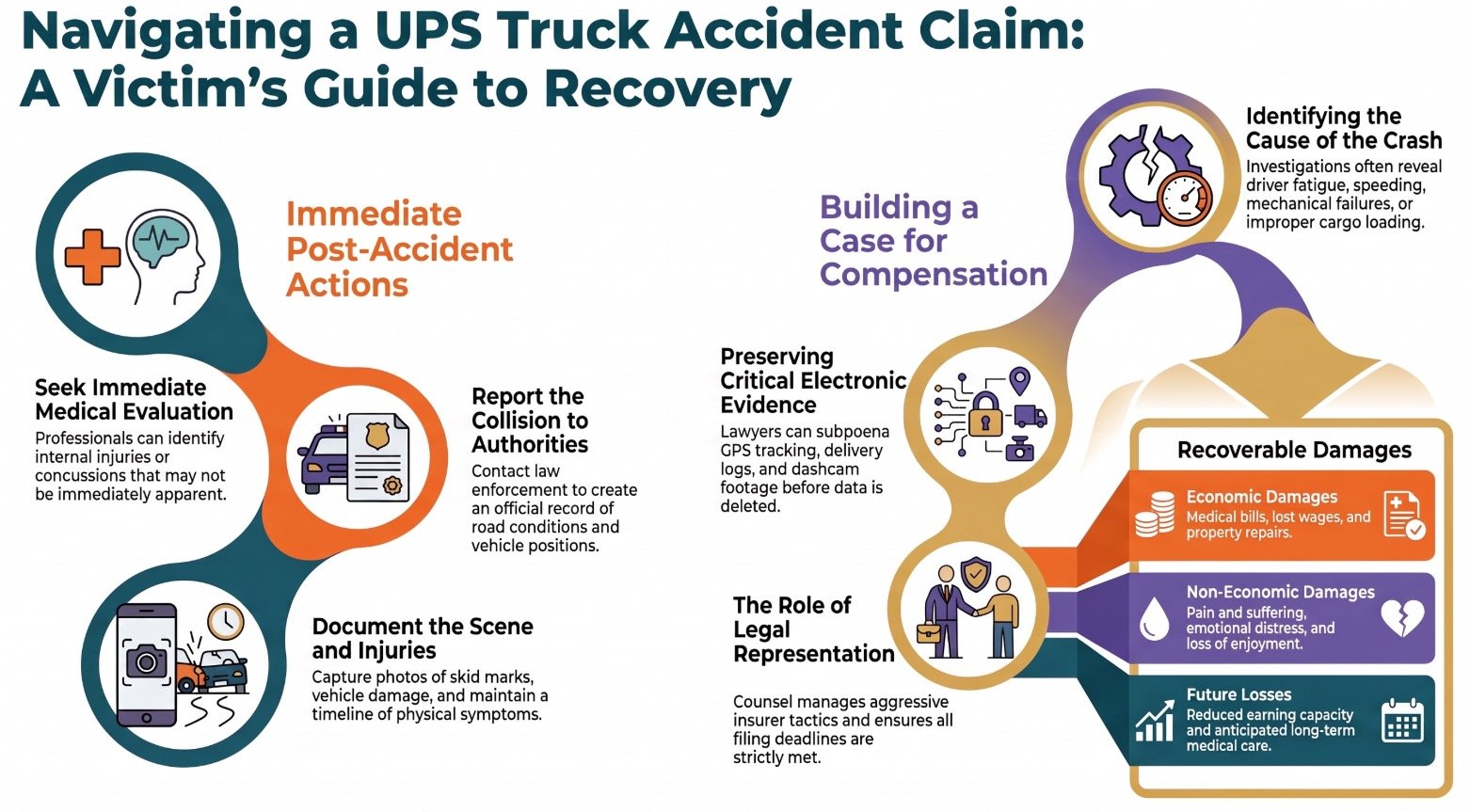
How We Can Help With Your Daytona Beach UPS Truck Accident Injury Claim
When a UPS truck accident causes injuries, an experienced Daytona Beach truck accident lawyer can help protect the injured person’s legal rights and pursue appropriate compensation. The lawyer can provide steady guidance while the injured individual focuses on medical treatment and recovery.
How evidence is gathered may substantially affect the claim. Counsel can obtain crash reports, photographs, vehicle records, delivery information, surveillance footage, witness statements, and relevant medical documentation. This process may clarify how the collision occurred and identify potentially responsible parties without placing unnecessary burdens on the injured person.


Insurance claim strategies can also help address communications with insurers, damage evaluations, and settlement offers. A lawyer may review available coverage, document losses, respond to disputed allegations, and present a supported demand for compensation. If negotiations do not produce a fair resolution, counsel can explain available legal options and prepare the claim for further action. Throughout the process, professional representation supports accountability and helps ensure that an injured community member receives attentive, respectful service.
Understanding Daytona Beach UPS Truck Accident Injury Cases
OUR CONSULTATIONSARE FREE
START YOUR FREE CASE REVIEW

UPS truck accident injury cases in Daytona Beach often involve complex questions about fault, insurance coverage, and the full extent of resulting losses. A careful evaluation may examine collision reports, medical records, wage documentation, vehicle damage, and witness accounts. These materials can help establish how the incident occurred and whether the injured person’s losses are connected to the crash.
Applicable Truck Safety Standards may provide important context when determining whether the carrier, driver, or another responsible party failed to meet required duties. Liability may also depend on employment relationships, maintenance responsibilities, and available commercial insurance policies. Because coverage disputes can complicate recovery, claimants generally benefit from understanding policy terms and preserving supporting evidence promptly.


Insurance Claim Deadlines can affect the ability to pursue compensation, particularly when notice requirements or legal filing periods apply. A thorough case assessment considers current medical needs, future treatment, reduced earning capacity, property damage, and other recoverable losses. Professional guidance can help protect each claimant’s interests while supporting a fair resolution.
Don’t Wait. Call Our Daytona Beach Truck Accident Lawyers Now.
Common Causes of Daytona Beach UPS Truck Accident
Common causes of Daytona Beach UPS truck accidents include driver fatigue or distraction, speeding, and other reckless driving behaviors. Improper vehicle maintenance can also contribute to mechanical failures, while unsafe loading practices may allow cargo to shift and impair vehicle control. Identifying the contributing factor is vital when evaluating liability and potential injury claims.
Driver Fatigue and Distraction
Driver fatigue and distraction are significant contributors to Daytona Beach UPS truck accidents, as both conditions can impair a driver’s awareness, reaction time, and judgment. Long shifts, insufficient rest, demanding delivery schedules, mobile-device use, and in-cab activity may reduce a driver’s ability to observe traffic and respond safely. These risks can affect motorists, pedestrians, and other road users, creating consequences that extend beyond physical injuries. Investigators may examine delivery records, electronic logging data, dispatch communications, onboard camera footage, and witness accounts to determine whether fatigue or distraction contributed to a collision.
Prompt action can support Preserving Claim Evidence before records are altered or lost. Clear documentation of medical treatment, vehicle damage, and financial losses may also assist with Avoiding Insurance Delays and ensuring that affected individuals receive appropriate support.
Speeding and Reckless Driving
When a UPS truck travels too fast or is operated recklessly, its size, weight, and limited handling can substantially increase the severity of a collision. Speeding reduces the driver’s reaction time and lengthens stopping distances, particularly near intersections, residential streets, and delivery zones. Aggressive lane changes, unsafe passing, tailgating, and running red lights can place motorists, bicyclists, and pedestrians at significant risk. These behaviors may occur independently or alongside Distracted Driving, including phone use or attention diverted by delivery demands. Investigators may examine traffic-camera footage, vehicle data, witness statements, and dispatch records to determine whether unsafe speed or deliberate disregard for traffic rules contributed to an injury. Poor Maintenance Safety may also be considered separately, although mechanical conditions involve different evidence and legal issues.
Careful documentation can help injured individuals and their families seek accountability.
Improper Vehicle Maintenance
Mechanical failures can make a UPS truck dangerous even when the driver is following traffic laws. Brake failure may prevent timely stopping, especially in congested Daytona Beach traffic or near pedestrian crossings. Maintenance neglect can allow worn components, fluid leaks, or defective safety systems to remain uncorrected, increasing the likelihood of a collision. Regular axle inspection is important because damaged or misaligned parts may affect steering, stability, and the vehicle’s ability to respond during emergency maneuvers. Tire wear also merits careful attention; insufficient tread or uneven deterioration can reduce traction on wet roads and lengthen stopping distances.
When maintenance records reveal missed inspections or delayed repairs, injured individuals may question whether reasonable safety procedures were followed. Identifying these conditions can help affected individuals seek accountability and support from qualified legal professionals.
Unsafe Loading and Cargo Shifts
Improperly loaded or secured packages can shift inside a UPS truck, changing the vehicle’s balance and making it more difficult to control. Improper pallet stacking may place excessive weight on one side, obstruct the driver’s view, or cause parcels to fall when doors open. These conditions can contribute to sudden braking, jackknifing, rollovers, or collisions with other motorists and pedestrians. UPS operators and contractors are expected to follow Cargo securement policies that address weight distribution, load limits, restraints, and inspection procedures. Failure to follow those requirements may indicate negligent preparation, supervision, or maintenance of the cargo area.
After an accident, investigators may examine delivery records, loading photographs, employee statements, and vehicle data to determine whether shifting cargo affected the crash. Such evidence can help injured individuals pursue appropriate support and accountability.
Legal Rights of Daytona Beach UPS Truck Accident Injury Victims
Daytona Beach UPS truck accident injury victims may have legal rights to pursue compensation when another party’s negligence caused the collision and resulting harm. A claim may address medical expenses, lost income, rehabilitation, property damage, and documented pain and suffering. Legal guidance can help preserve evidence, identify responsible parties, and communicate with insurers while protecting the victim’s interests.
Daytona Beach UPS truck accident victims may pursue compensation for medical costs, lost income, property damage, and documented pain and suffering.
- Medical documentation: Prompt treatment and organized records can connect injuries to the crash and establish necessary care.
- Insurance claim timelines: Policies and Florida law impose deadlines that may affect coverage, negotiations, or litigation.
- Commercial truck regulations: Safety rules, driver records, maintenance materials, and company policies may provide evidence concerning responsibility.
- Legal representation: A qualified attorney can assess damages, handle communications, and pursue a fair resolution through settlement or court action.
Victims and their families may benefit from avoiding recorded statements or premature settlements before understanding the claim’s full value. Because evidence can disappear and deadlines can expire, a timely consultation supports informed decisions and enables counsel to serve the injured person’s needs diligently.
Why Do Daytona Beach UPS Truck Accident Injuries Happen?
UPS truck injuries in Daytona Beach may result from driver error, unsafe delivery practices, inadequate vehicle maintenance, or hazardous roadway conditions. Drivers may collide with motorists, pedestrians, or cyclists while rushing deliveries, backing without adequate observation, following too closely, or operating while fatigued. Distractions, insufficient training, and unfamiliarity with local streets can also contribute to serious crashes.
Delivery operations may create additional risks when trucks are stopped in travel lanes, parked near intersections, or loaded in ways that obstruct visibility. Mechanical failures involving brakes, tires, wheel control systems, or warning equipment may reflect inadequate inspections or repairs. Rain, construction, poor lighting, and congested roads can further increase collision risks.
Determining the cause often requires Proving Fault through careful Evidence Collection, including vehicle data, witness accounts, photographs, and maintenance records. Medical Documentation can connect injuries to the incident and clarify their effects. These facts may support Insurance Negotiation by establishing responsibility, damages, and the need for appropriate compensation.
What Should You Do After a Daytona Beach UPS Truck Accident Injury?
After a Daytona Beach UPS truck accident injury, the injured person should seek immediate medical care, even if symptoms initially appear minor. The collision should be reported to law enforcement and any relevant insurance representatives, while medical records and other evidence are preserved. Prompt documentation of injuries, treatment, and related limitations can help establish the extent of the harm.
Seek Immediate Medical Care
Prompt medical evaluation should be obtained immediately, even when the injury initially appears minor. A qualified healthcare professional can identify concussions, internal injuries, fractures, and soft-tissue damage that may worsen without treatment. Following medical instructions supports recovery and reduces the risk of preventable complications. The injured person should describe every symptom accurately, including pain, dizziness, numbness, or changes that develop later. Medical records, diagnostic results, prescriptions, and treatment recommendations may become important post-accident documentation. They also help establish the timing and extent of harm for Insurance Claim Steps.
Individuals assisting an injured person should arrange transportation or emergency services when necessary, remain attentive to changing symptoms, and help preserve discharge instructions. Prompt care protects health first and provides reliable information for future legal evaluation.
Report The Collision
Once immediate medical needs have been addressed, the collision should be reported promptly to the appropriate authorities. In Daytona Beach, calling law enforcement can create an official record and help secure information about road conditions, traffic controls, and involved vehicles. Police report filing should be completed accurately, with a clear account of what occurred and where the crash happened. The injured individual should provide identification and insurance information when requested, while avoiding speculation about fault. If the UPS driver or another party suggests handling the matter privately, that proposal should be treated cautiously.
Names, telephone numbers, and witness contact details should be collected from anyone who observed the collision. The reporting person should request the incident number, officer’s name, and instructions for obtaining the completed report.
Document Your Injuries
Documenting injuries should begin as soon as practical, even when symptoms initially appear minor. An injured person should obtain prompt medical evaluation and follow every recommended treatment plan. Medical documentation can establish the nature of the injuries, connect them to the collision, and clarify the care required. Records should include diagnoses, prescriptions, referrals, work restrictions, and anticipated recovery concerns.
A symptom timeline may help explain when pain, swelling, dizziness, limited movement, or emotional distress began and how those conditions changed. Patients should describe symptoms accurately to healthcare providers rather than minimizing discomfort. Photographic evidence can preserve visible bruising, cuts, swelling, vehicle damage, and other conditions that may change during recovery. Consistent records may help demonstrate injury severity and support informed assistance for those affected, including appropriate insurance and legal decisions.
Critical Evidence in a Daytona Beach UPS Truck Accident Injury Case
Evidence can establish how the UPS truck accident occurred, identify responsible parties, and support the injured person’s claim.
A Daytona Beach UPS truck accident lawyer may examine the following sources:
- Accident scene photographs
- Driver records
- Delivery route data
- Witness statements
Together, these materials can clarify disputed facts and preserve information that may become unavailable over time.
Accident Scene Photos
Photographs taken at a Daytona Beach UPS truck accident scene can preserve critical details that may change or disappear before an investigation is completed. Images may show vehicle positions, roadway conditions, traffic signals, skid marks, debris, weather conditions, and visible injuries. Wide photographs establish context, while closer images document property damage and relevant markings without altering the scene. When safely possible, photographs should be taken from several angles and accompanied by notes identifying the location and approximate time. These materials can assist with witness identification issues by capturing nearby businesses, signs, and other features that help locate potential observers.
Prompt documentation also supports insurance claim timing, particularly when insurers request early evidence. A person seeking assistance should prioritize medical care and personal safety, then preserve original files and avoid editing them.
Driver Records
When available, UPS driver records can provide important information about the events leading to a Daytona Beach truck accident and the driver’s condition at the time of impact. These records may document Driver Employment qualifications, training, certifications, disciplinary actions, and compliance with company safety requirements. They can also reveal whether the driver had prior medical restrictions or reported concerns affecting safe vehicle operation. A driver’s Violation History may identify citations, license suspensions, preventable collisions, or repeated safety violations that could support an investigation into negligent hiring, retention, or supervision. Attorneys may seek these materials through formal requests, subpoenas, or litigation discovery, while appropriately protecting confidential information.
Reviewing the records can help establish whether company personnel recognized risks and failed to take reasonable steps to protect motorists, passengers, and the wider Daytona Beach community.
Delivery Route Data
Delivery route data can help reconstruct a UPS truck’s movements before a Daytona Beach collision and clarify whether the driver followed assigned procedures. GPS Tracking may show vehicle locations, speed changes, and periods of stationary activity, helping establish the sequence leading to impact. Delivery Records can identify assigned addresses, completed deliveries, attempted stops, and operational instructions relevant to the route. Route Timing may reveal whether the driver was delayed, rushing to meet expectations, or traveling outside a reasonable schedule. Stop Schedules can help determine whether the truck paused where expected and whether timing conflicts existed before the crash.
Attorneys may preserve these electronic records promptly because companies often maintain data for limited periods. Properly analyzed route information can support a careful, evidence-based evaluation of responsibility and damages.
Witness Statements
Witness statements can supplement route data by providing firsthand accounts of what occurred before, during, and after a Daytona Beach UPS truck collision. These accounts may clarify traffic conditions, vehicle movements, delivery activity, and statements made at the scene. Eyewitness reliability should be evaluated by considering each person’s vantage point, attention, consistency, and possible bias. Documentation timing also matters because promptly recorded observations may preserve details that fade or become disputed. A careful investigator can compare accounts with photographs, surveillance footage, police reports, and electronic delivery records.
Witness credibility may strengthen when independent statements align on important facts without appearing coordinated. Contact list creation helps preserve names, telephone numbers, addresses, and preferred communication methods. Respectful outreach allows witnesses to assist injured individuals while protecting the accuracy and integrity of the evidence.
Don’t Wait. Call Our Daytona Beach Truck Accident Lawyers Now.
Long-Term Effects of Daytona Beach UPS Truck Accident Injuries
Daytona Beach UPS truck accident injuries may produce chronic pain conditions that persist well beyond initial treatment and interfere with daily activities. Ongoing mobility challenges can limit employment, independence, and participation in ordinary routines. These lasting consequences may also create significant emotional and financial strain through medical expenses, lost income, and reduced quality of life.
Chronic Pain Conditions
When injuries from a UPS truck collision fail to recover properly, affected individuals may develop chronic pain that persists for months or years after the initial incident. Persistent symptoms may involve the back, neck, joints, or soft tissues, and can interfere with sleep, concentration, employment, and ordinary responsibilities. Treatment often requires coordinated care, including physical therapy, expert evaluations, and careful Medication management. Providers may document pain flare-ups, treatment responses, and limitations to establish how the condition affects daily life. Chronic pain can also create disability impacts, including reduced earning capacity and the need for assistance with household tasks.
Detailed medical records and consistent treatment help clarify these long-term consequences during settlement negotiations. Supportive legal guidance may help affected individuals pursue compensation while preserving access to appropriate care and services.
Ongoing Mobility Challenges
Ongoing mobility challenges can develop after a UPS truck collision, particularly when injuries affect the spine, joints, muscles, or connective tissues. Limited range of motion, weakness, balance problems, or reduced endurance may interfere with walking, standing, lifting, and personal care. Rehabilitation experts can evaluate functional abilities and recommend treatment plans designed to preserve independence. Home safety measures, including improved lighting, secure handrails, and unobstructed pathways, may reduce fall risks. Mobility aids such as canes, walkers, wheelchairs, or orthotic devices can support safer movement when properly fitted and used. Some individuals may require workplace accommodations, including modified duties, ergonomic equipment, flexible scheduling, or accessible facilities.
When driving remains appropriate, adaptive driving equipment and professional assessment may improve vehicle control. Ongoing medical documentation can help track limitations and guide necessary services.
Emotional And Financial Strain
Although physical injuries may receive primary attention after a UPS truck collision, the long-term emotional and financial effects can be substantial. Survivors may experience Grief and trauma, including anxiety, depression, sleep disruption, or fear of driving. These conditions can affect employment, family responsibilities, and the ability to participate in community life. Financial strain may continue when treatment, rehabilitation, prescriptions, and transportation costs accumulate over time. Lost income can further complicate household stability, particularly when an injured person requires ongoing assistance or cannot return to the same occupation. Careful medical bills planning can help organize current expenses, anticipated treatment, insurance communications, and potential future needs. Documentation of emotional symptoms, financial losses, and professional recommendations may assist a legal representative in presenting a complete account of the collision’s lasting consequences.
Proving Liability in Daytona Beach UPS Truck Accident Injury Cases
Proving liability in a Daytona Beach UPS truck accident injury case requires evidence establishing that the driver, UPS, or another responsible party caused the collision and resulting injuries. Investigators may examine police reports, photographs, vehicle damage, roadway conditions, witness statements, and available traffic-camera footage. Driver conduct, including speeding, distraction, fatigue, or unsafe navigating, can support a negligence claim. Company responsibility may involve inadequate training, improper supervision, maintenance failures, or pressure that contributed to unsafe driving. Electronic logging data, delivery records, inspection documents, and onboard vehicle systems may provide additional proof.
Prompt evidence preservation is necessary because video recordings, electronic data, and physical conditions can disappear or change. Medical records must connect the collision to documented injuries, treatment, and functional limitations. A thorough investigation can identify all responsible parties and protect an injured person’s ability to seek accountability. Insurance bad faith may create separate concerns, but liability must first be established through reliable, organized evidence.
Dealing With Insurance Companies After a Daytona Beach UPS Truck Accident Injury
Dealing with insurance companies after a Daytona Beach UPS truck accident requires careful communication and a clear understanding of the claims process. An insurer may request recorded statements, authorize medical evaluations, or seek broad access to personal information. Before responding, an injured person may benefit from consulting a qualified attorney who can protect legal rights and that communications remain accurate and limited to relevant facts.
Thorough documentation can help address coverage disputes and establish the nature, severity, and financial impact of injuries. Important materials may include medical records, treatment invoices, wage information, photographs, and correspondence with insurers. Counsel can evaluate settlement strategies based on documented losses, anticipated treatment, and the individual’s need for long term support, rather than accepting an early offer that fails to reflect continuing consequences.
Professional representation also helps families communicate respectfully while preserving evidence and pursuing fair treatment. Each claim requires individualized attention because policy provisions, injury circumstances, and available coverage can differ substantially.
What to Expect During a Daytona Beach UPS Truck Accident Injury Claim Process
A Daytona Beach UPS truck accident injury claim typically begins with an initial assessment of the injuries, liability, and available insurance coverage. The process then involves gathering accident evidence, reviewing medical records, and negotiating with insurers to pursue appropriate compensation. If negotiations do not produce a fair resolution, the injured party may consider pursuing legal action.
Initial Claim Assessment
During the initial claim assessment, a Daytona Beach UPS truck accident lawyer reviews the collision circumstances, available evidence, and the injured person’s medical records to determine whether the claim has a viable legal basis. The assessment typically considers fault, insurance coverage, injury severity, treatment needs, and potential financial losses. Counsel may explain applicable deadlines, identify responsible parties, and clarify what the claimant should expect from communications with insurers. Early Insurance negotiation strategies can help protect the injured person from premature statements, inadequate settlement offers, or unnecessary disputes regarding responsibility.
A tailored Evidence preservation checklist may also be provided, emphasizing careful recordkeeping and consistent medical follow-up without addressing the broader evidence-gathering process. The lawyer then outlines practical options, potential challenges, and recommended next steps, allowing the claimant to make informed decisions while supporting a fair resolution.
Gathering Accident Evidence
Evidence gathering establishes the factual foundation of a Daytona Beach UPS truck accident injury claim. Investigators typically secure crash reports, photographs, vehicle data, delivery records, roadway information, and available surveillance footage. These materials help clarify the sequence of events and identify potentially responsible parties without relying solely on recollection.
Medical Records document diagnoses, treatment, prescriptions, and limitations, creating a timeline connecting injuries to the collision. Employment records and expert assessments may also support Proving Damages, including lost income and necessary care. Statements from bystanders, passengers, and first responders are evaluated for Witness Credibility, consistency, and firsthand knowledge. Attorneys may preserve testimony before memories fade or evidence disappears. Documentation concerning prognosis and Future Impairment helps establish the injury’s continuing effects. The process remains focused on preserving reliable facts for later claim evaluation.
Negotiating Insurance Coverage
Negotiating insurance coverage requires a careful assessment of the policies that may apply to a Daytona Beach UPS truck accident injury claim, including UPS’s commercial liability coverage and any available personal or supplemental policies. Insurers typically review liability, medical records, lost income, and property damage before evaluating settlement value. Claimants should provide accurate documentation while avoiding recorded statements or releases that could limit recovery prematurely. Preserving Evidence remains significant because photographs, delivery records, witness information, and medical documentation can support negotiations. Hiring Experts, such as medical professionals or accident analysts, may clarify the injury’s severity, future treatment needs, and financial consequences.
A representative can communicate with adjusters, identify applicable coverage limits, and respond to disputed findings. Careful review helps ensure that compensation reflects documented losses and ongoing needs.
Pursuing Legal Action
When settlement negotiations do not adequately address the injuries and losses involved, a Daytona Beach UPS truck accident claimant may pursue legal action against the responsible parties. The process generally begins with filing a complaint that identifies the defendants, explains the alleged negligence, and states the compensation sought. Each party then exchanges evidence through discovery, which may include medical records, employment documentation, vehicle data, witness testimony, and expert evaluations. Depositions can require the claimant to answer questions under oath about the collision, treatment, and financial impact. A Legal strategy overview helps organize evidence, address comparative fault, and prepare for potential trial.
Although settlement discussions may continue during litigation, settlement negotiation tips can support informed decisions regarding offers. If no agreement is reached, a judge or jury determines liability and damages based on the evidence presented.
Don’t Wait. Call Our Daytona Beach Truck Accident Lawyers Now.
Compensation for Daytona Beach UPS Truck Accident Injury Damages
Compensation for injuries caused by a UPS truck accident in Daytona Beach may include medical expenses, lost wages, reduced future earning capacity, property damage, and pain and suffering. The recoverable amount generally depends on the severity of the injuries, the treatment required, and the evidence connecting the harm to the collision. Medical documentation, including records, bills, and physician opinions, can establish treatment needs and ongoing limitations. Witness evidence, photographs, delivery records, and crash reports may help clarify liability and support the claim. A legal representative may communicate with insurers, protect the injured person from premature statements, and address insurance disputes involving coverage, fault, or valuation. Settlement timelines vary because investigations, medical stabilization, and negotiations may take time.
If a fair resolution is unavailable, a civil action may provide another avenue for pursuing compensation. Timely assistance can help preserve evidence, organize documentation, and advance the matter while supporting the injured person’s recovery and practical needs.
Economic vs Non-Economic Damages in Daytona Beach UPS Truck Accident Cases
Economic damages compensate documented financial losses, including medical expenses, lost income, and necessary future care. Non-economic damages address less tangible harm, such as pain, emotional distress, and diminished quality of life. Comparing these damage types helps determine the full compensation potentially available in a Daytona Beach UPS truck accident claim.
Economic Damages Explained
A Daytona Beach UPS truck accident claim may involve both economic and non-economic damages, which compensate for different forms of harm caused by the collision. Economic damages cover measurable financial losses supported by records and other evidence. They may include emergency treatment, hospitalization, medication, rehabilitation, and future medical care related to accident injuries. Lost wages can also be recovered when injuries prevent work, while reduced earning capacity may apply if lasting limitations affect future employment. Property damage, transportation expenses, and necessary household assistance may qualify as well. Medical documentation is vital for connecting treatment to the crash and establishing its cost. Detailed wage records and repair estimates further strengthen the claim.
Careful preparation may help address an Insurance claim denial and ensure documented financial losses receive appropriate consideration.
Non-Economic Damages Explained
When a Daytona Beach UPS truck collision causes pain, emotional distress, or lasting disruption, non-economic damages may relieve those harms even though they do not have a fixed dollar value. These damages can include physical discomfort, anxiety, loss of enjoyment, sleep difficulties, and effects on family relationships or daily independence. Claimants may strengthen their presentation through medical observations, personal journals, witness documentation, evidence of emotional distress, and compensation records showing treatment-related consequences. Consistent descriptions from healthcare providers, relatives, coworkers, and other witnesses may help explain how the collision changed the injured person’s life. Legal guidance can help preserve relevant proof and comply with Insurance claim deadlines. Careful preparation allows decision-makers to understand personal suffering respectfully while supporting a fair request for recovery under applicable Florida law.
Comparing Damage Types
Distinguishing economic from non-economic damages helps clarify the full scope of losses in a Daytona Beach UPS truck accident case. Economic damages generally include documented medical bills, rehabilitation costs, lost wages, reduced earning capacity, property damage, and anticipated future treatment. These amounts may be supported by invoices, employment records, expert evaluations, and medical documentation. Non-economic damages address less measurable consequences, including pain, emotional distress, loss of enjoyment, disfigurement, and disruption of family relationships. Damage severity, long-term impairment, and Injury permanence can influence the value assigned to these losses. A careful assessment considers how the injuries affect daily responsibilities, independence, and future plans.
By distinguishing both categories, legal professionals can present a complete claim and help injured individuals pursue compensation that supports recovery and continued service to their families and communities.
When a Daytona Beach UPS Truck Accident Injury Case Goes to Trial vs Settlement
Although many Daytona Beach UPS truck accident injury claims resolve through settlement, some proceed to trial when the parties cannot agree on liability, damages, or the value of the claim. Settlement discussions may provide a faster, more predictable resolution, allowing an injured person to receive compensation without the uncertainty and expense of courtroom proceedings. Attorneys may use Pretrial negotiation tactics, including organized medical documentation, witness statements, and carefully supported damage calculations, to encourage a fair offer.
Trial becomes more likely when disputes remain about how the collision occurred, the seriousness of injuries, or the extent of future losses. Each side presents evidence, questions witnesses, and explains its position to a judge or jury. A lawyer may also develop a jury selection strategy intended to identify impartial jurors who can evaluate testimony carefully. The decision to settle or proceed should reflect the client’s needs, risk tolerance, and long-term interests. Skilled representation helps ensure that serving the injured person remains the central objective throughout the process.
Florida Laws That May Affect Your Daytona Beach UPS Truck Accident Case
Florida law can significantly affect how a Daytona Beach UPS truck accident claim is investigated, valued, and resolved. Several rules may determine available compensation, responsible parties, and required procedures. A careful review can help protect injured people and support fair outcomes.
Florida law can shape liability, compensation, and procedures in Daytona Beach UPS truck accident claims.
- Comparative Negligence Rules may reduce recovery when an injured person shares responsibility for the collision. Evidence about speed, visibility, and roadway conduct can be important.
- Vicarious liability may place responsibility on UPS for qualifying employee actions performed within the scope of employment, while independent-contractor issues can complicate analysis.
- Commercial vehicle regulations concerning driver qualifications, hours, inspections, maintenance, and cargo may provide important evidence regarding negligence.
- Government Claims Process requirements may apply when a public vehicle, roadway condition, or governmental entity contributed to the crash. Notice procedures and documentation can affect how the claim proceeds.
Insurance coverage, medical evidence, property damage, and witness testimony also influence valuation. Legal counsel can coordinate investigations, preserve records, communicate with insurers, and serve the injured individual’s interests while pursuing an accountable resolution.
The Statute of Limitations for Daytona Beach UPS Truck Accident Injury Cases
Time limits can determine whether a Daytona Beach UPS truck accident injury claim proceeds, regardless of the severity of the injuries or the strength of the evidence. Florida law generally provides a limited period to file a personal injury lawsuit, and the applicable deadline may depend on the accident date, the parties involved, and the claim’s legal basis. Claims involving governmental entities can require earlier notice and shorter deadlines, while wrongful death actions follow their own statutory period. Missing a deadline may result in dismissal, leaving an injured person without a court remedy.
Prompt attention also preserves evidence and supports informed decisions. Medical Documentation should be gathered consistently, including diagnoses, treatment records, prescriptions, and related expenses. Insurance Negotiations do not necessarily extend the statute of limitations; ongoing discussions with an insurer should not replace timely legal action. Because exceptions and deadline calculations can be intricate, an affected individual may benefit from promptly confirming the applicable period and preserving all relevant claim materials.
How a Daytona Beach UPS Truck Accident Lawyer Can Help You
With prompt involvement, a Daytona Beach UPS truck accident lawyer can evaluate the collision, identify responsible parties, and develop a legal strategy supported by evidence. Counsel may help injured individuals and families pursue fair treatment while protecting their ability to serve loved ones and communities.
- Investigate vehicle maintenance records, driver qualifications, delivery policies, roadway conditions, and available surveillance or electronic data.
- Identify whether UPS, a contractor, another motorist, or multiple parties may bear responsibility under applicable Florida law.
- Handle communications with insurers, challenge inadequate offers, and address Insurance Claim Delays that could obstruct necessary medical care and household stability.
- Prepare injury, disability, and property-damage claims, including Wrongful Death Claims when a fatal collision leaves dependents seeking accountability.
A lawyer can also organize medical documentation, calculate economic and non-economic losses, consult qualified experts, and negotiate from an informed position. If litigation becomes necessary, counsel can present evidence clearly, manage procedural requirements, and advocate for compensation that supports recovery, dependents, and long-term security while reducing administrative burdens during a difficult period.
When to Contact a Daytona Beach UPS Truck Accident Lawyer
Although some injuries initially appear manageable, contacting a Daytona Beach UPS truck accident lawyer promptly can protect key evidence and preserve legal options. Early consultation is appropriate when a collision causes bodily harm, vehicle damage, missed work, or uncertainty about responsibility. Symptoms may worsen after the crash, and delayed treatment can complicate efforts to connect injuries with the incident.
A lawyer can advise on Immediate documentation, including photographs, medical records, witness information, police reports, and communications with UPS or its insurer. Prompt preservation requests may also help protect driver logs, delivery records, vehicle data, and available surveillance footage before routine procedures remove them.
Legal assistance becomes particularly important after an insurer requests a recorded statement, offers a quick settlement, assigns fault, or issues a denial. Understanding an insurance denial strategy can help identify missing evidence, policy issues, or disputed causation without sacrificing the injured person’s rights. Contacting counsel early supports informed decisions and helps protect family and community responsibilities during recovery.
Why You Need an Experienced Daytona Beach UPS Truck Accident Lawyer
An experienced Daytona Beach UPS truck accident lawyer understands the overlapping insurance, employment, and liability issues that may arise after a delivery-vehicle collision. Such counsel can investigate whether driver conduct, company policies, vehicle maintenance, or roadway conditions contributed to the crash. Early evidence preservation is critical because surveillance footage, electronic driving data, delivery records, and witness recollections may disappear or change.
An attorney also recognizes Insurance adjuster tactics that can reduce or delay a legitimate claim. Adjusters may seek recorded statements, emphasize preexisting conditions, or propose settlements before the full medical impact becomes clear. Experienced representation helps protect an injured person from avoidable concessions while documenting treatment, lost income, property damage, and future needs.
A knowledgeable lawyer can coordinate communication with insurers and involved parties, allowing the injured individual to focus on recovery and family responsibilities. This support also promotes accountability and helps secure resources needed for medical care, rehabilitation, and continued service to others.
How to Choose the Right Daytona Beach UPS Truck Accident Lawyer for Your Case
Selecting the right Daytona Beach UPS truck accident lawyer requires more than reviewing advertising claims or settlement statistics. A careful evaluation considers experience with commercial vehicle collisions, knowledge of federal safety rules, and a demonstrated commitment to protecting injured people.
During the initial consultation, the prospective client should ask who will manage the case, how evidence will be preserved, and what outcomes are realistically possible. A lawyer’s Communication strategy should include timely updates, accessible explanations, and honest discussions about risks, expenses, and litigation options. The attorney should also provide an evidence checklist covering medical records, photographs, witness information, vehicle data, employment documentation, and related losses.
Experience in insurance negotiation is particularly important because trucking claims may involve corporate insurers, layered coverage, and contested liability. References, professional standing, and written fee terms can help inform the decision. The strongest choice is a lawyer who listens carefully, investigates thoroughly, and remains prepared to serve the client’s long-term interests.
About The Law Offices of Anidjar & Levine
The Law Offices of Anidjar & Levine represents individuals injured in commercial vehicle collisions, including accidents involving UPS trucks in Daytona Beach. The firm focuses on helping injured people understand their legal options and pursue accountability when negligence causes harm. Its attorneys evaluate collision circumstances, identify potentially responsible parties, and explain how applicable deadlines may affect a claim.
Case preparation may include evidence gathering from crash reports, medical records, vehicle data, photographs, witness accounts, and available surveillance footage. These materials can support liability proof concerning driver conduct, company practices, vehicle maintenance, or other contributing factors. The firm also develops attorney strategies tailored to the facts, injuries, and financial consequences presented by each case.
When insurers seek to minimize compensation, the attorneys handle insurance negotiation and review settlement proposals against documented losses. If a fair resolution cannot be reached, the firm may prepare the matter for litigation. Its client-centered approach emphasizes communication, careful preparation, and service to individuals seeking meaningful recovery after a serious collision.
Frequently Asked Questions
Can I Still Sue if the UPS Driver Was an Independent Contractor?
Yes, an injured person may still sue when a UPS driver is classified as an independent contractor, although liability depends on the driver’s conduct, contractual relationship, and applicable Florida law. Independent contractor liability may attach directly to the driver or, in limited circumstances, to the delivery company for negligent hiring, supervision, or other misconduct. Comparative negligence can reduce compensation if the injured person contributed to the accident. Evidence and deadlines require prompt legal evaluation.
What Happens if I Was Partially at Fault for the UPS Truck Accident?
Partial fault does not necessarily prevent recovery after a UPS truck accident. Under comparative negligence rules, an injured person’s compensation may be reduced by the percentage of responsibility assigned to that person. The applicable rule depends on state law and case facts. Insurance companies may emphasize alleged fault, making comparative negligence coverage and a careful settlement negotiation strategy important. Evidence, medical records, witness accounts, and legal guidance can help protect a fair claim.
Can Family Members File a Claim After a Fatal UPS Truck Accident?
Family members may file a claim after a fatal UPS truck accident when state law recognizes them as eligible beneficiaries or personal representatives of the estate. Wrongful death eligibility commonly includes a surviving spouse, children, or certain dependent relatives, although priority and recoverable damages vary. Statute timing is crucial because deadlines may apply to wrongful death, survival, and claims involving government or corporate entities. Prompt legal guidance helps preserve evidence and protect beneficiaries’ rights.
Will My Health Insurance Company Seek Reimbursement From My Settlement?
Yes, a health insurance company may seek reimbursement from a settlement for medical expenses it previously paid. This health reimbursement claim generally depends on the policy, applicable state law, and the settlement’s terms. Medicare may also assert a Medicare recovery claim, requiring repayment for accident-related treatment. The injured person’s representative should request a written payment ledger, verify each charge, and negotiate reductions when appropriate before distributing settlement funds.
Can Dashcam or Delivery-Camera Footage Be Subpoenaed in My Case?
Yes, dashcam or delivery-camera footage can often be subpoenaed if it may clarify how the collision occurred. Counsel should promptly request evidence preservation because recordings may be overwritten under routine company policies. A subpoena generally must identify the materials sought, establish their relevance, and comply with applicable court procedures. The court may require notice to affected parties and can limit disclosure of confidential information. Early action helps protect reliable evidence for all involved.
—————————
Victims of Daytona Beach UPS truck accidents may suffer serious injuries, financial losses, and complicated liability issues. Understanding applicable laws, preserving evidence, and identifying all potentially responsible parties are important steps in protecting a claim.
An experienced Daytona Beach Truck Accident Lawyer can assess the circumstances, communicate with insurers, and pursue appropriate compensation on the victim’s behalf. The Law Offices of Anidjar and Levine provide personalized legal guidance to help injured individuals make informed decisions with greater confidence.