The Law Offices of Anidjar and Levine, a Daytona Beach FMCSA violations truck accident lawyer, investigates whether hours-of-service violations, inadequate training, unsafe maintenance, overloaded cargo, or inspection failures contributed to a collision.
The firm can help preserve electronic logs, dispatch records, vehicle data, photographs, and witness accounts before they are lost.
Counsel may also assess employer responsibility, causation, comparative negligence, insurance coverage, and damages, including long-term medical and emotional effects.
For legal guidance, visit the Daytona Beach Truck Accident Lawyer page to learn more about available legal help, evidence, claim preparation, and selecting qualified representation.
Main Takeaways
- A Daytona Beach truck accident lawyer can investigate FMCSA violations involving hours of service, maintenance, cargo securement, inspections, and driver qualifications.
- Attorneys can review electronic logs, dispatch records, inspection documents, photographs, onboard data, and witness statements to evaluate causation.
- Prompt evidence preservation helps prevent the loss or alteration of electronic records, maintenance files, communications, and video evidence.
- Lawyers can assess employer responsibility, driver negligence, regulatory violations, and comparative fault under Florida law.
- Victims should seek medical care, document the crash, preserve records, and obtain legal guidance about insurance, settlement, or litigation.


How We Can Help With Your Daytona Beach FMCSA Violations Truck Accident Injury Claim
When a commercial truck crash in Daytona Beach involves violations of Federal Motor Carrier Safety Administration (FMCSA) regulations, an injured person may face a claim that requires detailed legal and factual analysis. A qualified legal team can help protect that person’s interests by organizing evidence, communicating with insurers, and identifying responsible parties.
A thorough truck incident investigation may include reviewing driver qualification records, hours-of-service logs, maintenance documents, electronic data, inspection materials, photographs, and witness accounts. This process can clarify how the collision occurred and whether regulatory violations contributed to the injuries. Counsel can also coordinate medical documentation, consult qualified professionals, and preserve evidence that might otherwise be lost.
Damages calculation requires careful evaluation of medical expenses, anticipated treatment, lost income, reduced earning capacity, property damage, and other legally recognized losses. Attorneys can present these losses in an organized claim while addressing insurer challenges and settlement proposals. Their assistance allows an injured individual and family to focus on recovery while informed representatives pursue accountability through appropriate legal channels.
OUR CONSULTATIONSARE FREE
START YOUR FREE CASE REVIEW

Understanding Daytona Beach FMCSA Violations Truck Accident Injury Cases
Understanding a Daytona Beach FMCSA violations truck accident injury case requires examining both the collision and the federal safety rules that may have been breached. The analysis may include driver qualifications, inspection records, hours-of-service documentation, maintenance files, and company oversight, without assuming that any single violation caused the injury.
Evidence Preservation is critical because electronic logs, dispatch communications, onboard recordings, medical records, and witness accounts can change or disappear. A careful review helps establish chronology, responsibility, and the full measure of damages. Comparative Fault may also affect recovery if another motorist or the injured person is found partly responsible under Florida law.
The parties may evaluate liability and damages through negotiation or mediation. Mediation Outcomes depend on the strength of the evidence, medical prognosis, insurance coverage, and willingness to resolve the dispute. Settlement Deadlines, including applicable limitation periods and contractual requirements, must be monitored carefully. Accurate guidance helps injured individuals and their families pursue fair treatment while supporting an orderly legal process.
Common Causes of Daytona Beach FMCSA Violations Truck Accident
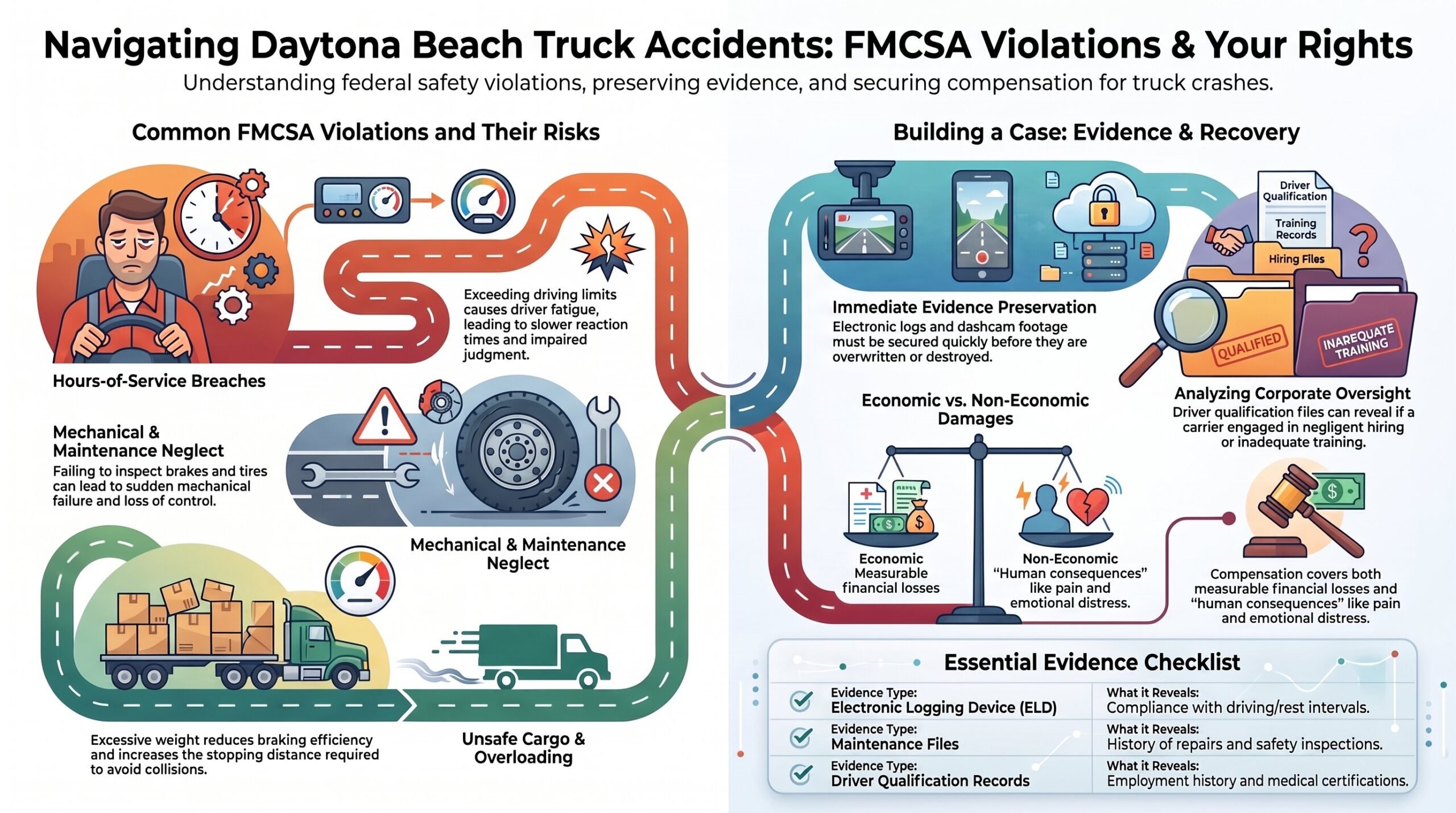
Common causes of Daytona Beach FMCSA violations in truck accidents include hours-of-service violations, overloaded vehicles, inadequate driver training, and poor vehicle maintenance. Each issue can increase crash risks by contributing to driver fatigue, reduced vehicle control, insufficient judgment, or mechanical failure. Identifying these contributing factors is critical when evaluating liability and regulatory compliance in truck accident claims.
Hours-of-Service Violations
Hours-of-service violations occur when commercial truck drivers or motor carriers exceed federally established driving limits, shorten required rest periods, or fail to maintain accurate duty-status records. These violations can produce Driver fatigue, slower reactions, impaired judgment, and an increased risk of collisions on Daytona Beach roads. Federal rules generally require qualifying rest periods and restrict driving after defined on-duty intervals, although limited exceptions may apply.
Investigators may examine electronic logging devices, dispatch communications, fuel records, toll data, and employment policies to determine whether a carrier encouraged unlawful schedules. Such evidence can support liability proof by connecting excessive driving to the crash and identifying responsible parties. A truck accident lawyer may help preserve records, consult safety professionals, and explain how regulatory violations affected injured individuals, families, and the broader community.
Overloaded Truck Accidents
When a commercial truck exceeds lawful weight limits, its reduced braking ability, altered handling, and increased stopping distance can create serious collision risks on Daytona Beach roads. Overloaded trailers may also experience tire failures, suspension damage, or cargo shifts that destabilize the vehicle. These conditions can increase the severity of crashes involving passenger vehicles, pedestrians, and cyclists. Investigators may examine weigh-station records, loading documents, inspection reports, electronic data, and maintenance histories to determine whether a carrier or shipper violated federal or state weight requirements.
Such evidence can support a Daytona claims strategy by connecting unsafe loading practices to the collision and resulting injuries. FMCSA compliance proof, or its absence, may help establish responsibility, preserve relevant records, and guide claims for medical expenses, lost income, property damage, and other legally recognized losses.
Inadequate Driver Training
Inadequate driver training can create FMCSA violations and increase the likelihood of serious truck crashes in Daytona Beach. Drivers may lack instruction on hours-of-service requirements, vehicle control, defensive driving, or procedures for responding to changing traffic and weather conditions. Insufficient preparation can also prevent a driver from recognizing how unsafe loading affects stability, braking, and handling.
Carriers that place unprepared individuals behind the wheel may face allegations of negligent hiring or inadequate supervision, particularly when qualifications and training records were not properly reviewed. These failures can endanger motorists, passengers, and pedestrians who depend on commercial drivers to operate responsibly. Investigators may examine testing, orientation, refresher instruction, and compliance documentation after a collision. Identifying training deficiencies can help injured people and their families pursue informed assistance and accountability.
Poor Vehicle Maintenance
Poor vehicle maintenance can lead to FMCSA violations and preventable truck crashes in Daytona Beach. Commercial carriers must maintain tractors and trailers in safe operating condition, while drivers should report defects promptly. Maintenance neglect may leave essential components worn, improperly adjusted, or unsafe for service. Brake failure can prevent a fully loaded truck from stopping within a safe distance, increasing the risk of severe collisions. Defective tires may cause tire blowouts, sudden loss of control, or debris hazards for nearby motorists.
Required safety inspections help identify mechanical problems before vehicles enter public roads. When inspections are skipped, or records are inaccurate, regulatory violations may follow, and dangerous conditions can remain hidden. Thorough maintenance programs protect drivers, passengers, pedestrians, and communities by addressing hazards before they cause injuries or fatalities.


Legal Rights of Daytona Beach FMCSA Violations Truck Accident Injury Victims
Daytona Beach truck accident injury victims may have legal rights when a carrier or driver violates Federal Motor Carrier Safety Administration (FMCSA) regulations, and that violation contributes to a collision. Depending on the evidence, an injured person may pursue compensation for medical treatment, lost income, rehabilitation, pain, and other legally recognized losses.
A qualified legal team can help protect those rights through:
- Evidence preservation: Counsel may secure inspection records, electronic logging data, driver qualifications, maintenance files, video, photographs, and witness statements before information disappears.
- Liability analysis: Attorneys can evaluate regulatory violations, causation, employer responsibility, and Comparative negligence affecting potential recovery.
- Deposition strategy: Focused questioning may clarify training, supervision, compliance procedures, and the events preceding the crash.
- Trial preparation: If settlement efforts fail, counsel can organize expert testimony, medical proof, exhibits, and persuasive legal arguments for court.
Prompt guidance also helps victims understand deadlines, insurance communications, and available remedies while supporting a fair process for all affected individuals.
Why Do Daytona Beach FMCSA Violations Truck Accident Injuries Happen?
FMCSA violations that contribute to truck accident injuries often arise when carriers or drivers disregard safety requirements involving hours of service, vehicle maintenance, cargo securement, licensing, or required inspections. These failures can increase fatigue, reduce vehicle control, or allow mechanical defects and unstable loads to create preventable hazards on Daytona Beach roads.
Some crashes also reflect Negligent Hiring or inadequate supervision, particularly when a carrier overlooks disqualifying history, insufficient training, substance-related concerns, or repeated safety violations. Employment Records may reveal whether the company verified qualifications, monitored performance, and responded appropriately to prior incidents. A Driver Dashcam can provide information about speed, following distance, distraction, roadway conditions, and conduct immediately before impact.
Injury claims may depend on Evidence Preservation because electronic logs, inspection reports, maintenance files, dispatch communications, and onboard recordings can be overwritten or discarded. Understanding why the violation occurred helps identify responsible parties and clarify how unsafe practices caused physical harm. Careful review of these circumstances supports accountability and informs efforts to protect other motorists, passengers, and commercial drivers.
What Should You Do After a Daytona Beach FMCSA Violations Truck Accident Injury?
After a Daytona Beach FMCSA violations truck accident injury, the injured person should seek immediate medical care, even if symptoms initially appear minor. The crash scene should be documented with photographs, witness information, police reports, and medical records when possible. Consulting a truck accident lawyer can help preserve evidence, assess regulatory violations, and protect potential legal claims.
Seek Immediate Medical Care
When a truck accident involves suspected FMCSA violations, the injured person should obtain immediate medical care, even if the symptoms initially appear minor. A qualified healthcare professional can identify concussions, internal bleeding, spinal injuries, and other conditions that may recover without treatment. Prompt evaluation also creates a reliable medical record connecting the injuries to the collision. The injured person should follow prescribed instructions, attend recommended appointments, and explain all symptoms accurately, including pain, dizziness, numbness, or emotional distress.
If emergency transportation is necessary, responders should be allowed to provide it rather than attempting to travel independently. Supportive family members or caregivers can help monitor changes and communicate with providers. They should prioritize recovery over investigating the crash, using crush safety steps and arranging to collect witness names only when medically safe.
Document The Crash Scene
Once immediate medical needs are addressed, the injured person or a safe accompanying individual should document the Daytona Beach crash scene without interfering with emergency operations or risking further harm. Scene documentation may include photographs of vehicle positions, roadway conditions, traffic signals, visible damage, debris, skid marks, and relevant warning signs. A photograph checklist can help ensure that wide views, close details, license plates, and weather or lighting conditions are recorded. Notes should identify the date, time, location, and apparent sequence of events while memories remain clear.
Witness statements should be collected politely, including names and contact information, without pressuring anyone or suggesting answers. Copies of available trucking details, such as company markings or cargo information, may also preserve useful evidence for investigators and injured parties. Safety and accuracy should guide every effort.
Consult A Truck Accident Lawyer
Consulting a truck accident lawyer can help an injured person evaluate whether FMCSA violations contributed to the Daytona Beach collision and identify the parties who may be legally responsible. Counsel can review crash reports, driver logs, maintenance records, inspection results, and electronic data to determine whether regulatory violations support a negligence claim. Prompt legal guidance also helps preserve Liability evidence before records are altered, lost, or destroyed.
A lawyer may coordinate medical documentation, communicate with insurers, and assess damages involving treatment, lost income, rehabilitation, and continuing care. When insurance resistance delays or limits a fair settlement, legal representation can protect the injured person’s interests and pursue appropriate compensation. Serving others includes helping victims understand their rights, make informed decisions, and avoid statements or agreements that could weaken a valid claim.
Critical Evidence in a Daytona Beach FMCSA Violations Truck Accident Injury Case
Critical evidence can establish whether FMCSA violations contributed to a Daytona Beach truck accident and the resulting injuries. Key records may reveal failures involving driver qualifications, operating hours, vehicle upkeep, and recorded events.
The following sources commonly warrant prompt preservation and review:
- Driver Qualification Records
- Hours-of-Service Logs
- Vehicle Maintenance Files
- Electronic Data and Video
Driver Qualification Records
Driver qualification records can provide decisive evidence in a Daytona Beach truck accident involving alleged FMCSA violations because they document whether a carrier properly evaluated and monitored the driver’s eligibility to operate a commercial vehicle. These files may include license verification, medical certification, employment history, and Driver background checks that reveal disqualifying offenses or prior safety concerns. They may also contain training compliance records, written examinations, road-test results, and acknowledgments of required policies.
Missing, outdated, or inconsistent materials can indicate that a motor carrier failed to meet federal hiring and supervision duties. Investigators may compare the records with testimony, inspection findings, and collision evidence to assess accountability. Careful review helps protect injured individuals and supports a fair determination of whether preventable qualification failures contributed to the harm.
Hours-of-Service Logs
Hours-of-service logs can provide important evidence in a Daytona Beach truck accident involving alleged FMCSA violations because they show whether a commercial driver complied with federally required limits on driving and rest. These records may reveal excessive driving, insufficient breaks, or falsified entries before the collision. Investigators can compare log information with dispatch records, fuel transactions, toll data, electronic logging device records, and witness accounts to assess whether fatigue contributed to the crash.
Such analysis may help clarify responsibility, support injury claims, and explain related cargo damage. Prompt evidence preservation is important because electronic records may be overwritten, altered, or lost under routine retention practices. A careful review also can identify inconsistencies that warrant further investigation while protecting the interests of injured individuals and the broader community.
Vehicle Maintenance Files
Vehicle maintenance files may provide key evidence in a Daytona Beach truck accident involving alleged FMCSA violations because they document whether the vehicle was inspected, repaired, and kept in safe operating condition. These materials can include inspection records, repair invoices, defect reports, mechanic notes, and schedules for required maintenance. They may show whether the carrier identified a dangerous condition and responded within a reasonable time.
Evidence of recurring brake problems, worn tires, alignment defects, or Brake failure can help clarify whether preventable mechanical issues contributed to the collision. Investigators and attorneys may compare maintenance documentation with federal safety requirements and the vehicle’s service history. Preserving these files supports a careful evaluation of accountability, assists injured individuals seeking fair treatment, and helps determine whether negligent maintenance endangered drivers, passengers, and other road users.
Electronic Data and Video
Electronic data and video can supplement maintenance records by showing what occurred before, during, and after a Daytona Beach truck accident involving alleged FMCSA violations. Electronic logging records may indicate driving hours, rest periods, route changes, and possible violations of hours-of-service requirements. Event data from the tractor, trailer, or onboard safety systems can document speed, braking, steering, and impact forces. Dashboard cameras, surveillance footage, and cellular records may further clarify roadway conditions, driver conduct, and the timing of relevant events.
A Daytona Beach FMCSA violations truck accident lawyer may request these materials promptly through preservation letters, discovery, or court orders. Spoliation prevention is essential because routine software updates, device replacement, or company retention policies can erase essential information. Careful collection and authentication help serve injured individuals seeking an accurate, fair evaluation.
Long-Term Effects of Daytona Beach FMCSA Violations Truck Accident Injuries
Daytona Beach truck accident injuries linked to FMCSA violations may produce chronic pain requiring sustained medical care and structured pain management. Lasting mobility challenges can affect employment, independence, and daily activities, often necessitating rehabilitation or assistive devices. Emotional trauma may also persist, contributing to anxiety, depression, or post-traumatic stress that warrants professional treatment.
Chronic Pain Management
When FMCSA violations contribute to a truck accident in Daytona Beach, resulting injuries may produce chronic pain that persists long after fractures, soft-tissue damage, or surgical wounds have recovered. Effective management often requires coordinated care from physicians, pain experts, physical therapists, and behavioral health professionals. Treatment may include medication monitoring, targeted injections, therapeutic exercise, counseling, and strategies for improving sleep and daily function.
Patients benefit from maintaining accurate symptom records, following prescribed care, and reporting medication effects promptly. A lawyer evaluating a claim may consider Risk assessment factors, including driving-hour violations, inadequate maintenance, or insufficient training, that could explain the collision and ongoing harm. Early evidence preservation can support medical documentation, establish treatment continuity, and protect the injured person’s ability to obtain resources for continuing care.
Lasting Mobility Challenges
Lasting mobility challenges may develop after a truck accident involving FMCSA violations, particularly when injuries damage the spine, joints, nerves, or weight-bearing bones. Affected individuals may require walkers, wheelchairs, braces, or assistance with ordinary activities for extended periods. Some cannot return to prior employment, while others need modified duties, accessible transportation, and ongoing physical or occupational therapy. Medical evaluations can document limitations, projected recovery, and the need for future care.
Evidence concerning Workplace compliance, safety reporting, traffic incident response, and crash reconstruction may help establish how regulatory failures contributed to the collision and resulting disability. Attorneys and medical providers can coordinate to protect access to treatment, rehabilitation, adaptive equipment, and appropriate compensation. Reliable support allows injured people to preserve independence and participate in family, community, and service-oriented responsibilities.
Emotional Trauma Effects
Although physical injuries may receive immediate attention after a truck collision, emotional trauma can mend long after visible wounds have recovered. Survivors may experience post-crash insomnia, recurring memories, irritability, or difficulty concentrating, disrupting employment, relationships, and daily responsibilities. Anxiety symptoms can arise when individuals approach highways, hear commercial vehicles, or recall the impact. Some may withdraw from supportive communities, while others may struggle with depression or diminished confidence.
These effects can interfere with rehabilitation and limit a person’s ability to serve family members, colleagues, and the broader community. Mental health evaluations, counseling, and consistent support can help identify lasting harm and guide recovery. Documentation of emotional symptoms may also help establish the full impact of injuries when legal professionals assess compensation and pursue accountability for regulatory violations.
Proving Liability in Daytona Beach FMCSA Violations Truck Accident Injury Cases
Proving liability in a Daytona Beach truck accident involving Federal Motor Carrier Safety Administration (FMCSA) violations requires evidence connecting the regulatory breach to the collision and resulting injuries. Investigators may examine driver qualification records, hours-of-service logs, inspection reports, maintenance files, dispatch communications, and electronic logging data. Photographs, roadway evidence, surveillance footage, witness statements, and medical records can help establish how the violation contributed to the event and document the resulting harm.
Prompt evidence preservation is essential because vehicle data, camera recordings, and company records may be altered, overwritten, or discarded. A qualified attorney may issue preservation demands and coordinate inspections before essential evidence disappears. Liability may extend beyond the driver to a motor carrier, maintenance provider, shipper, or other responsible entity, depending on the facts. Comparative negligence can affect recovery if the injured person’s conduct contributed to the accident. Careful analysis of applicable FMCSA standards, Florida law, and causation supports an accurate, fair determination of responsibility and helps protect the injured person’s interests.
Dealing With Insurance Companies After a Daytona Beach FMCSA Violations Truck Accident Injury
After a Daytona Beach truck accident involving alleged FMCSA violations, insurance companies may promptly contact the injured person to obtain statements, medical authorizations, or settlement information. Such communications should be handled carefully because casual remarks can be taken out of context and used to minimize responsibility or damages. An injured person may decline recorded interviews, avoid signing broad authorizations, and refer communications to qualified legal counsel.
Effective evidence preservation tips include saving photographs, vehicle and roadway information, medical records, prescription receipts, employment documentation, and all insurer correspondence. Counsel may also seek inspection records, driver logs, electronic data, maintenance materials, and company communications before evidence disappears. Understanding Claim denial strategies can help identify unsupported assertions involving comparative fault, preexisting conditions, treatment gaps, or alleged policy exclusions. Accurate, consistent documentation supports a fair evaluation and protects the injured person’s interests. Prompt professional guidance can also help families communicate responsibly while preserving dignity, cooperation, and access to appropriate resources.
What to Expect During a Daytona Beach FMCSA Violations Truck Accident Injury Claim Process
A Daytona Beach FMCSA violations truck accident injury claim typically begins with an initial case evaluation, followed by an investigation into applicable federal safety violations. The process may then involve insurance claim negotiations based on medical records, crash evidence, and documented losses. If settlement efforts fail, the matter may proceed to trial, where liability and damages are presented to the court.
Initial Case Evaluation
How does an initial case evaluation shape a Daytona Beach truck accident injury claim involving alleged FMCSA violations? It establishes whether the available facts support pursuing compensation and identifies the issues requiring careful attention. The evaluation typically begins with a confidential account of the collision, medical treatment, employment impact, and continuing limitations. Counsel may review the crash report, photographs, witness information, insurance communications, and relevant medical records.
Damages evidence helps clarify the claim’s financial and personal consequences, including treatment costs, lost income, and reduced quality of life. A preliminary liability analysis considers how the truck driver, carrier, or other parties may have contributed to the incident without reaching premature conclusions. The evaluation also explains potential procedures, deadlines, and practical next steps, helping the injured person make informed decisions while preserving important information.
FMCSA Violation Investigation
When a Daytona Beach truck accident injury claim involves alleged FMCSA violations, the investigation examines whether regulatory noncompliance contributed to the collision and resulting injuries. Counsel may review driver qualification files, hours-of-service records, inspection reports, maintenance histories, electronic logging data, and company safety policies. Data subpoenas can preserve records held by carriers, brokers, technology providers, or government agencies when voluntary production is incomplete.
Investigators may compare these materials with witness statements, dispatch communications, medical documentation, and available video evidence. Crash reconstruction can help determine vehicle movements, speed, braking, visibility, and whether fatigue, defective equipment, improper loading, or inadequate training affected the event. The process may also involve interviewing employees and consulting transportation-safety professionals. Its purpose is to establish reliable facts, preserve accountability, and clarify how the injuries occurred.
Insurance Claim Negotiations
During insurance claim negotiations, the injured party’s attorney typically presents evidence linking the FMCSA violations to the crash, the resulting injuries, and the claimed financial losses. This evidence may include inspection records, driver logs, electronic data, medical documentation, wage statements, and testimony from qualified professionals. A thorough pre-litigation strategy helps organize the claim, identify responsible parties, and address arguments concerning comparative fault or unrelated medical conditions.
The attorney communicates with insurers, assesses coverage limits, and responds to requests for information while protecting the claimant’s privacy and legal interests. Documented regulatory violations can provide negotiation leverage by demonstrating potential negligence and supporting the requested compensation. Throughout this process, the attorney explains developments, preserves relevant evidence, and works to ensure that the injured person’s needs receive careful, responsible consideration.
Settlement Or Trial
A Daytona Beach FMCSA violations truck accident injury claim may resolve through a negotiated settlement or proceed to trial, depending on the strength of the evidence, the parties’ willingness to agree, and the extent of the claimed losses. Counsel may negotiate settlements after reviewing inspection records, driver qualifications, medical documentation, and evidence of regulatory violations. Settlement discussions can provide timely compensation and reduce uncertainty, but an injured person may reject an offer that fails to address future care, lost income, or lasting impairment.
If negotiations fail, counsel develops a trial strategy, identifies witnesses, and presents evidence concerning liability and damages. Trial timelines may extend because of discovery, motions, and court scheduling. The parties must also evaluate verdict risks, including disputed causation, comparative fault, and limits on recoverable damages.
Compensation for Daytona Beach FMCSA Violations Truck Accident Injury Damages
Compensation for injuries caused by a Daytona Beach truck crash involving Federal Motor Carrier Safety Administration (FMCSA) violations may include medical expenses, lost income, reduced future earning capacity, property damage, and pain and suffering. A careful review of the carrier’s safety records, driver history, and crash evidence can help connect the violation to the resulting harm. Damages documentation should include medical records, invoices, wage statements, repair estimates, and written accounts of functional limitations.
Accurate medical billing is particularly important when treatment continues or providers assert payment interests. Post-accident budgeting may identify immediate household needs, transportation costs, and anticipated care expenses while a claim proceeds. Insurers may question causation, minimize injuries, or issue an insurance denial despite available evidence. A lawyer can communicate with adjusters, preserve relevant records, and seek compensation from responsible parties. Supportive legal guidance also helps families make informed decisions while protecting an injured person’s recovery and dignity. Each claim depends on its evidence, applicable law, and specific losses.
Economic vs Non-Economic Damages in Daytona Beach FMCSA Violations Truck Accident Cases
Economic damages may include medical expenses, lost wages, property damage, and other measurable financial losses resulting from an FMCSA-related truck accident. Non-economic damages address less quantifiable harm, such as pain and suffering, emotional distress, and diminished quality of life. Proving these losses generally requires medical records, employment documentation, expert testimony, and evidence connecting the carrier’s regulatory violation to the claimant’s injuries.
Economic Damages
When an FMCSA violation contributes to a truck crash in Daytona Beach, economic damages represent the measurable financial losses caused by the collision. These losses may include emergency treatment, hospitalization, surgery, medication, rehabilitation, and necessary medical equipment. A careful Medical bills calculation should account for amounts charged, insurance payments, deductibles, and reasonably expected future care. A billing records review can identify outstanding balances, duplicated charges, unrelated services, and treatment connected to the crash.
Economic damages may also include wages lost during recovery, reduced future earning capacity, property damage, transportation costs, and household services required because of physical limitations. Documentation such as pay records, tax returns, repair estimates, receipts, and medical opinions helps establish value. Thorough evidence supports fair compensation and helps affected families meet required financial obligations.
Non-Economic Damages
Although non-economic damages lack a fixed price, they address the human consequences of a truck crash caused by an FMCSA violation in Daytona Beach. These damages may include physical pain, emotional distress, loss of enjoyment, disfigurement, and diminished quality of life. Unlike medical bills or lost wages, they reflect how injuries alter daily routines, relationships, independence, and personal goals. Quantifying emotional harm requires careful consideration of the injury’s severity, treatment demands, recovery duration, and psychological effects.
The impact on a person’s ability to participate in family, work, and community life may also influence the evaluation. Proving future suffering involves examining lasting impairments, medical expectations, and the likelihood of continued discomfort or trauma. A fair assessment recognizes each injured person’s dignity and supports meaningful recovery beyond financial reimbursement alone.
Proving FMCSA-Related Losses
Proving FMCSA-related losses in a Daytona Beach truck accident case requires connecting each claimed damage to the collision, the resulting injuries, and the applicable trucking violation. Economic damages may include emergency treatment, ongoing medical care, rehabilitation, prescription costs, lost wages, reduced earning capacity, and necessary vehicle or household services. Medical records, billing statements, employment documentation, and expert testimony support a reliable damages calculation.
Non-economic damages address pain, disability, emotional distress, inconvenience, and diminished quality of life, which require testimony from the injured person, family members, and treating professionals. Causation proof must distinguish accident-related harm from preexisting conditions or unrelated expenses. Evidence of safety violations, such as hours-of-service breaches or inadequate inspections, can strengthen liability arguments, but each loss still requires specific, credible documentation.
When a Daytona Beach FMCSA Violations Truck Accident Injury Case Goes to Trial vs Settlement
Whether a Daytona Beach truck accident injury case involving alleged FMCSA violations proceeds to trial or settles depends on the strength of the evidence, the severity of the injuries, the parties’ willingness to negotiate, and the disputed value of the claim. Settlement may provide a faster, more predictable resolution while reducing the stress, expense, and uncertainty of courtroom proceedings. Strong documentation of driver conduct, vehicle records, company policies, medical treatment, and financial losses can create settlement leverage during negotiations.
If the opposing parties dispute responsibility, minimize the injuries, or refuse to offer fair compensation, trial strategy may become necessary. At trial, attorneys present witnesses, records, expert testimony, and arguments explaining how the alleged violations contributed to the collision and resulting harm. The process may require substantial time and preparation, but it can allow a jury to evaluate contested facts. Decisions should reflect the injured person’s medical needs, financial security, tolerance for delay, and desire to protect others from preventable commercial trucking dangers.
Florida Laws That May Affect Your Daytona Beach FMCSA Violations Truck Accident Case
Florida law may materially affect how a Daytona Beach truck accident claim involving alleged FMCSA violations is investigated, valued, negotiated, or litigated. Important considerations include:
Florida law can significantly influence how Daytona Beach truck accident claims involving alleged FMCSA violations are investigated, valued, and litigated.
- Florida comparative negligence: A claimant’s recovery may be reduced by the percentage of fault assigned to that person. Evidence concerning roadway conduct, visibility, and vehicle use can therefore become significant.
- Negligence defenses: Trucking companies and insurers may argue that another driver, a maintenance provider, or an unexpected roadway condition caused the collision. Records, testimony, and qualified analysis can help evaluate those defenses.
- Employer responsibility: Florida agency principles may allow claims based on a driver’s conduct within employment. Separate allegations may address negligent hiring, retention, supervision, or training when supported by evidence.
- Safety priorities: Federal compliance records, inspection materials, electronic logs, maintenance histories, and company policies can illuminate truck safety priorities and potential departures from them.
A careful review also helps preserve reliable evidence, identify responsible parties, and present the injured person’s needs with accuracy and respect. Judges and juries may weigh regulatory violations alongside ordinary negligence principles when determining responsibility and damages.
The Statute of Limitations for Daytona Beach FMCSA Violations Truck Accident Injury Cases
Because filing deadlines can determine whether a claim proceeds at all, the statute of limitations requires immediate attention in a Daytona Beach truck accident case involving alleged FMCSA violations. Florida law generally provides a limited period to file a personal injury lawsuit, although the applicable deadline can vary according to the injury, defendant, governmental involvement, and date of discovery. Missing that deadline may permanently bar judicial relief, regardless of the seriousness of the crash or apparent regulatory violations.
Comparative negligence rules may also affect the amount recoverable, but they do not ordinarily extend the filing period. Potential claimants should identify all responsible parties and confirm deadlines promptly, particularly when multiple vehicles, employers, insurers, or public entities are involved. Evidence preservation tips include securing medical records, crash reports, photographs, witness information, driver logs, inspection records, and electronic data before materials disappear or become altered. Early attention supports accurate evaluation and protects the interests of injured individuals and families seeking accountability. Rules may change, so deadline calculations require careful review of current Florida law.
How a Daytona Beach FMCSA Violations Truck Accident Lawyer Can Help You
A Daytona Beach FMCSA violations truck accident lawyer can investigate the collision, identify regulatory violations, and determine which parties may be legally responsible.
The lawyer’s work may support injured individuals, families, and community members seeking accountability after a serious crash.
- Evidence development: Counsel can obtain crash reports, driver logs, maintenance records, inspection results, and electronic data before relevant information disappears.
- Regulatory analysis: The lawyer can examine hours-of-service compliance, licensing, substance-testing records, vehicle maintenance, and prior truck safety audits to identify unsafe practices.
- Agency coordination: When appropriate, counsel can explain the FMCSA complaint process, organize supporting documentation, and communicate concerns to responsible regulators.
- Liability and recovery: A lawyer can assess claims involving drivers, carriers, contractors, manufacturers, or maintenance providers, then pursue compensation for medical care, lost income, property damage, and other legally recognized losses.
Through careful preparation and professional advocacy, counsel can help present reliable evidence, address disputed facts, and seek a resolution that serves the injured person’s interests while promoting safer commercial transportation practices.
When to Contact a Daytona Beach FMCSA Violations Truck Accident Lawyer
When should an individual contact a Daytona Beach FMCSA violations truck accident lawyer? Contact is appropriate as soon as possible after a collision involving a commercial vehicle, particularly when injuries, fatalities, property damage, or disputed responsibility are present. Early guidance can help preserve crash evidence, identify potential Federal Motor Carrier Safety Administration violations, and protect a person’s ability to pursue lawful compensation.
A lawyer may also be contacted after an insurer requests a recorded statement, offers a quick payment, or disputes medical treatment. Post-accident insurance communications can affect available benefits, so injured individuals may benefit from legal review before signing releases or accepting settlement terms. Prompt consultation also helps clarify Settlement timelines, required documentation, and applicable filing deadlines. Families serving injured relatives may seek assistance when the victim cannot manage these responsibilities independently. The consultation should occur before evidence disappears or important decisions limit potential recovery, allowing the matter to proceed with informed, orderly attention.
Why You Need an Experienced Daytona Beach FMCSA Violations Truck Accident Lawyer
An experienced Daytona Beach FMCSA violations truck accident lawyer can identify how federal safety violations contributed to a collision and determine which parties may be legally liable. Such violations may involve hours-of-service limits, vehicle inspections, driver qualifications, maintenance duties, or improper cargo securement. Establishing these issues requires careful review of electronic logging data, inspection reports, employment records, dispatch communications, and company policies.
Experienced counsel also helps protect a claim from avoidable weaknesses. Evidence preservation tips may include promptly requesting onboard data, photographing vehicles and roadway conditions, identifying witnesses, and preserving medical records. Medical treatment documentation can demonstrate the nature of injuries, the continuity of care, and the financial impact of necessary services.
A lawyer can coordinate investigations while communicating with insurers and responsible businesses on the injured person’s behalf. This support allows victims and families to focus on recovery while their interests receive informed attention. It also helps ensure that accountability and compensation are pursued through an organized, evidence-based process.
How to Choose the Right Daytona Beach FMCSA Violations Truck Accident Lawyer for Your Case
Selecting the right Daytona Beach FMCSA violations truck accident lawyer requires more than confirming that an attorney handles personal injury claims. A suitable lawyer should understand federal motor carrier regulations, electronic logging requirements, driver qualification standards, and how violations may establish negligence. Experience investigating commercial crashes can help preserve evidence, identify responsible parties, and interpret inspection records, employment files, and black-box data.
Potential clients should ask how the lawyer evaluates regulatory violations, communicates case developments, and prepares families for significant decisions. A clear Client communication strategy may include scheduled updates, accessible staff, and prompt explanations of legal options. The firm should also explain its investigation process, expected timelines, and the evidence needed to support a claim.
Financial terms merit careful review. Comparing contingency fee options, litigation expenses, and potential case-related charges can prevent misunderstandings. A lawyer who demonstrates careful preparation, ethical judgment, and respect for injured individuals may be better positioned to provide effective representation while protecting the client’s interests.
About The Law Offices of Anidjar & Levine
The Law Offices of Anidjar & Levine represents individuals and families pursuing compensation after serious truck accidents, including collisions involving alleged FMCSA violations.
Its attorneys examine crash evidence, driver records, maintenance histories, dispatch communications, and company policies to determine whether negligence contributed to a client’s injuries.
The firm’s work may include a clear overview of FMCSA rules, helping clients understand how federal safety requirements relate to hours of service, vehicle inspections, cargo securement, licensing, and drug or alcohol testing.
Counsel may also assess whether a carrier’s truck compliance defense is supported by documentation or contradicted by operational practices and regulatory records.
The Law Offices of Anidjar & Levine coordinates investigations, communicates with insurers, and develops claims based on medical evidence, financial losses, and applicable liability principles.
Its approach is intended to reduce the burden on injured individuals and families while preserving important evidence.
Case evaluations can help potential clients understand available legal options and the steps involved in pursuing a fair recovery after a Daytona Beach truck collision.
Frequently Asked Questions
What FMCSA Violations Commonly Affect Commercial Truck Drivers and Carriers?
Common FMCSA violations affecting commercial truck drivers and carriers include hours-of-service breaches, inaccurate logs, vehicle maintenance failures, distracted driving, and inadequate cargo securement. Brake compliance violations can create serious roadway hazards, while improper licensing or missing CDL endorsements may disqualify drivers from operating certain vehicles. Carriers may also face penalties for insufficient drug and alcohol testing, unsafe hiring practices, and inadequate supervision, particularly when these failures contribute to preventable collisions or injuries.
Can FMCSA Violations Impact a Truck Driver’s License or Employment?
FMCSA violations can affect a truck driver’s license and employment eligibility, depending on the offense, severity, and compliance history. How violations are recorded may influence safety ratings, disqualification periods, and carrier hiring decisions. Licensing impacts can include suspension, revocation, or mandatory corrective action, while employers may restrict driving duties or terminate employment. After a collision, crash consequences may include investigations, civil liability, increased scrutiny, and difficulty securing future commercial driving opportunities.
How Can I Report Suspected FMCSA Violations After a Daytona Beach Crash?
After a Daytona Beach crash, the injured person should gather evidence, including photographs, witness information, medical records, and relevant driver or carrier details. They should report promptly through the FMCSA National Consumer Complaint Database or contact FMCSA directly regarding suspected safety violations. A law enforcement report may also preserve important findings. The individual should document communications, retain submission confirmations, and provide accurate, factual information without speculation.
Are Federal Trucking Regulations Different for Intrastate and Interstate Drivers?
Federal trucking regulations can differ for intrastate and interstate drivers, although important safety standards often overlap. Interstate operators generally follow FMCSA rules governing commercial vehicles, hours of service, medical qualifications, and drug testing while crossing state lines. Intrastate enforcement is primarily handled by the state, which may adopt federal standards or impose additional requirements. Federal definitions determine whether a trip qualifies as interstate commerce, even when the vehicle remains within one state.
Where Can I Check a Trucking Company’s FMCSA Safety Rating?
A trucking company’s safety rating can be checked through the FMCSA’s Safety and Fitness Electronic Records (SAFER) System, using its legal name or USDOT number. The agency’s FMCSA SafetyScore resources provide inspection, crash, and violation information, although a score is not necessarily an official safety rating. For disputed or inaccurate records, authorized users may review the FMCSA DataQ&A process. These tools help communities evaluate carriers and promote safer transportation decisions.
—————————
Victims of Daytona Beach truck accidents involving FMCSA violations may face serious injuries, financial losses, and complex liability issues.
Identifying regulatory breaches, preserving evidence, and establishing negligence require careful legal analysis and prompt action.
An experienced Daytona Beach Truck Accident Lawyer can investigate the crash, communicate with insurers, and pursue compensation for medical expenses, lost income, property damage, and other losses.
The Law Offices of Anidjar and Levine evaluates each claim and helps injured individuals understand their legal options.