The Law Offices of Anidjar & Levine helps personal representatives pursue claims for eligible survivors after a fatal collision caused by negligence, wrongful conduct, or breach of duty.
A Florida Car Accident Lawyer investigates liability, preserves crash evidence, reviews insurance coverage, documents medical and funeral expenses, and evaluates losses such as lost support and companionship.
Legal guidance also helps families meet deadlines and respond to insurer disputes.
The sections below explain these issues in greater detail.
Main Takeaways
- Florida wrongful death car accident claims are usually filed by the estate’s personal representative for eligible surviving family members.
- A valid claim must show the death resulted from another party’s negligence, wrongful act, default, or breach of duty.
- Common fatal crash causes include distracted driving, impaired driving, speeding, reckless conduct, dangerous roads, and commercial vehicle negligence.
- Important evidence includes police reports, witness statements, crash scene photos, medical records, autopsies, vehicle data, and insurance documents.
- A Florida wrongful death car accident lawyer can protect deadlines, preserve evidence, handle insurers, and pursue compensation for survivors.
How We Can Help With Your Florida Wrongful Death Car Accident Injury Claim
After a fatal car accident, a Florida wrongful death attorney can help the surviving family secure their legal rights, identify the parties responsible, and pursue compensation through a properly prepared claim. The attorney’s role includes gathering records, preserving evidence, and coordinating with investigators to establish proof of wrongful death in a clear, organized manner. This support allows grieving relatives to focus on caring for one another while the legal process is handled with diligence.
A careful insurance coverage review is also vital because available recovery may depend on multiple policies, including liability, uninsured motorist, or commercial coverage. Counsel can communicate with insurers, protect the family from harmful statements, and evaluate settlement offers against documented losses. By preparing each claim with accuracy and purpose, the attorney serves the family’s need for accountability, financial stability, and respectful advocacy during a difficult period. This guidance can help ensure deadlines are met and claims remain properly supported.
Understanding Florida Wrongful Death Car Accident Injury Cases


Before a family can evaluate legal options, it is important to understand what makes a fatal car accident a wrongful death case under Florida law. A wrongful death action may arise when a person’s death results from another party’s negligence, wrongful act, default, or breach of duty. In Florida, these cases are generally brought by the personal representative of the estate for the benefit of eligible survivors.
OUR CONSULTATIONSARE FREE
START YOUR FREE CASE REVIEW

Such matters require careful attention to damages, legal deadlines, insurance coverage, and the relationship between the decedent and surviving family members. Wrongful claims often involve compensation for funeral expenses, lost support, lost services, and the emotional impact recognized by statute. Evidence preservation is also important because records, photographs, witness information, and vehicle data may help establish responsibility. A careful legal review can help families act with dignity, protect the interests of survivors, and pursue accountability in a manner consistent with Florida law.
Florida Wrongful Death Car Accident — Statistics and Why They Matter
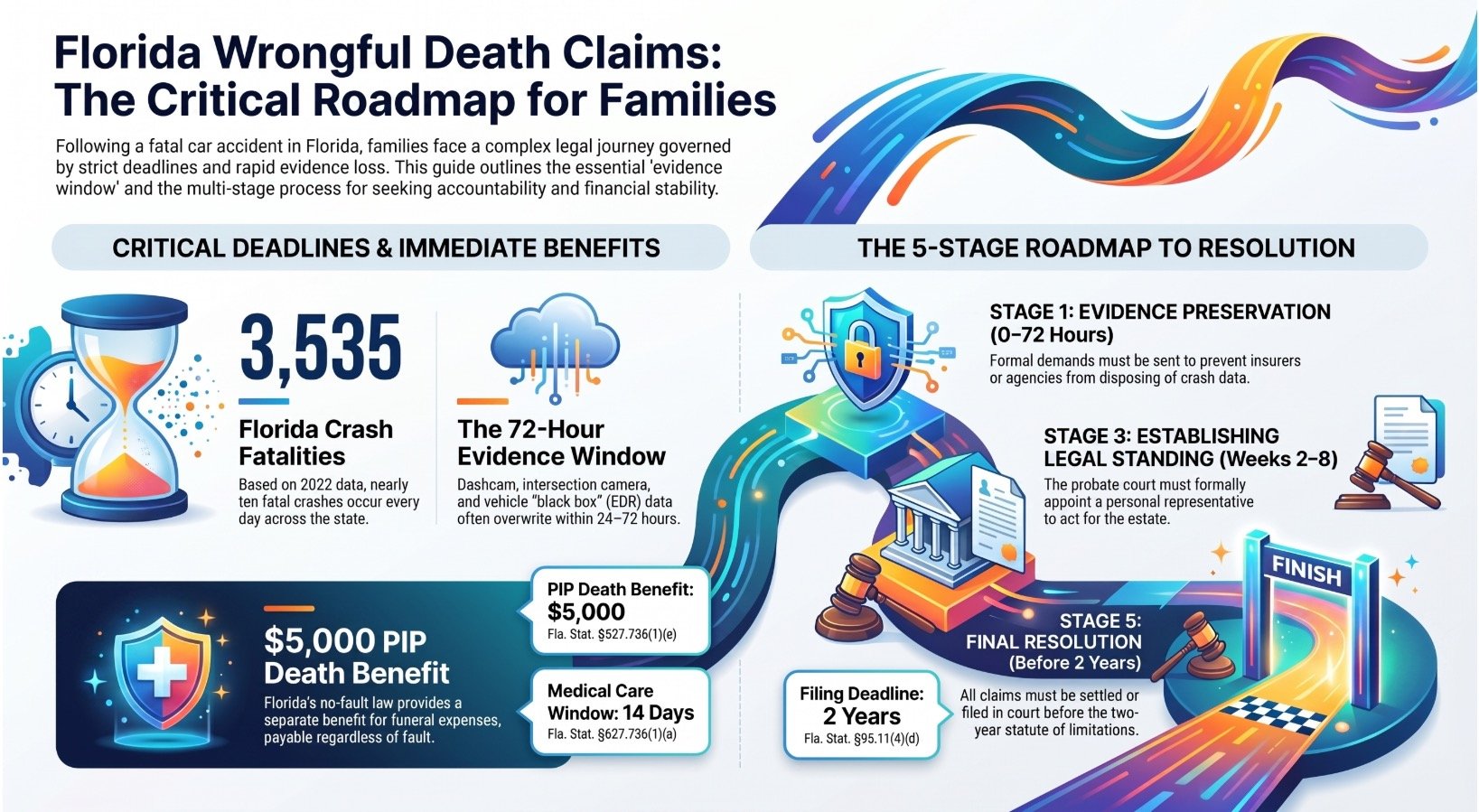
According to the FLHSMV 2022 Florida Traffic Crash Facts, Florida recorded 3,535 crash fatalities in 2022 — an average of nearly ten fatal crashes every day across the state. More than 401,523 total crashes were reported that year, and 253,888 people sustained documented injuries. Behind each fatality is a family facing the wrongful death process while grieving, managing finances, and raising children — often simultaneously.


Florida’s two-year wrongful death filing deadline (running from the date of death under Florida’s Wrongful Death Act) may feel distant, but the evidence that decides these cases — dashcam recordings, event data recorder (EDR) files, and traffic camera footage — disappears on an overwrite cycle of just 24 to 72 hours.
The national data reflects the same urgency: NHTSA reports that distracted driving alone claimed 3,308 lives nationally in 2022, a leading contributing factor in Florida fatal crashes as well. Families who contact an attorney within the first 72 hours of the crash give counsel the best chance to preserve the evidence that proves what happened.
Florida Wrongful Death Claim — The 5-Stage Roadmap for Surviving Families
Most families don’t know what happens after a fatal crash — or how fast the evidence and legal deadlines move. This roadmap shows what each stage requires and why the first 72 hours matter most.
Florida HB 837 (2023) impact on wrongful death claims: Before March 24, 2023, Florida’s pure comparative fault system allowed the estate to recover even when the deceased shared some blame for the crash. HB 837 converted this to modified comparative fault — if a court finds the deceased more than 50% at fault, the family recovers nothing from the negligent party. Insurers now have a direct financial incentive to build a record attributing majority fault to the deceased. Stage 1 evidence — EDR data, camera footage, and early witness accounts — is the most effective protection against that strategy, because it establishes the facts before the insurer’s narrative can take hold.
Common Causes of Florida Wrongful Death Car Accident
Florida wrongful death car accident claims often arise from preventable conduct, including distracted driving, impaired driving, speeding, and reckless behavior. Fatal crashes may also result from dangerous road conditions, such as poor signage, defective traffic signals, or inadequate roadway maintenance. Identifying the cause of the collision is crucial because liability may involve one driver, multiple parties, or a public entity responsible for road safety.
Distracted Driving
Distracted driving endangers everyone on the road by diverting a driver’s attention from safe vehicle operation. In Florida wrongful death car accident claims, distraction may involve texting, navigation use, grooming, eating, or conversations that reduce awareness of traffic conditions. Phone distraction is especially dangerous because it can combine visual, manual, and cognitive inattention within seconds. Teen driving also presents heightened risk, as inexperienced drivers may struggle to recognize hazards while managing passengers, messages, or other distractions. According to NHTSA’s distracted driving research, thousands of lives are lost each year to preventable inattention crashes. When a fatal crash occurs, investigators may review phone records, witness statements, vehicle data, and roadway evidence to determine whether inattention contributed. Families seeking accountability often depend on careful documentation, compassionate guidance, and disciplined advocacy to honor their loved one’s life and help protect the wider community.
Impaired Driving
On Florida roadways, impaired driving remains one of the most preventable causes of fatal car accidents, yet it continues to devastate families with sudden and irreversible loss. Alcohol, illegal drugs, and certain prescription medications can reduce judgment, coordination, and reaction time, creating grave risks for motorists, passengers, pedestrians, and first responders. In wrongful death cases, evidence of impairment may include officer observations, witness statements, sobriety checkpoints, blood alcohol testing, toxicology reports, and bar or restaurant records. These details can help determine whether a driver or another responsible party failed to act with reasonable care. For families seeking accountability while serving the memory of a loved one, careful investigation may support a claim for funeral costs, lost support, and other recoverable damages under Florida law.
Speeding and Recklessness
When a driver exceeds the speed limit or operates a vehicle with reckless disregard for others, the risk of a fatal collision increases sharply. Higher speeds reduce reaction time, increase stopping distance, and magnify the force of impact, often leaving families and communities with irreversible loss. The distinction between speeding and recklessness may involve different legal considerations, but both can show a failure to protect human life on Florida roads. Reckless conduct may include aggressive lane changes, racing, tailgating, or ignoring traffic signals despite obvious danger. In wrongful death claims, evidence such as crash data, witness accounts, and citations may help establish liability. In severe cases, punitive damages in Florida may be pursued when conduct shows intentional misconduct or gross negligence, reinforcing accountability and public safety.
Dangerous Road Conditions
Driver misconduct is not the only factor that can lead to a fatal crash, as dangerous road conditions may also create or worsen deadly hazards on Florida roads. Poorly maintained surfaces, missing signs, unsafe construction zones, and obstructed sightlines can leave careful motorists with little time to react. Wrongful lane markings may direct vehicles into unsafe positions, confuse merging traffic, or increase the risk of head-on collisions. Likewise, poor lighting hazards can reduce visibility for drivers, pedestrians, and cyclists, especially at intersections and rural roadways. When public agencies, contractors, or other responsible parties fail to address known dangers, families may face preventable loss. A wrongful death claim may examine maintenance records, prior complaints, and roadway design to determine accountability and support those harmed.
Legal Rights of Florida Wrongful Death Car Accident Injury Victims
After a fatal car accident in Florida, surviving family members may have the right to pursue compensation through a wrongful death claim when another party’s negligence caused the crash. These rights can help provide financial stability while honoring the dignity of the person who was lost and supporting those left to care for children, elders, or dependents.
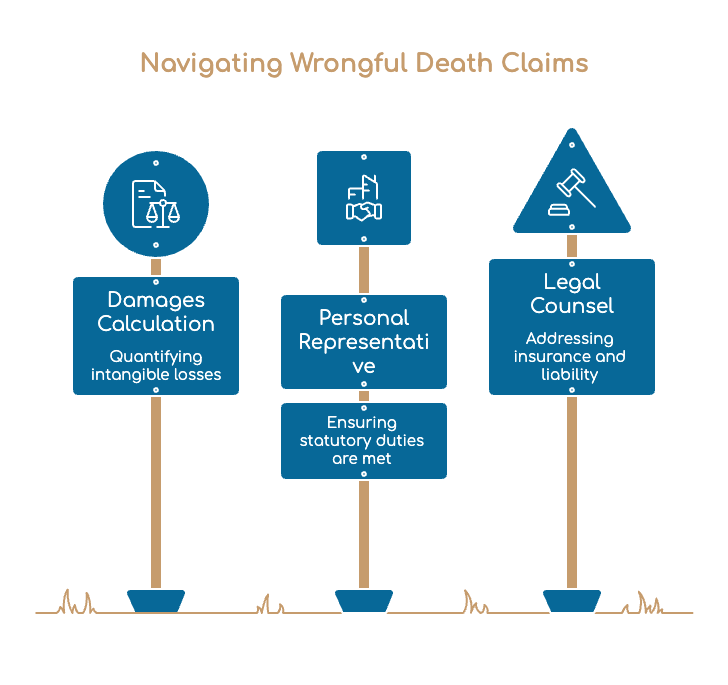
- Eligible survivors may seek damages for lost support, funeral expenses, medical costs, and the loss of companionship, guidance, and household services.
- A personal representative typically brings the claim on behalf of the estate and survivors, ensuring the process reflects statutory duties and family interests.
- Legal counsel may address insurance coverage, evaluate liability, preserve evidence, and guide families through settlements and appeals when a fair resolution is in dispute.
Florida law imposes strict filing deadlines, so timely action is important. Careful legal review can protect survivors’ rights and promote accountability through an orderly civil process.
Why Do Florida Wrongful Death Car Accident Injuries Happen?
Why do fatal car accident injuries occur on Florida roads, despite traffic laws, safety technology, and public awareness? They often result from preventable conduct, hazardous conditions, or failures in judgment that create sudden, severe harm. Common causes include speeding, impaired driving, distracted driving, fatigue, aggressive actions, unsafe lane changes, and failure to yield. Commercial vehicle collisions may involve negligent hiring, poor maintenance, or pressure to meet delivery schedules. Road design defects, weather, low visibility, and defective vehicle parts may also contribute.
When a death occurs, the impact reaches far beyond the crash scene. Survivors may face loss of family support, loss of income, funeral expenses, and emotional disruption. Insurance dispute delays can intensify hardship, particularly when responsibility is contested or multiple parties are involved. Understanding why these injuries happen helps clarify accountability, supports careful investigation, and promotes safer practices intended to protect families, communities, and those committed to serving others.
What Should You Do After a Florida Wrongful Death Car Accident Injury?
After a fatal car accident in Florida, immediate steps can affect both safety and any future wrongful death claim. Medical help should be sought for all injured parties, the accident should be reported to law enforcement, and critical evidence should be preserved as early as possible. These actions help create a reliable record of what occurred, which may be vital when liability, damages, and legal rights are later evaluated.
Seek Immediate Medical Help
When a fatal or potentially fatal car accident occurs in Florida, immediate medical attention should be the first priority for every injured person involved. Prompt evaluation protects life, identifies hidden trauma, and creates medical documentation that may later assist a wrongful death or injury matter. Bystanders, family members, and caregivers should encourage emergency treatment without delay, even when symptoms appear limited. Internal bleeding, brain injuries, and spinal damage may worsen quickly without proper care. Medical providers can also connect families with emotional support resources during the earliest stage of crisis. Timely treatment may affect insurance claim timelines because insurers often review gaps in care when evaluating losses. Serving the injured well begins with restoring health, stabilizing conditions, and ensuring that qualified professionals document the full extent of harm.
Report the Accident
At the scene of a serious or fatal Florida car accident, the crash should be reported to law enforcement as soon as emergency medical needs are being addressed. A prompt report allows officers to secure the area, direct traffic, identify involved parties, and prepare an official crash report. Family members, passengers, or assisting bystanders should provide accurate information without speculation or blame. When appropriate, they may help identify people who saw the collision, supporting the collection of witness statements for the investigating officer. They should also note whether damaged vehicles remain available for vehicle inspection documentation by authorities or qualified personnel. Reporting the accident creates an official record that may assist grieving families, insurers, and legal representatives in understanding what occurred while respecting the dignity of those harmed.
Preserve Key Evidence
Once the accident has been reported and immediate safety concerns have been addressed, families should take reasonable steps to preserve evidence that may help explain how the fatal crash occurred. Photographs of vehicle positions, roadway conditions, skid marks, debris, traffic signals, and visible injuries can provide important context. If available, dash camera footage, surveillance video, event data recorder information, and repair records should be secured before they are lost or altered. Witness interviews should be documented promptly, since memories may fade and contact information may become difficult to locate.
Families should also keep medical records, funeral expenses, employment documents, and communications from insurers. Because insurance timelines can affect notice requirements and claim handling, organized records help protect the rights of surviving relatives seeking accountability.
As the blog post What Medical Records Matter Most in a Florida Injury Claim explains, the specific records tied to the crash injuries are often the most decisive evidence in any Florida injury or wrongful death case.
Critical Evidence in a Florida Wrongful Death Car Accident Injury Case
Critical evidence in a Florida wrongful death car accident injury case often determines whether liability, causation, and damages can be proven with clarity. Key materials may include: (1) police crash reports, (2) accident scene evidence and vehicle damage analysis, and (3) medical records and autopsy findings. Each category can help establish how the collision occurred, who may be responsible, and how the fatal injuries resulted from the crash.
Police Crash Reports
After a fatal collision, the police crash report often becomes one of the first organized records of what occurred, who was involved, and what evidence existed at the scene. In a Florida wrongful death car accident case, this report may identify drivers, passengers, vehicle owners, insurance information, citations, roadway conditions, and the officer’s preliminary observations. It can also reference eyewitness statements, dashcam footage, diagrams, and documented timelines that help clarify how the crash unfolded. Although the report may not be admissible for every purpose, it can guide further investigation and support a careful review of responsibility. For families seeking accountability while honoring a loved one’s memory, the report offers a structured foundation for counsel, insurers, and experts to evaluate the claim with diligence and care.
Accident Scene Evidence
Preserving accident scene evidence can play a central role in determining how a fatal Florida car collision occurred and who may be legally responsible. Skid marks, debris fields, traffic signal timing, roadway defects, lighting conditions, and weather observations may help clarify the sequence of events leading up to impact. Photographs, video recordings, measurements, and witness locations should be documented promptly, before conditions change or materials are removed. This evidence can assist investigators, attorneys, and experts in evaluating whether a driver, public entity, or other party failed to meet applicable negligence standards. It may also provide causal proof by connecting unsafe conduct to the fatal outcome. Careful preservation supports families seeking accountability while serving the broader public interest in safer roads, responsible driving, and accurate legal determinations after tragedy.
Vehicle Damage Analysis
In a fatal Florida car accident case, vehicle damage analysis can provide important physical evidence about the direction, force, and sequence of a collision. Trained investigators may examine crush patterns, paint transfer, broken components, airbag deployment, and intrusion into the passenger compartment to understand how the impact occurred. This information can help confirm or challenge witness statements, police findings, and insurance positions. When coordinated with accident reconstruction, criminal investigations, and video evidence analysis, vehicle damage findings may clarify speed, braking, the point of impact, and vehicle movement prior to impact. For families seeking accountability, this evidence can support a careful, service-focused pursuit of justice. A Florida wrongful death lawyer may preserve damaged vehicles, consult qualified experts, and ensure that vital evidence is documented before repair, sale, or disposal.
Medical Records and Autopsies
Why do medical records and autopsy findings matter so deeply in a Florida wrongful death car accident case? They document the physical harm, treatment course, cause of death, and timing of decline, allowing responsible parties to be identified with greater precision. Emergency records, surgical notes, imaging, toxicology reports, and autopsy conclusions may connect the crash to fatal injuries, while also addressing preexisting conditions or disputed causation. These materials can support wrongful death eligibility by showing that the death resulted from another party’s negligence. They also help representatives meet insurance claim timelines, evaluate damages, and respond to defense challenges.
Long-Term Effects of Florida Wrongful Death Car Accident Injuries
The long-term effects of a Florida wrongful death car accident often extend beyond the initial loss, creating lasting emotional trauma for surviving family members. Financial hardship may follow when medical bills, funeral costs, and lost income place persistent pressure on the household. Family life can also change significantly, as survivors adjust to altered roles, responsibilities, and daily routines.
Emotional Trauma
Emotional trauma often remains after the physical injuries and legal proceedings have ended, especially when a fatal Florida car accident leaves surviving family members with shock, grief, anxiety, or post-traumatic stress. Survivors may experience PTSD symptoms, including intrusive memories, sleep disruption, avoidance of driving, irritability, or heightened fear when encountering reminders of the crash. These effects can impair caregiving, communication, and daily responsibilities, requiring attentive support from professionals and trusted community members. In wrongful death cases, emotional harm is not limited to immediate grief, because anniversaries, investigations, and case developments may renew distress. Family counseling can help relatives process loss, preserve relationships, and develop healthy coping strategies. Compassionate legal guidance may also reduce confusion, allowing families to focus on recovery while their rights are carefully protected.
Financial Hardship
Beyond grief and psychological strain, a fatal Florida car accident can create lasting financial hardship for surviving family members. Funeral expenses, medical bills, lost income, and reduced benefits may quickly overwhelm a household already facing profound loss. When the deceased provided wages, caregiving, transportation, or household management, the economic impact can extend for years. Careful review of insurance coverage options may help identify available benefits, including bodily injury liability, uninsured motorist coverage, or personal injury protection. However, insurers may dispute liability, policy limits, or the value of damages. A wrongful death lawyer can help evaluate losses, preserve evidence, and pursue compensation with diligence. Legal fee assistance, including contingency arrangements, may enable families to pursue accountability without paying upfront attorney fees, thereby supporting access to justice during a difficult financial period.
Family Life Changes
After a fatal car accident, family life may change in ways that extend far beyond immediate financial concerns. Surviving relatives often assume new caregiving duties, manage household decisions alone, and help children adjust to the absence of a parent or guardian. Custody disruptions can arise when the deceased provided primary care, requiring courts or relatives to determine stable arrangements that protect the child’s welfare. These changes may affect school performance, routines, transportation, and emotional security. Families serving one another during this period may need coordinated grief support, counseling, and practical assistance from trusted community resources. In a Florida wrongful death claim, these long-term family consequences can help show the depth of loss, including the loss of guidance, companionship, and support once provided by the deceased loved one.
Proving Liability in Florida Wrongful Death Car Accident Injury Cases
When a fatal crash occurs, proving liability in a Florida wrongful death car accident case requires a careful showing that another party’s negligent or wrongful conduct caused the death. This process often involves reviewing police reports, crash reconstruction findings, witness statements, vehicle data, medical records, and roadway conditions. Evidence preservation is crucial because key evidence may be lost, tampered with, erased, or altered if action is delayed.
Liability may rest with a careless driver, a commercial carrier, a vehicle owner, a manufacturer, or another responsible party. The personal representative must connect the misconduct to the fatal injuries and the resulting wrongful death damages sought for surviving family members and the estate. Filing deadlines must also be respected, since Florida law limits the time available to bring a claim. Although insurance bad faith may become relevant in some cases, the central liability inquiry focuses on duty, breach, causation, and legally recognized losses arising from the crash.
Dealing With Insurance Companies After a Florida Wrongful Death Car Accident Injury
In the aftermath of a fatal Florida car accident, insurance companies often become engaged quickly, sometimes before surviving family members understand the full value or legal structure of a wrongful death claim. Their representatives may request statements, medical authorizations, or early releases, while presenting the exchange as routine. Families committed to honoring a loved one’s life should recognize that these communications can impact available wrongful death damages.
Insurance carriers evaluate claims with financial interests in mind, including limits, defenses, and potential exposure. A careful response helps safeguard dignity, accuracy, and fairness. Statements should be measured, documentation should be organized, and any proposed payment should be reviewed in light of statutory beneficiaries and compensable losses.
During settlement negotiation, a lawyer may address liability evidence, policy coverage, and the human consequences of the death. This advocacy can help protect grieving families from undervalued offers and ensure that resolutions reflect both legal rights and lasting responsibility.
Florida No-Fault Insurance and Wrongful Death Car Accident Claims
Florida requires all registered vehicles to carry at least $10,000 in personal injury protection (PIP) coverage. Under Florida Statute §627.736(1)(c), the PIP law also provides a separate $5,000 death benefit for funeral and burial expenses, payable to the estate or designated survivors regardless of who caused the crash. This death benefit is distinct from the $10,000 medical PIP and is not subject to the 14-day treatment window — though it must be properly claimed through the correct insurer.
If the deceased received emergency or hospital treatment before dying of crash injuries, PIP medical coverage may also apply to those bills — provided initial care began within 14 days of the accident. In wrongful death cases, PIP is typically the estate’s first and fastest source of payment for immediate expenses while the larger liability claim is developed.
For a detailed explanation of how Florida’s no-fault system works and when families can step outside PIP to pursue a direct liability claim, see the firm’s blog post Florida PIP Insurance Explained: How No-Fault Really Works.
When injuries meet Florida’s serious injury threshold — which is almost always satisfied in a wrongful death case — the personal representative may pursue full liability damages against the at-fault driver above and beyond PIP.
Event Data Recorder Evidence in Florida Wrongful Death Car Accident Cases
Most vehicles manufactured after 2012 contain an event data recorder (EDR), commonly called a black box, that captures speed, braking force, throttle position, steering angle, and seat-belt status in the seconds before and during a crash. In wrongful death cases, this data can reconstruct exactly what the at-fault driver was doing in the final moments before the fatal impact — directly establishing negligence and countering defense theories about sudden emergencies or unavoidable conditions.
EDR data can be permanently overwritten the next time either vehicle’s ignition is turned on after the crash. If a tow operator starts the engine during recovery, or if the other driver moves their vehicle from the scene, the recording may be lost. We send formal preservation demands immediately upon being retained and work with certified EDR specialists to extract the data before it is erased or the vehicle is repaired.
The same principles that apply to truck accident black box evidence — as detailed in the firm’s post How Black Box Data Can Make or Break Your Florida Truck Accident Case — apply equally to passenger vehicle EDRs in fatal crash cases.
In wrongful death matters where the at-fault driver disputes liability, EDR evidence is often the most decisive and objective proof available.
What to Expect During a Florida Wrongful Death Car Accident Injury Claim Process
A Florida wrongful death car accident injury claim typically begins with determining eligibility and legal standing, since only authorized parties may pursue compensation under state law. The process then moves to evidence collection, insurance claim negotiations, and a careful assessment of damages tied to the fatal crash. If negotiations do not produce a fair resolution, the claim may proceed toward settlement discussions or trial, depending on the strength of the case and the parties’ positions.
Eligibility and Legal Standing
Who has the legal right to bring a wrongful death claim after a fatal car accident in Florida is determined by the Florida Wrongful Death Act, which sets specific rules for eligibility and legal standing. Generally, the estate’s personal representative files the claim for the benefit of surviving family members, including a spouse, children, parents, and certain dependent relatives. This structure helps ensure that those most affected are represented in an orderly, fair, and respectful manner. Legal standing also affects related matters, such as survival actions and claims involving available insurance coverage. A lawyer may review family relationships, estate authority, and statutory priorities before any claim proceeds. Careful attention to eligibility supports the service’s purpose, protecting survivors while honoring the legal rights associated with the deceased person’s life.
Evidence Collection Process
After legal standing is confirmed, the evidence collection process often becomes one of the most important parts of a Florida wrongful death car accident claim. This stage may involve gathering crash reports, medical records, death certificates, vehicle photographs, and electronic data from nearby cameras or involved vehicles. A careful review can help clarify how the collision occurred and who may bear responsibility.
Attorneys may also focus on preserving witness statements while memories remain reliable and documenting road hazards that contributed to the fatal event. These hazards may include poor signage, obstructed sightlines, defective traffic signals, or unsafe construction zones. For families seeking accountability, thorough evidence collection serves a broader purpose: honoring the deceased by helping reveal the truth with accuracy, diligence, and respect for all affected.
Insurance Claim Negotiations
During insurance claim negotiations, the personal representative and surviving family members may encounter a structured process focused on liability, damages, policy limits, and available evidence. Insurers often review police reports, medical records, witness statements, and car accident timelines to assess responsibility and claim value. The representative may present documentation showing financial support, funeral expenses, medical costs, and the loss of companionship or guidance. Careful wrongful death damages calculations help frame the demand in a manner that reflects both statutory rights and practical proof. Adjusters may request clarifications, challenge causation, or compare the claim to policy coverage. Throughout this stage, accurate records and timely communication help protect the family’s interests, while honoring the decedent through a disciplined, service-minded approach to accountability and recovery.
Settlement or Trial
When negotiations reach a point of decision, a Florida wrongful death car accident claim may resolve through settlement or proceed toward trial. A settlement can provide timely support, reduce uncertainty, and spare surviving family members from the burden of courtroom testimony. Counsel evaluates whether the offer reflects medical expenses, funeral costs, lost support, companionship, and the dignity of the life lost. Insurance negotiation remains central, as carriers may test the strength of liability and damages before increasing payment. If a fair resolution is not offered, litigation may continue toward trial, where a judge or jury reviews testimony, expert opinions, and documented losses. Evidence preservation is key throughout, ensuring records, photographs, vehicle data, and witness accounts remain available to serve the pursuit of justice.
Compensation for Florida Wrongful Death Car Accident Injury Damages
Although no financial recovery can substitute for a life lost in a fatal crash, compensation in a Florida wrongful death car accident claim is intended to address the measurable losses caused by the death. These claims seek to place responsibility on the party whose negligence caused the collision, while providing support to surviving family members and the estate. A personal representative generally brings the action on behalf of eligible survivors, following the wrongful death procedure established under Florida law.
Compensation may arise through settlement negotiations, insurance dispute resolution, or a court judgment when liability and damages are contested. The process often requires careful documentation, including crash evidence, medical records, employment information, and proof of family relationships. For those serving grieving families, the focus remains on accountability, stability, and orderly recovery. A well-prepared claim can help ensure that available insurance and legal remedies are pursued with diligence, respect, and attention to statutory requirements. Results may vary. Prior results do not guarantee a similar outcome.
Economic vs. Non-Economic Damages in Florida Wrongful Death Car Accident Cases
In Florida wrongful death car accident cases, damages are often divided into economic and non-economic categories to reflect the full scope of loss. Economic damages may include measurable financial losses, while non-economic losses address harms such as grief, loss of companionship, and emotional suffering. Proving the value of damages requires careful documentation, credible evidence, and a clear connection between the fatal accident and the losses claimed.
Economic Damages Explained
Economic damages represent the measurable financial losses that arise after a fatal car accident, and they form a central part of many Florida wrongful death claims. These losses may include medical bills incurred before death, funeral and burial expenses, lost income, lost benefits, and the value of household services the decedent provided. In serving surviving family members, a lawyer may gather employment records, tax returns, invoices, and expert evaluations to support a wrongful death damages calculation. The insurance claim timeline can affect when documentation must be submitted, reviewed, and challenged, making organized evidence critical. Economic damages are intended to restore financial stability as closely as the law allows while reflecting the practical support the deceased provided to dependents and the estate.
Non-Economic Losses
When a fatal car accident causes losses that cannot be measured by receipts or wage records, Florida wrongful death law may allow certain survivors to seek non-economic damages. These losses recognize the human consequences of a death, including emotional suffering, loss of companionship, guidance, protection, and parental instruction. For families committed to caring for one another, such damages acknowledge the absence of daily support that once shaped home, service, and responsibility. Florida law identifies which survivors may recover these damages, and the available categories can depend on the survivor’s relationship to the deceased. Non-economic losses are separate from medical bills, funeral expenses, and lost earnings. In rare cases involving intentional misconduct or gross negligence, punitive damages may also be considered, though they serve a different legal purpose than compensation.
Proving Damage Value
For families pursuing a Florida wrongful death claim after a fatal car accident, proving damage value requires evidence that connects each claimed loss to the death and places that loss within the categories allowed by law. Economic damages often depend on records such as medical expense documentation, proof of funeral costs, employment files, tax returns, and expert-supported wage-loss calculations. These materials help show the financial support, services, and expenses affected by the loss.
Non-economic damages require a different form of proof. Loss of loss of companionship may include family testimony, caregiving history, household roles, and accounts showing the relationship’s depth. A careful presentation allows the court or insurer to understand both measurable costs and human losses, while respecting the dignity of survivors and the person who died.
When a Florida Wrongful Death Car Accident Injury Case Goes to Trial vs. Settlement
After a fatal car accident, a Florida wrongful death claim may resolve through settlement or proceed to trial, depending on the evidence, insurance coverage, liability disputes, and the damages suffered by the surviving family members. Settlement may provide a structured path toward resolution, especially when responsibility is clear and the insurer evaluates wrongful death damages with reasonable care. This approach can reduce delay, limit uncertainty, and help families focus on service, stability, and support for those affected.
Trial may become necessary when the defense contests fault, minimizes loss, or refuses a fair valuation. In that setting, counsel develops a trial strategy based on accident reconstruction, medical proof, financial records, witness testimony, and the human impact of the death. A jury may then determine liability and damages. Whether settlement or trial is appropriate, the central purpose remains the same: to pursue accountability while honoring the family’s need for dignity and practical recovery.
Florida Laws That May Affect Your Florida Wrongful Death Car Accident Case
The path of a Florida wrongful death car accident case is shaped not only by settlement negotiations or trial strategy, but also by the statutes and legal doctrines that govern liability, damages, deadlines, and who may bring a claim.
These rules can affect how a family, guided by a personal representative, seeks accountability while honoring the life lost.
- Comparative negligence may reduce recovery if the deceased is found partly responsible for the crash — and under HB 837, if they are found more than 50% at fault, the family may recover nothing, making careful review of the evidence crucial.
- Florida’s wrongful death framework identifies eligible survivors and categories of recoverable losses, including support, services, companionship, and certain expenses.
- Punitive damages may be available when conduct shows intentional misconduct or gross negligence, such as impaired or reckless driving.
A lawyer serving the family must evaluate these laws early, preserve proof, and present the claim with accuracy, dignity, and a clear focus on responsible compensation.
The Statute of Limitations for Florida Wrongful Death Car Accident Injury Cases
When a fatal car accident gives rise to a wrongful death claim in Florida, the statute of limitations becomes one of the most important legal deadlines in the case. Florida generally requires a wrongful death lawsuit to be filed within two years from the date of death. This period is strict, and missing it may prevent the personal representative from seeking compensation for eligible survivors and the estate.
Timely action also supports the preservation of evidence of liability, including crash reports, vehicle data, roadway conditions, witness statements, and available video footage. These materials may become harder to obtain as time passes, especially when businesses overwrite recordings or witnesses relocate. The deadline also matters because comparative fault rules may affect how responsibility is assigned among drivers, vehicle owners, or other parties. A careful understanding of the filing period helps preserve the claim while respecting the family’s duty to seek accountability for a life lost through negligence.
How a Florida Wrongful Death Car Accident Injury Lawyer Can Help You
Meeting Florida’s two-year filing deadline is only one part of protecting a wrongful death claim after a fatal car accident. A Florida wrongful death car accident injury lawyer helps the personal representative pursue accountability while respecting the family’s broader duty to care for surviving dependents, preserve dignity, and seek stability after loss.
- Case evaluation: Counsel identifies eligible survivors, assesses recoverable damages, and connects the facts of the crash to negligence, causation, and measurable harm.
- Claim management: The lawyer monitors the insurance claim timeline, prepares required notices, responds to adjuster requests, and challenges settlement positions that undervalue the family’s losses.
- Evidence development: Counsel builds a courtroom evidence strategy through police reports, medical records, expert analysis, witness statements, and documentation of financial and relational impact.
This guidance allows the estate to proceed with organized advocacy, reducing administrative burden while promoting a claim grounded in service, responsibility, and lawful recovery.
When to Contact a Florida Wrongful Death Car Accident Injury Lawyer
After a fatal car accident, legal counsel should be contacted as soon as the immediate medical and family emergencies are addressed. Early contact allows a family representative to receive guidance while crucial details remain available, organized, and reliable. In Florida, certain deadlines and procedural requirements may affect a wrongful death claim, so delay can create unnecessary risk.
Prompt consultation also supports evidence preservation, including vehicle condition, roadway conditions, photographs, surveillance footage, event data, and witness information. These materials may become harder to locate or verify as time passes. A careful review of the client’s timeline can help identify medical treatment dates, communications with insurers, funeral arrangements, and other events relevant to the family’s next steps.
Families who support one another during grief should not be left to manage legal uncertainty alone. Contacting a lawyer early can help protect the estate’s interests while allowing relatives to focus on care, stability, and practical responsibilities.
Why You Need an Experienced Florida Wrongful Death Car Accident Injury Lawyer
Early legal contact is important, but the quality of representation can have an even greater effect on how a wrongful death car accident claim is developed. An experienced Florida wrongful death car accident injury lawyer understands how to build a claim while respecting the family’s grief, responsibilities, and desire to honor the person lost. Such representation helps identify causes of crashes, preserve evidence, evaluate liability, and connect the death to legally recoverable damages.
Experience also matters because wrongful death claims often involve multiple insurers, medical records, employment documentation, and statutory requirements. A lawyer familiar with insurance claim timelines can help prevent missed deadlines, incomplete submissions, or premature settlement discussions that may undervalue the loss. Skilled counsel can coordinate investigations, communicate with insurance adjusters, and present the full impact of the death accurately and with dignity. For families seeking to protect surviving loved ones, informed legal guidance can provide structure during an overwhelming process.
How to Choose the Right Florida Wrongful Death Car Accident Injury Lawyer for Your Case
For families facing the aftermath of a fatal crash, choosing the right Florida wrongful death car accident injury lawyer requires careful attention to experience, communication, and case strategy. Counsel should understand Florida’s wrongful death laws, insurance practices, and the practical burdens survivors face while trying to honor a loved one’s life. A qualified attorney will clearly explain legal options, identify eligible beneficiaries, and evaluate damages with respect for the family’s long-term needs.
Families should ask about prior case results, courtroom experience, and methods for evidence documentation, including crash reports, medical records, witness statements, and expert analysis. The lawyer’s approach to settlement timelines also matters, because premature resolutions may fail to account for future financial and emotional losses. Compassionate representation should include regular updates, organized case management, and honest guidance about risks. The right choice is a lawyer prepared to protect the claim while allowing the family to focus on stability, service, and recovery.
About The Law Offices of Anidjar & Levine
Founded in 2005 by Marc Anidjar and Glen Levine, the firm began as a two-person operation working out of a construction office conference room. Over the past 20 years, that modest start has grown into one of Florida’s most recognized personal injury practices — with more than $1 billion recovered in settlements for injury clients across the state. We bring that same determination and depth of experience to every case we handle.
With a focus on personal injury and wrongful death claims, The Law Offices of Anidjar & Levine represents Florida families seeking accountability after fatal car accidents. The firm assists surviving relatives as they navigate insurance disputes, liability questions, and the financial consequences that often follow an unexpected loss.
Its attorneys prepare each case with attention to evidence, deadlines, and the needs of those left behind. This approach supports families who must make difficult decisions while honoring their loved one’s life and service. The firm’s work includes investigating crashes, identifying responsible parties, and pursuing compensation permitted under Florida law.
A legal consultation can help families understand whether they have grounds to bring a claim and what steps to take next. Through professional guidance, The Law Offices of Anidjar & Levine seeks to provide clear direction, diligent advocacy, and steady support to grieving Florida families statewide during a demanding legal process.
Frequently Asked Questions
Who Can File a Wrongful Death Claim in Florida?
In Florida, the personal representative of the decedent’s estate files a wrongful death claim, acting for the estate and eligible survivors. This establishes legal standing under state law. Survivors may include a spouse, children, parents, and certain dependent relatives. The distinction between estate claims and survivor claims matters because recoverable damages may belong to the estate or survivors, depending on the circumstances and in accordance with Florida’s Wrongful Death Act (Fla. Stat. §§ 768.16–768.26).
Can Multiple Family Members Receive Separate Compensation?
Yes, multiple family members may receive compensation, but awards are usually pursued through one wrongful death action, not isolated lawsuits. Eligible survivors can recover distinct damages based on their relationship, losses, and statutory rights. Family consent may affect decisions, especially when appointing a personal representative or resolving settlement terms. A careful claims strategy can help clarify each survivor’s losses while supporting an orderly, fair recovery that serves everyone involved.
Are Punitive Damages Available in Fatal Car Accident Cases?
Yes, punitive damages may be available in fatal car accident cases when the conduct shows intentional misconduct or gross negligence, rather than ordinary carelessness. Negligence proof must demonstrate serious disregard for human life, such as impaired driving, racing, or knowingly dangerous behavior. Courts apply strict standards, and insurance coverage may not pay punitive awards. Families seeking accountability should receive careful guidance, so their service to a loved one’s memory is pursued responsibly.
What if the Deceased Was Partially at Fault?
If the deceased was partially at fault, recovery may still be possible, but compensation can be reduced under comparative fault principles. Florida HB 837 (effective March 24, 2023) converted Florida to a modified comparative fault system — if the deceased is found more than 50% at fault, the family may recover nothing from the negligent party. Partial liability requires an examination of each party’s conduct, available evidence, and applicable traffic duties. Careful preservation of evidence is essential to counter fault-shifting strategies used by opposing insurers.
How Are Wrongful Death Settlement Funds Distributed?
Wrongful death settlement funds are distributed according to statutory priorities, settlement terms, and, when required, court approval. Eligible living beneficiaries may include a spouse, children, parents, or dependent relatives, depending on the case facts. Funds are often allocated for economic losses, support, companionship, and related damages. The estate’s share may pass through the probate process, during which valid debts, expenses, and distributions are addressed under careful oversight.
Does Florida PIP Insurance Cover a Wrongful Death Car Accident?
Yes. Florida’s personal injury protection (PIP) law provides a separate $5,000 death benefit for funeral and burial expenses, payable to the estate or designated survivors regardless of fault (Fla. Stat. §627.736(1)(c)). This is distinct from the $10,000 medical PIP benefit and is not subject to the 14-day treatment window. In addition, if the deceased received emergency or hospital treatment before dying of crash injuries, PIP medical coverage may offset those bills — provided initial treatment began within 14 days of the accident. An attorney can help ensure both PIP benefits are properly claimed while the larger liability claim is developed.
Can a Vehicle’s Black Box (EDR) Help Prove Fault in a Florida Wrongful Death Case?
Yes. Most vehicles manufactured after 2012 contain an event data recorder (EDR) that captures pre-crash speed, braking force, steering angle, throttle position, and seat-belt status in the seconds before impact. In wrongful death cases, this data can reconstruct exactly what the at-fault driver was doing in the moments before the fatal crash — directly establishing negligence and countering defense claims of sudden, unavoidable emergencies. EDR data can be overwritten the next time the vehicle’s ignition is turned on after the crash, so formal preservation demands must be sent immediately. We work with certified EDR specialists to extract recordings before they are lost.
A Florida wrongful death car accident claim can involve intricate liability issues, strict filing deadlines, and significant financial consequences for surviving family members.
An experienced Florida Car Accident Lawyer can investigate the crash, identify responsible parties, calculate recoverable damages, and manage negotiations or litigation.
The Law Offices of Anidjar & Levine helps families pursue accountability with focused legal guidance.
Prompt action can protect important evidence, preserve legal rights, and support a stronger claim for compensation after a fatal collision. Results may vary.
Prior results do not guarantee a similar outcome.