At the Law Offices of Anidjar and Levine, we’re Jacksonville T‑bone car accident lawyers who guide you through injury assessment, evidence preservation, and claim filing, ensuring every photograph, medical record, and witness statement is secured for a strong case.
Our team reviews police reports, reconstructs the collision, and calculates both economic and non‑economic damages, while negotiating with insurers to counter low‑ball offers and preparing for litigation if needed. Continue to discover how our proficiency protects your rights and maximizes compensation.
Learn more from our Jacksonville Car Accident Lawyer.
Main Takeaways
- Choose a Jacksonville attorney experienced in T‑bone collisions who promptly initiates medical documentation and evidence preservation.
- Ensure the lawyer secures police reports, dash‑cam footage, and witness statements to establish liability and comparative negligence.
- Verify the attorney can calculate both economic damages (medical bills, lost wages) and non‑economic losses (pain, suffering).
- Look for a firm that retains expert witnesses—medical, reconstruction, and economic analysts—to strengthen the case.
- Confirm the lawyer provides a clear timeline for claim filing, settlement negotiations, and potential trial preparation.


How We Can Help With Your Jacksonville T-Bone Car Accident Claim
We investigate every facet of your Jacksonville T‑bone car accident claim to make certain you receive full compensation for injuries, property damage, and related losses.
Our team coordinates with healthcare providers to address medical liens promptly, ensuring that lien amounts are accurately reflected in the settlement package.
We map out settlement timelines, keeping you informed of each milestone from initial demand to final disbursement, so you can plan your recovery without uncertainty.
By reviewing police reports, witness statements, and repair estimates, we build a thorough case narrative that highlights liability and quantifies damages.
We negotiate with insurers, presenting evidence that supports a fair valuation while protecting your interests against lowball offers.
Throughout the process, we maintain transparent communication, answering questions and adjusting strategies as new information emerges.
Our commitment is to secure the maximum recovery possible, honoring your right to justice and financial stability after a traumatic collision.
OUR CONSULTATIONSARE FREE
START YOUR FREE CASE REVIEW

Understanding Jacksonville T-Bone Car Accident Cases
Our investigation into the details of your claim naturally leads to a broader view of what makes T‑bone car accidents in Jacksonville distinct.
Our investigation reveals the unique dynamics and injury patterns of T‑bone car accidents in Jacksonville.
We examine intersection dynamics, noting that many collisions occur at signal‑controlled crossings where right‑of‑way rules intersect with high traffic volumes.
By analyzing vehicle trajectories, we identify patterns in impact angle and speed that influence injury severity.
Injury biomechanics then guides our assessment of how forces travel through the body during a side‑impact, explaining why occupants often suffer chest, shoulder, and head trauma.
We also consider the role of vehicle size, road surface conditions, and driver reaction times, all of which shape the outcome of a T‑bone event.
Our all‑encompassing approach integrates these factors to predict liability, quantify damages, and develop a strategy that protects the injured party’s rights while honoring our commitment to serve the community with proficiency and integrity.
Common Causes of Jacksonville T-Bone Car Accidents
We observe that distracted driving, such as texting or using navigation devices, often leads to missed signals and sudden lane deviations.
Failure to yield at intersections, combined with speeding or aggressive driving, creates hazardous conditions where vehicles collide at right angles.
Improper lane changes, especially without checking blind spots, further increase the likelihood of T‑bone collisions in Jacksonville’s busy roadways.
Distracted Driving
When drivers let their attention wander—whether by texting, adjusting the radio, or checking navigation apps—the risk of a T‑bone collision rises dramatically on Jacksonville’s busy streets.
We see that poor smartphone etiquette directly compromises lane discipline, making it harder to anticipate sudden stops or turns.
Likewise, pedestrian distraction—whether from earbuds, mobile devices, or visual overload—reduces awareness of crossing individuals, increasing the likelihood of side‑impact crashes.
In our experience, these behaviors erode the shared responsibility that keeps traffic flow safe.
By reinforcing disciplined device use and encouraging mindful walking practices, we can collectively lower the incidence of T‑bone accidents.
Our commitment to public safety demands that we address these distractions with clear, actionable guidance.
Failure to Yield
Because drivers often misjudge right‑of‑way rules at intersections, failure to yield becomes a leading cause of T‑bone collisions in Jacksonville.
We see that right-of-way confusion frequently stems from unclear intersection signage, especially when stop signs or traffic lights are obscured or when drivers assume they have the right of way.
In many cases, motorists entering a primary road fail to yield to oncoming traffic traveling straight, creating a side‑impact scenario that can severely damage vehicles and endanger lives.
We advise vigilant observation of all signs and a cautious approach when uncertain about who has the right of way.
Speeding and Aggressive Driving
If drivers exceed posted speed limits or engage in aggressive maneuvers, the margin for error at intersections shrinks dramatically, making T‑bone collisions far more likely.
We see that speed-induced road rage often fuels the escalation of tailgating, turning a simple commute into a high‑risk scenario.
When motorists accelerate to gain a few seconds, they reduce reaction time and impair judgment, increasing the chance of running red lights or misjudging gaps.
This behavior creates a cascade of unsafe decisions, where one driver’s impatience pressures another to respond similarly, amplifying danger.
Improper Lane Changes
Swerving into another lane without signaling or checking blind spots frequently triggers T‑bone collisions at Jacksonville intersections.
We observe that many drivers neglect lane discipline, assuming they can merge without confirming that the adjacent lane is clear.
When a motorist fails to use turn signals, other road users can’t anticipate the movement, and the blind spot becomes a hidden hazard.
This lack of communication often leads to side‑impact crashes, especially at busy junctions where vehicles travel at varying speeds.
We advise drivers to perform a thorough visual sweep, including checking mirrors and over‑shoulder views, before any lane change.
By maintaining strict lane discipline and practicing blind-spot awareness, we can reduce the frequency of T‑bone accidents and protect the community.


Legal Rights of Jacksonville T-Bone Car Accident Victims
When a T‑bone collision occurs on Jacksonville’s busy streets, victims immediately acquire a set of legal rights that protect their interests and facilitate fair compensation.
We must understand that statutory deadlines dictate the timeframe for filing a claim, and comparative negligence determines how fault is apportioned when multiple parties share responsibility.
These principles guide our efforts to secure the maximum recovery for medical expenses, lost wages, and pain and suffering.
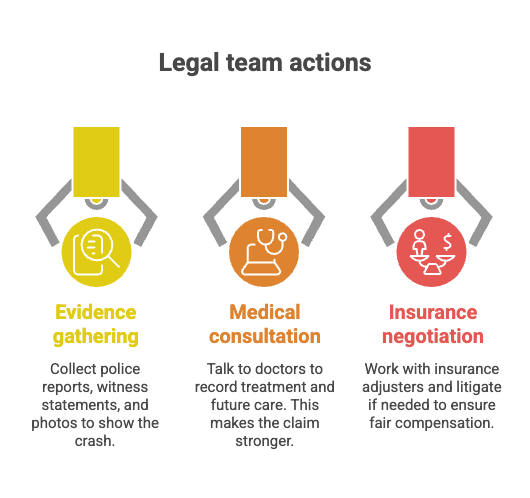
- We gather police reports, witness statements, and photographic evidence to illustrate the crash scene and injuries.
- We consult medical professionals to document treatment timelines and future care needs, reinforcing the claim’s credibility.
- We engage insurance adjusters and, if necessary, litigate to make certain that comparative negligence doesn’t diminish entitled compensation.
Steps to Take After a Jacksonville T-Bone Car Accident
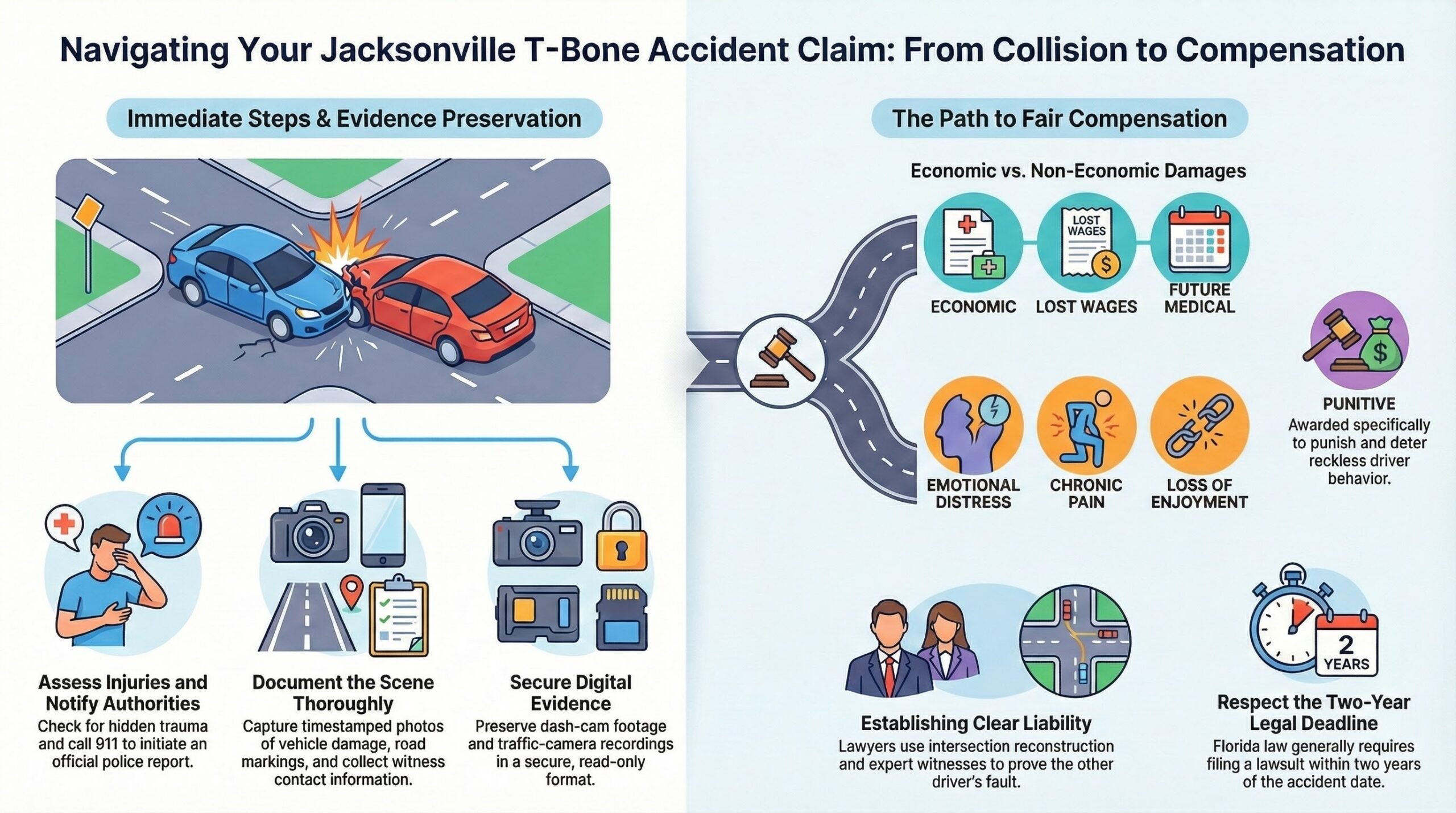
We should first assess any injuries right away, ensuring that everyone receives necessary medical attention before moving the vehicles.
Next, we must promptly notify the police and our insurers, providing accurate details to initiate official reports and claims.
Finally, we document the scene thoroughly—photographs, witness statements, and vehicle positions—to preserve crucial evidence for any subsequent legal or insurance proceedings.
Assess Injuries Immediately
A T‑bone collision can cause a range of injuries that demand immediate attention, and we must act swiftly to safeguard our health and preserve evidence.
First, we conduct an immediate assessment of ourselves and any passengers, checking for pain, dizziness, bleeding, or loss of mobility.
Even minor discomfort may signal hidden trauma, so we document each symptom in writing, noting time, location, and intensity.
We photograph visible injuries and record any swelling or bruising for future reference.
If someone appears unconscious or has difficulty breathing, we treat those signs as emergencies and seek professional medical help without delay.
This systematic injury documentation not only guides our recovery but also creates a reliable record for any subsequent legal or insurance processes.
Notify Police and Insurers
Although adrenaline may be high after a T‑bone collision, we must promptly notify law enforcement and our insurance providers to protect our legal rights and guarantee proper documentation.
We should call 911 immediately, providing a precise location and a brief description of the incident, because police response time can affect the thoroughness of the report and the credibility of our claim later.
While waiting for officers, we gather the officer’s name and badge number, then request a copy of the police report once it’s filed.
After the scene is secured, we contact our insurer without delay, reporting the accident and supplying the police report reference.
Prompt communication helps prevent insurer denials and ensures that the claim process proceeds with accurate, timely information.
Document Evidence Thoroughly
Once the police report is secured and the insurer has been notified, we must turn our attention to gathering concrete evidence at the scene.
We photograph vehicle damage, road markings, and surrounding hazards from multiple angles, ensuring each image is timestamped to preserve the chain of custody.
We collect witness statements, note contact information, and, with consent, record their accounts, which supports later digital forensics analysis.
We secure any dash‑cam or smartphone footage, storing it in a secure, read‑only format to prevent alteration.
We also retrieve traffic‑camera recordings and preserve tire‑track impressions, clearly labeling each item.
How a Jacksonville T-Bone Car Accident Lawyer Can Help You
When a T‑bone collision occurs, the resulting injuries and property damage can quickly overwhelm anyone, and that’s why we guide you through the legal process from start to finish.
We assess the post‑accident landscape, identify liable parties, and develop a strategy that prioritizes your recuperation while protecting your rights.
Our team coordinates medical documentation, insurance communications, and expert testimony to build a compelling case.
By managing settlement timing, we aim to secure a fair resolution without unnecessary delays, allowing you to focus on mending and supporting your community.
- A detailed reconstruction of the crash scene, visualizing impact forces and vehicle trajectories.
- A thorough timeline of medical treatment, highlighting each step of your recovery journey.
- A clear roadmap of negotiation milestones, illustrating how we advance your claim toward a timely settlement.
Long-Term Effects of Jacksonville T-Bone Car Accident Injuries
We recognize that chronic pain often persists long after the collision, requiring ongoing management strategies.
Many victims experience reduced mobility and functional limitations that affect daily activities and employment.
Additionally, emotional distress and cognitive challenges can emerge, influencing mental health and decision‑making capacity.
Chronic Pain Management
Managing chronic pain after a Jacksonville T‑bone car accident requires a thorough, long‑term strategy that addresses both physical symptoms and the psychological impact of sustained discomfort.
We guide clients through extensive pain coping techniques, integrating physical therapy, mindfulness, and targeted medication plans that reduce reliance on narcotics.
Our approach emphasizes sleep strategies, recommending consistent bedtime routines, ergonomic pillows, and relaxation exercises to improve restorative rest.
We also advise regular assessments to adjust treatment as conditions evolve, ensuring that each intervention aligns with the client’s overall health goals.
Mobility and Functional Limitations
Although many victims of Jacksonville T‑bone collisions initially focus on acute injuries, the long‑term impact on mobility and functional abilities often proves far more debilitating.
We must acknowledge that post‑accident stiffness, joint degeneration, and nerve damage can restrict walking, climbing stairs, and performing daily tasks.
Consequently, we guide clients toward assistive devices such as walkers, wheelchairs, and ergonomic braces that restore independence while reducing fall risk.
We also recommend home modifications—ramp installations, widened doorways, and bathroom grab bars—to adapt living spaces to new physical limits.
Emotional and Cognitive Impacts
When a Jacksonville T‑bone collision leaves a survivor with lingering pain, the emotional and cognitive repercussions can be as profound as the physical injuries.
We recognize that post-traumatic stress often emerges, manifesting as anxiety, depression, and heightened vigilance that can disrupt daily responsibilities.
Memory changes may appear as difficulty recalling details, concentrating on tasks, or retaining new information, which hampers both personal and professional performance.
These effects can persist for months or years, influencing decision‑making and interpersonal relationships.
By acknowledging these challenges, we empower survivors to seek appropriate therapeutic support and legal advocacy.
Our guidance emphasizes thorough documentation, early intervention, and coordinated care to mitigate long‑term emotional and cognitive decline while protecting the client’s rights.
Proving Liability in Jacksonville T-Bone Car Accident Injury Cases
Accountability hinges on establishing clear fault, and we begin by gathering all evidence linking the other driver to the collision.
We collect police reports, dash‑cam footage, and witness statements to create a timeline of events.
Intersection reconstruction then allows us to map vehicle positions, speeds, and trajectories, revealing how the other driver violated right‑of‑way rules.
We also secure medical records and repair estimates to quantify damages.
When the facts alone don’t paint a complete picture, we retain expert testimony from accident reconstructionists who can explain intricate dynamics in lay terms. These consultants validate our findings and bolster our argument that the opposing party breached a duty of care.
Dealing With Insurance Companies After a Jacksonville T-Bone Car Accident
Having established liability with solid evidence, we turn our focus to navigating the insurance process.
We advise clients to review their policy carefully, noting coverage limits and exclusions, then employ policy tactics that protect their rights while avoiding premature admissions.
We counsel them to document every interaction, request written statements, and keep detailed logs of medical treatment, repair estimates, and lost wages. By presenting a clear, organized file, we influence settlement timing, encouraging insurers to propose a fair offer promptly rather than delay in an effort to weaken our position.
We also remind clients that insurers often use low‑ball offers as a negotiation strategy, so we remain prepared to counter with well‑supported demand letters.
Throughout, we maintain open communication, ensuring clients understand each step and feel confident that their interests are being vigorously defended.
This disciplined approach maximizes the likelihood of an equitable resolution while minimizing unnecessary stress.
What to Expect During a Jacksonville T-Bone Car Accident Claim Process
We’ll begin by reviewing the initial report and evaluating the medical documentation you’ve gathered to gauge the claim’s strength.
Next, we’ll negotiate with the insurers, present the evidence, and seek a fair settlement while preparing for any counter‑offers.
If negotiations stall, we’ll outline a potential litigation timeline to ensure you understand each phase and the steps needed to protect your rights.
Initial Report Assessment
When you file a claim after a Jacksonville T‑bone collision, the first step is the initial report assessment, during which insurance adjusters review the police report, medical records, and any witness statements to determine liability and estimate damages.
We explain that the adjuster’s initial findings shape the case’s trajectory, so we stress the importance of preserving evidence from day one.
Photographs, dash‑cam footage, and repair estimates must be secured and shared promptly.
We guide you to organize documents chronologically, ensuring that every piece of evidence is readily accessible for the adjuster’s review.
By maintaining meticulous records, we help you present a clear, compelling narrative that supports a fair settlement while upholding the highest standards of service to those we represent.
Medical Documentation Review
Documentation is the cornerstone of any successful T‑bone claim, and we’ll guide you through each step of the medical review process.
We begin by gathering every record, from emergency‑room notes to specialist consultations, ensuring that each document reflects the timeline of your injury.
Our team conducts thorough medical audits, cross‑checking diagnoses, treatment plans, and provider notes to verify consistency.
We also scrutinize billing statements to identify any discrepancies that could reduce your compensation.
When inconsistencies appear, we request clarifications and, if necessary, seek corrected invoices.
Throughout, we keep you informed, explaining how each piece of evidence strengthens your claim and why precise documentation matters.
This disciplined approach protects your rights and maximizes recovery.
Negotiation With Insurers
We begin negotiations with insurers by first reviewing their initial settlement offer and comparing it against the full scope of your medical expenses, lost wages, and property damage.
Then we assess the limits of policy negotiations, identify any gaps, and develop a settlement strategy that reflects the true value of your claim.
Our team presents a detailed demand package that highlights documented losses and supporting evidence.
We anticipate insurers’ counteroffers and respond with calibrated adjustments while preserving your best interests.
Throughout the process, we maintain open communication to ensure you understand each step and the rationale behind our tactics. By aligning our approach with your recovery goals, we aim to secure a fair resolution without unnecessary delay.
Potential Litigation Timeline
If your claim moves beyond settlement negotiations, we’ll guide you through a structured litigation timeline that typically begins with filing a complaint and serving the defendant within 30 days.
We then enter a discovery phase, where we exchange documents, take depositions, and conduct pre-suit mediation to explore settlement possibilities while preserving our right to trial.
Throughout this period, we prioritize expert retention, securing medical, accident reconstruction, and economic analysts whose testimony strengthens our position.
After discovery, the case proceeds to dispositive motions, where we may seek summary judgment or dismissals.
If the matter remains unresolved, we prepare for trial, presenting evidence and arguments before a jury or judge.
Throughout each step, we keep you informed, ensuring transparency and strategic focus on achieving the best possible outcome.
Compensation for Jacksonville T-Bone Car Accident Damages
Many victims of Jacksonville T‑bone collisions discover that their losses extend far beyond immediate medical expenses, encompassing lost wages, diminished earning capacity, pain and suffering, and property damage.
We recognize that quantifying these losses requires careful documentation and a clear strategy.
First, we gather pay stubs, tax returns, and employer statements to prove lost wages and demonstrate how the accident interrupted earning potential.
Next, we assess property damage by obtaining repair estimates, vehicle valuation reports, and receipts for any related replacement costs.
Our team then compiles this evidence into a thorough demand package that reflects both the tangible financial impact and the broader disruption to daily life.
By presenting a well‑structured claim, we aim to secure fair compensation that restores financial stability and acknowledges the hardships endured.
We remain committed to advocating for each client, ensuring their rights are protected throughout the process.
Economic vs Non-Economic Damages in Jacksonville T-Bone Car Accident Cases
We’ll start by outlining the medical and other economic damages that can be quantified, such as hospital bills, lost wages, and ongoing treatment costs.
Next, we’ll identify non‑economic losses, including pain and suffering, emotional distress, and reduced quality of life, which are harder to measure but equally important.
Finally, we’ll explain how these categories combine to determine total compensation, ensuring that every recoverable loss is accounted for in the claim.
Medical Economic Damages Overview
When a Jacksonville T‑bone collision leaves you with injuries, the compensation you pursue typically splits into economic and non‑economic damages, each serving a distinct purpose in the settlement process.
We focus on medical economic damages, which cover quantifiable costs directly linked to treatment.
These include hospital bills, medications, physical therapy, and any billing disputes arising from insurance adjustments.
We also assess future medical expenses, projecting the cost of ongoing care based on injury severity.
In addition, we calculate lost wages and future earnings, estimating how the accident will affect your ability to work over time.
Non-Economic Loss Types
Evaluating non‑economic loss types is vital because they capture the intangible harms that economic calculations can’t quantify.
We explain that pain evaluation, emotional distress, and loss of enjoyment of life form the core of non‑economic damages in Jacksonville T‑bone collisions.
Our approach highlights how life disruption—such as diminished ability to work, care for family, or engage in hobbies—directly impacts a victim’s overall wellbeing.
We discuss how courts assess these losses, often using standardized scales and expert testimony to quantify suffering.
By distinguishing these harms from medical bills and lost wages, we help clients understand the full scope of compensation they merit.
Our guidance empowers victims to pursue fair restitution while honoring the principle of serving others responsibly.
Calculating Total Compensation
Having outlined the intangible harms, we now turn to how those non‑economic losses, together with measurable economic losses, form the total compensation a victim can recover.
We calculate economic damages by adding medical bills, lost wages, and future expenses such as ongoing therapy or rehabilitation.
Non‑economic damages cover pain, suffering, and emotional distress, often quantified by applying a multiplier to the economic total.
In Jacksonville T‑bone cases, punitive damages may be awarded when the at’s conduct was reckless, serving both to punish and deter similar behavior.
When a Jacksonville T-Bone Car Accident Case Goes to Trial vs Settlement
If a Jacksonville T‑bone car accident case proceeds to trial, we must first assess the strengths of our evidence, the liability issues, and the potential damages before deciding whether a settlement is more advantageous.
We evaluate jury dynamics, recognizing that jurors’ perceptions of fault and injury severity can dramatically shift outcomes.
In parallel, we consider settlement confidentiality, which protects client privacy and may secure a quicker resolution without public scrutiny.
When the trial appears favorable, we prepare persuasive arguments, expert testimony, and demonstrative exhibits to influence the jury’s deliberations.
Conversely, if the risk of an unfavorable verdict outweighs potential gains, we negotiate a confidential settlement that preserves resources and provides certainty for the injured party.
Our approach balances the pursuit of full compensation with the practical benefits of avoiding prolonged litigation, ensuring we act in the best interest of those we serve.
The Statute of Limitations for a Jacksonville T-Bone Car Accident Case
Within three years of a Jacksonville T‑bone collision, the law requires us to file a personal‑injury claim, and we must be mindful of the state’s two‑year statutory deadline for filing a lawsuit.
We appreciate that filing deadlines are essential to preserving a client’s right to recovery, and we advise clients to act promptly.
The two‑year limit begins on the date of the accident, but tolling exceptions may extend this period under certain circumstances, such as when the injured party is a minor, incapacitated, or when the defendant is out of state.
Recognizing these exceptions helps us avoid inadvertent dismissal of a claim.
We also monitor any discovery‑related delays that could pause the clock.
By staying vigilant about both the primary deadline and any applicable tolling exceptions, we ensure that our clients’ cases remain viable and their rights are fully protected throughout the legal process.
When to Contact a Jacksonville T-Bone Car Accident Lawyer After a Jacksonville T-Bone Car Accident
Because a T‑bone collision can cause hidden injuries and elaborate liability issues, we recommend contacting a Jacksonville T‑bone car accident lawyer as soon as possible after the crash.
We advise an immediate consultation to assess medical needs, insurance communications, and potential claims.
Prompt action ensures the preservation of evidence, allowing us to secure photographs, police reports, and witness statements before they degrade or disappear. When you reach out within the first 24‑48 hours, we can guide you on documenting symptoms, obtaining proper medical treatment, and avoiding statements that might undermine your case.
Early involvement also helps us identify all liable parties, including drivers, vehicle owners, and possibly third‑party insurers.
By acting quickly, we protect your rights and lay a solid foundation for negotiations or litigation.
Our team stands ready to assist you in steering through the complications of a T‑bone accident while focusing on your recovery and fair compensation.
Why You Need an Experienced Jacksonville T-Bone Car Accident Lawyer
When a T‑bone collision occurs, the stakes are high, and the legal landscape is intricate, so we insist on engaging an experienced Jacksonville T‑bone car accident lawyer from the outset.
We appreciate that victims often feel overwhelmed by insurance nuances and the pressure of settlement timing.
Our team works directly with insurers, decoding policy language that can otherwise diminish rightful compensation.
By acting early, we preserve essential evidence and protect your claim from procedural pitfalls that can delay or reduce recovery.
We also coordinate medical documentation and expert testimony, ensuring that every injury is fully represented in negotiations.
This proactive approach shortens settlement timing while maximizing the settlement amount.
Our experience translates into strategic advocacy, allowing us to anticipate defense tactics and counter them effectively.
Ultimately, we safeguard your financial future and help you focus on recuperating, confident that seasoned legal skill is guiding your case.
How to Choose the Right Jacksonville T-Bone Car Accident Lawyer for Your Case
Having secured an experienced Jacksonville T‑bone car accident lawyer, we now turn our focus to selecting the professional who best matches your specific case.
First, we examine lawyer fees, ensuring transparency and alignment with your budget while confirming that the fee structure—whether contingency, hourly, or hybrid—reflects the complexity of your claim.
Next, we review client testimonials, looking for consistent praise regarding communication, empathy, and successful settlements, which signal a lawyer’s commitment to serving others.
We also verify the attorney’s track record in T‑bone accidents, assessing courtroom experience and negotiation skill.
Finally, we consider accessibility, confirming that the lawyer’s office offers responsive support and clear updates throughout the process.
About The Law Offices of Anidjar & Levine
Although many firms claim proficiency in personal injury law, we’ve built a reputation for delivering results that matter to our clients.
At The Law Offices of Anidjar & Levine, we combine rigorous legal strategy with a deep commitment to community outreach, ensuring that every case receives attentive, personalized advocacy.
Our team reviews each claim with meticulous detail, leveraging years of experience to negotiate fair settlements and, when necessary, pursue trial litigation. Client testimonials consistently highlight our responsiveness, transparency, and unwavering dedication to protecting victims’ rights.
We also invest in local charities, educational programs, and safety initiatives, reinforcing our belief that legal service extends beyond the courtroom.
By aligning our practice with the values of service and integrity, we create a supportive environment where clients feel heard and empowered throughout the recovery process.
This holistic approach distinguishes us as a trusted partner for those seeking justice after a T‑bone collision.
Frequently Asked Questions
Do I Need a Medical Doctor’s Report to File a Claim?
We recommend obtaining a medical doctor’s report before filing a claim, because medical documentationstrengthens your case and provides vital evidence of injury severity.
Without it, insurers may question the legitimacy of your damages, and you could lose credibility when expert testimony is needed.
A thorough report also helps us calculate appropriate compensation, guarantees accurate loss documentation, and supports a more persuasive negotiation or litigation strategy.
Can I Claim for Lost Future Earnings After a T‑Bone Accident?
We can claim lost future earnings after a t‑bone accident if we demonstrate that the injury permanently reduces our capacity to work.
We must provide evidence of projected future wages, supported by medical assessments and expert testimony.
Vocational rehabilitation reports can substantiate the extent of impairment and the inability to return to prior employment.
What if the Other Driver Is Uninsured or Underinsured?
If the other driver is uninsured or underinsured, we’ll pursue an uninsured motorist claim against your own policy, seeking compensation up to your policy limits.
We’ll also explore any underinsured motorist coverage to bridge gaps between the at-fault’s liability and the damages incurred.
Our team coordinates with insurers, gathers evidence, and negotiates aggressively to maximize recovery while protecting your financial interests throughout the process.
How Does a T‑Bone Injury Affect My Auto Insurance Rates?
We explain that a t‑bone injury typically triggers increased premiums because insurers view the claim as high‑severity and anticipate higher future payouts.
However, we can pursue rate mitigation by documenting swift medical recovery, providing thorough accident reports, and demonstrating no fault.
By maintaining a clean driving record and promptly addressing the claim, we help you preserve lower rates while still meeting the insurer’s risk assessment criteria.
Is a Settlement Ever Better Than Going to Trial?
We find that a settlement can be preferable to trial when you seek a quicker resolution and reduced uncertainty.
Settlements allow us to control costs, avoid prolonged litigation, and provide immediate compensation, which often serves clients who prioritize timely assistance over the unpredictability of a jury verdict.
While trials may yield higher awards, they entail extensive discovery, higher legal fees, and the risk of an unfavorable judgment, making settlements a pragmatic choice for many.
—————————
The Law Offices of Anidjar and Levine stand ready to protect your rights and secure the compensation you merit after a Jacksonville T-bone car accident.
Our experienced team will guide you through every step, from gathering evidence to negotiating with insurers and, if necessary, litigating in court.
By choosing our Jacksonville Car Accident Lawyer, you gain a dedicated advocate who understands the intricacies of these cases and will pursue your claim with unwavering diligence and skill.
Let us handle the legal challenges while you focus on recovery.