The Law Offices of Anidjar and Levine, a Jacksonville wrong-way driver accident lawyer, investigates how the collision occurred, identifies responsible parties, and preserves evidence such as crash reports, video, witness statements, and medical records.
The lawyer can communicate with insurers, evaluate comparative-fault issues, and pursue compensation for medical expenses, lost income, property damage, pain and suffering, and future care.
Prompt legal guidance also helps protect filing deadlines and prevent inadequate settlements.
For additional information, visit our Jacksonville Car Accident Lawyer page to learn about the claims process, injury documentation, and selecting appropriate legal representation.
Main Takeaways
- A Jacksonville wrong-way driver accident lawyer investigates crash evidence, identifies liable parties, and evaluates available insurance coverage.
- Wrong-way collisions may result from impairment, distraction, confusing signs, fatigue, medication effects, or cognitive decline.
- Attorneys can help document medical expenses, lost income, property damage, pain, suffering, and future care needs.
- Prompt medical treatment, police reporting, evidence preservation, and accurate communications can strengthen an injury claim.
- A lawyer can negotiate with insurers, address comparative negligence, monitor deadlines, and pursue litigation when necessary.
How We Can Help With Your Jacksonville Wrong-Way Driver Accident Injury Claim
When a wrong-way driver causes a collision in Jacksonville, an injured person may face substantial medical expenses, lost income, and lasting physical or emotional harm. A qualified legal team can provide practical assistance while treating the individual with respect, patience, and care.
The process may include reviewing crash reports, photographs, witness statements, medical records, and available insurance coverage. Counsel can help identify responsible parties, preserve relevant evidence, and communicate with insurers so the injured person is not pressured into an inadequate resolution. Attention to Insurance claim deadlines is important because missed filing requirements may limit recovery options.
Assistance may also address medical bill disputes by examining inaccurate charges, coordinating documentation, and explaining how outstanding balances could affect a claim. The legal team can organize damages, evaluate settlement proposals, and pursue appropriate compensation through negotiation or litigation when necessary. Throughout the matter, clear updates and compassionate guidance help the injured person make informed decisions while focusing on recovery and stability.
Understanding Jacksonville Wrong-Way Driver Accident Injury Cases
Understanding a Jacksonville wrong-way driver injury case begins with identifying how the collision occurred, which parties may be legally responsible, and the full extent of the resulting harm. A careful evaluation may consider police reports, vehicle damage, witness accounts, medical records, and available roadway evidence. These materials help establish liability and connect the crash to physical injuries, emotional distress, lost income, and future care needs.
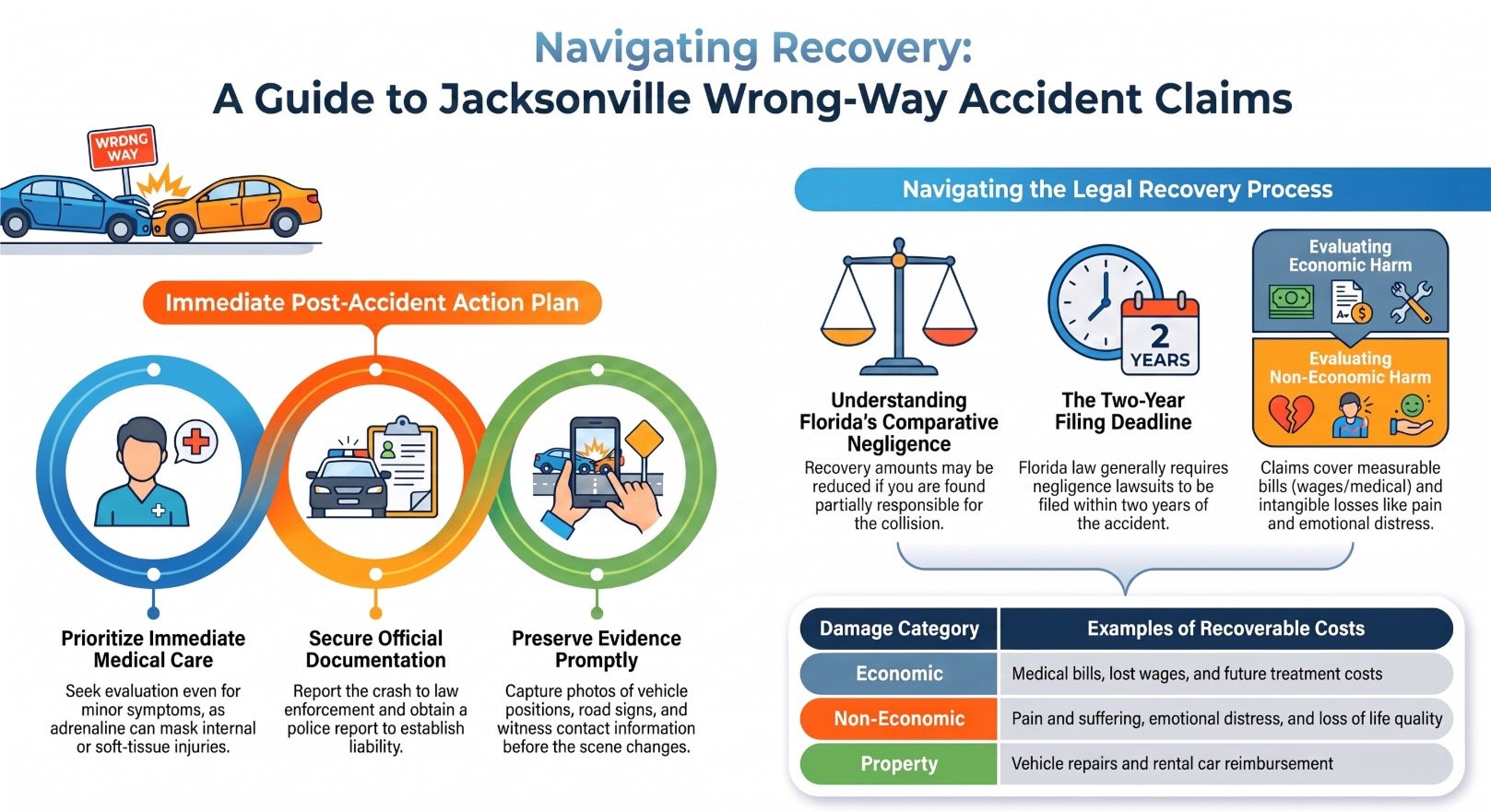
Comparative negligence may affect recovery if an injured person is alleged to have contributed to the collision. The application of this rule depends on the evidence and the circumstances presented. A claim may involve the wrong-way driver, an employer, an insurer, or another responsible entity, depending on the facts.
Settlement timelines vary because treatment, documentation, negotiations, and liability disputes can develop at different rates. Legal guidance can help preserve evidence, communicate with insurers, and pursue compensation while allowing injured individuals and their families to focus on recovery and serving their communities.
Common Causes of Jacksonville Wrong-Way Driver Accident
Wrong-way driving in Jacksonville commonly results from impaired driving, driver distraction, confusing road signs, and fatigue or drowsiness. Each factor can impair judgment, reduce roadway awareness, or cause motorists to enter opposing traffic lanes. Identifying the underlying cause is crucial when evaluating liability and the circumstances of an accident.
Impaired Driving
Impaired driving is a significant cause of wrong-way collisions in Jacksonville, as alcohol, drugs, and certain prescription medications can diminish judgment, coordination, and the ability to recognize traffic signs. Drivers under the influence may enter an exit ramp or travel against traffic without understanding the immediate danger to others. Such conduct can produce severe injuries, fatalities, and complicated liability disputes. Investigators may examine breathalyzer results, blood tests, witness statements, surveillance footage, and vehicle data when determining whether impairment contributed to a crash. Victims and families may also face criminal charges or issues involving the responsible driver, although criminal proceedings differ from civil injury claims.
A Jacksonville wrong-way driver accident lawyer can help preserve evidence, explain legal options, and pursue compensation while supporting affected individuals and their families through recovery.
Driver Distraction
Distraction can also cause Jacksonville drivers to miss directional signs, overlook roadway markings, or turn onto an exit ramp while focused on a phone, navigation system, passenger, or other activity. Cell phone use is particularly dangerous because texting, scrolling, and adjusting applications divert visual, manual, and mental attention from driving. Even brief inattention can prevent a driver from recognizing traffic movement, responding to other motorists, or correcting an unsafe action. Eating, reaching for objects, or engaging in an intense conversation may create similar risks. Effective distraction awareness requires drivers to prepare navigation before departure, secure loose items, silence notifications, and keep their attention on roadway conditions.
Encouraging these practices can help protect passengers, pedestrians, and other motorists while supporting safer travel throughout Jacksonville. Witnesses may document apparent distraction when reporting incidents.
Confusing Road Signs
Confusing road signs can cause Jacksonville motorists to misinterpret traffic direction, enter restricted ramps, or proceed against the established flow of traffic. Road Sign Confusion may arise when signs are obscured by vegetation, poorly positioned, damaged, or inconsistent with nearby pavement markings. Temporary construction signs can further complicate navigation, particularly where lanes shift or familiar exits are closed. Drivers unfamiliar with Jacksonville’s bridges, interchanges, and one-way access roads may rely on incomplete visual information and select an incorrect route. These circumstances can produce Driver Error Patterns, including sudden turns, improper ramp entries, hesitation, and continued travel despite opposing traffic.
Municipal agencies and contractors have a responsibility to maintain clear, visible, and consistent warnings. Documenting sign conditions can help establish whether roadway design or maintenance contributed to a collision and support affected individuals seeking appropriate assistance.
Fatigue And Drowsiness
Fatigue and drowsiness can impair a driver’s judgment, reaction time, and ability to recognize roadway direction, increasing the risk of entering an opposing lane or traveling the wrong way on a Jacksonville road. Sleep apnea and other untreated sleep disorders may prevent restorative rest, leaving motorists vulnerable to sudden lapses in attention. Extended work shifts, overnight travel, prescription medications, and alcohol can further intensify driver fatigue. Responsible motorists should recognize warning signs, including frequent yawning, drifting across lane markings, delayed reactions, and difficulty maintaining a steady speed.
They should stop driving when alertness declines and arrange a safe ride or rest period. Vehicle maintenance also supports safety because mechanical problems can increase stress and distraction during travel. Understanding these risks helps families, employers, and community advocates promote safer decisions and protect other road users.
Legal Rights of Jacksonville Wrong-Way Driver Accident Injury Victims
Wrong-way crash injury victims in Jacksonville may have legal rights to seek compensation for medical expenses, lost income, property damage, pain and suffering, and other losses caused by another party’s negligence. A careful legal assessment can help preserve evidence, identify responsible parties, and support a fair claim.
Jacksonville wrong-way crash victims may pursue compensation for injuries, financial losses, and other damages caused by negligence.
Victims and their families may consider:
- Reporting the collision and obtaining the official crash report.
- Documenting treatment, employment losses, property damage, and continuing limitations.
- Reviewing insurance coverage, liability evidence, and applicable filing deadlines.
- Consulting a qualified attorney before accepting a settlement or providing recorded statements.
Florida’s Comparative negligence rules may reduce recovery when an injured person shares responsibility, making accurate evidence particularly important. When a collision causes a fatality, surviving relatives may also pursue wrongful death claims for eligible financial and personal losses. A representative Jacksonville wrong-way driver accident lawyer can explain available remedies, communicate with insurers, and help coordinate support for the injured person and family. Prompt, compassionate guidance can serve victims while protecting their legal interests throughout the claims process and any resulting litigation.
Why Do Jacksonville Wrong-Way Driver Accident Injuries Happen?
Understanding how these collisions occur can help clarify the evidence needed to establish liability and damages. Jacksonville wrong-way driver accident injuries commonly arise when a motorist enters an interstate exit ramp, divided highway, or other roadway against traffic. Confusion, inadequate signage, impaired driving, fatigue, medication effects, and cognitive decline may contribute to the error. Some crashes also result from reckless decisions, such as ignoring barriers, driving around warning devices, or continuing after recognizing the mistake.
The severity of harm increases because vehicles approach one another at substantial closing speeds, leaving little time for avoidance. Head-on impacts can cause traumatic brain injuries, spinal damage, fractures, internal bleeding, and fatal outcomes. Establishing the cause may require roadway evidence, vehicle data, witness accounts, toxicology findings, and medical documentation. Missed follow-ups can obscure changing symptoms and complicate damage assessments. Insurance Disputes may then develop over fault, coverage, treatment necessity, or long-term losses, making accurate documentation and compassionate legal guidance especially important.
What Should You Do After a Jacksonville Wrong-Way Driver Accident Injury?
After a Jacksonville wrong-way driver accident injury, the injured person should seek immediate medical care, even if symptoms initially appear minor. The accident should also be reported to law enforcement, with relevant information recorded for official documentation. Evidence, including photographs, witness details, medical records, and insurance information, should be documented promptly to preserve potential claims.
Seek Immediate Medical Care
Prompt medical evaluation should be a priority for anyone injured in a Jacksonville wrong-way driver accident, even when symptoms initially appear minor or absent. Adrenaline can mask pain, while concussions, internal injuries, and soft-tissue damage may develop gradually. An injured person should allow emergency responders to assess immediate risks and follow their recommendations regarding transportation and treatment. If responders are unavailable, prompt evaluation at an emergency department or urgent care facility may help identify conditions requiring timely intervention. Medical professionals can document symptoms, findings, prescribed care, and expected recovery needs.
Individuals should follow discharge instructions, attend recommended appointments, and report worsening pain, confusion, dizziness, weakness, or breathing difficulties without delay. Supporting injured people in obtaining care promotes compassion, strengthens traffic safety awareness, and complements broader wrong-way crash prevention efforts throughout Jacksonville.
Report The Accident
When a Jacksonville wrong-way driver accident causes an injury, the collision should be reported to law enforcement as soon as it is reasonably safe to do so. An officer can arrange emergency assistance, control hazards, and prepare an official crash report. Injured individuals should provide accurate contact and insurance information without speculating about fault or minimizing symptoms. If the driver leaves, witnesses should note that circumstance and promptly notify authorities. Witness statement collection may help clarify traffic signals, vehicle movements, and other relevant circumstances. Each person should cooperate respectfully with investigators and provide information through appropriate channels.
The injured person should also notify medical providers that the condition resulted from a collision and maintain Medical bill documentation, including invoices, payment records, and insurance correspondence, for later administrative and legal needs.
Document Evidence Promptly
Although memories may fade quickly, evidence from a Jacksonville wrong-way driver accident should be documented as soon as the injured person’s condition and safety permit. Photographs and documentation can capture vehicle positions, roadway conditions, traffic signs, visible injuries, property damage, and surrounding hazards before changes occur. A trusted family member or representative may record these details when the injured person cannot do so. Witness contact attempts should include names, telephone numbers, email addresses, and brief notes about what each person observed. Medical records, discharge instructions, repair estimates, insurance correspondence, and employer notices should also be retained.
These evidence preservation steps support accurate case timeline building and help clarify how the collision occurred. Original files should remain unaltered, with copies stored securely for review by an experienced Jacksonville attorney.
Critical Evidence in a Jacksonville Wrong-Way Driver Accident Injury Case
A Jacksonville wrong-way driver injury case may depend on evidence that establishes how the collision occurred, who was responsible, and the extent of the resulting harm.
Core sources commonly include:
- Police crash reports
- Dashcam and surveillance footage
- Medical records and bills
- Eyewitness statements
A Jacksonville wrong-way driver accident lawyer can evaluate these materials and identify gaps that may affect the claim.
Police Crash Reports
Police crash reports often provide crucial evidence in a Jacksonville wrong-way driver accident injury case by documenting the collision’s location, timing, roadway conditions, vehicle positions, and preliminary findings regarding fault. Officers may record statements from drivers, passengers, and witnesses, along with apparent injuries, citations, sobriety concerns, and roadway signage. These details can help establish a timeline and support traffic incident analysis when determining how the wrong-way movement occurred. However, a report does not automatically prove liability. Its contents must be evaluated against medical records, testimony, photographs, and other reliable evidence. A Jacksonville wrong-way driver accident lawyer can assess whether statements or conclusions satisfy legal admissibility rules and identify inconsistencies requiring further investigation. Promptly preserving the report may help injured individuals and their families pursue fair compensation while supporting accurate, responsible case preparation.
Dashcam And Surveillance Footage
Dashcam and surveillance footage can supplement a Jacksonville wrong-way driver accident report by showing how the collision developed before, during, and immediately after impact. Video may clarify the vehicle’s direction, lane position, speed, traffic signals, weather conditions, and driver conduct. Footage from nearby businesses, traffic cameras, toll facilities, or witnesses’ vehicles may also reveal events that a report cannot capture. Because recordings can be overwritten or deleted, prompt surveillance preservation requests may help protect relevant evidence. A legal professional can identify potential sources, document when footage was obtained, and maintain its original format. Dashcam admissibility may depend on authenticity, relevance, continuity, and whether the recording accurately represents the scene. Attorneys may also compare video with physical evidence and witness accounts to present a reliable, service-focused explanation of the crash.
Medical Records And Bills
Medical records and bills provide crucial evidence of the injuries, treatment, and financial losses arising from a Jacksonville wrong-way driver accident. Hospital reports, diagnostic imaging, physician notes, prescriptions, therapy records, and invoices can establish the connection between the collision and the patient’s condition. They also document treatment duration, medical recommendations, future care needs, and amounts charged or paid. Consistent records may help demonstrate the seriousness of injuries and support claims for economic damages. Documentation gaps, inconsistent descriptions, or missing evidence can create challenges when insurers evaluate responsibility and losses. Careful organization of every record, including statements from providers and health insurance payment information, helps identify errors and prevent insurance denials. When a denial occurs, complete records can support denial appeals and clarify why treatment was medically necessary, related, and reasonably priced.
Eyewitness Statements
When a wrong-way driver collision occurs in Jacksonville, eyewitness statements can provide important evidence regarding how the crash happened and who may be responsible. Witnesses may describe the vehicle’s direction, speed, lane position, traffic signals, driver behavior, and events immediately before impact. Their observations can help clarify disputed facts when drivers provide conflicting accounts or physical evidence is incomplete. Prompt interviews are important because memories can change, and witnesses may become difficult to locate. Crash scene documentation, including photographs, traffic-camera footage, and recorded statements, can preserve details that support later evaluation.
A careful Witness credibility assessment considers the person’s location, visibility, attention, consistency, and relationship to those involved. Investigators may also compare statements with police reports, vehicle damage, roadway markings, and other evidence to develop an objective account for injured individuals and their families.
Long-Term Effects of Jacksonville Wrong-Way Driver Accident
Injuries
Wrong-way driver accident injuries may produce chronic pain conditions that interfere with mobility, employment, and daily activities long after the initial treatment. Survivors may also experience emotional trauma, including anxiety, depression, sleep disturbances, or fear of driving. Continuing care, rehabilitation, medication, and related services can create ongoing medical expenses requiring careful financial assessment.
Chronic Pain Conditions
Chronic pain can persist long after the visible injuries from a Jacksonville wrong-way driver accident have recovered, affecting mobility, sleep, concentration, and the ability to work or perform daily activities. Conditions may include nerve pain, spinal discomfort, headaches, joint limitations, or pain caused by damaged muscles and connective tissue. Symptoms can remain steady or develop as chronic pain flareups triggered by exertion, weather changes, or prolonged positioning. Treatment may involve physical therapy, prescribed medication, injections, and carefully monitored activity modification. Medication side effects, including fatigue, nausea, dizziness, or impaired concentration, may create additional safety and employment concerns. Detailed medical records can help establish the condition’s persistence, required care, and effect on functional capacity. Appropriate legal guidance may help an injured person pursue compensation for treatment, lost income, and continuing assistance.
Emotional Trauma Effects
Emotional trauma may continue after the physical injuries from a Jacksonville wrong-way driver accident have stabilized, affecting a person’s sense of safety, sleep, concentration, and ability to travel or participate in ordinary activities. Survivors may experience anxiety after trauma, including panic, heightened alertness, intrusive memories, or fear when approaching roads and intersections. Some withdraw from family, employment, or community responsibilities, while others struggle with irritability and reduced confidence. Grief and mourning may arise after the loss of a loved one, a former lifestyle, or a sense of independence. These effects can persist even when outward symptoms are not apparent. Supportive relatives, counselors, and trusted advocates can help survivors identify needs and pursue appropriate emotional support. Documentation of symptoms may also clarify how the collision continues affecting daily life.
Ongoing Medical Expenses
Ongoing medical expenses may continue long after initial treatment for injuries sustained in a Jacksonville wrong-way driver accident. Victims may require follow-up surgeries, rehabilitation, prescription medication, medical equipment, or in-home assistance. Some conditions also necessitate periodic evaluations and treatment adjustments as symptoms develop or worsen.
A careful assessment of anticipated care can help document the financial effects of permanent or progressive injuries. Medical professionals may provide life-care projections, while financial experts can address inflation and expected changes in treatment costs. A disability impact evaluation may further explain how limitations affect employment, independence, and daily responsibilities.
Future benefits planning is also important when injuries reduce earning capacity or create long-term support needs. Complete records, professional opinions, and consistent treatment documentation help protect access to appropriate compensation and vital services.
Proving Liability in Jacksonville Wrong-Way Driver Accident


Injury Cases
Proving liability in a Jacksonville wrong-way driver accident injury case requires establishing that the opposing driver’s conduct caused the collision and resulting damages. Evidence may include police reports, traffic-camera recordings, vehicle data, eyewitness accounts, photographs, and testimony from accident reconstruction professionals. Medical records can connect the crash to documented injuries, while employment and financial records may support lost-income claims.
A legal representative may investigate whether the driver was impaired, distracted, fatigued, unfamiliar with the roadway, or otherwise violating traffic laws. Establishing negligence generally requires demonstrating a duty of care, a breach of that duty, causation, and measurable damages. Comparative-fault arguments may also affect recovery if another party is alleged to share responsibility.
Clear documentation helps support insurance negotiations and informs Settlement timelines without prematurely assigning unsupported values. Prompt evidence preservation is important because recordings can be overwritten, vehicles may be repaired, and witness recollections can fade. A careful liability analysis serves injured individuals by presenting an accurate, well-supported account of the collision.
Dealing With Insurance Companies After a Jacksonville Wrong-Way Driver Accident Injury
After a Jacksonville wrong-way driver accident injury, insurance companies may request statements, medical records, and other information while evaluating liability and damages. Injured individuals should provide accurate information but avoid speculation, admissions, or recorded statements without understanding their potential impact. Adjusters may attempt to minimize losses, challenge treatment, or attribute symptoms to prior conditions. Careful documentation, including medical bills, wage records, photographs, and correspondence, can help present a consistent account of the harm suffered.
An attorney may communicate with insurers, protect the individual from unnecessary pressure, and assess whether an offered payment reflects documented losses. When coverage disputes arise, denied claims appeals may require organized evidence, policy review, and timely written responses. In addition, medical lien negotiations can help address provider reimbursement while preserving more of the recovery for ongoing needs. Compassionate legal guidance supports injured people and their families as they focus on treatment, financial stability, and informed decisions during a difficult period.
What to Expect During a Jacksonville Wrong-Way Driver Accident Injury Claim Process
The claim process typically begins with an initial case evaluation to assess liability, injuries, damages, and available legal options. Evidence collection may include crash reports, medical records, witness statements, vehicle data, and other documentation, followed by negotiations with the insurance company. If settlement efforts do not produce a fair resolution, the matter may proceed to trial.
Initial Case Evaluation
An initial case evaluation gives a Jacksonville wrong-way driver accident lawyer an opportunity to assess the circumstances, evidence, and potential legal claims arising from the collision. During this meeting, the attorney typically reviews the client’s account, injuries, treatment status, financial losses, and concerns about recovery. The lawyer may explain applicable deadlines, potential responsible parties, and the general stages of an injury claim without promising a particular result. A medical documentation checklist can help identify records needed to understand diagnosis, treatment, prognosis, and ongoing care. The evaluation also provides an opportunity to discuss communication expectations, legal fees, and decisions that may affect the claim. After reviewing available information, counsel can develop an insurance settlement strategy focused on pursuing fair compensation while supporting the client’s immediate and long-term needs.
Evidence Collection Process
Once the initial evaluation is complete, evidence collection helps establish how the wrong-way collision occurred, who may be responsible, and how the injuries have affected the claimant. A legal team may obtain crash reports, photographs, vehicle damage records, roadway surveillance, and available phone or navigation data. Medical records and treatment statements document diagnoses, ongoing limitations, and related expenses. Eyewitness timeline development can clarify traffic signals, vehicle movements, lighting, and the moments before impact. Investigators may also examine road design, signage, construction conditions, and potential vehicle defects. Preservation requests can help prevent relevant recordings or electronic information from being lost.
Organized evidence supports accurate claim preparation and helps a representative serve the injured person responsibly. During this stage, the focus remains on facts and documentation, not insurance bad-faith negotiation.
Insurance Company Negotiations
During insurance company negotiations, a Jacksonville wrong-way driver accident lawyer typically presents organized evidence supporting liability, medical causation, and the full scope of the claimant’s damages. The insurer may evaluate police reports, witness statements, vehicle damage, medical records, employment documentation, and applicable coverage before responding. Counsel’s negotiation strategies can address disputed facts, future treatment needs, lost income, and non-economic harm while maintaining clear communication with the adjuster. A policy limits review may identify available bodily injury coverage, additional policies, and potential coverage issues affecting the claim’s evaluation. The lawyer generally responds to requests for information, corrects inaccurate assessments, and documents each communication. This process allows the claimant’s interests to be represented carefully and helps ensure that the insurer considers complete, reliable evidence when assessing the injury claim.
Settlement Or Trial
Settlement or trial represents the stage at which a Jacksonville wrong-way driver accident lawyer evaluates whether the insurer’s offer fairly reflects the claimant’s documented losses or whether litigation is necessary. Settlement timeline planning considers medical progress, evidence collection, liability issues, and applicable filing deadlines. The lawyer may recommend continued negotiations when an agreement can provide timely support for treatment, lost income, and long-term needs. If negotiations fail, trial strategy preparation begins with organizing witness testimony, accident reports, expert opinions, photographs, and medical records. The claimant generally decides whether to accept a proposed resolution after receiving informed advice about potential benefits, risks, costs, and delays. Throughout the process, the legal team seeks accountability while protecting the claimant’s interests and preserving resources needed for recovery, stability, and service to others.
Compensation for Jacksonville Wrong-Way Driver Accident Lawyer Injury Damages
Compensation for injuries caused by a wrong-way driver may cover medical expenses, lost income, property damage, pain and suffering, and other legally recognized losses. A careful claim evaluation considers the collision’s circumstances, the driver’s conduct, available insurance, and the injured person’s documented consequences. Jacksonville accident counsel may help preserve evidence, identify responsible parties, and present a demand supported by reliable records.
Medical bill documentation should include invoices, treatment summaries, prescription costs, mileage records, and information concerning future care recommended by qualified providers. Employment records and wage statements can help establish income interruption, while repair estimates and photographs may support property-related losses. Insurance negotiation tactics may include organizing evidence chronologically, addressing disputed liability, and responding to inadequate settlement offers with specific supporting facts. A representative may also communicate with insurers so an injured individual can focus on recovery and family responsibilities. Settlement discussions should account for legally supported damages without exaggeration.
When negotiations do not produce a fair resolution, the claim may proceed through litigation, where admissible evidence and applicable Florida law guide recovery.
Economic vs Non-Economic Damages in Jacksonville Wrong-Way Driver Accident
OUR CONSULTATIONSARE FREE
START YOUR FREE CASE REVIEW

Cases
Economic damages include measurable financial losses, such as medical expenses, lost wages, and future treatment costs. Non-economic losses address less tangible harm, including pain, emotional distress, and diminished quality of life. Calculating total compensation requires evaluating both categories in light of the victim’s injuries, recovery needs, and long-term effects.
Economic Damages Explained
After a Jacksonville wrong-way driver accident, damages generally fall into two categories: economic and non-economic. Economic damages compensate measurable financial losses caused by the collision. They may include emergency treatment, hospitalization, medication, rehabilitation, medical equipment, and transportation for care. If injuries prevent employment, recoverable amounts may also include past lost wages, reduced earning capacity, and necessary household services. Detailed bills, wage records, medical opinions, and other documentation help establish these losses while proving fault. Insurance coverage can affect available compensation, particularly when multiple vehicles, policies, or coverage limits are involved.
A careful review may identify benefits that require prompt notice or coordination. Punitive damages are separate and generally require evidence of exceptionally reckless or intentional misconduct. Economic documentation can also influence negotiations and the settlement timeline, helping involved parties evaluate a fair resolution and serve the injured individual’s needs responsibly.
Non-Economic Losses
Although non-economic losses do not have fixed prices, they represent significant harm caused by a Jacksonville wrong-way driver accident. These losses may include pain and suffering, emotional distress, mental anguish, disfigurement, disability, and diminished enjoyment of life. They address how injuries affect a person’s comfort, independence, relationships, and ability to participate in meaningful activities. Unlike medical bills or lost wages, these harms require careful evaluation of personal circumstances and the injury’s lasting consequences. Testimony from the injured person, family members, medical professionals, and other witnesses may help demonstrate the severity of these effects. A court may also consider whether the driver’s conduct was especially reckless when reviewing issues related to a punitive damages calculation.
Such damages are distinct from compensation for non-economic harm and generally require proof of particularly culpable conduct.
Calculating Total Compensation
Calculating total compensation in a Jacksonville wrong-way driver accident case requires evaluating both economic and non-economic damages. Economic damages may include emergency care, ongoing medical treatment, rehabilitation, prescription costs, lost wages, reduced earning capacity, property damage, and necessary household assistance. Documentation such as invoices, employment records, medical evaluations, and pain treatment plans can support these calculations.
Non-economic damages address losses without fixed prices, including physical pain, emotional distress, diminished quality of life, disfigurement, and loss of companionship. Their value depends on injury severity, recovery duration, permanence, and effects on daily activities. A careful insurance dispute strategy should account for comparative fault arguments, available policy limits, and evidence establishing the driver’s negligence. Legal professionals can organize records, consult qualified experts, and present a complete claim that seeks fair compensation while protecting the injured person’s long-term interests.
When a Jacksonville Wrong-Way Driver Accident Lawyer Injury Case Goes to Trial vs Settlement
When a Jacksonville wrong-way driver accident lawyer evaluates an injury case, the decision to pursue settlement or proceed to trial depends on the strength of the evidence, the severity of the injuries, and the parties’ willingness to reach a fair resolution. Settlement may provide compensation sooner, reduce uncertainty, and spare an injured person the demands of courtroom proceedings. Trial may become necessary when liability, damages, or the adequacy of an insurance offer remains genuinely disputed.
Before recommending either path, counsel may review crash reports, medical records, witness accounts, and available vehicle or roadway evidence. A trial timeline overview generally includes preparation, motions, discovery, jury selection, testimony, and deliberation. During jury selection, a careful jury selection strategy seeks impartial decision-makers able to evaluate evidence fairly. The legal team should explain risks, costs, and likely time commitments so the client can make an informed choice. The central objective remains securing appropriate support for recovery while serving the client’s interests with diligence and integrity.
Florida Laws That May Affect Your Jacksonville Wrong-Way Driver Accident
Case
Florida law may affect a Jacksonville wrong-way driver accident lawyer case through rules governing negligence, comparative fault, insurance coverage, and the time allowed to file a claim. Alternative considerations may include:
Florida law shapes wrong-way driver cases through negligence standards, comparative fault, insurance requirements, and filing deadlines.
- Florida comparative fault rules can reduce compensation when an injured person shares responsibility for the collision, making evidence about conduct, visibility, and roadway conditions important.
- Florida’s no-fault insurance system may require injured motorists to seek initial benefits through personal injury protection coverage, while serious injuries can support claims against responsible parties.
- Commercial drivers and their employers may face duties under state law and federal trucking regulations, including requirements involving licensing, drug testing, vehicle maintenance, and hours of service.
- Evidence such as crash reports, surveillance footage, vehicle data, medical records, and witness statements can help establish breach of duty, causation, and damages.
A Jacksonville wrong-way driver accident lawyer may also evaluate uninsured or underinsured motorist coverage and applicable liability policies. Careful legal review helps protect injured people and supports informed decisions throughout the claim process.
The Statute of Limitations for Jacksonville Wrong-Way Driver Accident Injury Cases
The statute of limitations establishes the deadline for filing a personal injury lawsuit after a Jacksonville wrong-way driver accident. In Florida, injured individuals generally have two years from the accident date to pursue a negligence claim. Missing that deadline can result in dismissal, even when the evidence strongly supports the injured person’s position.
Different rules may apply when a government entity is involved, or when an injured person is a minor or otherwise legally incapacitated. A wrongful death action generally must be filed within two years of the person’s death, although specific circumstances can affect that calculation. Separate deadlines may govern claims involving insurance coverage, including uninsured or underinsured motorist benefits.
Prompt attention helps preserve medical records, crash evidence, witness information, and other materials needed to evaluate the claim. Because the deadline can depend on the parties, injuries, and applicable exceptions, each matter requires careful review. Families and injured individuals may seek timely legal information to protect their rights and support accountability.
How a Jacksonville Wrong-Way Driver Accident Lawyer Can Help You
Timely legal guidance can help an injured person protect a claim after a Jacksonville wrong-way driver accident. A Jacksonville wrong-way driver accident lawyer can provide structured assistance while the injured person focuses on recovery and family responsibilities. The lawyer may:
A Jacksonville wrong-way driver accident lawyer can protect your claim while you focus on recovery, family, and rebuilding stability.
- Investigate crash evidence, vehicle damage, roadway conditions, and available witness accounts.
- Coordinate medical documentation that connects injuries, treatment, disability, and future care needs.
- Communicate with insurers, challenge inadequate evaluations, and protect the client from pressured statements.
- Calculate losses, including medical expenses, lost income, pain, and reduced earning capacity.
Through Wrong Way Victim Support, legal counsel can help preserve evidence and explain practical decisions in understandable terms. Assistance may also address Rebuilding Healthcare Coverage when treatment costs, employment changes, or insurance complications create additional burdens. A lawyer can consult qualified professionals when evaluating long-term consequences and can present a well-supported demand or court claim. This representation promotes fair accountability and helps an injured person pursue resources needed for restoration, stability, and continued service to others.
When to Contact a Jacksonville Wrong-Way Driver Accident Lawyer
Contact with a Jacksonville wrong-way driver accident lawyer should occur as soon as possible after the collision, particularly when injuries, disputed liability, or significant property damage are involved. Early guidance can help an injured person understand immediate obligations, protect relevant records, and communicate accurately with insurers while serving family and community needs.
Statute deadlines may restrict the time available to pursue compensation, making prompt review important even when injuries initially appear minor. Evidence preservation should begin promptly, including securing photographs, medical records, vehicle information, witness contacts, traffic-camera details, and available crash reports. A lawyer can also assess driver liability standards when intoxication, impairment, fatigue, distraction, roadway confusion, or intentional misconduct may have contributed to the wrong-way event.
Legal contact is especially appropriate after insurance claim denials, delayed responses, recorded statements, or settlement offers that do not reflect documented losses. Consultation may also be warranted when multiple vehicles, serious injuries, fatalities, commercial transportation, or uncertain coverage complicate the claim. Prompt action supports orderly fact gathering and informed decisions.
Why You Need an Experienced Jacksonville Wrong-Way Driver Accident Lawyer
Because wrong-way collisions often involve disputed facts and severe consequences, experienced legal counsel can be key to protecting an injured person’s rights. A knowledgeable Jacksonville attorney can investigate roadway evidence, vehicle data, witness accounts, medical records, and police findings before important information disappears.
Legal experience also helps identify every potentially responsible party. In some cases, negligent hiring, inadequate supervision, impaired driving, or unsafe company practices may have contributed to the crash. When a commercial vehicle is involved, a trucking policy review can reveal violations involving driver qualification, alcohol testing, fatigue management, maintenance, or operational procedures.
An attorney can coordinate communication with insurers, preserve evidence, assess the full scope of physical and financial harm, and pursue appropriate compensation through negotiation or litigation. This support allows injured individuals and their families to focus on recovery while a representative works to promote accountability and protect their interests during a demanding legal process.
How to Choose the Right Jacksonville Wrong-Way Driver Accident Lawyer for Your Case
Selecting the right Jacksonville wrong-way driver accident lawyer requires careful consideration of the attorney’s experience, investigative resources, and record handling complex injury claims. A qualified attorney should understand collision reconstruction, roadway evidence, impaired-driving issues, and the medical consequences of severe trauma. The lawyer’s background with comparable cases can indicate whether the practice is prepared to pursue responsible parties and protect an injured person’s interests.
During consultations, prospective clients should ask Client vetting questions about communication practices, case evaluation, anticipated timelines, and who will manage daily concerns. Clear answers may help establish trust and make certain the attorney understands the client’s priorities, including recovery and family responsibilities. Fee structure transparency is equally important. The agreement should explain contingency percentages, litigation expenses, liens, and any charges that could reduce compensation.
A careful review of credentials, disciplinary history, references, and written representation terms allows an injured person to make an informed decision. The selected lawyer should demonstrate preparation, accessibility, integrity, and a service-oriented commitment to pursuing fair relief.
About The Law Offices of Anidjar & Levine
When evaluating legal representation after a wrong-way driver collision, The Law Offices of Anidjar & Levine provides focused assistance for individuals and families facing serious injury claims. The firm represents clients in Jacksonville and throughout Florida, addressing cases involving catastrophic injuries, fatalities, medical expenses, lost income, and lasting emotional harm. Its attorneys examine crash evidence, identify potentially responsible parties, communicate with insurers, and pursue compensation supported by the circumstances of each claim.
The firm’s approach emphasizes client-focused legal services, with attention to each person’s medical needs, financial pressures, and objectives. Legal professionals may coordinate with investigators and other experts when technical evidence is necessary to clarify liability or damages. They also explain procedural developments so clients can make informed decisions while focusing on recovery and family responsibilities.
Potential clients can explore free consultation options to discuss the collision, available legal remedies, and applicable deadlines. Representation and results depend on the specific facts, evidence, and governing law.
Frequently Asked Questions
Can Passengers Recover Compensation After a Jacksonville Wrong-Way Driver Accident?
Passengers may recover compensation after a Jacksonville wrong-way driver accident, even when they did not cause the collision. Potential damages include medical expenses, lost income, pain and suffering, and other accident-related losses. Comparative negligence may reduce recovery if a passenger’s conduct contributed to the injuries, such as knowingly accepting an unsafe ride. Depending on the circumstances, rental car reimbursement may also be available. Evidence and timely legal guidance remain important.
What if the Wrong-Way Driver Was Uninsured or Underinsured?
If the wrong-way driver lacks insurance, an injured passenger may seek compensation through their own policy’s uninsured coverage, subject to policy terms, limits, and applicable Florida law. If the driver carries inadequate limits, an underinsured claim may provide additional recovery for medical expenses, lost income, and other covered damages. The passenger should promptly preserve records, notify the insurer, and obtain professional guidance before accepting a settlement or signing any release.
Can Family Members File a Claim After a Fatal Wrong-Way Accident?
Family members may file a claim after a fatal wrong-way accident, but eligibility depends on state law and the relationship to the deceased. Wrongful death claims are commonly brought by a surviving spouse, children, or parents, while other relatives may qualify under limited circumstances. Survivor eligibility can also depend on financial dependence and statutory priority. A personal representative may pursue the claim for eligible beneficiaries, seeking compensation for losses caused by the death.
Are Rental Car Expenses Covered While My Vehicle Is Being Repaired?
Rental car expenses may be covered while a vehicle is being repaired, but payment depends on the responsible driver’s Insurance coverage, the owner’s policy, and the repair circumstances. Some policies include rental reimbursement, while others require the at-fault insurer to accept liability before authorizing a car rental. The vehicle owner should preserve repair estimates, rental receipts, and communications with insurers, then seek guidance to protect reimbursement rights and avoid unnecessary expenses.
Can I Still Recover Damages if I Was Partially at Fault?
A person may still recover damages after being partially at fault, depending on Florida’s comparative negligence rules. The recoverable amount is generally reduced according to the person’s fault percentage. For example, someone found 20 percent responsible may receive only 80 percent of proven damages. Because evidence, disputed liability, and statutory exceptions can affect the outcome, injured individuals should promptly preserve records, obtain medical care, and seek qualified legal guidance focused on serving their best interests.
—————————
Wrong-way collisions can cause severe injuries, extensive losses, and complex insurance disputes. Jacksonville victims may benefit from prompt legal guidance to preserve evidence, evaluate liability, and pursue appropriate compensation. An experienced Jacksonville Car Accident Lawyer can address medical expenses, lost income, property damage, and long-term effects while communicating with insurers and opposing parties.
The Law Offices of Anidjar and Levine evaluates each claim carefully and helps injured individuals understand their legal options, responsibilities, and potential recovery under Florida law.