A Florida Sexual Assault Lawyer at Law Offices of Anidjar and Levine assists survivors by protecting evidence, clarifying legal rights, and evaluating whether hotels, staff, or related entities failed to act on clear warning signs.
Counsel may help preserve digital records, seek surveillance footage, coordinate reporting to authorities, and pursue civil claims for damages tied to abuse and negligence.
Early legal guidance can also support safety planning, privacy concerns, and access to community resources.
The sections below explain these issues in greater detail.
Main Takeaways
- A Florida hotel sex trafficking lawyer can assess whether a hotel, manager, contractor, or franchise may be civilly liable for preventable failures.
- Immediate priorities are survivor safety, emergency medical care, and contacting 911 if danger is ongoing or urgent help is needed.
- Preserve evidence by saving messages, receipts, photos, room details, witness names, and a written timeline of events.
- Lawyers often move quickly to request surveillance, incident reports, booking records, staff policies, and other evidence before it disappears.
- Reporting suspected trafficking to police, the National Human Trafficking Hotline, and relevant agencies can help protect others and strengthen documentation.
How We Can Help With Your Florida Hotel Sex Trafficking Claim
When a survivor seeks legal guidance after being exploited in a Florida hotel, experienced counsel can provide a structured path toward accountability and recovery. Legal support often begins with careful listening, immediate Victim safety planning, and coordination with trusted medical, counseling, and community resources that protect dignity and stability.
Counsel may then organize evidence-protection steps, preserve records, identify witnesses, and manage communications so that the survivor is not burdened by avoidable pressure. A disciplined legal team can assess available claims, explain options in plain language, and prepare a strategy centered on the survivor’s goals. They may also work with advocates and service providers to reduce disruption in housing, employment, schooling, and family life. Throughout the process, representation should remain steady, confidential, and service-minded.
By handling deadlines, documentation, and negotiations with precision, counsel helps create space for restoration while pursuing meaningful accountability from all responsible parties under Florida law.
Understanding Hotel Sex Trafficking Cases in Florida


Because these cases often involve concealed conduct, transient guests, and layered business relationships, understanding hotel sex trafficking cases in Florida requires close attention to how trafficking activity occurs and how hotels may become part of that process. These matters often center on whether a property recognized warning signs, responded appropriately, and fulfilled its Duty of Care under Florida law.
OUR CONSULTATIONSARE FREE
START YOUR FREE CASE REVIEW

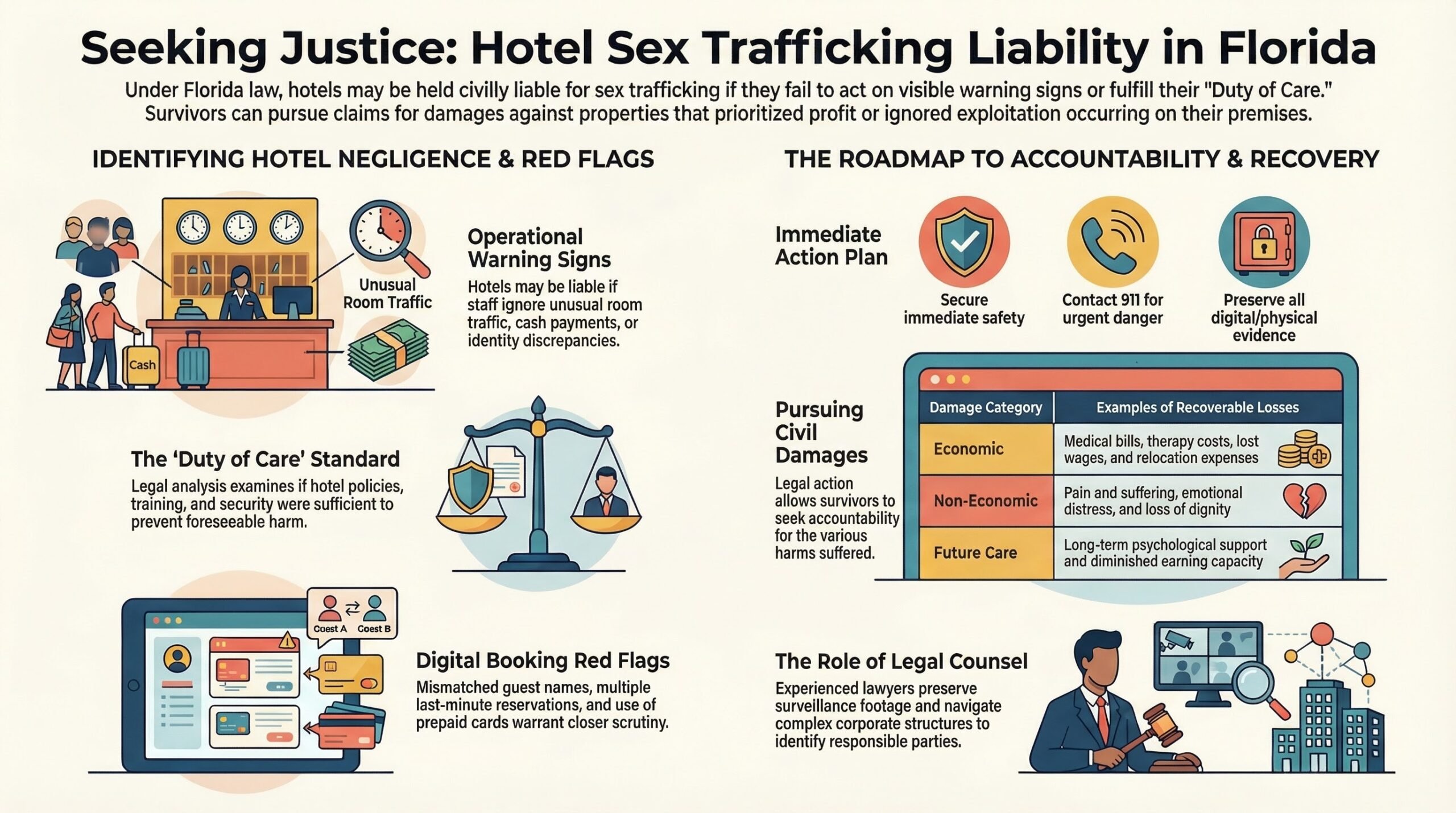
A careful review commonly examines hotel policies, staff training, security practices, incident reporting, and communication between employees and management. Legal analysis may also consider ownership structures, franchise relationships, and third-party contractors to determine who had authority and responsibility. In many claims, the central issue is not only criminal conduct by traffickers, but whether preventable failures allowed harm to continue.
A service-minded approach emphasizes accountability, safety improvements, and meaningful Victim Support. By understanding the legal and operational framework surrounding these cases, those seeking justice can better evaluate potential claims and pursue outcomes that protect vulnerable individuals and strengthen community responsibility.
Common Scenarios When Hotel Sex Trafficking Might Take Place in Florida


Certain hotel sex trafficking situations in Florida may arise through patterns that appear routine at first, but present clear operational warning signs upon closer review. These scenarios can include suspicious online booking activity, extended stays with limited luggage or unusual guest behavior, and frequent traffic to and from a single room. Cash payments, efforts to avoid identification, and unusual secrecy may further indicate circumstances that warrant immediate attention.
Online Booking Red Flags
Why do online reservations sometimes warrant closer scrutiny in the hotel context? Digital booking patterns may reveal risks that attentive staff can address to protect vulnerable guests and support lawful operations. Concerning indicators include Identity fraud, mismatched guest names, repeated last-minute reservations, and payment anomalies such as multiple declined cards or prepaid cards used for separate rooms. Reservations made through third parties with inconsistent contact details may also deserve review.
Additional concern may arise when one person books several rooms, requests secluded locations, or communicates only through messaging apps while refusing standard verification. Staff are not expected to investigate criminal activity independently. However, careful documentation, adherence to hotel policies, and prompt reporting of suspicious circumstances to supervisors or authorities can help hotels respond responsibly and may interrupt ongoing exploitation.
Extended Stay Warning Signs
Although extended stays are common in Florida’s hospitality industry, they may warrant closer attention when paired with unusual guest behavior or room activity. Staff members serving vulnerable individuals may note repeated requests for linen drops without housekeeping, reluctance to provide identification for all occupants, or payments extended in short increments despite long occupancy.
Other indicators can include a controlling companion who speaks for another guest, signs of fear, limited personal belongings, or minors staying for days without a clear family context. Hidden booking loopholes, such as rotating reservations under different names, may further obscure accountability. In these situations, careful documentation, policy-based reporting, and awareness of victim support resources can help personnel respond responsibly while protecting guest safety and preserving information that may assist later investigations or intervention efforts.
Frequent Room Traffic
In many hotel settings, frequent room traffic may signal activity that warrants closer review, especially when numerous visitors arrive at short intervals, remain only briefly, and depart throughout the day or late at night. This pattern can indicate exploitation rather than ordinary guest conduct.
Staff members who serve guests and protect community welfare may be expected to notice repeated movement to a single room, especially when visitors avoid common areas or appear to be directed by others. Room surveillance, when lawful and properly limited, may help document concerning patterns without intruding on legitimate privacy. These circumstances can also raise questions of manager liability if reports are ignored, warning signs accumulate, or reasonable safety measures are delayed.
Careful observation, prompt internal reporting, and appropriate coordination with authorities may help reduce harm and support vulnerable individuals.
Cash Payments And Secrecy
When hotel transactions are structured around cash and unusual secrecy, the circumstances may suggest efforts to avoid identification, conceal guest activity, or limit the creation of records that could reveal exploitation. Staff may observe requests for Anonymous payment, refusal to present identification, or insistence that housekeeping and security avoid a room. In some situations, guests seek short stays, late-night check-ins, or under-the-table agreements with employees to bypass standard procedures.
These patterns do not prove trafficking, yet they can indicate an environment where vulnerable individuals are controlled and hidden from public view. For those committed to protecting others, careful documentation, prompt internal reporting, and timely communication with law enforcement or trained advocates may help interrupt abuse, preserve evidence, and support potential victims with appropriate care and safety.
Legal Rights of Hotel Sex Trafficking Victims in Florida
Because Florida law and federal law recognize sex trafficking as a serious civil and criminal wrong, victims exploited in hotels may have important legal rights beyond the prosecution of traffickers.
These rights can help restore dignity, protect safety, and support long-term stability for those harmed by exploitation.
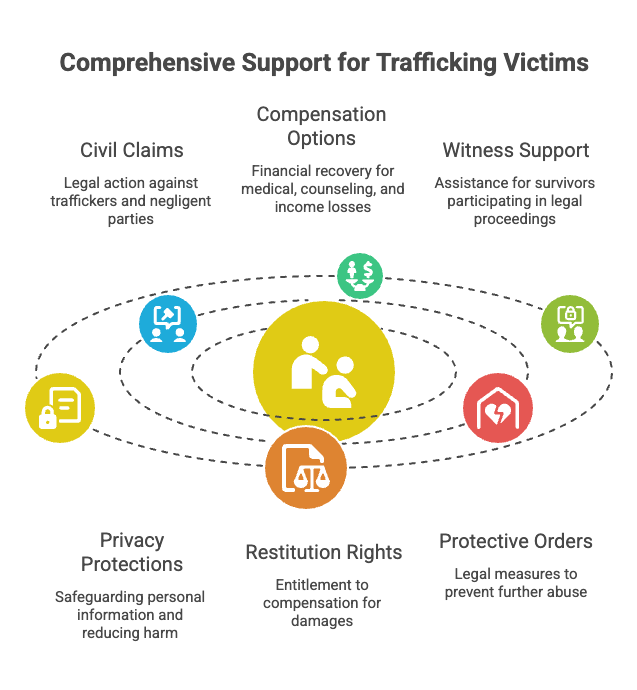
- Victims may pursue civil claims against traffickers and, in some cases, hotels or third parties whose negligence enabled abuse.
- Survivor compensation options may include damages for medical care, counseling, lost income, pain and suffering, and other trafficking-related losses.
- Victim witness support may be available through prosecutors, advocates, and service organizations that help survivors participate in legal proceedings with greater security.
- Privacy protections, restitution rights, and access to protective orders may further reduce harm and promote accountability.
In many situations, legal remedies are designed not only to punish wrongdoing, but also to recognize survivors as persons entitled to protection, respect, and meaningful opportunities for recovery and justice.
Steps to Take After a Hotel Sex Trafficking Incident in Florida
After a hotel sex trafficking incident in Florida, the first priority is to secure immediate safety and protection from further harm. Attention should then turn to preserving vital evidence, including records, communications, photographs, and any information that may support a future claim or investigation. It is also important to report legal violations to law enforcement and other appropriate authorities, as timely reporting can affect both safety measures and legal options.
Ensure Immediate Safety
Although the events may be overwhelming, the first priority is to reach a secure location away from the trafficker, any suspected accomplices, and the hotel area if it appears unsafe. Immediate escape planning may include leaving through a public exit, seeking help from uniformed personnel, or moving to a nearby business, hospital, or police station.
Once safety is established, contacting trusted advocates can provide practical guidance, emotional steadiness, and connection to emergency services or community support. A survivor may also contact 911 if danger is ongoing or urgent medical attention is needed. If children or other vulnerable individuals are involved, their safety should be addressed without delay. Every decision should focus on minimizing further harm, maintaining distance from those involved, and securing compassionate assistance as quickly as possible.
Preserve Key Evidence
Once immediate safety has been secured, attention should turn to preserving any evidence that may help establish what occurred at the hotel and who was involved. This step can protect vulnerable individuals and support those working to restore safety and accountability. They should preserve digital records, including text messages, emails, call logs, ride-share receipts, payment confirmations, and social media communications. Photographs of injuries, room conditions, hallway areas, access cards, and visible surveillance cameras may also be valuable.
It is also important to document incident timelines while memories remain fresh. Notes should identify dates, times, room numbers, employee interactions, vehicle descriptions, and any observed conduct involving guests or staff. Clothing, receipts, and personal items should be kept in their original condition when possible. Organized evidence can later assist advocates, investigators, and counsel.
Report Legal Violations
Where immediate danger has passed, suspected legal violations should be reported to appropriate authorities without unnecessary delay, as timely reporting may help protect others and preserve official records. Reports may be made to local law enforcement, the National Human Trafficking Hotline, and relevant regulatory agencies overseeing hotel operations. A clear, factual account should identify dates, locations, observed conduct, involved personnel, and any preserved evidence.
If concerns involve Staff policy gaps or HR compliance failures, those issues should also be documented for investigators and counsel. Internal reports to hotel management may be appropriate, but they should not replace formal reporting to outside authorities. Those serving vulnerable individuals should focus on accuracy, cooperation, and follow-through to help agencies thoroughly assess criminal conduct, regulatory breaches, and potential civil liability.

How a Florida Hotel Sex Trafficking Lawyer Can Help You Initiate a Case
How can a Florida hotel sex trafficking lawyer help initiate a case effectively and with proper legal support? Counsel begins by evaluating facts, preserving records, and identifying whether a hotel, manager, contractor, or third party may bear civil liability.
This early guidance helps survivors and those assisting them act with order, dignity, and purpose.
- The lawyer gathers reports, surveillance requests, witness accounts, and hotel policies before evidence disappears.
- The lawyer connects clients with Victim support resources, including shelters, counseling referrals, and emergency room advocacy when urgent medical documentation is needed.
- The lawyer explains deadlines, privacy protections, and reporting options, allowing informed decisions that respect safety and service to others.
- The lawyer coordinates with investigators and experts to build a clear timeline, assess damages, and prepare a complaint grounded in Florida law.
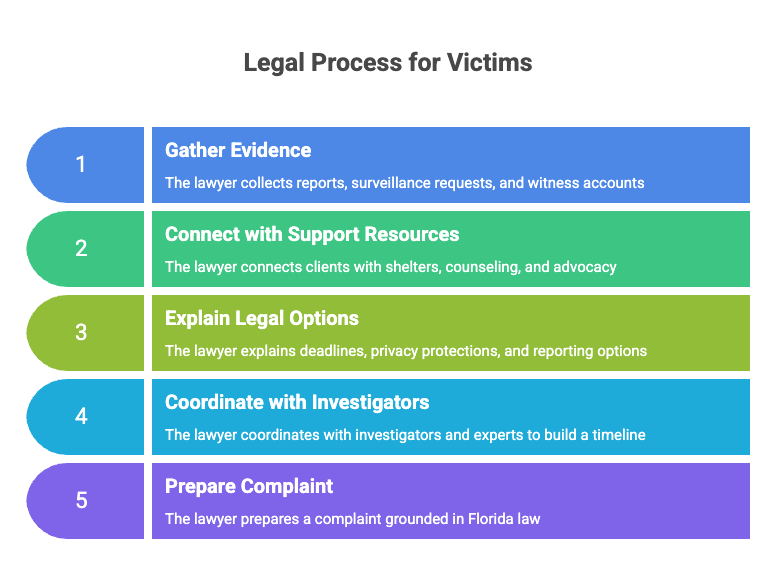
With structured legal action, the case can begin on a stable foundation, centered on accountability, protection, and practical assistance.
Long-Term Effects of Hotel Sex Trafficking Trauma
Hotel sex trafficking trauma can repair psychological harm, including chronic anxiety, depression, and post-traumatic stress that may persist long after the exploitation ends. Survivors may also face serious physical health consequences, from untreated injuries to long-term medical conditions linked to prolonged abuse and neglect. In addition, relationship instability and trust struggles often affect a survivor’s ability to feel safe, maintain connections, and rebuild daily life.
Lasting Psychological Harm
Although the immediate physical danger may end, the psychological effects of sex trafficking in a hotel setting often persist for years and can substantially impair a survivor’s daily functioning. Survivors may experience fear, shame, depression, anxiety, distrust, and recurring trauma responses that affect relationships, employment, and decision-making.
For those seeking to help, understanding these harms is critical. Therapy and recovery often require sustained support, trauma-informed counseling, and safe environments that restore dignity and stability. In legal matters, PTSD documentation may help demonstrate the depth of emotional injury, the need for continuing care, and the lasting impact on a survivor’s quality of life. Compassionate advocacy recognizes that repair is rarely linear.
Meaningful service begins with patience, careful listening, and a commitment to protecting survivors as they rebuild autonomy and trust over time.
Physical Health Consequences
When exploitation continues over time, survivors may face significant physical recovery consequences that persist long after the trafficking has ended. Repeated violence, deprivation, and untreated injuries can contribute to chronic pain, gastrointestinal problems, headaches, sleep disruption, reproductive harm, and increased vulnerability to infectious disease. Some individuals also experience long-term effects from malnutrition, substance exposure, or traumatic brain injury.
Those who support survivors should understand that sexual assault recovery often requires coordinated medical care, patient monitoring, and trauma-informed advocacy. Forensic medical documentation can help connect past abuse to present symptoms, while also preserving objective evidence for legal proceedings. Consistent treatment, safe housing, and access to experts may improve outcomes over time.
Even with dedicated care, physical recovery is often gradual, and many survivors require sustained, compassionate support throughout recovery.
Relationship And Trust Struggles
Because trafficking often relies on coercion, manipulation, and repeated violations of personal boundaries, survivors may struggle to view other people as safe, reliable, or deserving of trust. In daily life, this can affect family bonds, friendships, workplace interactions, and intimate relationships, often long after the trafficking has ended.
Those who seek to support survivors should understand that Coercion Tactics and Grooming Patterns can distort expectations about care, loyalty, and control. Survivors may withdraw, test boundaries, fear kindness, or remain vulnerable to further exploitation. Healthy relationships often require patient consistency, clear communication, and respect for autonomy. Trauma-informed advocacy, counseling, and legal support can help survivors recover confidence in their judgment and recognize trustworthy behavior.
With sustained support, many gradually develop safer connections and stronger relational stability over time.
What to Expect During a Florida Hotel Sex Trafficking Claim Process
A Florida hotel sex trafficking claim typically begins with an initial case evaluation, during which the facts, potential liability, and available legal options are assessed. The process then moves to gathering evidence and filing the claim, with attention to records, witness statements, and other materials that may support the case. From there, the matter may proceed toward settlement negotiations or, if necessary, trial.
Initial Case Evaluation
Although each matter turns on its own facts, the initial case evaluation in a Florida hotel sex trafficking claim is generally designed to determine whether the hotel, its staff, or related entities may be held legally responsible for failing to recognize, report, or prevent clear signs of trafficking. During this stage, counsel typically listens to the survivor’s account, reviews the timeline, and assesses whether Florida or federal law may support a civil claim.
The process often begins through confidential consultations that prioritize privacy, dignity, and victim-centered support. Attorneys may explain possible defendants, legal duties owed by hotels, applicable deadlines, and the general path of litigation. They may also address immediate safety, communication preferences, and available supportive services, helping survivors and those assisting them understand whether moving forward would serve accountability, recovery, and public protection.
Evidence Gathering Steps
Once counsel determines that a viable claim may exist, the process typically turns to gathering and preserving evidence that can show what occurred, who knew or should have known, and whether a hotel failed to act on visible warning signs.
Attorneys may interview witnesses, including staff, guests, responding officers, and service providers who observed patterns or conditions linked to exploitation. They often seek photographic documentation of rooms, hallways, entrances, and security features, as well as incident reports, guest logs, and communications. Payment records can help trace bookings, repeated room changes, unusual charges, or transactions connected to traffickers.
Counsel may also pursue surveillance access to review movements, staff responses, and activity around key areas. Throughout this stage, careful preservation supports accountability and helps those working to protect vulnerable individuals and strengthen community safety through informed action.
Filing The Claim
When sufficient facts and documentation have been assembled, counsel typically prepares and files a civil claim that identifies the parties involved, outlines the factual basis of the allegations, and states the legal grounds for holding a hotel or related entity responsible. The filing may rely on witness statements, records, and Investigative Reports to present a clear account of negligence or participation. After submission, the defendants are formally notified and given a deadline to respond.
Counsel also reviews procedural requirements, venue, and applicable limitation periods to protect the survivor’s interests and avoid technical dismissal. If insurers or businesses issue a Wrongful Denial, that response is examined against the available evidence and governing law. Throughout this stage, organized communication and accurate records help support accountability, dignity, and informed service to those harmed.
Settlement Or Trial
Negotiation often becomes the next major phase after a claim is filed, though some cases proceed to trial if liability or damages remain in dispute. Counsel generally evaluates Settlement Readiness by reviewing records, witness statements, and Wrongful Evidence that may reveal the hotel’s knowledge, security failures, or profits from trafficking activity.
If a meaningful resolution is unavailable, formal trial preparation begins. A careful Litigation Strategy may include expert testimony, motions, depositions, and clear damage calculations designed to support accountability and long-term care needs. The parties may still negotiate during this period, especially after pivotal rulings clarify strengths and weaknesses. At trial, a judge or jury assesses credibility, legal responsibility, and compensation.
While no outcome is guaranteed, thorough preparation can strengthen the presentation and reduce surprises that might affect the jury’s conviction or the final award.
Compensation for Florida Hotel Sex Trafficking Damages
Although no financial award can fully address the harm caused by hotel sex trafficking, Florida law may allow survivors to pursue compensation for a broad range of damages tied to the abuse and the hotel’s alleged negligence or misconduct. Claims often focus on Hotel duty, victim protection, foreseeability, notice, and whether staff ignored warning signs demanding intervention.
| Basis | Focus | Purpose |
|---|---|---|
| Hotel policies | Training, reporting | Promote safety |
| Staff conduct | Warning signs | Show failures |
| Security measures | Access, monitoring | Prevent exploitation |
| Prior incidents | Notice, patterns | Establish foreseeability |
Compensation may also reflect the survivor’s need for restorative support, accountability, and resources that aid long-term stability. In service-minded communities, civil actions can encourage safer hospitality practices, stronger screening, and better compliance with anti-trafficking standards. A careful legal evaluation helps identify responsible parties, preserve evidence, and seek remedies that recognize both survivor welfare and broader public protection interests in Florida.
Economic vs Non-Economic Damages in Florida Hotel Sex Trafficking Cases
Florida hotel sex trafficking cases often involve both economic damages, such as medical expenses, lost income, and future care costs, and non-economic damages, including pain and suffering, emotional distress, and loss of dignity. Because non-economic harm does not carry a fixed market value, courts and juries must assess its severity through testimony, records, and other supporting evidence. Establishing either category in court generally requires clear documentation, credible witnesses, and a factual link between the trafficking and the losses claimed.
Economic Damage Categories
In these cases, damages are generally divided into economic and non-economic categories, a distinction that helps clarify the full scope of harm caused by hotel sex trafficking. Economic damages address measurable financial losses tied to the survivor’s care, safety, and future stability. These losses often include Medical expenses, such as emergency treatment, hospitalization, therapy, medication, and follow-up care. They may also include loss of earnings, diminished earning capacity, relocation costs, security expenses, and other out-of-pocket costs directly related to the trafficking.
A careful review of records, billing statements, employment history, and expert analysis may help document these losses. This process supports those seeking accountability by identifying concrete financial impacts and presenting them in a way that promotes informed advocacy, practical assistance, and meaningful recovery for affected individuals and families.
Non-Economic Harm Valuation
When a survivor’s losses cannot be captured by bills, receipts, or wage records, non-economic damages become a crucial part of the valuation process. These damages address human consequences that often endure long after immediate exploitation ends. In Florida hotel sex trafficking cases, valuation may consider emotional distress, loss of dignity, fear, humiliation, disrupted relationships, and diminished enjoyment of daily life.
A careful assessment also recognizes how trauma recovery can affect independence, trust, sleep, concentration, and the ability to participate in work, education, faith, and community service. Because these harms are deeply personal, a fair valuation requires thoughtful attention to the survivor’s lived experience and long-term well-being. This approach reflects a service-centered commitment to accountability, restoration, and the survivor’s full humanity, not only measurable financial loss alone.
Proving Damages In Court
Because damages must be established with competent evidence, court proceedings in hotel sex trafficking cases typically separate proof into two categories: economic and non-economic loss. Economic damages may include medical expenses, counseling costs, lost income, diminished earning capacity, and other measurable financial consequences supported by evidence documentation, billing records, employment files, and expert analysis. Non-economic damages address pain, trauma, humiliation, loss of dignity, and lasting psychological injury.
Florida courts evaluate these claims through testimony, professional opinions, and corroborating records, while carefully considering witness credibility. A consistent factual narrative often strengthens both categories of loss. Service-minded advocates recognize that thorough preparation can help survivors present the full extent of harm with accuracy and respect. Clear proof allows the court to assess compensation that reflects both tangible costs and profound human suffering.
When a Florida Hotel Sex Trafficking Case Goes to Trial vs Settlement
How a Florida hotel sex trafficking case proceeds, whether toward trial or settlement, depends on the strength of the evidence, the extent of the victim’s damages, and the willingness of the parties to resolve the matter without court intervention. Settlement is often considered when liability is clear, damages are well documented, and an agreement can provide prompt financial relief and access to victim support resources.
Trial may become necessary when hotels, management companies, or other defendants deny responsibility, challenge causation, or dispute the scope of harm. In those situations, the local court process includes discovery, motions, witness testimony, and presentation of records showing warning signs, staffing failures, or ignored reports. A trial can produce public accountability and a formal verdict, but it also requires more time, preparation, and emotional endurance.
Counsel usually evaluates both options by weighing legal risks, likely compensation, privacy concerns, and the survivor’s broader recovery needs, while aiming to advance safety, dignity, and informed decision-making.
The Statute of Limitations for Florida Hotel Sex Trafficking Cases
Although filing deadlines vary by claim type and case facts, the statute of limitations in a Florida hotel sex trafficking case is a pivotal issue that can determine whether a survivor may pursue compensation in court. Civil claims against hotels, managers, or related parties may be governed by different deadlines, and exceptions can apply depending on age, coercion, delayed discovery, or other circumstances recognized by Florida law.
A careful review of the Criminal liability timeline may also matter, because criminal investigations and prosecutions can intersect with civil matters without creating identical deadlines. In the service of survivor-centered accountability, courts and counsel often examine when harm o
Prompt legal analysis helps protect claims by identifying applicable limitations periods and preserving essential proof for future proceedings.
When to Contact a Hotel Sex Trafficking Lawyer in Florida
Often, the appropriate time to contact a hotel sex trafficking lawyer in Florida is as soon as there is any indication that a hotel, motel, resort, or extended-stay property may have facilitated, ignored, or profited from trafficking activity. Prompt action can help protect vulnerable people, support informed reporting, and guide families, advocates, or survivors toward responsible next steps.
Early contact is also important when there are concerns about a property’s Duty to Report suspicious conduct, repeated room rentals, visible coercion, or staff indifference to warning signs. A lawyer may advise on immediate measures that strengthen Evidence Preservation, including securing surveillance footage, digital records, payment information, incident reports, witness details, and communications before materials are lost or destroyed.
Contact may also be appropriate after a rescue, a police investigation, medical treatment, or a disclosure by a survivor, especially when community members seek accountability to help prevent further harm to others. Timely consultation supports careful, service-minded decision-making.
Why You Need an Experienced Florida Hotel Sex Trafficking Lawyer
Because hotel sex trafficking claims frequently involve layered corporate structures, third-party operators, insurance issues, and overlapping state and federal laws, experienced Florida counsel is essential to evaluate liability with precision and to pursue accountability effectively. An informed attorney can identify negligent security failures, ignored warning signs, deficient staff training, and corporate practices that may have enabled exploitation within hotel properties.
Experienced representation also helps protect the survivor’s broader interests beyond litigation alone. Counsel can coordinate case strategy with investigators, preserve evidence before it disappears, and connect individuals and families with Victim Support services and trusted Legal Resources. This integrated approach helps reduce avoidable delays and strengthens the factual record needed to seek civil justice.
For people motivated by service, accountability matters because it can encourage safer policies, better reporting procedures, and stronger protections for vulnerable guests. Skilled legal advocacy, therefore, serves both the individual survivor and the wider community by advancing prevention, responsibility, and meaningful institutional change.
How to Choose the Right Hotel Sex Trafficking Lawyer for Your Case in Florida
When selecting a hotel sex trafficking lawyer in Florida, careful attention should be given to the attorney’s specific experience with trafficking-related civil claims, premises liability issues, and litigation involving hotels or other commercial lodging providers. A qualified lawyer should demonstrate a clear understanding of state and federal legal frameworks, trauma-informed representation, and the practical challenges survivors often face during litigation.
It is also important to assess the lawyer’s approach to communication, case strategy, and responsiveness. Strong advocacy should include respect for the victim’s privacy, thoughtful guidance, and a commitment to evidence preservation from the earliest stages of a claim. Reviews, case results, and professional standing may help indicate reliability and preparedness. Fee structures should be explained plainly, allowing families and advocates to make informed decisions without confusion.
Ultimately, the right attorney should combine legal skill, discretion, and a service-centered commitment to pursuing accountability while supporting the survivor’s long-term well-being and recovery process.
About The Law Offices of Anidjar & Levine
The Law Offices of Anidjar & Levine represent injury victims and vulnerable individuals throughout Florida, including those pursuing civil claims connected to hotel sex trafficking.
The firm is recognized for careful legal advocacy, responsive communication, and a client-centered approach that respects the dignity, privacy, and safety of survivors throughout the legal process.
Its attorneys evaluate facts thoroughly, identify liable parties, and develop case strategy planning tailored to each matter.
They also help clients understand available remedies, important deadlines, and the evidence needed to support a strong civil claim.
In matters involving trafficking-related harm, the firm appreciates the importance of coordination with Victim support services and other community resources that promote stability and recovery.
This broader perspective can help clients and their families make informed decisions as legal work progresses.
By combining practical guidance with disciplined representation, the firm aims to serve those affected by exploitation with professionalism, accountability, and steady attention to the demands of intricate litigation in Florida.
Frequently Asked Questions
Can Hotel Security Footage Be Preserved Before It Is Automatically Deleted?
Yes, hotel security footage can often be preserved before it is automatically deleted if prompt action is taken. A legal hold may be sent to request retention of relevant recordings, and a court order can compel preservation when necessary. If footage is destroyed after notice is given, a spoliation motion may address the loss. Timely, service-oriented legal intervention helps protect critical evidence and supports those seeking accountability, safety, and informed resolution through proper channels.
Are Hotel Employees Required to Receive Anti-Trafficking Awareness Training in Florida?
No, Florida does not impose a universal state mandate requiring all hotel employees to receive anti-trafficking awareness training. Certain businesses may adopt training based on company policy, risk management practices, or local expectations. Federal guidance strongly encourages hospitality staff to recognize warning signs and report concerns appropriately. For those committed to protecting vulnerable persons, voluntary training remains a prudent measure that strengthens awareness, supports early intervention, and promotes responsible service.
Can Online Booking Records Help Identify Traffickers or Witnesses?
Yes, online booking records can help identify traffickers or witnesses. Their Digital Evidence may reveal repeated reservations, false identities, payment patterns, shared devices, and linked locations. Through Booking Analytics, investigators can detect suspicious travel behavior and connect associated individuals. These records also support Witness Identification by showing who booked, checked in, or appeared on surveillance. In some cases, they assist Victim Tracing, helping responders locate vulnerable persons and coordinate timely protection efforts.
What Privacy Protections Exist for Victims During Public Court Filings?
Victims often receive privacy protections through Protective Orders, Confidential Filings, and the sealing or redaction of sensitive records. Courts may permit pseudonyms, restrict public access to identifying details, and limit disclosure of medical, counseling, or shelter information. These measures help safeguard dignity and safety while allowing claims to proceed. In service-oriented advocacy, careful filing practices and prompt motions are critical to reducing exposure, preventing retaliation, and supporting informed participation.
Can Claims Involve Trafficking That Occurred Across Multiple Florida Hotels?
Yes, claims can involve trafficking across multiple Florida hotels when facts show a connected pattern of exploitation. Such cases often require careful review of jurisdictional challenges, because conduct, witnesses, and records may span several counties or entities. Courts may consider cross-hotel evidence to establish notice, participation, or negligence by different operators. A coordinated legal approach helps survivors pursue accountability while preserving clarity, efficiency, and service to those harmed across locations.
—————————
Hotel sex trafficking claims in Florida demand careful legal analysis, prompt action, and a clear understanding of victim rights.
Hotels and related parties may be held accountable when negligence contributes to trafficking activity on their premises.
A qualified Florida Sexual Assault Lawyer can evaluate the facts, preserve crucial evidence, and pursue appropriate compensation.
The Law Offices of Anidjar and Levine provides informed legal guidance to help victims and families take meaningful steps toward accountability and recovery.