The Law Offices of Anidjar & Levine helps injured people seek benefits when an at-fault driver lacks coverage. A Florida Car Accident Lawyer can review policy limits, exclusions, and notice duties, then gather police reports, medical records, wage proof, photographs, and witness statements to prove negligence and damages.
Counsel may negotiate with the injured person’s insurer, challenge delays or denials, and pursue litigation when necessary.
The sections below explain coverage, evidence, rights, and claim strategy in greater detail.
Main Takeaways
- A Florida uninsured motorist lawyer can review your policy to identify available UM coverage, limits, exclusions, and notice requirements.
- You may recover benefits if you prove the uninsured driver’s negligence caused the crash and your injuries.
- Key evidence includes police reports, photos, witness statements, medical records, wage documentation, and repair estimates.
- Your own insurer must fairly evaluate the claim but may still dispute, delay, or undervalue payment.
- Legal help can support negotiations, claims denials, settlement reviews, and litigation when fair compensation is refused.
How We Can Help With Your Florida Uninsured Motorist Accident Injury Claim
When an at-fault driver has no insurance, an injured person may face medical bills, lost income, and disputes over claims without a clear source of compensation. A Florida uninsured motorist accident injury lawyer can help identify available benefits, preserve evidence, and communicate with insurers on the claimant’s behalf. This assistance allows the injured person to focus on recovery, family responsibilities, and continued service to others.


Counsel may review policy language, confirm coverage limits, and determine whether uninsured motorist benefits, personal injury protection, or other sources may apply. The lawyer can gather medical records, document wage losses, evaluate future care needs, and build a claim that reflects the full value of the losses. When an insurer delays, undervalues, or disputes payment, legal representation can support negotiation and, when necessary, litigation. This disciplined approach helps protect the injured person’s rights while pursuing fair compensation with order, diligence, and respect for the client’s circumstances.
Understanding Florida Uninsured Motorist Accident Injury Cases
OUR CONSULTATIONSARE FREE
START YOUR FREE CASE REVIEW

Although every collision has its own facts, Florida uninsured motorist accident injury cases generally center on whether the injured person can recover benefits through available insurance coverage after the at-fault driver lacks liability insurance. These matters often require careful review of the injured person’s policy, including uninsured motorist provisions, exclusions, notice duties, and coverage limits. The purpose is to identify resources that may help pay medical expenses, lost income, and other documented losses when the responsible driver cannot provide compensation.
A claim may involve communications with the injured person’s own insurer, which still has a duty to evaluate the loss fairly. When disputes arise, records, medical opinions, and proof of damages become important to the review process. Service-minded advocates focus on protecting the claimant’s dignity while pursuing lawful recovery. If benefits are delayed or denied, available claim-denial options may include internal review, negotiated resolution, or litigation under Florida law. For a detailed explanation of how Florida’s PIP no-fault system interacts with UM coverage — including when PIP is exhausted and when UM benefits may step in — the firm’s blog post Florida PIP Insurance Explained: How No-Fault Really Works provides practical guidance for anyone navigating a crash involving an uninsured driver.
Florida Uninsured Motorist Crashes — Statistics and Why They Matter


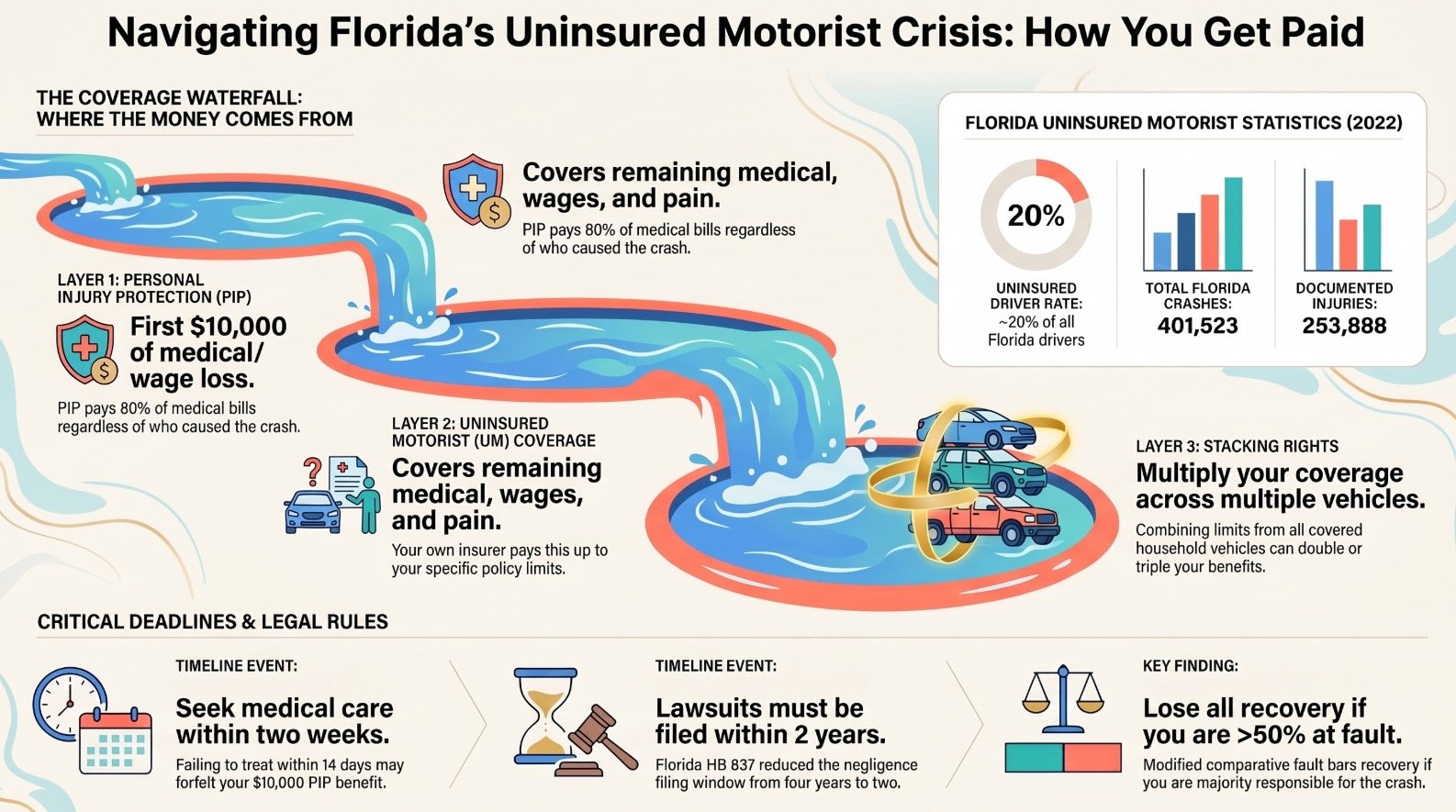
According to the FLHSMV 2022 Florida Traffic Crash Facts, Florida recorded 401,523 total crashes and 253,888 documented injuries in a single year — and an estimated one in five Florida drivers carries no liability insurance at all, one of the highest uninsured motorist rates in the nation. That means every fifth crash that injures a Florida driver creates an immediate coverage gap — a collision where the responsible party simply cannot pay. Nationally, NHTSA data shows distracted driving claimed 3,308 lives in 2022, a leading cause of the Florida crashes that generate UM claims every day.
The practical consequence is clear: Florida drivers who do not carry UM coverage — or who carry it but don’t understand their stacking rights — may have no meaningful compensation when the at-fault driver turns out to be uninsured. Florida HB 837 (effective March 24, 2023) also shortened the negligence filing deadline from four years to two years from the crash date, meaning evidence preservation and prompt legal contact are more important than ever for injured people dealing with uninsured-driver situations.
Florida Uninsured Driver Crisis — Who Pays When the At-Fault Driver Has No Coverage
When an uninsured driver causes a crash in Florida, payment doesn’t automatically appear — it flows through a specific sequence of coverage layers. Most injured people don’t know this order, miss coverage they’ve paid for, or accept less than they’re owed. This chart shows exactly how each layer works and where the gaps are.
Florida HB 837 (2023) and UM claims: HB 837 converted Florida from pure comparative fault to modified comparative fault. Under the old system, even a driver 90% at fault could recover 10% of damages from the other party. Under the new system, if you are found more than 50% responsible for the crash, you recover nothing — including from your own UM carrier. In UM claims where your insurer stands in the shoes of the at-fault driver, insurers now have a direct financial incentive to build a record attributing majority fault to you. Preserving crash evidence, EDR data, witness accounts, and camera footage from the first 72 hours after the crash is the most effective protection against this strategy.
Common Causes of Florida Uninsured Motorist Accidents
Florida uninsured motorist accidents often arise from preventable driving behaviors that increase the risk of serious injury. Common causes include distracted driving, impaired driving, speeding violations, and reckless lane changes, each of which can complicate liability and insurance recovery. Understanding these factors helps clarify how such collisions occur, and why legal evaluation may be necessary after an accident.
Distracted Driving
Because driver attention can shift in an instant, distracted driving remains a leading cause of uninsured motorist accidents in Florida. Cell phone misuse — including texting — can prevent drivers from observing traffic signals, pedestrians, bicyclists, or stopped vehicles. When an uninsured driver looks away, reaches for a device, or responds to a message, the resulting collision may leave injured people without a reliable source of compensation. According to NHTSA’s distracted driving data, thousands of lives are lost every year to preventable inattention behind the wheel.
For families, caregivers, and community members, these crashes create urgent needs for medical support, transportation, and financial stability. Careful documentation of distraction-related evidence, such as phone records, witness statements, and crash reports, may help establish fault. An injury lawyer can evaluate uninsured motorist coverage, preserve evidence, and pursue available benefits for those harmed by careless, inattentive driving.
Impaired Driving
When alcohol, drugs, or certain medications affect a driver’s judgment, reaction time, and coordination, the risk of an uninsured motorist accident can increase sharply. Impaired drivers may drift between lanes, misjudge traffic signals, or fail to recognize hazards, leaving responsible motorists and passengers exposed to serious harm. In Florida, injury claims involving uninsured drivers often require careful review of police reports, witness accounts, impairment test results, and medical documentation. These records may help establish how impairment contributed to the collision and the resulting losses. Alcohol impairment defenses can complicate disputed claims, especially when evidence is incomplete or testing procedures are challenged. A careful legal evaluation can support injured individuals while promoting accountability, public safety, and compassionate service to those affected.
Speeding
As roadway speeds increase, drivers have less time to recognize hazards, adjust to traffic conditions, and avoid collisions with nearby vehicles. In Florida uninsured motorist accidents, excessive speed often increases injury severity and complicates recovery for injured people who need support, stability, and fair compensation. Speeding liability may depend on posted limits, weather, traffic density, vehicle damage, skid marks, and witness accounts. Careful crash scene documentation can help establish whether an uninsured driver was traveling too fast for conditions, even when no citation was issued. Photographs, police reports, surveillance footage, and event data may preserve crucial facts before evidence is lost. For injured individuals and those assisting them, identifying speed as a contributing factor can clarify fault and support a claim for damages under available uninsured motorist coverage.
Reckless Lane Changes
Although a lane change may appear routine, an unsafe or reckless movement can create a sudden risk of collision, especially when an uninsured driver fails to signal, checks mirrors poorly, or cuts across traffic without sufficient space. These crashes often harm careful motorists, passengers, pedestrians, or cyclists who had little opportunity to respond. Lane change liability may depend on witness accounts, vehicle positions, skid marks, camera footage, and police findings. In Florida, comparative fault may reduce recovery if another driver shares fault, making precise documentation of damages crucial. Medical records, photographs, repair estimates, and consistent treatment histories can help show how the crash affected the injured person. When the at-fault driver lacks coverage, uninsured motorist benefits may determine the practical path toward compensation and stability.
Legal Rights of Florida Uninsured Motorist Accident Injured Persons
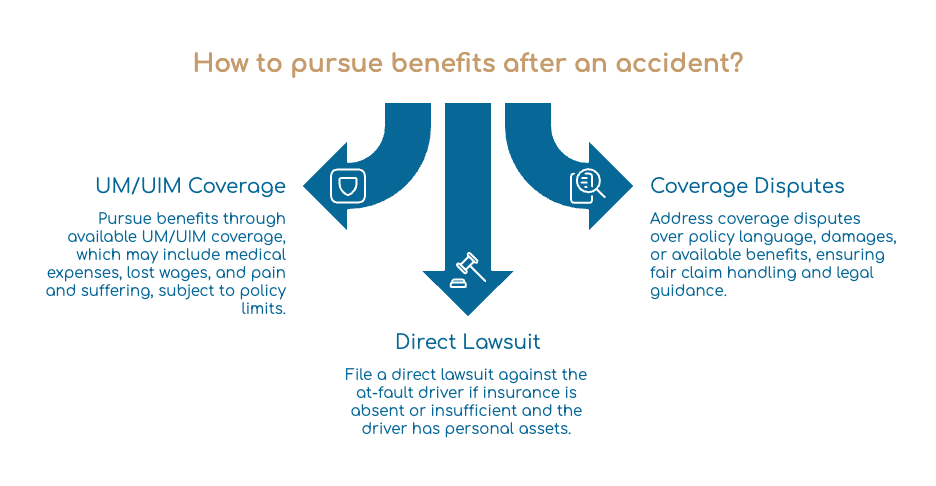
Under Florida law, a person struck by an uninsured motorist may have several important legal rights, including the right to seek benefits through available uninsured motorist coverage and, in some cases, the right to pursue a personal injury claim against the at-fault driver.
These rights may support medical care, lost income, and other damages, while also protecting families, caregivers, and communities that depend on the injured person’s stability.
- Injured policyholders may pursue benefits through available UM/UIM coverage, which may include medical expenses, lost wages, and pain and suffering, subject to policy limits.
- Coverage disputes may arise over policy language, damages, or available benefits — and the right to fair claim handling, timely review, and legal guidance before accepting any settlement is protected under Florida law.
- When insurance is absent or insufficient, and the at-fault driver has personal assets, a direct lawsuit may provide an additional avenue for accountability and recovery.
Careful action helps preserve evidence, meet deadlines, and support recovery with dignity and purpose.
Why Do Florida Uninsured Motorist Accident Injuries Happen?
After legal rights are identified, the next issue is often how these collisions occur and why the resulting injuries can be so severe. In Florida, uninsured motorist crashes frequently arise from financial instability, lapsed policies, excluded drivers, or vehicles operated without proper registration. Some drivers cannot maintain coverage because premiums rise after prior violations, crashes, or financial hardship, leaving responsible road users exposed to preventable harm.
Injuries may worsen because uninsured drivers often operate older, poorly maintained vehicles or delay repairs. Faulty brakes, worn tires, and inadequate lighting can increase crash force or reduce reaction time. High-speed roads, dense traffic, distracted driving, and impaired judgment further compound the danger. For injured people, families, caregivers, and community advocates, these events show how one driver’s lack of coverage can shift medical, financial, and practical burdens onto those already serving others through recovery and daily support.
What Should You Do After a Florida Uninsured Motorist Accident Injury?
After a Florida uninsured motorist accident injury, the injured person should take prompt steps to protect health, preserve evidence, and comply with insurance requirements. Medical care should be sought as soon as possible, the crash should be reported to law enforcement, and the insurer should be notified promptly. These actions can help document the injury, establish the facts of the collision, and support any uninsured motorist claim that may follow.
Seek Medical Care
When an uninsured motorist accident occurs in Florida, prompt medical care is one of the most important steps an injured person can take. Even when symptoms appear minor, conditions such as concussions, internal injuries, or soft tissue damage may worsen without evaluation. An emergency room visit can identify urgent concerns, create a medical record, and guide the next stage of treatment. Medical professionals also help injured people understand limitations, prescriptions, and warning signs that require immediate attention.
Follow-up appointments are equally important because recovery often depends on consistent care and careful monitoring. Missed visits may delay recovery and make injuries harder to document. By seeking treatment early and continuing recommended care, an injured person supports personal recovery while helping caregivers, advocates, and legal professionals understand the full impact of the accident.
Report the Crash
At the scene of a Florida uninsured motorist accident, reporting the crash to law enforcement helps create an official record of what occurred and who was involved. Officers can secure safety at the scene, direct traffic, identify witnesses, and prepare a report that may later support an injury claim. Prompt reporting also helps avoid delays, especially when details may fade or parties leave before information is gathered. Injured persons should cooperate respectfully, provide accurate facts, and avoid speculation about fault or medical prognosis. When possible, they should note visible damage, road conditions, and the other driver’s identifying details. Documenting injuries through photographs and observations may help connect harm to the collision. Preserving receipts for towing, transportation, and emergency expenses can further support accurate records.
Contact Your Insurer
Once the crash has been reported and the basic facts have been documented, the injured person should notify their own automobile insurer as soon as reasonably possible. Prompt notice may protect available uninsured motorist benefits and help ensure that the claim is opened without avoidable delay. The insured should provide accurate information about the collision, the other driver, the police report, and any known witnesses. He or she should communicate with adjusters carefully, remaining truthful while avoiding speculation about fault or the full extent of injuries. It is also important to document personal injuries through medical records, photographs, treatment notes, and written descriptions of pain, limitations, and missed work. Organized records assist the insurer, support fair evaluation, and help preserve benefits for necessary care.
Critical Evidence in a Florida Uninsured Motorist Accident Injury Case
Critical evidence in a Florida uninsured motorist accident injury case helps establish fault, confirm damages, and identify available coverage. Key materials typically include police crash reports, medical treatment records, insurance policy documents, and witness statements and photographs. Each category contributes to a complete picture of how the collision occurred and what losses the injured person has sustained.
Police Crash Reports
When a Florida crash involves an uninsured or unidentified driver, the police crash report often becomes one of the first documents used to evaluate the injury claim. It may identify drivers, witnesses, insurance status, roadway conditions, citations, and the officer’s observations. For those committed to helping injured people pursue fair recovery, this report provides an organized starting point for understanding what occurred. It can also lead to supporting evidence, including dashcam footage, police bodycam recordings, photographs, and 911 call information. Although the report may not determine fault on its own, it can guide further investigation and accident reconstruction. Careful review helps reveal inconsistencies, missing details, or witness accounts requiring follow-up, especially when the at-fault driver lacks insurance or leaves the scene after impact.
Medical Treatment Records
After an uninsured motorist accident in Florida, medical treatment records often become the central evidence linking the collision to the injured person’s physical harm. These records may include emergency room notes, physician evaluations, imaging results, therapy notes, medication lists, and follow-up recommendations. They assist in diagnosing injuries, documenting symptoms, and showing whether treatment was sought promptly and consistently. A clear medical timeline can help demonstrate how pain, limitations, and recovery needs developed after the crash. For a detailed guide to which medical documents carry the most weight in Florida injury claims — including UM disputes — the firm’s blog post What Medical Records Matter Most in a Florida Injury Claim explains exactly what providers and attorneys look for when building a strong claim file. Gaps in treatment or incomplete documentation may weaken the presentation of harm, while thorough records can clarify causation, severity, and the ongoing impact of the uninsured driver’s conduct.
Insurance Policy Documents
Because coverage disputes often shape the outcome of an uninsured motorist claim, insurance policy documents are vital evidence in a Florida accident injury case. These records identify available uninsured motorist benefits, exclusions, notice duties, coverage limits, and any stacking provisions that may affect recovery. A careful review can also confirm whether the insured complied with required reporting obligations after the crash. When medical records show significant injuries, the policy language helps determine whether benefits may respond to ongoing treatment, lost income, and other losses. Attorneys may compare declarations pages, endorsements, renewal notices, and correspondence to resolve disputes fairly and efficiently. Although witness statements may support liability, policy documents define the available contractual protection. Accurate organization of these materials helps advocates serve injured clients with diligence, care, and accountability.
Witness Statements and Photos
In a Florida uninsured motorist accident injury case, witness statements and photographs can provide critical support for proving how the crash occurred and the extent of the resulting harm. Neutral witnesses may describe traffic signals, vehicle positions, speed, weather, and driver conduct, helping clarify disputed facts with integrity. Photographs can preserve damage patterns, roadway conditions, debris, injuries, and visibility issues before evidence changes or disappears. This information may also assist in evaluating coverage, because insurers often compare physical evidence with policy requirements and reported losses. Prompt collection is important, since memories fade and claim deadlines can affect the ability to pursue compensation. Careful documentation serves the injured person and supports a fair review by counsel, insurers, and, when necessary, the court.
Event Data Recorder Evidence in Florida Uninsured Motorist Cases
Most vehicles manufactured after 2012 contain an event data recorder (EDR) that captures speed, braking force, throttle position, steering angle, and seat-belt status in the seconds before and during a crash. In uninsured motorist cases, EDR data is often the most objective evidence available to reconstruct how the crash occurred — especially when the at-fault driver disputes fault, claims a sudden emergency, or has fled the scene. Because UM claims are evaluated by your own insurer, which has a financial interest in minimizing the payout, independent EDR evidence is a powerful counterweight to insurer-sponsored independent medical examinations or reconstruction reports that minimize the impact.
EDR data can be permanently overwritten the next time either vehicle’s ignition is turned on after the crash. Formal preservation demands must be sent immediately — to the other driver (or the vehicle owner, if different) and to both insurers — before the data is lost. In hit-and-run cases, the surviving vehicle’s EDR may also contain pre-impact data showing the injured driver’s speed, lane position, and braking — evidence that directly contradicts any insurer argument that the injured person contributed to the crash.
Long-Term Effects of Florida Uninsured Motorist Accident Injuries
Uninsured motorist accidents in Florida can lead to lasting consequences that extend well beyond the initial injury. Chronic pain complications, ongoing medical expenses, and reduced earning capacity may greatly affect an injured person’s financial stability and quality of life. These long-term effects often require careful documentation, medical evaluation, and legal assessment when pursuing compensation.
Chronic Pain Complications
After a collision with an uninsured motorist, chronic pain may become one of the most disruptive long-term effects of an accident injury. Persistent neck, back, joint, or nerve pain can limit mobility, reduce work capacity, and interfere with daily service to family, patients, clients, or community members. These complications may develop from soft tissue damage, spinal trauma, fractures, or aggravated preexisting conditions. Careful documentation helps connect ongoing symptoms to the crash, especially when insurers question the severity or origin of pain.
According to the Mayo Clinic, traumatic brain injuries — which can result from crashes of even moderate force — may produce symptoms that evolve over days, weeks, or months after impact, making early and consistent medical evaluation critical. Effective pain management may include supervised therapy, medication oversight, injections, rehabilitation, and lifestyle adjustments guided by qualified providers. Legal review may also address wrongful insurance practices, including unfair delays, minimized evaluations, or improper claim denials that undermine an injured person’s recovery and stability.
Ongoing Medical Expenses
Several categories of medical costs may continue long after a Florida uninsured motorist accident, including professional visits, diagnostic testing, therapy, prescription medication, injections, surgery, and follow-up care. These expenses can place persistent pressure on injured individuals and the families or caregivers assisting them. Medical documentation helps demonstrate the nature of the injuries, the treatment already received, and the continuing care recommended by qualified providers. Reliable records may include physician notes, imaging results, therapy reports, medication histories, and billing statements.
Future treatment estimates can also clarify anticipated costs when injuries require ongoing management or later procedures. In uninsured motorist claims, these records support a thorough evaluation of damages and help ensure that necessary care is not missed during settlement discussions or litigation. Such preparation promotes responsible advocacy for recovery.
Reduced Earning Capacity
When serious injuries affect a person’s ability to work, reduced earning capacity may become a major component of a Florida uninsured motorist accident claim. This loss may involve diminished wages, fewer opportunities for advancement, or the inability to return to a prior occupation. Medical evidence, employment history, and expert analysis can help show how injuries limit future work performance. In some cases, vocational retraining may be necessary when physical restrictions prevent continued employment in the same field. Claims may also address future disability when lasting impairments reduce a person’s ability to earn income over time.
Careful evaluation is important because reduced earning capacity affects long-term stability, family support, and financial independence. For a broader understanding of how Florida injury settlements account for these long-term losses by case type, the firm’s blog post Average Personal Injury Settlements in Florida by Case Type provides useful context for injured people evaluating their UM claims. A lawyer may help present these losses with accuracy, compassion, and disciplined advocacy.
Proving Liability in Florida Uninsured Motorist Accident Injury Cases
In proving liability after a Florida uninsured motorist accident, the injured party must establish that the uninsured driver’s negligence caused the crash and resulting injuries. This proof often begins with evidence such as police reports, witness statements, photographs, traffic camera footage, and medical records linking the collision to specific harm. A careful investigation may show speeding, distraction, impairment, unsafe lane changes, or failure to yield.
Florida’s comparative fault standard may reduce recovery if the injured party shares fault, making accurate fact development critical. Liability findings also support a proper calculation of damages, including medical expenses, lost income, reduced earning capacity, and pain-related losses. Although uninsured motorist claims involve the injured person’s own coverage, coverage limits and policy exclusions may affect available recovery after fault and damages are established. Clear documentation helps present the case responsibly, supports fair accountability, and serves the broader purpose of helping injured people seek lawful restoration after preventable harm.
Dealing With Insurance Companies After a Florida Uninsured Motorist Accident Injury
After an uninsured motorist accident in Florida, dealing with insurance companies often requires careful communication, prompt documentation, and an understanding that the injured person’s own insurer may still evaluate the claim as an opposing financial interest. Adjusters may request recorded statements, medical authorizations, or early descriptions of injuries before the full harm is known. A measured response helps protect the claim while allowing necessary information to be provided in good faith.
Documentation should include medical records, wage information, repair estimates, photographs, and any correspondence from insurers. The injured person should also review uninsured coverage limits, because those limits may define the maximum available recovery under the policy. Attention to the policy settlement timeline is important, as delays, incomplete submissions, or unclear communications can affect negotiations. Those assisting an injured person should encourage organized records, accurate reporting, and respectful but cautious communication. Legal guidance can help preserve rights while supporting a fair evaluation of covered losses.
What to Expect During a Florida Uninsured Motorist Accident Injury Claim Process
A Florida uninsured motorist accident injury claim typically begins with timely crash reporting, followed by filing the appropriate insurance claim under the available coverage. The injured party’s medical records, treatment history, and proof of losses become central to documenting the extent of harm and financial impact. As the claim progresses, settlement negotiations may determine whether compensation can be resolved without formal litigation.
Reporting the Crash
When a crash involves an uninsured or unidentified driver, prompt reporting becomes a critical first step in protecting an injury claim. Law enforcement should be contacted at the scene whenever possible, especially when injuries, property damage, or a hit-and-run are involved. An official crash report can record important facts, identify witnesses, note visible injuries, and preserve details that may later support the injured person’s account.
Accurate reporting also assists those who help the injured person by providing a reliable foundation for resolving fault disputes. Photographs, driver information, license plate details, and medical symptoms should be documented without speculation or blame. Early reporting also helps ensure that deadlines, notice requirements, and evidentiary needs are not overlooked after the crash.
Insurance Claim Filing
Once the crash has been reported and the available facts have been documented, the injury claim typically moves into the insurance filing stage. In Florida, this may involve notifying the injured person’s insurer of a potential uninsured motorist claim and requesting confirmation of available protection. The insurer may open a claim file, assign an adjuster, and begin the benefits verification process. This step helps identify applicable policy coverage limits, exclusions, notice requirements, and any available personal injury protection benefits. A lawyer may assist by ensuring communications are timely, organized, and accurate, while protecting the claimant from unnecessary statements or premature conclusions. Careful filing supports orderly review and helps preserve the injured person’s access to contractual benefits intended to provide responsible assistance after harm caused by an uninsured driver.
Injury Documentation
As the claim develops, injury documentation becomes central to proving the physical, financial, and functional impact of the crash. Records should reflect emergency care, diagnostic testing, treatment plans, prescribed medication, therapy, and follow-up appointments. Consistent medical attention helps show how injuries affect daily responsibilities, work capacity, and personal independence.
A well-prepared file may include physician notes, medical bills, wage records, mobility restrictions, and statements from caregivers who observe limitations. Photo evidence of visible injuries, damaged assistive devices, or recovery conditions may also support the claim. In Florida uninsured motorist cases, careful documentation allows the injured person’s representative to present a clear account of harm and helps insurers evaluate the claim based on organized, reliable information rather than assumptions or incomplete records.
Settlement Negotiations
After sufficient medical and financial documentation has been gathered, settlement negotiations typically begin with a formal demand to the uninsured motorist carrier. The demand outlines liability, injuries, treatment costs, lost income, and the impact on daily life. The insurer may respond with questions, a lower offer, or a request for additional records. A careful negotiation strategy helps present the claim firmly while remaining grounded in evidence. If litigation has started, information from the discovery process may clarify disputed facts and strengthen the valuation of damages. Throughout this stage, the attorney evaluates offers against the client’s medical needs, future care, and financial losses. The goal is a fair resolution that supports recovery, preserves dignity, and recognizes the harm caused by an uninsured driver. Results may vary. Prior results do not guarantee a similar outcome.
Compensation for Florida Uninsured Motorist Accident Injury Damages
Recovering compensation after a Florida uninsured motorist accident often requires a thoughtful review of insurance coverage, medical losses, and the full impact of the injury. When the at-fault driver lacks coverage, the injured person may need to pursue benefits through uninsured motorist coverage, if available under the policy. This process can require timely notice, accurate medical documentation, and a clear connection between the collision and the claimed injuries.
A lawyer handling these matters may examine policy limits, prior communications, treatment records, and insurer conduct. Careful preparation helps protect the injured person from undervalued offers or improper claim denials. For individuals and families focused on restoring stability, compensation can help cover treatment costs and relieve immediate financial pressure. Legal guidance may also help ensure that insurers evaluate the claim fairly, based on the evidence and the duties imposed by Florida insurance law. Each case depends on its specific facts and available coverage.
Economic vs. Non-Economic Damages in Florida Uninsured Motorist Accident Cases
Florida uninsured motorist accident cases often involve both economic and non-economic damages, each addressing a different category of loss. Economic damages include measurable financial harm, while non-economic damages account for injuries such as pain, suffering, and diminished quality of life. Proving both types of losses requires clear documentation, credible evidence, and a careful presentation of how the accident affected the injured person’s life.
Economic Damages Explained
Economic damages form the documentary foundation of many Florida uninsured motorist accident claims. These losses may include emergency care, hospitalization, surgery, rehabilitation, medication, medical equipment, lost wages, reduced earning capacity, and necessary replacement services. Careful records help a claimant present the harm in a way insurers, attorneys, and courts can evaluate. Fault and liability must be clearly connected because proof of the uninsured driver’s conduct must link the crash to specific financial consequences. Coverage limits also shape recovery, since uninsured motorist benefits may not fully match the documented loss. A service-minded legal review can organize bills, employment records, expert opinions, and future care estimates, helping the injured person seek fair compensation without confusing economic proof with other categories of damages.
Non-Economic Damages Explained
Non-economic damages address the human consequences of an uninsured motorist accident that do not appear directly on invoices, wage statements, or repair estimates. These damages may include pain, emotional distress, inconvenience, loss of enjoyment of life, and the strain placed on family relationships. In Florida uninsured motorist cases, such losses recognize that injury affects dignity, independence, and the ability to serve family, work, and community. Their value depends on the severity of the injury, the duration of recovery, and the lasting effect on daily living. How fault is determined may influence whether compensation is reduced under comparative fault rules. Insurance claim timelines also matter because delayed reporting or missed deadlines can affect access to benefits, even when the harm is real and deeply felt by the injured person.
Proving Both Losses
When an injured person seeks uninsured motorist benefits, proving damages requires more than stating that losses occurred. Economic damages should be supported through medical bills, wage records, repair estimates, receipts, and expert opinions when future care or reduced earning capacity is disputed. Non-economic damages require a different showing, often relying on medical documentation, symptom history, testimony from family members, and evidence of daily limitations. These evidence requirements help connect the crash to both financial harm and human suffering. A careful settlement strategy presents both categories together, showing how documented expenses relate to pain, impairment, and loss of normal life. For those serving injured Floridians, thorough preparation promotes fair evaluation and discourages insurers from minimizing genuine, necessary, and legally compensable losses.
When a Florida Uninsured Motorist Accident Injury Case Goes to Trial vs. Settlement
Although many Florida uninsured motorist accident injury claims are resolved through settlement, some proceed to trial when the parties cannot agree on liability, damages, coverage, or the value of the claim. Settlement may allow an injured person to obtain compensation sooner, reduce uncertainty, and preserve resources needed for medical care, family stability, and continued service to others. Trial may become necessary when an insurer disputes fault, minimizes injuries, challenges treatment, or refuses to offer an amount consistent with available evidence.
In evaluating whether settlement or trial is suitable, counsel may consider negligence standards, medical documentation, witness testimony, expert opinions, and applicable policy limits. A trial presents evidence to a judge or jury, who determines responsibility and compensation based on the record. This process can provide accountability, but it also involves delays, expenses, and risks. A careful case assessment helps ensure decisions reflect both practical realities and the injured person’s long-term needs.
Florida Laws That May Affect Your Florida Uninsured Motorist Accident Case
Several Florida laws may shape the outcome of an uninsured motorist accident injury case, including rules governing fault, insurance coverage, damages, deadlines, and claims against insurers.
These laws help determine who is legally responsible, what benefits may be available, and how an injured person’s losses should be measured.
- Florida UM coverage (Fla. Stat. §627.727) is optional but, once purchased, cannot be reduced or removed without a signed written rejection form from the named insured.
- Stacking of UM/UIM limits across multiple vehicles or policies is permitted unless validly rejected in writing — a right many policyholders are unaware they hold.
- Florida HB 837 (effective March 24, 2023) converted Florida to modified comparative fault — recovery is barred entirely if the injured person is found more than 50% at fault.
- Florida’s two-year negligence filing deadline applies to UM claims, and insurers may impose additional contractual deadlines — both must be tracked and met to preserve the right to recover.
A lawyer may evaluate whether the at-fault driver qualifies as uninsured or underinsured, whether stacking applies, and whether the insurer honored its duties. This review supports injured people and their families as they seek lawful, fair compensation after a serious crash.
The Statute of Limitations for Florida Uninsured Motorist Accident Injury Cases
Beyond the coverage and liability issues that may affect a Florida uninsured motorist accident injury case, filing deadlines can determine whether an injured person may pursue compensation at all. Florida law now requires negligence-based injury lawsuits to be filed within two years of the crash (Florida HB 837, effective March 24, 2023), while uninsured motorist claims may involve additional contractual deadlines tied to the insurance policy. These time limits should be examined early, because delays can affect claim evidence, witness availability, medical documentation, and the insurer’s review process.
Deadlines may also interact with coverage limits, policy exclusions, and settlement timelines. An insurer may continue evaluating a claim, but ongoing discussions do not always pause the legal filing period. When an injured person serves family, clients, coworkers, or a community, protecting the right to recover can also protect those who depend on that person’s stability. Careful attention to statutory and policy-based deadlines helps preserve a valid path toward lawful compensation.
How a Florida Uninsured Motorist Accident Injury Lawyer Can Help You
A Florida uninsured motorist accident injury lawyer can help an injured person identify available coverage, evaluate the strength of the claim, and address disputes that may arise with the insurance company. This assistance often includes reviewing policies, organizing medical documentation, calculating losses, and explaining the steps of the claims process with clarity.
The lawyer may also assess liability, document damages, and prepare communications that support fair review.
- Coverage audit: The lawyer reviews declarations pages, endorsements, and stacking provisions to identify all UM/UIM benefits available under the policy — including limits that many policyholders don’t know they hold.
- Evidence preservation: The lawyer organizes records, photographs, treatment notes, and EDR data into a case file that clearly and completely presents the accident and its consequences.
- Insurer negotiation: Through settlement negotiation, the lawyer challenges low offers, responds to coverage defenses, and presents evidence that reflects the full impact of harm.
- Accountability: This role helps protect the claim, promote fair insurer conduct, and support a more informed resolution that reflects the claimant’s actual losses.
When to Contact a Florida Uninsured Motorist Accident Injury Lawyer
After an uninsured motorist crash, legal guidance should be considered as soon as injuries, disputed fault, unclear coverage, or insurer delays begin to affect the claim. Early contact can help an injured person understand reporting duties, policy deadlines, and the practical steps needed to protect a potential recovery.
Prompt action is especially important when medical treatment is ongoing, witnesses may become difficult to locate, or vehicle damage must be documented. Evidence preservation can support an accurate account of the collision and reduce later uncertainty. Photographs, police reports, medical records, repair estimates, and communications from insurers should be carefully gathered and maintained.
A lawyer may also be contacted when an insurance carrier questions the severity of injuries, denies coverage, requests repeated statements, or offers limited compensation. In those circumstances, insurer dispute resolution may require organized documentation and careful communication. Timely legal review can help protect the injured person’s interests while the claim develops.
Why You Need an Experienced Florida Uninsured Motorist Accident Injury Lawyer
When an uninsured motorist claim involves injury, coverage questions, and competing insurance interests, experienced legal representation can be important to the outcome. A lawyer can help protect an injured person’s ability to recover compensation and reduce preventable errors that could harm the claim. This support is especially valuable when the injured person is focused on recovery, family responsibilities, and service to others.
Experienced counsel can address evidence preservation, including photographs, witness information, crash reports, and vehicle damage documentation. The lawyer can also organize medical records, link treatment history to the collision, and present losses clearly. Proper insurer communication helps prevent statements or forms from being used against the claimant. Legal guidance may also influence the settlement timeline by identifying coverage limits, documenting damages, and responding to delay tactics. In these cases, experienced representation provides structure, advocacy, and accountability when insurance processes become difficult.
How to Choose the Right Florida Uninsured Motorist Accident Injury Lawyer for Your Case
Choosing the right Florida uninsured motorist accident injury lawyer begins with evaluating whether the attorney has direct experience handling UM claims, bodily injury disputes, and insurer coverage issues under Florida law. A suitable lawyer should understand policy language, medical evidence, liability disputes, and the tactics insurers may use to limit recovery. This experience helps injured people pursue compensation while focusing on recovery, family responsibilities, and community obligations.
A careful selection process should also examine responsiveness, case organization, and the lawyer’s ability to explain each step with accuracy. Client communication updates should be consistent, meaningful, and timely, so the injured party remains informed without unnecessary confusion. Fee agreement terms are equally important, including how costs are handled and when payment may be owed. The lawyer should demonstrate preparation, compassion, and a service-focused approach, while maintaining professional judgment. Strong representation supports both the client’s legal needs and the broader duty to restore stability after harm.
About The Law Offices of Anidjar & Levine
Founded in 2005 by Marc Anidjar and Glen Levine, the firm began as a two-person operation working out of a construction office conference room. Over the past 20 years, that modest start has grown into one of Florida’s most recognized personal injury practices — with more than $1 billion recovered in settlements on behalf of injury clients across the state. We bring that same determination and depth of experience to every case we handle.
The Law Offices of Anidjar & Levine assist injured individuals and families with steady guidance after collisions involving uninsured or underinsured drivers. Its attorneys review the facts of the accident, medical records, policy language, and insurance coverage limits, and then pursue compensation through a disciplined legal strategy.
The firm’s work emphasizes service, accessibility, and practical support for clients facing physical, financial, and emotional strain. Staff members help explain how to file a claim, communicate with insurers, document losses, and protect deadlines that may affect recovery. This approach allows clients to focus on treatment while their legal team manages negotiations and case preparation. Through organized advocacy and attention to detail, The Law Offices of Anidjar & Levine seeks fair outcomes for those harmed by negligent drivers who lack sufficient insurance protection.
Frequently Asked Questions
Can Passengers Use Uninsured Motorist Coverage in Florida?
Yes, passengers may use uninsured motorist coverage in Florida when coverage applies. Passengers insured under the vehicle owner’s policy, their own household policy, or another applicable policy may seek benefits for injuries caused by an uninsured driver. They should provide proof of loss, follow the insurer’s claim procedure, and document medical damages. Recovery remains subject to policy limits, coverage terms, and priority rules governing available insurance.
Does Uninsured Motorist Coverage Apply to Hit-and-Run Accidents?
Yes, uninsured motorist coverage may apply to hit-and-run accidents when the fleeing driver cannot be identified. Policy terms should be reviewed carefully because hit-and-run exclusions may limit recovery. Insurers often impose proof requirements, such as timely police reports, evidence of physical contact, or corroborating witnesses. Those assisting injured drivers or passengers should promptly preserve records to ensure valid claims are presented accurately and diligently.
Will My Premiums Increase After Filing a UM Claim?
Premiums may increase after a UM claim, but the impact depends on policy terms, fault, prior history, and state rules. An insurer typically reviews whether the insured caused the loss, whether coverage applies, and the amount paid. A rate change is not automatic, but policyholders should request written explanations from their insurer. Documenting facts carefully and responding truthfully throughout the claim process supports accurate review.
Can I Stack Uninsured Motorist Coverage in Florida?
Yes, uninsured motorist coverage may be stacked in Florida if stacking was selected or not validly rejected in writing. Stacking allows coverage from multiple vehicles or policies to be combined, increasing available protection. The controlling factor is the policy language, including any written rejection form. Those helping injured individuals should review declarations pages, endorsements, and exclusions carefully, because insurers may dispute stacking when documentation is incomplete or ambiguous.
Does UM Coverage Apply if I’m Injured as a Pedestrian?
Yes. UM coverage may apply when a person is injured as a pedestrian, if the policy terms and Florida law support coverage eligibility. Pedestrian claims often involve a negligent uninsured or underinsured driver. The injured person may qualify through a personal auto policy, a resident relative’s policy, or other applicable coverage. Careful review helps protect medical recovery, lost income, and the ability to continue meeting daily responsibilities.
What Is the Difference Between Uninsured and Underinsured Motorist Coverage in Florida?
Uninsured motorist (UM) coverage applies when the at-fault driver has no liability insurance at all — including hit-and-run drivers where the responsible party cannot be identified. Underinsured motorist (UIM) coverage applies when the at-fault driver has liability insurance, but those limits are insufficient to fully compensate the injured person’s losses. In Florida, UM and UIM coverage are typically sold together under the same endorsement. The injured person’s own insurer pays the difference between the at-fault driver’s policy limit and the actual damages, up to the UIM policy limit.
Do I Have to Prove the Other Driver Was Uninsured to Collect UM Benefits?
Yes, in most cases, you must establish that the at-fault driver had no liability insurance (or insufficient coverage for UIM claims) before your own UM/UIM benefits become available. This typically requires the at-fault driver to confirm no coverage or for your insurer to investigate and verify the absence of coverage. In hit-and-run cases where the driver cannot be identified, Florida policies generally require physical contact with the unidentified vehicle as proof — though some policies have broader language. An attorney can help gather the documentation needed to satisfy your insurer’s proof requirements.
A Florida uninsured motorist accident injury claim can involve challenging coverage issues, strict deadlines, and disputed liability. Skilled legal representation helps injured people protect their rights, pursue available compensation, and address insurers that undervalue valid claims.
The Law Offices of Anidjar & Levine provides informed guidance and focused advocacy for those harmed by uninsured drivers, including support from a Florida Car Accident Lawyer.
Prompt legal action can preserve evidence, clarify policy options, and support a stronger path toward financial recovery. Results may vary. Prior results do not guarantee a similar outcome.