The Law Offices of Anidjar and Levine help injured victims in texting-while-driving accident cases prove distraction, preserve phone and vehicle evidence, and pursue compensation for crash-related losses. A Florida Car Accident Lawyer can handle cases involving phone records, witness accounts, surveillance footage, crash reports, and medical documentation linking injuries to the collision.
Damages may include medical expenses, lost income, pain, disability, and future care needs. Early legal guidance can protect evidence and address insurer challenges, while the sections below explain the process in greater detail.
Main Takeaways
- A Florida texting-while-driving injury lawyer can investigate liability, causation, roadway conditions, and distracted driving evidence.
- Key evidence may include phone records, crash reports, witness statements, photos, surveillance footage, and vehicle damage.
- Prompt medical care and consistent documentation help connect injuries to the crash and support treatment-related damages.
- Recoverable damages may include medical expenses, lost income, pain, disability, and reduced daily function.
- Claims may proceed through insurance negotiations or a lawsuit, with comparative negligence potentially reducing recovery.


How We Can Help With Your Florida Texting While Driving Accident Injury Claim
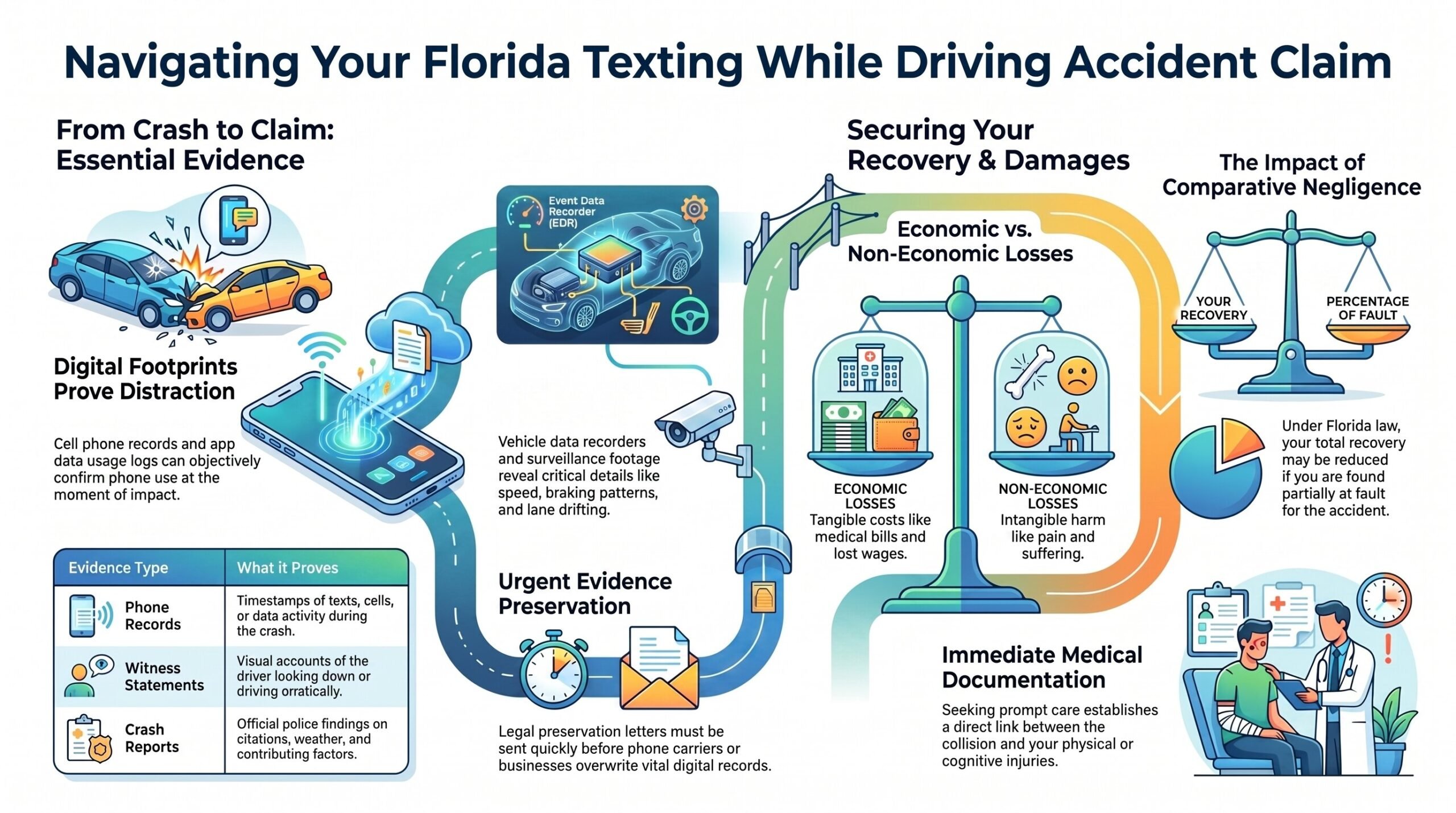
Building a strong Florida texting-while-driving accident injury claim requires prompt investigation, careful documentation, and a clear showing of how the distracted driver’s conduct caused the crash. A legal team can serve injured people by coordinating Evidence preservation, including vehicle data, phone records, witness accounts, photographs, and surveillance footage, before crucial proof is lost.
Through a focused liability investigation, counsel may identify negligent conduct, evaluate roadway conditions, and determine whether additional parties contributed to the harm. Careful medical documentation also helps link injuries to the collision, document treatment needs, and support claims for future care, lost income, and diminished daily functioning.
During insurance negotiation, an attorney can present organized proof, respond to adjuster challenges, and protect the claimant from statements or settlements that undervalue the loss. This structured assistance allows the injured person and family to focus on recovery, service, and stability while the claim proceeds with discipline and purpose.
OUR CONSULTATIONSARE FREE
START YOUR FREE CASE REVIEW

Understanding Florida Texting While Driving Accident Injury Cases
When a driver ensures attention to a text message, even for a few seconds, the resulting loss of roadway awareness can create serious consequences under Florida law. Injury cases involving texting while driving often require careful review of duty, breach, causation, and damages. A claim may involve medical expenses, lost income, pain, disability, and the broader effect on a person’s ability to care for family or serve the community.
Florida’s Comparative negligence rules may also affect recovery when more than one party is alleged to share responsibility. For this reason, documentation is important from the beginning. Practical evidence-preservation tips include securing crash reports, medical records, witness information, photographs, vehicle data, and phone records when legally available. A lawyer can help ensure relevant materials are requested before they are lost or destroyed. These cases demand disciplined investigation, accurate valuation, and a clear presentation of how the texting-related conduct caused harm.
Common Causes of Florida Texting While Driving Accidents
Common causes of Florida texting-while-driving accidents often stem from driver distraction, which reduces attention to traffic signals, road conditions, and surrounding vehicles. When a driver’s reaction time is delayed, even briefly, the risk of lane departure or failure to slow in time increases substantially. These factors frequently contribute to rear-end collisions, especially in congested traffic or areas requiring sudden stops.
Driver Distraction
Driver distraction is one of the primary reasons texting while driving leads to serious accidents on Florida roads. When a motorist reads, types, or sends a message, attention shifts away from traffic conditions, roadway signs, and nearby vehicles. This form of distracted driving can place passengers, cyclists, and pedestrians at unnecessary risk, particularly at busy intersections, in school zones, and in areas with heavy foot traffic.
Pedestrian safety depends on drivers maintaining steady visual and mental awareness, rather than dividing their focus between a phone and the road. In many Florida crashes, evidence of phone use may help explain why a driver failed to notice hazards or lawful movement around them. Careful review of these circumstances can support accountability and promote safer choices that protect the public.
Delayed Reaction Time
Texting while driving not only diverts attention from the road but also slows the driver’s ability to respond to changing traffic conditions. When a driver looks at a phone, important seconds are lost before the brain recognizes danger and initiates corrective action. This delay weakens hazard perception, especially when traffic slows, pedestrians enter a crosswalk, or another vehicle stops unexpectedly.
In Florida, where roads often carry tourists, commuters, cyclists, and service vehicles, a delayed response can place many people at risk. Even a brief hesitation may increase stopping distance and contribute to greater crash severity. Those who serve injured individuals should understand that delayed reaction time is not a minor lapse. It is a measurable impairment that can connect texting behavior to preventable harm and accountability.
Lane Departure
On Florida roads, lane departure is a frequent and dangerous consequence of visual and manual distraction. When a driver looks down to read or send a text, the vehicle may drift across lane markings before corrective action occurs. This risk increases in construction zones, in rain, in darkness, or in areas with lane visibility issues, where steady attention is critical.
Unchecked drifting can force nearby motorists to brake, swerve, or lose safe positioning, creating conditions for side-swipe crashes and roadway departures. For passengers, pedestrians, cyclists, and other drivers, the harm may be sudden and severe. Those committed to serving injured people should recognize lane departure as evidence of preventable neglect, often requiring careful investigation into phone use, roadway conditions, witness statements, and vehicle movement prior to impact.
Rear-End Collisions
When a motorist diverts attention to a phone, the reduced reaction time can make a rear-end collision almost unavoidable. In Florida traffic, even a brief glance away may prevent a driver from noticing stopped vehicles, slowing traffic, or a changing signal. These impacts can cause neck injuries, back trauma, head injuries, and the need for Emergency medical treatment, especially when vulnerable passengers are involved. Those serving injured individuals must understand how evidence may clarify fault and support accountability.
Vehicle blackbox data can reveal speed, braking, and impact timing, helping determine whether distraction contributed to the crash. Witness statements, phone records, and crash scene details may further establish negligence. Careful investigation helps protect victims while encouraging safer driving standards across the community and promoting responsible conduct on Florida roads.


Legal Rights of Florida Texting While Driving Accident Injury Victims
In Florida, individuals injured by a driver who was texting may have the right to pursue compensation when the other driver’s distraction caused or contributed to the crash. These rights may include recovery for medical expenses, lost income, pain, and reduced quality of life. A claim may be affected by Comparative Negligence if the injured person shared some fault.
Damages Caps may also be relevant in limited circumstances, depending on the claim.
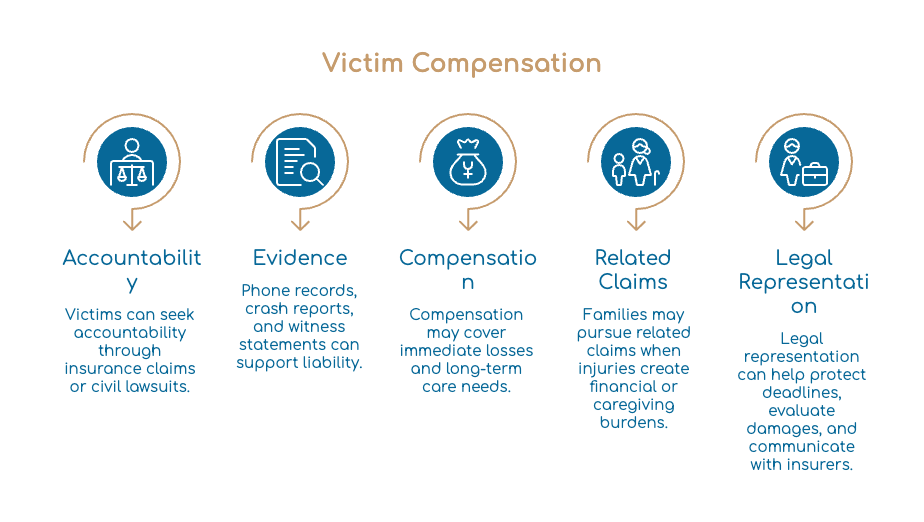
- Victims may seek accountability through an insurance claim or civil lawsuit.
- Evidence, including phone records, crash reports, and witness statements, may support liability.
- Compensation may address both immediate losses and long-term care needs.
- Families may pursue related claims when injuries create financial or caregiving burdens.
- Legal representation may help protect deadlines, evaluate damages, and communicate with insurers.
These rights serve a broader purpose, promoting responsibility and helping injured people restore stability after preventable harm caused by unsafe conduct.
Why Do Florida Texting While Driving Accident Injuries Happen?
Because texting divides a driver’s attention between the phone and the road, Florida texting while driving accident injuries often happen when a driver fails to see changing traffic conditions in time to react safely. A brief message can delay braking, reduce lane control, and prevent recognition of pedestrians, cyclists, emergency vehicles, or stopped traffic. These collisions may occur at intersections, in work zones, near schools, and on highways where seconds matter.
Injury risks increase when distracted drivers travel at higher speeds, follow too closely, or drift across lanes while reading or sending messages. Florida’s traffic density and frequent tourist travel can further magnify the danger, especially when unfamiliar drivers rely on phones for navigation. In later legal proceedings, facts about distraction may affect fault evaluation, mediation benefits, and even jury selection. Understanding why these injuries occur helps communities, families, and advocates promote safer choices and protect vulnerable road users with greater care.
What Should You Do After a Florida Texting While Driving Accident Injury?
After a Florida texting while driving accident, an injured person should take prompt steps to protect both health and any potential legal claim. Medical care, crash documentation, and preservation of available evidence can affect the strength and value of an injury case. Contacting an injury lawyer may also help ensure that insurance issues, liability disputes, and filing deadlines are handled properly.
Seek Medical Care
Why is prompt medical care so important after a Florida texting while driving accident? Immediate evaluation helps protect health, identify hidden trauma, and create a reliable treatment history. Injured individuals may feel obligated to assist others first, yet they also serve their families and communities by addressing medical needs without delay.
A physician can assess pain, dizziness, numbness, concussion signs, soft tissue injuries, and worsening mobility concerns. Documenting injuries begins with accurate medical records, clear diagnoses, and consistent notes about limitations. Tracking symptoms between visits helps providers adjust care and recognize complications. Preserving receipts for prescriptions, medical devices, transportation, and therapy supports an organized record of treatment costs. Scheduling follow-ups also shows diligence, encourages restoration, and helps ensure that developing conditions are evaluated before they become more serious.
Document The Crash
When it is safe to do so, documenting the crash can help preserve facts that may become important later. An injured person, or a trusted helper, should photograph vehicle positions, damage, skid marks, traffic signals, weather conditions, and visible injuries. If witnesses are present, their names and contact information should be recorded respectfully, without argument or pressure.
The crash report number, officer information, and any statements made by the other driver may also be useful. Evidence of phone use, such as admissions, visible screens, or related observations, should be noted carefully. These records may assist in negotiating with insurers and clarify issues if mediation vs. trial becomes relevant. Organized documentation supports truthful claims and helps those serving the injured present a clear, reliable account of what occurred.
Contact An Injury Lawyer
Because texting-while-driving cases often depend on evidence that can disappear quickly, an injured person should consider contacting a Florida injury lawyer as soon as practical. Counsel can send preservation letters, review police findings, identify witnesses, and seek phone records when legally available. This support may be crucial for proving negligence, especially when a distracted driver denies sending or reading messages.
A lawyer also helps protect the injured person from insurance tactics that may minimize harm or shift blame. For those committed to caring for family, coworkers, and community, timely legal guidance can preserve resources needed for recovery and service. Counsel can coordinate medical documentation, evaluate lost income, and conduct a careful calculation of damages that reflects treatment, pain, limitations, and future needs under Florida law.
Critical Evidence in a Florida Texting While Driving Accident Injury Case
Critical evidence in a Florida texting-while-driving accident injury case may establish whether driver distraction contributed to the crash and can also support the extent of liability and damages. A thorough review often focuses on objective records, physical evidence, and statements that help reconstruct events accurately.
Critical forms of evidence may include:
- Cell phone records showing call, text, or data activity near the time of the collision
- Police crash reports documenting officer observations, citations, and crash details
- Witness statements describing visible phone use or erratic driving behavior
- Vehicle damage evidence indicating impact angles, speed, and crash dynamics
- Photographs, video footage, or surveillance recordings preserving the accident scene
Cell Phone Records
Cell phone records often provide some of the strongest objective evidence in a Florida texting while driving accident injury case. These records may show call times, message activity, data usage, and app access near the moment of impact. When reviewed carefully, they can help determine whether a driver was distracted, even when the driver denies improper phone use. Attorneys may also seek digital device logs, which can identify screen activity, notifications, or other interactions.
In some cases, social media footage may confirm that a driver was posting, viewing, or recording shortly before the collision. Quickly preserving this evidence is key because data may be overwritten or lost. Careful collection supports injured people, promotes accountability, and helps ensure that the facts are presented fairly and accurately.
Police Crash Reports
Along with phone records and digital activity logs, a police crash report can provide an important early framework for evaluating a Florida texting-while-driving accident injury case. It may identify the drivers, vehicles, roadway conditions, citations, diagrams, and the officer’s initial assessment of contributing factors. When distraction is suspected, the report may note delayed braking, lane deviation, or failure to obey a signal.
In intersection collisions, red light evidence and traffic signal timing can help clarify whether a distracted driver entered unlawfully or failed to react in time. Although the report is not always conclusive, it can guide further investigation and preserve vital details. For those committed to helping injured people, careful review supports accountability, informed decisions, and a more complete understanding of preventable harm.
Witness Statements
When distraction is not immediately proven by records, witness statements can help establish what happened before, during, and after a Florida texting-while-driving accident. Eyewitness testimony may describe a driver looking down, holding a phone, drifting out of their lane, braking late, or failing to react to traffic conditions. Such observations can support claims of driver distraction when promptly collected and accurately preserved.
Statements from passengers, nearby motorists, pedestrians, or responding individuals may provide independent evidence that strengthens the injured person’s account. A careful investigation often compares these statements with reports, timelines, and available digital information. For those committed to serving injured people diligently, witness accounts help clarify responsibility, reduce uncertainty, and ensure crucial facts are not overlooked during the injury claim process.
Vehicle Damage Evidence
Beyond witness statements, vehicle damage evidence can provide an objective picture of how a texting-while-driving accident occurred. Impact location, crush patterns, broken glass, paint transfer, and airbag deployment may help determine speed, the angle of impact, and whether a driver failed to brake. Photos and videos of vehicle damage, skid marks, debris fields, and final resting positions can preserve details that may disappear quickly after a crash.
Scene measurements, including lane width, stopping distance, and point of impact, can assist investigators in reconstructing the event. This evidence may also support injured victims by connecting careless phone use to the harm suffered. When carefully collected and reviewed, vehicle damage evidence helps attorneys, insurers, and courts evaluate responsibility with greater accuracy and fairness in Florida texting-while-driving claims.
Long-Term Effects of Florida Texting While Driving Accident Injuries
Texting while driving accidents in Florida can cause injuries that extend well beyond the initial collision, including chronic pain conditions that limit mobility and daily function. Victims may also experience cognitive and emotional impacts, such as memory problems, anxiety, depression, or difficulty concentrating. These long-term effects often require ongoing medical care, rehabilitation, and financial resources, making future expenses a vital consideration in any injury claim.
Chronic Pain Conditions
A texting while driving accident in Florida can leave an injured person with chronic pain that persists long after emergency treatment, vehicle repairs, and insurance communications have ended. Persistent back, neck, shoulder, or limb pain may limit work, caregiving, mobility, and basic household duties. Some injuries involve damaged discs, joints, muscles, or nerves, requiring ongoing therapy, medication, injections, or evaluation for nerve pain relief.
These conditions can also reduce endurance, interfere with sleep, and make routine service to family or community difficult. Medical documentation is important because chronic pain may not appear fully on early imaging or initial examinations. A careful legal review may address future treatment costs, reduced earning capacity, home assistance, and disability compensation when lasting limitations affect independence and daily functioning. This support helps restore stability.
Cognitive And Emotional Impacts
Serious crashes caused by distracted driving can produce cognitive and emotional problems that last well beyond the initial physical injuries. Survivors may experience memory loss, reduced concentration, irritability, sleep disruption, anxiety, depression, or post-traumatic stress responses. These effects can impair work, caregiving, communication, and participation in community life, especially when symptoms are subtle but persistent.
Careful documentation may link these changes to the collision, while text-message behavior evidence can help clarify why the crash occurred. Investigators and advocates must also respect the privacy of crash witnesses, obtaining necessary accounts without unnecessary exposure or pressure. For families and service-minded caregivers, understanding these impacts supports patience, structure, and appropriate referrals. A legal claim may address how cognitive and emotional harm affects daily function, independence, and relationships over time.
Ongoing Medical Expenses
Beyond cognitive and emotional harm, many Florida texting while driving accident victims face ongoing medical expenses that continue long after emergency treatment ends. These costs may include surgeries, rehabilitation, prescription medication, mobility equipment, expert visits, and home health support. For individuals committed to caring for families and communities, such expenses can limit their ability to work, serve, and maintain independence. When injuries require lifelong treatment, careful documentation becomes critical to show the full financial burden.
Medical providers, case managers, and legal advocates may help identify future care needs and preserve records. Insurance denials can delay treatment, prevent recovery, and increase hardship, especially when coverage disputes arise. In fatal cases, families may also seek wrongful death damages to address medical bills, funeral costs, and related losses.
Proving Liability in Florida Texting While Driving Accident Injury Cases
When a crash involves suspected texting while driving, proving liability in Florida requires evidence that connects the driver’s phone use to the collision. Liability may be supported by Texting Evidence, including phone records, message timestamps, app activity, or data showing active use near the moment of impact. Investigators may also examine police reports, witness statements, vehicle damage, skid marks, and event data to determine whether distraction contributed to the crash.
Surveillance Footage from nearby businesses, traffic cameras, parking lots, or residential systems may show a driver looking down, drifting from a lane, or failing to brake. This evidence can help establish negligence by showing that the driver breached the duty to operate safely. For injured persons and those assisting them, careful preservation of evidence is important. A lawyer may send preservation letters, obtain subpoenas when needed, and organize proof so the facts clearly demonstrate how texting caused preventable harm to others.
Dealing With Insurance Companies After a Florida Texting While Driving Accident Injury
After a texting-while-driving crash in Florida, insurance companies often begin evaluating the claim before the injured person fully understands the extent of the harm. Adjusters may request statements, medical authorizations, or quick settlement discussions, each of which can affect available compensation. A careful response helps protect the injured person’s interests while ensuring that truthful, complete information supports the claim.
Coverage disputes may arise when liability is contested, policy limits are low, or the at-fault driver lacks insurance. Denied coverage does not always end the matter, particularly when an appeal process or policy review may reveal overlooked benefits. If the texting driver is uninsured or underinsured, uninsured motorist coverage may serve as an important source of recovery. Other claim alternatives may also exist, depending on vehicle ownership, employment status, or additional responsible parties. Handling insurer communications with discipline allows those supporting the injured person to preserve fairness, dignity, and accountability.
What to Expect During a Florida Texting While Driving Accident Injury Claim Process
A Florida texting-while-driving accident injury claim typically begins with an initial case evaluation, during which liability, damages, and available insurance coverage are assessed. The process then moves into evidence collection and insurance claim negotiations, which may involve crash reports, phone records, medical documentation, and witness statements. If a fair resolution is not reached, the claim may proceed toward settlement discussions or trial, depending on the facts and legal strategy.
Initial Case Evaluation
Before a Florida texting while driving accident injury claim can be valued or pursued, the initial case evaluation focuses on confirming how the collision occurred, who may be legally responsible, and what evidence supports the injured person’s damages. During this review, a lawyer may assess the crash timeline, the parties involved, insurance coverage, reported injuries, medical treatment, and any early signs of phone-related distraction.
Questions may address text messaging apps, hands-free features, vehicle settings, and whether distraction-prevention tools were disabled or ignored. This stage also identifies urgent needs, such as medical coordination, wage concerns, or communication with insurers. By organizing these issues early, the legal team can serve the injured person with care, protect important rights, and determine whether the claim has a sound basis under Florida law.
Evidence Collection Process
Once the initial facts are understood, the evidence collection process focuses on preserving proof that may show driver distraction, establish fault, and document the injured person’s losses. Attorneys may seek phone records, GPS tracking data, electronic logs, and vehicle information to evaluate timing, movement, and driver behavior before impact. Video footage from traffic cameras, nearby businesses, dash cameras, or residential systems may help confirm lane position, speed, braking, and visible signs of inattention.
Medical records, crash reports, photographs, witness statements, and repair estimates are also gathered to connect the collision to specific injuries and damages. Prompt preservation requests may be sent to prevent loss or deletion of digital evidence. This careful process supports a responsible claim, protects the injured person’s dignity, and helps clarify what happened.
Insurance Claim Negotiations
After evidence is secured and arranged, the claim typically proceeds into negotiations with the insurance companies responsible for evaluating coverage, liability, and damages. During this stage, representatives review medical records, crash reports, witness statements, and phone-related evidence to assess the texting driver’s fault. Recorded communications may be requested, and injured parties are often advised to approach them cautiously, since statements can affect the value and direction of the claim.
Insurance adjuster tactics may include questioning treatment gaps, disputing the severity of the injury, or suggesting shared fault under Florida law. A lawyer can respond with documented proof, structured demands, and clear explanations of losses. This process helps ensure the claim is presented responsibly, so the injured person’s needs, recovery, and future care receive fair consideration.
Settlement Or Trial
When negotiations do not fully resolve the claim, the case may move toward a decision point between settlement and litigation. Counsel evaluates liability, medical proof, insurance limits, and the client’s long-term needs before recommending a course. Strong Evidence preservation, including phone records, crash data, witness statements, and medical documentation, can increase settlement leverage and encourage a fair resolution without trial.
If the insurer undervalues the harm, filing a lawsuit may allow formal discovery, sworn testimony, and judicial oversight. Throughout this stage, the injured person’s interests remain central, especially when recovery supports family stability, caregiving duties, or continued service to others. Settlement offers are measured against likely trial outcomes, costs, and risk, so the final decision is informed, practical, and aligned with justice.
Compensation for Florida Texting While Driving Accident Injury Damages
Because texting-related crashes can cause extensive financial and personal harm, compensation in a Florida injury claim may account for both economic and non-economic damages. The amount available often depends on the severity of the injuries, the strength of the evidence, insurance coverage, and whether the distracted driver’s conduct supports additional remedies. A lawyer may evaluate medical records, crash reports, witness accounts, phone evidence, and expert opinions to present a clear claim for recovery.
Florida’s comparative fault rules may reduce compensation if the injured person shares responsibility for the collision. When a crash causes a fatality, eligible survivors may pursue a wrongful death claim to address losses recognized by law. In rare cases involving especially reckless behavior, punitive damages may be considered to punish misconduct and deter similar conduct. If the at-fault driver lacks sufficient coverage, uninsured motorist benefits may provide an important source of recovery for injured parties and families.
Economic vs Non-Economic Damages in Florida Texting While Driving Accident Cases
In Florida texting-while-driving accident cases, damages are generally classified as economic or non-economic, depending on the type of loss suffered. Economic damages cover measurable financial losses, while non-economic damages address harms such as pain, suffering, and diminished quality of life. Proving these accident losses requires clear evidence, careful documentation, and a well-supported explanation of how the collision affected the injured person.
Economic Damages Explained
After a texting-while-driving crash, economic losses are the measurable financial losses an injured person suffers as a result of the accident. These losses may include emergency care, hospital bills, surgery, rehabilitation, prescription costs, medical equipment, and future treatment needs. They may also include lost wages, reduced earning capacity, transportation expenses, and costs for necessary household help during recovery.
In Florida, careful documentation helps connect each expense to the collision, especially when liability is disputed. Phone usage evidence may support the claim by showing the distracted driver’s conduct caused the crash. Attorneys often use medical records, employment documents, invoices, and insurance negotiation strategies to present a clear financial picture. This disciplined approach helps ensure the injured person’s practical needs are considered and properly valued.
Non-Economic Damages Explained
While economic damages focus on documented financial losses, non-economic damages address the personal harm that does not appear on an invoice or wage statement. In Florida texting while driving cases, these damages may reflect pain, emotional distress, loss of enjoyment of life, disfigurement, or the strain placed on family relationships. They recognize that an injured person’s suffering can affect dignity, independence, and the ability to serve family, coworkers, and community.
Non-economic damages are influenced by the seriousness and duration of the injury, as well as its effect on daily living. Comparative negligence may reduce recovery if the injured person shares fault. Insurance coverage can also affect available compensation, making careful evaluation important in every claim involving distracted driving and resulting human harm under Florida law.
Proving Accident Losses
Proving accident losses often requires more than showing that a driver was texting before a crash. In Florida, economic damages may be supported through medical bills, wage records, repair invoices, and expert opinions on future care. Non-economic damages require careful evidence of pain, emotional distress, and reduced daily functioning. Witness credibility can influence how clearly these losses are understood, especially when family members, coworkers, or treating providers describe changes after the collision.
Attorneys may also address insurance negotiation tactics that minimize injuries, dispute treatment, or separate symptoms from the crash. A well-prepared claim connects evidence of distracted driving to measurable harm and human consequences. This disciplined approach helps injured persons seek fair compensation while promoting accountability, safer conduct, and respect for the burdens placed on others.
When a Florida Texting While Driving Accident Injury Case Goes to Trial vs Settlement
Although many Florida texting-while-driving accident injury cases resolve through settlement, some proceed to trial when liability, causation, damages, or insurance coverage remain disputed. Settlement may be appropriate when evidence clearly links distracted driving to the crash, medical losses are documented, and the insurer offers fair compensation. This path can reduce delay, expense, and stress for injured individuals seeking stability.
Trial may become necessary when an insurer minimizes injuries, contests treatment, disputes future care needs, or depends on a comparative negligence analysis to reduce payment. Insurance coverage limits may also shape negotiations, especially when losses exceed available policy benefits. In a trial, a judge or jury evaluates testimony, records, expert opinions, and the actions of each party.
A lawyer may prepare every claim as if a trial is possible, while continuing to pursue a reasonable resolution. This balanced approach supports accountability, safeguards the injured person’s interests, and helps ensure that settlement decisions reflect the full harm suffered.
Florida Laws That May Affect Your Florida Texting While Driving Accident Case
After settlement and trial considerations are assessed, the legal framework governing the crash often determines how a Florida texting-while-driving accident injury case is evaluated. Florida law prohibits texting while operating a moving vehicle, and violations may support proof of negligence when linked to unsafe conduct.
- Traffic citations may help show unlawful phone use.
- Comparative fault rules can reduce recovery when multiple parties share blame.
- Police reports may identify observed violations and witness statements.
- Cell phone records can provide evidence of distracted driving when properly obtained.
- Injury claims must connect the conduct to medical losses and service-related harms.
Courts and insurers examine whether the driver breached a duty of reasonable care, whether that breach caused the collision, and whether the injured person suffered measurable damages. For those committed to serving injured community members, these laws help clarify responsibility, support accountability, and guide a focused claim strategy grounded in credible evidence.
The Statute of Limitations for Florida Texting While Driving Accident Injury Cases
When a crash involves texting while driving, the statute of limitations sets a strict deadline for filing a Florida personal injury lawsuit. In most negligence cases arising from motor vehicle collisions, Florida law generally allows two years from the date of the crash to bring a claim. Missing that deadline can bar recovery, even when the injured person’s needs are serious and well documented.
Timely action also supports Evidence Preservation. Phone records, vehicle data, surveillance footage, witness recollections, and crash-scene details may become harder to obtain over time. In texting-while-driving cases, these materials can help demonstrate distraction, timing, and causation with greater accuracy.
The deadline may also affect issues involving Comparative Fault, in which responsibility is divided among the parties involved. Because Florida law can reduce compensation based on assigned fault, early attention to deadlines and records helps protect the integrity of the claim and supports a fair evaluation of the harm caused.
How a Florida Texting While Driving Accident Injury Lawyer Can Help You
A Florida texting-while-driving accident injury lawyer can help protect a claim by acting quickly to identify deadlines, secure evidence, and evaluate the full scope of liability. This support allows injured persons and caregivers to focus on recovery while legal tasks are handled with diligence and care.
Timely legal support helps preserve evidence, protect deadlines, and let families focus on healing.
- Investigates police reports, witness statements, vehicle damage, roadway conditions, and medical records to build a clear account of the collision.
- Pursues the preservation of texting evidence, including phone records, app data, carrier information, and vehicle infotainment details, when available.
- Uses AI crash reconstruction, expert analysis, and physical evidence to clarify speed, impact angles, braking, and driver conduct.
- Communicates with insurers, medical providers, and opposing parties, reducing pressure on families already caring for injured loved ones.
- Calculates damages involving medical expenses, lost income, pain, disability, and future care needs, then presents a well-supported claim for fair compensation under Florida law.
When to Contact a Florida Texting While Driving Accident Injury Lawyer
Because texting-related crash evidence can disappear quickly, legal guidance should be sought as soon as an injured person’s immediate medical needs are addressed. Prompt contact allows responsible steps to be taken before phone records, vehicle data, witness memories, surveillance footage, or roadway evidence become harder to secure. This urgency for evidence preservation is especially important when distracted driving is suspected but not yet confirmed.
A Florida texting while driving accident injury lawyer should also be contacted when injuries require ongoing care, time away from work, assistance with daily needs, or support for a family member. Early consultation helps protect deadlines, including the Statute of limitations, which can affect the right to pursue compensation. It may also help families understand what information to gather and what communications to avoid. Timely action serves injured individuals by preserving options, reducing uncertainty, and supporting a more orderly path toward accountability after a preventable crash.
Why You Need an Experienced Florida Texting While Driving Accident Injury Lawyer
Prompt legal action helps preserve evidence, but the value of that evidence often depends on how it is identified, obtained, and used. An experienced Florida texting-while-driving accident injury lawyer understands how distracted driving claims are built, including phone records, crash data, witness accounts, and medical documentation. This experience supports a careful case evaluation, allowing the injured person’s losses, responsibilities, and recovery needs to be presented accurately and with dignity.
Effective representation also shapes the Legal strategy from the beginning. Insurers may dispute causation, minimize injuries, or argue that another factor caused the collision. A seasoned lawyer can respond with focused proof, organized records, and disciplined negotiation tactics. This preparation may create settlement leverage by showing that the claim is supported, trial-ready, and aligned with Florida law. For injured individuals and families seeking stability, experienced counsel can help protect resources needed for care, service, and long-term recovery.
How to Choose the Right Florida Texting While Driving Accident Injury Lawyer for Your Case
Selection begins with careful attention to experience, resources, and case-specific judgment. A qualified Florida texting while driving accident injury lawyer should understand distracted driving evidence, including phone records, witness statements, crash data, and police reports. This knowledge helps establish how inattentive driving harmed an injured person and affected a family, workplace, or community.
The attorney’s record with serious injury claims also matters. Cases may involve Negligence defenses, disputed medical causation, or arguments about comparative fault. A capable lawyer should evaluate these issues early, explain likely challenges, and prepare evidence that supports fair accountability. Clear communication is equally important, especially for clients who are focused on recovery and service to others.
Prospective clients should consider whether the lawyer has the staff, financial resources, and trial-preparation practices needed to fully pursue the claim. The right choice is a lawyer who provides steady guidance, careful advocacy, and a disciplined plan for seeking compensation.
About The Law Offices of Anidjar & Levine
When an injured person seeks legal help after a texting-while-driving crash, The Law Offices of Anidjar & Levine offers representation focused on accountability, careful case preparation, and client support.
The firm assists people harmed by negligent drivers, including those distracted by mobile devices, with practical legal guidance from the start of the claim.
Its attorneys evaluate liability, medical evidence, insurance issues, and financial losses before shaping a case strategy suited to the client’s needs.
This approach helps injured individuals pursue compensation while allowing them to focus on recovery, family responsibilities, and service to their communities.
The firm’s client testimonials often reflect attention to communication, responsiveness, and steady advocacy during difficult circumstances.
A free consultation gives potential clients an opportunity to discuss the crash, ask questions, and understand available options.
Through organized representation, the firm works to protect injured people and help restore stability after preventable collisions.
Frequently Asked Questions
Can a Texting Driver Face Criminal Charges in Florida?
Yes, a texting driver can face criminal charges in Florida when conduct causes injury, death, or reckless danger. Texting Evidence, including phone records, witness accounts, and crash data, may support Criminal Liability. Prosecutors must satisfy the Proof Standards beyond a reasonable doubt, which are distinct from those in civil claims. Penalties Exposure may include fines, license consequences, probation, or incarceration. Those assisting victims should promptly preserve evidence, coordinate care, and seek qualified legal guidance.
Does Hands-Free Texting Affect My Accident Claim?
Yes, hands-free texting can affect an accident claim if it shows that distraction contributed to the crash. Even when legal, it may support Negligence evidence when a driver’s attention was diverted from safely operating the vehicle. Investigators may review phone records, vehicle data, and witness accounts. For insurance causation, the central issue is whether the distraction contributed to the collision, affecting fault, compensation, and responsibility to injured parties.
Can Passengers Sue After a Texting While Driving Crash?
Yes, passengers may sue after a texting-while-driving crash when negligence caused their injuries. Texting laws can help establish that a driver breached a safety duty, especially when phone use contributed to the collision. Civil liability may extend to the texting driver, another negligent motorist, or other responsible parties. A careful claim can seek medical costs, lost income, pain, and related losses while supporting fair accountability.
What if the Texting Driver Was Working?
If the texting driver was working, the employer may share liability when job duties, policies, or supervision contributed to the crash. Employer negligence and workplace standards may be examined, including whether phone use was encouraged or inadequately controlled. Injured workers may face Workers’ comp coverage and claim limitations, while passengers or others may pursue separate claims. Careful review of records helps identify responsible parties and supports fair recovery for those harmed.
Are Teen Drivers Treated Differently in Texting Crash Cases?
Teen drivers are not automatically treated differently, but their age, licensing status, and driving experience may affect how a texting crash is evaluated. Jury considerations may include maturity, awareness of the rules, and whether parents or vehicle owners enabled unsafe driving. Comparative negligence may also reduce recovery if another party contributed to the collision. In service to injured people, each case requires careful review of evidence, including phone records, witness accounts, and traffic violations.
—————————
A Florida texting-while-driving accident injury claim requires careful investigation, clear evidence, and prompt legal action.
Injured victims may face medical bills, lost income, and long-term consequences caused by another driver’s negligence.
An experienced Florida Car Accident Lawyer can protect their rights, manage insurance disputes, and pursue fair compensation under Florida law.
The Law Offices of Anidjar and Levine provides knowledgeable guidance to victims seeking accountability, financial recovery, and a stronger path forward after a distracted-driving collision.