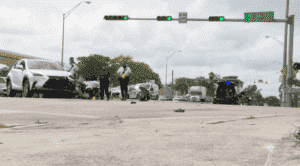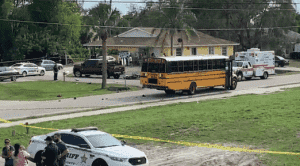
The Law Offices of Anidjar & Levine helps injured people and families evaluate fault, preserve evidence, address insurance coverage, and pursue compensation after a crash involving a teen driver.
These cases may involve distraction, speeding, inexperience, weather hazards, comparative fault, parental responsibility, or uninsured motorist benefits.
Legal support from a Florida Car Accident Lawyer can organize police reports, medical records, witness statements, photos, and electronic evidence while protecting a teen’s rights.
The sections below explain crucial claim issues and practical next steps.
Main Takeaways
- A Florida teen driver accident lawyer helps evaluate liability, insurance coverage, crash facts, and available compensation sources.
- Legal help protects injured people by preserving police reports, medical records, witness statements, photos, video, and electronic evidence.
- Teen crash claims may involve speeding, distraction, impairment, inexperience, unsafe lane changes, failure to yield, or hazardous Florida weather.
- Parents or guardians usually participate in claims involving minors, including insurance communications and settlement decisions.
- Compensation may cover medical expenses, lost educational opportunities, pain, disability, future care needs, and other accident-related losses.
How We Can Help With Your Florida Teen Driver Car Accident Injury Claim
After a crash involving a teen driver, an injury claim may require careful review of liability, insurance coverage, and the specific facts that led to the collision. Legal counsel can assist by gathering police reports, medical records, witness statements, photographs, and available electronic evidence. This support helps preserve important information while the injured person focuses on treatment, family responsibilities, and community obligations.
A lawyer may also evaluate types of damages, including medical expenses, lost income, pain, suffering, and future care needs. Insurance issues often require close attention, especially when policy limits affect the amount available for recovery. Counsel can communicate with insurers, address disputed fault, and present the claim in a structured, evidence-based manner.
When negotiations do not produce a fair result, the attorney can prepare the case for litigation. This process provides organized advocacy, ensures deadlines are met, and helps injured individuals seek accountability through lawful, service-minded representation.
Understanding Florida Teen Driver Car Accident Injury Cases


When a collision involves a teen driver in Florida, the legal and factual issues may extend beyond the immediate cause of the crash. These cases often require careful review of licensing status, insurance coverage, vehicle ownership, injury severity, and the responsibilities of parents or guardians. Because minors may be subject to different practical and legal considerations, a claim must be evaluated with attention to both accountability and protection.
OUR CONSULTATIONSARE FREE
START YOUR FREE CASE REVIEW

Florida’s graduated licensing structure, traffic safety education, and teen driving training programs may also become relevant when evaluating the circumstances surrounding a crash. These factors can help clarify whether appropriate supervision, preparation, and compliance were present before the incident occurred.
For injured individuals and families seeking to serve the well-being of others, understanding these cases supports informed decisions. A thorough legal evaluation can preserve evidence, identify available sources of recovery, and promote responsible outcomes after a serious teen driver accident.
Florida Teen Driver Crash — Statistics and Why They Matter
According to the FLHSMV 2022 Florida Traffic Crash Facts, Florida recorded more than 401,523 crashes in 2022, resulting in 3,535 fatalities and more than 253,888 documented injuries. Distracted driving was a contributing factor in more than 50,000 Florida crashes that year — and teen drivers are disproportionately represented in distraction-related collisions. According to the National Highway Traffic Safety Administration (NHTSA), teen drivers aged 16–19 are nearly three times more likely to be involved in a fatal crash per mile driven compared to drivers 20 and older.


In Florida, where heavy traffic, wet roads, and aggressive driving patterns create year-round hazards, that statistical risk translates directly to serious injuries and contested insurance claims. When a teen driver crash occurs, evidence disappears within hours, adjusters begin building their file immediately, and the filing deadline under Florida HB 837 (2023) is now two years. Experienced legal guidance from the first day after a crash can make the difference between a fully documented claim and one that is weakened by delay.
Florida Teen Driver Crash — GDL Phases, Restrictions & Liability at Each Stage
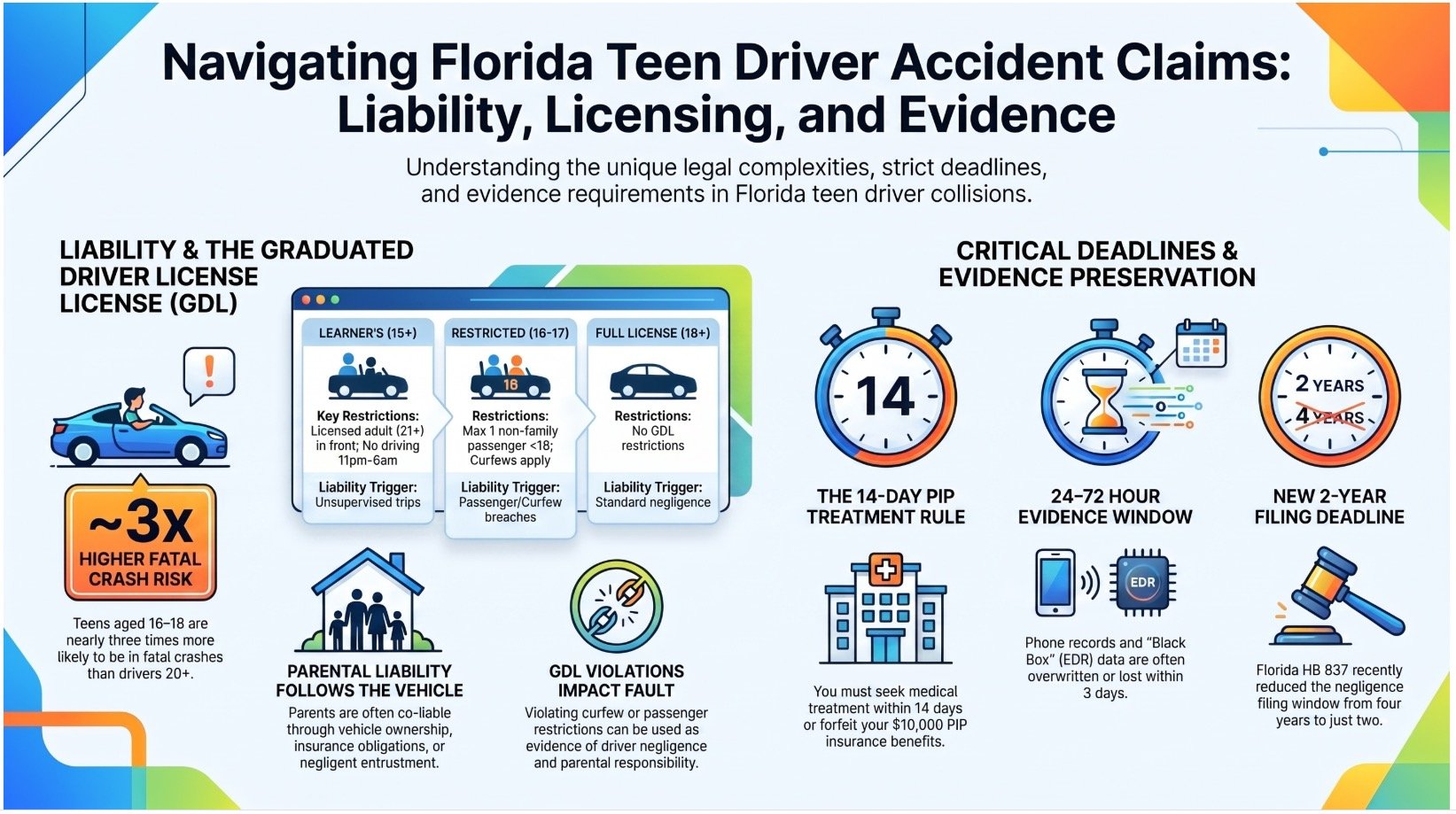
Florida’s Graduated Driver Licensing (GDL) program restricts teen driving in phases. When a crash happens during a GDL phase, those restrictions become evidence — and parental liability follows the vehicle, not just the license.
Florida HB 837 (2023) impact on teen driver crash claims: Before March 24, 2023, Florida’s pure comparative fault system allowed recovery even when the injured person shared some blame for the crash. HB 837 converted this to modified comparative fault — if a court finds the injured person more than 50% at fault, they recover nothing. In teen driver cases, insurers now have a direct financial incentive to argue that a passenger knowingly rode with a reckless or unlicensed teen, assigning the passenger majority fault to eliminate the claim entirely. Preserving evidence of the teen’s GDL violations, cell phone activity, and vehicle data — before adjusters build that narrative — is the most effective protection for injured passengers and families.
Common Causes of Florida Teen Driver Car Accidents
Several factors commonly contribute to Florida teen driver car accidents, including distraction, excessive speed, reckless behavior, impairment, and limited experience in hazardous conditions. Distracted teen driving remains a major concern, while speeding and reckless driving can sharply reduce reaction time and increase crash severity. Impaired driving risks and nighttime driving hazards further heighten the danger, particularly when judgment, visibility, and road awareness are compromised.
Distracted Teen Driving
Although many teen drivers understand the dangers of distraction, inexperience often makes it harder for them to recognize how quickly attention can shift away from the road. In Florida, teen distraction may involve texting, social media use, talking with passengers, adjusting music, eating, or checking navigation. Even brief lapses can reduce reaction time, interfere with lane control, and prevent a young driver from noticing traffic signals, pedestrians, or sudden hazards. Families, educators, and community advocates can serve young drivers by encouraging consistent phone limits, passenger rules, and supervised driving habits.
When a crash occurs, investigators may review phone records, witness accounts, vehicle data, and roadway evidence. In some circumstances, parental liability may become relevant, particularly when vehicle ownership, negligent entrustment, or supervision issues are involved.
Speeding and Reckless Driving
Beyond distraction, excessive speed and reckless driving are frequent factors in serious Florida teen driver accidents, often because young motorists lack the experience needed to judge risk at higher speeds. A teen may underestimate stopping distance, overcorrect during a sudden movement, or follow another vehicle too closely. These choices can endanger passengers, other drivers, cyclists, and pedestrians who depend on appropriate conduct. Florida’s graduated license rules are designed to reduce exposure to high-risk situations while teens build judgment over time.
Proper passenger supervision can also help discourage aggressive behavior, especially when peers create pressure to take risks. Families, schools, and community advocates serve young drivers well by reinforcing lawful speeds, safe spacing, and responsible decision-making before preventable harm occurs on Florida roads.
Impaired Driving Risks
When alcohol, marijuana, prescription medication, or other impairing substances affect a teen driver’s judgment, the risk of a serious Florida crash can rise sharply. Impairment can reduce coordination, slow reaction time, distort distance perception, and weaken decision-making when careful attention is critical. Even small amounts may affect an inexperienced driver, especially when combined with peer pressure or limited awareness of legal consequences. Families, schools, and community advocates can support car crash safety by promoting clear expectations, substance-free transportation plans, and early intervention when warning signs appear.
Consistent supervision of teen drivers helps reinforce accountability before harmful patterns develop. After an impaired-driving collision, injured parties may need careful evaluation of police reports, toxicology evidence, and liability issues to determine who should be held responsible under Florida law.
Nighttime Driving Hazards
After sunset, Florida teen drivers face higher crash risks because darkness reduces visibility, increases glare, and makes it harder to detect pedestrians, cyclists, road debris, and sudden traffic changes. Limited experience can make these hazards more difficult to judge, especially on rural roads, construction zones, and poorly lit intersections. Driver fatigue also becomes more common at night, reducing reaction time, attention, and sound decision-making. A tired teen may drift, miss traffic signals, or fail to maintain proper speed for conditions. Lane departure crashes are a serious concern when darkness, distraction, or drowsiness affects vehicle control. Families, schools, and community advocates can help by encouraging supervised practice, reasonable curfews, and clear safety expectations. These measures protect young drivers while serving the broader public.
Legal Rights of Florida Teen Driver Car Accident Injury Victims
Although teen drivers may face additional scrutiny after a collision, injured teenagers in Florida have the same fundamental right to seek compensation when another party’s negligence causes harm. These rights may involve medical care, lost educational opportunities, pain, disability, and future needs. Teen driving safety and parental supervision often shape prevention efforts, but they do not erase an injured person’s legal protections.
Injured Florida teens deserve fair legal protection when negligence disrupts their health, education, or future.
- A teen may pursue damages when another driver, vehicle owner, or responsible entity contributed to the crash.
- Parents or guardians may act on behalf of a minor during the claims process.
- Compensation may address emergency treatment, rehabilitation, counseling, and long-term medical support.
- Evidence, including police reports, medical records, and witness statements, can protect the teen’s interests.
- Legal guidance can help families serve the injured person with diligence, order, and care.
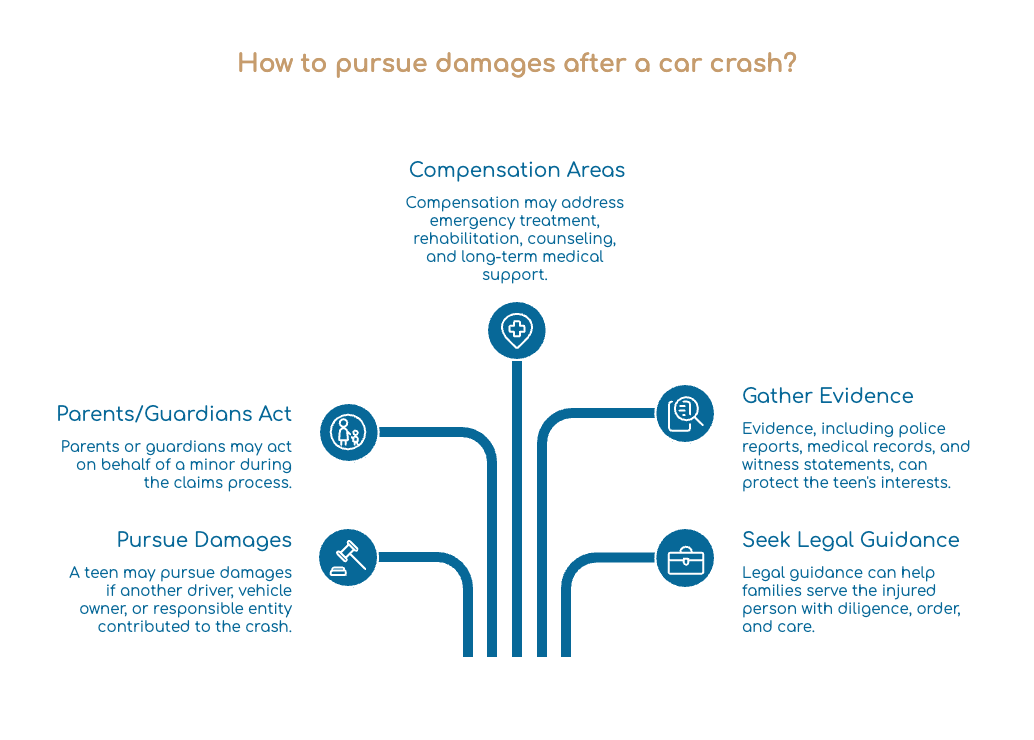
Florida law recognizes that young people merit fair consideration, respectful advocacy, and recovery focused on their future.
Why Do Florida Teen Driver Car Accident Injuries Happen?
Understanding a teen’s legal rights also requires examining the circumstances that commonly lead to serious crashes. Teen driver injuries often occur because young motorists have limited experience recognizing risk, judging speed, and responding to sudden roadway changes. Distraction, including mobile device use or passenger interaction, can reduce attention during key moments. Speeding, unsafe lane changes, and failure to yield also contribute to preventable collisions.
Weather-related hazards are especially important in Florida, where heavy rain, standing water, fog, and reduced visibility can quickly affect safe vehicle control. Inexperienced drivers may overcorrect, brake too sharply, or follow other vehicles too closely during these conditions. Teen vehicle maintenance may also play a role when worn tires, faulty brakes, broken lights, or neglected wipers make hazards more dangerous. These factors can combine with nighttime driving, unfamiliar roads, or peer pressure, creating conditions in which a minor mistake can cause lasting harm to teens and others.
What Should You Do After a Florida Teen Driver Car Accident Injury?
After a Florida teen driver car accident injury, prompt medical attention is essential, even when symptoms appear minor or delayed. Accurate documentation of accident details, including photographs, witness information, and police reports, can help preserve important evidence. Consultation with qualified injury counsel may also help protect legal rights, assess available compensation, and guide the next steps.
Seek Medical Attention
When a teen driver accident occurs in Florida, prompt medical attention is one of the most important steps for protecting an injured person’s recovery and legal interests. Even injuries that seem minor may worsen over time, including concussions, soft tissue damage, or internal trauma. A medical evaluation creates a clear record linking the injury to the collision, which can support any future claim. Caregivers, first responders, and concerned bystanders serve best by encouraging immediate treatment and avoiding assumptions about a person’s condition. Follow all medical advice, attend follow-up appointments, and keep copies of discharge papers, prescriptions, and bills. While others may later document accident details or gather witness statements, the injured person’s recovery should remain the first priority after the crash. Delays may weaken recovery and legal options.
Document Accident Details
Once immediate medical needs are addressed, accurate documentation can help preserve important facts about a Florida teen driver car accident. A responsible adult should record the date, time, location, weather, traffic conditions, and names of all involved drivers, passengers, and witnesses. Photographs should include vehicle positions, roadway markings, traffic signals, visible injuries, debris, and any property damage when it can be done safely and respectfully.
Families caring for an injured teen should also understand the basics of police reporting. Officers may document statements, insurance information, citations, crash diagrams, and preliminary observations. A report number and the responding agency’s name should be obtained so the record can be requested later. Notes should remain factual, avoiding guesses about fault, speed, or intent, and should be stored securely with medical and repair records.
Consult Injury Counsel
Because teen driver crashes often involve layered insurance coverage, parental responsibility questions, and long-term medical concerns, families may benefit from promptly consulting an experienced Florida injury lawyer. Counsel can review police reports, medical records, witness statements, and Florida traffic violations to identify liability and preserve important evidence. A lawyer may also explain insurance claim timelines, including notice requirements, coverage disputes, and deadlines that could affect recovery. This guidance helps families make informed choices while focusing on care, stability, and support for the injured person. When a young driver causes harm, counsel can evaluate available policies, household coverage, and potential negligent entrustment issues. Early legal involvement also enables professional communication with insurers, reducing pressure on families during a difficult period and protecting their rights.
Critical Evidence in a Florida Teen Driver Car Accident Injury Case
Pivotal evidence in a Florida teen driver car accident injury case helps establish fault, confirm the sequence of events, and connect the crash to the resulting injuries.
Essential materials may include:
- Police crash reports
- Witness statements
- Cellphone usage records
- Vehicle damage photos
- Medical records
Preserving these items early can strengthen an injury claim, especially when distraction, speeding, inexperience, or disputed liability may be involved.
Police Crash Reports
After a teen driver crash in Florida, the police crash report is often among the first pieces of evidence reviewed by injury lawyers, insurance adjusters, and investigators. It may identify the drivers, vehicles, roadway conditions, citations, insurance information, and the officer’s initial assessment of contributing factors. For families seeking to protect an injured person well, this report can help organize the early facts with care and discipline. It may also reveal whether adult supervision, vehicle ownership, or permission issues raise concerns about negligent entrustment. When teen insurance coverage is involved, the report can guide early communication with carriers and help confirm policy details. Although not the final word on liability, it provides a structured foundation for further legal review.
Witness Statements
While a police crash report may organize the initial facts, witness statements can provide the independent details needed to understand how a crash involving a Florida teen driver actually occurred. Neutral observers may describe speed, traffic signals, lane position, braking, distractions outside the vehicle, weather, lighting, and the conduct of each driver before impact. These accounts can help confirm or challenge statements from involved parties, especially when young drivers, parents, passengers, or insurers offer conflicting versions of events.
Promptly recorded witness statements preserve memory before details fade. They may support liability findings, strengthen proof of damages, and clarify how the injuries affected the injured person’s daily responsibilities. In insurance negotiations, credible witnesses can encourage fair evaluation by providing objective facts that serve accountability, safety, and just recovery for those harmed.
Cellphone Usage Records
Witness statements may describe a driver looking down or failing to react, but cellphone usage records can help determine whether distraction was present at the time of a Florida teen driver crash. These records may show calls, text activity, app use, or data transmissions close to the collision time. They can also identify GPS distraction, including navigation interaction that diverted attention from traffic conditions. In some cases, social media activity may reveal posting, messaging, or video use while driving. Attorneys may seek these records through proper legal channels, then compare them with crash reports, testimony, and timing evidence. For injured families, this information can clarify responsibility and support a truthful claim. Careful review helps protect injured people while promoting accountability and safer choices among young drivers throughout Florida.
Vehicle Damage Photos
Because vehicle damage often reflects how a collision occurred, photographs of the involved vehicles can become pivotal evidence in a Florida teen driver car accident injury case. Clear images may show impact points, crush patterns, broken lights, deployed airbags, and vehicle positions before towing or repairs alter the scene. These details can help explain speed, direction, braking, and whether a young driver failed to yield, followed too closely, or drifted from a lane. Families serving an injured teen’s best interests should preserve photographs from several angles, including close views and wider roadway context. Prompt collection also supports compliance with Florida claim deadlines. When insurers challenge fault or minimize injuries, organized damage photos may provide practical insurance dispute help and strengthen a careful, evidence-based claim for accountability.
Long-Term Effects of Florida Teen Driver Car Accident Injuries
Florida teen driver car accident injuries can create lasting consequences, including ongoing medical complications that require extended treatment and monitoring. Emotional trauma may also affect a teen’s education, relationships, and daily functioning long after the crash. Future financial losses, such as reduced earning capacity and continuing care costs, must be carefully evaluated in any injury claim.
Ongoing Medical Complications
After a serious crash, a teen driver’s injuries may continue to affect health, mobility, education, and daily functioning long after the initial emergency treatment has ended. Ongoing complications may include chronic pain, limited range of motion, nerve damage, headaches, scarring, orthopedic problems, or symptoms from traumatic brain injuries. According to the Mayo Clinic, traumatic brain injuries can produce symptoms — including cognitive difficulties, mood changes, and fatigue — that persist long after the initial injury, often disrupting school performance, social relationships, and daily function for young patients. These conditions can require repeated evaluations, medication management, therapy, surgeries, assistive devices, and school accommodations.
Teen injury treatment should be monitored carefully because growing bodies may respond differently to fractures, spinal injuries, or joint damage over time. Medical providers, caregivers, and legal advocates often rely on detailed records to understand future needs and support responsible decisions. Future care planning may address anticipated treatment costs, rehabilitation, transportation, and adaptive support, helping protect the teen’s long-term health and independence.
Emotional Trauma Impact
Why can the emotional effects of a teen driver crash persist long after physical wounds appear to mend? A collision can alter a teenager’s sense of safety, trust, and control, especially when injuries, fear, or guilt remain unresolved. Anxiety, sleep disruption, irritability, withdrawal, and fear of riding in vehicles may interfere with school, family life, and healthy development. Caregivers, counselors, and advocates serve the injured teen best by recognizing these symptoms early and encouraging consistent mental health support. Emotional trauma may also affect how the teen recalls events, communicates with professionals, or participates in claim-related tasks, including dealing with police reports and gathering witness identities. A careful legal approach should respect the teen’s emotional condition while preserving important facts for accountability and recovery.
Future Financial Losses
Emotional trauma is only one part of the long-term harm a teen may face, because serious crash injuries can also create financial consequences that extend well into adulthood. A spinal injury, traumatic brain injury, or permanent mobility limitation may reduce future earning capacity before a young person has entered the workforce. Some teens experience education disruption, including missed classes, delayed graduation, or reduced access to vocational training and scholarships. These setbacks can affect career choices, income stability, and independence. If a later workplace injury worsens crash-related limitations, the financial burden may become more intricate. Families seeking to protect an injured teen should consider future medical care, assistive devices, counseling, and lost opportunity costs when evaluating recovery. Careful legal assessment helps protect long-term needs and dignity.
Proving Liability in Florida Teen Driver Car Accident Injury Cases
When a crash involves a teen driver, proving liability requires a careful review of the conduct that caused the collision and the evidence available under Florida law. Investigators may examine police reports, witness statements, vehicle damage, roadway conditions, traffic citations, phone records, and available video footage. These materials help determine whether speeding, distraction, failure to yield, impairment, or inexperience contributed to the harm.
A lawyer may also evaluate parental liability issues, including ownership of the vehicle, consent to drive, and negligent entrustment when a parent allowed an unsafe or unqualified teen to operate the car. Florida’s comparative fault rules may affect recovery if more than one person contributed to the crash. Early preservation of evidence is important, especially when insurance adjusters use tactics to shift blame or minimize a teen driver’s role. A disciplined liability analysis helps injured people, families, and caregivers seek fair accountability after a serious collision.
Dealing With Insurance Companies After a Florida Teen Driver Car Accident Injury
After liability evidence has been identified, the insurance process often becomes the next major challenge in a Florida teen driver accident injury claim. Insurers may contact injured parties, parents, or witnesses quickly, seeking statements before the full impact of the injuries is understood. Careful communication helps protect the claim and supports fair treatment for families focused on recovery, service, and responsibility.
Coverage questions may involve the teen driver’s policy, a parent’s household policy, uninsured motorist benefits, or issues of parental responsibility. Adjusters may also examine facts related to teen passenger safety, including supervision, seat belt use, and the number of young occupants in the vehicle. Medical records, repair estimates, wage information, and consistent documentation should be organized before discussing settlement. A lawyer can manage insurer communications, challenge undervalued offers, and help ensure that injured teens and families are not pressured into decisions that fail to reflect their losses.
Florida No-Fault Insurance and Teen Driver Crash Claims
Florida requires all registered vehicles to carry at least $10,000 in personal injury protection (PIP) coverage. PIP benefits apply regardless of who caused the crash, providing 80% of medical bills and 60% of lost wages — but only when the injured person seeks treatment within 14 days of the accident. Missing that 14-day window forfeits PIP eligibility entirely, eliminating the most reliable first source of medical payment while the larger liability claim plays out.
In teen driver crash cases, PIP issues can become complicated when multiple vehicles and policies are involved. A teen’s household PIP policy typically covers the injured teen as a family member. Injured occupants of other vehicles file under their own PIP policy first, then may pursue a liability claim against the teen driver and, when applicable, the parents. When injuries meet Florida’s serious injury threshold — permanent injury, significant and permanent disfigurement, or death — the injured person may step outside the no-fault system and pursue a direct liability claim against all responsible parties. An attorney can help identify which policies apply and ensure that PIP deadlines and documentation requirements are met from the outset.
Event Data Recorder Evidence in Florida Teen Driver Crash Cases
Most vehicles manufactured after 2012 contain an event data recorder (EDR), commonly called a black box, that captures speed, braking force, throttle position, steering angle, and seat-belt status in the seconds before and during a collision. In teen driver cases, EDR data can directly confirm or contradict claims about speeding, sudden braking, or failure to react — evidence that is particularly significant when distraction or inexperience is disputed by the teen’s insurer. The National Highway Traffic Safety Administration (NHTSA) maintains detailed information about EDR regulations and the types of data these devices record.
EDR data can be silently overwritten the next time the vehicle’s ignition is turned on after the crash. If the vehicle is driveable and moved from the scene, or if a tow operator starts the engine during recovery, the recording may be lost permanently. We send formal preservation demands immediately upon being retained and work with certified EDR specialists to extract recordings before they are overwritten or the vehicle is repaired or sold. Early action on EDR preservation is especially important in teen-driver cases where the at-fault party’s family controls the vehicle and has a financial incentive to allow the data to be overwritten.
What to Expect During a Florida Teen Driver Car Accident Injury Claim Process
A Florida teen driver car accident injury claim typically begins with initial claim filing, followed by a careful review of the crash facts, injuries, and available insurance coverage. Liability investigation steps may include gathering police reports, witness statements, vehicle records, and medical documentation to determine fault and damages. After insurance settlement talks begin, the claim may resolve through negotiation, although unresolved disputes can lead to possible court proceedings.
Initial Claim Filing
Before an injury claim begins in earnest, the initial filing stage establishes the foundation for how the case will be evaluated by insurers and, if necessary, by a court. For a Florida teen driver accident, this step usually includes notifying the appropriate insurance carriers, identifying available coverage, and submitting basic documentation, such as crash reports, medical records, and proof of losses. Careful filing helps protect the injured person’s interests while allowing caregivers, advocates, and legal representatives to serve the family with order and diligence. Early accuracy may reduce the risk of an insurance claim being denied, especially when deadlines, policy terms, and required forms are addressed promptly. During this stage, settlement timeline expectations should remain measured, because insurers need time to review materials before meaningful discussions can begin.
Liability Investigation Steps
Once the claim has been opened and the basic materials have been submitted, the liability investigation begins to determine how the crash occurred and who may be legally responsible. Investigators may review police reports, witness statements, photographs, vehicle damage, roadway conditions, and available video footage. In teen driver cases, they may also examine licensing status, passenger restrictions, phone use, speeding, distraction, or impairment concerns. Comparative negligence factors are considered carefully, because fault may be shared among drivers, vehicle owners, or others whose conduct contributed to the crash. The review may also confirm teen driver insurance coverage, including household policies or permissive-use issues. This stage helps injured people, families, and advocates understand responsibility before later decisions are made regarding the claim’s direction and potential recovery.
Insurance Settlement Talks
During insurance settlement talks, the insurer typically evaluates liability, injury severity, medical treatment, wage loss, vehicle damage, and available coverage before making or responding to a settlement demand. In a Florida teen driver injury claim, adjusters may review liability evidence, including crash reports, witness statements, photographs, and traffic citations. They also examine medical records to confirm diagnoses, treatment duration, future care needs, and the relationship between the collision and claimed injuries. A lawyer may present a demand package that explains damages clearly and supports fair compensation. Negotiations can involve several offers, counteroffers, and requests for clarification. Families seeking to protect an injured teen’s best interests should avoid rushed decisions, document all losses, and rely on careful guidance before accepting any proposed settlement.
Possible Court Proceedings
If settlement negotiations do not resolve a Florida teen driver injury claim, the case may proceed to litigation by filing a civil lawsuit. Court proceedings may include pleadings, discovery, depositions, motions, mediation, and, if necessary, trial. Each stage requires careful attention to deadlines, testimony, medical records, and accident documentation. For families seeking to protect an injured person’s future, evidence preservation can be critical, including vehicle data, photographs, witness statements, and school or work impact records. The defense may examine fault, damages, treatment history, and parental liability issues. Insurance defense strategies often focus on reducing claimed losses or shifting responsibility. A judge or jury may ultimately decide liability and compensation, while structured preparation supports a fair presentation of the injured person’s needs in court.
Compensation for Florida Teen Driver Car Accident Injury Damages
After a crash involving a teen driver in Florida, compensation may be available for the financial and personal losses caused by the accident. An injury claim may seek payment through insurance policies, responsible parties, or available uninsured coverage when the at-fault driver lacks adequate protection. Compensation may address medical care, rehabilitation, lost income, vehicle repair, and related property damage, depending on the facts and supporting evidence.
When teen recklessness contributes to a collision — such as speeding, distraction, or impaired driving — liability must be evaluated carefully. A lawyer may gather police reports, witness statements, medical records, and insurance information to identify all potential sources of recovery. In the most serious cases, families may pursue wrongful death compensation for funeral costs and the lasting harm caused by the loss of a loved one. Results may vary. Prior results do not guarantee a similar outcome.
The purpose of compensation is to help injured people restore stability, hold negligent drivers accountable under Florida law, and support their recovery with dignity.
Economic vs. Non-Economic Damages in Florida Teen Driver Car Accident Cases
In Florida teen driver car accident cases, damages are generally divided into economic losses, such as medical expense recovery and lost future earnings, and non-economic losses, such as pain and suffering. Economic damages address measurable financial harm, while non-economic damages reflect the physical discomfort, emotional distress, and reduced quality of life caused by the crash. This distinction helps establish the full scope of compensation, particularly when a young injury person faces long-term treatment, educational disruption, or diminished earning capacity.
Medical Expense Recovery
Recovering medical expenses is often the first priority in a Florida teen driver car accident claim, because treatment costs can begin immediately and continue long after the crash. These economic damages may include emergency care, hospitalization, surgery, diagnostic testing, medication, rehabilitation, and future medical needs supported by reliable documentation. A careful review of bills, records, and providers’ opinions helps demonstrate that the treatment was necessary and related to the collision. During insurance negotiations, organized evidence can protect an injured teen’s claim from delays, reductions, or unfair disputes. Witness credibility may also support how the crash occurred, helping clarify responsibility for payment. Families seeking to serve the teen’s recovery should preserve every invoice, referral, and care plan, so compensation reflects the full medical burden created by the accident.
Pain and Suffering
Although medical bills provide a measurable part of a claim, pain and suffering addresses the personal harm that cannot be proved through invoices alone. In Florida teen driver accident cases, these non-economic damages may reflect physical discomfort, emotional distress, loss of enjoyment, anxiety, scarring, or disruption to daily life. Their value depends on the severity of injury, recovery length, medical evidence, and credible testimony from caregivers, teachers, or others who observe the teen’s limitations. Comparative fault may reduce recovery if the injured teen or another party shares responsibility for the crash. When insurers undervalue suffering or ignore clear evidence, concerns involving insurance bad faith may arise. Careful documentation helps ensure the claim honors the full human impact while promoting fair, responsible resolution for the injured young person.
Lost Future Earnings
Pain and suffering captures the personal effects of an injury, but a teen driver accident claim may also need to account for long-term financial harm caused by reduced earning ability. Lost future earnings are economic damages, often requiring careful evaluation of the teen’s education, health, career goals, work history, and likely advancement. When injuries limit mobility, cognition, stamina, or independence, the projected loss may affect decades of income and benefits. In severe cases, vocational experts and economists may help measure diminished earning capacity with reliable data. If a crash results in wrongful death, surviving family members may also seek losses tied to expected financial support. These claims remain separate from non-economic damages, such as emotional distress, yet both may reflect the serious consequences of preventable harm.
When a Florida Teen Driver Car Accident Injury Case Goes to Trial vs. Settlement
When a Florida teen driver car accident injury case is evaluated for settlement or trial, the decision often depends on liability, available insurance coverage, injury severity, and the strength of the evidence. A settlement may serve the injured person by providing faster resolution, reduced stress, and funds for care without the uncertainty of a courtroom. However, settlement timelines can vary when medical treatment is ongoing, damages are disputed, or insurers delay fair evaluation.
Trial may become necessary when responsibility is denied, injuries are undervalued, or offers do not reflect long-term harm. Trial strategy often includes expert testimony, medical proof, crash analysis, and careful preparation of witnesses. Jury selection also matters, because jurors must fairly assess teen driving conduct, family impact, and the needs of an injured person. Strong documentation can increase negotiation leverage before trial, encouraging a resolution that protects recovery while preserving accountability when settlement is inadequate.
Florida Laws That May Affect Your Florida Teen Driver Car Accident Case
Given the layered nature of teen driver crashes, Florida law can affect nearly every part of an injury claim, from fault allocation to insurance recovery. A careful review helps families, insurers, and advocates understand duties owed to injured people and the community.
Key legal issues may include:
- Comparative negligence, which can reduce compensation when an injured person shares fault.
- Teen driver laws, including licensing restrictions, curfews, and passenger limits.
- Parental liability questions when a parent signs a minor’s driving application.
- No-fault insurance rules require initial claims through personal injury protection coverage.
- Evidence of distracted, impaired, or reckless driving that may support broader accountability.
These laws shape how responsibility is measured and how losses are documented. They also encourage safer conduct by reinforcing that young drivers, parents, and vehicle owners hold meaningful obligations. Legal guidance can help protect injured people while promoting careful, service-minded decision-making after a serious crash.
The Statute of Limitations for Florida Teen Driver Car Accident Injury Cases
Although liability and insurance issues often receive immediate attention after a crash involving a teen driver, the statute of limitations can determine whether an injured person may file a lawsuit at all. In Florida, personal injury claims arising from motor vehicle collisions generally must be filed within 2 years of the crash, under the tort reform provisions of Florida HB 837, effective March 24, 2023. Missing this deadline can bar recovery, even when injuries are severe and responsibility appears clear.
For families seeking to protect an injured teen or another person, prompt attention to filing deadlines supports responsible care and preserves legal options. Comparative negligence may also affect the case, because Florida law can reduce recovery based on each party’s share of fault. However, fault analysis does not extend the statutory deadline.
Insurance timelines are separate from court filing deadlines. Notice requirements, medical documentation, and claim communications may move quickly, but they do not replace the need to file suit within the required limitations period under Florida law.
How a Florida Teen Driver Car Accident Injury Lawyer Can Help You
How can legal guidance change the course of a teen driver accident claim in Florida? A Florida teen driver car accident injury lawyer can help families pursue accountability while protecting a young person’s future. Legal support may clarify duties, preserve evidence, and address insurers with careful preparation.
- Reviews police reports, medical records, and witness accounts to establish a clear factual foundation.
- Explains insurance coverage options, including PIP, liability coverage, and uninsured motorist benefits.
- Evaluates damages related to treatment, rehabilitation, schooling disruption, and family caregiving burdens.
- Manages communication with insurance adjusters, reducing pressure on injured teens and responsible caregivers.
- Assists with negotiating claim timelines to help avoid delays that may weaken recovery efforts.
Through disciplined advocacy, the lawyer serves injured families by organizing complex information into a purposeful claim. This guidance can support fair compensation, encourage responsible conduct, and help communities respond to preventable harm with order, dignity, and informed care.
When to Contact a Florida Teen Driver Car Accident Injury Lawyer
After a teen driver accident in Florida, legal guidance should be considered as soon as injuries, disputed fault, insurance questions, or significant vehicle damage become apparent. Prompt contact helps protect the injured person’s ability to document facts, preserve evidence, and understand time-sensitive obligations without placing added strain on families already focused on care.
A lawyer may be contacted when medical treatment is ongoing, when a teen’s actions are in question, or when another party makes conflicting statements. Early review can also support the accuracy of the police report, especially if it omits witnesses, road conditions, or other relevant details. If an insurer delays payment, reduces available benefits, or refuses coverage, counsel can help prepare insurance denial appeals by organizing records and providing clear supporting information. Families, caregivers, and community members who want to act responsibly after a crash should seek guidance before signing releases, accepting settlements, or making recorded statements that may affect recovery.
Why You Need an Experienced Florida Teen Driver Car Accident Injury Lawyer
Teen driver crashes in Florida often involve more than a basic insurance claim, because inexperience, parental responsibility, vehicle ownership, school or work obligations, and injury severity may all affect liability and recovery. An experienced Florida teen-driver car-accident injury lawyer can identify all responsible parties, preserve evidence, and address issues that families may overlook while caring for an injured person.
Such representation supports injured people by managing communications with insurers, medical providers, and other parties. Counsel can monitor the insurance claim timeline, prevent missed deadlines, and evaluate whether settlement offers reflect medical costs, lost income, future care, and pain-related losses. Accurate property damage valuation also matters because vehicle loss may affect transportation to school, work, treatment, and family duties.
Experience is especially important when fault is disputed or coverage is limited. A lawyer can build a documented claim, reduce avoidable mistakes, and help pursue recovery with dignity and purpose.
How to Choose the Right Florida Teen Driver Car Accident Injury Lawyer for Your Case
Selecting the right Florida teen driver car accident injury lawyer requires serious attention to experience, case strategy, communication practices, and familiarity with the legal issues that often arise when a young driver is involved. Families may begin by examining whether the lawyer has handled injury claims involving teen motorists, parental liability concerns, insurance disputes, and serious medical consequences. A thorough evaluation helps ensure the injured person receives steady guidance, while caregivers remain informed and supported.
Prospective clients should ask how evidence will be gathered, how witnesses will be approached, and how negotiations with insurers may proceed. They should also assess attorney fees, including contingency arrangements and case-related costs, before signing an agreement. It is equally important to consider case timelines, recognizing that investigation, treatment, settlement talks, or litigation may affect progress. A suitable lawyer communicates clearly, respects the client’s needs, and pursues accountability with diligence, professionalism, and a service-minded commitment to justice.
About The Law Offices of Anidjar & Levine
Founded in 2005 by Marc Anidjar and Glen Levine, the firm began as a two-person operation working out of a construction office conference room. Over the past 20 years, that modest start has grown into one of Florida’s most recognized personal injury practices — with more than $1 billion recovered in settlements for injury clients across the state. We bring that same determination and depth of experience to every case we handle.
When families need guidance after a crash involving a young driver, The Law Offices of Anidjar & Levine provides legal support focused on injury claims, insurance challenges, and the practical concerns that follow a serious accident. The firm assists injured teens, parents, and affected motorists by reviewing liability, documenting damages, and addressing medical care, lost income, and long-term recovery needs.
Its legal team evaluates insurance coverage options, including parental policies, teen-driver exclusions, uninsured-motorist protection, and available bodily-injury limits. This careful review helps clients understand potential sources of compensation and their responsibilities during the claims process.
The firm also employs settlement negotiation tactics to present evidence clearly, address insurer disputes, and pursue fair compensation without unnecessary delay. When litigation becomes necessary, its attorneys prepare each case with attention to facts, deadlines, and client communication. Their work reflects a service-centered approach, offering steady direction during difficult circumstances.
Frequently Asked Questions
Can Parents Be Held Responsible for Their Teen’s Crash?
Yes, parents can be held responsible for their teen’s crash when the facts support legal accountability. Negligent supervision may apply if a parent allowed unsafe driving despite known risks. Joint liability can arise through vehicle ownership, insurance obligations, or consent to drive. Parental negligence may also be examined when families, schools, or community members seek accountability, protection, and fair support for those injured through preventable conduct.
Does Florida Require Teen Drivers to Complete Graduated Licensing?
Yes. Florida requires teen drivers to follow graduated licensing rules before receiving full privileges. The process includes a learner’s permit timeline, supervised driving requirements, and staged restrictions designed to reduce risks in teen driving. Eligibility limits apply by age, driving hours, and compliance with traffic laws. This structure helps families, schools, and community members promote safer road habits while supporting young drivers through measured responsibility and public safety.
Can a Teen’s Phone Records Be Used in Court?
Yes, a teen’s phone records may be used in court if privacy laws and evidentiary rules are satisfied. Judges consider court admissibility, relevance, lawful access, and whether the records reliably show calls, texts, app activity, or location data. Data retention policies may limit what providers can produce. Authenticity challenges can arise, so careful verification is critical when serving injured persons, families, or the public interest through responsible legal action.
What if the Injured Person Was Riding With the Teen Driver?
An injured passenger may pursue a claim against the teen driver, another at-fault driver, or applicable insurance policies. Liability coverage can help pay medical bills, lost income, and related damages, depending on fault and policy limits. Careful review of the crash facts, permissions, and household coverage is important. Those assisting the injured person should preserve records, report injuries promptly, and seek guidance to protect the passenger’s legal rights.
Are Teen Driver Accident Claims Different From Adult Driver Claims?
Yes, teen driver accident claims can differ from adult claims because youth, licensing restrictions, parental responsibility, and insurance issues may affect evaluation. Teen liability is assessed through the same negligence principles, but facts such as curfew violations, passenger limits, or inexperience may matter. Comparative negligence may reduce recovery if another party contributed. Careful investigation helps protect injured people, support accountability, and guide families toward informed, service-focused legal decisions after harm.
Does Florida PIP Insurance Cover Injuries in a Teen Driver Crash?
Yes. Florida’s personal injury protection (PIP) coverage applies regardless of fault, including crashes caused by teen drivers. PIP covers 80% of reasonable medical expenses and 60% of lost wages, up to the $10,000 minimum. Treatment must begin within 14 days of the accident. When injuries are serious — permanent injury, significant and permanent disfigurement, or death — a separate liability claim against the teen driver and potentially the parents may also be available. An attorney can help identify which policies apply and ensure PIP deadlines are met.
Can a Teen Driver’s Vehicle Black Box (EDR) Be Used as Evidence?
Yes. Most vehicles manufactured after 2012 contain an event data recorder (EDR) that captures pre-crash speed, braking, throttle, steering, and seat-belt status. In teen driver cases, this data can confirm or disprove claims about speeding, distraction, or failure to react. EDR data can be overwritten the next time the ignition is turned on after a crash, so formal preservation demands must be sent immediately. Attorneys work with certified EDR specialists to extract the recording before it is lost.
Teen driver crashes in Florida can leave injured people facing serious injuries, financial losses, and complex insurance issues.
A knowledgeable Florida Car Accident Lawyer can evaluate liability, protect legal rights, and pursue compensation through a focused, evidence-based claim. The Law Offices of Anidjar & Levine provides experienced representation for injured clients seeking accountability after a collision involving a teen driver.
Prompt legal guidance can help preserve evidence, meet deadlines, and position a claim for the strongest possible outcome. Results may vary. Prior results do not guarantee a similar outcome.