The Law Offices of Anidjar and Levine helps injured victims pursue compensation after a hit-and-run car accident in Florida when a driver flees the scene. Legal support may include identifying uninsured motorist coverage, preserving surveillance footage, gathering witness statements, correcting incomplete records, and managing insurer communications.
Prompt action can protect medical documentation, evidence of vehicle damage, and claim deadlines. These cases often involve uncertainty, missing drivers, and intricate insurance matters.
The sections below explain vital rights, evidence steps, and legal options available with a Florida Car Accident Lawyer.
Main Takeaways
- A Florida hit-and-run injury lawyer can help identify insurance coverage and potential compensation sources.
- Victims should seek medical treatment, report the crash, and document evidence as soon as safely possible.
- Uninsured motorist coverage may help when the fleeing driver is unknown or lacks insurance.
- Preserving witness information, surveillance footage, vehicle damage, and medical records can strengthen a claim.
- A lawyer can handle insurer communications and protect victims from damaging statements or unfair claim handling.


How We Can Help With Your Florida Hit-and-Run Car Accident Injury Claim
Pursue a Florida hit-and-run car accident injury claim with guidance from a lawyer who can identify available sources of compensation, preserve crucial evidence, and manage communications with insurers. Legal support may begin with a focused review of medical needs, lost income, Property Damage, and insurance coverage, including uninsured motorist benefits when applicable.
A lawyer can coordinate Evidence Preservation by seeking police reports, locating witnesses, requesting surveillance footage, reviewing vehicle debris, and documenting injuries before details fade. This careful approach supports the injured person’s ability to seek fair recovery while reducing burdens on family members, caregivers, and community supporters.
Counsel may also handle insurer requests, protect the claimant from damaging statements, calculate current and future losses, and prepare negotiations with disciplined documentation. When settlement discussions do not resolve the matter, legal representation can advance the claim through formal proceedings, allowing the injured person to focus on restoration and responsibilities to others.
OUR CONSULTATIONSARE FREE
START YOUR FREE CASE REVIEW

Understanding Florida Hit And Run Car Accident Injury Cases
When a driver leaves the scene after causing a crash, the injured person may face both immediate medical concerns and uncertainty about how to pursue compensation. Florida hit-and-run injury cases require careful attention to reporting duties, insurance coverage, and proof of loss. Because the at-fault driver may not be identified, the injured person’s own uninsured motorist coverage may become a pivotal source of recovery.
These cases often depend on prompt action. Evidence preservation timelines can affect access to surveillance footage, vehicle debris, witness information, and accident reports. Timely collection helps protect the claim and supports a clear account of what occurred. Independent medical documentation is also important, as it connects injuries to the crash and helps establish the extent of treatment needs.
A structured legal approach can help injured individuals and their families pursue available benefits while maintaining dignity, accuracy, and accountability throughout the claims process.
Common Causes of Florida Hit-and-Run Car Accidents
Hit-and-run crashes in Florida often arise from negligent conduct, including distracted driving, impaired driving, and other unsafe choices behind the wheel. In some cases, drivers leave the scene because they lack insurance, fear arrest, or believe fleeing will help them avoid responsibility. Understanding these common causes can clarify how liability may be evaluated after a serious accident.
Distracted Driving
Distracted driving frequently contributes to Florida hit-and-run car accidents because it reduces a driver’s ability to recognize hazards, maintain lane position, control speed, and react in time to avoid a collision. Common distractions include texting, adjusting navigation, eating, reaching for objects, or focusing on passengers instead of the roadway. When a crash occurs, a distracted driver may panic, leave the scene, and avoid responsibility for the harm caused.
Texting negligence is especially serious because phone records, witness statements, and vehicle data may help establish inattentiveness. A thorough police investigation can identify the fleeing driver, document roadway evidence, and connect distracted conduct to the impact. Careful review of these facts supports accountability, helps injured people seek lawful recovery, and promotes safer conduct throughout Florida communities.
Impaired Driving
Impaired driving often plays a central role in Florida hit-and-run car accidents because alcohol, illegal drugs, and certain prescription medications can weaken judgment, slow reaction time, and reduce physical control of a vehicle. When a driver is impaired, panic may follow a collision, leading that person to leave injured motorists, passengers, pedestrians, or cyclists without assistance.
This conduct can exacerbate harm by delaying medical care and obstructing responsible community protection efforts. Evidence of impairment may appear through witness observations, traffic camera footage, damaged vehicles, or law enforcement reports. During an Insurance Investigation, inconsistent accounts or False Statements about drinking, drug use, or location can affect claim evaluation. Careful review helps identify accountability while supporting victims who need fair guidance, stability, and access to recovery.
Uninsured Drivers
Uninsured drivers contribute to Florida hit-and-run car accidents because they may fear financial liability, license consequences, or legal exposure after a collision. When a driver lacks required coverage, even a minor crash can create serious concerns about medical bills, vehicle damage, and personal responsibility. This pressure may lead some motorists to leave injured people without aid, placing greater burdens on victims, families, first responders, and community support systems.
An Uninsured motorist claim may become an important source of recovery when the at-fault driver cannot be identified or lacks coverage. Careful documentation, prompt medical evaluation, and experienced guidance can strengthen settlement strategies. In these cases, legal advocacy helps protect injured parties while supporting fair compensation through available insurance benefits and responsible claims handling.
Fear Of Arrest
Why does fear of arrest lead some drivers to flee after a Florida car accident? A driver may panic after realizing that an active warrant, a suspended license, an allegation of impaired driving, or a prior criminal history could bring immediate law enforcement attention. In that moment, avoiding custody may seem more urgent than helping injured people or reporting the crash.
This decision can deepen harm, delay medical care, and complicate Vehicle Identification for investigators seeking the responsible party. Witnesses who remain calm and serve others by calling 911, assisting victims when safe, and noting license plates may support accountability. However, concerns about Bystander Liability can make some witnesses hesitate, so clear legal guidance matters. Fear never excuses leaving the scene, especially when injured persons need protection, documentation, and timely emergency response.


Legal Rights of Florida Hit And Run Car Accident Injury Victims
After a hit-and-run crash in Florida, an injured victim may have several legal rights, even when the at-fault driver has not been identified.
These rights can support medical care, lost income claims, and accountability through available insurance, public records, and timely legal action.
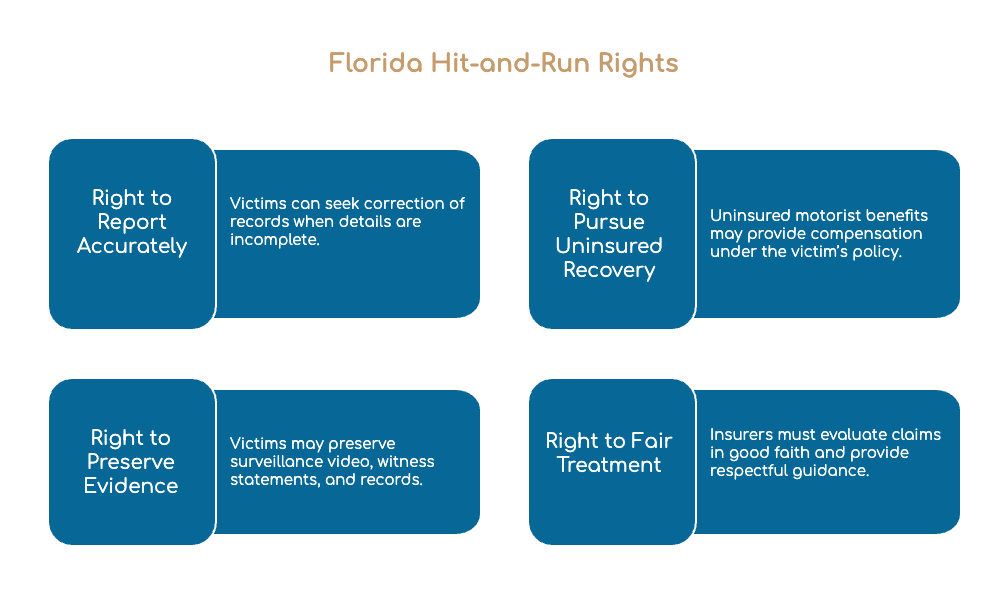
- Right to report accurately: Faulty reporting can weaken a claim, so victims may seek correction of police, insurance, or medical records when details are incomplete.
- Right to pursue uninsured recovery: If the fleeing driver is unknown or lacks coverage, uninsured motorist benefits may provide compensation under the victim’s policy.
- Right to preserve evidence: Victims may preserve surveillance video, witness statements, vehicle damage records, and medical documentation before critical evidence disappears.
- Right to fair treatment: Insurers must evaluate claims in good faith, and injured people deserve respectful guidance that helps restore stability, protect families, and serve community safety.
Why Do Florida Hit-and-Run Car Accident Injuries Happen?
Although every collision has its own facts, Florida hit-and-run car accident injuries often occur because a driver makes a reckless decision before, during, or immediately after a crash. Common causes include impaired driving, speeding, distraction, lack of insurance, outstanding warrants, or fear of legal consequences. Some drivers flee because they are operating a stolen vehicle, driving without a valid license, or attempting to avoid responsibility for injuring another person.
These incidents may also occur at crowded intersections, in parking lots, in work zones, and on late-night roadways, where confusion can delay identification. A Hidden camera may capture the fleeing vehicle, while witness statements can clarify direction of travel, vehicle description, and driver behavior.
Accident reconstruction may help explain impact angles, speed, and injury mechanisms. Because evidence can disappear quickly, proof preservation is central to understanding why the crash occurred and how the fleeing driver’s conduct harmed others.
What Should You Do After a Florida Hit-and-Run Car Accident Injury?
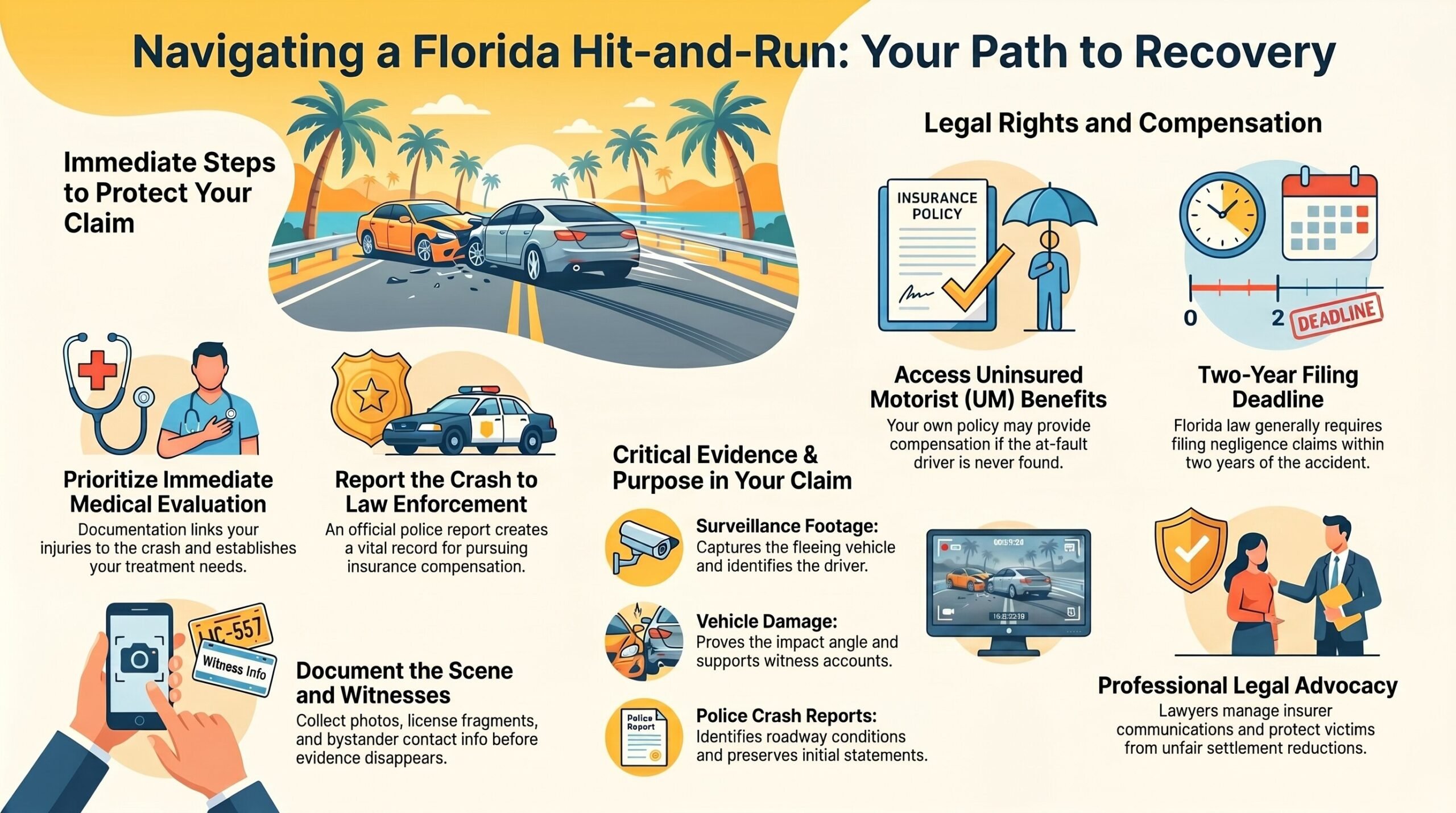
After a Florida hit-and-run car accident injury, the injured person should take immediate steps to protect their health, safety, and potential legal claim. Prompt medical treatment, a timely crash report, and careful evidence documentation can substantially affect the outcome of the case. These actions help establish the facts of the collision, preserve available proof, and support any later claim for recovery.
Prioritize Medical Treatment
When injuries are suspected in a Florida hit-and-run car accident, medical treatment should be the immediate priority, even if symptoms appear minor at first. Prompt evaluation protects the injured person’s health, identifies hidden trauma, and creates medical records that may later support a claim. Caregivers, family members, or bystanders should assist with transportation or request emergency help when pain, dizziness, confusion, bleeding, or breathing problems are present.
While treatment comes first, Emergency evidence gathering may occur only if it does not delay care. This may include preserving photos, clothing, or vehicle damage. Documenting witness statements can also help, but injured persons should not be burdened with investigative tasks. Compassionate support means ensuring safety, stabilizing the situation, and helping the person receive timely medical attention.
Report The Crash
At the earliest safe opportunity, a Florida hit-and-run crash should be reported to law enforcement so an official record can be created. A prompt report helps officers respond, search for the fleeing driver, and connect the collision to later injury claims. The injured person, or someone assisting them, should provide accurate location details, vehicle descriptions, direction of travel, and any known identifying information.
If emergency care is needed, Medical documentation should align with the reported time and nature of the crash. Officers may also gather witness statements, which can support accountability and protect others on the road. Reporting is an act of responsible service, helping public safety officials identify dangerous drivers while preserving critical information for insurance and legal review after the incident.
Document Critical Evidence
Once the crash has been reported, the injured person should preserve and document evidence before it is lost, altered, or forgotten. Photographs should capture vehicle damage, debris, skid marks, traffic signals, injuries, and the surrounding roadway. Notes should include the time, weather, direction of travel, and any details about the fleeing vehicle, including color, make, model, license plate fragments, and other Vehicle identification details.
If bystanders stopped to help, their names and contact information should be collected with care. Driver witness statements may help confirm how the collision occurred and identify the responsible motorist. Nearby businesses, homes, or traffic cameras may have recorded the crash. Prompt documentation supports law enforcement, insurance claims, and any legal efforts to effectively serve the injured person’s recovery needs.
Critical Evidence in a Florida Hit-and-Run Car Accident Injury Case
Important evidence can determine whether an injured person can identify the fleeing driver, prove fault, and support a claim for compensation after a Florida hit-and-run crash.
The most important materials often include:
- Police crash reports
- Witness contact information
- Surveillance camera footage
- Vehicle damage evidence
These records and observations should be preserved quickly, because delays can weaken the factual foundation of the case.
Police Crash Reports
In a Florida hit-and-run injury case, the police crash report is often among the earliest and most important records of what occurred. It may identify the location, time, roadway conditions, vehicle descriptions, responding officers, citations, and the injured person’s initial account. This report can assist attorneys, insurers, and medical providers in understanding the event with greater accuracy and care.
Although the report may not prove every disputed fact, it can guide investigation, support Florida insurance coverage claims, and preserve details that might otherwise fade. It may also influence liability determination options, especially when the fleeing driver is later found. Careful review helps identify errors, missing information, or follow-up needs, allowing advocates to serve the injured person with diligence, fairness, and informed judgment throughout the case.
Witness Contact Information
Witness contact information can be decisive when a Florida hit-and-run investigation relies on details not captured in a police crash report, surveillance footage, or vehicle damage analysis. A bystander may remember the fleeing vehicle’s color, direction of travel, partial plate number, or driver behavior immediately before impact. Promptly recording names, phone numbers, email addresses, and locations helps preserve access to those observations before memories fade or witnesses become difficult to locate.
Eyewitness identification may support liability, especially when physical evidence is limited or disputed. Reliable contact details also assist with police statement collection, insurance review, and later attorney investigation. For injured victims, careful witness documentation serves the broader purpose of accountability, helping the legal process protect the harmed party and promote safer conduct on Florida roads.
Surveillance Camera Footage
Surveillance camera footage can provide powerful evidence in a Florida hit-and-run car accident injury case because it may capture the collision, the fleeing vehicle, or the events immediately before and after impact. Nearby businesses, residences, traffic cameras, parking lots, and public facilities may hold recordings that help identify the driver, confirm timing, or support witness accounts. Because many systems overwrite video quickly, prompt action is essential.
Secure evidence preservation efforts may include written requests to property owners, coordination with law enforcement, and careful documentation of camera locations. Dashcam footage from other motorists, rideshare vehicles, delivery drivers, or commercial fleets may also assist the investigation. For injured individuals and those helping them seek accountability, timely collection can protect essential proof and strengthen a claim.
Vehicle Damage Evidence
Vehicle damage evidence can help connect an unidentified vehicle to a Florida hit-and-run crash, especially when physical markings, debris, paint transfer, or impact patterns are carefully documented. Investigators may compare dents, broken lenses, bumper fragments, and scrape locations with the damage on the victim’s vehicle to determine direction, force, and point of contact.
This evidence can also support witness accounts and surveillance footage, creating a clearer timeline for those assisting an injured person. When the fleeing driver remains unknown, damage documentation may strengthen Uninsured Motorist Claims by showing that another vehicle caused the collision. A careful Medical Records Review can further align injury patterns with the crash mechanics. Preserving photographs, repair estimates, and damaged parts helps ensure that crucial proof remains available for fair case evaluation.
Long-Term Effects of Florida Hit-and-Run Car Accident Injuries
Long-term injuries from a Florida hit-and-run accident may extend beyond the initial recovery period, creating lasting physical and financial consequences. Victims may face chronic pain conditions, emotional trauma, and ongoing medical expenses that affect daily life, employment, and future stability. These effects often become central considerations when evaluating the full value of an injury claim.
Chronic Pain Conditions
Chronic pain after a Florida hit-and-run car accident can persist for months or years, even when initial injuries appear moderate or resolve on standard imaging. Ongoing neck, back, joint, or nerve pain may limit mobility, reduce work capacity, and interfere with caregiving or community responsibilities. These conditions often require consistent pain management, including medical evaluation, therapy, medication, injections, or expert care.
Accurate injury documentation is vital, as treatment records, symptom logs, diagnostic findings, and physician opinions help show the connection between the crash and lasting limitations. For injured individuals seeking to restore stability and continue serving others, early medical follow-up is important. A careful legal review may also identify available insurance benefits and damages for future care, reduced earning capacity, and daily functional loss.
Emotional Trauma
Physical pain is not the only lasting consequence of a Florida hit-and-run car accident, as emotional trauma may continue long after visible injuries begin to improve. Survivors may experience anxiety, fear of driving, sleep disruption, intrusive memories, or heightened distress when passing the crash location. The driver’s flight can intensify feelings of vulnerability, abandonment, and injustice, especially when the injured person is left without immediate accountability.
Effective aftermath support may include family guidance, community assistance, and professional trauma counseling to help the injured person regain stability. Those serving survivors should recognize that emotional harm can affect work, relationships, caregiving, and daily confidence. Careful documentation of psychological symptoms, treatment needs, and functional limitations may help show the broader impact of the incident within a legal claim.
Ongoing Medical Expenses
Ongoing medical expenses can become a significant burden after a Florida hit-and-run car accident, particularly when injuries require extended treatment, follow-up evaluations, or future procedures. Victims may face costs for rehabilitation, prescription medication, diagnostic testing, mobility equipment, and expert care. For those assisting injured individuals, careful documentation of medical bills helps preserve an accurate record of treatment needs and financial losses.
These records may also support claims involving uninsured motorist benefits, personal injury protection, or other insurance coverage options available under Florida law. When expenses continue beyond initial emergency care, projected future costs should be reviewed with medical providers and legal counsel. A thorough evaluation can help identify responsible payment sources, reduce uncertainty, and protect the injured person’s access to necessary care during recovery and beyond.
Proving Liability in Florida Hit-and-Run Car Accident Injury Cases
When the at-fault driver leaves the scene, proving liability in a Florida hit-and-run injury case requires a careful investigation focused on identifying the driver, establishing how the crash occurred, and linking the victim’s injuries to the collision. Police reports, traffic camera footage, debris patterns, vehicle damage, witness statements, and nearby surveillance video may help reconstruct events accurately and fairly.
Counsel serving an injured person may also review medical records, emergency response notes, and crash-scene photographs to connect physical harm to the impact. Evidence preservation tips include securing the damaged property, saving dashcam footage, documenting visible injuries, and requesting nearby video footage before it is erased.
Insurance claim timelines also matter because delays can weaken available proof, even before compensation issues are addressed. A disciplined liability investigation can protect the victim’s rights, support public accountability, and help ensure that those harmed receive responsible legal guidance after a serious roadway violation.
Dealing With Insurance Companies After a Florida Hit-and-Run Car Accident Injury
Notify the appropriate insurer promptly after a Florida hit-and-run injury, because insurance coverage may depend on timely reporting, accurate documentation, and strict compliance with policy terms. The injured person should provide basic facts, including the date, location, police report number, and available witness information, while avoiding speculation about fault or injury severity.
Insurance adjusters may request recorded statements, authorizations, or broad access to records. Careful review is important, especially when the goal is fair treatment and responsible stewardship of available benefits. Medical Records should be organized, complete, and consistent with the injuries reported, since gaps may be questioned. Preserving Evidence also remains critical, including photographs, repair estimates, surveillance leads, and communications with law enforcement.
A lawyer can help ensure that communications remain accurate, deadlines are monitored, and the insurer receives necessary information without exposing the injured person to unnecessary disputes or unfair reductions. Such guidance supports accountable recovery.
What to Expect During a Florida Hit-and-Run Car Accident Injury Claim Process
A Florida hit-and-run car accident injury claim typically begins with prompt crash reporting, followed by a careful review of all available insurance coverage. The injured party must then establish injury-related damages through medical records, financial documentation, and other supporting evidence. Once liability issues and coverage sources are assessed, the claim may proceed to negotiation with the insurer to seek fair compensation.
Reporting The Crash
After a hit-and-run crash in Florida, reporting the collision promptly is a critical first step in protecting an injury claim. Law enforcement should be contacted immediately, and emergency medical help should be requested for anyone harmed. Clear 911 Reporting Tips include giving the exact location, describing the fleeing vehicle, noting its direction of travel, and identifying visible injuries or hazards.
Officers may prepare a crash report, interview witnesses, and document the scene. Those assisting the injured person should remain calm, avoid speculation, and preserve details that may help identify the driver. Florida Evidence Collection may include photographs, vehicle debris, surveillance locations, witness names, and the time of impact. Prompt reporting supports accountability, helps establish a reliable record, and serves the broader goal of protecting injured persons.
Identifying Available Coverage
Often, the next stage in a Florida hit-and-run injury claim involves identifying every source of insurance coverage that may apply when the at-fault driver is unknown or uninsured. This review may include the injured person’s personal injury protection benefits, uninsured motorist coverage, household policies, and any coverage connected to the vehicle involved. A careful assessment of policy limits helps determine how much protection may be available for responsible claim handling.
The investigation scope may also extend to employer policies, rideshare coverage, or other parties with legal responsibility. Attorneys and claim professionals often coordinate the preservation of evidence, including crash reports, photographs, witness statements, and insurance records, to ensure coverage questions are addressed accurately. This process supports orderly decision-making and helps preserve resources for those in need of assistance.
Proving Injury Damages
Once potential coverage has been identified, the claim typically turns to proving the nature and extent of the injured person’s damages. This phase requires careful collection of medical documentation, including emergency records, diagnostic imaging, physician reports, therapy notes, and billing statements. Treatment compliance is also important because missed appointments or gaps in care may be used to question the seriousness of the injuries.
Supporting evidence may include surveillance footage, photographs, crash reports, and records showing lost income or reduced ability to serve a family, employer, or community. Witness credibility can affect how decision-makers view the accident and its consequences, especially when the fleeing driver is unknown. A well-supported damages presentation connects the collision to physical harm, financial loss, and ongoing limitations in daily life and service.
Negotiating Your Claim
When the evidence of injury and available coverage have been organized, negotiation usually begins with a demand package submitted to the appropriate insurer. This package may include medical records, wage documentation, crash reports, photographs, witness information, and a clear explanation of losses. A thoughtful Settlement strategy accounts for policy limits, uninsured motorist coverage, comparative fault issues, and the injured person’s long-term needs.
Insurers may respond with questions, requests for clarification, or a lower offer. Counsel evaluates each response, protects the claimant from premature compromise, and maintains evidence preservation for disputed facts. The process often requires patience, disciplined communication, and careful review of medical progress. The goal is a fair resolution that supports recovery, accountability, and responsible stewardship of available compensation for the client.
Compensation for Florida Hit And Run Car Accident Injury Damages
After a hit-and-run crash in Florida, an injured person may pursue compensation for both economic and non-economic damages, depending on the available insurance coverage and the facts of the collision. Because the at-fault driver may remain unidentified, recovery often begins with the injured person’s own insurance. No-Fault Benefits and Eligibility Rules can affect payment for initial medical treatment and lost income, making timely notice and proper documentation important.
Additional compensation may depend on uninsured motorist coverage, liability findings, and the policy language that applies to the vehicle or household. Policy limits and coverage gaps may restrict recovery, even when injuries are serious and care is ongoing.
A lawyer can review each source of coverage, coordinate claims, and protect deadlines while the injured person focuses on recuperation. This process supports fair treatment, careful stewardship of resources, and accountability where the law allows it, especially when victims need guidance after sudden harm and uncertainty.
Economic vs Non-Economic Damages in Florida Hit And Run Car Accident Cases
In Florida hit-and-run car accident cases, damages are generally categorized as economic or non-economic losses. Economic damages may include medical expenses, lost income, and repair costs, while non-economic damages address pain, suffering, emotional distress, and loss of enjoyment of life. Proving these losses requires clear documentation, credible evidence, and a careful assessment of how the accident affected the injured person’s financial stability and daily life.
Economic Damages Explained
During a Florida hit-and-run car accident claim, economic damages refer to the measurable financial losses caused by the crash. These losses may include emergency care, hospital bills, follow-up visits, rehabilitation, medication, lost wages, and reduced earning capacity when injuries limit work. Medical treatment proof, such as invoices, records, prescriptions, and provider statements, helps connect each expense to the collision and supports accurate valuation.
Vehicle-related losses may also be recoverable, including towing, rental transportation, and repairs supported by car repair estimates. In cases involving public servants, caregivers, or others committed to serving their communities, documenting these costs helps protect stability while recovery continues. A lawyer may organize financial records, identify future expenses, and present evidence to insurers or courts seeking fair reimbursement under Florida law.
Non-Economic Damages Explained
Beyond the financial losses that can be demonstrated through bills, wage records, and repair estimates, Florida hit-and-run car accident claims may also involve non-economic damages. These losses reflect the human impact of injury, including physical pain, emotional distress, loss of enjoyment of life, inconvenience, and harm to personal relationships. In service-centered legal advocacy, recognizing these harms helps ensure that the injured person is treated with dignity, not reduced to mere receipts.
Non-economic damages may be especially important when trauma disrupts daily responsibilities, caregiving roles, faith activities, or community service. Because hit-and-run cases can involve insurance coverage gaps, careful pain settlement strategies may be needed to pursue fair compensation through available policies. Such damages address real suffering, even when it cannot be measured by a direct invoice.
Proving Your Losses
After a Florida hit-and-run collision, proving losses requires more than identifying the injuries and stating that compensation is needed. Economic damages must be supported through collecting medical records, wage statements, repair invoices, prescription receipts, and documentation of transportation or caregiving costs. These materials help show the direct financial burden caused by the crash.
Non-economic damages require careful proof as well, even though pain, anxiety, disability, and reduced quality of life are not measured by bills. Documenting witness testimony from family members, coworkers, medical providers, and others may help demonstrate how the injuries changed daily living and service to others. A well-prepared claim connects each loss to the collision, separates speculation from evidence, and presents a clear foundation for fair recovery under Florida law.
When a Florida Hit And Run Car Accident Injury Case Goes to Trial vs Settlement
When a Florida hit-and-run car accident injury case is evaluated for settlement or trial, the decision usually turns on liability evidence, available insurance coverage, the severity of injuries, and the insurer’s willingness to pay fair compensation. Settlement may serve injured people by providing faster resolution, lower costs, and reduced uncertainty, especially when medical documentation clearly connects the crash to the injuries and future care needs.
Trial becomes more likely when fault is disputed, damages are undervalued, or insurance coverage gaps complicate recovery. A lawyer may assess witness statements, crash reports, vehicle evidence, treatment records, and expert opinions to determine whether presenting the case to a jury is necessary. For clients seeking restoration and stability, the goal is not simply speed, but a result that reflects the full harm suffered. Each path requires careful preparation, disciplined negotiation, and a commitment to protecting the injured person’s dignity and long-term wellbeing.
Florida Laws That May Affect Your Florida Hit And Run Car Accident Case
Florida law can materially affect a hit-and-run car accident injury case, even before the injured person knows who caused the crash. These rules guide the evaluation of responsibility, insurance duties, and available compensation.
Florida law may shape a hit-and-run injury claim before the at-fault driver is identified.
- Comparative Negligence: Florida’s modified Comparative Negligence system may reduce recovery if the injured person is found partly responsible and may bar recovery when fault exceeds the legal threshold.
- No-Fault Coverage: Personal injury protection benefits may apply regardless of fault, helping address medical needs while the investigation continues.
- Uninsured Motorist Coverage: When the fleeing driver cannot be identified, uninsured motorist coverage may become a crucial source of compensation if available under the policy.
- Insurance Bad Faith: If an insurer unreasonably delays, denies, or undervalues a valid claim, Insurance Bad Faith principles may support additional accountability.
These laws serve injured people by promoting orderly claims, fair review, and responsible conduct after preventable harm.
The Statute of Limitations for Florida Hit And Run Car Accident Injury Cases
Legal rules governing fault, insurance coverage, and claim handling must be considered alongside the strict filing deadlines that control a Florida hit-and-run car accident injury case. In Florida, most negligence claims arising from vehicle crashes must be filed within 2 years of the accident. If the deadline passes, the injured person may lose the right to seek compensation, even when the harm is severe and the unidentified driver acted unlawfully.
These deadlines also affect practical steps taken soon after the crash. Evidence preservation should begin promptly, including photographs, medical records, vehicle damage documentation, surveillance footage, and police reports. Witness statements may become harder to obtain as memories fade or contact information is lost. For individuals committed to helping injured people receive fair treatment, timely action supports accountability and protects the integrity of the claim. Special circumstances may alter deadlines, so each case requires careful review under Florida law.
How a Florida Hit And Run Car Accident Injury Lawyer Can Help You
After a hit-and-run crash, an injury lawyer can help protect the claim by identifying available insurance coverage, preserving evidence, and addressing the procedural requirements that often shape the outcome. Counsel may coordinate with investigators, review police reports, locate witnesses, and evaluate uninsured motorist benefits. This work supports recovery while allowing the injured person and family to focus on care, stability, and service to others.
- Claim evaluation: The lawyer assesses liability, damages, medical records, wage losses, and future needs with practical judgment.
- Evidence preservation: Counsel helps secure camera footage, vehicle damage records, scene details, and communications before they are lost.
- Insurance handling: The lawyer manages insurer requests, deadlines, and coverage disputes to reduce unfair pressure on the claimant.
- Resolution efforts: Counsel may negotiate settlements with insurers, present organized proof, and pursue litigation when reasonable compensation is not offered under the insurance coverage available.
When to Contact a Florida Hit And Run Car Accident Injury Lawyer
When injuries, vehicle damage, or insurance questions arise from a hit-and-run crash, contacting a Florida hit-and-run car accident injury lawyer should be considered as early as possible. Early contact allows orderly review of police reports, medical needs, witness details, and available coverage, while the affected person focuses on recovery and family responsibilities.
Timely guidance also supports 2. Immediate evidence preservation, including photographs, surveillance footage, vehicle debris, roadway marks, and witness statements, may quickly disappear. In service to an injured person’s wellbeing, prompt action can help protect facts before memories fade or records are overwritten.
A lawyer may also help identify deadlines connected to the 3. Insurance claim timeline, including notice requirements under personal injury protection, uninsured motorist coverage, or other available policies. Contact is especially important when pain increases, treatment continues, the driver remains unidentified, or an insurer requests statements, forms, or recorded information after the crash.
Why You Need an Experienced Florida Hit And Run Car Accident Injury Lawyer
Why does experience matter in a Florida hit-and-run injury claim? It shapes how evidence is preserved, claims are valued, and responsible parties are pursued when the fleeing driver is unknown or difficult to locate. An experienced Florida hit-and-run car accident injury lawyer understands the urgency of securing Surveillance Footage, witness statements, police reports, and evidence of vehicle damage before it disappears or becomes harder to verify.
Experience also supports careful coordination with insurers, medical providers, and investigators. A lawyer can connect Medical Records to the crash, document ongoing limitations, and present the full effect of the injuries on the victim’s life and ability to serve family, community, or workplace responsibilities.
Hit-and-run cases often involve uninsured motorist coverage, disputed fault, and incomplete facts. Skilled legal guidance helps protect the injured person from avoidable errors, missed deadlines, and undervalued settlements, while pursuing accountability through a disciplined, evidence-based approach.
How to Choose the Right Florida Hit And Run Car Accident Injury Lawyer for Your Case
Selecting the right Florida hit-and-run car accident injury lawyer begins with evaluating whether the attorney has specific experience handling cases involving unidentified drivers, uninsured motorist claims, disputed liability, and time-sensitive evidence. A suitable lawyer should understand how to preserve surveillance footage, locate witnesses, review police reports, and address insurance obstacles with care.
Prospective clients should assess Client communication, including how promptly updates are provided and whether questions receive clear answers. A transparent fee structure is also crucial, as it helps injured individuals and their families make informed decisions while focusing on recovery and service to others.
The lawyer’s settlement strategy should reflect the full impact of medical costs, lost income, pain, and future needs. However, trial readiness remains equally important because insurers may undervalue claims when counsel appears unwilling to litigate. Careful selection can support accountability, protect legal rights, and promote a fair path forward.
About The Law Offices of Anidjar & Levine
The Law Offices of Anidjar & Levine represents injured clients throughout Florida, including individuals harmed in hit-and-run car accidents involving uninsured drivers, unknown motorists, and complex insurance disputes.
The firm serves people facing medical bills, lost income, vehicle damage, and uncertainty after another driver leaves the scene.
Its attorneys handle claims with attention to liability, insurance coverage, evidence preservation, and the deadlines that may affect recovery.
The firm’s approach emphasizes Independent case intake, allowing each matter to be reviewed based on its facts, available coverage, and the client’s immediate needs.
This process supports informed decision-making and helps identify practical paths forward.
Strong legal team communication is also central to the firm’s service model, giving clients updates and guidance throughout the case.
By managing negotiations, documentation, and litigation when necessary, the firm helps injured Floridians pursue compensation while focusing on health, stability, and obligations.
Frequently Asked Questions
Can Traffic Cameras Help Identify a Hit and Run Driver?
Yes, traffic cameras can help identify a hit-and-run driver, but the results depend on the quality, angle, timing, and access to the camera footage. Investigators may use identification methods such as plate recognition, vehicle description, route tracking, and witness comparison. Evidence limitations, including blurred images or missing data, can affect reliability. Legal admissibility also matters, since footage must be properly obtained, preserved, and authenticated to support those seeking accountability.
Will My Premiums Increase After a Hit and Run Claim?
Premiums may increase after a hit-and-run claim, depending on insurer rules, fault findings, and policy terms. The impact of Florida coverage often depends on whether uninsured motorist, collision, or personal injury protection benefits apply. Claim history effects may also influence future rates, even when the insured served responsibly and was not at fault. A careful policy review helps clarify obligations, options, and potential financial consequences before resolving the claim.
Can Passengers File Claims After a Florida Hit and Run?
Yes, passengers may file claims after a hit-and-run in Florida. They can seek passenger compensation through the vehicle owner’s uninsured motorist coverage, their own policy, or other available insurance. Uninsured liability issues often determine which policy responds first. A careful claim review helps protect medical care, lost income, and related losses. Service-focused advocates can guide injured passengers diligently, ensuring their rights are preserved and deadlines are met.
What if the Hit and Run Driver Was Uninsured?
If the hit-and-run driver was uninsured, an injured passenger may seek recovery through Uninsured motorist benefits available under the vehicle owner’s policy, a household policy, or another applicable policy. These coverage claims can address medical expenses, lost income, and pain-related losses, subject to policy limits and proof requirements. Careful documentation, prompt notice, and coordinated guidance help protect the passenger’s rights while supporting responsible service to those harmed.
Do Hit and Run Cases Involve Criminal Charges?
Yes, hit-and-run cases often involve criminal charges because leaving an injured person without aid violates public safety duties. Prosecutors may pursue misdemeanor or felony charges, depending on injury severity, death, intoxication, or prior offenses. In a Wrongful Death matter, criminal proceedings may run alongside civil claims. Prompt Evidence Preservation, including vehicle debris, surveillance footage, and witness statements, helps protect victims, families, and those committed to serving community justice.
—————————
A Florida hit-and-run car accident injury claim can involve intricate insurance issues, strict deadlines, and difficult evidence challenges.
Victims should understand their rights, document their losses, and seek qualified legal guidance as soon as possible.
An experienced Florida Car Accident Lawyer can investigate the crash, identify available coverage, and pursue fair compensation.
The Law Offices of Anidjar and Levine provide focused representation for injured victims throughout the claims process.