The Law Offices of Anidjar and Levine help injured delivery drivers pursue compensation after work-related collisions. A Florida Car Accident Lawyer can identify liable parties, review insurance coverage, preserve app data, crash reports, medical records, witness statements, and employment documents, and evaluate negligence by motorists, employers, platforms, or vehicle owners.
Claims may involve medical expenses, lost income, reduced earning capacity, pain, future care, workers’ compensation, or wrongful death.
The sections below explain the key issues, evidence, and steps in the case.
Main Takeaways
- A Florida delivery driver injury lawyer identifies liable parties, including drivers, employers, platforms, insurers, and vehicle owners.
- Claims often involve evidence such as medical records, crash reports, witness statements, app data, and employment documents.
- Lawyers evaluate insurance coverage and employer issues, including contractor disputes, negligent hiring, and possible retaliation.
- Common delivery crash causes include distracted driving, deadline pressure, unsafe parking, poor maintenance, blind spots, and hazardous weather.
- Recoverable damages may include medical expenses, lost income, reduced earning capacity, pain, future care, and sometimes punitive damages.


How We Can Help With Your Florida Delivery Driver Car Accident Injury Claim
When a delivery driver accident causes serious injuries, a Florida car accident injury lawyer can help identify every responsible party, evaluate available insurance coverage, and build a claim supported by evidence. Counsel may coordinate medical records, crash reports, witness statements, vehicle data, and employment documents to show how the harm occurred and what losses followed. For clients focused on caring for family, work, and community, this guidance can preserve time and reduce burdens.
A lawyer may also address complicated employer issues, including independent contractor disputes, negligent hiring concerns, and related Wrongful termination claims when retaliation affects key witnesses or injured workers. If a company, insurer, or third party fails to preserve driver logs, app data, maintenance files, or surveillance video, counsel may pursue evidence spoliation remedies. Through careful investigation, timely notices, and disciplined negotiation, legal representation helps present a clear claim for medical expenses, lost income, pain, and long-term support needs.
OUR CONSULTATIONSARE FREE
START YOUR FREE CASE REVIEW

Understanding Florida Delivery Driver Car Accident Injury Cases
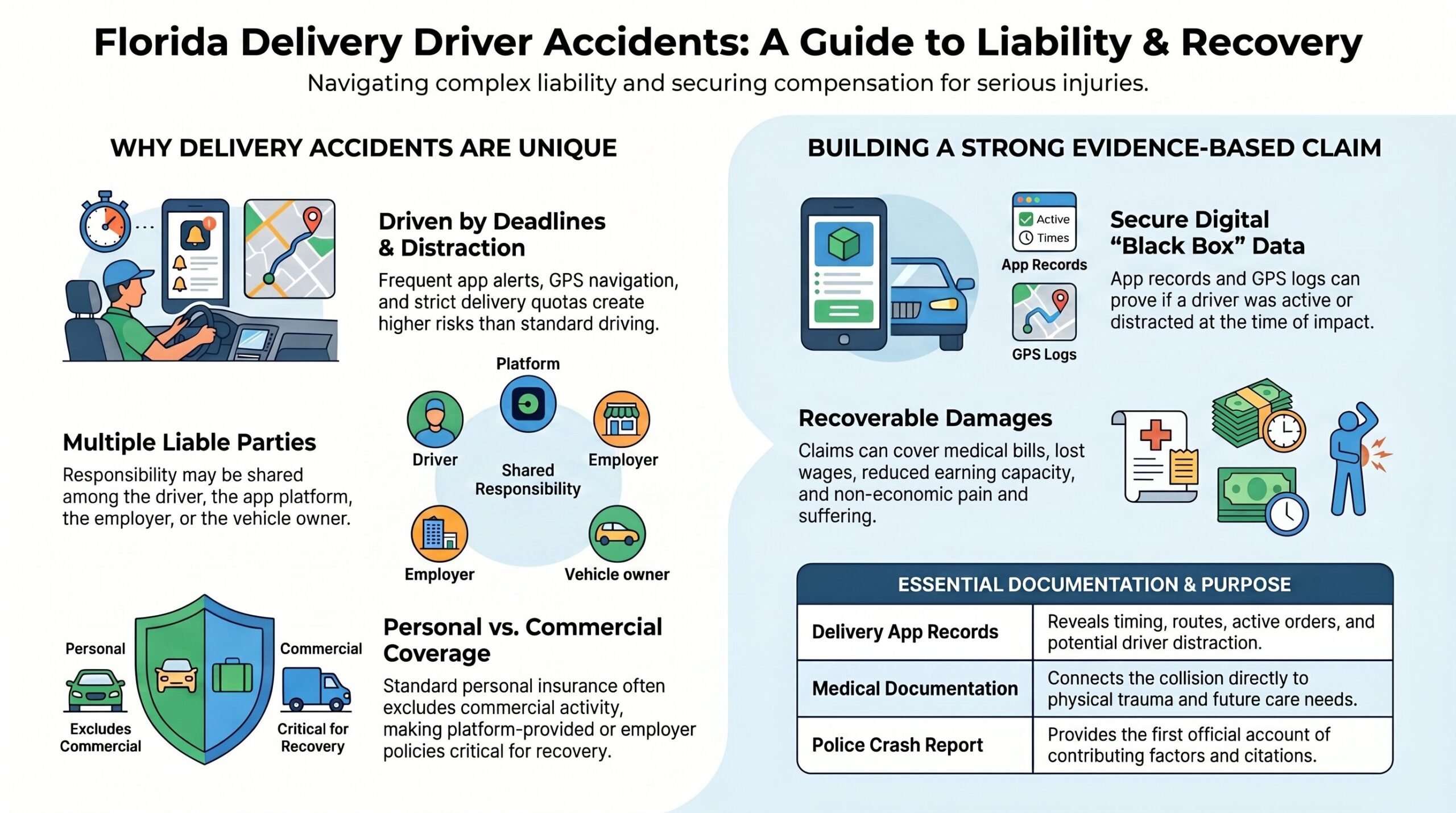
Effective representation begins with a clear understanding of how delivery driver accident cases differ from ordinary vehicle collisions. These matters often involve overlapping responsibilities among the driver, a delivery platform, an employer, an insurer, and sometimes a vehicle owner. Careful review is needed to determine who had control, who benefited from the delivery activity, and which insurance coverage applies.
Florida law requires a focused analysis of the Negligence standard, including whether the responsible party failed to exercise reasonable care under the circumstances. For injured individuals and their families, this process supports accountability while helping preserve resources needed for recovery, service, and stability.
Damages may include medical expenses, lost income, pain, and future care needs. In rare cases involving intentional misconduct or grossly reckless conduct, punitive damages may also be considered. Each case must be assessed based on evidence, timing, documentation, and the legal relationships associated with the delivery work.
Common Causes of Florida Delivery Driver Car Accidents
Florida delivery driver car accidents often result from preventable conditions tied to the demands of commercial and app-based delivery work. Common causes include distracted driving, tight delivery deadlines, poor vehicle maintenance, and unsafe parking choices that create hazards for drivers, pedestrians, and other motorists. Identifying these factors can help clarify liability, insurance issues, and the legal options available after an injury.
Distracted Driving
Distracted driving is a leading cause of delivery driver accidents in Florida, particularly because these drivers often rely on phones, GPS systems, dispatch alerts, and delivery apps while operating through traffic. Even brief phone use can draw attention from changing signals, pedestrians, cyclists, or vehicles stopping ahead. App notifications may also create repeated visual and mental interruptions, especially in congested areas where careful observation is vital.
For drivers whose work supports households, businesses, medical needs, and community services, safe driving remains a serious responsibility. A distraction-related crash can harm the driver, other motorists, passengers, or vulnerable road users. Injury claims may examine device records, navigation activity, witness statements, and crash evidence to determine whether inattention contributed to the collision and resulting damages.
Tight Delivery Deadlines
Often, tight delivery deadlines contribute to Florida delivery driver accidents by encouraging rushed decisions, aggressive lane changes, speeding, and reduced caution in heavy traffic or at frequent stops. Drivers serving customers, patients, restaurants, or households may feel compelled to prioritize rapid completion over careful judgment, especially when Employer Pressure affects scheduling, ratings, or continued work opportunities.
App Navigation can also intensify urgency when routes change, delays appear, or estimated arrival times become difficult to meet. Under these conditions, a driver may overlook pedestrians, cyclists, school zones, or suddenly braking vehicles. After a crash, accurate Injury Reporting becomes important because delayed or incomplete notice can affect medical documentation and claim evaluation. Legal review may examine deadlines, communications, trip data, and dispatch expectations to determine whether time pressure contributed.
Poor Vehicle Maintenance
When delivery vehicles are not properly inspected or repaired, mechanical problems can increase the risk of serious crashes on Florida roads. Worn brakes, bald tires, faulty lights, control defects, and neglected suspension systems may prevent a driver from responding safely in traffic. Delivery companies, contractors, and vehicle owners may have duties to maintain safe equipment, especially when their work serves customers, patients, families, and local businesses.
After a maintenance-related crash, evidence preservation can be pivotal, including repair records, inspection logs, dash data, and damaged parts. Witness statements may help confirm unusual noises, tire failures, or loss of control. Injured parties should also maintain medical documentation linking their harm to the collision. These records may become central during insurance disputes over fault, causation, and compensation.
Unsafe Parking Choices
Unsafe parking choices by delivery drivers can create sudden hazards for motorists, bicyclists, and pedestrians on Florida roads. When a driver stops in a travel lane, blocks a driveway, or parks near an intersection, others may be forced to swerve, brake abruptly, or step into traffic. These risks increase in busy commercial areas, apartment complexes, and shopping centers where parking lot design may already limit safe movement.
Poor curbside visibility can also prevent approaching drivers or pedestrians from recognizing a stopped vehicle until avoidance becomes difficult. A delivery driver serving the public has a duty to choose lawful, visible, and stable stopping locations. When unsafe parking contributes to a crash, investigators may review delivery records, vehicle position, signage, lighting, and nearby obstructions to determine whether negligence occurred.


Legal Rights of Florida Delivery Driver Car Accident Injury Victims
After a crash involving a delivery vehicle, an injured Florida delivery driver may have multiple legal rights depending on the driver’s employment status, the cause of the collision, and the available insurance coverage. These rights may include claims for medical care, lost income, diminished earning capacity, and pain-related losses. Workers’ compensation may apply when the driver was acting within the scope of their job duties, while a separate injury claim may exist against a negligent motorist or other responsible party. Comparative Negligence can affect recovery if fault is shared, making careful evaluation indispensable. Statute Deadlines also limit the time available to act.
A Florida delivery crash may involve workers’ compensation, third-party claims, shared fault issues, and strict filing deadlines.
- A family may need stability while a dedicated worker recuperates.
- Medical bills can threaten a household built on service and effort.
- Lost wages may interrupt the ability to care for others.
- Legal protection can help preserve dignity after harm.
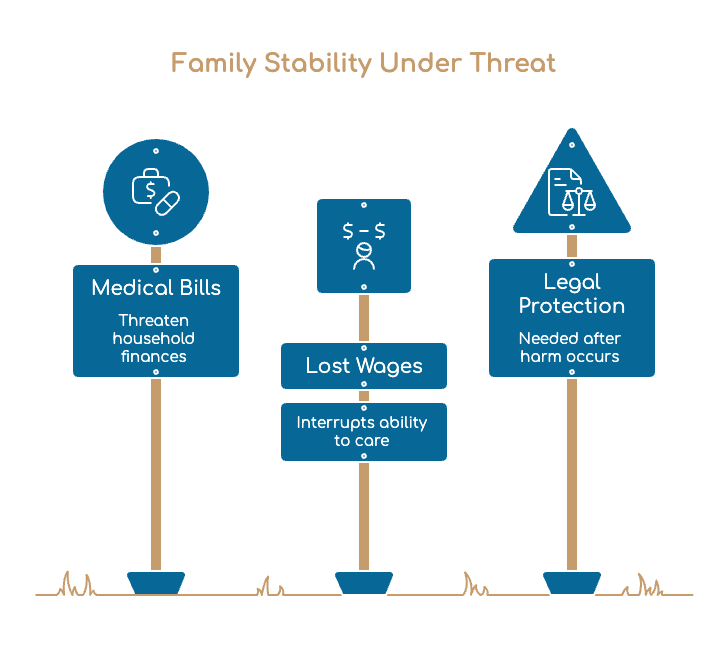
Prompt legal review helps identify coverage, preserve evidence, and protect available remedies.
Why Do Florida Delivery Driver Car Accident Injuries Happen?
Understanding the legal rights of an injured delivery driver also requires examining how these collisions occur in the first place. Delivery drivers often work under demanding conditions, traveling through dense neighborhoods, commercial corridors, apartment complexes, and congested intersections while trying to complete routes efficiently. These pressures can increase exposure to careless motorists, sudden stops, unsafe lane changes, and distracted driving.
Weather-related collisions are also common in Florida, where heavy rain, reduced visibility, standing water, and slick pavement can make routine deliveries hazardous. A driver serving customers during poor conditions may have limited time to react when another vehicle hydroplanes or fails to slow appropriately.
Vehicle blind spots pose another serious risk, especially near vans, box trucks, rideshare vehicles, and large commercial trucks. Delivery drivers may be struck when other motorists merge, reverse, or turn without ensuring the area is clear. These incidents often result from preventable inattention, poor judgment, or failure to share the road responsibly.
What Should You Do After a Florida Delivery Driver Car Accident Injury?
After a Florida delivery driver car accident injury, prompt action can protect health, legal rights, and the strength of any future claim. The injured person should seek medical care, report the crash to the proper authorities, and preserve vital evidence before it is lost or altered. These steps help establish the cause of the collision, the extent of injuries, and the parties who may be legally responsible.
Seek Medical Care
In the immediate aftermath of a Florida delivery driver car accident, prompt medical care is essential, even when injuries appear minor or symptoms have not fully developed. A medical evaluation can identify hidden trauma, including concussions, soft tissue injuries, or internal complications that may worsen without treatment. For drivers who serve customers, families, and communities, protecting health supports both recovery and continued responsibility.
Emergency room documentation may also create a clear record of injuries, treatment timing, and medical findings. This record can become important when questions arise about the crash-related harm. Follow-up care should be completed as recommended, including imaging, therapy, consultant evaluations, or pain management referrals. Consistent treatment helps stabilize recovery, prevents avoidable complications, and demonstrates that the injured person acted with reasonable care after the collision.
Report The Crash
Once medical needs are being addressed, the crash should be reported through the proper channels as soon as conditions permit. In Florida, law enforcement should be notified when injuries, death, suspected intoxication, hit-and-run conduct, or significant property damage are involved. A responding officer can create an official report, document involved parties, and identify basic circumstances without relying on informal accounts.
Delivery drivers should also notify their employer or platform in accordance with established reporting procedures, while avoiding speculation about fault. Accurate reporting supports accountability, protects others on the road, and helps ensure that injured people receive appropriate attention. Eyewitness statements may be noted during the reporting process, along with the incident timeline, location, vehicle information, and insurance details. Prompt reporting creates a reliable foundation for later review.
Preserve Key Evidence
As soon as the scene is safe, critical evidence should be preserved before vehicles are moved, debris is cleared, or memories begin to fade. Photographs should document vehicle positions, damage, skid marks, roadway conditions, traffic signs, delivery logos, and visible injuries. A Witness statement should be requested from anyone who observed the collision, including nearby drivers, pedestrians, customers, or store employees. Their contact information may later help confirm how the crash occurred.
Nearby businesses, residences, traffic cameras, and delivery vehicles may have video surveillance that captures the impact or events leading to it. Because footage is often erased quickly, prompt requests are important. Preserving app records, delivery logs, police reports, and medical documentation also helps protect the injured person’s claim and supports a fair review of responsibility.
Critical Evidence in a Florida Delivery Driver Car Accident Injury Case
Critical evidence can determine whether an injured person is heard, believed, and fairly compensated after a crash involving a Florida delivery driver, especially when liability or insurance coverage is disputed.
- Police crash reports that preserve the first official account
- Delivery app records that may reveal timing, routes, and active orders
- Driver employment status that affects who may be financially responsible
- Medical injury documentation that connects pain, treatment, and loss
Each category can help establish what happened, who may be accountable, and how seriously the collision changed the injured person’s life.
Police Crash Reports
When a delivery driver is involved in a Florida traffic collision, the police crash report often becomes one of the first documents reviewed in the injury claim. This report may identify the drivers, vehicles, witnesses, road conditions, apparent contributing factors, and any citations issued. For injured persons and advocates committed to responsible service, it provides an organized starting point for understanding what occurred.
Although the report is not the final determination of fault, it can influence insurance coverage analysis and early settlement negotiations. Attorneys may compare the officer’s observations with medical records, photographs, witness statements, and vehicle damage to confirm accuracy. Any errors should be addressed promptly because inaccurate information may affect liability discussions. A complete report helps preserve fairness, accountability, and informed decision-making throughout the claim process.
Delivery App Records
Beyond the police crash report, delivery app records can provide highly important evidence in a Florida delivery driver car accident injury case. These records may show when an order was accepted, when the driver began traveling, and whether the delivery was active at the time of the collision. GPS Data can help establish location, route, speed patterns, and timing, which may clarify how the crash occurred.
App Notifications may also reveal whether the driver received pickup instructions, customer messages, route changes, or delivery prompts shortly before impact. For injured people seeking fair care and accountability, this information can help them gain a clear understanding of events. Attorneys may act quickly to preserve these digital records because app data can be limited, changed, or lost over time.
Driver Employment Status
App data may show what a delivery driver was doing at the time of a crash, but the driver’s employment status helps determine which parties may be legally and financially responsible. This evidence may include contracts, payroll records, tax forms, company policies, uniforms, vehicle markings, and dispatch control. Independent contractor classification is often raised by delivery companies to limit responsibility, but labels alone do not decide the issue.
Florida courts may consider the extent of control the company exercised over routes, schedules, customer contact, and delivery methods. If the driver was acting within the scope of work, employer liability coverage may apply, supporting compensation through available insurance. Careful review of status evidence helps identify accountable parties and protects injured people seeking fair, service-centered justice after a preventable collision.
Medical Injury Documentation
Preserve medical injury documentation from the earliest point after a delivery driver crash, because treatment records often connect the collision to the harm claimed in a Florida injury case. Emergency room notes, diagnostic images, prescriptions, referrals, therapy records, and follow-up evaluations may show the nature, timing, and progression of injuries. Consistent care also helps clarify whether symptoms worsened or improved after the crash. Evidence preservation should include medical bills, discharge instructions, work restrictions, and provider opinions regarding future treatment needs.
These records may be reviewed with crash documentation, photo evidence, and witness statements to present a complete account of impact, injury, and recovery. When carefully organized, medical documentation supports fair evaluation while helping injured individuals receive responsible attention, appropriate care, and informed legal guidance after a serious delivery-related collision.
Long-Term Effects of Florida Delivery Driver Car Accident Injuries
Delivery driver car accident injuries in Florida may lead to lasting consequences, including chronic pain conditions that interfere with mobility, sleep, and daily function. These injuries can also reduce earning capacity, particularly when physical limitations prevent a driver from returning to prior work demands. Ongoing medical needs, such as therapy, medication, follow-up care, or future procedures, often become central issues in evaluating the full value of a claim.
Chronic Pain Conditions
After a delivery driver survives a serious crash, chronic pain may become one of the most disruptive long-term consequences of the injury. Persistent neck, back, shoulder, or nerve pain can limit daily function, interfere with rest, and require ongoing medical supervision. For individuals committed to serving customers and communities, these limitations may create frustration and a loss of independence.
Treatment may involve physical therapy, injections, expert assessments, or long-term prescriptions. Medication side effects, including drowsiness or impaired concentration, can further complicate recovery and daily responsibilities. Careful documentation of pain levels, treatment history, and medical opinions is vital. A Florida injury lawyer may use this evidence to support a settlement strategy that accounts for future care, diminished quality of life, and the enduring burden of chronic pain.
Reduced Earning Capacity
Chronic pain and related physical limitations can also affect a delivery driver’s ability to earn a living over time. A driver who once managed long routes, repeated lifting, stair climbing, and tight delivery schedules may no longer be able to meet those demands safely. Reduced earning capacity may arise when the person must accept fewer shifts, lower-paying assignments, or different work that better fits lasting limitations.
A Vocational impairment evaluation can help identify how injuries affect job options, transferable skills, and realistic wages. Work restrictions documentation may also support the connection between the collision and diminished employment opportunities. For individuals devoted to dependable service, these losses can be especially significant because physical reliability often determines income. Careful documentation helps measure the financial harm caused by impaired ability to work.
Ongoing Medical Needs
When crash injuries require treatment beyond the initial recovery period, ongoing medical needs can become a major part of a delivery driver’s long-term losses. Follow-up surgery, physical therapy, pain management, medication, assistive devices, and expert care may continue for months or years. These needs can affect a driver’s ability to serve customers, support family members, and maintain dependable work.
Accurate car crash documentation helps establish the connection between the collision and future care. Medical records, treatment plans, physician opinions, and cost projections can show how an injury may progress over time. This information also supports an insurance settlement strategy that accounts for future expenses, not only past bills. Careful evaluation can help prevent an injured worker from accepting compensation that fails to address lasting medical responsibilities and related financial pressure.
Proving Liability in Florida Delivery Driver Car Accident Injury Cases
Although delivery crashes often seem straightforward at first, proving liability in a Florida delivery driver car accident injury case requires a careful review of the driver’s conduct, the delivery company’s role, and the evidence connecting each party to the collision. Investigators may examine traffic laws, delivery deadlines, driver distraction, vehicle maintenance, hiring practices, and electronic route data to determine whether negligence caused harm.
Liability may rest with the driver, an employer, a vehicle owner, or another negligent party. In severe cases involving Wrongful Death, the analysis must also address family losses and statutory claims. Accurate Damages Calculations depend on medical records, wage information, future care needs, and the human impact of lasting injury.
Evidence preservation supports sound Trial Strategy, especially when corporate policies or unsafe scheduling practices contributed to the crash. While Insurance Bad Faith may arise later, liability proof begins with disciplined fact gathering and careful legal evaluation.
Dealing With Insurance Companies After a Florida Delivery Driver Car Accident Injury
After a Florida delivery driver crash, insurance communications can quickly become complicated because several policies may be involved, including the driver’s personal coverage, a commercial auto policy, employer liability coverage, or a corporate delivery platform policy. Each insurer may attempt to limit responsibility, question the driver’s work status, or shift blame to another party. Injured individuals, including those focused on caring for families or supporting others, should approach these discussions with caution and organization.
Insurance adjusters may request recorded statements, medical authorizations, or early settlement discussions before the full extent of injuries is clear. Documentation can help protect the claim, including police reports, medical records, photographs, Surveillance footage, and witness statements. Careful communication also matters because inconsistent details may be used to dispute damages or liability. A lawyer can manage insurer contact, preserve important evidence, and help ensure that injured people are not pressured into accepting less-than-fair compensation.
What to Expect During a Florida Delivery Driver Car Accident Injury Claim Process
A Florida delivery driver car accident injury claim typically begins with an initial investigation into fault, vehicle use, and the circumstances surrounding the collision. The process then includes a careful review of available insurance coverage and the collection of medical evidence documenting injuries, treatment, and related losses. Once liability and damages are assessed, settlement negotiations may begin, often requiring close attention to policy limits, employment status, and disputed facts.
Initial Claim Investigation
The initial claim investigation begins with a detailed review of how the delivery driver accident occurred, who may be legally responsible, and what insurance coverage may apply under Florida law. Investigators examine the crash report, roadway conditions, vehicle damage, delivery records, and available photographs to understand the sequence of events.
Witness statement collection is often prioritized because neutral accounts may clarify speed, lane position, traffic signals, and driver conduct. Dashcam video preservation is also important, since footage from commercial vehicles, nearby cars, or businesses may be lost if not requested promptly. The process may include documenting injuries, medical treatment, and lost work time, while identifying whether fatigue, distraction, unsafe loading, or rushed delivery practices contributed to the collision. Careful investigation supports fair accountability.
Insurance Coverage Review
Once the facts of the crash are established, the insurance coverage review determines which policies may provide compensation for the injured delivery driver or other injured parties. This review may examine the driver’s personal auto policy, any commercial coverage maintained by an employer, and coverage connected to a delivery platform. Each policy must be evaluated for exclusions, notice requirements, policy limits, and whether the driver was actively engaged in a delivery assignment.
Coverage for uninsured motorists may also be important when the at-fault driver lacks adequate insurance. A careful review helps identify responsible carriers and prevents overlooked sources of recovery. For those committed to protecting injured workers and their families, this step supports a fair, well-organized claims process that respects both legal obligations and practical needs.
Medical Evidence Collection
As medical treatment begins, evidence collection focuses on documenting the full nature, cause, and progression of the delivery driver’s injuries. Records from emergency care, diagnostic testing, physical therapy, prescriptions, and expert evaluations are gathered to support a clear connection between the crash and the resulting harm. A careful symptom chronology helps identify when pain, limitations, or complications first appeared and how they changed over time.
This timeline can be important when injuries develop gradually or worsen during continued recovery. Doctor correspondence may clarify work restrictions, treatment recommendations, impairment opinions, and the need for future care. For those committed to serving injured workers responsibly, thorough medical documentation promotes accuracy, accountability, and dignity throughout the claim. Consistent records also help prevent misunderstandings about the driver’s condition and recovery needs.
Settlement Negotiations
When the medical record is sufficiently developed, settlement negotiations usually begin with a detailed review of liability, insurance coverage, injury severity, lost income, and future care needs. In delivery driver cases, counsel may present liability proof strategies that organize crash reports, witness accounts, app data, vehicle logs, photographs, and expert opinions into a clear demand package. This presentation helps insurers evaluate fault, damages, and the responsible coverage layer.
Insurance coverage disputes may arise when personal auto policies, commercial policies, employer coverage, or app-based delivery protections overlap. Negotiations often require patient, service-minded advocacy that respects the injured person’s medical needs while addressing insurer questions. If the offer does not reflect documented losses, the claim may continue toward mediation, arbitration, or litigation. Clear evidence supports fair resolution.
Compensation for Florida Delivery Driver Car Accident Injury Damages
Compensation for a Florida delivery driver car accident injury may include payment for medical care, lost income, reduced earning capacity, property damage, and the broader personal losses caused by the crash. The value of a claim often depends on the severity of the injuries, the available insurance coverage, and whether the facts satisfy Florida’s No Fault Threshold. Because delivery work serves customers, businesses, and communities, a careful claim should reflect the driver’s role and the disruption caused by service interruptions.
Insurance carriers may dispute responsibility, challenge treatment, or rely on Policy Limits to restrict recovery. Documentation is crucial. Medical records, employment records, delivery logs, photographs, and Witness Statements can help establish how the collision occurred and how the injuries affected the driver’s work. When injuries limit Future Earnings, the claim may require vocational evidence, wage history, and clear proof of long-term limitations. Strong preparation supports fair, accountable compensation.
Economic vs Non-Economic Damages in Florida Delivery Driver Car Accident Cases
Economic and non-economic damages in Florida delivery driver car accident cases address different categories of loss, including lost income, medical expenses, and personal hardship. Economic damages are tied to measurable financial costs, while non-economic damages may include pain and suffering, emotional distress, and reduced quality of life. Proving damage value often requires organized records, medical evidence, employment documentation, and a clear connection between the crash and the claimed losses.
Lost Income And Expenses
After a serious delivery driver crash, lost income and related expenses often become central parts of a Florida injury claim. Economic damages may include Lost wages, reduced earning capacity, medical bills, rehabilitation costs, transportation to appointments, and necessary household support. For drivers who serve customers, families, restaurants, pharmacies, or local businesses, time away from work can disrupt both personal stability and community service.
Documentation is crucial and includes pay records, app earnings statements, tax returns, physician restrictions, and receipts for out-of-pocket costs. When injuries prevent a driver from returning to the same route, schedule, or workload, future income losses may also require careful evaluation. A thorough claim should connect each financial loss to the crash, helping ensure the injured driver’s practical needs are fully addressed.
Pain And Suffering
While financial losses can be measured through records and receipts, pain and suffering address the human impact of a Florida delivery driver car accident. These damages may involve physical discomfort, reduced mobility, disrupted sleep, scarring, or the loss of ordinary daily activities. For a delivery driver, injuries can also affect independence, family responsibilities, and the ability to serve customers with reliability.
Non-economic harm may include emotional distress, anxiety while driving, fear of returning to traffic, or frustration caused by prolonged limitations. Psychological recovery can require time, patience, and consistent support, especially when the crash changes a person’s routines or sense of safety. In Florida injury cases, pain and suffering recognize that a serious collision causes more than bills; it can alter dignity, purpose, and quality of life.
Proving Damage Value
Pain and suffering account for part of the harm caused by a Florida delivery driver car accident, but proving the value of a claim requires showing both measurable losses and the broader impact of the injury. Economic damages may include hospital bills, rehabilitation costs, lost income, reduced earning ability, and vehicle-related expenses. Medical documentation helps connect those losses to the crash and supports the need for ongoing care.
Non-economic damages address physical discomfort, emotional strain, loss of normal activities, and diminished quality of life. These losses require careful explanation because they are not shown by invoices alone. In insurance disputes, clear records, consistent treatment, witness statements, and expert opinions may help establish fair value. A well-supported claim serves the injured person by presenting the full impact with dignity and accuracy.
When a Florida Delivery Driver Car Accident Injury Case Goes to Trial vs Settlement
Whether a Florida delivery driver car accident injury case proceeds to trial or is resolved through settlement depends on the strength of the evidence, the severity of the injuries, the amount of available insurance coverage, and the parties’ willingness to negotiate in good faith. Settlement may serve injured individuals by providing timely compensation, reducing uncertainty, and preserving resources needed for medical care, household stability, and long-term recovery.
Trial may become necessary when liability is disputed, damages are undervalued, or an insurer refuses a fair resolution. A careful Trial strategy evaluates witness credibility, medical proof, delivery records, and accident reconstruction. Courtroom evidence must be organized to show how the crash occurred and how the injuries affected daily life and service to family or community.
Settlement timing often affects negotiation leverage. Strong documentation, clear damages, and readiness for trial may encourage a reasonable offer before a jury is required to decide the case.
Florida Laws That May Affect Your Florida Delivery Driver Car Accident Case
Because delivery-related crashes often involve multiple drivers, insurers, and business entities, Florida law can materially affect how fault, insurance coverage, and compensation are evaluated. Florida’s No Fault Coverage requirements may require an injured person to first seek benefits through personal injury protection, regardless of who caused the crash. However, serious injuries may allow claims beyond that coverage.
Florida delivery crash claims may require careful review of fault, insurance coverage, and available compensation beyond No Fault benefits.
Florida’s Comparative Negligence Rules can also reduce recovery when an injured person shares responsibility. In delivery cases, fault may involve a driver, employer, app company, vehicle owner, or another motorist.
- A caregiver may lose wages while trying to protect an injured family member’s dignity.
- A delivery worker may face pain, uncertainty, and pressure to return before repair.
- A crash victim may struggle to serve others while needing care themselves.
- A family may feel overwhelmed when insurers dispute responsibility.
These laws make careful investigation, documentation, and coverage analysis necessary in a Florida delivery driver accident case.
The Statute of Limitations for Florida Delivery Driver Car Accident Injury Cases
When must an injured person act after a delivery driver accident in Florida? In most Florida negligence cases, a person injured in a vehicle collision must file a lawsuit within two years of the crash. This deadline applies even when the at-fault driver was delivering food, packages, groceries, or other goods. If the injured person misses the filing deadline, the court may dismiss the case, regardless of the harm suffered or the need to support a household or community.
Timely action also supports Evidence preservation. Delivery app records, vehicle data, photos, witness statements, and business communications may become harder to obtain over time. Prompt attention can also affect insurance negotiations, as insurers often assess whether a claim is documented, timely, and legally viable.
Certain facts may change the applicable deadline, including claims involving government vehicles or minors. For that reason, limitation periods should be reviewed carefully after any delivery-related collision in Florida.
How a Florida Delivery Driver Car Accident Injury Lawyer Can Help You
After a delivery driver collision in Florida, an injury lawyer can evaluate liability, identify available insurance coverage, and begin protecting the injured person’s claim from the earliest stages. Counsel may examine police reports, delivery app records, vehicle data, medical documentation, and witness accounts to determine whether the driver, employer, platform, or another party may be responsible.
A lawyer can also manage communications with insurers, reducing the risk that statements or documents are used unfairly. This support is especially important when companies use settlement tactics designed to minimize payments before the full extent of the harm is understood.
- Helping an injured caregiver remain focused on recovery and family duties
- Preserving evidence that may honor the truth of what occurred
- Pursuing compensation that supports medical care, lost income, and stability
- Standing against pressure when vulnerable people are asked to accept less
Through careful advocacy, legal counsel can help restore order after disruption.
When to Contact a Florida Delivery Driver Car Accident Injury Lawyer
Promptly contacting a Florida delivery driver car accident injury lawyer can be important when injuries, disputed fault, commercial insurance, or delivery app involvement may affect the claim. Early contact is especially useful after emergency care, before recorded statements, or when an insurer requests broad authorizations. Timely guidance may support Evidence preservation, including vehicle damage, app activity, delivery records, photographs, and available video footage.
A lawyer may also help identify and secure witness statements while memories remain fresh, particularly when a driver, customer, restaurant, or third party observed key events. Contact should not be delayed when insurance disputes arise over driver status, coverage limits, fault, or the value of medical losses.
Early review can also inform a negotiation strategy that reflects the facts of the accident and the injured person’s ongoing needs. For individuals focused on caring for family, coworkers, or community members, prompt legal consultation may provide structure during a difficult recovery period.
Why You Need an Experienced Florida Delivery Driver Car Accident Injury Lawyer
Delivery driver injury claims often involve more legal and insurance intricacy than an ordinary passenger vehicle collision. An experienced Florida delivery driver car accident injury lawyer understands how to evaluate employment status, app-based delivery arrangements, commercial policies, and overlapping coverage. This knowledge helps injured drivers, passengers, pedestrians, and families pursue recovery while allowing them to focus on recovery and continued service to others.
Counsel can identify liable parties, preserve delivery records, analyze crash reports, and communicate with insurers that may attempt to limit responsibility. Building a case strategy early is important because evidence can disappear quickly, and statements may later affect compensation. A seasoned attorney also understands that hiring expert witnesses may strengthen proof of fault, medical causation, lost income, or future care needs.
Through disciplined advocacy, legal counsel can pursue fair compensation for medical expenses, wage loss, pain, and long-term limitations, while protecting the claimant from procedural errors and unfair settlement pressure.
How to Choose the Right Florida Delivery Driver Car Accident Injury Lawyer for Your Case
How should an injured person evaluate which attorney is best suited for a Florida delivery driver car accident case? The review should begin with experience in collisions involving commercial delivery vehicles, app-based drivers, and employer insurance disputes. A qualified lawyer should understand Florida negligence law, available insurance coverage, and the evidence needed to prove fault and damages.
The injured person should also consider how the attorney communicates. Clear updates, careful listening, and respectful guidance help clients make informed decisions while focusing on recovery and family responsibilities. A sound case strategy should address liability, medical documentation, lost income, and long-term care needs.
It is also important to ask about settlement timing, including when negotiation may serve the client’s interests and when litigation may be necessary. The right lawyer should demonstrate preparation, judgment, and a commitment to protecting the injured person’s future, not merely to resolving the claim quickly after the crash.
About The Law Offices of Anidjar & Levine
When a crash involving a delivery driver causes serious injuries, The Law Offices of Anidjar & Levine provides legal representation focused on identifying liable parties, pursuing available insurance coverage, and documenting the full impact of the accident.
The firm assists injured clients and their families with attentive service, clear communication, and diligent case management from the first consultation through resolution.
Its legal team evaluates driver conduct, employer responsibility, vehicle records, delivery schedules, and policy limits to build a fact-supported claim.
Prompt evidence preservation is a priority, including photographs, witness statements, electronic data, police reports, and medical documentation.
The firm also addresses Insurance company tactics that may delay payment, undervalue injuries, or shift blame away from responsible parties.
Frequently Asked Questions
Can I Sue a Delivery App for Negligent Driver Onboarding?
Yes, an injured person may sue a delivery app for negligent onboarding if the company failed to follow standard hiring safeguards, such as background checks, driving record reviews, or policy enforcement. Liability depends on whether the app’s screening failures contributed to placing an unsafe driver on the road. Those harmed may seek accountability to protect the public, support recovery, and encourage safer systems for workers, customers, and communities served.
What if the Delivery Driver Was Using a Personal Vehicle?
If the delivery driver used a Personal Vehicle, Accident Responsibility may still extend beyond the driver, depending on the app status, the route purpose, and the company’s control. Insurance Coverage often becomes disputed because personal policies may exclude commercial delivery activity. The platform may face Independent Liability if it failed to screen, train, or remove an unsafe driver. Injured parties should gather app records, police reports, and insurance details to support accountability.
Are Amazon Flex Crashes Handled Differently From Company-Truck Accidents?
Yes, Amazon Flex crashes are often handled differently from company-truck accidents. A Flex driver usually operates a personal vehicle, so insurance coverage may depend on app status, delivery activity, and policy exclusions. Company-truck cases often involve clearer employer responsibility. Comparative liability may still divide fault among drivers, Amazon-related entities, and insurers. Those serving injured people should document evidence early because crash damages depend heavily on coverage, fault, and injury proof.
Can GPS or App Data Show the Driver Was Distracted?
Yes, GPS timeline evidence and app distraction logs may show whether a driver was distracted before a crash. Investigators can compare route data, delivery prompts, screen interactions, braking, speed, and stop patterns. If an app required attention near impact, that information may support negligence findings. Those serving injured people should preserve this data quickly, because companies and platforms may retain digital records for limited periods under internal policies.
What if a Delivery Driver Hit Me While off the Clock?
If a delivery driver caused a crash while off the clock, liability may rest primarily with the driver rather than the delivery company. Investigators would examine whether any work-related task was occurring, as well as insurance coverage, vehicle ownership, and app activity. Eyewitness accounts may clarify the driver’s conduct and purpose of travel. Those helping an injured person should promptly preserve evidence, because coverage disputes can affect recovery and responsible service to the harmed.
—————————
Delivery driver accident claims in Florida can involve intricate insurance issues, employer liability, and serious injuries.
A qualified Florida Car Accident Lawyer can evaluate the facts, protect the victim’s rights, and pursue fair compensation for medical care, lost income, and other damages.
The Law Offices of Anidjar and Levine provides focused legal guidance for injured victims, helping them tread through each stage of the claims process with diligence, professionalism, and attention to detail.