The Law Offices of Anidjar and Levine help preserve proof, assess liability, and connect documented injuries to the collision. A Florida Car Accident Lawyer may use crash reports, medical records, photographs, witness statements, repair documentation, video footage, and evidence-preservation notices to support a claim.
Strong evidence can address insurer disputes over causation, treatment gaps, damages, or fault. Legal guidance also protects deadlines, privacy, and the value of claims under Florida law. The sections below explain how evidence supports a stronger injury claim.
Main Takeaways
- A Florida car accident evidence injury lawyer helps preserve crash reports, photos, videos, witness statements, and vehicle damage documentation.
- Strong evidence connects the collision to injuries, medical treatment, work limits, and documented financial losses.
- Key proof may include dashcam footage, phone records, toxicology results, skid marks, repair records, and event data.
- Prompt medical care and consistent symptom documentation can support the establishment of causation and the assessment of injury severity.
- Legal support can address insurer disputes, evidence preservation, settlement evaluation, and compensation for lawful damages.
How We Can Help With Your Florida Car Accident Evidence Injury Claim
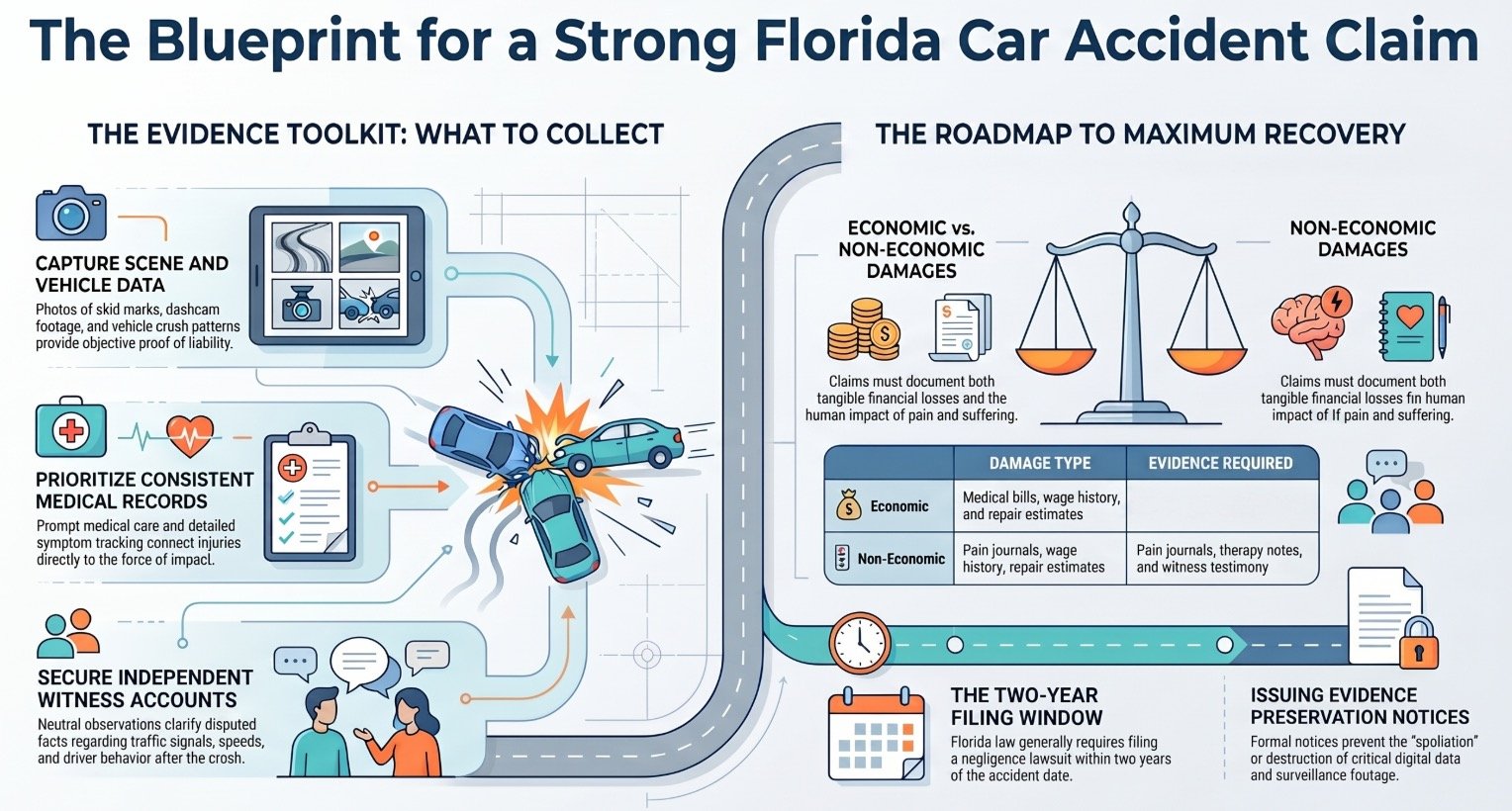
After a Florida car accident, evidence often determines whether an injury claim is properly valued, contested, or rejected. A law firm assisting an injured person can help organize the claim with discipline, compassion, and service-focused attention. Counsel may identify relevant records, protect photographs, request crash reports, locate witnesses, and send notices designed to prevent loss of important materials. These Evidence preservation tips can support a clearer presentation to insurers, opposing parties, or a court.
Legal assistance may also coordinate documentation of injuries, treatment, work limits, and future care needs. Through Medical proof strategies, attorneys can help ensure that diagnoses, imaging, physician opinions, therapy notes, and billing records are collected and presented consistently. This support allows the injured person to focus on recovery while the claim is prepared responsibly. Careful advocacy can also address insurers’ questions, evaluate settlement offers, and pursue compensation that aligns with documented harm and lawful damages.
Understanding Florida Car Accident Evidence Injury Cases


In Florida car accident evidence injury cases, the strength of a claim often depends on how clearly the available proof connects the collision to the injuries, treatment, and losses at issue. Attorneys, insurers, medical providers, and courts may review records, photographs, witness accounts, repair documentation, and professional opinions to determine whether the facts support responsibility and damages.
OUR CONSULTATIONSARE FREE
START YOUR FREE CASE REVIEW

These cases require careful attention to timing, consistency, and medical interpretation. Gaps in treatment, conflicting reports, or unclear diagnostic findings may affect how an injury is evaluated. Scar tissue disputes can arise when parties disagree about whether lingering pain, limited movement, or visible tissue changes resulted from the crash or from earlier conditions. Medical malpractice considerations may also appear when treatment complications, delayed diagnosis, or disputed care decisions affect the injury picture. A thorough evidence review helps protect truthful claims, supports fair accountability, and serves injured individuals with diligence, accuracy, and respect for the legal process.
Common Causes of Florida Car Accident Evidence
Common causes of Florida car accident evidence often include distracted driving evidence, proof of impaired driving, speeding collision records, and documentation of unsafe lane changes. Each category can help establish how a crash occurred, whether a driver violated traffic laws, and what factors contributed to the resulting injuries. Careful review of these materials allows an injury lawyer to assess liability, preserve crucial evidence, and build a clear claim strategy.
Distracted Driving Evidence


Distracted driving evidence can determine whether a motorist’s inattention contributed to a Florida car accident and caused the resulting injuries. Attorneys may review phone records, messaging timestamps, navigation activity, and app usage to evaluate whether the driver was focused elsewhere. Surveillance footage from nearby businesses, traffic cameras, or residential systems may show a driver looking down, drifting, or failing to react. Metadata analysis can clarify when photos, texts, or calls were sent or received in relation to the crash. Vehicle telemetry and black box data may reveal braking, speed, steering inputs, or sudden maneuvers consistent with delayed awareness. Witness statements can also support the timeline. Careful preservation of this evidence helps injured people, families, insurers, and courts understand conduct, assign responsibility fairly, and promote safer roadway practices across Florida communities.
Impaired Driver Proof
Beyond evidence of inattention, proof of driver impairment can play a significant role in determining fault after a Florida car accident. Investigators may examine alcohol or drug indicators, field sobriety observations, officer reports, toxicology findings, and witness statements describing slurred speech, odor, confusion, or unsafe control of the vehicle. Careful review helps ensure that injured people receive fair consideration and that responsible parties are accurately identified. Breathalyzer calibration records may indicate whether testing equipment was properly maintained, while a review of dashcam metadata can confirm the timing, location, and conduct captured during the stop or crash response. Medical records may also document symptoms consistent with impairment. When gathered promptly, this evidence can support accountability, preserve credibility, and assist legal professionals serving victims with diligence and care.
Speeding Collision Records
When speed contributes to a Florida car accident, collision records can provide key insights into how the crash occurred and whether a driver failed to exercise reasonable care. These records may include crash reports, event data recorder information, witness statements, skid mark measurements, and roadway evidence. Together, they help clarify vehicle velocity, braking behavior, and stopping distance before impact. A careful review may also explain how speed limits are applied to the location, including construction zones, school areas, or changing traffic conditions. Where radar was used, police radar accuracy may need to be evaluated using calibration records, officer training, and equipment maintenance history. For injured persons and those assisting them, preserving these materials promptly supports accountability, fair assessment of fault, and informed decisions about recovery and legal options.
Unsafe Lane Changes
Although many lane changes may appear routine, an unsafe lane change can create significant evidentiary issues in a Florida car accident case. Investigators may review traffic camera footage, dashcam recordings, vehicle damage, skid marks, and witness statements to determine whether a driver failed to signal, checked mirrors poorly, or crossed into an occupied lane. These facts may reveal lane-change signs, including abrupt control, sideswipe impact patterns, or braking by nearby motorists. When a sudden lane shift causes following traffic to strike another vehicle, the analysis may overlap with rear-end causes, yet fault may still rest with the driver who moved unsafely. Careful evidence review helps injured persons, families, and advocates understand responsibility, preserve accountability, and support fair assistance for those harmed by negligent roadway conduct in Florida.
Legal Rights of Florida Car Accident Evidence Injury Victims
After a Florida car accident, an injured victim has specific legal rights that can affect medical care, insurance benefits, evidence preservation, and the ability to pursue compensation. These rights help protect dignity while supporting fair claims handling and responsible service to injured persons.
- No Fault Coverage may provide prompt payment for necessary medical treatment and wage loss, subject to policy terms and Florida law.
- Eligibility Limits can affect whether additional recovery is available beyond personal injury protection benefits, especially when injuries meet statutory thresholds.
- Evidence Privacy protects sensitive medical, financial, and personal information from unnecessary disclosure during claim review or litigation.
- Post-injury documentation, including treatment records, photographs, repair estimates, and witness information, may strengthen a claim and preserve accuracy.
- Legal representation can help ensure deadlines are met, insurers respond appropriately, and evidence is safeguarded for a complete evaluation.
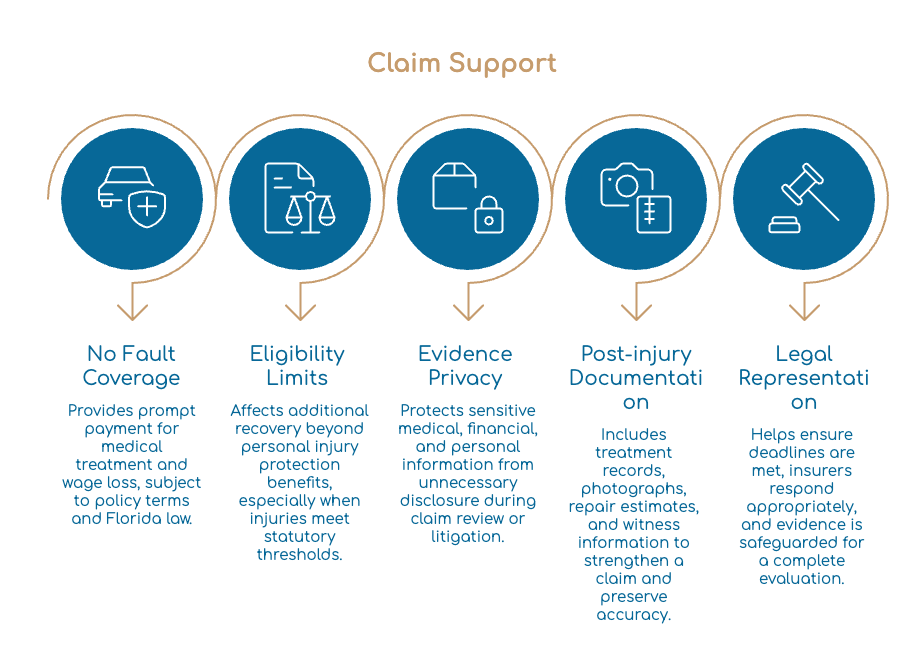
These protections allow victims, families, and advocates to make informed decisions after serious harm.
Why Do Florida Car Accident Evidence Injuries Happen?
Because collisions rarely result from a single cause, injuries from Florida car accidents often arise from a combination of driver conduct, roadway conditions, vehicle performance, and the force of impact. Distracted driving, speeding, impaired judgment, unsafe lane changes, and fatigue can create circumstances where injuries occur and essential proof becomes contested. Poor lighting, rain, worn pavement, obstructed signage, or defective vehicle components may also influence how a crash unfolds.
These injuries matter because physical harm and proof often develop jointly. Skid marks, vehicle damage, event data, medical findings, photographs, and witness accounts may explain both causation and severity. When parties with greater resources control major information, evidence spoliation prevention becomes important to preserve fairness and accountability. Insurance adjuster tactics may also shape how facts are framed, particularly when responsibility or injury severity is questioned. Understanding why these injuries happen helps communities, caregivers, and legal advocates serve victims with diligence and informed concern.
What Should You Do After a Florida Car Accident Evidence Injury?
After a Florida car accident involving injury, prompt action can affect both medical recovery and the strength of any legal claim. A person hurt should seek medical care, preserve accident evidence, and steer clear of actions that may weaken documentation of fault or damages. Contacting an attorney early can help ensure that evidence is protected, deadlines are monitored, and communications with insurers are handled appropriately.
Seek Medical Care
Why should medical care be a priority following a Florida car accident? Prompt evaluation protects health, identifies hidden injuries, and creates a reliable record of necessary care. Even when pain appears minor, conditions such as concussion, internal trauma, or soft tissue damage may worsen without timely treatment. A responsible injured person seeks emergency assistance when needed, follows physician instructions, and attends recommended follow-up appointments. Those who serve families, clients, or communities should protect their capacity to continue doing so by addressing injuries early. They should document important symptoms, including pain levels, dizziness, numbness, mobility limits, and emotional changes. They should also keep treatment receipts, prescription records, and appointment summaries. Consistent medical care supports recovery and helps establish how the crash affected daily functioning, work, and caregiving responsibilities.
Preserve Accident Evidence
When it is safe to do so, preserving evidence at the accident scene should be a priority because crucial details can disappear quickly. A responsible observer may photograph vehicle positions, skid marks, debris, traffic signals, road conditions, and visible injuries before cleanup begins. Names and contact information for witnesses should be gathered respectfully, recognizing that their accounts may later support truthful resolution. Nearby businesses, homes, or public agencies may have Surveillance footage, so noting camera locations and the time of the collision is important. Damaged vehicles should remain available for vehicle inspection when possible. Receipts, medical records, towing documents, repair estimates, and insurance paperwork should be organized carefully. Clear records may also assist future expert testimony by explaining how the crash occurred and how harm resulted.
Contact An Attorney
Because evidence can be lost, disputed, or misinterpreted, an injured person should consider contacting a Florida car accident attorney as soon as immediate medical and safety needs are addressed. Counsel can evaluate the circumstances of the crash, protect the person’s rights, and guide practical steps to support recovery and accountability. An attorney may help document evidence, timeline details, including medical treatment, witness information, vehicle damage, photographs, and communications with insurers. This organized approach can assist those serving an injured person, such as family members or caregivers, in preserving accurate records. Legal guidance may also help avoid common insurance delays by ensuring required notices, forms, and supporting materials are submitted properly. Prompt contact allows evidence requests, investigation, and claim decisions to proceed with discipline, purpose, and informed judgment.
Critical Evidence in a Florida Car Accident Evidence Injury Case
Critical evidence in a Florida car accident injury case helps establish fault, document damages, and connect the collision to the claimant’s injuries.
Critical materials may include:
- Police crash reports
- Medical treatment records
- Witness statements
- Vehicle damage photos
- Insurance and repair documentation
Each item may strengthen the factual record, allowing attorneys, insurers, or courts to assess liability and compensation with greater accuracy.
Police Crash Reports
Although a police crash report is not the only evidence in a Florida car accident injury case, it often provides an important starting point for evaluating what occurred. The report may identify drivers, passengers, vehicle locations, roadway conditions, citations, insurance information, and the responding officer’s observations. For those committed to serving injured people with diligence, this document can help organize the investigation and guide timely follow-up. Witness statement preservation is especially important because names, contact details, and brief accounts may appear in the report before memories fade. The importance of dashcam video should also be considered when the report notes commercial vehicles, patrol response, or nearby traffic cameras. A careful review may reveal inconsistencies, missing facts, or leads that require further inquiry, ensuring that the evidence is examined responsibly and thoroughly.
Medical Treatment Records
After a collision, medical treatment records often become some of the most important evidence in a Florida car accident injury case. These records document diagnoses, symptoms, treatment plans, prescriptions, referrals, and physical limitations, helping show how the crash affected the injured person’s health. When reviewed with Crash scene documentation, they may support timeline reconstruction by connecting medical complaints to the impact and later care. They also assist with Insurance coverage investigation, because insurers often examine whether treatment was reasonable, necessary, and related to the collision. Accurate records can strengthen damage valuation by identifying medical expenses, future care needs, and the effect of injuries on daily responsibilities. For those committed to serving injured individuals, complete medical documentation helps promote accountability, fair evaluation, and informed legal guidance throughout the claim.
Witness Statements
When a collision is disputed, witness statements can provide independent details that clarify how the crash occurred and who may bear responsibility. Neutral observers may describe traffic signals, lane positions, speeds, driver behavior, weather conditions, or statements made immediately after impact. How eyewitnesses corroborate an injured person’s account can strengthen a claim, especially when insurers question fault or minimize harm. Prompt collection is important because memories fade, witnesses move, and contact information may become unavailable. A lawyer may identify witnesses, obtain recorded or written statements, and compare accounts with reports, treatment timelines, and other evidence. Preserving witness credibility requires careful documentation, avoiding suggestion, and confirming each person’s opportunity to observe. Reliable statements can help present a truthful, service-centered case that supports fair accountability under Florida law.
Vehicle Damage Photos
Because physical damage often reflects the mechanics of a collision, photos of vehicle damage can serve as important evidence in a Florida car accident injury case. Clear images may show the point of impact, crush patterns, airbag deployment, broken glass, fluid leaks, and damage to surrounding property. This damage documentation can help counsel, insurers, medical providers, and fact-finders understand how force was transmitted through the vehicles and affected occupants. Photos should be taken from several angles, including close-up views and wider-scene perspectives, before repairs or disposal occur. When available, video evidence preservation should also include dash-camera footage, surveillance recordings, and walk-around videos for each vehicle. Careful collection supports fair evaluation, helps protect injured persons, and promotes responsible service to those seeking lawful recovery after a serious crash.
Long-Term Effects of Florida Car Accident Evidence Injuries
Long-term injuries after a Florida car accident require careful evidence showing how the harm continues beyond the initial recovery period. Chronic pain documentation, lost earning capacity, and future medical needs can help establish the full scope of damages in a claim. Medical records, expert evaluations, and employment evidence often become crucial in proving these lasting consequences.
Chronic Pain Documentation
Chronic pain documentation often becomes a central form of evidence in Florida car accident injury claims, especially where symptoms continue after initial treatment has ended. Accurate records help explain how ongoing discomfort affects mobility, sleep, household responsibilities, caregiving, and participation in community life. Treating Physician Records may show diagnoses, prescribed therapies, medication changes, imaging results, and clinical observations that support the persistence of pain.
Pain Level Tracking can also provide a consistent account of daily symptoms, including frequency, intensity, triggers, and activities that worsen or relieve discomfort. When maintained responsibly, these notes assist medical providers, insurers, and legal representatives in understanding the person’s condition over time. Clear documentation promotes fair evaluation while respecting the injured person’s dignity, needs, and ongoing recovery efforts.
Lost Earning Capacity
Medical records that document ongoing pain may also help explain why an injured person can no longer perform the same work duties, maintain prior hours, or pursue expected career advancement after a Florida car accident. Evidence of lost earning capacity may include employment records, wage history, performance reviews, vocational assessments, and testimony from supervisors or coworkers. These materials can show how physical limitations, reduced stamina, or workplace disability have affected a person’s ability to serve clients, patients, students, or the public with the same level of reliability. Financial projections may then estimate income losses over time, considering age, occupation, training, and promotion opportunities. Clear documentation helps connect the injury to diminished earning potential, allowing decision-makers to evaluate the long-term economic impact with fairness, accuracy, and proper context under Florida law.
Future Medical Needs
Future medical needs often become a central issue when injuries from a Florida car accident are expected to require treatment beyond the initial recovery period. Evidence may include physician opinions, rehabilitation plans, medication requirements, surgical recommendations, and projected costs for assistive devices or home care. These materials help clarify the support an injured person may need to maintain dignity, stability, and safe daily functioning. When permanent limitations are present, disability future planning can guide decisions about ongoing therapy, vocational changes, and personal assistance. Accurate documentation also strengthens settlement negotiation, because insurers and opposing parties often dispute care that has not yet occurred. A lawyer may work with medical and financial professionals to present these needs with precision, ensuring future losses are considered alongside immediate damages.
Proving Liability in Florida Car Accident Evidence Injury Cases
To prove liability in a Florida car accident injury case, the evidence must show that another party failed to use reasonable care and that this failure caused the crash and resulting injuries. This process often involves establishing negligence benchmarks, including the duty to obey traffic laws, maintain proper lookout, control speed, and respond safely to road conditions.
Police reports, witness statements, photographs, video footage, vehicle damage, and medical records may help connect careless conduct to specific harm. A careful review can also address Comparative negligence defenses, which may claim the injured person shared fault for the collision. Florida law may reduce recovery when responsibility is divided, making accurate evidence especially important.
For those committed to serving injured individuals, liability proof should be organized, consistent, and grounded in facts. Strong documentation helps clarify what happened, identify accountable parties, and support a fair evaluation of the injury claim under Florida law and applicable standards.
Dealing With Insurance Companies After a Florida Car Accident Evidence Injury
Once liability evidence has been gathered and organized, communications with insurance companies become a significant part of a Florida car accident injury claim. Adjusters may request statements, medical records, repair estimates, and proof of lost income, but each exchange should be handled with care. A clear Documentation Checklist can help ensure that photographs, witness information, treatment records, bills, and correspondence are preserved in an orderly manner.
Insurance companies are responsible for evaluating claims under applicable coverage, yet injured parties and caregivers should understand Policyholder Rights before providing recorded statements or signing releases. Incomplete submissions, disputed fault, gaps in treatment, or unclear damages may lead to Claim Denials or reduced settlement positions. Careful communication helps prevent misunderstandings and supports accurate review. When information is shared respectfully, consistently, and with proper documentation, the claim record better reflects the harm suffered and the injured person’s practical needs.
What to Expect During a Florida Car Accident Evidence Injury Claim Process
A Florida car accident injury claim generally begins with the collection of initial evidence, including crash reports, photographs, witness statements, and vehicle damage records. The process then moves to medical documentation review and insurance claim filing, where treatment records, bills, and policy details are evaluated for accuracy and completeness. Settlement negotiations typically follow, with each party estimating liability, damages, and available coverage before determining whether resolution is possible without litigation.
Initial Evidence Collection
After a Florida car accident, initial evidence collection often begins with securing information that may later establish how the crash occurred, the extent of the injuries, and the value of the claim. Attorneys and support staff may coordinate Scene documentation, including photographs, roadway conditions, debris locations, traffic controls, and property damage. A prompt vehicle inspection can help preserve impact patterns, safety system data, and repair-related details before evidence changes. Careful witness follow up may clarify observations, confirm timelines, and identify additional sources of information. Camera preservation is also important, as nearby businesses, residences, traffic systems, or dash cameras may contain footage that is erased quickly. This early work supports a disciplined claim process, helping injured persons pursue accountability while allowing advocates to serve with diligence, accuracy, and care.
Medical Documentation Review
Evidence gathered from the crash scene gains significant value when it is matched with clear, accurate medical documentation. During review, a Florida car accident evidence injury lawyer evaluates treatment records, physicians’ notes, emergency reports, therapy plans, and discharge summaries to link injuries to the collision. This careful review helps identify gaps, inconsistencies, or delayed complaints that may require clarification from providers. When injuries are complex, a Second Medical Opinion may help confirm the diagnosis, prognosis, and necessary care. A Diagnostic Imaging Review can also help explain fractures, spinal trauma, soft tissue damage, or other conditions shown on X-rays, CT scans, or MRIs. By organizing medical evidence diligently, the legal team supports an honest presentation of harm, promoting fair service to the injured person.
Insurance Claim Filing
When an insurance claim is filed after a Florida car accident, the process typically begins with notice to the appropriate insurer, identification of available coverage, and submission of basic collision and injury information. Claim representatives may request police reports, medical records, photographs, repair estimates, and proof of lost income to evaluate responsibility and damages. A careful policy limits analysis helps determine the availability of bodily injury, uninsured motorist, personal injury protection, and other applicable benefits. In serious injury cases, accurate filing protects the record and supports timely review. In wrongful death claims, representatives may also seek estate documents, beneficiary information, and evidence of funeral expenses or financial support. Each submission should be organized, complete, and consistent, allowing the insurer to assess the claim while preserving the injured person’s legal position.
Settlement Negotiation Process
Once the claim record is sufficiently developed, settlement negotiations usually begin with a review of liability, insurance coverage, medical evidence, wage loss, property damage, and the long-term effect of the injuries. The insurer evaluates risk, while the injured person’s representative presents a supported demand that reflects documented losses and future needs. Medical Documentation helps connect treatment, diagnosis, limitations, and prognosis to the crash, giving the negotiation a reliable foundation. Evidence Preservation also remains important because photographs, repair records, witness statements, and electronic data may strengthen the case on disputed issues. Counteroffers often follow, requiring careful comparison with medical bills, lost income, and the human impact of reduced function. A fair resolution should serve the injured person’s recovery, protect available rights, and avoid premature closure before damages are reasonably understood.
Compensation for Florida Car Accident Evidence Injury Damages
After a Florida car accident, compensation for injury recovery damages often depends on the strength, relevance, and timing of the evidence gathered. Documentation may show how the collision affected the injured person’s health, responsibilities, and ability to function with dignity. Lawyers evaluate medical records, photographs, witness statements, police reports, vehicle data, and expert opinions to connect the crash to the claimed harm.
Settlement negotiation is shaped by whether the evidence presents a clear, organized account of liability and resulting losses. When proof is incomplete or delayed, insurers may question the claim or reduce the offer. Strong evidence supports fair review and helps protect the injured person from avoidable hardship.
Trial readiness also matters because a case prepared for court often carries greater credibility. Careful evidence preservation, consistent recordkeeping, and reliable testimony allow counsel to advocate effectively while honoring the broader purpose of helping injured individuals seek lawful accountability for preventable harm.
Economic vs Non-Economic Damages in Florida Car Accident Evidence Cases
In Florida car accident evidence cases, damages are generally assessed as economic losses, such as medical bills and lost income, and non-economic losses, such as pain, suffering, and reduced quality of life. Economic damage documentation often relies on records, invoices, and wage evidence, while non-economic loss evidence may require medical opinions, personal testimony, and proof of daily limitations. Proving the value of damages depends on connecting each claimed loss to the accident with clear, credible, and well-organized evidence.
Economic Damage Documentation
Because financial losses must be proven with reliable records, documentation of economic damages is a central part of a Florida car accident injury claim. Attorneys and claim representatives often review medical invoices, repair estimates, pharmacy receipts, mileage logs, and proof-of-insurance payments to confirm the amount owed or already paid. Employment records may also establish lost wages, including missed workdays, reduced hours, or diminished earning capacity, supported by payroll data and employer statements. Clear documentation helps injured persons seek reimbursement for bills and also assists insurers, courts, and opposing parties in evaluating the claim fairly. Organized records serve a practical purpose, allowing those responsible for helping the injured to present verified losses accurately, consistently, and with respect for the financial strain caused by the crash.
Non-Economic Loss Evidence
While economic losses rely on bills and wage records, evidence of non-economic losses addresses the human impact of a Florida car accident, including pain, suffering, emotional distress, inconvenience, and loss of enjoyment of life. This evidence may include documentation of pain from medical visits, therapy notes, prescriptions, photographs, journals, and descriptions of daily limitations. Family members, caregivers, coworkers, or community members may explain changes in mood, mobility, sleep, and participation in service, work, or household responsibilities. Attorneys often assess the consistency between medical findings and personal accounts when conducting witness credibility analysis to identify reliable observations. Non-economic evidence should present lived consequences with dignity, not in an exaggerated manner. Clear records help show how injuries disrupted ordinary routines, relationships, and meaningful responsibilities, allowing the claim to reflect personal harm beyond financial expense.
Proving Damage Value
After the human impact of an injury is documented, the next issue is assigning a supported value to the full scope of harm. In Florida car accident cases, economic damages are proven through bills, wage records, repair estimates, future care opinions, and other verifiable financial data. Non-economic damages require careful proof of suffering, inconvenience, emotional strain, and diminished daily function. Pain impact documentation can connect medical findings to lived limitations, helping decision-makers understand why compensation should reflect more than invoices. Effective Insurance settlement strategies compare objective losses with credible personal evidence, while also considering policy limits, liability disputes, and long-term prognosis. A well-organized valuation helps protect the injured person’s dignity, supports fair negotiation, and guides service-minded advocates toward resolutions grounded in evidence, compassion, and lawful measure.
When a Florida Car Accident Evidence Injury Case Goes to Trial vs Settlement
A Florida car accident injury case may resolve through settlement or proceed to trial, depending on the strength of the evidence, the severity of the injuries, the available insurance coverage, and the parties’ willingness to negotiate in good faith. Settlement often serves injured persons by reducing delay, limiting uncertainty, and providing resources for medical care, lost income, and future needs. A careful calculation of damages helps determine whether an offer fairly reflects the harm proven by records, testimony, and expert evaluation.
When settlement discussions fail, a trial may become necessary to seek accountability. Effective trial strategy depends on the preservation of evidence, clear presentation of liability, and credible proof of injury-related losses. Attorneys may prepare witnesses, organize exhibits, and address disputed facts before a judge and jury. Jury selection also matters because impartial decision-makers must evaluate the evidence with fairness. The choice between settlement and trial should be guided by proof, preparation, and the client’s long-term welfare.
Florida Laws That May Affect Your Florida Car Accident Evidence Case
Florida law can shape how evidence is gathered, evaluated, and used long before a car accident injury case reaches settlement discussions or trial. Certain rules influence what facts matter, how responsibility is measured, and whether missing proof may harm a party’s position.
A careful legal review helps protect injured people while honoring a broader duty to act fairly, preserve truth, and serve the community.
- Comparative fault rules may reduce compensation when an injured person shares responsibility for the collision.
- Evidence spoliation can arise when records, vehicles, video, or digital data are destroyed or altered.
- Police reports, medical records, and witness statements may carry different weights depending on admissibility rules.
- Insurance reporting duties can affect claim handling, documentation, and the timing of requested proof.
- Privacy laws may limit access to medical, employment, or electronic information without proper authorization.
These laws encourage disciplined evidence preservation and responsible advocacy at every stage.
The Statute of Limitations for Florida Car Accident Evidence Injury Cases
Because filing deadlines can control whether an injured person may pursue compensation, the statute of limitations is a pivotal part of every Florida car accident evidence injury case. Florida generally gives an injured person two years from the date of a car accident to file a negligence lawsuit, although limited exceptions may apply. When a death results, a wrongful death claim also carries a separate filing period, which must be evaluated with care.
These legal deadlines work alongside evidence deadlines and insurance claim timeframes. Medical records, crash reports, witness statements, repair documentation, and digital data may become harder to obtain over time. Insurance policies may also require prompt notice of a claim, cooperation with investigation, and timely submission of requested information. For people committed to caring for injured family members or community members, early attention to these timelines helps preserve dignity, order, and accountability. Missing a deadline can severely restrict recovery, regardless of the evidence’s strength.
How a Florida Car Accident Evidence Injury Lawyer Can Help You
When evidence begins to fade after a collision, a Florida car accident evidence injury lawyer can help protect the injured person’s claim by identifying, preserving, and organizing the proof needed to establish fault, causation, and damages.
This support allows families, caregivers, and advocates to serve the injured with steadiness and purpose.
- Secures police reports, photographs, medical records, repair estimates, and witness statements before crucial details are lost.
- Reviews crash facts with reconstruction experts, medical professionals, and investigators to clarify responsibility and injury impact.
- Evaluates insurance issues, including Wrongful Death Coverage, when a fatal crash leaves dependents seeking accountability.
- Prepares demand packages and litigation materials that present losses clearly, respectfully, and in a form insurers and courts can assess.
- Addresses involved claim developments, including Post Settlement Appeals, when unresolved legal issues require careful review.
Through this work, the lawyer helps convert scattered facts into a coherent claim.
When to Contact a Florida Car Accident Evidence Injury Lawyer
After a serious collision, contacting a Florida car accident evidence injury lawyer should occur as soon as the injured person’s immediate medical needs are addressed. Early contact helps ensure that important details aren’t overlooked while the situation is still fresh and witnesses may still be available. Those assisting an injured family member, neighbor, or community member can support the process by encouraging timely legal guidance.
A lawyer may advise how to protect photos, document injuries, and gather basic information without disrupting medical recovery. This may include images of vehicle damage, roadway conditions, visible injuries, treatment records, and the names of those who observed the crash. Prompt communication is especially important when evidence could be removed, repaired, or forgotten.
Delays can create avoidable challenges, particularly when insurance representatives request statements or when medical documentation is still developing. Seeking counsel early allows the injured person and supportive caregivers to proceed with greater organization, accuracy, and care after the collision.
Why You Need an Experienced Florida Car Accident Evidence Injury Lawyer
Timely legal guidance is only one part of protecting an injury claim; the lawyer’s experience handling the evidence can greatly affect how the case develops. In Florida car accident cases, evidence often changes quickly, and small omissions may weaken an otherwise valid claim. An experienced lawyer understands how to identify essential proof, secure it promptly, and present it in a manner that supports the injured person’s needs with dignity and care.
This work may include Preserving cellphone records, obtaining crash reports, locating witnesses, reviewing medical documentation, and documenting pain symptoms as they affect daily responsibilities. Such evidence helps connect the collision to the injuries and losses suffered. For those committed to helping an injured person recover stability, careful evidence handling serves a practical and compassionate purpose. It supports fair evaluation by insurers, strengthens negotiations, and prepares the case for litigation when necessary, while protecting the injured person from avoidable procedural harm.
How to Choose the Right Florida Car Accident Evidence Injury Lawyer for Your Case
Selection, in a Florida car accident evidence injury case, should begin with a careful review of a lawyer’s ability to identify, preserve, and use evidence before it becomes unavailable or disputed. A qualified lawyer should understand crash reports, vehicle damage, medical records, witness statements, surveillance footage, and digital data, while coordinating investigation efforts with discipline and care.
The choice should also reflect the lawyer’s client communication skills, since injured individuals often need clear guidance as they manage medical treatment, insurance claims, and family responsibilities. Consistent updates, direct explanations, and respectful availability help clients make informed decisions and serve their households with stability.
Experience with negotiation and litigation is also important because evidence may need to be presented to support settlement demands or courtroom presentation. Prospective clients should review contingency fee structures, case handling practices, and prior experience with similar claims. This careful approach helps identify counsel prepared to protect both legal rights and practical needs.
About The Law Offices of Anidjar & Levine
The Law Offices of Anidjar & Levine represents injured clients throughout Florida, including individuals whose car accident claims depend on careful evidence collection and case preparation. The firm assists people facing medical, financial, and personal disruption after a collision, with attention to both legal strategy and practical needs.
Its team provides client-focused consultations to help injured individuals understand their options, deadlines, and potential sources of compensation. This approach supports clients who may be overwhelmed, while ensuring important facts are identified early.
The firm also offers evidence preservation guidance, which may include securing crash reports, photographs, witness statements, medical records, vehicle damage documentation, and any available video footage. By addressing these matters promptly, the legal team works to protect the integrity of a claim.
Through organized case management, communication, and advocacy, The Law Offices of Anidjar & Levine serves clients seeking accountable representation after Florida car accidents and related injuries.
Frequently Asked Questions
How Long Should I Keep Car Accident Evidence?
Car accident evidence should generally be kept until all claims, medical treatment, insurance issues, and any legal deadlines are fully resolved. A careful person should preserve medical records, repair estimates, photographs, bills, correspondence, and digital files in secure locations. They should also get witness statements promptly, while memories remain reliable. Keeping evidence for several years is prudent because it helps protect injured people, supports fair accountability, and serves justice responsibly.
Can Dashcam Footage Be Used in Florida Car Accident Cases?
Yes, dashcam footage can be used in Florida car accident cases if it is relevant, authentic, and not unfairly prejudicial. Dashcam admissibility often depends on confirming the recording’s source, date, and integrity. Those preserving evidence to serve injured parties should retain original files, avoid edits, and document custody. Destroying or altering footage may trigger spoliation sanctions, harming a claim or defense and reducing the court’s trust.
What if Evidence Disappears After My Florida Car Accident?
If evidence disappears after a Florida car accident, the affected party may seek remedies through a Spoliation notice and evidence preservation demands. Courts may consider whether someone had a duty to protect relevant materials, such as video, vehicle data, or records. When loss harms the truth-seeking process, sanctions, adverse inferences, or other relief may follow. Prompt action helps protect accountability, supports fair service to injured persons, and preserves justice.
Should I Photograph Vehicle Damage Before Repairs?
Yes, vehicle damage should be photographed before repairs, because early images help Document Damage accurately and preserve conditions that may later change. Clear photographs from multiple angles, including close views and surrounding areas, can assist those evaluating responsibility and harm. If available, Witness Statements should be gathered promptly to support the visual record. This careful approach helps protect the interests of injured persons and promotes fair, service-centered resolution.
Can Social Media Posts Affect My Car Accident Evidence Claim?
Yes, social media posts can affect a car accident evidence claim. Insurers may review photos, comments, check-ins, or activity updates to challenge injuries, timelines, or credibility. Social media risks include innocent posts being misinterpreted or taken out of context. Deleting content after a claim may create a spoliation risk. A claimant should preserve existing material, limit new posts, adjust privacy settings, and seek guidance before sharing accident-related information.
—————————
A Florida car accident injury claim depends on timely documentation, informed legal strategy, and careful protection of the victim’s rights. The Law Offices of Anidjar and Levine can evaluate the facts, preserve essential evidence, communicate with insurers, and pursue compensation for qualifying losses.
Those injured in a Florida collision should seek legal guidance promptly from a Florida Car Accident Lawyer before evidence is lost or deadlines approach.
A knowledgeable attorney can provide direction, reduce uncertainty, and support a stronger claim.