The Law Offices of Anidjar and Levine help injured people in Gainesville protect the evidence needed to prove fault, answer insurer disputes, and pursue full compensation after a car accident.
Our team gathers police reports, medical records, witness statements, photos, repair estimates, camera footage, and insurance documents before critical proof disappears.
We also address comparative negligence claims by building a clear record of driver conduct, injuries, and damages.
Below, we explain how strong evidence can support your case with guidance from a Gainesville Car Accident Lawyer.
Main Takeaways
- A Gainesville car accident injury lawyer helps preserve evidence proving fault, injuries, damages, and insurance responsibility.
- Key evidence includes medical records, photos, police reports, witness statements, vehicle damage, and surveillance footage.
- Prompt evidence collection can prevent the loss of video, the repair of vehicle damage, the fading of skid marks, and the weakening of witness memories.
- Strong documentation helps counter insurer disputes, comparative negligence claims, and unfair attempts to reduce compensation.
- Evidence can prove distracted driving, speeding, impairment, reckless conduct, future medical needs, and lost earning capacity.
How We Can Help With Your Gainesville Car Accident Evidence Injury Claim
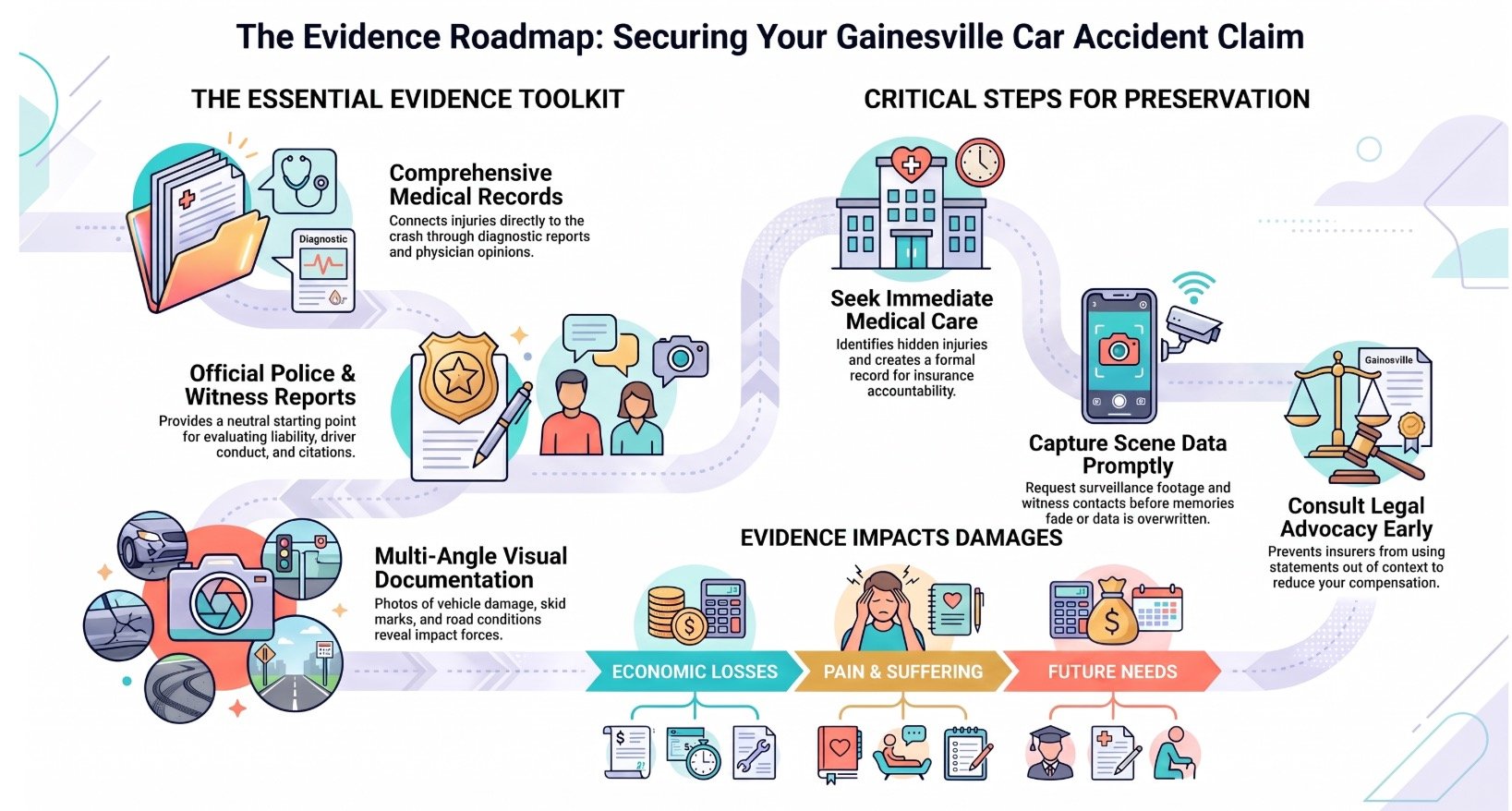
After a Gainesville car accident, evidence can determine whether your injury claim succeeds or falls short. We help you protect that evidence, organize it, and present it with the care your case warrants. Our work focuses on Liability proof, including driver conduct, roadway conditions, witness accounts, vehicle damage, and records that show what happened.
We also address comparative negligence when an insurer tries to shift blame onto you. By building a clear record, we help reduce unfair fault arguments and support the full value of your losses. If insurance disputes arise, we respond with documented facts, policy analysis, and firm advocacy.
Medical causation is equally important. We connect your injuries to the crash through treatment records, physician opinions, and timelines that explain your recovery. While you focus on getting better and serving those who depend on you, we handle the evidence strategy, communications, and claim preparation needed to move your case forward.
Understanding Gainesville Car Accident Evidence Injury Cases


When a crash in Gainesville leads to injuries, the strength of your case often depends on how quickly we identify, preserve, and evaluate the available evidence. We help you understand what matters, why it matters, and how each record can support the truth of what happened. Evidence may include medical records, witness statements, vehicle damage, photographs, police reports, Insurance documentation, and traffic camera footage.
OUR CONSULTATIONSARE FREE
START YOUR FREE CASE REVIEW

We review these materials with care, because injured people often carry both physical burdens and practical concerns. You may need support with treatment, lost income, transportation, and future stability. Our role is to organize the facts, protect your rights, and present a clear claim to insurers or, when necessary, a court.
We also look for gaps that could weaken recovery. By acting early, we can request essential records, preserve proof, and help you move forward with confidence and purpose after a serious collision.
Common Causes of Gainesville Car Accident Evidence
We examine common causes of Gainesville car accidents by identifying evidence of how a crash occurred and who may be responsible. We’ll consider distracted driving evidence, speeding accident proof, impaired driver records, and reckless driving indicators as essential factors in building a strong injury claim. By understanding these details, you can better recognize the proof needed to protect your rights after a collision.
Distracted Driving Evidence


Because distracted driving often happens in the seconds before impact, evidence must show what pulled the driver’s attention away from the road and how that distraction contributed to the crash. We help you identify evidence that supports the truth and accountability, including cell phone records, witness statements, surveillance footage, and vehicle data. Texting, app use, eating, navigation adjustments, or conversations with passengers can all affect safe driving when they interrupt it. We also review black-box evidence when available because it may show braking, steering, or other actions before impact. By quickly preserving this information, we can prevent loss, challenge incomplete accounts, and build a clear timeline. Our goal is to present reliable evidence that honors your experience and helps protect others.
Speeding Accident Proof
Although speeding may seem obvious after a severe collision, proving it requires evidence that shows how fast the driver traveled and how that speed affected the crash. We examine physical evidence, roadway conditions, and vehicle data to help you establish a clear connection between excessive speed and the injuries caused. Crash reconstruction can reveal impact forces, travel paths, and whether a driver had time to react safely. We also use speed limit analysis to compare lawful limits with the driver’s estimated speed. Braking distance helps show whether the vehicle could have stopped before impact, while tire mark review may confirm sudden braking, swerving, or loss of control. By preserving this evidence, we help support accountability and protect those harmed by unsafe driving.
Impaired Driver Records
When impairment contributes to a Gainesville car accident, driver records can reveal whether alcohol, drugs, fatigue, or medication use affected the driver’s judgment and reaction time. We examine police reports, toxicology results, medical notes, and prior citations to identify evidence that supports your claim. Alcohol detection records, including breath, blood, or field testing documentation, can help establish whether the driver operated unlawfully or unsafely. We also review criminal histories, license restrictions, and probation violations when they relate to substance use or driving conditions. These materials can show patterns that responsible parties should not ignore. As we serve injured people and their families, we use these records to present a clear account of impairment, accountability, and the harm caused by preventable choices in Gainesville.
Reckless Driving Indicators
Reckless driving often leaves measurable signs that help explain how a Gainesville car accident occurred and why it could’ve been prevented. We look for excessive speed, unsafe lane changes, tailgating, racing, ignored signals, and sudden braking patterns. These facts can show a driver chose convenience over community safety. When we review dashcam video, vehicle damage, skid marks, witness accounts, and roadway conditions, we help you identify conduct that placed others at unnecessary risk. A traffic violation may also support the broader story, especially when it aligns with crash data or police observations. We approach this evidence with care because responsible advocacy serves injured people, families, and the public. By documenting reckless choices clearly, we can strengthen accountability and support a claim for full, fair recovery.
Legal Rights of Gainesville Car Accident Evidence Injury Victims
After a collision in Gainesville, injured victims have the right to pursue compensation when another driver’s negligence caused their harm. We help you protect those rights by identifying admissible proof under Florida evidence rules and evaluating how liability insurance limits may affect recovery.
Your claim can include medical costs, lost income, pain, and other documented losses.
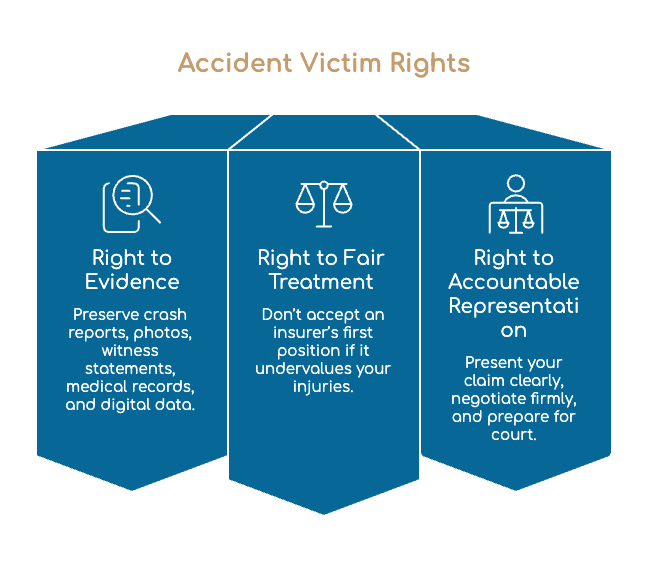
- Right to evidence: We can preserve crash reports, photos, witness statements, medical records, and digital data before important proof disappears.
- Right to fair treatment: We don’t have to accept an insurer’s first position, especially when it undervalues your injuries or ignores crucial facts.
- Right to accountable representation: We can present your claim clearly, negotiate firmly, and prepare for court when necessary.
When we serve injured people, we also help restore stability for families, workplaces, and the broader Gainesville community. Your legal rights merit careful, timely action.
Why Do Gainesville Car Accident Evidence Injuries Happen?
Because every crash has a cause, Gainesville car accident evidence injuries often begin with choices that violate basic safety rules, such as speeding, distracted driving, impaired driving, unsafe lane changes, or following too closely. We also see injuries occur when drivers ignore traffic signals, fail to yield, drive fatigued, or operate unsafe vehicles. These acts can harm you, your family, and others who rely on careful conduct.
Evidence-related injury claims develop when the facts must show how the collision happened, who acted negligently, and how the harm followed. Common Evidence Errors include overlooking skid marks, vehicle damage patterns, lighting conditions, surveillance footage, and witness observations. When these details are missed, accountability becomes harder to establish.
We value service because strong proof helps protect injured people and promotes safer roads. Proof Preservation Tips matter because accurate records, timely documentation, and careful analysis can connect negligent conduct to real losses without guesswork, delay, or unfair doubt in your case.
What Should You Do After a Gainesville Car Accident Evidence Injury?
After a Gainesville car accident, we must act quickly to protect your recovery and any evidence that may support your injury claim. We encourage you to seek immediate medical care, preserve accident scene evidence when possible, and avoid statements that could weaken your position. We can then help you contact an injury lawyer, assess your legal options, and pursue the compensation you may be entitled to recover.
Seek Immediate Medical Care
If you’ve been hurt in a Gainesville car accident, seek medical care as soon as possible, even when your symptoms seem minor. We understand many people try to continue serving family, work, or community before caring for themselves, but prompt treatment protects both health and accountability. A physician can identify hidden injuries, order appropriate testing, and create records that connect your condition to the crash.
We should follow all treatment instructions, attend follow-up visits, and keep copies of medical records, prescriptions, and referrals. Document injury photos when bruising, swelling, cuts, or mobility limits appear, and date each image carefully. Track symptom progression in writing, including pain levels, headaches, dizziness, sleep problems, and work limitations. These steps help doctors recover you properly and support any injury claim later.
Preserve Accident Scene Evidence
Medical care safeguards your health, and preserving accident scene evidence protects the facts of what happened. We should document the scene as soon as safely possible, because roadway conditions, vehicle positions, debris, skid marks, and traffic signals may change quickly. Take photographs and video from multiple angles, including injuries, property damage, weather, lighting, and nearby businesses or homes.
We can also identify witnesses, gather names and contact information, and note any cameras that may have recorded the collision. Prompt video surveillance requests matter because many systems overwrite footage within days. Keep damaged personal items, repair estimates, towing records, and written notes about what you saw, heard, and felt. Careful attention to evidence-preservation timelines helps restore truthful accounts and supports a fair, service-minded resolution for everyone involved.
Contact An Injury Lawyer
When questions about fault, insurance, or injuries begin to arise, we should contact an injury lawyer promptly to protect your rights and preserve the value of your claim. Early guidance helps us avoid statements or delays that may weaken your position. We can request legal consultation before speaking with adjusters, signing forms, or accepting payment. A lawyer can review the evidence, explain deadlines, and identify compensation for medical care, lost income, and long-term needs. We should also gather insurance documentation, including policy details, claim numbers, correspondence, and coverage notices. By organizing these materials, we help your advocate act efficiently and serve your recovery with diligence. Prompt legal support allows us to make informed decisions while focusing on recovery, family responsibilities, and community commitments after a Gainesville accident.
Critical Evidence in a Gainesville Car Accident Evidence Injury Case
We help you identify and preserve the evidence that can support fault, injuries, and damages after a Gainesville car accident.
- Police accident reports and witness contact information
- Medical treatment records and related documentation
- Vehicle damage photos and scene-based evidence
These materials can strengthen your claim, reduce disputes, and give us a clearer foundation for pursuing compensation.
Police Accident Reports
Although a police accident report doesn’t prove every fact in a Gainesville car accident injury case, it often provides an important starting point for the evidence we’ll need to evaluate liability, insurance coverage, and the strength of a claim. We review the officer’s narrative, diagrams, citations, roadway conditions, driver statements, and insurance details to understand what happened and what needs follow-up. Because police report errors can affect how insurers view responsibility, we compare the report with medical records, photographs, repair estimates, and other available proof. We also act quickly when there’s risk of Spoliation of evidence, including lost video, damaged vehicles, or erased electronic data. By examining the report carefully, we help you protect a valid claim and serve your recovery with disciplined, informed advocacy.
Witness Contact Information
Because witness memories can fade quickly after a Gainesville car accident, contact information from independent witnesses often becomes critical evidence in an injury case. We should gather each witness’s name, phone number, email address, and physical address when possible. These contact details help us follow up, confirm observations, and preserve a reliable Witness statement before details become uncertain. We also compare witness accounts with emergency logs, crash scene photographs, and insurance verification materials to identify any inconsistencies or conflicts. Independent witnesses may clarify lane positions, traffic signals, driver behavior, weather conditions, and statements made at the scene. When we protect this information early, we strengthen your claim and help make sure every person involved receives fair, careful attention. Prompt action allows us to serve your interests with accuracy and diligence.
Medical Treatment Records
Preserve medical treatment records as soon as care begins after a Gainesville car accident, since they often connect the crash to the injuries claimed. We should gather emergency room notes, diagnostic reports, prescriptions, therapy records, referral letters, and physician opinions. This evidence gathering helps show how symptoms developed, what care was necessary, and whether limitations affect work, caregiving, or daily service to others. If Chronic pain appears weeks later, consistent records can help explain its progression and medical basis. We also use a documentation strategy that tracks appointments, missed activities, expenses, and provider recommendations. Complete records support Future medical planning by identifying expected treatment, rehabilitation needs, and long-term restrictions. When we organize this information early, we protect your claim and present your injuries accurately, with dignity and purpose.
Vehicle Damage Photos
Photograph vehicle damage as soon as it’s safe to do so after a Gainesville car accident, since these images can show the force, angle, and point of impact. We encourage you to capture every side of each vehicle, close-ups of dents, broken glass, deployed airbags, fluid leaks, and license plates. Include wider shots that show lane position, debris, skid marks, traffic signals, and nearby landmarks. This careful vehicle-damage photo documentation can help us explain how the crash occurred and protect people who were harmed. When needed, experts may use photogrammetry collision analysis to measure crush patterns and estimate impact dynamics from quality images. Preserve originals, avoid filters, and back up files promptly, because accurate photos can support accountability and help us serve injured clients well.
Long-Term Effects of Gainesville Car Accident Evidence Injuries
We help you show how a Gainesville car accident injury can continue to affect your health, finances, and daily life long after the crash. We document chronic pain, identify future medical needs, and connect those losses to the evidence needed for a strong claim. We also assess reduced earning capacity, so you can pursue compensation that reflects both current harm and long-term consequences.
Chronic Pain Documentation
When pain continues after the initial emergency care and visible injuries begin to recover, detailed documentation can help connect ongoing symptoms to the Gainesville car accident. We encourage you to record pain levels, location, duration, and triggers in daily pain logs, because consistent entries show patterns that memory may not preserve. We also track how pain affects service to family, work, worship, or community duties, since these limits explain real impact. Medication consistency matters as well; missed doses, side effects, and changes in prescriptions should be noted with dates. We gather appointment records, therapy notes, imaging results, and provider recommendations to support your account. Clear documentation helps us present chronic pain as a continuing injury rather than an isolated complaint, while respecting your commitment to serving others.
Future Medical Needs
Future medical needs often become clearer as chronic pain records, expert evaluations, and therapy progress notes reveal whether an injury will require continued care. We review these materials carefully because your future treatment plan may include surgery, injections, medication management, mobility support, counseling, or ongoing rehabilitation. When we build this evidence, we focus on how each recommendation supports your health, dignity, and ability to participate in daily life.
We also align the Deposition strategy with the medical evidence, so that treating providers can explain why future care is necessary and reasonable. Clear testimony strengthens witness credibility, especially when records show consistent symptoms and responsible follow-through. By documenting future needs early, we help you seek resources that support improvement, stability, and appropriate long-term care after a Gainesville car accident.
Reduced Earning Capacity
As an injury limits strength, focus, mobility, or stamina, reduced earning capacity can affect your financial future long after medical recovery begins. We examine how your condition changes the work you can perform, the hours you can sustain, and the opportunities you may lose. For those committed to serving others, whether in healthcare, education, public safety, or community work, these losses can carry both financial and vocational consequences.
We gather employment records, medical opinions, wage history, and expert evaluations to show the difference between your prior earning path and your current limitations. Vocational rehabilitation may help identify realistic work options, while disability benefits may provide necessary support. We use this evidence to pursue compensation that reflects your long-term ability to work and contribute.
Proving Liability in Gainesville Car Accident Evidence Injury Cases
Because liability drives the outcome of a car accident injury claim, we must connect the other driver’s careless conduct to the crash and the injuries that followed. We do this by gathering police reports, photographs, witness statements, medical records, vehicle damage proof, and any available traffic or surveillance footage. These materials help us demonstrate how a driver failed to exercise reasonable care, whether through speeding, distraction, impaired driving, or unsafe turns.
Our Evidence preservation strategies should begin quickly because skid marks fade, vehicles are repaired, and memories fade. We also examine Comparative negligence factors, since Florida law may reduce compensation if you’re found partly responsible. By addressing these issues early, we help protect your claim and support a fair presentation of the facts. When we build liability carefully, we serve your recovery with diligence, accountability, and a clear commitment to justice. Accurate proof gives your case strength and direction.
Dealing With Insurance Companies After a Gainesville Car Accident Evidence Injury
After a Gainesville car accident, insurance companies often move quickly to control the claim, limit payouts, and gather statements that may weaken your position. We help you respond with care, purpose, and respect for the truth, especially when your injuries affect your ability to work, care for family, or serve others.
We don’t let adjusters define the value of your harm without complete evidence. Our documentation strategy may include medical records, repair estimates, photographs, wage information, and witness details, all organized to support your claim. We also review policy limits early, so you understand available coverage and avoid decisions based on incomplete information.
When insurers create claim delays, request unnecessary repetition, or issue a Wrongful denial, we challenge those tactics directly. We protect your voice, manage communications, and work to prevent statements from being taken out of context. With steady advocacy, we help you pursue fair treatment after a serious crash.
What to Expect During a Gainesville Car Accident Evidence Injury Claim Process
We guide you through each stage of the Gainesville car accident evidence injury claim process, starting with the initial claim filing and the steps needed to preserve crucial evidence. We then help you understand how insurers review documentation, challenge liability, and approach negotiation. If a fair settlement isn’t available, we evaluate whether filing a lawsuit is the appropriate next step.
Initial Claim Filing
Filing an initial claim starts the formal process of notifying the insurance company that a Gainesville car accident caused injuries, damages, and potential legal liability. We help you identify available No fault options, report the loss promptly, and avoid statements that may limit recovery. At this stage, we provide basic notice, confirm policy information, and explain how coverage may apply to medical expenses, lost income, and property damage.
We also watch for early claim denials, incomplete responses, or requests that seem premature. You shouldn’t have to manage pressure from adjusters while serving your family, workplace, or community. We track attorney timelines, preserve your rights, and keep the process organized from the start, so each required deadline receives timely attention and your claim begins on firm procedural ground.
Evidence Collection Steps
Once the claim is open, evidence collection becomes the foundation for proving how the Gainesville car accident happened, who caused it, and how the injuries changed your life. We help you gather records that preserve truth and support accountability. We review police reports, medical records, witness information, roadway conditions, and vehicle damage. When possible, we photograph damages before repairs occur, document visible injuries, and identify nearby cameras from businesses, homes, or traffic systems. We also work to collect dashcam footage, cellphone recordings, and 911 records before they disappear. Each item helps us build a clear timeline and connect the collision to your losses. By organizing evidence early, we protect your claim, honor your recovery, and help you pursue justice with confidence. This careful process serves your future.
Insurance Negotiation Process
After we’ve gathered and organized relevant evidence, the insurance negotiation process usually begins with a clear presentation of liability, injuries, treatment, damages, and future needs. We prepare a demand package that explains how the crash occurred, why the other driver bears responsibility, and how your losses affect daily life, work, and service to others.
Liability proof may include police reports, witness statements, medical records, photographs, repair estimates, and traffic camera footage when available. We then respond to the insurer’s questions, correct inaccurate assumptions, and challenge efforts to minimize your claim. Throughout this process, we keep you informed, carefully review offers, and measure each response against documented harm. Our goal is to pursue fair compensation with discipline, patience, and a complete evidentiary record.
Settlement Or Lawsuit
When settlement discussions don’t produce a fair result, we evaluate whether a lawsuit gives your claim the strongest path forward. We review Insurance negotiation history, liability proof, medical records, and damages valuation to determine whether continued talks serve your interests or delay accountability. If filing suit becomes necessary, we guide you through each step, including pleadings, discovery, depositions, mediation, and court deadlines. Trial preparation begins early so that evidence remains organized, witnesses stay informed, and your losses are presented accurately. We also consider your personal goals, including recovery, family stability, and the ability to continue serving others with dignity. A lawsuit doesn’t always mean a trial, but it shows we’re prepared to pursue full compensation when the insurer doesn’t offer a reasonable resolution.
Compensation for Gainesville Car Accident Evidence Injury Damages
Because a car accident can create financial pressure almost immediately, compensation in a Gainesville injury claim should account for both current losses and future harm supported by clear evidence. We help you connect each claimed loss to reliable proof, so your request reflects the real impact of the crash and not an insurer’s limited view.
Strong documentation allows us to present the full story of your injuries, treatment needs, lost time, and ongoing limitations. Our Evidence preservation tips include saving medical records, repair estimates, photographs, witness details, and all insurance communications. These materials support an Insurance settlement strategy built on accuracy, consistency, and preparedness.
We also consider how the claim serves your stability and your ability to care for those who depend on you. By organizing evidence early, we reduce disputes, strengthen negotiations, and prepare for litigation if settlement discussions fail. Compensation should reflect documented harm, responsible advocacy, and careful attention to your recovery.
Economic vs Non-Economic Damages in Gainesville Car Accident Evidence Cases
We assess economic and non-economic damages separately, so you can see how financial losses differ from pain and suffering. We use records, bills, wage documentation, and medical evidence to prove the measurable costs tied to your Gainesville car accident. We also evaluate evidence of non-economic harm, including physical pain, emotional distress, and lasting effects on your daily life.
Proving Financial Losses
Often, proving financial losses after a Gainesville car accident requires more than showing medical bills or repair estimates; it requires a clear evidentiary link between the crash, the injury, and each claimed loss. We help you gather medical expenses documentation, including treatment records, invoices, prescriptions, therapy charges, and future care opinions when supported by your providers. We also review employment records, tax returns, schedules, and employer statements to prepare accurate lost wages calculations. If your injuries limit your ability to serve your family, workplace, or community, we connect those limitations to specific financial harm. We organize records so insurers, judges, or juries can see what happened, what care you needed, and what income or expenses the crash directly caused.
Valuing Pain And Suffering
After we document the financial losses from a Gainesville car accident, we also evaluate how the injury has changed your daily life. Pain and suffering reflect harm that does not appear on a bill, yet still merits careful valuation. We consider how physical pain limits your movement, rest, work, caregiving, and service to others. We also examine whether the injury has disrupted family roles, community involvement, independence, or spiritual and social routines.
Documenting emotional distress and demonstrating loss of enjoyment help show the full impact of the crash. We assess anxiety, frustration, sleep disruption, and the inability to participate in meaningful activities. Our goal is to present non-economic damages with accuracy, dignity, and restraint, so your claim reflects both measurable losses and human consequences.
Evidence For Damages
A clear damages claim depends on evidence that separates financial losses from personal harm while showing how both arose from the Gainesville car accident. We gather medical bills, wage records, repair estimates, and future care opinions to prove economic damages with precision. For non-economic damages, we use treatment notes, pain journals, family observations, and testimony showing how injuries changed your daily service to others, relationships, and independence. Demonstrating causation requires linking each loss to the crash, not to prior conditions or unrelated events. We compare records before and after the collision, consult qualified experts, and address insurer challenges directly. When calculating compensation, we consider measurable costs and the human impact supported by credible proof. Strong evidence helps us present your losses clearly and pursue a fair result.
When a Gainesville Car Accident Evidence Injury Case Goes to Trial vs Settlement
Deciding whether to settle or take a Gainesville car accident injury case to trial depends on the strength of the evidence, the severity of the injuries, and the insurer’s willingness to offer fair compensation. We evaluate each option with your recovery, stability, and dignity in mind. Trial vs mediation requires a careful review of liability proof, medical records, witness statements, and expert opinions.
We use pretrial evidence to show the insurer what a jury may see, which can increase our negotiating leverage and support a fair settlement. Mediation often allows you to resolve the case sooner, reduce stress, and protect resources needed for recovery. However, if the insurer undervalues your losses, we may recommend trial.
A trial can create accountability, but the risks of a jury trial remain. Jurors may interpret evidence differently, and outcomes can vary. We prepare each case thoroughly, so you can make informed decisions that serve your future and your family.
Florida Laws That May Affect Your Gainesville Car Accident Evidence Case
Florida law shapes how we collect, preserve, and use evidence in a Gainesville car accident injury case, whether we’re negotiating with an insurer or preparing for trial. We focus on rules that affect responsibility, compensation, and the proof needed to serve your recovery with care.
- Comparative Negligence: Florida may reduce compensation if evidence shows you share fault. We examine crash reports, witness statements, photos, and expert findings to challenge unfair blame.
- Proving Damages: We connect medical records, wage documentation, treatment plans, and daily limitations to the harm you suffered. Clear evidence helps us present losses accurately and responsibly.
- Insurance Requirements: Florida’s no-fault system and coverage rules can influence which benefits apply first and what claims may move forward.
The Statute of Limitations for Gainesville Car Accident Evidence Injury Cases
Protecting your claim starts with understanding the deadline for filing a lawsuit after a Gainesville car accident. In Florida, most injury lawsuits arising from vehicle crashes must be filed within 2 years of the collision. If we miss that deadline, the court may dismiss the case, and the opportunity to pursue compensation can end.
We should also treat insurance deadlines with care, because reporting rules and policy requirements may move faster than the lawsuit deadline. Prompt action helps preserve witness memories, medical records, crash reports, photographs, and other evidence that can serve your recovery and support those depending on you.
The statute of limitations also influences Negotiation strategies. When we understand the filing deadline, we can evaluate settlement discussions without allowing delay to weaken your position. Careful attention to time limits helps protect your rights while maintaining a focused, responsible path forward after the crash.
How a Gainesville Car Accident Evidence Injury Lawyer Can Help You
After a crash disrupts your life, we can help you identify, preserve, and use the evidence needed to build a stronger injury claim. We guide you with practical care so you can focus on recovery, support your family, and continue serving those who depend on you.
- We explain how to gather photographs of vehicle damage, road conditions, injuries, traffic signs, and visible hazards, while ensuring images support the facts clearly.
- We obtain and organize police reports, witness statements, medical records, repair estimates, and available video, then connect each item to liability and damages.
- We handle insurer communications, evaluate settlement offers, and assist with negotiating medical bills, so unpaid expenses do not undermine your recovery.
Our role is to protect your claim with disciplined preparation. We work to present the evidence accurately, challenge unsupported defenses, and pursue compensation that reflects your losses.
When to Contact a Gainesville Car Accident Evidence Injury Lawyer
When a serious collision leaves you facing injuries, vehicle damage, and insurance questions, you should contact a Gainesville car accident evidence injury lawyer as soon as possible. We can help you take timely steps while you focus on recovery, family responsibilities, and serving those who depend on you.
You should reach out immediately if medical care is needed, fault is disputed, witnesses may disappear, or an insurer contacts you for a statement. Early case evaluation helps us review available records, photographs, crash reports, and communications before important details are lost. We can also help you understand when to file claims, including insurance notices and legal deadlines that may affect your rights.
If your injuries seem minor, it’s still wise to speak with us before accepting payment or signing documents. Some conditions worsen over time, and early guidance can protect your ability to pursue fair compensation while you continue meeting personal and community obligations.
Why You Need an Experienced Gainesville Car Accident Evidence Injury Lawyer
Because strong evidence can determine the value and direction of your claim, you need an experienced Gainesville car accident evidence injury lawyer who knows how to identify, preserve, and use it effectively. We help you focus on recovery while we gather records, photographs, witness statements, crash reports, and expert opinions that support the truth of what happened.
Car accident claims often turn on Negligence vs liability. A driver may have acted carelessly, but we must connect that conduct to legal responsibility under Florida law. We also understand the importance of Proving damages, including medical costs, lost income, pain, impairment, and future care needs.
When we build evidence carefully, we strengthen your ability to pursue fair compensation and hold the proper parties accountable. This work also serves the broader community by encouraging safer conduct, responsible decisions, and respect for people harmed by preventable crashes. Evidence gives your claim structure, credibility, and purpose.
How to Choose the Right Gainesville Car Accident Evidence Injury Lawyer for Your Case
Strong evidence only helps your claim if your lawyer knows how to secure it, interpret it, and present it in a way that supports your position. When we choose a Gainesville car accident evidence injury lawyer, we should look for focused experience with crash investigations, medical documentation, insurance disputes, and trial preparation. The right lawyer should explain evidence preservation immediately, including photographs, vehicle damage, witness statements, surveillance footage, and electronic data when available.
We should also value Client communication, because you need timely updates, clear answers, and guidance that respects your responsibilities after an injury. A strong case strategy should connect the evidence to liability, causation, and damages, while anticipating insurer defenses. Settlement planning matters as well, since careful preparation can support fair negotiations without weakening your position if litigation becomes necessary. By choosing counsel with discipline, organization, and service-minded attention, we place your claim on steadier ground.
About The Law Offices of Anidjar & Levine
At The Law Offices of Anidjar & Levine, we help injured clients in Gainesville protect their rights after car accidents by taking control of the evidence, communications, and claim process from the start. We serve clients with steady guidance, prompt updates, and focused legal support, so you can concentrate on recovery and family responsibilities.
Our Local firm history reflects a commitment to people who need reliable advocacy after serious collisions. We investigate crash scenes, preserve records, speak with insurers, and work to show how another party’s negligence changed your life. When a case requires litigation, we prepare with discipline and purpose.
Our proven trial results guide how we build each claim, from early documentation through settlement talks or court proceedings. We recognize you’re seeking justice, accountability, and practical help during a difficult time. We’re ready to stand with you and pursue the compensation your case merits.
Frequently Asked Questions
Can Dashcam Footage From Rideshare Vehicles Help My Case?
Yes, dashcam footage from rideshare vehicles can help your case. We use it to clarify fault, vehicle movements, traffic signals, and driver conduct. You’ll need to address dashcam admissibility, including authenticity, relevance, and proper preservation. We also review rideshare permissions, because company policies and privacy rules may affect access. When secured promptly, this evidence can support your claim and help us serve your interests with accuracy and care.
Should I Repair My Car Before My Lawyer Inspects It?
Don’t repair your car before we inspect it, unless safety or storage concerns require action. We need the vehicle preserved, because damage patterns can support service-focused, truthful claims. Follow Document preservation tips: keep estimates, tow records, repair invoices, and damaged parts. Use photo documentation basics: capture all angles, close-ups, VIN, mileage, interior damage, and roadway debris. If repairs can’t wait, tell us first so we can guide you promptly.
Can Poor Road Design Affect My Accident Evidence Claim?
Yes, poor road design can affect your accident evidence claim. We’ll examine whether poor signage, confusing lane layouts, limited sight distance, or slippery intersections contributed to the crash. These conditions may support claims against a driver, contractor, or government entity, depending on maintenance duties. You should preserve photos, witness information, and repair records promptly. We’ll help you identify responsible parties, protect evidence, and present a service-focused, well-supported claim.
What if My Crash Evidence Was Lost or Destroyed?
If your crash evidence was lost or destroyed, we act quickly to identify substitutes and protect your claim. We’ll preserve medical records, repair invoices, photos, police reports, and digital data. We also document witness accounts before memories fade. You can serve justice by sharing every detail, however small. When evidence disappears, we examine why, request explanations, and pursue remedies when destruction harmed your ability to prove fault or damages.
Do Gainesville Traffic Cameras Record Every Car Accident?
No, Gainesville traffic cameras don’t record every car accident. We help you evaluate whether footage exists, then preserve it before deletion. When cameras miss a crash, we build accident timelines using GPS data, eyewitness statements, and police reports. You merit a careful review that supports accountability and service to others. We act promptly because agencies and businesses may overwrite recordings quickly, and delayed requests can limit the proof available to you.
—————————
If you were injured in a Gainesville car accident, strong evidence can protect your claim and support the compensation you qualify for.
Our Gainesville Car Accident Lawyer can investigate the crash, gather records, deal with insurers, and build a case focused on your losses. Don’t wait to understand your rights or preserve essential proof.
Contact The Law Offices of Anidjar and Levine today for a free consultation, and let us help you move forward with confidence.