The Law Offices of Anidjar and Levine can help injured people after crashes involving faulty brakes, tire blowouts, control defects, electrical malfunctions, or negligent maintenance. A Daytona Beach Car Accident Lawyer can preserve damaged components, obtain repair records, review inspection materials, coordinate expert analysis, and identify liable parties, including drivers, owners, repair facilities, dealerships, or manufacturers.
Legal representation can also handle insurers and pursue damages for medical care, lost income, pain, disability, and future treatment. The sections below explain these issues in detail.
Main Takeaways
- A Daytona Beach mechanical failure lawyer investigates whether a mechanical failure in the brakes, tires, steering, electrical systems, or maintenance neglect caused the crash.
- Legal help can preserve damaged parts, crash data, photos, inspection records, repair invoices, and maintenance histories before evidence disappears.
- Potentially liable parties may include drivers, vehicle owners, repair shops, dealerships, parts manufacturers, or other connected entities.
- Claims may seek compensation for medical bills, rehabilitation, lost income, pain, disability, future care, and family disruption.
- An attorney can handle insurers, technical experts, medical documentation, fault disputes, and settlement negotiations after a crash caused by a mechanical failure.


How We Can Help With Your Daytona Beach Mechanical Failure Car Accident Injury Claim
When a mechanical failure causes or contributes to a collision, an injury claim often requires more than a standard review of the crash report. A lawyer can help coordinate evidence preservation, obtain maintenance records, review repair histories, and identify responsible parties with care and diligence. This support allows injured individuals and their families to focus on recovery while the claim is developed with purpose.
Legal guidance may also involve communication with insurers, medical providers, witnesses, and technical consultants. During an Insurance investigation, counsel can respond to requests, challenge incomplete conclusions, and protect the claimant from statements that may be used unfairly. Each step should reflect the client’s needs, financial pressures, and long-term care concerns.
A thoughtful settlement strategy considers liability evidence, medical documentation, lost income, future treatment, and the human impact of the injury. Through organized advocacy, the claim can be presented clearly, responsibly, and with respect for those harmed.
OUR CONSULTATIONSARE FREE
START YOUR FREE CASE REVIEW

Understanding Daytona Beach Mechanical Failure Car Accident Injury Cases
Because mechanical problems can alter how a collision occurs, Daytona Beach mechanical failure car accident injury cases often require a careful review of both the vehicle condition and the events leading to the crash. These matters may involve injured drivers, passengers, pedestrians, or families seeking answers after harm has disrupted daily life and community responsibilities.
A thorough Liability investigation helps identify which parties may bear legal responsibility, including drivers, maintenance providers, vehicle owners, and other entities involved in the vehicle’s safe operation. Evidence preservation is especially important, since inspection records, damaged components, photographs, and crash data may help clarify what occurred before memories fade or materials are lost.
Medical documentation also plays a central role in showing the nature, extent, and progression of injuries. Accurate records support care planning and demonstrate how the crash affected work, service, mobility, and family obligations. During insurance negotiations, organized evidence can strengthen a claim and promote fair evaluation.
Common Causes of Daytona Beach Mechanical Failure Car Accident
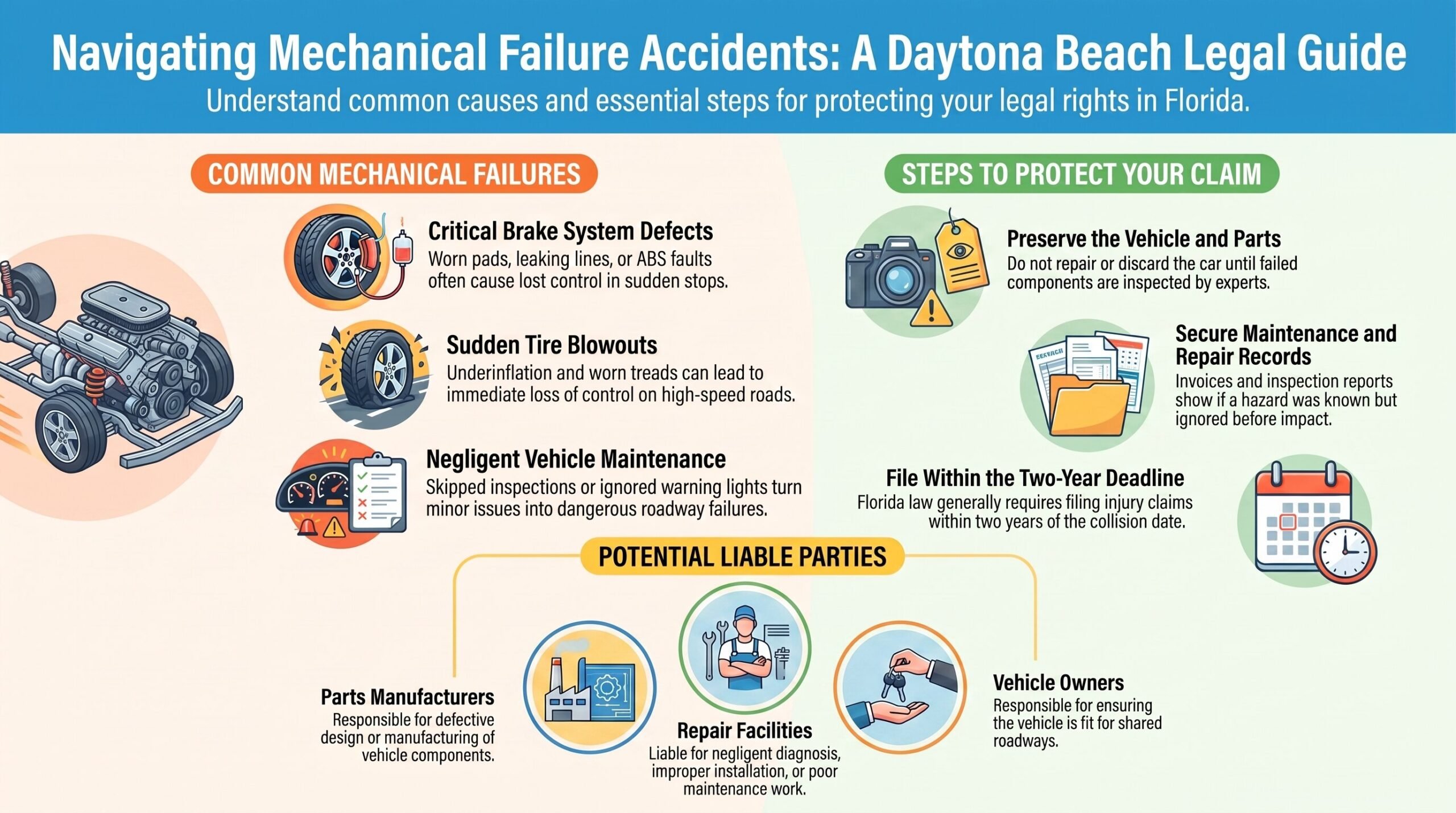
Mechanical failure accidents in Daytona Beach often arise from preventable defects or neglected vehicle systems that compromise safe operation. Common causes include brake system defects, tire blowouts, steering component failures, and faulty vehicle maintenance, each of which can create serious hazards for drivers, passengers, and pedestrians. Identifying the specific cause is crucial, as liability may lie with a vehicle owner, a repair facility, a parts manufacturer, or another responsible party.
Brake System Defects
Brake system defects are among the most serious causes of mechanical failure car accidents in Daytona Beach, particularly in congested traffic, sudden-stop conditions, and high-speed roadway environments. When brakes fail to respond properly, drivers may be unable to prevent a collision, placing passengers, pedestrians, cyclists, and nearby motorists at significant risk.
Common concerns include worn pads, damaged rotors, leaking lines, Brake fluid issues, and ABS module faults that interfere with controlled stopping. These failures may result from poor maintenance, defective parts, improper repairs, or ignored warning signs. In injury cases, careful investigation can help determine whether a driver, repair facility, manufacturer, or another party failed to meet a duty of care. Identifying brake defects supports accountability and helps protect the wider community from preventable harm.
Tire Blowouts
When a tire fails suddenly, a driver may lose control within seconds, especially on busy Daytona Beach roads, bridges, or high-speed routes. Blowouts often result from worn tread, hidden punctures, manufacturing defects, overloaded vehicles, or heat buildup during extended travel. Regular tire pressure checks help identify underinflation, which can weaken sidewalls and increase the risk of separation.
Poor maintenance, including neglected rotation schedules or unresolved wheel alignment issues, may cause uneven wear, leaving tires vulnerable during ordinary driving. After a crash, investigators may examine the tire, service records, vehicle load, and roadway conditions to determine whether preventable neglect or defective equipment contributed. For those serving injured people and families, careful attention to tire evidence can support accountability and promote safer transportation practices throughout the community.
Steering Component Failures
Although guiding systems are built to withstand routine stress, worn or defective components can cause a driver to lose directional control with little warning. Steering racks, tie rods, ball joints, and power steering units may fail due to corrosion, impact damage, manufacturing defects, or fluid loss. When these parts degrade, a vehicle may drift, shake, bind during turns, or respond unevenly to driver input, creating serious danger for passengers, pedestrians, and nearby motorists.
In Daytona Beach collisions, investigators may review steering behavior alongside Brake warning signs and tire tread analysis to determine whether a mechanical issue contributed to the crash. Careful evaluation can help identify responsible parties, preserve evidence, and support injured individuals seeking accountability after preventable harm on Florida roads. Such findings may guide fair recovery efforts.
Faulty Vehicle Maintenance
Overlooking routine service, a vehicle owner or maintenance provider may allow small mechanical problems to develop into dangerous failures on Daytona Beach roads. Worn brake pads, aging tires, leaking fluids, loose belts, and neglected suspension parts can reduce control and place families, workers, and visitors at risk. Proper maintenance supports public safety by ensuring vehicles remain fit for shared roadways.
After a crash, service records, repair invoices, and Vehicle inspection photos may help show whether required care was ignored or performed poorly. These materials can also address insurance denial strategies that attempt to shift blame away from negligent maintenance. A careful review may identify responsible parties, including owners, repair shops, fleet operators, or contractors, when preventable neglect contributes to serious injury or loss. Timely documentation strengthens accountability.


Legal Rights of Daytona Beach Mechanical Failure Car Accident Injury Victims
After a crash caused by mechanical failure, an injured person in Daytona Beach may have the right to pursue compensation from any party whose negligence contributed to the defect or unsafe condition. These rights can protect medical stability, lost income, and the ability to serve family, community, and workplace responsibilities.
Mechanical failure crash victims may pursue compensation to protect recovery, income, and essential life responsibilities.
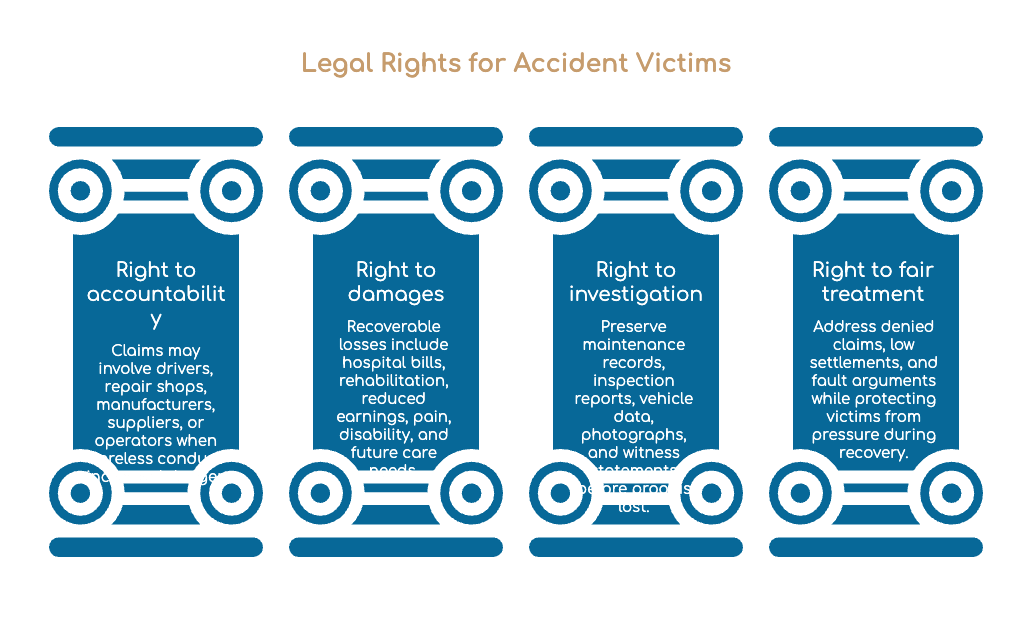
- Right to accountability: A claim may involve a driver, repair shop, manufacturer, parts supplier, or fleet operator when careless conduct increased danger.
- Right to damages: Recoverable losses may include hospital bills, rehabilitation costs, reduced earnings, pain, disability, and future care needs.
- Right to investigation: Timeline evidence preservation can secure maintenance records, inspection reports, vehicle data, photographs, and witness statements before critical proof is lost.
- Right to fair treatment: An Insurance dispute strategy may address denied claims, low settlement offers, fault arguments, and policy issues while protecting the victim from unnecessary pressure during recovery and legal decision-making.
Why Do Mechanical Failure Car Accident Injuries Happen at Daytona Beach?
Why do mechanical failures turn ordinary trips through Daytona Beach into serious-injury incidents? They often occur when preventable risks combine with traffic speed, busy roads, and limited reaction time. A worn tire, a faulty brake system, a defective guidance component, or an electrical malfunction can cause a sudden loss of control, leaving nearby motorists, cyclists, and pedestrians exposed to harm.
Many injury events trace back to maintenance neglect, including skipped inspections, ignored warning lights, or delayed replacement of essential parts. Driver distraction may worsen the danger when a motorist fails to notice unusual sounds, dashboard alerts, or changes in vehicle handling. In other cases, a vehicle recall may reveal a known defect that was not repaired before the crash.
Liability for negligence can involve owners, drivers, repair facilities, parts manufacturers, or dealerships, depending on who failed to exercise reasonable care. Understanding these causes helps communities promote safer travel and better protect vulnerable road users.
What Should You Do After a Daytona Beach Mechanical Failure Car Accident Injury?
After a Daytona Beach mechanical failure car accident injury, the injured person should seek prompt medical care to document injuries and protect health. The vehicle and any failed components should be preserved, because repairs or disposal may compromise important evidence. An attorney should be contacted as soon as possible to assess liability, coordinate inspections, and protect the injured person’s legal rights.
Seek Medical Care
Following a Daytona Beach mechanical failure car accident, an injured person should seek medical care as soon as possible, even when symptoms appear minor or delayed. Prompt Emergency Response can identify concussions, internal injuries, fractures, or soft tissue damage that may worsen without care. Medical professionals also support Documenting Injuries through examinations, diagnostic testing, and written records, which can help clarify the connection between the crash and resulting harm.
Consistent Medical Checkups allow providers to monitor recovery, adjust medications, and recognize complications before they become more serious. When doctors recommend Treatment Plans, the injured person should follow them carefully, including therapy, visits with specialists, and activity restrictions. This diligence protects health, supports accurate records, and demonstrates responsible conduct after an injury, while respecting the needs of family, caregivers, and others affected.
Preserve Vehicle Evidence
Preserving vehicle evidence should begin as soon as medical needs are addressed, because the vehicle’s condition may help explain how the mechanical failure occurred. The damaged vehicle should not be repaired, sold, or discarded until crucial parts can be inspected and photographed. Tires, brakes, steering components, lights, and electronic data may reveal whether a defect, worn part, or improper maintenance contributed to the crash.
Careful photographs from multiple angles, repair records, maintenance receipts, and tow yard information should be gathered promptly. Documentation deadlines may affect the availability of records, especially when insurers, repair facilities, or storage companies become involved. Witness statements from passengers, bystanders, mechanics, or responding officers can also preserve observations about sounds, warning lights, or handling problems before impact occurred in Daytona Beach.
Contact An Attorney
When a crash may involve mechanical failure, contacting an attorney early can help protect evidence, identify responsible parties, and prevent important deadlines from being missed. Counsel can guide the injured person through Emergency contact steps, medical documentation, insurer communications, and preservation of the vehicle before repairs or disposal occur. An attorney may also coordinate a request for a police report, obtain maintenance records, review recall information, and consult qualified experts when a brake, tire, guidance, or other component failure is suspected.
This support can be especially important when multiple parties may share responsibility, including drivers, repair shops, manufacturers, or parts suppliers. Prompt legal guidance allows the injured person and family to focus on recovery, while a professional advocate works to secure facts, protect rights, and pursue accountability with diligence and care.
Critical Evidence in a Daytona Beach Mechanical Failure Car Accident Injury Case
Critical evidence in a Daytona Beach mechanical failure car accident injury case may establish whether poor upkeep, faulty components, or overlooked safety issues contributed to the crash. Key materials often include: 1. maintenance and repair records, 2. vehicle inspection reports, 3. defective parts evidence, and 4. crash scene documentation. Each category can help clarify fault, support injury claims, and preserve a reliable record for legal evaluation.
Maintenance And Repair Records
After a crash involving suspected mechanical failure, maintenance and repair records often provide the clearest account of what was known, what was ignored, and whether the vehicle was safe to operate. These records may show prior complaints, delayed repairs, recurring brake, tire, steering, or lighting issues, and any service performed before the collision. For injured people and the advocates serving them, such evidence helps identify whether a preventable hazard was allowed to remain in service.
A careful review may also reveal maintenance policy violations, including skipped service intervals, incomplete work orders, or repairs performed without qualified oversight. Driver witness statements can further support the records by describing warning signs, prior breakdowns, or reported concerns. In combination, these materials may establish notice, negligence, and responsibility for the resulting harm.
Vehicle Inspection Reports
In a Daytona Beach mechanical failure car accident injury case, vehicle inspection reports may provide direct evidence of a defect, unsafe condition, or missed warning sign that existed before the collision. These reports can show whether brakes, steering, tires, lights, or other safety systems were examined, noted as deficient, or cleared without proper attention.
For those committed to protecting injured people, timely procurement of police reports helps determine whether an officer documented visible mechanical concerns, vehicle condition, or statements from drivers and witnesses. Careful selection of expert inspectors is also important, because a qualified reviewer can interpret inspection findings, compare them with industry standards, and explain whether ignored conditions contributed to the crash. When preserved early, these reports may strengthen accountability and support a clearer path toward fair recovery.
Defective Parts Evidence
When a vehicle component fails before or during a collision, the damaged part may become central evidence in a Daytona Beach mechanical failure car accident injury case. Attorneys, investigators, and mechanical experts may preserve brakes, tires, steering components, airbags, or replacement components to determine whether wear, improper installation, or a defective design contributed to the injury.
Proper handling protects the part from contamination and supports reliable testing. Records showing purchase dates, service history, and part numbers may clarify spare parts liability when an aftermarket or replacement item fails to meet reasonable safety expectations. Manufacturer recall coverage may also reveal whether a known defect required repair before the crash. By identifying the failed component and tracing its source, responsible parties can be evaluated fairly and accurately, with due concern for injured people.
Crash Scene Documentation
How crash-scene conditions are documented can strongly affect the evaluation of a Daytona Beach mechanical-failure car-accident injury case. Photographs of skid marks, debris fields, vehicle positions, fluid leaks, road defects, and traffic controls may help show whether a failed brake, tire, steering component, or other system contributed to the collision. Prompt documentation also supports fair service to injured people by preserving facts before weather, cleanup, or vehicle movement alters the scene.
Witness statement collection should occur as soon as reasonably possible, while memories remain clear and contact information is available. Retrieval of surveillance video from nearby businesses, homes, traffic cameras, or dash cameras may confirm vehicle behavior before impact. Careful scene records help attorneys, insurers, and experts assess responsibility with accuracy, discipline, and respect for those harmed.
Long-Term Effects of Daytona Beach Mechanical Failure Car Accident Injuries
Mechanical failure car accident injuries in Daytona Beach may create lasting consequences, including chronic pain complications that interfere with work, sleep, and daily function. Some victims require extended mobility support and rehabilitation, particularly when fractures, spinal injuries, or joint damage limit physical independence. Emotional trauma effects may also persist, making long-term medical documentation vital in evaluating the full impact of the crash.
Chronic Pain Complications
Chronic pain can become one of the most disruptive long-term consequences of a Daytona Beach mechanical failure car accident, particularly where brake defects, tire blowouts, guiding failures, or other equipment malfunctions cause severe impact forces. Persistent neck, back, shoulder, nerve, or joint pain may interfere with sleep, concentration, family responsibilities, and the ability to consistently serve others.
These conditions often require ongoing evaluation, documented treatment plans, and careful monitoring of Medication Management Issues, especially when pain relievers affect alertness, mood, or daily functioning. Work Restriction Challenges may also arise when injured individuals cannot lift, stand, drive, or perform critical duties without worsening symptoms. In legal claims, chronic pain evidence may include medical records, expert opinions, pain journals, and testimony describing how the injury continues to limit ordinary life.
Mobility And Rehabilitation
Recovery from a Daytona Beach mechanical failure car accident may require extensive mobility support and rehabilitation, especially when sudden brake failure, tire separation, vehicle guidance defects, or other vehicle malfunctions cause fractures, spinal injuries, joint damage, or severe soft tissue trauma. Long-term care may involve Adaptive physical therapy to rebuild strength, improve balance, preserve range of motion, and reduce dependence on others.
Medical providers, caregivers, and community support teams may help coordinate assistive devices, home modifications, and transportation solutions. Wheelchair accessibility planning can be critical when injuries limit standing, walking, bathing, or safely entering a residence. These needs may create lasting expenses for therapy, equipment, ramps, vehicle alterations, and attendant care. Careful documentation helps identify the support required to protect dignity, independence, and daily function.
Emotional Trauma Effects
After a serious collision caused by brake failure, tire separation, handling defects, or another vehicle malfunction, emotional trauma may persist long after physical injuries begin to recover. Victims may experience anxiety in traffic, intrusive memories, irritability, or avoidance of routine travel. Sleep disruption can weaken concentration, slow recovery, and strain family responsibilities, especially when nightmares require consistent clinical support.
In Daytona Beach, these effects may interfere with work, caregiving, medical appointments, and participation in community life. A careful injury evaluation should consider counseling needs, medication management, and the impact of trauma on daily functioning. Documentation from mental health providers, family observations, and employment records can help show the full scope of harm, ensuring that legal claims reflect both visible injuries and enduring psychological consequences.
Proving Liability in Daytona Beach Mechanical Failure Car Accident Injury Cases
A mechanical failure accident in Daytona Beach requires a careful liability analysis because fault may extend beyond the driver who lost control of the vehicle. Responsibility may involve a negligent maintenance provider, a careless vehicle owner, a parts manufacturer, or another party whose conduct allowed an unsafe condition to remain uncorrected. Establishing liability often requires service records, inspection findings, recall information, crash data, and expert evaluation of the failed component.
Attorneys and investigators serving injured people must also consider how the evidence may be challenged. Comparative fault defenses may claim the injured person contributed to the crash through speed, distraction, or failure to react. Eyewitness credibility issues can also affect whether testimony supports the physical evidence. A thorough investigation compares witness accounts with photographs, roadway marks, electronic data, and repair history. This disciplined approach helps identify responsible parties, preserve accountability, and support a claim grounded in reliable proof.
Dealing With Insurance Companies After a Daytona Beach Mechanical Failure Car Accident Injury
When a mechanical failure contributes to a Daytona Beach car accident, insurance companies often examine the claim from several angles before accepting responsibility. Adjusters may question whether poor maintenance, defective parts, driver conduct, or a repair provider contributed to the crash. Careful communication is especially noteworthy when providing insurance statement responses that could affect fault assessments.
Injured parties are often asked to submit recorded medical bills, photographs, repair records, and service histories. These materials help clarify the connection between the failure and the injuries suffered. An independent vehicle inspection may also help guide the claim by identifying brake defects, tire separation, steering failure, or other mechanical issues.
Insurers may also dispute damage calculations, particularly when future care, lost income, or vehicle replacement costs are involved. A careful, service-focused legal approach helps advance the injured person’s interests while promoting accountability, accuracy, and fair treatment in insurer negotiations following the collision.
What to Expect During a Daytona Beach Mechanical Failure Car Accident Injury Claim Process
A Daytona Beach mechanical failure car accident injury claim typically begins with an initial claim evaluation, where the facts, injuries, and available insurance coverage are reviewed. The process then moves into evidence collection and liability investigation, including vehicle inspections, maintenance records, crash reports, and witness statements. Settlement negotiations may follow once damages and fault are assessed, although the timeline often depends on the intricacy of the mechanical defect and the parties involved.
Initial Claim Evaluation
Before a Daytona Beach mechanical failure car accident injury claim can move forward, the initial evaluation focuses on identifying how the failure occurred, who may be legally responsible, and whether the available evidence supports a viable claim. This review considers the injured person’s account, the vehicle’s condition, reported maintenance history, and any early signs of defective parts or negligent service.
Attorneys also assess potential issues with witness statements, such as inconsistent observations or limited knowledge of the vehicle problem. The evaluation may address whether liability could involve a driver, repair shop, manufacturer, or parts distributor. A careful insurance dispute strategy is also considered, especially when insurers attempt to shift blame or question causation. This stage helps determine whether pursuing compensation can responsibly serve the injured person’s recovery.
Evidence Collection Process
Once the initial claim evaluation identifies potential sources of liability, the evidence collection process begins with preserving information that may explain the mechanical failure and connect it to the collision. Attorneys may obtain repair records, inspection reports, photographs, vehicle data, medical documentation, and police reports before evidence is altered or lost. This careful gathering supports the injured person’s need for fair treatment while helping protect others from similar harm.
Witness statement gathering may also be coordinated early, while memories remain clear and details can be documented accurately. Statements from passengers, bystanders, mechanics, or first responders may clarify the vehicle’s condition before impact. Organized evidence then informs an Insurance negotiation strategy, allowing counsel to present a clear, documented claim focused on damages, safety concerns, and accountability.
Liability Investigation Steps
As the liability investigation moves forward, the focus shifts from collecting available records to identifying who may be legally responsible for the mechanical failure and resulting crash. Investigators may review repair histories, maintenance schedules, recall notices, inspection reports, and vehicle component data to determine whether negligence occurred.
Witness statement collection helps clarify how the vehicle behaved before impact, whether warning signs appeared, and how other drivers responded. Dashcam video preservation may also be crucial, particularly when footage shows braking issues, tire separation, steering loss, or evasive actions. Each potential party, including drivers, repair facilities, parts manufacturers, fleet operators, and vehicle owners, may be evaluated carefully. This process supports injured people by building accountability, protecting facts, and helping guide a responsible claim forward.
Settlement Negotiation Timeline
During the settlement negotiation phase, a Daytona Beach mechanical failure car accident injury claim typically shifts from investigation and documentation to a structured exchange of liability arguments, evidence of damages, and compensation demands. The timeline often begins after medical treatment stabilizes and repair, inspection, and maintenance records are reviewed. Counsel may prepare a demand package, then evaluate the insurer’s response based on comparative negligence rules, settlement impact, and available evidence of defect or negligent maintenance.
Negotiation strategy planning, insurance leverage may shape each step, especially when multiple parties share responsibility, such as drivers, repair shops, manufacturers, or fleet owners. Counteroffers can continue for weeks or months. A service-focused legal team monitors deadlines, protects the injured person’s interests, and recommends settlement only when the proposed resolution fairly reflects documented losses.
Compensation for Daytona Beach Mechanical Failure Car Accident Injury Damages
When a mechanical failure causes a collision in Daytona Beach, injured parties may be entitled to compensation for the full range of losses connected to the crash. A claim may focus on the driver who failed to maintain the vehicle, a repair facility that performed careless work, or a manufacturer linked to defective parts and product recalls. Attorneys often review maintenance records, inspection reports, crash data, and witness statements to identify every responsible party.
Compensation may also depend on Comparative negligence, because fault can be shared among drivers, service providers, or vehicle owners. Insurance disputes may arise when carriers question the cause of the failure or the severity of harm. In limited situations, medical malpractice may affect recovery if negligent treatment worsens crash-related injuries. Careful case development helps protect the injured person’s right to fair compensation while supporting accountability that improves safety for the broader Daytona Beach community.
Economic vs Non-Economic Damages in Daytona Beach Mechanical Failure Car Accident Cases
In Daytona Beach mechanical failure car accident cases, damages are commonly divided into economic losses and non-economic harm. Economic losses may include medical bills, lost income, repair costs, and future expenses, while non-economic damages address pain, emotional distress, and reduced quality of life. Proving these claims requires clear documentation, credible testimony, and careful valuation tied to the facts of the crash.
Economic Losses Explained
After a mechanical failure car accident in Daytona Beach, economic losses refer to the measurable financial harm caused by the crash. These losses may include emergency care, hospital treatment, rehabilitation, vehicle repair, replacement transportation, lost wages, and reduced earning capacity. Accurate records help attorneys, insurers, and courts understand the practical burdens placed on an injured person and the household depending on that person’s stability.
Helpful proof may include invoices, pay statements, repair estimates, towing receipts, prescription records, and employer letters. Insurance claim timelines can affect when these materials should be gathered and submitted, making prompt organization important. A DMV documentation checklist may also support orderly reporting, title issues, and crash-related records. Careful documentation allows responsible parties to evaluate reimbursement fairly and promotes service-centered accountability.
Non-Economic Harm Valuation
Beyond the bills and wage records, non-economic harm in a Daytona Beach mechanical failure car accident concerns the personal consequences that cannot be measured by receipts alone. These losses may include pain, anxiety, loss of independence, disrupted family roles, and diminished enjoyment of daily life. Valuation requires careful judgment, because the impact often varies with the injury, recovery path, and personal responsibilities affected.
Emotional distress proof may help frame the seriousness of these harms, particularly when fear, sleep disruption, or trauma changes ordinary living. A service-minded legal team considers how these effects influence caregiving, work relationships, and community participation. During trial strategy planning, non-economic damages must be presented with dignity, consistency, and restraint so that the decision-maker can understand human loss without exaggeration or speculation.
Proving Damage Claims
When a mechanical failure causes a collision, proving damages requires a clear separation between financial losses and the personal harm that follows the crash. Economic damages may include medical bills, lost wages, repair costs, and future care needs, supported by records, invoices, and employment documentation. Non-economic damages address pain, emotional distress, reduced mobility, and loss of enjoyment, which often require consistent medical notes and credible personal accounts.
Witness statement basics help confirm how the defect contributed to the crash and to the injured person afterward. Photos and timeline accuracy also support the claim by showing vehicle condition, injuries, roadway evidence, and recovery progress in proper sequence. Careful documentation allows advocates to serve injured clients with fairness and dignity, and to present evidence that reflects both measurable costs and human consequences.
When a Daytona Beach Mechanical Failure Car Accident Injury Case Goes to Trial vs Settlement
Although many Daytona Beach mechanical failure car accident injury cases resolve through settlement, some proceed to trial when liability, causation, or damages remain disputed. Settlement may serve injured people efficiently by reducing delay, expense, and uncertainty. Counsel may use Insurance negotiation strategies to present maintenance records, expert opinions, medical evidence, and loss documentation in a clear, persuasive manner. Settlement timelines often depend on treatment progress, insurer evaluation, evidence collection, and the willingness of all responsible parties to engage in reasonable discussions.
Trial becomes more likely when an insurer denies responsibility, minimizes injuries, or contests whether a defect caused the crash. Trial preparation tasks may include retaining experts, preparing witnesses, organizing exhibits, reviewing repair histories, and developing testimony for the court.
Attorneys may also explain attorney fee structures so clients understand costs, contingency arrangements, and litigation expenses. This guidance helps injured individuals pursue accountability while preserving dignity, service, and informed decision-making throughout the process.
Florida Laws That May Affect Your Daytona Beach Mechanical Failure Car Accident Case
Florida law can shape a Daytona Beach mechanical failure car accident case from the earliest investigation through settlement negotiations or trial. Several rules may guide the evaluation of responsibility, especially when injured people need practical support and careful advocacy.
- Comparative Negligence may reduce recovery if an injured person is found partly responsible, for example, by ignoring warning lights or failing to address overdue repairs.
- Fault Apportionment allows liability to be divided among drivers, vehicle owners, mechanics, manufacturers, or other responsible parties based on their roles.
- Governmental Immunity may affect claims involving public vehicles, road maintenance, or agency decisions, often requiring special analysis before pursuing accountability.
- Municipal Liability may arise when a city-owned vehicle, public employee, or unsafe public maintenance practice contributes to the crash.
These laws help determine evidence priorities, available claims, and negotiation strategy, while encouraging a case approach that respects injured clients and the broader community they depend upon.
The Statute of Limitations for Daytona Beach Mechanical Failure Car Accident Injury Cases
After a mechanical failure crash in Daytona Beach, the statute of limitations can determine whether an injured person still has the legal right to seek compensation. In Florida, injury claims generally must be filed within 2 years of the collision. If the deadline passes, a court may dismiss the case, regardless of the severity of the harm or the strength of the evidence.
This time limit matters when a vehicle defect, poor maintenance, or failed repair may have contributed to the crash. Records can disappear, vehicles may be altered, and witnesses may become unavailable. Prompt attention also helps preserve information needed to address Comparative negligence defenses, which may allege that the injured person shared responsibility.
Separate insurance company deadlines may also apply, including notice requirements under a policy. Those deadlines do not replace the court filing limit, but they can affect access to benefits intended to support recovery and continued care.
How a Daytona Beach Mechanical Failure Car Accident Lawyer Can Help You
A Daytona Beach mechanical failure car accident lawyer can help identify the cause of the crash, preserve critical evidence, and determine which parties may be legally responsible. This support allows injured people and their families to focus on recovery, caregiving, and community obligations while the legal issues are handled with care.
A lawyer can help protect evidence, clarify responsibility, and support recovery after a crash caused by a mechanical failure.
- Evidence review: The lawyer may examine repair records, inspection reports, recall notices, and damaged vehicle parts to connect a defect or neglected maintenance to the collision.
- Claim organization: Careful review may uncover errors in insurance documentation that could delay or weaken a claim.
- Liability assessment: The lawyer may address vehicle ownership disputes, maintenance responsibility, employer involvement, or possible fault by repair shops and manufacturers.
- Case preparation: Professional handling includes collecting witness statements, documenting damages, and monitoring legal claim deadlines.
Through these efforts, the lawyer provides structured guidance, protects the claim, and supports fair accountability.
When to Contact a Daytona Beach Mechanical Failure Car Accident Lawyer
When a crash may involve brake failure, tire defects, handling problems, or neglected maintenance, legal guidance should be sought as soon as the injured person’s immediate medical needs are addressed. Early contact helps preserve evidence before vehicles are repaired, altered, stored, or destroyed. This timing is especially important when service records, recall notices, inspection reports, or parts histories may reveal whether preventable danger contributed to the collision.
A lawyer may be contacted after emergency treatment, once the injured person or a trusted representative can share basic facts. Prompt documentation after the accident, including photographs, witness information, tow yard details, and repair communications, can support a clearer understanding of what occurred.
Concerns about Garage safety, recent mechanical work, or repeated vehicle problems should also be noted. Quick action allows responsible parties to be identified while records remain available, helping protect the injured person’s interests and promoting accountability in circumstances where safer maintenance practices may have prevented harm.
Why You Need an Experienced Daytona Beach Mechanical Failure Car Accident Lawyer
Because mechanical failure claims often involve hidden evidence and multiple responsible parties, experienced legal representation can be essential to building a complete case. A Daytona Beach attorney can examine maintenance records, repair invoices, recall notices, inspection reports, and crash evidence to determine whether negligence contributed to the collision. This work may identify fault by a driver, repair shop, parts manufacturer, dealership, fleet operator, or maintenance contractor.
Experienced counsel also helps protect injured people from avoidable errors that may weaken recovery efforts. Insurance documentation mistakes can delay claims, reduce compensation, or create disputes about the cause of the crash. Roadside assistance disputes may also arise when towing records, service calls, or emergency repairs become crucial evidence. A lawyer can organize these details, communicate with insurers, preserve proof, and pursue accountability.
For those committed to caring for injured community members, skilled legal guidance supports fair outcomes and helps ensure that responsible parties are held accountable for preventable harm.
How to Choose the Right Daytona Beach Mechanical Failure Car Accident Lawyer for Your Case
Selecting the right Daytona Beach mechanical failure car accident lawyer requires careful attention to the attorney’s experience with evidence-heavy vehicle defect and maintenance cases. Sound Client selection criteria include prior handling of brake failures, tire defects, negligent repairs, and inadequate fleet maintenance. The lawyer should understand how to preserve repair records, inspection reports, black box data, and expert testimony before essential evidence is lost.
A thoughtful review should also consider Injury claim costs, including medical care, lost income, rehabilitation, and long-term support needs. A Free case evaluation can help an injured person determine whether the lawyer’s approach reflects both legal strength and respect for the client’s recovery goals.
Attorney communication style is equally important. The lawyer should explain deadlines, case risks, and settlement options clearly, while remaining responsive to questions. A well-chosen attorney helps injured clients pursue accountability in ways that support their stability, dignity, and future care.
About The Law Offices of Anidjar & Levine
For injured motorists facing the consequences of a mechanical failure crash, The Law Offices of Anidjar & Levine provides legal representation focused on accountability, evidence preservation, and client support.
The firm serves clients in Daytona Beach by examining how defective parts, poor maintenance, or negligent repairs may have contributed to a collision.
Its legal team works to build claims through careful timelines of evidence, prompt vehicle inspections, and organized medical documentation.
These steps help clarify liability, connect injuries to the crash, and protect the client’s ability to seek fair compensation.
The firm also develops a Trial strategy when negotiations do not produce an appropriate resolution.
The Law Offices of Anidjar & Levine emphasizes responsive service for people facing disruption, pain, and financial pressure.
By handling communications, insurance demands, and case preparation, the firm allows injured clients and their families to focus on recovery while pursuing justice through disciplined legal advocacy.
Frequently Asked Questions
Can Recalls Affect My Daytona Beach Mechanical Failure Accident Case?
Yes, recalls can notably affect a mechanical failure accident case. Recall timing may show whether a manufacturer, dealer, or vehicle owner knew, or should have known, about a dangerous defect before the crash. If repairs were ignored, fault may shift or expand. Liability limits may still depend on insurance coverage, statutory rules, and available evidence. Careful review helps injured parties serve justice, protect others, and pursue accountable compensation.
What if the Failed Vehicle Part Was Aftermarket?
If the failed component was aftermarket, the investigation should examine its design, manufacture, installation, compatibility, and maintenance history. Aftermarket parts can create liability disputes involving the part maker, installer, seller, vehicle owner, or maintenance provider. Records, receipts, expert inspections, and service manuals may clarify fault. Those seeking to protect injured people should promptly preserve the vehicle and its parts, since the condition of the evidence often determines whether responsibility can be proven.
Can Poor Repairs Make a Mechanic Liable for My Crash?
Yes, poor repairs can make a mechanic liable when careless work causes or contributes to a crash. Liability may arise from negligent diagnosis, improper installation, failure to meet safety standards, or a breach of warranty. A repair invoice can identify the work performed, parts used, and responsible shop. Those serving injured persons should preserve records, vehicle components, photographs, and expert findings to clearly support causation, fault, and recoverable damages.
Should I Preserve the Damaged Vehicle After the Accident?
Yes, the damaged vehicle should be preserved after the accident, because it may contain crucial evidence of mechanical failure, repair defects, or impact forces. A neutral storage location helps prevent alteration, and its importance cannot be overstated for documenting visible damage and vehicle condition. Timely insurance notifications should be made, yet inspections should be coordinated carefully. Preserving evidence supports fair accountability, protects the injured, and serves the broader interest of responsible safety practices.
Do Mechanical Failure Claims Require Expert Witnesses?
Yes, mechanical failure claims often require expert witnesses to establish failure causation, identify defective parts, and explain how the defect contributed to the crash. Engineers, mechanics, or accident reconstruction professionals may review maintenance records, inspect damaged components, and provide objective opinions. Because these claims can affect injured people, passengers, and the public, careful consultation with an attorney helps preserve evidence, select qualified experts, and present findings in a clear, credible manner.
—————————
Mechanical failure accidents can leave victims facing serious injuries, financial losses, and intricate liability questions.
A Daytona Beach Car Accident Lawyer can investigate the cause, identify responsible parties, and pursue fair compensation through a well-supported claim.
The Law Offices of Anidjar and Levine provides informed legal guidance, careful case preparation, and dedicated representation for injured clients.
Those affected should seek legal support promptly to protect their rights and enhance their prospects for recovery.