The Law Offices of Anidjar and Levine can investigate how a crash occurred and identify drivers, vehicle owners, employers, or other parties who may share responsibility. Evidence such as crash reports, photographs, witness accounts, and medical records can help connect negligent conduct to injuries. Florida’s comparative negligence rules may reduce compensation based on an injured person’s share of fault, while available insurance coverage can affect recovery. For broader legal guidance after an injury, a Daytona Beach Personal Injury Lawyer may help explain your options, evidence needs, and next steps.
Main Takeaways
- A Daytona Beach car accident lawyer can investigate which drivers, vehicle owners, employers, or other parties may share responsibility.
- Crash reports, photos, witness statements, vehicle data, and accident reconstruction may help establish how the collision occurred.
- Florida’s comparative negligence rules may reduce compensation based on an injured person’s share of fault.
- Even if you contributed to a crash, you may have a claim when another party also caused your injuries.
- An attorney can review insurance coverage, including possible uninsured motorist benefits, deadlines, and options during a free consultation.


How We Can Help With Your Daytona Beach Car Accident At-Fault Parties Injury Claim
When a car accident in Daytona Beach causes serious injuries, identifying every at-fault party can be essential to pursuing compensation. A legal team can help injured people and their families manage the claim while they focus on medical care and recovery. Counsel may review available records, communicate with insurers, organize supporting documents, and explain important deadlines and options in clear terms.
Each claim requires careful attention to the client’s circumstances and priorities. Attorneys can coordinate with medical providers and other professionals as needed, respond to insurer requests, and ensure that relevant information is presented accurately. They can also keep clients informed about case developments and help them make considered decisions at each stage.
A Free consultation gives prospective clients an opportunity to discuss their concerns and learn how legal representation may assist. Many firms handle injury claims on a contingency fee basis, meaning attorneys’ fees are generally collected only if compensation is recovered. This arrangement can make experienced legal support more accessible to people facing unexpected expenses and uncertainty.
OUR CONSULTATIONSARE FREE
START YOUR FREE CASE REVIEW

Understanding Daytona Beach Car Accident At-Fault Parties Injury Cases
Determining who is legally responsible for a Daytona Beach car accident requires examining how the collision occurred and how each party’s actions contributed to the injuries. This review may include drivers, vehicle owners, employers, or other entities whose conduct or legal duties affected the outcome. Evidence such as crash reports, photographs, witness accounts, and medical records can help clarify responsibility and connect injuries to the collision.
Florida applies Comparative negligence principles when more than one party may have contributed to an accident. An injured person’s recovery may be reduced based on that person’s share of fault, and a finding of responsibility can affect the available compensation. Each case, as a result, requires careful evaluation of the relevant evidence and applicable insurance coverage.
When an at-fault driver lacks sufficient coverage, uninsured motorists benefits may provide another potential source of recovery, depending on the policy. Understanding these issues can help injured people make informed decisions, protect their interests, and pursue accountability while considering the needs of everyone affected.
Common Causes of Daytona Beach Car Accident At-Fault Parties
Common causes of Daytona Beach car accidents include distracted driving, speeding, and aggressive driving, which can impair a driver’s attention or control. Impaired driving also creates serious risks by reducing judgment and reaction time. Failure to yield may lead to collisions when drivers disregard traffic signals, signs, or the right-of-way.
Distracted Driving
Distracted driving is a significant cause of preventable car accidents in Daytona Beach, where a driver’s attention may be diverted by a phone, navigation system, passengers, or activity outside the vehicle. Even brief lapses can prevent a driver from noticing a pedestrian, cyclist, or changing traffic conditions. Texting, reaching for an object, and adjusting controls may take a driver’s eyes, hands, or focus away from the road. Hands-free phone use can reduce manual handling, but conversations may still divide attention. In-car infotainment distractions, including complicated menus and touchscreens, can also interfere with safe vehicle operation. When a collision occurs, evidence such as phone records, witness accounts, and vehicle data may help establish whether distraction contributed. Identifying the cause can support accountability and help injured people pursue appropriate compensation.
Speeding and Aggressive Driving
When drivers exceed safe speeds or engage in aggressive behavior, they have less time to respond to traffic and may cause serious crashes in Daytona Beach. Speed Limit Violations can increase stopping distances and make it harder to maintain control, especially near intersections, work zones, and busy commercial areas. A driver who travels too fast for road or weather conditions may be considered at fault when that conduct contributes to a collision.
Road Rage Behavior, including tailgating, unsafe passing, and deliberate lane blocking, can also place other road users at risk. These actions may trigger sudden braking or evasive actions that lead to crashes involving several vehicles. Investigators may review witness accounts, roadway evidence, and available video to determine how a driver’s conduct contributed. Identifying responsible parties can help injured people pursue appropriate compensation and support their recovery.
Impaired Driving
Impaired driving can prevent a motorist from judging distances, maintaining lane position, or responding promptly to changing traffic conditions. Alcohol, prescription medications, illegal drugs, and combinations of substances may affect coordination, attention, and decision-making. A driver’s impairment may not be obvious immediately, so investigators often review available evidence, including officer observations, witness accounts, toxicology results, and vehicle records. Field sobriety tests may help officers assess suspected impairment, while chemical testing can provide additional evidence, subject to applicable legal requirements. In a civil claim, evidence of impairment may help establish negligence and clarify how a collision occurred. Ignition interlocks can restrict a vehicle’s operation for certain drivers after impaired-driving offenses, but they do not prevent every incident. Careful documentation can help injured people pursue accountability and support safer roads throughout the Daytona Beach community.
Failure to Yield
Failure to yield occurs when a driver does not give another road user the right-of-way required by traffic laws or roadway conditions. In Daytona Beach, these violations may cause collisions at busy intersections, when entering traffic, or while turning across another vehicle’s path. Intersection right-of-way rules establish which road user must proceed and which must wait, including at signals, stop signs, and uncontrolled crossings. Drivers who disregard these rules can place motorists, cyclists, and pedestrians at risk. Left turn yielding duties require turning drivers to wait for approaching traffic that presents an immediate hazard, unless a signal or other lawful instruction permits the turn. Investigators may review traffic controls, witness accounts, vehicle damage, and available video to determine whether a failure to yield contributed to the crash and resulting injuries.
Don’t Wait. Call Our Florida Personal Injury Lawyers Now!


Legal Rights of Daytona Beach Car Accident At-Fault Parties Injury Victims
Even a driver found responsible for a Daytona Beach car accident may have legal rights if the crash caused injuries. Fault does not automatically prevent an injured person from seeking compensation. Florida’s comparative negligence rules may reduce recovery based on the injured party’s share of responsibility, while still allowing a claim when another person or entity also contributed to the collision. These Comparative negligence rights can help clarify available options.
An injured driver may consider several lawful steps:
- Request medical care and keep records of treatment, expenses, and work absences.
- Review available insurance coverage, including uninsured motorist options when applicable.
- Consult an attorney to assess fault allocation, deadlines, and potential claims.
A person who caused a crash may still pursue benefits under applicable insurance policies, subject to policy terms and legal limits. Prompt, accurate reporting can help protect a claim, but statements about fault should be handled carefully. Legal guidance can also help make certain that any recovery supports the injured person’s needs without disregarding the rights of others involved.
Why Do Daytona Beach Car Accident At-Fault Parties Injuries Happen?
Injuries to at-fault drivers in Daytona Beach can result from the same forces that harm other people in a collision, including sudden impact, vehicle intrusion, or a secondary crash. The cause of a collision does not determine who sustains physical harm; occupants may be injured when a vehicle strikes a barrier, rolls over, or is struck by another car.
Driver error, such as speeding, distraction, impaired driving, or following too closely, can contribute to crashes and the injuries that follow. Road conditions may also play a role. Wet pavement, poor visibility, debris, or uneven surfaces can reduce control and increase impact force. Tire blowouts may cause a driver to lose control, while vehicle defects, including faulty brakes or steering components, can interfere with safe operation.
In some collisions, several factors combine. Understanding how these circumstances contributed to a crash can help clarify its causes and the harm suffered by everyone involved, including the driver found at fault.
Don’t Wait. Call Our Florida Personal Injury Lawyers Now!
What Should You Do After a Daytona Beach Car Accident At-Fault Party Injury?
After a Daytona Beach crash, those involved should first check for injuries and contact emergency services if anyone needs medical attention. They should report the collision to law enforcement and provide accurate information about what occurred. When it is safe, they should document the scene by taking photographs and gathering witness contact details.
Check for Injuries
When a collision occurs, checking for injuries should be the first priority, even if the damage appears minor. A driver should assess personal condition and, when safe, check passengers and others involved without moving anyone who may have a serious injury. Emergency symptom screening should include difficulty breathing, heavy bleeding, confusion, severe pain, weakness, or loss of consciousness. If any of these symptoms are present, emergency medical assistance should be requested immediately. People should remain calm, avoid unnecessary movement, and follow instructions from trained responders. Hidden injury warning signs, including headache, dizziness, numbness, or increasing discomfort, may develop after the initial shock subsides. Anyone experiencing symptoms should seek prompt medical evaluation, even when they seem mild. Careful attention to each person’s condition can help protect everyone’s health and support timely treatment.
Report the Crash
If anyone is injured in a Daytona Beach car accident, the crash should be reported promptly to law enforcement. Calling 911 allows dispatchers to send officers and emergency medical personnel when needed. Even if injuries appear minor, an injured person may require assessment, and an official response can help establish an accurate account of the incident. Drivers should remain at the scene unless emergency care or safety concerns require otherwise. They should cooperate with responding officers, provide truthful information, and avoid speculating about fault. When it is safe and appropriate, parties should Exchange Information, including names, contact details, insurance information, and vehicle registration. They should notify authorities of any hazards or immediate safety concerns that could affect other road users. A police report can support later insurance or legal review.
Document the Scene
Once immediate medical and safety needs are addressed, documenting the scene can help preserve details that may become difficult to recall. If conditions permit, an injured person or another responsible individual can photograph vehicle positions, damage, traffic signals, skid marks, and visible injuries. Images should capture the broader roadway as well as specific details, without placing anyone in danger or obstructing emergency responders.
Record the time, location, direction of travel, and any relevant weather conditions, such as rain, glare, or poor visibility. Note Roadway debris, road hazards, and nearby construction that could help explain how the collision occurred. Names and contact information for witnesses may also assist those evaluating the incident. These observations can support accurate reporting and help protect everyone affected. Preserve original photographs and notes, and share them with appropriate representatives when requested.
Critical Evidence in a Daytona Beach Car Accident At-Fault Parties Injury Case
Evidence can help establish how a Daytona Beach crash occurred, who may be responsible, and the extent of resulting injuries. Records and accounts gathered promptly may preserve details that become difficult to verify later.
Important sources include:
- Police crash reports and scene photographs
- Witness statements describing the collision
- Medical records documenting injuries and treatment
Police Crash Reports
After a Daytona Beach car accident, the police crash report can provide an important early record of the collision and the parties involved. It may identify drivers, passengers, witnesses, responding officers, and the reported location and time. The report can also summarize statements and note citations or preliminary observations, but it does not determine legal fault on its own. Insurers and attorneys may compare its details with other reliable evidence when evaluating responsibility and injury claims. Report retrieval generally requires requesting the document from the agency that investigated the crash, subject to applicable access rules and processing times. If factual information appears inaccurate or incomplete, report corrections may be requested through the investigating agency. Prompt review can help preserve accurate records and support fair, informed decisions for everyone affected by the collision.
Scene Photographs
Photographs taken at a Daytona Beach car accident scene can preserve details that may change or disappear as vehicles are moved and roadways are cleared. Images may document vehicle positions, damage, skid marks, debris, traffic signals, road conditions, and nearby signs. These details can help clarify how a collision occurred and identify conduct that may have contributed to injuries. Clear Camera Angles can show the scene from multiple angles, while close-up images can capture specific damage or roadway marks. Photo Metadata, including date, time, and location information when available, may help establish when and where images were captured. Photographs should be preserved in their original form, with copies stored securely. Accurate visual evidence can support a careful review of responsibility and help those affected pursue fair treatment and appropriate compensation.
Witness Statements
Scene photographs can document physical details, while witness statements may explain what people observed before, during, and after a Daytona Beach car accident. Independent accounts can help clarify vehicle movements, traffic signals, road conditions, and actions taken by those involved. Witnesses may include pedestrians, nearby drivers, passengers, or business employees who saw the collision or its immediate aftermath. Their observations can help determine which parties may have contributed to the crash and whether the accounts are consistent with the available evidence. Witness credibility depends on factors such as the person’s vantage point, ability to perceive events, and willingness to provide an accurate account. Prompt statement preservation can reduce the risk of memories fading or contact information being lost. A careful record may support a fair review of responsibility and help those affected pursue appropriate remedies.
Medical Records
Medical records provide a detailed account of injuries and treatment following a Daytona Beach car accident, helping connect the reported harm to the collision. They can show when symptoms began, what diagnoses were made, and how care progressed. A Medical Record Chronology organizes emergency visits, examinations, referrals, and follow-up treatment by date, making changes in a person’s condition easier to assess.
Provider Documentation may include examination findings, imaging results, treatment recommendations, and notes about reported symptoms. These records can help clarify whether an injury is consistent with the crash and whether other factors may have contributed. Accurate, complete records also support a fair evaluation of damages and the care required. Promptly obtaining and preserving relevant medical information helps attorneys, insurers, and decision-makers review the evidence responsibly and understand the injured person’s needs.
Long-Term Effects of Daytona Beach Car Accident At-Fault Parties Injuries
Injuries caused by an at-fault driver may continue to affect a person long after the initial treatment ends. Chronic pain and lasting mobility limits can interfere with daily activities, employment, and independence. Emotional trauma may also persist, making it important to evaluate the full, long-term impact of the collision.
Chronic Pain
Chronic pain can persist long after a Daytona Beach car accident, even when visible injuries have recovered. Ongoing discomfort may affect sleep, concentration, mood, and a person’s ability to meet work or family responsibilities. For those who regularly support others, these effects can make dependable caregiving more difficult, underscoring the importance of appropriate evaluation and treatment.
Chronic Pain Management may involve coordinated care, prescribed medication, physical therapy, or other approaches selected by qualified providers. Keeping records of symptoms, appointments, treatment recommendations, and related expenses can help clarify how the injury affects daily life. Identifying flare-up triggers, such as prolonged activity, stress, or certain movements, may also help patients and clinicians adjust care plans. Persistent pain should not be dismissed simply because an injury appears to have resolved. Medical documentation can support treatment decisions and help establish the ongoing consequences of the collision.
Lasting Mobility Limits
Lasting mobility limits after a Daytona Beach car accident can make walking, climbing stairs, driving, or completing routine tasks difficult. These restrictions may result from fractures, spinal injuries, nerve damage, or lasting weakness, and their effects can continue after initial treatment ends. A person may need ongoing rehabilitation, home modifications, or assistance with daily activities to maintain safety and independence. Assistive technology, including mobility aids and adapted devices, can support movement and help individuals participate in work, family responsibilities, and community life. Accessible transportation may also be necessary for medical appointments, employment, and other vital activities when driving is no longer practical. Documented limitations and related expenses can help establish the long-term impact of an accident injury. Legal guidance can clarify options for pursuing compensation for continuing care and mobility-related needs.
Emotional Trauma
Beyond physical limitations, a Daytona Beach car accident may leave an injured person with emotional trauma that persists long after medical treatment begins or ends. Survivors may experience anxiety, sleep disruption, difficulty concentrating, or fear of driving. In some cases, post-traumatic stress symptoms interfere with work, relationships, and everyday responsibilities. These effects can arise even when physical injuries appear to be recovering, and they may require care from qualified mental health professionals. Family members and caregivers can support emotional recovery by listening without judgment, helping with practical needs, and encouraging consistent treatment. When another party’s negligence caused the collision, records of counseling, symptoms, and related expenses may help document the harm. A careful assessment can account for both visible injuries and lasting psychological effects when evaluating the full impact of the crash.
Proving Liability in Daytona Beach Car Accident At-Fault Parties Injury Cases
Proving liability in a Daytona Beach car accident case requires evidence that another party’s negligence caused the collision and resulting injuries. Establishing fault often begins with examining how each person acted before impact. Negligence standards generally require proof that a party failed to use reasonable care and that this failure contributed to the harm.
Useful evidence may include the crash report, photographs, vehicle damage, witness statements, and available traffic or surveillance footage. Medical records can document injuries and help connect them to the collision. In complicated cases, accident reconstruction experts may analyze vehicle movement, road conditions, and impact patterns. Prompt preservation of evidence can support a fair review and protect the interests of those affected.
Florida’s comparative fault rules may reduce a claimant’s recovery if that person also contributed to the crash. Each party’s conduct consequently matters. A careful investigation can identify responsible drivers or other liable parties, clarify disputed facts, and provide a sound basis for pursuing accountability.
Dealing With Insurance Companies After a Daytona Beach Car Accident At-Fault Parties Injury
After a Daytona Beach car accident, insurance companies may contact injured people to discuss the collision, assess responsibility, and evaluate potential claims. Their representatives may request statements, medical details, or permission to review records. Injured people can respond carefully, provide accurate information, and avoid guessing about events or injuries that remain uncertain. Recorded calls may preserve statements for later review, so a person should understand the questions and avoid speculation before responding.
An insurer may offer an early payment before the full extent of injuries, treatment needs, or lost income is known. Accepting a settlement or signing a release can affect the ability to seek further compensation. Before making decisions, injured people may review the offer, supporting documents, and applicable policy limits with a qualified attorney. Clear communication can help prevent misunderstandings while respecting the insurer’s role in evaluating the claim. Those assisting an injured person can encourage careful recordkeeping and timely responses without pressuring them to accept an offer.
What to Expect During a Daytona Beach Car Accident At-Fault Parties Injury Claim Process
A Daytona Beach car accident injury claim typically begins with an initial review of the incident, injuries, and available insurance coverage. The parties then gather evidence, such as crash reports, medical records, and witness statements, to assess how fault may be assigned. Once the evidence and damages are evaluated, settlement negotiations may begin, though unresolved disputes can require further legal action.
Initial Claim Review
During the initial claim review, a Daytona Beach car accident lawyer examines the available evidence, identifies potentially responsible parties, and assesses the injured person’s losses. This early evaluation helps clarify the claim’s scope and the practical steps that may follow. At an intake appointment, the lawyer typically asks about the collision, resulting injuries, medical care, missed work, and communications with insurers. The injured person can also explain immediate concerns, including financial pressures or responsibilities to dependents. The lawyer considers claim eligibility by reviewing applicable deadlines, potential legal grounds, and whether the losses may be pursued under Florida law. This review may identify questions requiring further investigation, but it does not establish a final outcome. The lawyer can explain available options, likely procedures, and the information needed before recommending an appropriate course of action.
Evidence Gathering
Evidence gathering helps establish how a Daytona Beach collision occurred, who may be legally responsible, and how the injuries affected the claimant. During this stage, the claimant or legal representative may collect photographs of vehicle damage, roadway conditions, traffic signs, and visible injuries. Police reports, witness contact details, medical records, and repair estimates can also document important aspects of the incident and its consequences.
Evidence preservation is important because physical conditions and records may change or become unavailable. Prompt requests may help retain surveillance footage from nearby businesses, residences, or traffic systems before routine deletion. Medical documentation should be maintained as treatment continues, while receipts and employment records can help show related expenses or missed work. Organized, accurate materials allow the claim to be reviewed carefully and support a fair process for everyone involved.
Fault Assessment
After the available evidence has been reviewed, fault assessment examines how each party’s actions may have contributed to the Daytona Beach collision. An insurer, attorney, or court may consider traffic laws, driver conduct, vehicle condition, and the sequence of events. Witness statements, crash reports, photographs, and expert analysis can help clarify whether a driver failed to use reasonable care. The review may also identify other responsible parties, such as an employer or vehicle owner, when the facts support their involvement.
Comparative fault applies when more than one party may have contributed to the crash. Liability apportionment assigns responsibility according to each party’s established role, subject to applicable Florida law. This assessment helps injured people and their representatives understand potential claims and obligations. Careful, impartial analysis supports accountability and serves the community by encouraging safer conduct on Daytona Beach roads.
Settlement Negotiations
Once fault has been assessed, settlement negotiations may begin between the injured person and the at-fault party’s insurer. The injured person or their representative typically submits a demand supported by medical records, repair estimates, wage documentation, and other evidence of losses. Demand evaluation involves reviewing the insurer’s offer against the documented costs, anticipated treatment, and applicable coverage. An initial offer may not reflect the full impact of the collision, so careful review can help prevent an uninformed decision. The parties may exchange proposals and supporting information while discussing responsibility and damages. A counteroffer strategy should be based on evidence, reasonable valuation, and the injured person’s needs, rather than pressure to resolve the claim quickly. If negotiations do not produce an acceptable agreement, the injured person may consider other legal options. Any settlement should be reviewed before acceptance.
Compensation for Daytona Beach Car Accident At-Fault Parties Injury Damages
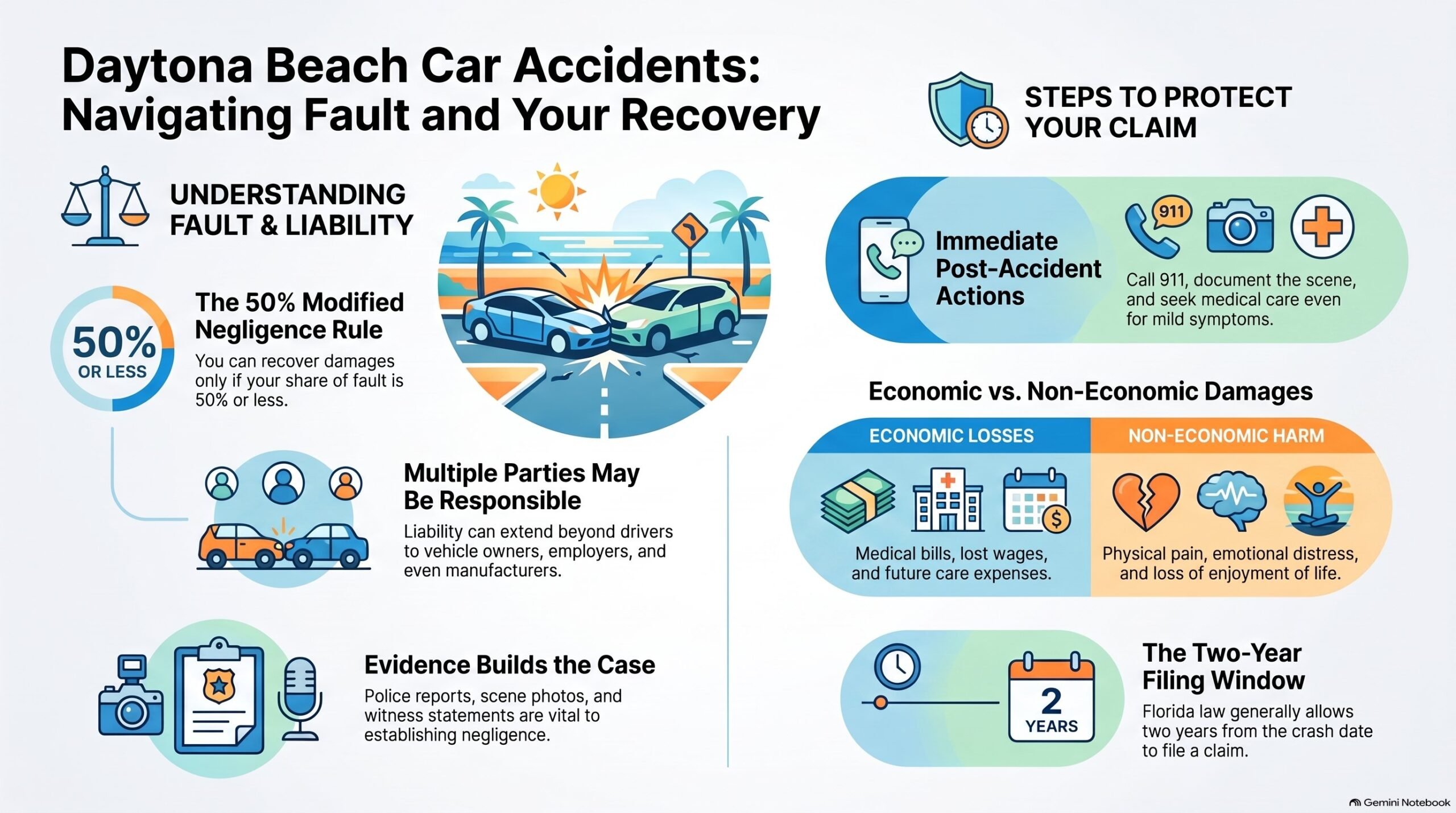
In Florida, an at-fault driver may recover compensation for injury damages after a Daytona Beach car accident only in limited circumstances. Florida follows a modified comparative negligence rule, so an injured driver generally cannot recover damages if found more than 50 percent responsible. If the driver’s share of fault is 50 percent or less, compensation may be reduced according to that percentage. A claim may be available when another person or entity also contributed to the crash, such as a negligent driver, vehicle owner, or responsible business.
Recoverable losses may include reasonable medical expenses, rehabilitation costs, and lost income resulting from injuries that prevent the driver from working. If the injuries affect the ability to earn a living later, evidence may support a claim for future earnings. Medical records, employment documentation, and witness accounts can help establish the connection between the collision, the injuries, and claimed losses. A careful review of fault and supporting evidence can help confirm that an injured person’s claim is assessed fairly.
Economic vs Non-Economic Damages in Daytona Beach Car Accident At-Fault Parties Cases
In Daytona Beach car accident cases, damages may include economic losses such as medical expenses and lost income, as well as non-economic harm such as pain and reduced quality of life. Each category reflects a different effect of the accident and may require distinct evidence. Clear records and credible documentation can help establish the extent and value of the claimed damages.
Economic Losses
Economic losses are the measurable financial costs caused by a Daytona Beach car accident, including medical bills, lost income, and expenses for future care or reduced earning capacity. These damages may include emergency treatment, hospital stays, medication, rehabilitation, and other accident-related health care expenses. Records such as invoices, payment statements, and medical evaluations can help document the amounts claimed. Lost wages may account for income missed during recovery, while diminished earning capacity may apply when lasting injuries limit a person’s ability to perform work or earn at the prior level. Other recoverable costs may include transportation to treatment, necessary medical equipment, and household assistance required because of physical limitations. A careful review of available evidence can help identify current expenses and reasonably supported future financial losses attributable to the collision.
Non-Economic Harm
Beyond measurable financial losses, a Daytona Beach car accident may cause non-economic harm, such as physical pain, emotional distress, and limitations on daily activities. These effects can disrupt a person’s routines, relationships, and ability to participate in meaningful responsibilities. Pain and suffering may include ongoing discomfort, anxiety, or the strain of adapting to temporary or lasting injuries. Loss of enjoyment can arise when an injured person can no longer pursue hobbies, social activities, or family obligations as before. Unlike medical bills or lost wages, these harms do not have a fixed dollar amount. Their significance depends on how the collision affects the individual’s life and well-being. Recognizing non-economic damages acknowledges that recovery involves more than replacing lost income or paying expenses; it also concerns the person’s dignity, independence, and connections with others.
Proving Damages
When a Daytona Beach car accident involves an at-fault party, proving damages requires evidence that connects the collision to the injured person’s losses. Economic damages include measurable costs such as medical bills, rehabilitation expenses, lost wages, and reduced earning capacity. Damage documentation may include invoices, treatment records, pay statements, and employer reports. When future care or income loss is expected, qualified professionals can provide financial projections based on the person’s condition, work history, and likely needs.
Non-economic damages address losses that do not have a direct monetary value, including pain, emotional distress, and limitations on daily activities. Medical notes, personal accounts, and observations from family or caregivers may help describe these effects. Clear, consistent evidence allows decision-makers to assess both categories fairly and understand how the collision changed the injured person’s health, responsibilities, and ability to serve others.
Don’t Wait. Call Our Florida Personal Injury Lawyers Now!
When a Daytona Beach Car Accident At-Fault Parties Injury Case Goes to Trial vs Settlement
After a Daytona Beach car accident, an injured person may resolve a claim against the at-fault party through settlement or pursue it at trial. Each path has different demands, and the appropriate choice depends on the evidence, the losses involved, and the parties’ willingness to negotiate. Settlement offers may provide a defined resolution without the uncertainty, expense, and delay of a courtroom proceeding. However, an offer should be assessed against documented damages and the injured person’s future needs, not accepted solely for convenience.
When negotiations do not produce acceptable terms, trial may allow a judge or jury to evaluate the evidence and determine responsibility and compensation. Trial preparation can include organizing records, preparing witnesses, and presenting a clear account of how the collision affected the injured person. A trial also carries risks, including an uncertain outcome and a longer timeline to resolution. Careful advice can help an injured person weigh these options while preserving the ability to focus on recovery and family responsibilities.
Florida Laws That May Affect Your Daytona Beach Car Accident At-Fault Parties Case
Florida law can shape how a Daytona Beach car accident claim is evaluated, including who may be held responsible and how compensation is calculated. Several rules may affect an injured person’s options and the responsibilities of drivers, insurers, and other parties.
Understanding these requirements can help claimants pursue fair outcomes while supporting accountability and community safety.
- Florida’s no-fault system generally requires drivers to seek initial medical expense and lost-income benefits through personal injury protection coverage, regardless of fault. Florida no-fault thresholds may affect when an injured person can pursue a claim against an at-fault driver for pain and suffering.
- Comparative negligence rules may reduce a claimant’s recoverable damages according to that person’s share of responsibility. Under Florida’s modified system, a person found more than 50 percent at fault generally cannot recover damages.
- Evidence of negligent conduct, such as speeding or failure to yield, can help establish liability. Depending on the circumstances, responsibility may also involve vehicle owners, employers, or other parties whose actions contributed to the collision.
The Statute of Limitations for Daytona Beach Car Accident At-Fault Parties Injury Cases
Time limits can determine whether an injured person may pursue a claim against a party responsible for a Daytona Beach car accident. Florida generally allows two years from the date of a crash to file a negligence action seeking compensation for injuries. Missing this deadline can result in dismissal, even when there is evidence of responsibility and the injured person has substantial losses.
The applicable period may differ depending on the claim and the parties involved. Claims against government entities, for example, may require advance notice and compliance with additional procedures. Deadline exceptions may also apply in limited circumstances, such as when an injured person is a minor or a defendant cannot be located. Florida’s tolling rules can pause or affect the filing period under specific conditions, but they do not apply automatically.
Because deadlines depend on the facts and the governing law, affected individuals should promptly confirm the relevant dates. Preserving the opportunity to seek accountability can support both the injured person’s recovery and the broader interest in safe roads.
How a Daytona Beach Car Accident At-Fault Parties Lawyer Can Help You
A Daytona Beach car accident at-fault parties lawyer can help an injured person identify who may be legally responsible and build a claim supported by reliable evidence. The lawyer may review crash reports, photographs, witness accounts, medical records, and other documentation to assess how the collision occurred and who contributed to the harm. This work can clarify potential claims involving drivers, employers, vehicle owners, or other responsible parties.
A lawyer may also provide focused assistance by:
- Organizing evidence and documenting losses, including medical expenses and missed income.
- Addressing liability disputes through investigation, legal analysis, and communication with insurers.
- Developing a Case strategy that reflects the facts, applicable law, and the injured person’s documented needs.
When to Contact a Daytona Beach Car Accident At-Fault Parties Lawyer
Prompt legal guidance may be important after a Daytona Beach car accident, particularly when injuries are serious, fault is disputed, or several parties may be responsible. Early Consultation can help preserve evidence while details remain clear and relevant records are available. A lawyer may also explain what information to gather and how to direct inquiries from insurers without making unsupported statements about responsibility.
Contact is especially timely when a crash involves a commercial vehicle, a government entity, multiple drivers, or a person acting within the scope of employment. These circumstances can raise questions about who may bear responsibility and whether special notice deadlines apply. A person seeking to protect a family member’s interests may also request guidance when that individual is unable to manage communications or decisions.
Attorney Selection should occur promptly enough to allow a careful review of the circumstances and applicable time limits. Consultation does not require certainty about fault; it can help clarify next steps before important opportunities are missed.
Why You Need an Experienced Daytona Beach Car Accident At-Fault Parties Lawyer
An experienced Daytona Beach car accident at-fault parties lawyer can help identify who may be legally responsible and assess the evidence supporting a claim. This work may involve reviewing crash reports, medical records, witness accounts, and available photographs to determine how the collision occurred. A careful investigation can clarify whether another driver, an employer, a vehicle owner, or another party may share responsibility.
Attorney experience can also help explain how Florida’s negligence rules may affect a claim and what evidence may be needed to support it. Familiarity with Local court procedures can help counsel manage filing requirements, deadlines, and case preparation if a dispute proceeds to court. These steps can reduce avoidable errors and support a clear presentation of the injured person’s losses.
How to Choose the Right Daytona Beach Car Accident At-Fault Parties Lawyer for Your Case
Choosing the right Daytona Beach car accident at-fault parties lawyer requires careful consideration of the attorney’s experience, investigative approach, and communication practices. A careful review can help an injured person select counsel prepared to identify responsible parties and pursue a fair resolution.
Attorney credentials offer a useful starting point. Prospective clients may verify licensing, relevant case experience, and familiarity with Florida negligence law. They can also ask how the lawyer investigates collisions, preserves evidence, reviews records, and evaluates whether multiple drivers or other entities contributed to the harm. A thorough approach supports accurate findings and responsible advocacy.
The lawyer’s communication style also matters. Clear explanations, timely responses, and realistic updates help clients understand decisions and prepare for each stage of a claim. During an initial consultation, a person can ask who will handle routine questions, how progress will be reported, and what information the legal team needs. Comparing these factors helps individuals make an informed choice while protecting their interests and supporting accountability.
About The Law Offices of Anidjar & Levine
The Law Offices of Anidjar & Levine represents people injured in car accidents, including collisions in Daytona Beach.
The firm assists clients in understanding their legal options and pursuing compensation for losses caused by another party’s negligence.
Its work may involve reviewing crash evidence, identifying potentially responsible parties, communicating with insurers, and preparing claims for negotiation or litigation.
These services can help injured people focus on medical care and recovery while their legal concerns receive attention.
An attorney’s background is an important consideration when selecting counsel.
The firm’s attorneys handle personal injury matters and assess each case according to its facts, available evidence, and applicable law.
Clients can ask about an attorney’s experience with vehicle collision claims, case strategy, and communication practices before deciding how to proceed.
Office Locations provide access to the firm’s services across Florida, including support for people in the Daytona Beach area.
Prospective clients can contact the firm to discuss their circumstances, learn about representation, and determine whether its approach suits their needs.
Frequently Asked Questions
Can Multiple Parties Share Fault in a Daytona Beach Car Accident?
Yes, multiple parties can share fault in a Daytona Beach car accident. Florida’s Comparative negligence rules allow responsibility to be divided among drivers and, in some cases, other parties whose conduct contributed to the collision. This shared liability can affect the compensation available to an injured person, as recovery may be reduced by that person’s percentage of fault. Evidence such as police reports, witness statements, and crash records can help establish how responsibility should be allocated.
Can a Vehicle Manufacturer Be Held Responsible for an Accident?
Yes. A vehicle manufacturer may be held responsible when a defect in the vehicle or one of its components causes or contributes to an accident. Examples include Defective airbags that fail to deploy properly or Brake failure linked to a faulty system. Responsibility depends on evidence showing the defect existed and caused harm. Investigators may examine maintenance records, vehicle data, and expert assessments to identify the cause and determine whether a claim is supported.
What Happens if the At-Fault Driver Was Driving a Rental Car?
If the at-fault driver was operating a rental car, the driver may remain personally responsible, while available Insurance Coverage may also pay for injuries and property damage. The rental company’s policy, the driver’s personal auto policy, and any credit-card coverage could apply, depending on their terms and limits. The Rental Agreement may clarify permitted drivers and coverage conditions. Promptly preserving the agreement, insurance records, and accident evidence can help injured parties identify responsible sources of compensation.
Can a Property Owner Be Liable for a Crash Caused by Unsafe Road Conditions?
A property owner may be liable for a crash caused by unsafe road conditions if the owner had a legal duty to maintain the area, knew or reasonably should have known about the hazard, and failed to address or warn of it. Road maintenance duties depend on who controls the roadway and applicable law. Premises liability claims may involve private roads, parking areas, or access routes, while public roads often implicate government entities and special notice requirements.
Does a Passenger Have a Claim Against the Driver of the Vehicle They Were In?
Yes, a passenger may have a claim against the driver of the vehicle they were in if the driver’s negligence caused the crash and the resulting injuries. Passenger Injury Claims may involve careless driving, speeding, distraction, or failure to obey traffic laws. Driver Negligence Liability depends on the evidence, applicable insurance coverage, and Florida law. A passenger may also pursue claims against other responsible parties, while timely medical care and documentation can support the case.
—————————
Determining who is responsible for a Daytona Beach car accident requires careful review of the evidence, applicable Florida law, and each party’s actions.
Injured people may have options for pursuing compensation, but deadlines and insurance rules can affect a claim.
The Law Offices of Anidjar and Levine can assess the circumstances, explain available legal steps, and help protect a client’s interests.
A Daytona Beach Personal Injury Lawyer can provide prompt legal guidance to support informed decisions while evidence is gathered and the claim is evaluated.